The remarkable timeline of a custom gene-editing therapy to save a newborn

News broke yesterday that researchers in Philadelphia appear to have successfully treated a 6-month-old baby boy, called KJ, with a personalized CRISPR gene-editing therapy. The treatment corrects an ultra-rare mutation in KJ that breaks a liver enzyme. That enzyme is required to convert ammonia, a byproduct of metabolism, to urea, a waste product released in urine. Without treatment, ammonia would build up to dangerous levels in KJ—and he would have a 50 percent chance of dying in infancy.

While the gene-editing treatment isn’t a complete cure, and long-term success is still uncertain, KJ’s condition has improved and stabilized. And the treatment’s positive results appear to be a first for personalizing gene editing.

Now, who doesn’t love a good story about a seemingly miraculous medical treatment saving a cute, chubby-cheeked baby? But, this story delivers more than an adorable bundle of joy; the big triumph is the striking timeline of the treatment’s development—and the fact that it provides a template for how to treat other babies with ultra-rare mutations.

Read full article

Comments

Woman Racer Spotlight: Joanne Grogan

Name: Joanne Grogan

Hometown: Hinesburg, VT, USA

How did you get into cycling? I have always ridden a bicycle out of function (living rurally, uni/work commuting, fastest mode of transport). I moved to the USA from Ireland at age 23 and functional bike riding was ‘more difficult’ (aka got a car) so I started recreational mountain biking which morphed into riding downhill/park riding. I got into racing probably the total opposite to most by picking up cyclocross at the suggestion of a friend.  Those first cyclocross races led to racing cyclocross, mountain and road bikes and led me to a very successful few years of racing, training and traveling to race at the professional/elite level. I picked up riding indoors as part of my training in the winter months as my racing at the elite level demanded focused pre-season training.

How many years have you been racing on Zwift? I joined Zwift in 2016 primarily out of curiosity about how the gamification of riding could help break the mundaneness of riding indoors.  Well, it worked lol. I quickly was doing meetups with IRL teammates and joining races as motivation for hard training efforts (think 20-minute threshold work with 10 laps of Crit City). It was not until 2022 that I picked up ZRL racing.

Are you part of a Virtual team? Yes, I joined Coalition in 2022 after a message via Zwift Companion app from a then Coalition team captain (looking at you Hollie).

What do you love most about racing? I love the mental challenge of racing: how you show up, goals, ability to transform in the race, reading tactics, acting on strategy. The roulette of how racing can make you perform, sometimes way above your expectation and sometimes below is what keeps me coming back for more.  It can create a lot of internal retrospection that helps as a tool in my daily life and vice-versa. 

What is your favourite style of race (e.g. points, scratch, iTT, TTT, Chase, duathlon)? I am most definitely a points racer/hunter. Nothing better than making your eyes cross with a good sprint then doing it all over again 3 minutes later.

What is your favourite Zwift women’s race series? ZRL is very close to my heart as it brings so many women together. I’ve very much enjoyed the stage race format such as the Tour de Boudicca.  Racing back-to-back days brings me back to my IRL racing days where your performance is not just individual or race-based but more so on how you prepare, recover, recon, etc so you can perform at your best over the stages and for your team.

What is your most memorable racing experience, inside or outside or BOTH? Oh gosh, there is A LOT to choose from.

Outside: stage 2 of a 4-day road stage race.  I was coming back from injury and was racing as a team floater/junior mentor aka no goals.  As we approached the first QOM of the stage, I drifted back in the pack to check on one of our younger riders and ensure she positioned herself to not get dropped once the surge started for the line.  As the surge started I surfed wheels and before I knew it I was in contention for the QOM points…. This was the day I 110% experienced the power of pack positioning and draft. It was eye-opening and let’s just say, I never looked back.

Inside: same, same ha, but really I’ve had so many memorable races with my Coalition ZRL teamies, we build each other up and commend each other on achievements, whether podiums or PBs.  It is a really great environment for harnessing the power of positive vibes.

But really, the most memorable experiences actually come from pre and post racing: crazy travel adventures and mishaps; friendly jenga sessions trying to fit all the bikes in the car; missing highway exits to races because you were chatting so intensely with your teamies; team dinners; working the pits for a teamie in the muddiest cyclocross race ever; cleaning up after the muddiest of cyclocross races; borrowing team kit because you left your entire kit bag behind you.  I can go on.

What is your favourite food to eat post race? I’m not one for having an appetite post race so I’m a protein shake post-effort gal and then go for the classic tea and a sandwich, yes rather boring.

What advice would you give to a woman entering her first Zwift race? Show up with an open mind and come with a plan A, B and C in preparation for how things pan out.  Ultimate goal is to finish and come away feeling good, so setting yourself up for that is a good starting point.

Any upcoming race you are looking forward to? Nothing huge on the calendar this year but I’ll be back at it for cyclocross in the fall months and in the meantime I will enjoy a bunch of community gravel events, some local glory racing and group rides.

Where can people follow your racing adventures? I’m all about the Strava for IRL adventures, and always lots of photos, gotta keep the fan club happy.

Nintendo Backtracks On Key Switch 2 Feature And Gamers Will Facepalm

Nintendo Backtracks On Key Switch 2 Feature And Gamers Will Facepalm
The run up to the launch of the Switch 2 has been somewhat tumultuous for Nintendo, although it seems it hasn’t hindered the hunger for its upcoming console. Some gamers were irked when the pre-order period was marred by unprepared retailers. Moreover, the company has had to contend with a chaotic economic environment with an on-again, off-agin

Apple claims it’s not blocking Epic from offering Fortnite in the EU

After claiming that Apple was blocking Epic from offering Fortnite in both the US App Store and the Epic Games Store in the European Union, Apple now says it wasn’t, according to a report from Bloomberg.

A spokesperson told Bloomberg that Apple “did not take any action to remove the live version of Fortnite from alternative distribution marketplaces,” and that the company wants Epic’s European branch to resubmit the latest game update for publishing, “without including the US storefront of the App Store so as not to impact Fortnite in other geographies.”

Apple has blocked our Fortnite submission so we cannot release to the US App Store or to the Epic Games Store for iOS in the European Union. Now, sadly, Fortnite on iOS will be offline worldwide until Apple unblocks it.

— Fortnite (@Fortnite) May 16, 2025

While that sounds like a denial of wrongdoing, it does imply Apple specifically doesn’t want Epic to relaunch Fortnite on the US App Store. The company submitted Fortnite for publishing on May 9 following a victory in court that forced Apple to allow developers to support alternative payment methods for apps on the web. At the time, Epic CEO Tim Sweeney was hoping to use the change as justification to bring Fortnite back entirely, after only offering the game through streaming platforms on mobile.

Fortnite was originally removed from the App Store because Epic started directing players to circumvent Apple’s in-app payment system to buy in-game currency. The move was part of a larger plan from Epic to push back on Apple and Google’s tight control over their respective platforms and storefronts. That plan has partially worked. Thanks to Epic’s court win, multiple app developers are now offering alternative payment methods in their apps, but it obviously hasn’t changed how Apple feels about the game developer.

This article originally appeared on Engadget at https://www.engadget.com/apps/apple-claims-its-not-blocking-epic-from-offering-fortnite-in-the-eu-175423021.html?src=rss

Data Shows Boys and Young Men Are Falling Behind

Boys and young men in the United States are experiencing declining outcomes in education, mental health, and transition to adulthood compared to their female counterparts, according to comprehensive data analyzed by researchers. High school graduation rates for boys stand at 83% versus 89% for girls, while college enrollment of recent male high school graduates has barely increased to 57% from 54% in 1960, compared to women’s surge to 66% from 38% in the same period.

Mental health indicators show 28% of boys ages 3-17 have mental, emotional, behavioral or developmental problems versus 23% of girls. Male suicide rates for ages 15-24 have nearly doubled to 21 per 100,000 in 2023 from 11 in 1968. Labor force participation among men ages 25-54 has declined to 89% from 94% in 1975, while women’s participation rose to 78% from 55%. Additionally, 19% of men ages 25-34 now live with parents, compared to 13% of women. “The contemporary American economy is not rewarding a lot of the characteristics associated with men and masculinity,” said Robb Willer, professor of sociology at Stanford.


Read more of this story at Slashdot.

OpenAI introduces Codex, its first full-fledged AI agent for coding

We’ve been expecting it for a while, and now it’s here: OpenAI has introduced an agentic coding tool called Codex in research preview. The tool is meant to allow experienced developers to delegate rote and relatively simple programming tasks to an AI agent that will generate production-ready code and show its work along the way.

Codex is a unique interface (not to be confused with the Codex CLI tool introduced by OpenAI last month) that can be reached from the side bar in the ChatGPT web app. Users enter a prompt and then click either “code” to have it begin producing code, or “ask” to have it answer questions and advise.

Whenever it’s given a task, that task is performed in a distinct container that is preloaded with the user’s codebase and is meant to accurately reflect their development environment.

Read full article

Comments

A Step-by-Step Guide to Planting Your Summer Vegetables

We may earn a commission from links on this page.

Vegetable plants are expensive. To get the best yield out of them, you need to pay attention to more than just the soil, sun, and watering. You need to get your plants off on the right foot by planting them the right way. Here’s what I mean.

Choose the right plant at the nursery

Tomatoes at the nursery

Credit: Amanda Blum

When I first started gardening, I thought the best vegetable starts to buy were the ones that were the biggest, with flowers and fruit already on them. This would give the plant a head start, right? 

Sadly, no. Plants go through something called “transplant shock” when you move them. You’re disturbing the plant’s roots, and moving it to a new environment. To survive, the plant needs to focus all its energy on the plant’s roots, and if there’s a lot of plant matter like leaves, flowers, and fruit to support, energy is wasted supporting them. Plants with established fruit, in particular, struggle during the transplant process. Choose plants that look healthy, with strong stems and leaves without damage, but that don’t yet have flowers or fruit.

Prepare your soil

Shovel in raised bed dirt

Credit: Amanda Blum

There are legions of ways to handle your garden from season to season. Some people till the soil, while others employ a no-till method, and still others use something called “chop-and-drop.” Regardless of the method, the soil you’re planting into has to be pliable enough that roots can flourish in them. For that reason, ensure that the soil is turned over and broken up—from a shovel to a shovel and a half’s depth. You can use a broadfork for this, if you don’t want to disturb the soil structure, but otherwise, just use a shovel. Breaking up the soil will help you see the texture—so you can add sand if the soil has too much clay in it, or compost if it isn’t holding any moisture. You can use this time to add amendments such as vegetable fertilizer and lime. Fertilizer is obvious, but lime is used to turn your soil less acidic, which happens over time through watering and growing. Most vegetables don’t enjoy acidic environments. Turn the amendments into the soil. 

Choose an overcast day

Your plants will already be stressed by transplanting. Planting them into the blazing sun is even more stress. A stretch of overcast days is the perfect planting time. If that’s not an option, plant at twilight to give your plants a night to adjust. Consider giving the plant some shade the next day to help it acclimate.

Get the plant out of the pot without damaging the roots

Eggplant in plastic pot

Credit: Amanda Blum

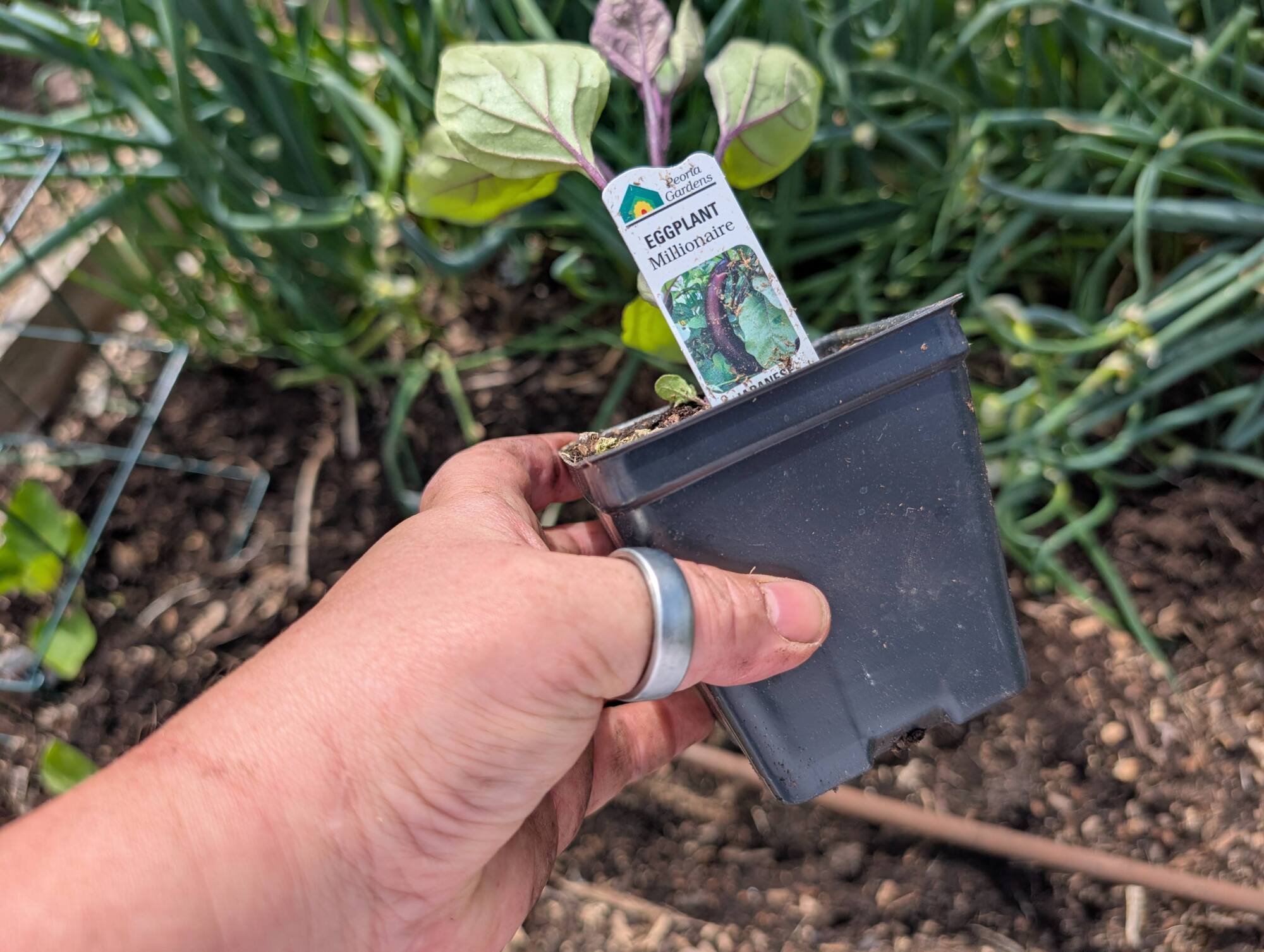
By the time plants reach the nursery, they’re often root-bound in the plastic pots or six packs you buy them in. Roots are resilient, but you don’t want to disturb them more than necessary. The best way to break a plant free from a plastic pot is to use two fingers and squeeze the bottom of the pot. This should free the plant. Don’t turn the pot over or pound on it with your palm, and definitely don’t try to pull it loose by the plant’s stem. 

eggplant seedling before and after roots broken up
on the left, the eggplant seedling just out of the pot, and on the right, after the roots have been broken up
Credit: Amanda Blum

Once the plant is out, you want to break up the roots by using your fingers like a comb on the bottom of the plant, so that roots are freed. That said, these plants do not enjoy their roots being disturbed: cucumbers, beans, pumpkins, luffa, beets, and most root vegetables. For these, I simply dig a hole, remove the plant from the plastic tray, carefully plop the plant in, and walk away. 

Separate plants as necessary

Carrots in a six pack

Credit: Amanda Blum

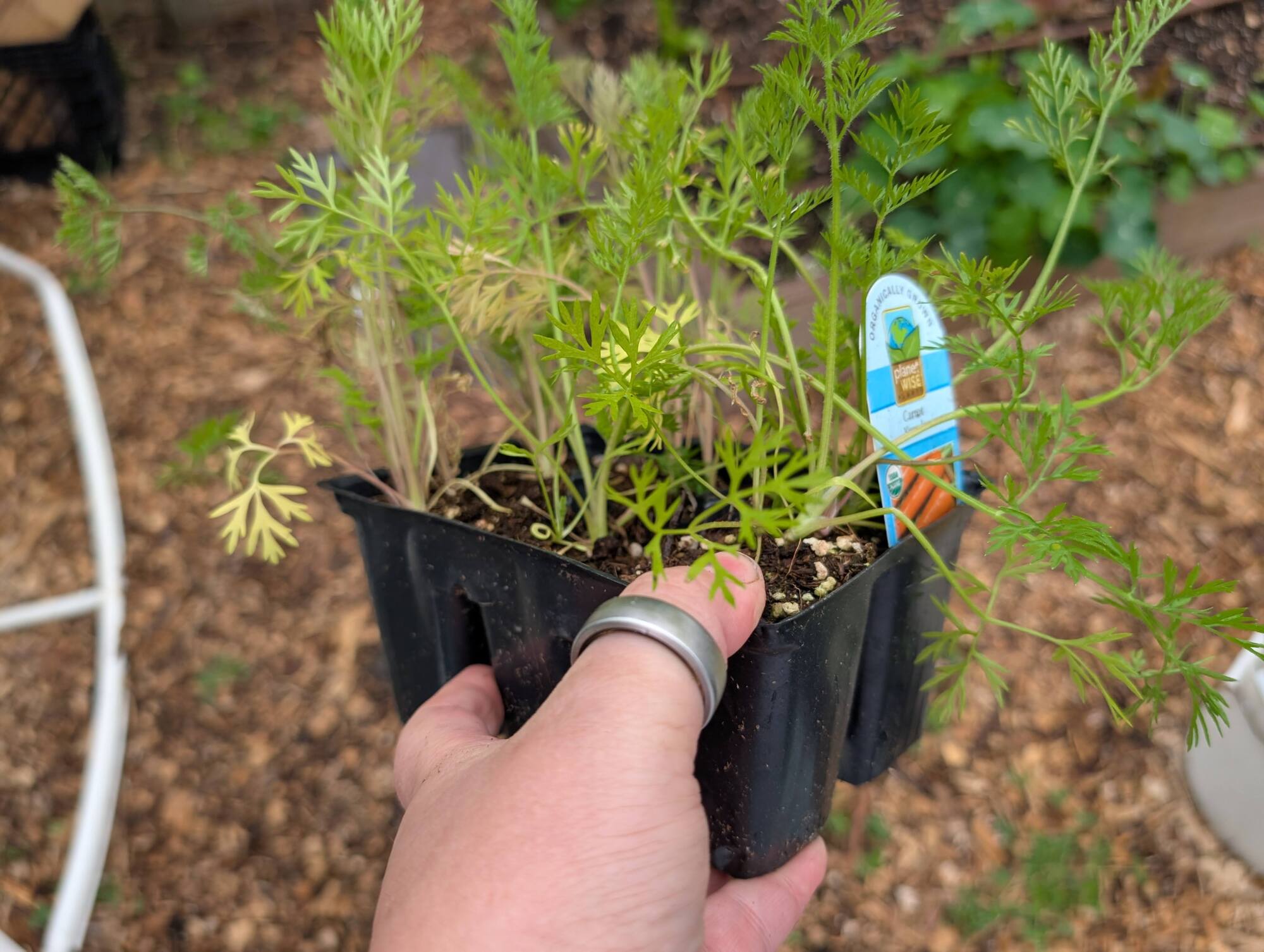
Most pots have more than one seed in each cell. In some cases, like tomatoes, someone usually culls the seedlings so only one is left to flourish. However, in some cases, like herbs and lettuce, nurseries leave the seeds alone and let multiple seeds grow. In other cases like onions and carrots, the cells are purposely overseeded to be filled with lots of seedlings. Strawberries usually come in a pot of five to 10 starts. 

Separating onion seedlings
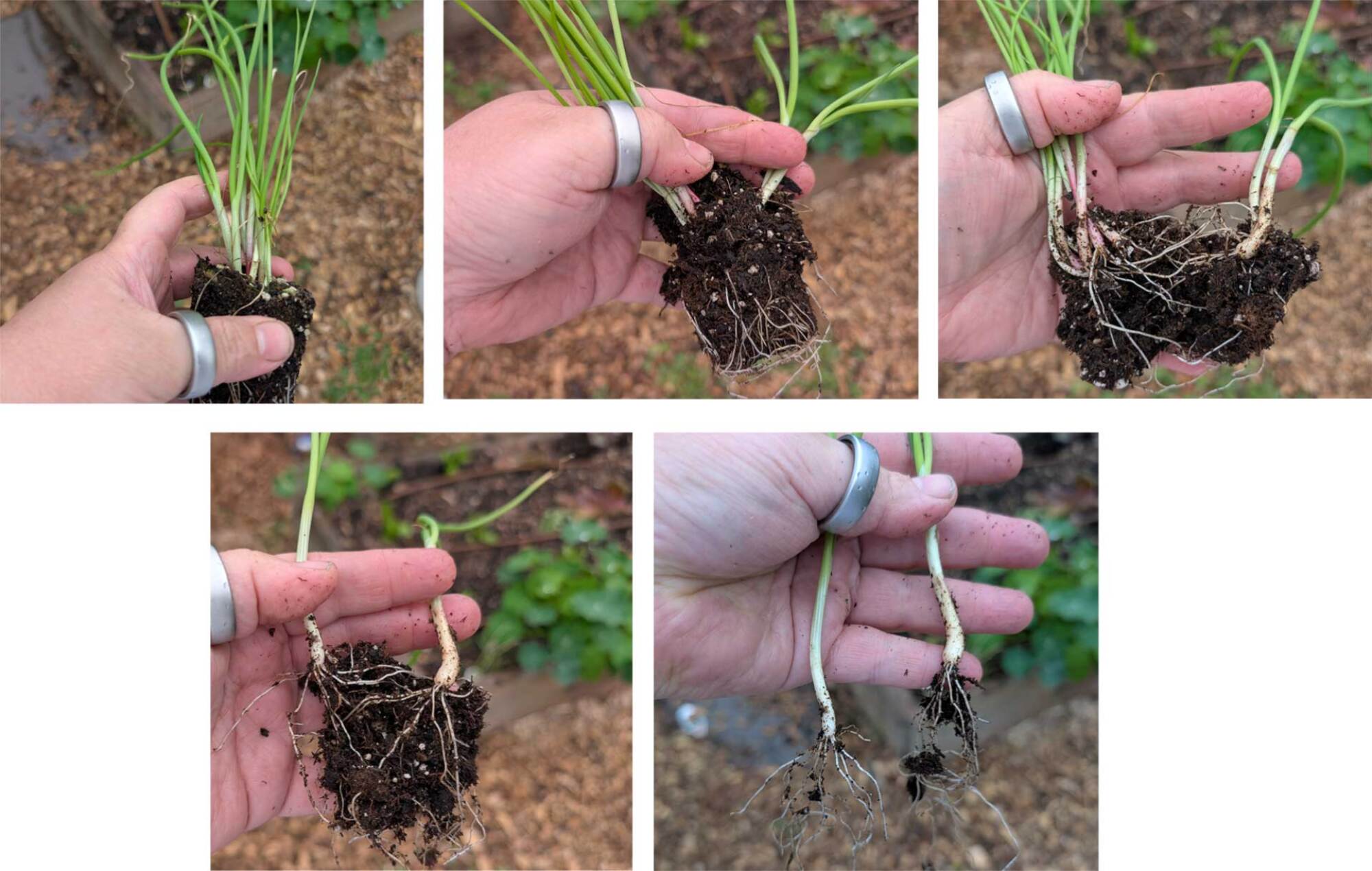
If you take a cell of onion seedlings out, you can separate them by diving the block in half over and over again, until you have individual seedlings.
Credit: Amanda Blum

When there’s more than one seedling, you need to separate them. You shouldn’t try to plant them altogether. For lettuce or herbs, this is simple: Remove one cell, and with your fingers, gently pull the soil pod apart. Start by pulling the pod in half, and then keep dividing until all the seedlings are free. This works on larger plants like squash, and smaller plants like carrots where there can be 20 or more seedlings in a single cell. 

Once the individual seedlings are free, they can each be planted as if they’re a whole plant. This is how you get a whole row of carrots or onions. This is also a great way to save money, since you usually get far more than six lettuce heads from a six-pack of lettuce. 

Know the right depth

Eggplants planted deep

Credit: Amanda Blum

Plants need to go in the ground at the right depth, ensuring that the base of the plant is at soil level. In some cases, though, you can (and should) plant the stem deeper.

Leeks and onions, for example, can be planted deeply. In particular, leeks can be planted as deeply as possible, with only an inch or two of seedling above the surface of the soil. This will help blanch the leek (keep it white). 

Tomatoes, eggplant, and peppers can be planted deeply, as they’ll form roots along their entire stem. If your tomato is leggy (tall with little horizontal branching), this is a spectacular way to fix the problem. 

When in doubt, follow the directions on the plant tag, or simply plant at a standard depth so the roots are covered, but the stem is exposed above the soil.

Don’t mulch against your stems

While mulch is an important part of insulating your vegetable plants and keeping moisture in the ground, it’s also a way to spread pathogens. You want to ensure plants have a few inches of clearance between them and the mulch. 

Keep your labels or make new ones

plant tags
Keep those plant tags.
Credit: Amanda Blum

In the melee of planting, it’s common to lose your plant tags. After all, a tomato is a tomato. However, you’ll be sad at the end of the season when one tomato does spectacularly and another doesn’t, and you don’t know what variety each was. Label your plants! 

Forgive me Volvo, I was wrong: The 2025 V60 Cross Country review

As we often like to remind people, beware buying any car in its first model year. It takes a little while for any OEM to find its feet with a new model, and now there’s half-baked software that can need frequent updating to worry about in addition to any mechanical woes. I bring this up because various bugs meant that an electric car we were supposed to review had to be repeatedly postponed, as it was away being fixed, and as a result our week with the 2025 Volvo V60 Cross Country turned into two. And what a pleasant two weeks they were.

The Volvo station wagon is not in its first production year. Any criticism of its onboard electronics would focus more on the fact that they are now increasingly vintage, but that also means the bugs have mostly been squashed by now. Sadly, Volvo killed off the regular V60 station wagon earlier this year, but you can still buy the Cross Country version, which starts at $51,495, including the delivery charge.

As the name probably implies, the V60 Cross Country has some adaptations for unpaved roads: it rides a little higher and on softer suspension, and there’s protective cladding here and there that gives this wagon a bit of a bold stance.

Read full article

Comments

New Lenovo Mini AI Workstation Rocks Blackwell Superchip And 128GB Of RAM

New Lenovo Mini AI Workstation Rocks Blackwell Superchip And 128GB Of RAM
Lenovo just announced the new ThinkStation PGX, a new compact personal AI developer workstation designed to empower AI researchers, developers, data scientists, practitioners, students, and application engineers. This purpose-built mini desktop solution, equipped with an NVIDIA GB10 Grace Blackwell Superchip offers significant AI capabilities

Apple Denies Blocking ‘Fortnite’ From EU Stores in Epic Dispute

Apple and Epic Games sparred over whether the iPhone maker was obstructing access to the hit game Fortnite, the latest tussle in a long-running feud over Apple’s control of game distribution revenue. From a report: The game developer said that Apple “blocked” its latest Fortnite app submission so that it can’t be released in the US or on the third-party Epic Games Store in the EU.

“Now, sadly, Fortnite on iOS will be offline worldwide until Apple unblocks it,” the company wrote on its X account. An Apple spokesperson responded later on Friday, saying that the company “did not take any action to remove the live version of Fortnite from alternative distribution marketplaces” in the EU. Apple said that it asked the game company’s European division, Epic Sweden, to “resubmit the app update without including the US storefront of the App Store so as not to impact Fortnite in other geographies.”


Read more of this story at Slashdot.

Carnivorous crocodile-like monsters used to terrorize the Caribbean

How did reptilian things that looked something like crocodiles get to the Caribbean islands from South America millions of years ago? They probably walked.

The existence of any prehistoric apex predators in the islands of the Caribbean used to be doubted. While their absence would have probably made it even more of a paradise for prey animals, fossils unearthed in Cuba, Puerto Rico, and the Dominican Republic have revealed that these islands were crawling with monster crocodyliform species called sebecids, ancient relatives of crocodiles.

While sebecids first emerged during the Cretaceous, this is the first evidence of them lurking outside South America during the Cenozoic epoch, which began 66 million years ago. An international team of researchers has found that these creatures would stalk and hunt in the Caribbean islands millions of years after similar predators went extinct on the South American mainland. Lower sea levels back then could have exposed enough land to walk across.

Read full article

Comments

Microsoft attemps to avoid EU fines by further decoupling Teams and Office

The European Commission (EC) has been firing on all cylinders in holding big tech to account through various fines and enforcement actions, attempting to create a more competitive landscape in a space that has become increasingly monopolized.

Microsoft has been in a years-long dispute with the EC, which opened an antitrust probe in 2023 after Slack filed a complaint in 2020 alleging that Microsoft’s bundling of Teams and Microsoft 365 was anticompetitive.

The company unbundled the two products in the EU shortly thereafter in a bid to avoid antitrust fines, but it wasn’t enough to appease the EC. In 2024, the Commission found that Microsoft did not go far enough and was still in violation of antitrust laws, risking massive fines.

This week, Microsoft responded with a more robust set of commitments. Its productivity software suites will continue to be offered without Teams in the European Economic Area (EEA) for at least seven years. Minimum price deltas will be set between versions of the suites that include Teams and those which do not.

Microsoft has also offered to align these options and pricing structures for its suites and Teams globally should the EC accept its proposal. Interoperability enhancements that make it easier to use third-party competitors to Teams were also included in the proposal.

“The proposed commitments are the result of constructive, good-faith discussions with the European Commission over several months. We believe that they represent a clear and complete resolution to the concerns raised by our competitors and will provide European customers with more choices,” said Nanna-Louise Linde, Microsoft’s VP of European Government Affairs.

The EC has begun an open feedback period, seeking comments from competitors and citizens on whether the proposed commitments by Microsoft are adequate and place the company back within the bounds of the EU’s antitrust regulations.

This article originally appeared on Engadget at https://www.engadget.com/big-tech/microsoft-attemps-to-avoid-eu-fines-by-further-decoupling-teams-and-office-170519085.html?src=rss

Tubi Has a New Category Filled With Classic Movies From the Criterion Collection

Max may be adding the “HBO” back into its name, but don’t let that fool you into thinking that streaming is getting any better for classic film fans in 2025—great movies older than a few decades are still hard to come by on popular subscription services like Hulu and Netflix.

Sure, you could sign up for The Criterion Channel, the streaming service from the boutique media label dedicated to highlighting the best in classic and contemporary films (if you are any kind of film history geek, it’s practically a moral imperative). But you actually don’t need to pay anything at all to enjoy a substantial library of Criterion-approved gems: As spotted on Reddit (and possibly inspired by a Redditor and Letterboxd user who goes by the handle “Geekstache”), Tubi now has a category page collecting all the movies in the Criterion Collection that you can watch for free on the ad-supported service.

“For the Cinephiles”

Of course, Tubi can’t come right out and say it has curated its own little Criterion corner (Criterion would probably take issue with that; plus, it’s not like it’s the blessing from Criterion that makes a movie great). Instead, it classifies these 150+ films—from old Hollywood screwball farces like Bringing Up Baby, to imported epics like Akira Kurasowa’s Ran, to recent indie darlings like Greta Gerwig’s Frances Ha—as being “For the Cinephiles.” (I’m sure it is just a coincidence all of them have been released on Blu-ray and DVD in fancy Criterion editions.)

The category includes a ton of movies I’ve long been meaning to see—and you too, probably. There are even a few I own on Criterion DVD that I haven’t gotten around to actually watching yet (It Happened One Night, All That Jazz). Of course, streaming on Tubi isn’t exactly equivalent to watching in high definition on a feature-packed disc, or even on The Criterion Channel itself—you’ll have to sit through commercial breaks, for one thing, and its unlikely Tubi will be offering up the same pristine restored prints. But you also won’t be paying for the privilege, and you can save yourself the time you’d otherwise spend endlessly scrolling for something good to watch.

MIT Says It No Longer Stands Behind Student’s AI Research Paper

MIT said Friday it can no longer stand behind a widely circulated paper on AI written by a doctoral student in its economics program. The paper said that the introduction of an AI tool in a materials-science lab led to gains in new discoveries, but had more ambiguous effects on the scientists who used it. WSJ: MIT didn’t name the student in its statement Friday, but it did name the paper. That paper, by Aidan Toner-Rodgers, was covered by The Wall Street Journal and other media outlets. In a press release, MIT said it “has no confidence in the provenance, reliability or validity of the data and has no confidence in the veracity of the research contained in the paper.”

The university said the author of the paper is no longer at MIT. The paper said that after an AI tool was implemented at a large materials-science lab, researchers discovered significantly more materials — a result that suggested that, in certain settings, AI could substantially improve worker productivity. But it also showed that most of the productivity gains went to scientists who were already highly effective, and that overall the AI tool made scientists less happy about their work.


Read more of this story at Slashdot.

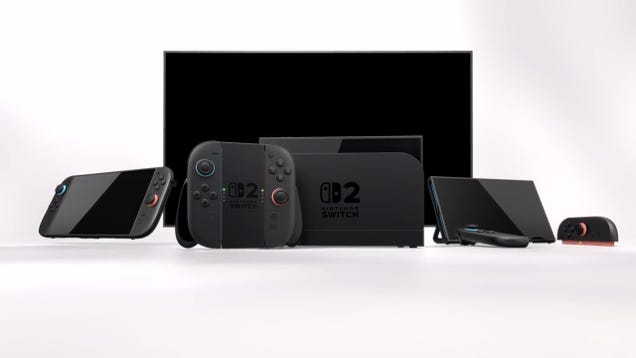
Rumors Suggest You Might Want to Keep Your Switch 2 Docked

We’ve learned a lot about the Switch 2 since Nintendo announced it in back in January. We know how basic specs compare on paper to the original Switch; we know that many physical game carts won’t actually have the games on them; and we know what games to expect this year. While there’s still more to learn about the console before it officially launches next month, some new leaks have provided fresh insights into how the Switch 2 actually performs.

Digital Foundry reports that it can definitively confirm leaks surrounding the Switch 2’s hardware, answering many of the remaining questions that Nintendo and Nvidia have left a mystery thus far. The outlet highlights the key hardware upgrades for the company’s new console, and explains how there are some major performance boosts—especially in docked mode.

Switch 2 is more powerful, especially when docked

Digital Foundry highlights that Nintendo calls the SoC (system on a chip) in both the Switch 2 and OG Switch “custom,” but notes that the original Switch’s SoC was really a “vanilla” chip. The Switch 2’s hardware, on the other hand, really is made solely with Nintendo’s console in mind. That means it should be better optimized for the company’s unique situation of needing to offer console-quality game play that can adapt to handheld mode.

The new custom Nvidia T239 has an eight-core ARM Cortext A87C CPU, compared to the four-core ARM Cortext A57 in the Switch 1. Digital Foundry reports that the original Switch reserved one CPU core for operating system features and left the other three open to developers, while the Switch 2 reserves six of its cores for developers, and uses two for OS tasks.

CPU specs are still unclear: The original Switch had a fixed CPU clock speed (the processing rate of the CPU) of 1020MHz whether it was docked or in handheld mode. The new Switch runs at 1101MHz in handheld, but 998MHz when docked. Digital Foundry isn’t sure why this is the case, though it does speculate it has something to do with memory bandwidth drops that would have an impact on CPU performance. The maximum theoretical clock speed here is 1.7GHz, compared to 1.785GHz on the Switch.

GPU specs make more sense at this time. The new Ampere GPU has a typical clock speed of 1007MHz when docked, and 561MHz in handheld mode, with a maximum clock speed of 1.4GHz. The original Switch’s Maxwell GPU ran at 768MHz when docked and up to 460MHz in handheld mode, with a maximum of 921MHz. An important metric to note here is TFLOPS, which measures the rate of performance for a GPU. When docked, the Switch 2’s GPU is rated for 3.072 TFLOPs, but drops to 1.71 TFLOPs in handheld mode. Digital Foundry makes the point that you can’t necessarily evaluate a GPU’s potential from TFLOPs alone, and that it’ll be up to developers to show us how well games can perform.

We already knew that the Switch 2 offers 12GB of RAM (102GBps when docked and 68GBps in handheld). Digital Foundry now says it can confirm how Nintendo is allocating that memory: The OS uses 3GB of RAM, which leaves 9GB for running games. It’s a stark comparison with the Switch 1, which only shipped with 4GB of RAM, with 3.2GB of that allocated to developers. That means the Switch 2 nearly triples the amount of memory game makers can use.

GameChat takes up a lot of resources

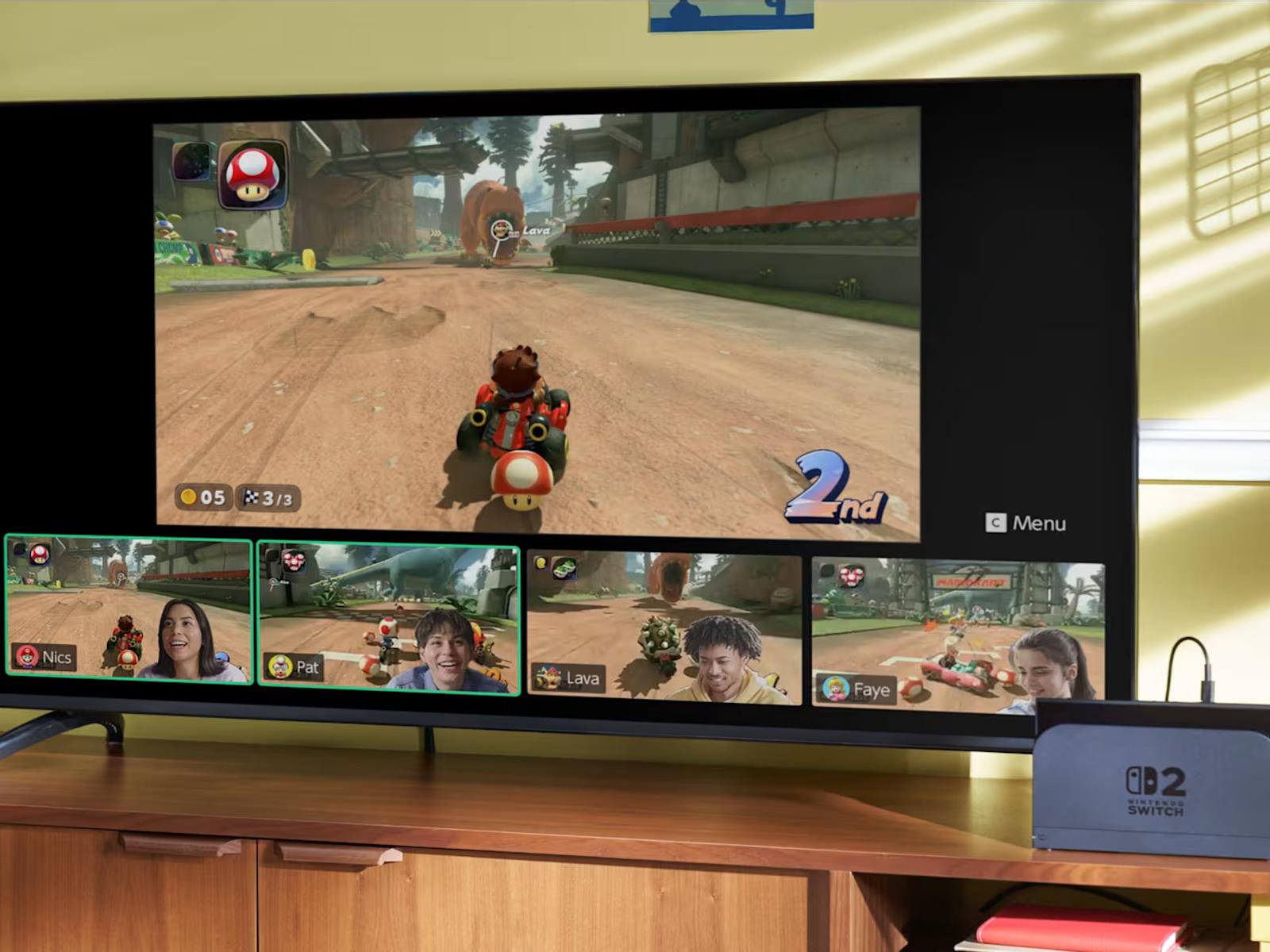
GameChat is one on Nintendo’s “big” new features for the Switch 2. Coming to market a mere 22 years after Xbox Live popularized online console chat, the feature offers in-game communication features like audio and video chat and screen sharing. However, it appears that innovation comes at cost to performance.

Digital Foundry says GameChat affects system resources to such a degree that Nintendo is offering developers a “Game Chat testing tool.” This tool replicates the resources Game Chat takes up while running, so developers can understand how that might impact their games, without actually needing to run Game Chat itself during development.

This should be no surprise to anyone who watched Nintendo’s Switch 2 demos. Game Chat looks choppy, especially when sharing your screen or making video calls. (Is that 5 fps?) I suppose it’s refreshing to see Nintendo so transparent about how laggy these features are, but the fact that it looks this bad in the official advertisement doesn’t bode well for Game Chat’s real-world performance.

We’ll need to wait for the games to judge the Switch 2’s true capabilities

Taken purely on paper, the Switch 2 has a big performance advantage when plugged into its dock. We already knew that the Switch 2 is capable of 4K 60 fps and 1440p 120 fps output in docked mode, compared to 1080p 120 fps output in handheld. It makes sense, then, for the Switch 2 to have an active cooling fan built into the dock to maintain that higher performance. (The Switch 1 does not have a fan in its dock, even though it is able to output a higher resolution in docked mode than handheld.)

However, we’ll have to see how the performance translates into real-world use. As with any piece of hardware, on-paper specs can only tell you so much. The true test is in how developers can optimize and push that hardware with their software. If devs can take advantage of the more advanced Switch 2 hardware to pull off more impressive graphics and performance, we’ll naturally see that for ourselves in the gameplay. For now, it’s a waiting game.