
Debian 12 “Bookworm” receives its eleventh refresh (12.11), featuring 81 bug fixes and 45 security updates. Here’s more on that.
Monthly Archives: May 2025
Paleontologists Identify Tiny Three-Eyed ‘Sea Moth’ Predator in Fossils
“With the help of more than five dozen fossils, paleontologists have uncovered a tiny three-eyed predator nicknamed the ‘sea moth’,” reports CNN, “that swam in Earth’s oceans 506 million years ago.”
Tiny as in 15 to 61 mm in total body length. (That’s 0.60 to 2.4 inches…) But check out the illustration in CNN’s article…
Mosura fentoni, as the species is known, belongs to a group called radiodonts, an early offshoot of the arthropod evolutionary tree, according to a new study published Tuesday in the journal Royal Society Open Science. While radiodonts are now extinct, studying their fossilized remains can illuminate how modern arthropods such as insects, spiders and crabs evolved. One of the most diverse animal groups, arthropods are believed to account for more than 80% of living animal species, said lead study author Dr. Joe Moysiuk, curator of paleontology and geology at the Manitoba Museum in Winnipeg.
Well-preserved specimens of the previously unknown Mosura fentoni also reveal something that’s never been seen in any other radiodont: an abdomen-like body region with 16 segments that include gills at its rear. This part of the creature’s anatomy is similar to a batch of segments bearing respiratory organs at the rear of the body found in distant modern radiodont relatives like horseshoe crabs, woodlice and insects, Moysiuk said…. No animal living today quite looks like Mosura fentoni, Moysiuk said, although it had jointed claws similar to those of modern insects and crustaceans. But unlike those critters, which can have two or four additional eyes used to help maintain orientation, Mosura had a larger and more conspicuous third eye in the middle of its head.
“Although not closely related, Mosura probably swam in a similar way to a ray, undulating its multiple sets of swimming flaps up and down, like flying underwater,” Moysiuk said in an email. “It also had a mouth shaped like a pencil sharpener and lined with rows of serrated plates, unlike any living animal.” About the size of an adult human’s index finger, Mosura and its swimming flaps vaguely resemble a moth, which led researchers to call it the “sea moth.”
The Royal Society publication notes the etymology of the species name (Mosura fentoni is “from the name of the fictional Japanese monster, or kaiju… also known as ‘Mothra’…in reference to the moth-like appearance of the animal.”
Thanks to long-time Slashdot reader walterbyrd for sharing the news.


Read more of this story at Slashdot.
Microsoft gets its own Spotlight-like feature with the Command Palette launcher
Microsoft has introduced the successor to PowerToys Run, its quick launcher for power users, called the Command Palette. As The Verge notes, it now functions pretty much like Mac’s Spotlight and will now let you search for apps, whole folders and single files, let you perform calculations just by typing on the search bar and let you do web searches without having to open a search engine. You can launch websites straight from the results it gives you, and it also lets you run system commands. The company has rolled out the new launcher ahead of this year’s Build developer conference.
In addition, Microsoft will let you add commands and features for your favorite apps to Command Palette, thanks to its support for extensions. XDA Developers recently took the launcher for a spin and said that you can search for extensions for it from WinGet and the Microsoft Store through its own search function. There’s even an option to create a project for a new extension that you’re building yourself.
You can access the Command Palette on Windows by pressing Win + Alt + Space. From within the Command Palette window that pops up, you can see the various actions you can do within the launcher. It’s also where you can access its Settings, which allow you to set the keyboard shortcut to show or hide the Palette, program the Backspace key to take you back to the previous page and set list items to activate on a single click, among other things.
Microsoft
This article originally appeared on Engadget at https://www.engadget.com/apps/microsoft-gets-its-own-spotlight-like-feature-with-the-command-palette-launcher-150006977.html?src=rss
Rust Creator Graydon Hoare Thanks Its Many Stakeholders – and Mozilla – on Rust’s 10th Anniversary
Thursday was Rust’s 10-year anniversary for its first stable release. “To say I’m surprised by its trajectory would be a vast understatement,” writes Rust’s original creator Graydon Hoare. “I can only thank, congratulate, and celebrate everyone involved… In my view, Rust is a story about a large community of stakeholders coming together to design, build, maintain, and expand shared technical infrastructure.”
It’s a story with many actors:
– The population of developers the language serves who express their needs and constraints through discussion, debate, testing, and bug reports arising from their experience writing libraries and applications.
– The language designers and implementers who work to satisfy those needs and constraints while wrestling with the unexpected consequences of each decision.
– The authors, educators, speakers, translators, illustrators, and others who work to expand the set of people able to use the infrastructure and work on the infrastructure.
– The institutions investing in the project who provide the long-term funding and support necessary to sustain all this work over decades.
All these actors have a common interest in infrastructure.
Rather than just “systems programming”, Hoare sees Rust as a tool for building infrastructure itself, “the robust and reliable necessities that enable us to get our work done” — a wide range that includes everything from embedded and IoT systems to multi-core systems. So the story of “Rust’s initial implementation, its sustained investment, and its remarkable resonance and uptake all happened because the world needs robust and reliable infrastructure, and the infrastructure we had was not up to the task.”
Put simply: it failed too often, in spectacular and expensive ways. Crashes and downtime in the best cases, and security vulnerabilities in the worst. Efficient “infrastructure-building” languages existed but they were very hard to use, and nearly impossible to use safely, especially when writing concurrent code. This produced an infrastructure deficit many people felt, if not everyone could name, and it was growing worse by the year as we placed ever-greater demands on computers to work in ever more challenging environments…
We were stuck with the tools we had because building better tools like Rust was going to require an extraordinary investment of time, effort, and money. The bootstrap Rust compiler I initially wrote was just a few tens of thousands of lines of code; that was nearing the limits of what an unfunded solo hobby project can typically accomplish. Mozilla’s decision to invest in Rust in 2009 immediately quadrupled the size of the team — it created a team in the first place — and then doubled it again, and again in subsequent years. Mozilla sustained this very unusual, very improbable investment in Rust from 2009-2020, as well as funding an entire browser engine written in Rust — Servo — from 2012 onwards, which served as a crucial testbed for Rust language features.
Rust and Servo had multiple contributors at Samsung, Hoare acknowledges, and Amazon, Facebook, Google, Microsoft, Huawei, and others “hired key developers and contributed hardware and management resources to its ongoing development.” Rust itself “sits atop LLVM” (developed by researchers at UIUC and later funded by Apple, Qualcomm, Google, ARM, Huawei, and many other organizations), while Rust’s safe memory model “derives directly from decades of research in academia, as well as academic-industrial projects like Cyclone, built by AT&T Bell Labs and Cornell.”
And there were contributions from “interns, researchers, and professors at top academic research programming-language departments, including CMU, NEU, IU, MPI-SWS, and many others.”
JetBrains and the Rust-Analyzer OpenCollective essentially paid for two additional interactive-incremental reimplementations of the Rust frontend to provide language services to IDEs — critical tools for productive, day-to-day programming. Hundreds of companies and other institutions contributed time and money to evaluate Rust for production, write Rust programs, test them, file bugs related to them, and pay their staff to fix or improve any shortcomings they found. Last but very much not least: Rust has had thousands and thousands of volunteers donating years of their labor to the project. While it might seem tempting to think this is all “free”, it’s being paid for! Just less visibly than if it were part of a corporate budget.
All this investment, despite the long time horizon, paid off. We’re all better for it.
He looks ahead with hope for a future with new contributors, “steady and diversified streams of support,” and continued reliability and compatability (including “investment in ever-greater reliability technology, including the many emerging formal methods projects built on Rust.”)
And he closes by saying Rust’s “sustained, controlled, and frankly astonishing throughput of work” has “set a new standard for what good tools, good processes, and reliable infrastructure software should be like.
“Everyone involved should be proud of what they’ve built.”


Read more of this story at Slashdot.
Debian 13 (Trixie) Installer Reaches First Release Candidate
Debian Installer Trixie RC 1 is here with Linux kernel 6.12, improved EFI support, better firmware handling, and expanded ARM device support.
Woman With A Transparent Phone Blows Up The Internet In A Viral Video

A pair or TikTok videos have gone viral for appearing to show a translucent smartphone like something out of a futuristic science fiction flick. The first video, which shows a woman standing in line while appearing to scroll on a see-through smartphone, has racked up 41.6 million views, 2.8 million hearts/likes, and over 13,800 comments at
XR News Roundup: Cosmic XR, RAGER, Grimlord, Death Game Hotel & More
Our latest edition of the XR News Roundup is here, bringing you further stories from across the week.
We’re halfway through the month, and May’s been one of the busiest months for VR gaming so far. This last week saw new songs for Beat Saber and Synth Riders, PS VR2 ports for Smash Drums, Iron Guard and Pirates VR, plus Pinball FX VR added nine new Williams tables. We also went hands-on with Starvault, Verse, Tunnels, and Of Lies and Rain, while Creature is hosting a presentation next week.
With hardware, developers reported issues with bugs and performance regression on Horizon OS. Google teased a smart glasses demo for I/O next week, VisionOS is getting brain-computer interface support, and Pimax announced the Dream Air SE. Samsung also unveiled advanced micro-OLED displays for next-generation headsets, and Ray-Ban Meta Glasses can now provide blind users a detailed description of what’s in view.
For regular updates, please subscribe to our weekly newsletter or check out our latest articles. Otherwise, here are a few additional stories from this week.
Cosmic XR Brings The Universe Into Your Living Room On Quest
0:00
/1:29
Cosmic XR by BRDY Studios is a mixed reality experience that initially launched last month on Quest that turns your living space into an interactive map of the universe. Paying homage to the Galaxy Explorer project on HoloLens, this allows you to touch, rotate and scale the different planets, moons, galaxies and black holes using hand tracking.
VR Soulslike Grimlord Gets Free Sands of Glory Update

Six months after Grimlord got its full release, a major update is now live on Quest and Steam. Version 1.1.0, otherwise known as the Sands of Glory update, has introduced a series of arena-based challenges with enemies, new boss fights, and an expanded weapon upgrade system. Weapon physics have also been reworked, and the studio advised modding support is on the way.
Rhythm Action Game RAGER Confirms Early Access Launch Window
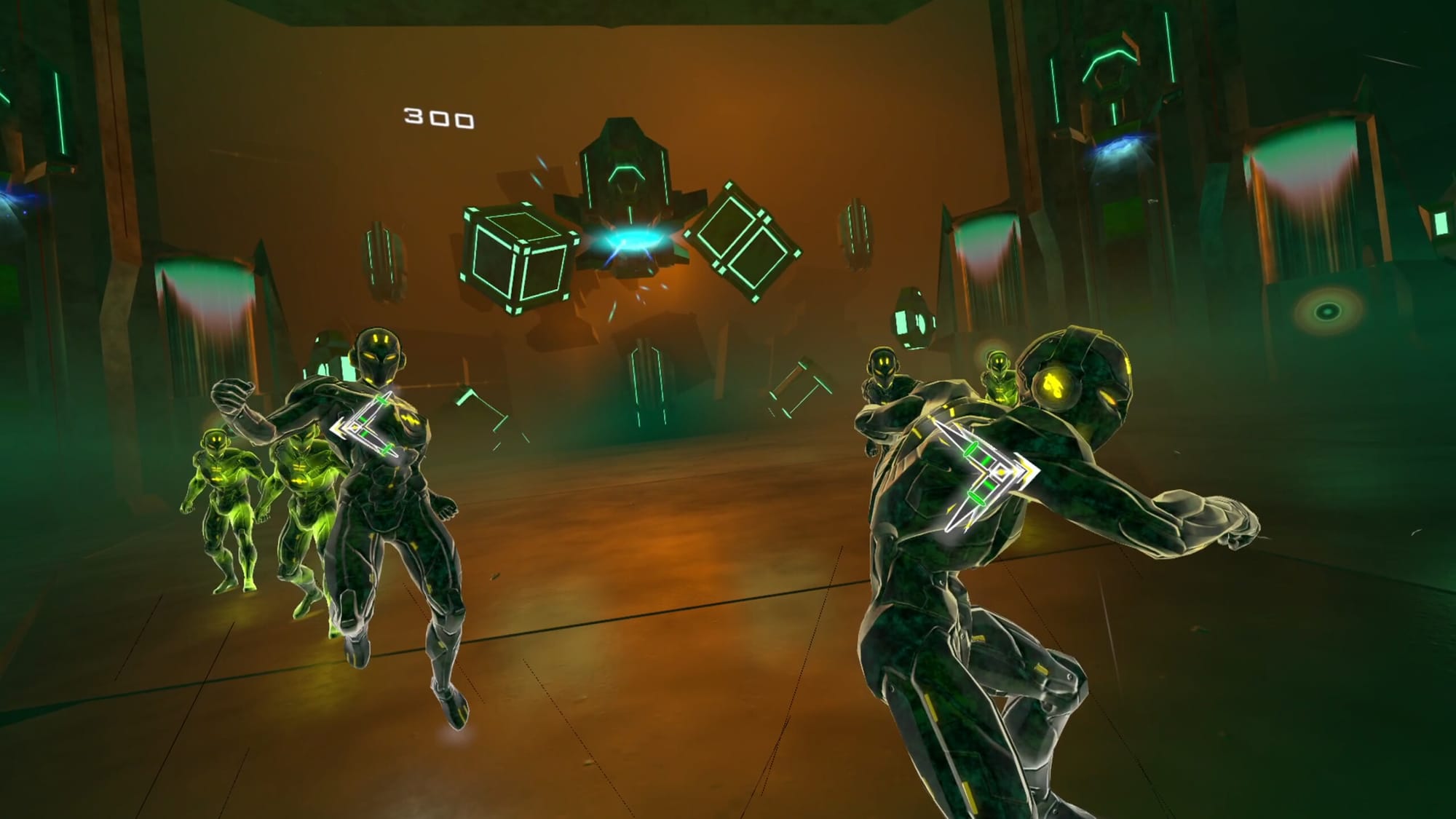
VR action rhythm game RAGER confirmed it’s officially launching in early access this September, and it’s received an updated demo on Quest. In a message to UploadVR, the developers informed us that RAGER’s Steam demo will also be updated soon and that the game was selected for the Oculus Ignition program.
SWERY’s Death Game Hotel Gets Major Update And PC VR Port
Following its recent freemium relaunch on Quest, multiplayer game Death Game Hotel from White Owls Inc, is now heading to Steam on May 29, and cross-platform multiplayer is supported. The announcement also coincided with its first major post-relaunch update which added expanded social features, a player rank system, a new VIP room exclusively for the highest tier players, and more.
FRENZIES Gets Progression System In Latest Update

FRENZIES, the free-to-play multiplayer shooter from nDreams, added a new progression system in its most recent update. Now live on Quest, that introduced a player ranking system, daily challenges where you can earn XP, new voice lines for the bots, and more.
Project Mix’s Kickstarter Reached Its Goal In 54 Minutes
VR anime bartending game Project MIX reached its crowdfunding target on Kickstarter in 54 minutes, as confirmed in a Steam post. It’s now currently over $100k with just under a month to go, it’s now surpassed two stretch goals for English voice acting. Further goals include enhanced visuals, an anime opening, a non-VR edition, and guest tracks from Shoji Meguro.
Other Updates
Want even more stories? Here’s everything else we’ve seen this week.
- The soundtrack for Vertigo 2: Into the Aether is now available on Steam and streaming services.
- Eleven Table Tennis received a large patch in preparation for its next update.
- Rec Room released a minor update that sees it parting ways with Steam’s Easy Anti-Cheat (EAC).
- Phasmophobia deployed a hotfix to address some minor concerns following its recent event.
- VR horror game OVRDark: A Do Not Open Story launches on June 13 on Quest.
- Sushi Ben now targets a September 2025 launch on Steam.
- After initially appearing with a June release date, Wanderer: The Fragments of Fate now shows a July launch on Pico.
- Besiege VR has been delayed from this month’s intended launch to “summer 2025.”
- Badminton Time VR is heading to PlayStation VR2.
If you’d like to inform us about a VR game we should know about for this article or future updates, you can use our contact page or email tips@uploadvr.com with details.
An Artist Spots Her Work In Bungie’s Marathon, Nintendo Isn’t Sending Out Switch 2 Review Units Until The Last Minute, And More Of The Week’s Top Stories

This week, it was reported that in a strange turn of events, Nintendo may not be sending out Switch 2 units to would-be reviewers before launch, which could result in a dearth of coverage at a time when you’d expect to see impressions and reviews of the console plastered across every gaming site and YouTube channel.…
Epic wants the court to compel Apple to approve Fortnite’s return to the US App Store
Epic has filed a “second motion to enforce injunction,” asking the US District Court for the Northern District of California to force Apple to do a timely review of its Fortnite app and to approve its submission if it’s compliant. The company recently accused Apple of blocking Fortnite’s return to the App Store in both the US and the EU. Epic submitted the app for approval after winning its case against the iPhone-maker. Specifically, after the court ordered Apple to stop collecting commissions on purchases that weren’t paid through the App Store and to allow external payment links in-app.
After Epic said that Apple was blocking Fortnite’s return to the App Store, the tech giant wrote a letter addressed to the video game developer. In it, Apple said it will not take action on Epic’s submission “until after the Ninth Circuit rules on [its] pending request for a partial stay of the new injunction.” It told Epic to resubmit the app to the EU storefront separately from its US submission. Apple, of course, filed an appeal against the court’s order to stop charging commissions for payments made outside the App Store. It also filed an emergency motion to put a pause on the order prohibiting it from charging commissions, telling the court that it will cost the company “substantial sums annually.”
In a post on X, Epic said that Apple’s suggestion to submit two different versions of Fortnite for review is in violation of its own guideline that prohibits developers from submitting multiple versions of the same app. “That’s not the standard Apple holds other developers to and it’s blocking us from releasing our update in the EU and US,” it wrote. Epic also asserted that its submission didn’t break any rules this time. Apple’s denial, the video game developer claimed in its filing, is a “blatant retaliation against Epic for challenging Apple’s anticompetitive behavior and exposing its lies to the Court, culminating in the Injunction and the Contempt Order.”
Yesterday afternoon, Apple broke its week-long silence on the status of our app review with a letter saying they will not act on the Fortnite app submission until the Ninth Circuit Court rules on the partial stay. We believe this violates the Court’s Injunction and we have filed…
— Epic Games Newsroom (@EpicNewsroom) May 17, 2025
This article originally appeared on Engadget at https://www.engadget.com/gaming/epic-wants-the-court-to-compel-apple-to-approve-fortnites-return-to-the-us-app-store-123054703.html?src=rss
FreeBSD 14.3 Beta 3 Brings KDE Plasma 6 Packages To The DVD ISOs
FreeBSD 14.3 Beta 3 is ready for testing as the newest test release on the road to the FreeBSD 14.3 point release due out in June…
Remastered Eldritch terror, a fantasy life sim and other new indie games worth checking out
Indie games! They’re rad, aren’t they? We’re keeping closer tabs on what’s going on in that scene with our new weekly roundup. We’ve got a jam-packed edition for you this time with a little something for everyone, from lo-fi horror and Eldritch terror to cosy train dioramas and a vaporwave driving game.
Before we get started, a quick word on a recent game I enjoyed. Idle games aren’t usually my kind of thing — I’d rather be actively doing things — but one I spotted on Itch.io offered some temporary respite from a virus I was dealing with. The DvD idle game from Cybo3D is all about watching a version of the classic DVD logo bouncing around your screen, buying upgrades and seeing numbers go up. Pleasantly relaxing stuff. I swear I even saw the logo go exactly into the corner a few times.
New releases
The Sinking City has a history that’s even odder than some of the Eldritch horrors that lie within. Now, developer Frogwares has remastered its self-published detective thriller in Unreal Engine 5 for PC, PS5 and Xbox Series X/S. Existing owners get a free upgrade to The Sinking City Remastered, which Frogwares shadow dropped this week. Along with 4K textures, lighting upgrades and support for upscaling tech, there are quality-of-life enhancements, accessibility improvements and a photo mode.
Free-to-play fantasy adventure life sim Palia (which is what you might get if you smushed together Animal Crossing and World of Warcraft) landed on PS5 and Xbox Series X/S this week. It’s been out on PC and Switch since 2023. There’s a new free expansion for all platforms too.
If you’ve ever looked at a Grand Theft Auto game and been mildly interested before deciding a life of virtual crime is not for you, then The Precinct might be up your alley. In this action sandbox title from developer Fallen Tree Games and publisher Kwalee, you’ll play as a rookie officer who tries to restore order in his city while trying to solve his father’s murder. How very ’80s!
Reviews have been mixed, but the art style is compelling and the isometric perspective with twin-stick controls make for an intriguing wrinkle. The Precinct is out now on PS5, Xbox Series X/S and PC.
Upcoming
Copycat, the debut game from the small team at Spoonful of Wonder, is another strong entry in the cat game canon. You play as a kitty who an elderly lady adopts from a shelter. Needless to say, things don’t entirely go smoothly.
I enjoyed Copycat — which debuted on PC last year — and its short but affecting story. The game has already sold over 50,000 copies and it’s now set to find a new audience. Copycat is coming to PS5 and Xbox Series X/S on May 29 for $15.
Folks who like last year’s very good and creepy walking sim Pools but yearn for more intensity from their liminal space horror might be interested in Backrooms Level X. This one is a mazy first-person survival game that has puzzles, “oppressive soundscapes” and things watching from the shadows. Backrooms Level X, from publisher Firenut Games and solo developer José Manuel Conesa Hernández, will hit Steam on May 29 and consoles at a later date.
Okay, maybe horror’s not your thing. Totally understandable. Perhaps what you’d rather do is chill out and build little railway dioramas without being beholden to timers or rules.
You can do just that in Islands & Trains, from developers Akos Makovics and Fabi Smith and publisher Future Friends Games. It’s rolling onto Steam on May 29.
It’s probably a little (okay, a lot) because of the laidback synthwave tune that soundtracks the trailer, but I’m into the whole aesthetic of Adrift. This is a “chill, offroad driving game” and it’s the first title from both car mechanic turned game developer Stefan Kwak and co-publisher Secret Sauce.
Your goal is to transport a fragile energy core across an ’80s-inspired, vaporwave landscape. Adrift is coming to Steam later this year and you can check out a demo now.
How about another Steam demo? One just dropped for Flick Shot Rogues from three-person studio Butter by the Fish and publisher Noodlecake. Turn-based tactics games usually aren’t my cup of tea, but the gameplay here reminds me a bit of Subpar Pool, a game I love very much.
In this roguelike, you flick your character across the screen to damage opponents (or evade their attacks) and try to pull off combo moves. Getting the angles just right is as important as piecing together effective builds.
I fired up the demo and suddenly 50 minutes had vanished as my first run ended. Yep, I’m liking what Flick Shot Rogues is putting down. I can see myself sinking dozens of hours into this one after it lands on Steam later this year.
An open beta for Splitgate 2, the followup to the Portal-with-guns multiplayer arena shooter, starts on May 22. You’ll be able to hop in on Steam, PS5 and Xbox Series X/S.
A new trailer shows off the map creator tool, The Lab. You can build maps with up to 15 of your friends in real-time collaboration.
I’m sure plenty of folks who are into miniature wargaming and other types of tabletop games have wondered what it might be like to run their own store that sells such wares. And hey, guess what? You’ll be able to get a taste of that in Tabletop Game Shop Sim from Knight Fever Games.
You’ll do everything from deciding on the layout and managing finances to hosting game nights and playing with customers. This one’s coming to Steam in 2025.
Let’s close things out on another cozy note. We love a chill puzzle game around here and Umami might just fit the bill. The idea here is to fit wooden blocks together to create dioramas of food towers. This 3D puzzler from Mimmox will hit Steam later this year. A demo will be available during the Steam Next Fest in mid-June.
This article originally appeared on Engadget at https://www.engadget.com/gaming/remastered-eldritch-terror-a-fantasy-life-sim-and-other-new-indie-games-worth-checking-out-110015794.html?src=rss
Sierra made the games of my childhood. Are they still fun to play?
My Ars colleagues were kicking back at the Orbital HQ water cooler the other day, and—as gracefully aging gamers are wont to do—they began to reminisce about classic Sierra On-Line adventure games. I was a huge fan of these games in my youth, so I settled in for some hot buttered nostalgia.
Would we remember the limited-palette joys of early King’s Quest, Space Quest, or Quest for Glory titles? Would we branch out beyond games with “Quest” in their titles, seeking rarer fare like Freddy Pharkas: Frontier Pharmacist? What about the gothic stylings of The Colonel’s Bequest or the voodoo-curious Gabriel Knight?
Nope. The talk was of acorns. [Bleeping] acorns, in fact!
6 VR classics you can snag for under $10 right now

Some of VR’s all-time greats are currently deeply discounted on Steam. Here are the can’t-miss deals that belong in every VR collection.
The post 6 VR classics you can snag for under $10 right now appeared first on MIXED Reality News.
NVIDIA Upstreams Newer GSP Firmware For Open-Source Nouveau Driver
NVIDIA has supplied updated GPU System Processor (GSP) firmware derived from their R570 driver series to the upstream linux-firmware.git repository…
Beyond Basics: Unlocking the Power of Advanced Bash Scripting
In this article, we’ll explore the lesser-known but incredibly powerful techniques that take your Bash scripting from basic automation to professional-grade tooling.
XR Weekly Round-up: Samsung previews new OLED displays, Pimax unveils ultra-light VR Headset, and Google teases Smart Glasses

New Google Smart Glasses on the horizon, Pimax presents lightweight OLED headsets and Vision Pro gets new features – the XR news of the week.
The post XR Weekly Round-up: Samsung previews new OLED displays, Pimax unveils ultra-light VR Headset, and Google teases Smart Glasses appeared first on MIXED Reality News.
T-LoRa Pager Combines ESP32-S3, LoRa, NFC, and GNSS in Handheld IoT Device
The T-LoRa Pager is a compact, programmable IoT development device designed by LILYGO. It integrates LoRa connectivity, NFC capabilities, GNSS positioning, and motion sensing via an embedded IMU, all within a portable form factor. Powered by the ESP32-S3 microcontroller, the device includes 16MB of flash memory and 8MB of PSRAM. The board features an RTC […]
Rockchip Open-Source NPU Driver “RKNN” Continues Making Progress
Started just over one year ago was the effort to create an open-source Rockchip NPU driver. While not yet mainlined to the Linux kernel, progress on this kernel driver and associated user-space driver continues…
The Top Five — For the Week Ending May 16, 2025
Did you miss this week’s top articles? Here are the five most read article on FOSS Force for the week that just ended.
The post The Top Five — For the Week Ending May 16, 2025 appeared first on FOSS Force.
Intel ISPC 1.27 Released With AVX10.2 Support
Intel’s Implicit SPMD Program Compiler (ISPC) is out with a new feature release in preparing for AVX10.2-enabled processors and bringing other enhancements to this C programming language variant focused on single program, multiple data (SPMD) programming…