Bluesky is testing a ‘live now’ feature with streamers and the NBA

Bluesky doesn’t have its own live streaming capabilities, but the service testing out a new feature to boost users’ streams off the platform. The company is allowing “select” accounts to link their Twitch or YouTube accounts to their profiles, which will display a red indicator and “live” badge when they’re actively streaming.

In an update, Bluesky described the feature as an “early test” that will initially only be available to a “handful of accounts” before it’s ready for a wider launch. “Bluesky is the place for breaking news and real-time updates,” the company said. “This tool supports streamers, journalists, and anyone sharing live moments as they happen.”

The update comes one day after the service showed off a similar badge for the NBA’s official Bluesky account. The league will apparently direct fans on Bluesky to “live content they are promoting,” Bluesky COO Rose Wang said. Partnering with the NBA on the feature is an interesting move for Bluesky. Sports fans, and NBA fans in particular, have had an outsized impact on Twitter’s culture. And the company now known as X has inked several high-profile deals with the NBA and other major sports leagues over the years to promote their content.

Notably, Bluesky doesn’t have advertising. It’s using the “live” indicators to direct users to off-platform content, so it’s unclear if there are any business opportunities for the upstart platform that come with this feature. But it shows that Bluesky wants to play a bigger role in the kinds of conversations that once shaped Twitter’s culture, and make a name for itself as a destination to follow live events.

This article originally appeared on Engadget at https://www.engadget.com/social-media/bluesky-is-testing-a-live-now-feature-with-streamers-and-the-nba-174443865.html?src=rss

23andMe bought by Regeneron in court auction

It has been nearly two months since 23andMe declared bankruptcy and the company has officially been sold. The US biotech company Regeneron has agreed to buy 23andMe and all of its assets for $256 million (even though it was valued at $50 million in March). This purchase marks the end of former 23andMe CEO Anne Wojcicki’s bid to buy the company, which included resigning in order to make an independent offer. 

According to Mark Jensen, Chair and member of the Special Committee of the Board of Directors of 23andMe, Regeneron is offering to keep all of the former company’s employees. This decision, “will allow us to continue our mission of helping people access, understand and gain health benefits through greater understanding of the human genome,” he said in a release. 

The announcement also tries to emphasize data protection following 23andMe users’ concerns about where their information might end up and, in some cases, deleting their data from the site. “We are pleased to have reached a transaction that maximizes the value of the business and enables the mission of 23andMe to live on, while maintaining critical protections around customer privacy, choice and consent with respect to their genetic data,” said Jensen. 

The sentiment was echoed by its soon to be new owner. “Through our Regeneron Genetics Center, we have a proven track record of safeguarding personal genetic data, and we assure 23andMe customers that we will apply our high standards for safety and integrity to their data and ongoing consumer genetic services,” said George D. Yancopoulos, MD, PhD, co-founder, board co-chair, president and chief scientific officer of Regeneron in a statement. “We believe we can help 23andMe deliver and build upon its mission to help people learn about their own DNA and how to improve their personal health, while furthering Regeneron’s efforts to improve the health and wellness of many.”

How exactly 23andMe will shake out after the Regeneron purchase is to be seen. The company has taken a dramatic fall in recent years, since going public. Hackers accessed the information of 6.9 million people in 2023 and 23andMe laid off over 200 people last year. 

This article originally appeared on Engadget at https://www.engadget.com/big-tech/23andme-bought-by-regeneron-in-court-auction-174003286.html?src=rss

Here’s the Oura Ring Data You Can Access Without a Subscription

We may earn a commission from links on this page.

The Oura ring can give you a ton of data on your sleep, health, and fitness, but you need to pay for a $5.99/month subscription to see all of it. So what happens if you get an Oura ring but don’t pony up for the subscription? Here’s the full rundown, with screenshots of exactly what you’ll see—and a little-known way of getting data the app doesn’t show you.. 

As I explain in my review of the Oura ring 4, you should budget for both the ring and its ongoing subscription if you want to get the data and analysis the Oura ring is famous for offering. The subscription isn’t for premium extras; it’s for the basic functionality of the app, without which there isn’t much point to wearing the ring.

But! There is a way to get the data the ring collects, without going through the app. It comes as a spreadsheet download, so it’s not useful for casual “how did I sleep last night?” use, but it’s fine if what you really want is to do some data analysis. I’ll explain how to get that below, but first, let’s see what the app looks like sans subscription.

The app only shows scores and meditations (mostly)

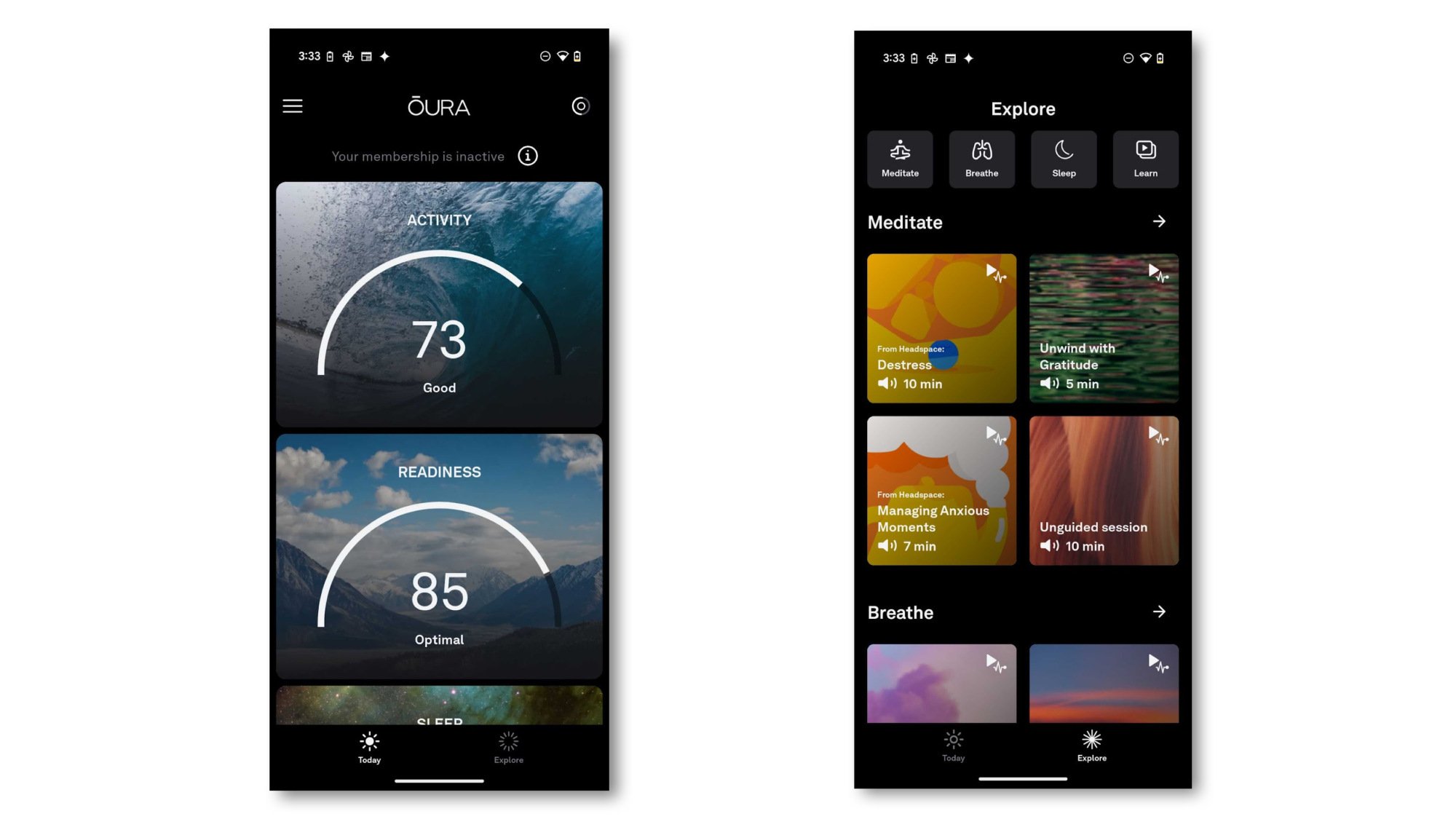
Two screenshots: scores, and meditations.
The two screens you get without a subscription.
Credit: Beth Skwarecki/Oura

Here’s what you’ll see in the Oura app: not much. You’ll get a score for each of Activity, Readiness, and Sleep. Each score is out of 100—higher is better—and comes with a label like “good” or “optimal.” That’s it. No heart rate, HRV, hours of sleep, stress timeline, Advisor chatbot, meal tracking, none of that. Just three somewhat inscrutable numbers. Without raw data, I don’t consider these scores useful at all. (Imagine somebody asking “how did you sleep?” and you answer “82,” like they’re supposed to know what that means.) 

You do still get an Explore tab, which contains guided meditations and a few Oura tutorials, such as a one-minute video explaining what your readiness score is supposed to mean. Interestingly, after doing a meditation on my no-subscription account, I don’t see my heart rate or HRV during the session, but I do see some text giving my “baseline” for each of those measures. That’s not my most recent night’s reading, though. For that, you need to go download a spreadsheet. 

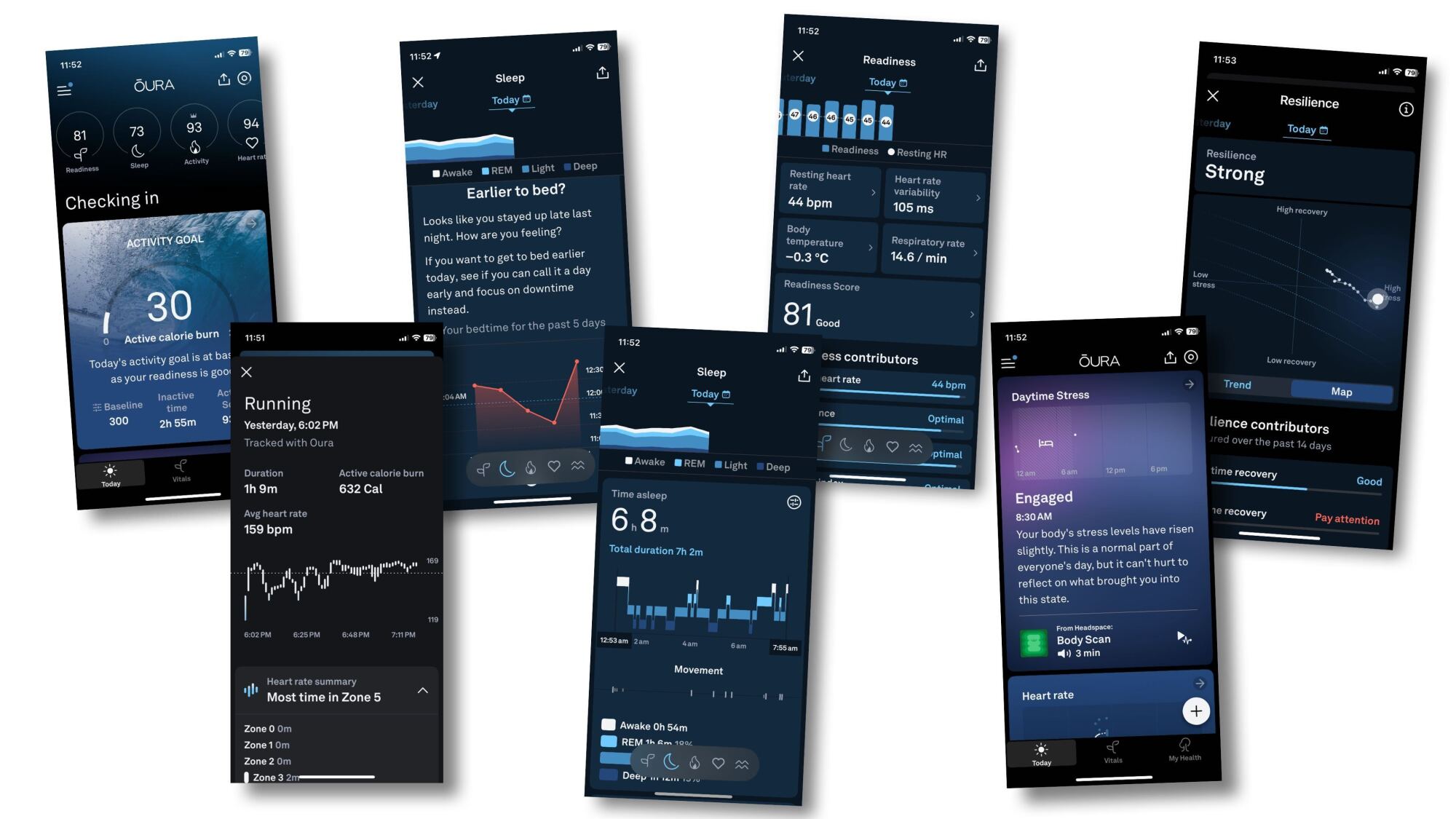
Scores, insights, sleep stages, bedtime analysis, stress resilience, etc.
For comparison, a sampling of what you get with a subscription.
Credit: Beth Skwarecki/Oura

You can download your data from Oura’s website, even without a subscription

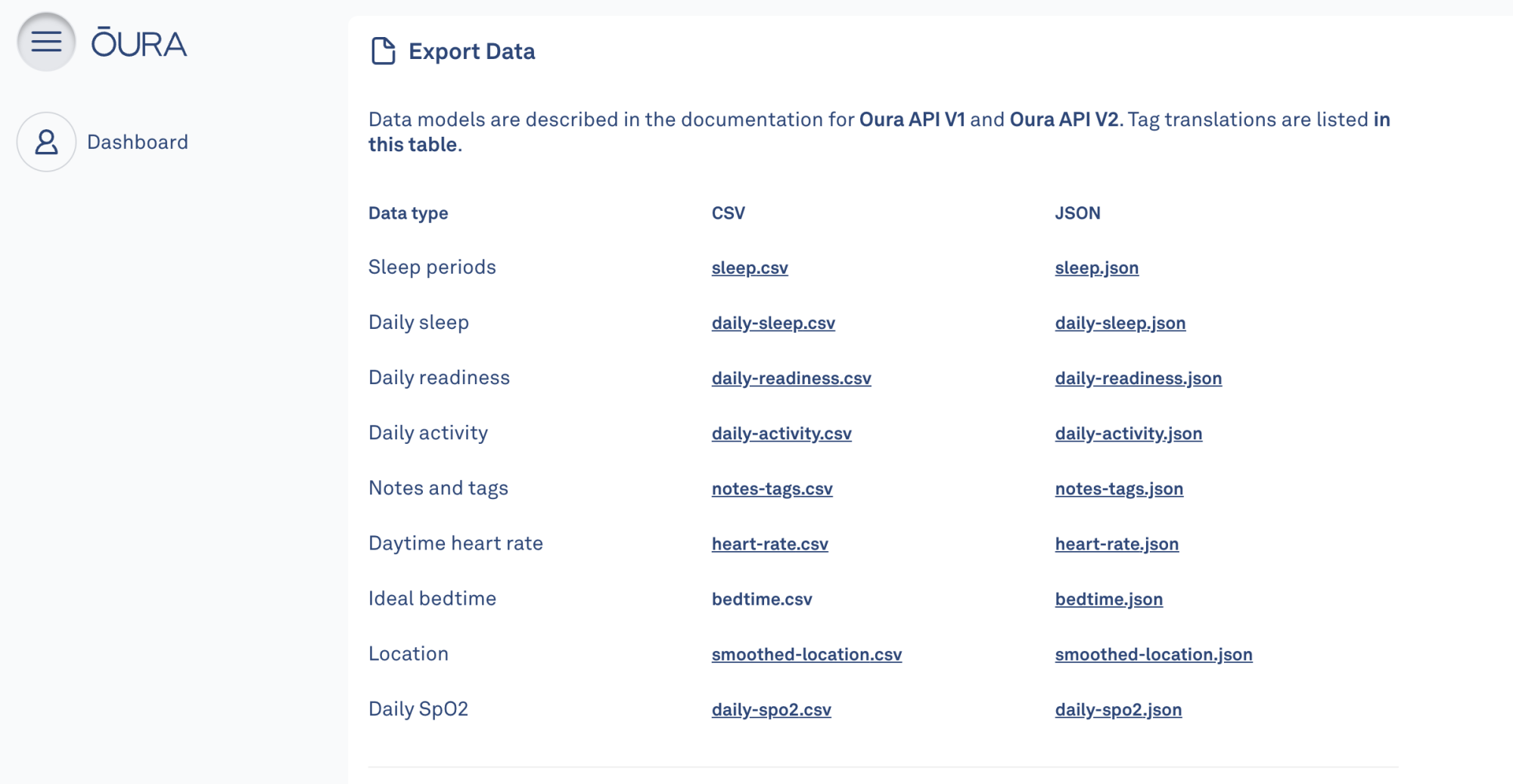
Alright, here’s the fun stuff. If you are OK with getting your data in spreadsheet form, you can download it directly from the Oura website. Go to cloud.ouraring.com. If you had a subscription, you’d be able to view some cool graphs on your dashboard, but you don’t, so the page is mostly blank. Tap on My Account and scroll down to Export Data. You’ll see a list of .csv and .json files. The very first one, sleep.csv (I think that link will work for you if you have an Oura account) is probably the most useful. Go ahead and bookmark that link on your phone, and you can check it in lieu of checking the app.

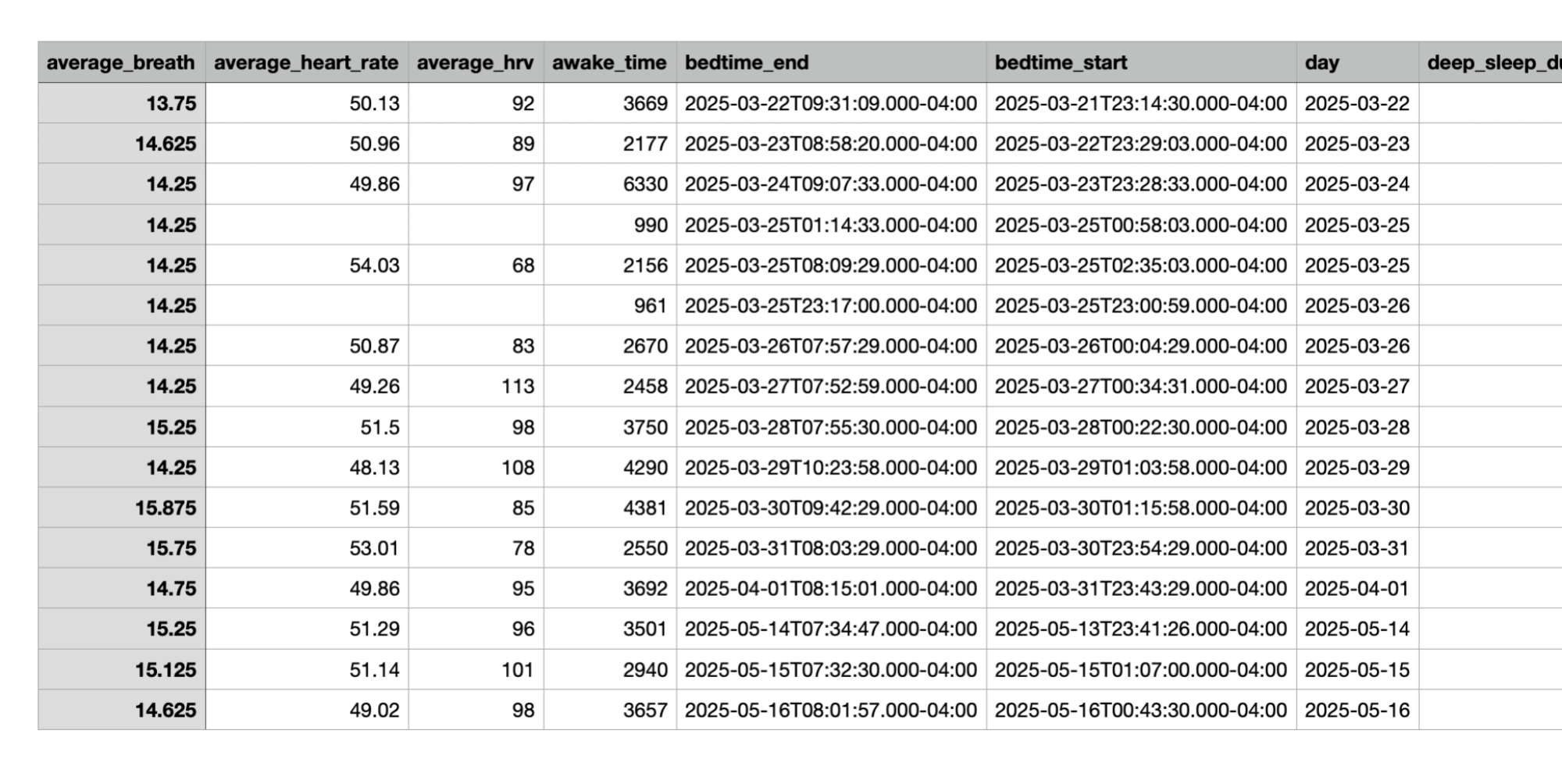
Screenshot of the spreadsheet from Oura
A partial view of sleep.csv (there are tons more columns than I can show in one screenshot).
Credit: Beth Skwarecki

From this spreadsheet, you can see your resting heart rate, HRV, and pretty much everything else that Oura logs every night. Your total sleep duration, for example, is in the 21st column, and it’s recorded in seconds. (28,410 seconds is about 7 hours and 54 minutes, if I’m doing my math right.) Explore the other files to see which ones have the data you’re most interested in. 

Oura screenshot showing other spreadsheets you can download
These are the downloads available without a subscription.
Credit: Beth Skwarecki/Oura

You need to give Oura a payment card to set up your ring in the first place

If you want nothing to do with the subscription at all, there’s an important caveat: The only way to set up your Oura ring (when it first arrives) is to sign up for a free trial that rolls into a regular subscription. So if you want to avoid giving Oura any payment information at all, you’re out of luck. You can cancel the subscription renewal immediately after signing up, though, which will mean you won’t be charged.

Microsoft’s Plan To Fix the Web: Letting Every Website Run AI Search for Cheap

Microsoft has announced NLWeb, an open protocol designed to democratize AI-powered search capabilities for websites and apps. Developed by Microsoft technical fellow Ramanathan V. Guha, who previously created RSS and Schema.org, NLWeb allows site owners to implement ChatGPT-style natural language search with minimal code. The protocol enables websites to process complex queries like “spicy and crunchy appetizers for Diwali” or “jackets warm enough for Quebec,” requiring only an AI model, some code, and the site’s own data.

During his demonstration to news outlet The Verge, Guha showed how NLWeb remembers user preferences, such as dietary restrictions, for future interactions. “It’s a protocol, and the protocol is a way of asking a natural-language question, and the answer comes back in structured form,” explained Guha, who argues the approach is significantly cheaper than traditional search methods that require extensive web crawling and indexing. Microsoft is partnering with publishers and companies including TripAdvisor, Eventbrite, and Shopify to implement NLWeb, though Guha acknowledges the challenge of achieving widespread adoption in a web that historically tends toward centralization.


Read more of this story at Slashdot.

FCC Chair Brendan Carr is letting ISPs merge—as long as they end DEI programs

It’s shaping up to be a big year for telecom mergers, and it appears the Federal Communications Commission is eager to approve the deals—as long as companies involved drop any DEI (Diversity, Equity, and Inclusion) policies criticized by FCC Chairman Brendan Carr. Verizon just got a big merger approved, and cable giant Charter is seeking permission to buy Cox.

The FCC on Friday announced approval of Verizon’s purchase of Frontier, one day after Verizon committed to end DEI policies in a filing with the commission. Carr previously sent letters to Verizon and other companies alleging that their diversity policies are “invidious forms of discrimination” that violate federal law and threatened to block mergers pursued by firms that enforce such policies.

“Verizon has now agreed to end its DEI policies as specified in a new FCC filing,” Carr wrote in a post on X. “These changes are effective immediately. A good step forward for equal opportunity, nondiscrimination, and the public interest.”

Read full article

Comments

F1 in Imola reminds us it’s about strategy as much as a fast car

Formula 1’s busy 2025 schedule saw the sport return to its European heartland this past weekend. Italy has two races on the calendar this year, and this was the first, the (deep breath) “Formula 1 AWS Gran Premio Del Made in Italy e Dell’Emilia-Romagna,” which took place at the scenic and historic (another deep breath) Autodromo Enzo e Dino Ferrari, better known as Imola. It’s another of F1’s old-school circuits where overtaking is far from easy, particularly when the grid is as closely matched as it is. But Sunday’s race was no snoozer, and for a couple of teams, there was a welcome change in form.

Red Bull was one. The team has looked a bit shambolic at times this season, with some wondering whether this change in form was the result of a number of high-profile staff departures toward the end of last season. Things looked pretty bleak during the first of three qualifying sessions, when Yuki Tsunoda got too aggressive with a curb and, rather than finding lap time, found himself in a violent crash that tore all four corners off the car and relegated him to starting the race last from the pit lane.

2025 has also been trying for Ferrari. Italy expects a lot from the red team, and the replacement of Mattia Binotto with Frédéric Vasseur as team principal was supposed to result in Maranello challenging for championships. Signing Lewis Hamilton, a bona fide superstar with seven titles already on his CV, hasn’t exactly reduced the amount of pressure on Scuderia Ferrari, either.

Read full article

Comments

Dell stuffed an enterprise-grade NPU into its new Pro Max Plus laptop

Dell just announced the new Pro Max Plus laptop, which the company has stuffed with an enterprise-grade NPU. This makes it a top-tier choice for on-device AI applications.

The Pro Max Plus features the Qualcomm AI 100 PC Inference Card, making it the “world’s first mobile workstation with an enterprise-grade discrete NPU.” This NPU offers 32 AI-cores and 64GB of memory. This is enough to directly handle the type of large AI models that typically require the cloud to run.

A Qualcomm NPU.
Dell

We don’t know anything else regarding traditional specs, but we do know that this will be one of many Pro Max Plus designs. The other models won’t be quite as focused on advanced AI applications.

Dell says this laptop is primarily intended for “AI engineers and data scientists,” and so it’s held off on announcing pricing. Given the specs, it’s likely to be way too expensive for traditional consumers. It’s coming out later this year. 

A laptop.
Dell

The company also revealed new server designs and a new cooling system for these servers. Dell’s PowerCool Enclosed Rear Door Heat Exchanger (eRDHx) is an alternative to standard rear door heat exchangers. Dell says it captures 100 percent of heat generated via a “self-contained airflow system.” It also suggests it can reduce cooling energy costs by up to 60 percent when compared to current alternatives.

This article originally appeared on Engadget at https://www.engadget.com/computing/laptops/dell-stuffed-an-enterprise-grade-npu-into-its-new-pro-max-plus-laptop-170043379.html?src=rss

Iron Rebellion Update Lets You Decorate Mechs With Custom Camo

Iron Rebellion adds two new community maps, a custom camo maker and more to the VR multiplayer mech game in today’s update.

Following its full release last December, the latest Iron Rebellion update is now live following a smaller patch back in February. Developer Black Beach Studio confirmed this includes a custom camo maker for your mechs with three layers of ‘unique textures and colors,’ alongside a camera toolkit for improved gameplay capture with additional settings. Here’s how the update looks.

0:00

/3:50

Elsewhere, buffs for FOS Beams, Intimidator, Pulse Rails, Infiltrator, and Shields are live as part of a weapons and rebalancing effort. Two new community maps, Desert Canyons and Sentinel Facility, are now live and older maps have received tweaks. Extra ammo and mass is also available on most maps, while other bug fixes and tweaks have also been made.

You can find the full patch notes below.

V1.142 Camo and Camera Toolkit Update – Full Patch Notes

Customization and Camo system

  • All new camo system with a strong focus on unique customization. Equip your mech with up to three pattern layers with adjustable scale, rotation, offset, and intensity. Create anything from stealth blends to aggressive high-contrast designs to drive fear into the enemy ranks. Patreon game supporters also gain access to a secret camo pattern known only to a select few.

Camera Toolkit

  • Improved Smooth Camera – Smoothed camera gets major upgrades to better capture cockpit interactions and mech dynamics like shaking from damage or movement. Improvements to how the camera moves and follows action make flat screen footage feel much closer to the real VR experience. Footage now feels more alive and true to the in-game experience.
  • All New Camcorder – A placeable camera that lets you frame shots exactly how you want. Perfect for cinematic angles, gameplay highlights, and custom scenes with full control over position and rotation. This also benefits from a lot of tech we built for smooth camera improvements!
  • Custom FOV – FOV settings let you control how wide or narrow the view is for each shot. Easily switch between portrait and landscape mode to suit different platforms and styles.

Gameplay & Balance

  • Increased Pulse Rails accuracy and damage, adjusted spread.
  • Increased Intimidators damage.
  • Reduced Spitfire damage slightly.
  • Gave LR-FOS BEAM a damage increase as well.
  • Artillery and airstrikes now hit shields and other blocking objects.
  • Cloaking: Halved cost.
  • Heavy Shield: Doubled health.
  • Healing drones are now networked and appear to other players as well.

UI & UX

  • Improved disconnecting and reconnecting logic and information conveyed, no more black screens without a reason!
  • All new sound and visual effects for picking mechs, weapons, augments and camo.
  • Force headphones option for Standalone Quest players

Maps & Environments

  • Echus: Ammo increased from 8 → 12
  • Redland: Major update- New layout and visual improvements
  • Abandoned Sector: Major update- Visual improvements
  • Sentinel: New map- Mountaintop facility environment with tight corridors and large rooms, mid size
  • Canyons: New map- Desert canyon environment, mid size
  • Magma Fields: Minor fixes and improvements, lava plane textures fixed for standalone
  • Badlands: Ammo increased from 8 → 16, added spawn cover.
  • Bulletheim: Ammo increased from 8 → 16

Inspired by Titanfall, MechWarrior and Hawken, Iron Rebellion initially launched in early access nearly four years ago before December’s full release. While our hands-on following version 1.0’s launch lamented a lack of single player content, we considered it a “laudable” effort that offers enjoyable multiplayer which feels ‘finely tuned and balanced.’

You can read our previous thoughts in full below, and Iron Rebellion is available now on Quest and Steam.

Iron Rebellion Might Be The Mechs Best Thing To MechWarrior In VR
Iron Rebellion counters lightweight content with strong VR design, delivering a versatile multiplayer mech game.
UploadVRRichie Shoemaker

Nintendo’s Making It Easier to Find Lost Switch 2 Joy-Cons

Continuing the steady stream of news about the upcoming Switch 2 console, Nintendo has now revealed that it’s improved the console’s ability to find lost Joy-Con controllers. The company demonstrated this in a video posted in the Nintendo Today app, which is available on Android and iPhone.

How to locate missing Nintendo Switch 2 Joy-Cons

To find your missing Switch 2 Joy-Cons, go to the home screen, open the Controllers menu, and select Search for controllers. Now, select the missing controller to start your search. If you don’t have the Nintendo Today app, check out this Bluesky post to see the feature in action.

A similar feature was available on the original Nintendo Switch, where you could remotely trigger Joy-Con controllers to rumble, which would hopefully help you find them. Still, now you can go beyond a simple rumble. With the Switch 2, missing Joy-Cons will now vibrate and play a beeping sound, which should make it easier to hear your poor controller’s cries for help. This process is quite similar to pinging your iPhone or Apple Watch.

Nintendo hasn’t yet revealed any speaker features for the Switch 2 Joy-Con, so it’s likely the beeping sound is actually just some a retuned rumble. Still, that does paint an impressive picture of what HD Rumble 2 can do.

This is not the only quality-of-life improvement Nintendo has confirmed for the Switch 2. Recently, the company revealed a charging limiter and the ability to lock the Switch 2 with a PIN. There’s also support for third-party USB-C webcams.

Still, not everyone will feel the need to spend more money to get the Switch 2. If you’re on the fence, click through to compare the Nintendo Switch 2’s specs with the original Switch. And don’t forget to check out the list of games coming to the Switch 2, or the new mouse controls feature.

Microsoft Open Sources Windows Subsystem for Linux

Windows Subsystem for Linux (WSL) is now open source, Microsoft said Monday. The tool, which allows developers to run Linux distributions directly in Windows, is available for download, modification, and contribution. “We want Windows to be a great dev box,” said Pavan Davuluri, corporate VP at Microsoft. “Having great WSL performance and capabilities” allows developers “to live in the Windows-native experience and take advantage of all they need in Linux.”

First launched in 2016 with an emulated Linux kernel, WSL switched to using the actual Linux kernel in 2019 with WSL 2, improving compatibility. The system has since gained support for GPUs, graphical applications, and systemd. Microsoft significantly refactored core Windows components to make WSL a standalone system before open sourcing it.


Read more of this story at Slashdot.

Syndicator Sequel Prison Boss Prohibition Sneaks Onto Quest & Steam Soon

Announced during the Creature Feature 2025 showcase, Prison Boss Prohibition, is making its debut on Quest and Steam this July.

The sequel to Prison Boss VR, Prison Boss Prohibition is a business management simulator with a twist: everything you stock is illegal. Set in the poultry populated city of New Yolk, the mayor has outlawed everything from cigarettes to exotic magazines. Instead of cowering, however, players become opportunistic businesspeople, manually making and distributing contraband.

0:00

/0:40

Full Trebuchet video

Alongside rolling cigarettes and brewing beverages, players must also keep the spoils of their misdeeds away from the eyes of Johnny Law, AKA the police. Prison Boss Prohibition also offers a co-op mode, where two players can try their best to trick the police and the mayor, working double time to satisfy the needs of the New Yolk citizens.

Developed by Trebuchet, the original Prison Boss VR is a crafting simulation game set in a jail. In our review of Prison Boss VR, we enjoyed its light-hearted and whimsical tone, saying:

“Fans of Job Simulator and tycoon-style games will find a lot to love here and far more content than expected, but what it gains in breadth it sacrifices in depth. Even still, this is a VR game we’d happily return to as a reward for good behavior.”

Prison Boss Prohibition arrives on July 10 for Quest and Steam, and the studio informed UploadVR that the PlayStation VR2 launch “will follow at a later date.” You can also sign up for the Alpha playtest on May 23.

The making of Apple TV’s Murderbot

In the mood for a jauntily charming sci-fi comedy dripping with wry wit and an intriguing mystery? Check out Apple TV’s Murderbot, based on Martha Wells’ bestselling series of novels The Murderbot Diaries. It stars Alexander Skarsgård as the titular Murderbot, a rogue cyborg security (SEC) unit that gains autonomy and must learn to interact with humans while hiding its new capabilities.

(Some minor spoilers below, but no major reveals.)

There are seven books in Wells’ series thus far. All are narrated by Murderbot, who is technically owned by a megacorporation but manages to hack and override its governor module. Rather than rising up and killing its former masters, Murderbot just goes about performing its security work, relieving the boredom by watching a lot of entertainment media; its favorite is a soap opera called The Rise and Fall of Sanctuary Moon.

Read full article

Comments

Deadly Delivery Is A Comedic Co-Op VR Horror Game In A Haunted Mine

Deadly Delivery is a comedic VR co-op horror game where you deliver parcels across a haunted mine on Quest and Steam.

Revealed during today’s Creature Feature presentation, Deadly Delivery is the latest game from Flat Head Studio. Playing as a goblin with up to four people, these dangerous shipping tasks involve avoiding monsters as you drop off packages. You need to try to reach your quota, survive, and “pay back your student loans.”

0:00

/1:15

Announcement trailer

The game uses physics-based gameplay and arms you with “questionable” equipment across procedurally generated tunnels, which involves sneaking and sprinting through to survive. Not much else is currently known, though Deadly Delivery’s official website confirms a closed beta will be held via Discord. It’s unclear at this time if cross-platform multiplayer is supported.

As for Flat Head Studio, Deadly Delivery marks its second title following 2023’s time loop puzzle adventure We Are One. At the time, we praised it in our review for its “surprisingly intuitive” mechanics that deliver a “refreshing and unconventional” puzzle experience.

Deadly Delivery doesn’t have a confirmed release date, but it’s coming in Q4 2025 on Quest and Steam.

ASUS unveiled new ROG Zephyrus G14 and G16 laptops at Computex

ASUS has revealed several new laptops at Computex, including the impressive-looking ROG Zephyrus G14. This high-spec computer looks perfect for on-the-go gaming and just about anything else.

First of all, this thing is pretty small. The 14-inch screen allows it to fit in just about any to-go bag. The 16:10 panel boasts a 3K display, a refresh rate of 120Hz, 500 nits of peak brightness and Dolby Vision integration. The bezels are slim, with an impressive 87 percent screen-to-body ratio.

A laptop.
ASUS

It’s also stylish, which is expected from the Zephyrus brand. The G14 features a CNC aluminum unibody that adds to the overall durability. It’s available in two colorways. There’s Eclipse Gray and Platinum White.

As for specs, the G14 can be outfitted with up to an AMD Ryzen AI 9 HX 370 processor with 12 cores and 24 threads and an AMD XDNA NPU with up to 50 TOPS. The graphics card maxes out with the NVIDIA GeForce RTX 5080. RAM options go up to 64GB and on-board storage up to 2TB.

The base model starts at $1,800, but won’t be available until June 25. The other variations are already available for purchase.

A laptop.
ASUS

The ROG Zephyrus G16 is bigger, obviously, but the screen ups the refresh rate up to 240Hz. These models boast the Intel Core Ultra 9 processor and up to the NVIDIA RTX 5070 GPU. It boasts a similar aluminum chassis to the G14 and a six-speaker system for increased immersion.

The base model here costs $2,150 and will be available on June 25. Other versions are already available for purchase.

A laptop.
ASUS

The company has also revealed refreshes of the ROG Strix G16 and G18. These gaming laptops can be outfitted with either AMD or Intel CPUs, with support for up to 32GB of RAM. Both models include the NVIDIA GeForce RTX 5060. All models include 1TB of on-board storage. The G18 starts at $1,700 and the G16 starts at $1,500.

This article originally appeared on Engadget at https://www.engadget.com/computing/laptops/asus-unveiled-new-rog-zephyrus-g14-and-g16-laptops-at-computex-163058281.html?src=rss

[$] Reports from OSPM 2025, day one

The seventh edition of the Power Management and Scheduling
in the Linux Kernel
(known as “OSPM”) Summit took place on March 18-20,
2025. It was organized by Juri Lelli, Frauke Jäger, Tommaso Cucinotta, and
Lorenzo Pieralisi, and was hosted by Linutronix at Alte Fabrik,
Uhldingen-Mühlhofen, Germany. The event was sponsored by Linutronix, Arm,
and the Scuola Superiore Sant’Anna in Pisa.