AMD’s Ryzen Threadripper 9000 chips have up to 96 cores, just like the last bunch

Not many people need a 96-core processor. But for creative professionals, engineers and AI developers who do, AMD has a new batch of chips on display at Computex 2025. The company announced its new Ryzen Threadripper 9000 series on Tuesday, with bonkers specs to power pro-level workstations and ultra-high-end prosumer desktops.

At the top of the line in the series is the AMD Threadripper Pro 9995WX. This chip has a staggering 96 cores and 192 threads, matching the highest-end model from 2023’s Threadripper Pro 7000 line. But the new 9000 series tops out with a higher maximum boost speed of 5.4GHz. That’s up from 5.1GHz in the premiere 7000 Pro chip.

AMD’s new batch includes six processors in the Threadripper Pro WX series, designed for pro-level workstations. (In addition to the 96-core 9995WX, options include 12-, 16-, 24-, 32- and 64-core models.) Moving past the Pro series, the standard Threadripper 9000 line for high-end desktops maxes out with the 64-core, 128-thread 9980X.

AMD hasn’t yet announced pricing or specific retail models carrying the chips. But the 7000 Pro series offers a hint. The top-shelf model from that line costs a cool $10,000. (Yep, that’s for the processor alone.) So, unless your work involves extremely demanding AI development, 3D modeling or ultra-high-res video editing, you can slowly step away and make your way back to the consumer aisle.

This article originally appeared on Engadget at https://www.engadget.com/computing/amds-ryzen-threadripper-9000-chips-have-up-to-96-cores-just-like-the-last-bunch-030003537.html?src=rss

19-Year-Old Accused of Largest Child Data Breach in US Agrees To Plead Guilty To Federal Charges

A Massachusetts man has agreed to plead guilty to hacking into one of the top education tech companies in the United States and stealing tens of millions of schoolchildren’s personal information for profit. From a report: Matthew Lane, 19, of Worcester County, Massachusetts, signed a plea agreement related to charges connected to a major hack on an educational technology company last year, as well as another company, according to court documents published Tuesday.

While the documents refer to the education company only as “Victim-2” and the U.S. attorney’s office declined to name the victim, a person familiar with the matter told NBC News that it is PowerSchool. The hack of PowerSchool last year is believed to be the largest breach of American children’s sensitive data to date.

According to his plea agreement, Lane admitted obtaining information from a protected computer and aggravated identity theft and agreed not to challenge a prison sentence shorter than nine years and four months. He got access simply by trying an employee’s stolen username and password combination, the complaint says, echoing a private third-party assessment of the incident previously reported by NBC News.


Read more of this story at Slashdot.

KDE Is Getting a Native Virtual Machine Manager Called ‘Karton’

A new virtual machine manager called Karton is being developed specifically for the KDE Plasma desktop, aiming to offer a seamless, Qt-native alternative to GNOME-centric tools like GNOME Boxes. Spearheaded by University of Waterloo student Derek Lin as part of Google Summer of Code 2025, Karton uses libvirt and Qt Quick to build a user-friendly, fully integrated VM experience, with features like a custom SPICE viewer, snapshot support, and a mobile-friendly UI expected by September 2025. Neowin reports: To feel right at home in KDE, Karton is being built with Qt Quick and Kirigami. It uses the libvirt API to handle virtual machines and could eventually work across different platforms. Right now, development is focused on getting the core parts in place. Lin is working on a new domain installer that ditches direct virt-install calls in favor of libosinfo, which helps detect OS images and generate the right libvirt XML for setting up virtual machines more precisely. He’s still refining device configuration and working on broader hypervisor support. Another key part of the work is building a custom SPICE viewer using Qt Quick from scratch:

If you’re curious, here’s the list of specific deliverables Lin included in his GSoC proposal, though he notes the proposal itself is a bit outdated […]. For those interested in the timeline, Lin’s GSoC proposal says the official GSoC coding starts June 2, 2025. The goal is to have a working app ready by the midterm evaluation around July 14, 2025, with the final submission due September 1, 2025. You can learn more via KDE.org.


Read more of this story at Slashdot.

KrebsOnSecurity Hit With Near-Record 6.3 Tbps DDoS

KrebsOnSecurity was hit with a near-record 6.3 Tbps DDoS attack, believed to be a test of the powerful new Aisuru IoT botnet. The attack, lasting under a minute, was the largest Google has ever mitigated and is linked to a DDoS-for-hire operation run by a 21-year-old Brazilian known as “Forky.” Brian Krebs writes: [Google Security Engineer Damian Menscher] said the attack on KrebsOnSecurity lasted less than a minute, hurling large UDP data packets at random ports at a rate of approximately 585 million data packets per second. “It was the type of attack normally designed to overwhelm network links,” Menscher said, referring to the throughput connections between and among various Internet service providers (ISPs). “For most companies, this size of attack would kill them.” […]

The 6.3 Tbps attack last week caused no visible disruption to this site, in part because it was so brief — lasting approximately 45 seconds. DDoS attacks of such magnitude and brevity typically are produced when botnet operators wish to test or demonstrate their firepower for the benefit of potential buyers. Indeed, Google’s Menscher said it is likely that both the May 12 attack and the slightly larger 6.5 Tbps attack against Cloudflare last month were simply tests of the same botnet’s capabilities. In many ways, the threat posed by the Aisuru/Airashi botnet is reminiscent of Mirai, an innovative IoT malware strain that emerged in the summer of 2016 and successfully out-competed virtually all other IoT malware strains in existence at the time.


Read more of this story at Slashdot.

Spain Blocks More Than 65,000 Airbnb Holiday Rental Listings

Spain has ordered Airbnb to remove over 65,000 listings that violate rental regulations, citing missing license numbers and unclear ownership details. The crackdown is part of a broader government effort to address the country’s housing crisis, which many blame on unregulated short-term rentals reducing long-term housing supply. Reuters reports: Most of the Airbnb listings to be blocked do not include their licence number, while others do not specify whether the owner was an individual or a corporation, the Consumer Rights Ministry said in a statement on Monday. Consumer Rights Minister Pablo Bustinduy said his goal was to end the general “lack of control” and “illegality” in the holiday rental business. “No more excuses. Enough with protecting those who make a business out of the right to housing in our country,” he told reporters.

Bustinduy said Madrid’s high court is backing the request to withdraw as many as 5,800 listings. Airbnb will appeal the decision, a spokesperson said on Monday. The company believes the ministry does not have the authority to make rulings over short-term rentals and failed to provide an evidence-based list of non-compliant accommodation. Some of the incriminated listings are non-touristic seasonal ones, the spokesperson said.


Read more of this story at Slashdot.

Google Showed Off Sleek Smart Glasses With A HUD Again At I/O

At Google I/O 2025, the company gave another on-stage demo of “prototype” smart glasses with a HUD.

We say another because the same duo, Shahram Izadi (Google’s Android XR lead) and Nishtha Bhatia (a Google PM), gave a very similar demo on stage at TED2025 last month.

Google Shows Off Sleek AI Smart Glasses With A HUD
At TED2025 Google showed off sleek smart glasses with a HUD, though the company described them as ” conceptual hardware”.
UploadVRDavid Heaney

The TED demo focused almost entirely on Gemini AI capabilities, as well as navigation, and the new I/O demo strongly focuses on Gemini too. But it also showcased some wider functionality, including receiving and replying to message notifications and taking photos.

Izadi and Bhatia finished the demo by attempting real-time speech translation, a feature Meta rolled out to the Ray-Ban Meta glasses last month. While it partially worked, the casted view from Bhatia’s glasses froze halfway through.

“We said it’s a risky demo”, Izadi remarked.

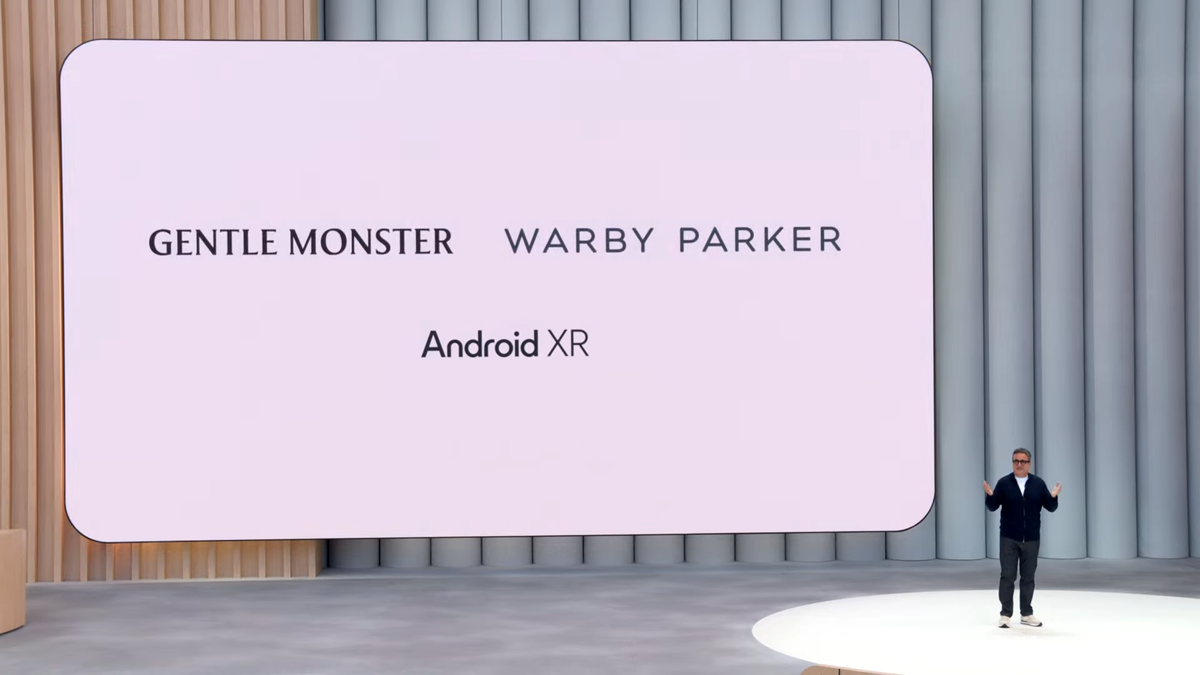
Google Working With Gentle Monster & Warby Parker On Gemini Smart Glasses
Google is working with Gentle Monster and Warby Parker on smart glasses with Gemini AI, the company’s plan to directly compete with Ray-Ban Meta.
UploadVRDavid Heaney

What’s really new at I/O compared to TED though is the announcement of actual products. Google says it’s working with Gentle Monster and Warby Parker, rising competitors to Ray-Ban and Oakley owner EssilorLuxottica, mirroring Meta’s strategy to deliver smart glasses in stylish designs.

However, Google described what was shown on stage at I/O as “prototype” hardware, said that including a display is “optional” for actual products, and did not say whether the first Gentle Monster and Warby Parker products will include a HUD. It’s possible they’ll be more basic devices like Ray-Ban Meta glasses.

If any of these glasses do have a HUD, they won’t be alone on the market. In addition to the existing Even Realities G1 and Frame glasses, Mark Zuckerberg’s Meta reportedly plans to launch its own smart glasses with a HUD later this year. Unlike Google’s glasses though, which appeared to be primarily controlled by voice, Meta’s HUD glasses will reportedly also be controllable via finger gestures, sensed by an included sEMG neural wristband.

Apple too is reportedly working on smart glasses, with apparent plans to release a product in 2027.

Coinbase Data Breach Will ‘Lead To People Dying,’ TechCrunch Founder Says

An anonymous reader quotes a report from Decrypt: The founder of online news publication TechCrunch has claimed that Coinbase’s recent data breach “will lead to people dying,” amid a wave of kidnap attempts targeting high-net-worth crypto holders. TechCrunch founder and venture capitalist Michael Arrington added that this should be a point of reflection for regulators to re-think the importance of know-your-customer (KYC), a process that requires users to confirm their identity to a platform. He also called for prison time for executives that fail to “adequately protect” customer information.

“This hack — which includes home addresses and account balances — will lead to people dying. It probably has already,” he tweeted. “The human cost, denominated in misery, is much larger than the $400 million or so they think it will actually cost the company to reimburse people.” […] He believes that people are in immediate physical danger following the breach, which exposed data including names, addresses, phone numbers, emails, government-ID images, and more.

Arrington believes that in the wake of these attacks, crypto companies that handle user data need to be much more careful than they currently are. “Combining these KYC laws with corporate profit maximization and lax laws on penalties for hacks like these means these issues will continue to happen,” he tweeted. “Both governments and corporations need to step up to stop this. As I said, the cost can only be measured in human suffering.” Former Coinbase chief technology officer Balaji Srinivasan pushed back on Arrington’s position that executives should be punished, arguing that regulators are forcing KYC onto unwilling companies. “When enough people die, the laws may change,” Arrington hit back.


Read more of this story at Slashdot.

Fortnite is finally back in the US App Store

Fortnite is back in the US App Store. Epic CEO Tim Sweeney announced that he intended to relaunch the game in late April, following a court order that demanded Apple stop collecting a 27 percent fee on app transactions that happen outside of its in-app purchase system. The company finally amending its rules to remove that additional commission is why Epic moved forward with the relaunch.

The origins of this conflict can be traced all the way back to 2020, when Epic added its own method for collecting payments for in-game items in Fortnite and encouraged players to circumvent Apple’s system. Fortnite was removed from the App Store (and the Google Play Store for that matter), Epic sued and the rest is history. 

Epic didn’t win its entire case against Apple, but it did secure a permanent injunction allowing developers to include in-app text that makes users aware of payment options other than the App Store. According to the latest court order, Apple allowed that text, but was still demanding developers pay it a fee for those non-App Store transactions. That prompted the judge overseeing the companies’ case to demand Apple stop and remove even more obstacles from the payment process.

Fortnite is BACK on the App Store in the U.S. on iPhones and iPads… and on the Epic Games Store and AltStore in the E.U! It’ll show up in Search soon!

Get Fortnite on the App Store in the U.S. ➡️ https://t.co/HQu3pYCXFm pic.twitter.com/w74QPFFkOS

— Fortnite (@Fortnite) May 20, 2025

It was anticipated that Fortnite would return far earlier than it actually did. Companies like Spotify swiftly updated their apps to take advantage of Apple’s rule change, with approved applications showing up in early May. In fact, Spotify managed to get a second update focused on Audiobooks approved before Epic was able to get Fortnite in the App Store. Today’s news comes in the wake of a Judge ordering Apple on May 19 to either resolve the matter or have the “Apple official who is personally responsible” show up in court next week to explain why.

Fortnite has technically been available on Apple devices in other ways for a while now, whether its through the Epic Game Store in the European Union, or game streaming services like Xbox Cloud Gaming and NVIDIA GeForce Now in the US. Returning to the App Store is a symbolic victory. The real prize are the court orders that came from Epic v. Apple.  

Assuming they survive Apple’s appeal, they could dramatically reshape Apple’s business and the way apps work on the iPhone. 

This article originally appeared on Engadget at https://www.engadget.com/mobile/fortnite-is-finally-back-in-the-us-app-store-222946133.html?src=rss

Call Of Duty: Black Ops Dev’s New PlayStation Studio Looking For Artist With ‘Advanced Expertise’ In Generative AI

Dark Outlaw Games is a new PlayStation studio born out of the ashes of Deviation Games and led by developer Jason Blundell, best known for Call of Duty: Black Ops’hit Zombies mode. The team is looking for a concept artist for its first project, but not just any concept artist. A new job listing on Sony’s website…

Read more…

Google Launches Veo 3, an AI Video Generator That Incorporates Audio

Google on Tuesday unveiled Veo 3, an AI video generator that includes synchronized audio — such as dialogue and animal sounds — setting it apart from rivals like OpenAI’s Sora. The company also launched Imagen 4 for high-quality image generation, Flow for cinematic video creation, and made updates to its Veo 2 and Lyria 2 tools. CNBC reports: “Veo 3 excels from text and image prompting to real-world physics and accurate lip syncing,” Eli Collins, Google DeepMind product vice president, said in a blog Tuesday. The video-audio AI tool is available Tuesday to U.S. subscribers of Google’s new $249.99 per month Ultra subscription plan, which is geared toward hardcore AI enthusiasts. Veo 3 will also be available for users of Google’s Vertex AI enterprise platform.

Google also announced Imagen 4, its latest image-generation tool, which the company said produces higher-quality images through user prompts. Additionally, Google unveiled Flow, a new filmmaking tool that allows users to create cinematic videos by describing locations, shots and style preferences. Users can access the tool through Gemini, Whisk, Vertex AI and Workspace.


Read more of this story at Slashdot.

Solar trade association warns of ‘devastating energy shortages’ if incentives are cut

The Solar Energy Industries Association released an assessment of how the budget reconciliation bill currently under review in Congress would have a negative impact on the economy. The legislation cuts incentives around solar power investment and adoption, such as the Section 25D residential tax credit.

The group’s analysis found that the bill, as it stands, would lead to the loss of nearly 300,000 current and future jobs in the US. It also said removal of incentives could mean a loss of ​​$220 billion in investment in the sector by 2030. It also pointed to a future energy shortage, claiming that solar was on course to be responsible for about 73 percent of the 206.5 GW of new energy capacity needed in the country by 2030.

“Passing this bill would create a catastrophic energy shortfall, cede AI and tech leadership to China, and damage some of the most vital sectors of the U.S. economy,” SEIA President and CEO Abigail Ross Hopper said.

It’s the type of reaction we expect to see when an industry is under threat from federal action. It’s also the type of researched data that doesn’t seem to have much influence on the current administration, particularly when it comes to the environment and sustainability.

This article originally appeared on Engadget at https://www.engadget.com/science/solar-trade-association-warns-of-devastating-energy-shortages-if-incentives-are-cut-214607526.html?src=rss