Quebec Culture Minister Mathieu Lacombe has introduced Bill 109, which would require streaming platforms like Netflix and Spotify to feature and prioritize French-language content. CBC.ca reports: Bill 109 has been in the works for over a year. It marks the first time that Quebec would set a “visibility quota” for French-language content on major streaming platforms such as Netflix, Disney and Spotify. […] The legislation, titled An Act to affirm the cultural sovereignty of Quebec and to enact the Act respecting the discoverability of French-language cultural content in the digital environment, would apply to every digital platform that offers a service for watching videos or listening to music and audiobooks online. Those include Canadian platforms such as Illico, Crave and Tou.tv. It would amend the Quebec Charter of Human Rights and Freedoms to enshrine “the right to discoverability of and access to original French-language cultural content.”
If the bill is adopted, streaming platforms and television manufacturers would be forced to present interfaces for screening online videos in French by default. Those interfaces would need to provide access to platforms that offer original French-language cultural content based on the government’s pending criteria. Financial penalties would be imposed on companies that don’t follow the rules. If the business models of some companies prevent them from keeping to the letter of the proposed law, companies would be allowed to enter into an agreement with the Quebec government to set out “substitute measures” to fulfil Bill 109 obligations differently. “We don’t want to exempt them. We’re telling them, ‘let’s negotiate substitute measures,'” Lacombe told reporters.
China is poised to be the next big donor to the World Health Organization after Trump abruptly withdrew the US from the United Nations health agency on his first day in office, leaving a critical funding gap and leadership void.
On Tuesday, Chinese Vice Premier Liu Guozhong said that China would give an additional $500 million to WHO over the course of five years. Liu made the announcement at the World Health Assembly (WHA) being held in Geneva. The WHA is the decision-making body of WHO, comprised of delegations from member states, which meet annually to guide the agency’s health agenda.
“The world is now facing the impacts of unilateralism and power politics, bringing major challenges to global health security,” Liu told the WHA, according to The Washington Post. “China strongly believes that only with solidarity and mutual assistance can we create a healthy world together.”
We may earn a commission from links on this page. Deal pricing and availability subject to change after time of publication.
The Mac mini has always been about packing a surprising amount of power into a tiny shell, and the Early 2023 Apple Mac mini M2 sticks to that idea. Right now, you can grab the refurbished 8GB RAM, 512GB SSD model on sale for $459.99 at StackSocial (down from $599), or the 256GB SSD version for $359.99. Both are rated “Grade A,” meaning they show little to no cosmetic wear and ship free across the contiguous U.S.
Powered by Apple’s M2 chip, this mini desktop quietly handles everything from daily multitasking to heavy-duty tasks like 8K video editing. Its 8-core CPU, 10-core GPU, and 16-core Neural Engine give it real muscle, especially for creatives or anyone who juggles multiple apps and tabs at once. However, keep in mind that while it’s a beast for most workflows, 8GB RAM might feel tight for heavier professional workloads down the line, like video production or 3D rendering.
These Mac minis run macOS Ventura out of the box (with an easy upgrade path to the latest macOS Sequoia, so you’re not starting on an outdated system), and support up to two external displays, including one up to 6K over Thunderbolt and another up to 5K (or 4K through HDMI), making it a strong centerpiece for creative setups. It’s got serious connectivity options too—two Thunderbolt 4 ports, an HDMI port with 8K support, two USB-A ports, Ethernet, and a headphone jack that’s ready for high-impedance headphones. Wifi 6E and Bluetooth 5.3 round things out, giving you faster and more stable wireless connections. With fast boot times, excellent security baked into the hardware, and a form factor that weighs just 2.6 pounds, the Mac mini M2 feels like a serious upgrade packed into a minimalistic design. It’s a small machine with serious ambition, and for most people, that’s more than enough.
Encrypted messaging platform Signal is rolling out a feature called Screen Security to its Windows app. It’s broadly a way to prevent a computer from logging screenshots of your messages when the app is open, but in a blog post, the company directly called out the Recall feature in Windows 11 as the reason for this new capability.
Signal explained that what it essentially did was to flag its application as protected by Digital Rights Management (DRM), because content under that umbrella will not be recorded in a screenshot on a Windows device. It’s the same reason that a movie streaming from Netflix will appear in screenshots as a black box. Screen Security will be on by default, but this setting can be easily disabled for cases where a user does need to be able to access the application, such as when using a screen reader.
“We hope that the AI teams building systems like Recall will think through these implications more carefully in the future,” the company said. “Apps like Signal shouldn’t have to implement ‘one weird trick’ in order to maintain the privacy and integrity of their services without proper developer tools.”
The Recall feature in Windows 11 has had a difficult and well-delayed development process. While the AI-powered tool to record everything on a PC’s screen has some potential benefits for user productivity, it’s also raised a lot of concerns about privacy and security. Although Microsoft has started rolling out Recall to Copilot+ PCs, not everyone is convinced that it’s ready for prime time.
This article originally appeared on Engadget at https://www.engadget.com/computing/signal-will-block-microsoft-recall-from-snooping-on-your-texts-225853193.html?src=rss
Longtime Slashdot reader theodp writes: In what reads a bit like a Sopranos plot, The Information suggests some of those in the recent batch of terminated Microsoft engineers may have in effect been forced to dig their own AI graves. The (paywalled) story begins: “Jeff Hulse, a Microsoft vice president who oversees roughly 400 software engineers, told the team in recent months to use the company’s artificial intelligence chatbot, powered by OpenAI, to generate half the computer code they write, according to a person who heard the remarks. That would represent an increase from the 20% to 30% of code AI currently produces at the company, and shows how rapidly Microsoft is moving to incorporate such technology. Then on Tuesday, Microsoft laid off more than a dozen engineers on Hulse ‘s team as part of a broader layoff of 6,000 people across the company that appeared to hit engineers harder than other types of roles, this person said.” The report comes as tech company CEOs have taken to boasting in earnings calls, tech conferences, and public statements that their AI is responsible for an ever-increasing share of the code written at their organizations. Microsoft’s recent job cuts hit coders the hardest. So how much credence should one place on CEOs’ claims of AI programming productivity gains — which researchers have struggled to measure for 50+ years — if engineers are forced to increase their use of AI, boosting the numbers their far-removed-from-programming CEOs are presenting to Wall Street?
The News/Media Alliance took aim at Google today after the tech company’s announcement at its I/O showcase that AI Mode will be rolling out to all US search users. This feature more closely integrates an AI chatbot into Google search. Ostensibly, AI Mode can help people get better answers to their queries, but it also serves to keep users on a Google property rather than clicking through to get information from other publications.
“Links were the last redeeming quality of search that gave publishers traffic and revenue. Now Google just takes content by force and uses it with no return, the definition of theft,” said News/Media Alliance President and CEO Danielle Coffey. “The DOJ remedies must address this to prevent continued domination of the internet by one company.”
This isn’t the first time the organization has fired shots at Google; it filed an amicus brief earlier this month looking for remedy in the antitrust case about Google’s monopoly control over search. The group argued that publishers should be able to opt out of letting search engines use their content for retrieval augmented generation.
Google has also taken an aggressive stance toward publishers as it develops more AI-driven services. The company’s recent attitude can be seen in Bloomberg‘s discovery of an internal document showing that the company decided not to give publishers a choice to opt out of AI training if they wanted their material to appear in search results.
This article originally appeared on Engadget at https://www.engadget.com/big-tech/newsmedia-alliance-calls-googles-ai-mode-theft-223128521.html?src=rss
We may earn a commission from links on this page. Deal pricing and availability subject to change after time of publication.
There was a time when you needed to spend over $1,000 to get your hands on a MacBook that could handle everything from spreadsheets to video edits without complaint. That’s no longer the case—at least not with this deal. This refurbished 2020 MacBook Air with the Apple M1 chip is down to $549.99 for the 8GB RAM + 512GB SSD model and $589.99 for the 16GB RAM + 256GB SSD configuration. Both are “Grade A” units, meaning they might have little to no visible wear even though they are refurbished.
You get the same M1 chip that helped Apple cut ties with Intel—an 8-core CPU, 8-core GPU, and a 16-core Neural Engine working together to make everything from browsing to photo editing fast and efficient. That chip also means zero fans, so the machine stays completely silent, no matter how long you’re running it. The Retina display still holds up with a crisp 2560×1600 resolution, and the battery life is solid, around 15 to 18 hours depending on use.
You do miss out on some newer features like MagSafe charging or a 1080p webcam, but for this price, those trade-offs feel minor. Both variants include two Thunderbolt/USB 4 ports, wifi 6, Bluetooth 5.0, stereo speakers with Dolby Atmos support, a responsive backlit Magic Keyboard, and Touch ID. And because it’s still supported, you’ll be able to upgrade to macOS Sequoia 15. If you’ve been eyeing a MacBook for work, school, or general creative projects and can live without the newest features, this deal makes a strong case for sticking with Apple’s first (and still very impressive) M1 machine.
A group of GeoGuessr map creators have pulled their contributions from the game to protest its participation in the Esports World Cup 2025, calling the tournament “a sportswashing tool used by the government of Saudi Arabia to distract from and conceal its horrific human rights record.” The protestors say the blackout will hold until the game’s publisher, GeoGuessr AB, cancels its planned Last Chance Wildcard tournament at the EWC in Riyadh, Saudi Arabia, from July 21 to 27.
GeoGuessris a browser game where players try to pinpoint locations using only Google Street View images, and it relies on community mapmakers to stay relevant. The blackout, which began on May 21, includes “dozens of creators and their maps, including a supermajority of the most popular competitively relevant world maps,” according to a statement the group shared on Reddit. The removed maps have been played tens of millions of times.
One of the largest GeoGuessr communities, Plonk It, has also removed its Map Directory and shared the mapping community’s open letter. That statement reads in full as follows:
We, the creators of a considerable share of GeoGuessr’s most popular maps, have decided to make our maps unplayable in protest of GeoGuessr AB’s decision to host a World Championship wildcard tourney at the Esports World Cup (EWC) in Riyadh.
The EWC is a sportswashing tool used by the government of Saudi Arabia to distract from and conceal its horrific human rights record.
Groups targeted by the government include women, LGBTQ people, apostates and atheists, political dissenters, migrant workers in the Kafala system, religious minorities, and many others. The subjugation of these groups is extensive and pervasive. Members of these groups are routinely subjected to discrimination, imprisonment, torture, and even public executions. These severe human rights violations are well-documented and indisputable.
By participating in the EWC, GeoGuessr is contributing to that sportswashing agenda, which is designed to take attention away from Saudi Arabia’s human rights violations.
The GeoGuessr community is diverse and includes many members of groups that would be harshly persecuted were they to live in Saudi Arabia. In solidarity with those currently residing in Saudi Arabia while being subject to oppression, as well as members of the community who would feel and be unsafe attending the tournament in Riyadh, we have decided to black out our maps by replacing all their previous locations with random garbage locations, rendering them unplayable.
This blackout includes dozens of creators and their maps, including a supermajority of the most popular competitively relevant world maps. It will continue until we see action from GeoGuessr; specifically, we demand that GeoGuessr cancels its wildcard event in Saudi Arabia and commits to not hosting any events there as long as it continues its oppressive regime.
You don’t play games with human rights.
Thank you for reading.
The GeoGuessr mapping community
We’ve hit up GeoGuessr AB for a comment on the blackout and will update this story as we hear back.
The EWC is a huge, multi-game event owned and operated by the Saudi government and held in the country’s capital city. It’s an evolution of the Gamers8 tournament and this year marks the second EWC-branded competition; it’s due to take place in July and August with a total prize pool of $38 million, split among 24 games. Franchises participating in the 2025 event include Rocket League, Apex Legends, Call of Duty, League of Legends, Counter-Strike, Overwatch, Dota 2, Valorant, Street Fighter 6, EA Sports FC and PUBG.
It’s difficult to compete in esports without running into Savvy Games Group, the video game arm of Saudi Arabia’s Public Investment Fund. Alongside hosting the EWC, Savvy has financial stakes in Nexon (10.2 percent ownership), Electronic Arts (9 percent), Embracer Group (8.3 percent), Nintendo (7.5 percent), Capcom (5 percent) and Take-Two Interactive (6.8 percent as of 2023). Savvy also runs ESL FACEIT Group, which contains the Electronic Sports League, a longstanding and significant esports event company. The New York Times reported last year that the Saudi government plans to invest $38 billion in the video game industry by 2030.
Human rights groups including Amnesty International and Human Rights Watch have long documented the abuses of the Saudi government. HRW describes Saudi Arabia’s human rights record as “abysmal,” and specifically calls out the PIF as a reputational whitewashing tool. Saudi authorities have been accused of sportswashing in traditional sports as well, specifically through the country’s ownership of LIV Golf and Newcastle United FC.
In February, Riot Games — the operator of League of Legends, Valorant and Teamfight Tactics, and arguably the largest name in esports — signed a three-year deal with the Esports World Cup Foundation for an undisclosed sum. Riot defended the partnership, arguing that the resulting financial boon for players and the esports industry outweighed other concerns.
“We know some of you may not feel great about our decision to partner with the EWC in this way, and we respect that,” Riot’s statement read.
Though corporate support for the EWC remains strong, the GeoGuessr mapping community isn’t alone in rejecting this year’s tournament. Street Fighter 6 player Christopher Hancock, who plays as ChrisCCH for FlyQuest, recently declined his spot at EWC 2025. In a social media statement, Hancock said, “I gave this decision a lot of thought and ultimately decided that, due to the nature in which the event is funded and managed, I do not feel comfortable participating in it.” He added that the partnership between the Capcom Pro Tour and the EWC effectively forced him to work with the Saudi-backed group.
“Choosing to not participate in any EWC qualifiers would effectively mean retirement from competing,” Hancock said. “I find it regrettable that this event has become so deeply embedded in the [fighting game community], but I have not yet made a decision on whether I will stop competing in events associated to it altogether.”
Alongside the GeoGuessr map blackout, the community protest added one new, short challenge to the game called How to Run A Dictatorship. It takes players through five locations around Riyadh, documenting the alleged government-sanctioned torture, kidnapping, imprisonment and oppression of women, LGBTQ people, religious minorities and political dissenters occurring in these places. The challenge takes just a few minutes, so feel free to experience it yourself.
This article originally appeared on Engadget at https://www.engadget.com/gaming/geoguessr-community-maps-go-dark-in-protest-of-ewc-ties-to-human-rights-abuses-221037118.html?src=rss
Containers have revolutionized how we develop, test, and deploy applications. While Docker is the most well-known containerization technology, Podman offers a compelling alternative that doesn’t require a daemon running in the background. Podman is a free and open-source container engine that’s compatible with Docker while providing additional security benefits through its daemonless and rootless design. This tutorial will walk you through setting up Podman on Ubuntu and getting started with basic container operations.
Rearview radars for cyclists can help you keep alert to vehicles approaching from behind.
For a long time, the Garmin Varia rearview radars were the only option, but now there are numerous radar tail lights available.
A type of smart bike light, all radar bike lights work in the same way and can be paired using either ANT+ or BLE to a range of cycling computers, smartphone apps or other devices, which alert you to what, if anything, the radar has detected.
We’ll run through how rearview radars work and who sells them, present some of the best options, and cover the pros and cons of running a cycling radar.
Editor’s note: this article was updated on 21 May 2025 with information on Wahoo’s Trackr Radar
How does a rearview radar work?
Rearview radars emit a millimetre wavelength signal, which bounces off objects behind you. Stan Portus / Our Media
Rearview radars all use similar tech to the Garmin Varia, which was the first rearview radar for bikes, launched in 2015.
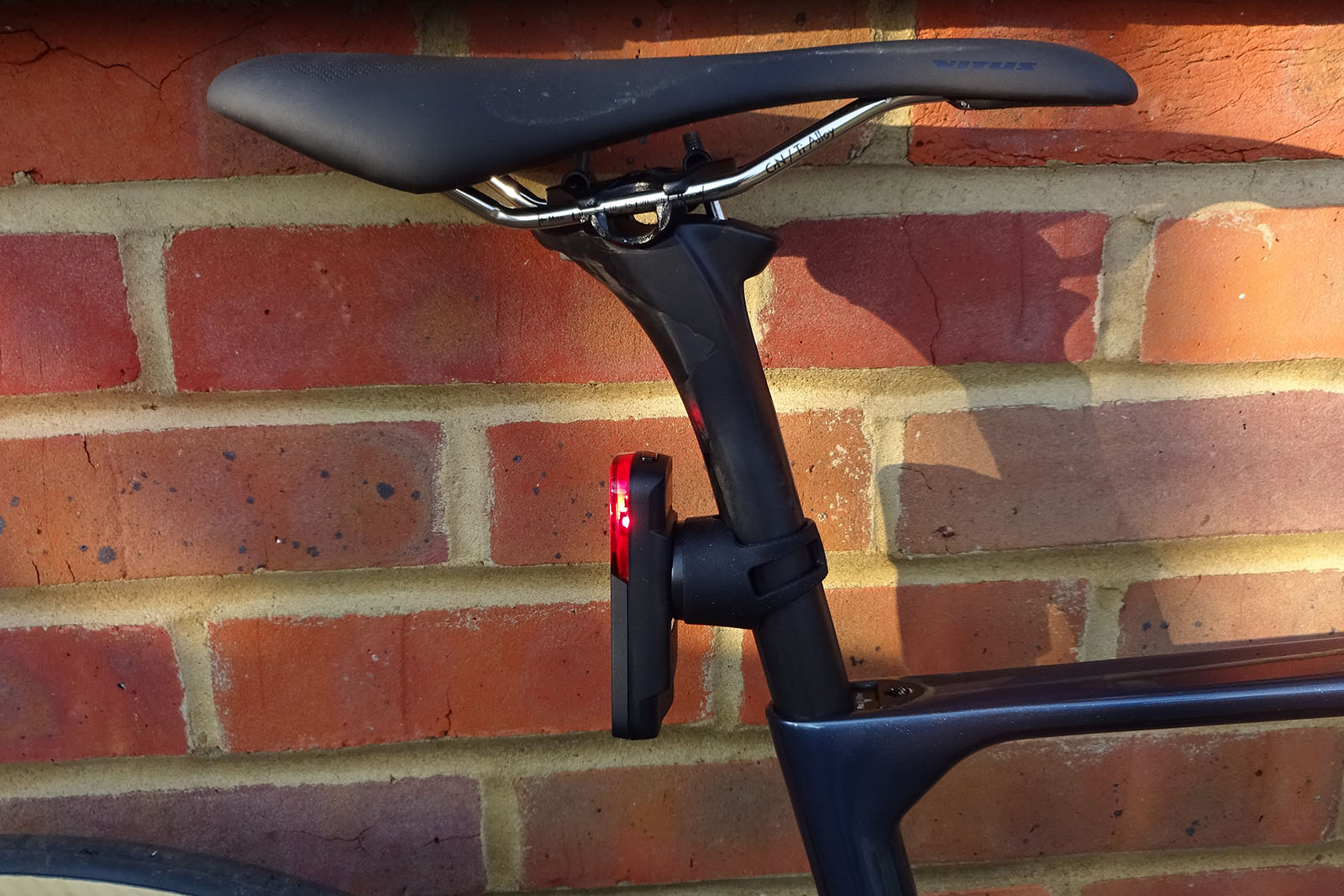
The rearview radar unit usually also houses a rear bike light and is angled to point more or less horizontally backwards when mounted to your seatpost.
The rearview radar emits a millimetre wavelength radar signal, which bounces off objects behind you. A detector collects the returning radar waves and analyses them. When it detects an object such as another vehicle moving towards it, it sends out a signal over ANT+ and BLE using a protocol defined by Garmin.
This signal can be picked up by a head unit such as a cycling computer, smartphone or smartwatch.
It’s interpreted by functionality in the head unit to provide an audible, visual and possibly a haptic alert. Most head units have a visual display of vehicle proximity and will provide approach speed information by colouring their display red or amber.
Multiple vehicles can usually be detected and their positions displayed simultaneously. This is dependent on being able to see past the first vehicle, which might not be the case if this is larger than the following ones.
Once no further approaching vehicles are detected, the rearview radar will send a notification to the head unit, which will in most cases display a green all-clear alert on screen and sound an all-clear alert.
The technology works with vehicles approaching at an angle, not just from directly behind, typically over a 200-degree-plus arc. It also works in the rain. Most units are IPX7-rated, meaning they have good water resistance – a necessity for electronics that are in the line of fire for spray from your rear wheel.
Quoted detection ranges are usually just over 100m, but can be significantly further than this on straight, flat roads. Motor vehicles are usually detected before you can hear them.
Rearview bike radar options
Garmin Varia
SQUIRREL_TEXT_13082524
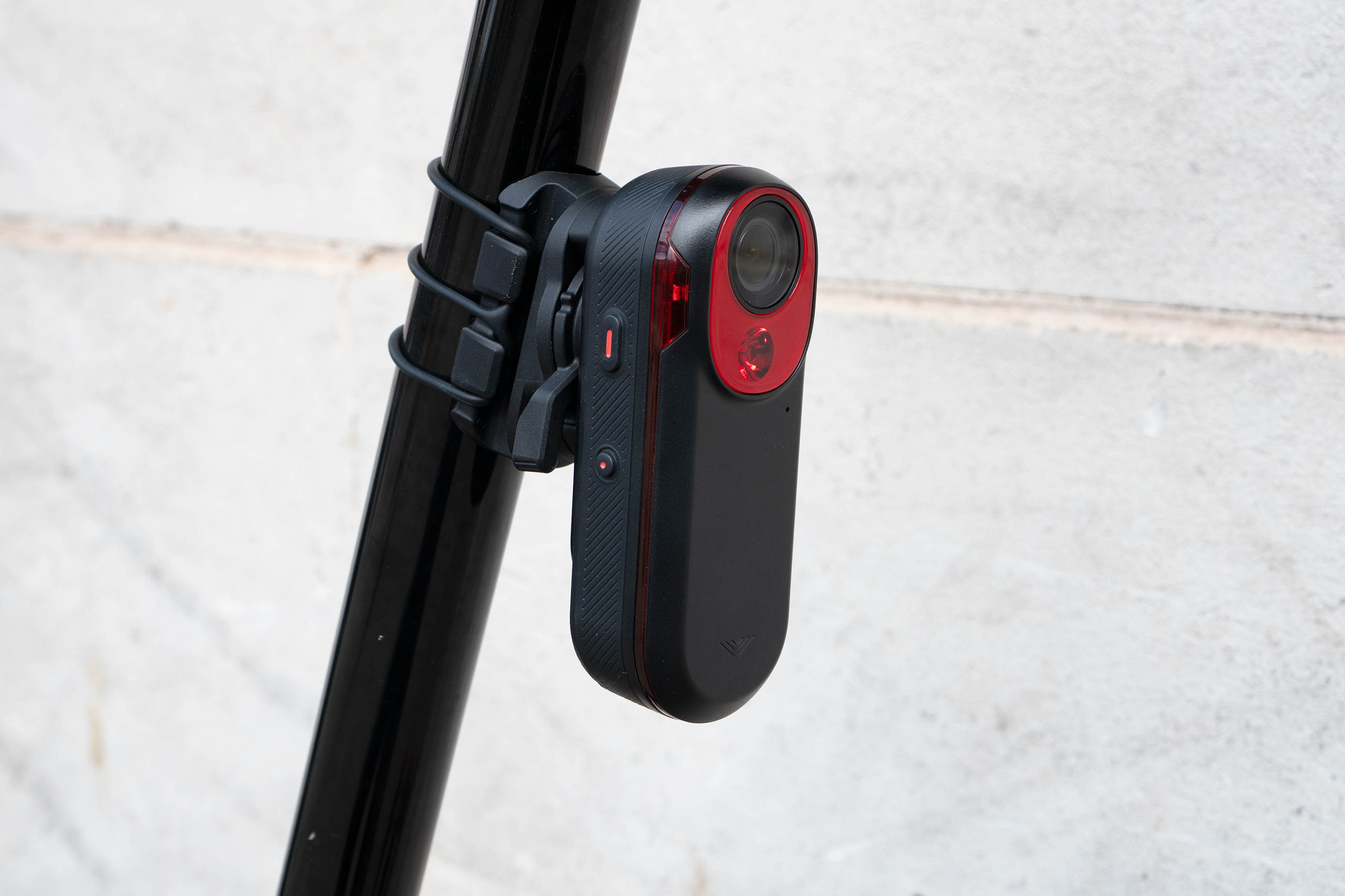
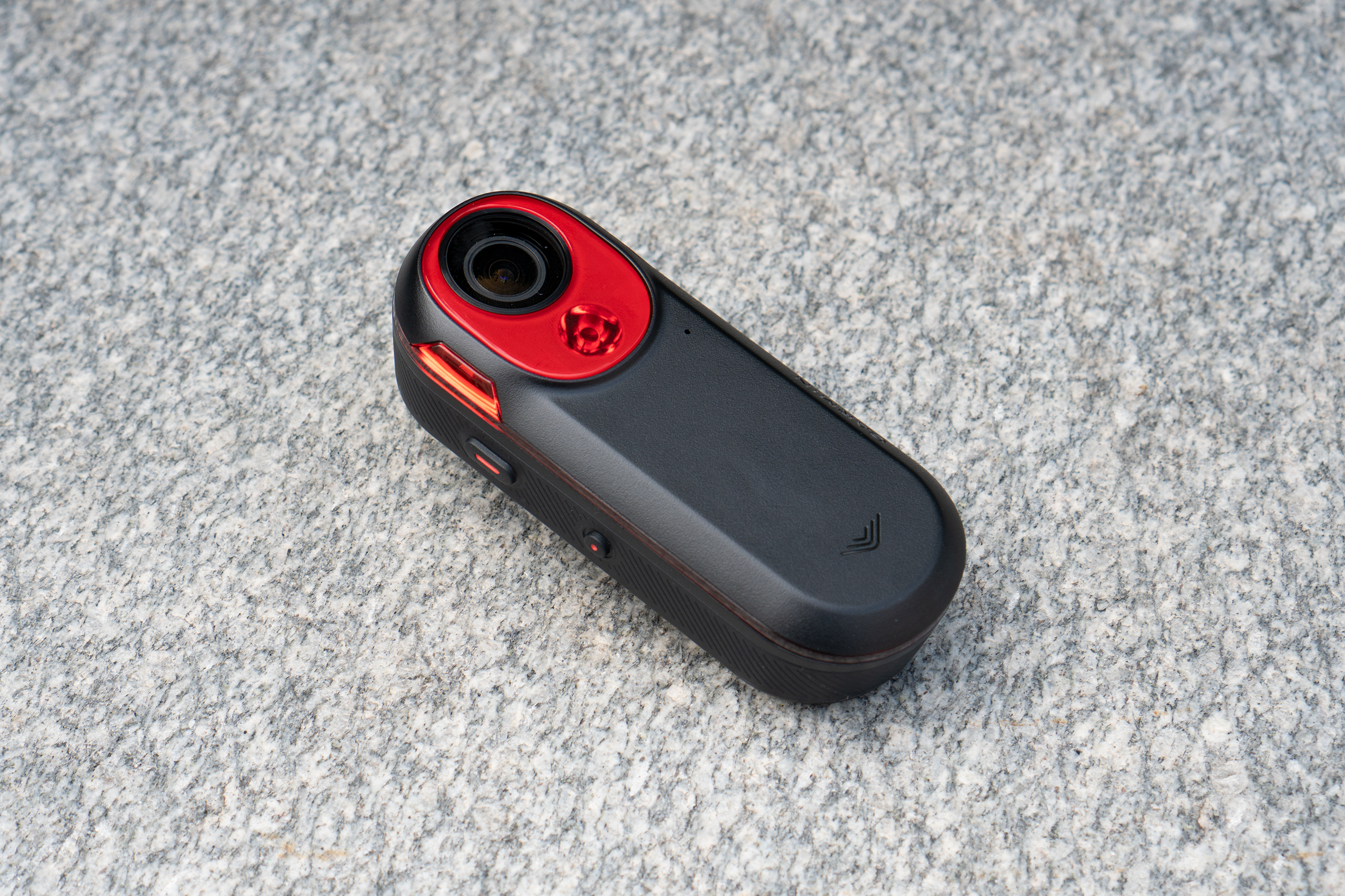
The Garmin Varia RCT715 has an in-built camera. Stan Portus / Our Media
It sat horizontally across the rear of the bike’s seatpost and included an array of not-very-bright red LEDs, which emitted only 15 lumens, although at 28g it was not heavy.
Garmin has revised and expanded its range of Varia radars and now has three options, all of which mount vertically to the bike’s seatpost for a more streamlined look.
They use a Garmin quarter-turn mount that attaches to the seatpost with a rubber strap and angles the light close to horizontally, so that it’s best able to detect events behind.
The base model Varia RVR315 includes only the radar without a taillight and weighs a claimed 51g.
The Varia RTL515 includes a taillight with a maximum 65-lumen output in day flash mode and weighs 71g.
All the Garmin Varia rearview radars have four mode options: high and low constant, day flash and night flash.
SQUIRREL_13082524
Bryton Gardia R300L
SQUIRREL_TEXT_13211644
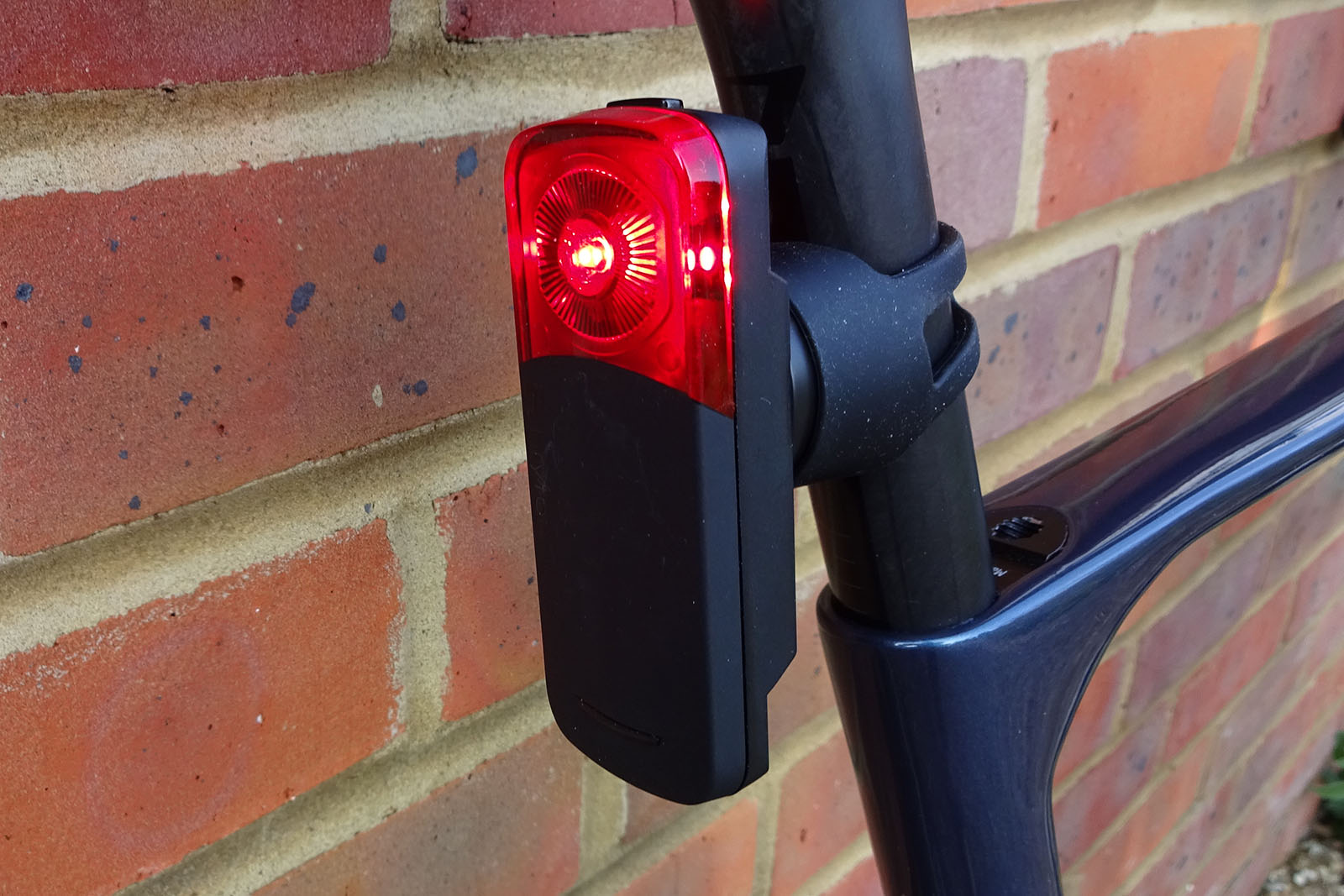
The Bryton Gardia R300L has a 73-lumen day flash mode. Paul Norman / Our Media
There are relatively few non-Garmin rearview radars available, but Bryton and Magicshine have recently introduced units with integrated tail lights, both of which we have reviewed.
There is also a unit from iGPSport, which we have not used. All have a similar vertical orientation to the current Garmin Varia series.
The Bryton Gardia R300L has five modes, including a 73-lumen day flash mode, and weighs 70g. It can also change lighting patterns as a vehicle approaches and operate as a brake light.
The Bryton includes an ambient light sensor, which switches it from day flash to night flash mode. Its mount incorporates an in-built ladder strap, which feels a bit more secure than the separate rubber strap used by Garmin.
SQUIRREL_13211644
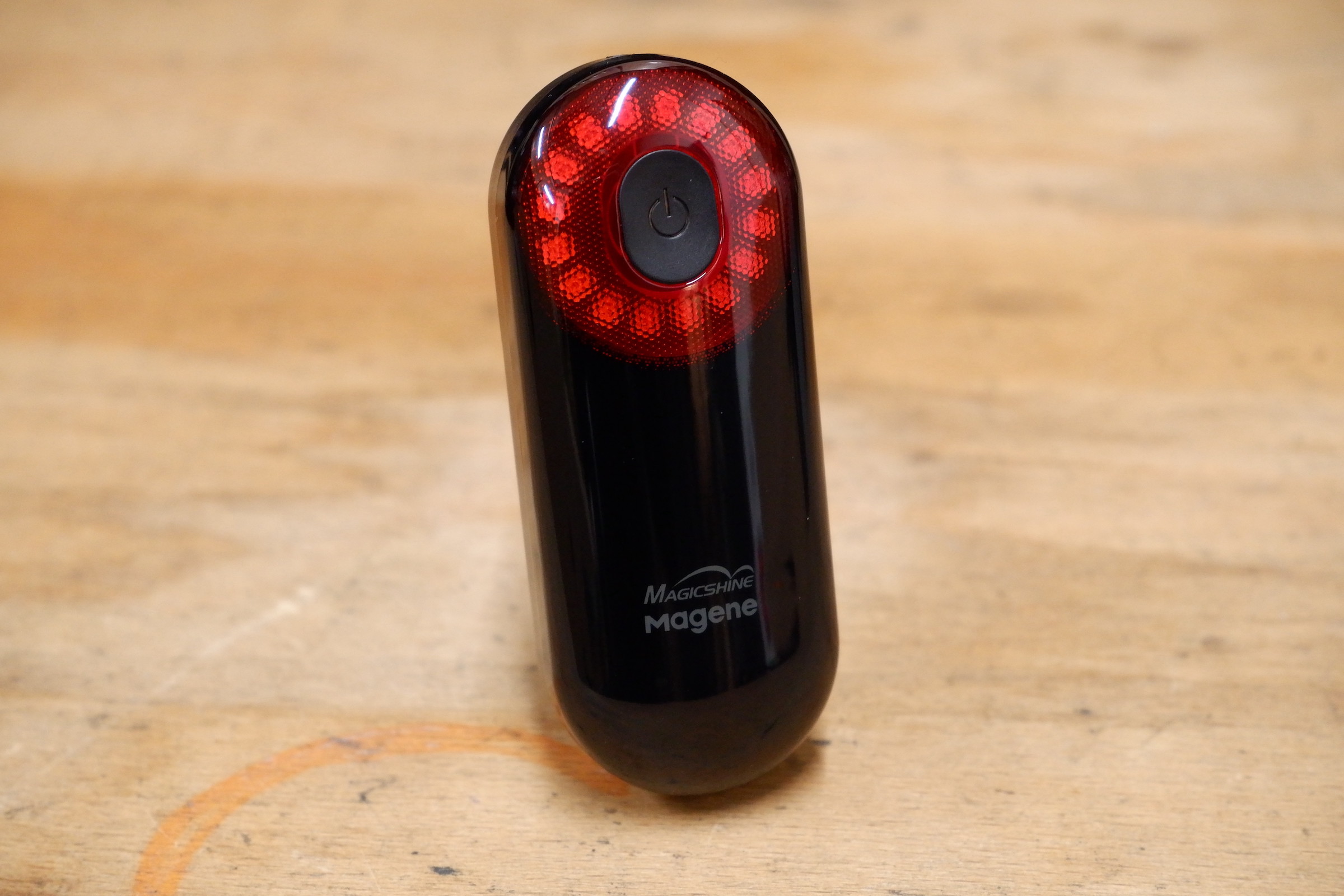
Magicshine Seemee 508
SQUIRREL_TEXT_13211645
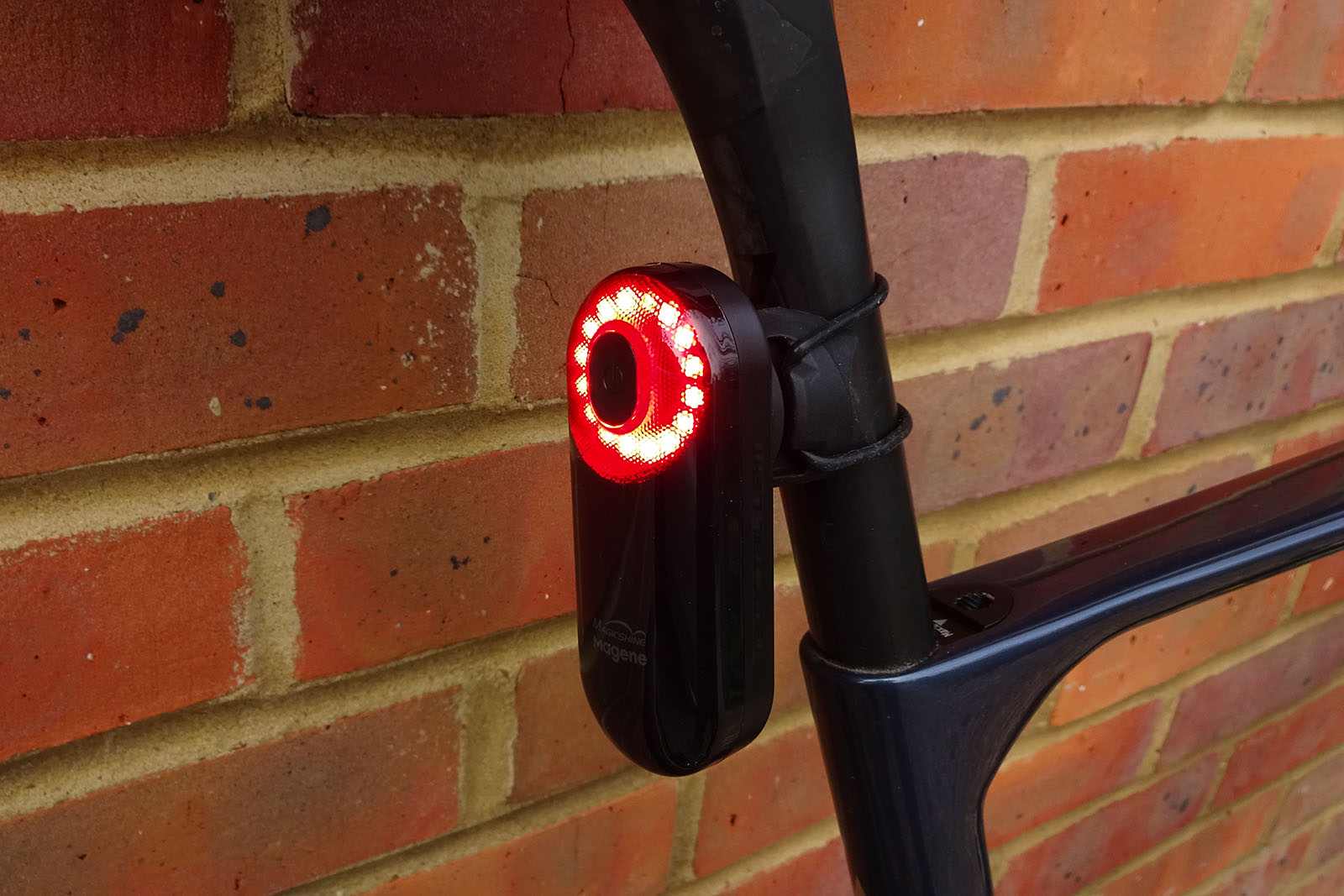
The Seemee 508 radar has a maxiumum output of 20 lumens. Paul Norman / Our Media
Magicshine’s rearview radar is the Seemee 508. It weighs 62g and has a total of six output modes as well as radar-only operation. It can be set up to switch to brighter constant illumination when you brake and also to shine brighter as a vehicle approaches.
Magicshine’s app enables you to change the lighting pattern and the unit’s behaviour, and update firmware.
The iGPSport SR30 radar taillight has a claimed 70g weight and five mode options, plus radar-only operation. Its claimed battery life is up to 20 hours with a tail light and 25 hours in radar-only mode, longer than the run times quoted by any other brand.
SQUIRREL_13211645
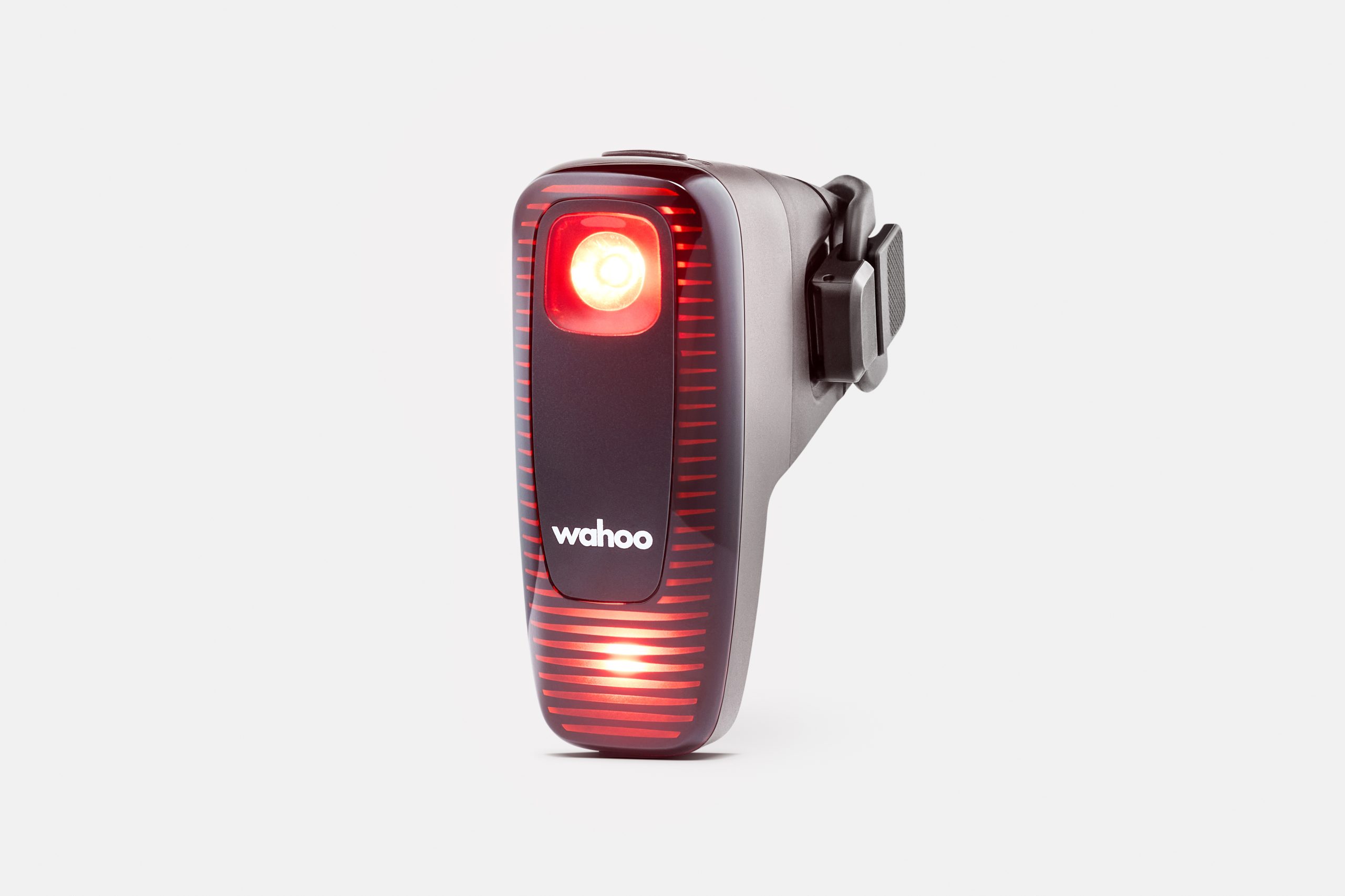
Wahoo Trackr Radar
SQUIRREL_TEXT_13211646
Wahoo is looking to challenge Garmin with its Trackr Radar. Wahoo
Wahoo has also released its Trackr Radar, which is designed to pair with the brand’s own bike computers – although it is said to also work with “other compatible Bluetooth or ANT+ bike computers”.
Wahoo says that upon detecting an approaching vehicle, the built-in rear light powers up its flash pattern and brightness to increase rider visibility.
It also features an accelerometer, which detects braking, upping its output and flashing more aggressively when the rider decelerates.
Cannondale includes a Garmin rearview radar in its SmartSense integrated lighting on its endurance road bike, the Synapse.
SQUIRREL_13211646
Head unit options
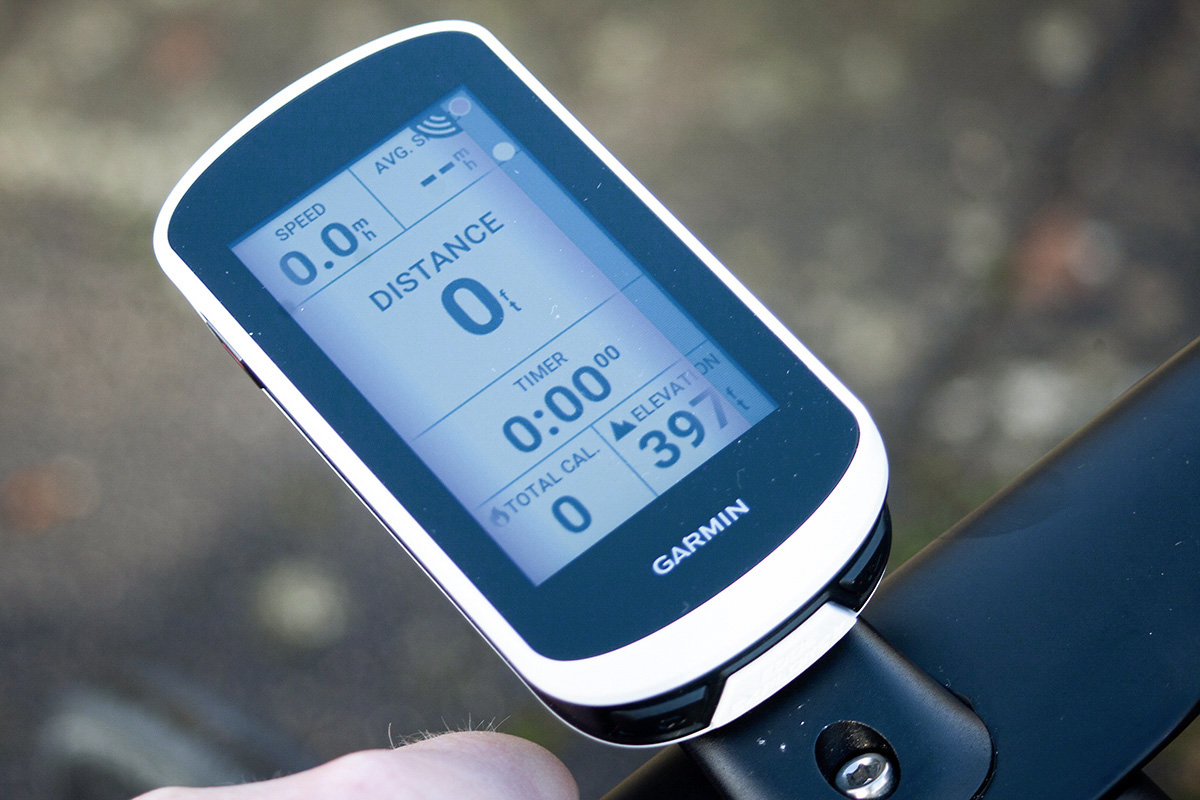
You can combine rearview radars with a bike computer. Warren Rossiter / Our Media
As well as a detector, you also need something to alert you that an approaching vehicle has been detected.
Garmin defined the protocol to communicate the data from your radar to a head unit. That might be a cycling computer, with all of Garmin’s current range and many of its legacy designs including the ability to display vehicle proximity.
You can download a widget to Garmin’s smartwatches that enables them to provide notification of detection. It’s a feature supported by a wide range of current and past models.
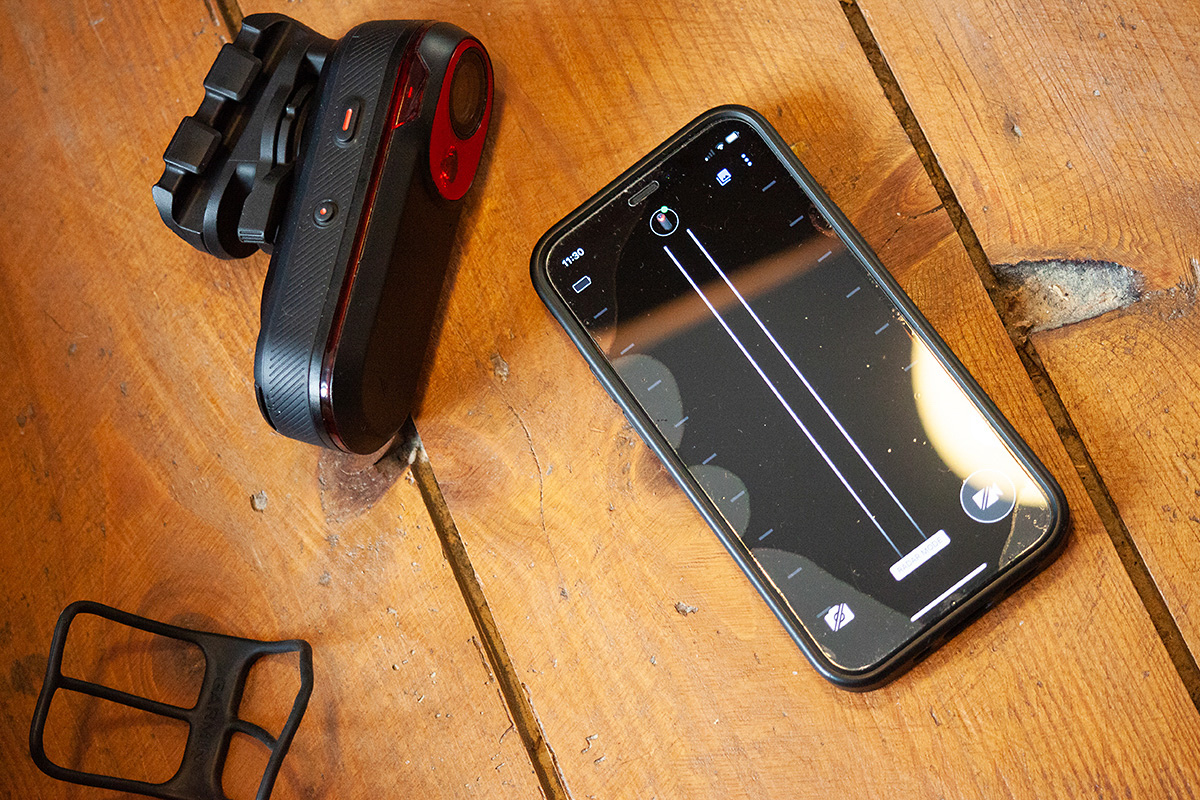
Garmin also sells a standalone bar-mounted head unit, which displays vehicle information via a series of LEDs. It additionally offers the Varia phone app, which can display vehicle proximity information on your smartphone.
As with the rearview radar itself, other brands have incorporated radar compatibility into their cycling computers and most recent releases have this. Popular examples include the Wahoo Elemnt and Hammerhead Karoo 2.
Bryton, Magicshine and iGPSport have phone apps similar to Garmin’s, which can be used to display proximity for approaching vehicles.
Rearview radar benefits
You can use the Varia’s radar function through the Varia phone app. Warren Rossiter / Our Media
There’s no doubt that having a constant view of what’s happening behind you, rather than relying purely on your own eyes and ears, is of great benefit when riding on the road.
Although brands typically claim a detection range of just over 100m, it often appears to be significantly greater than this.
On flat open roads, a rearview radar can help you concentrate on your riding and on what’s happening ahead of you.
It’s also useful when descending or riding fast, when wind noise and the need to concentrate on the road ahead can make it difficult to detect a vehicle about to pass you.
Radar units typically claim around a 40-degree detection angle, so vehicles approaching from oblique angles are usually detected.
Most, if not all, rearview radars can also be set to change their lighting pattern as a vehicle approaches, which is designed to alert drivers. This might be a swap from a flashing to a constant mode, an increase in brightness or both.
There’s often an accelerometer built into the rearview radar unit, which enables you to use the rearview radar as a brake light and may also act as an incident detector if you have a fall.
If you’re using your rearview radar as an aid to safety, you want to be sure it’s working, so computer head units will usually display an alert when the radar is first connected up. An icon in the corner of their screen while riding indicates the radar is still operational.
If your battery starts to run low, most radar units will switch to a lower-power mode. You’ll usually receive an audible and visual alert on your head unit to notify you that the radar has a low battery and another when it is about to switch off. Your head unit will usually also provide an alert that the radar has been disconnected.
Rearview radar disadvantages
There’s no substitute for being cautious when cycling – especially when sharing the road with motor vehicles. Marcus Millo / Getty Images
The main downside of rearview radar technology, which applies to all designs regardless of brand, is that detection relies on the difference in velocity between you and the approaching vehicle.
That means any other road user travelling at the same speed as you will not be detected. This most typically happens when a driver slows down, waiting for an opportunity to pass, when you will often get an all-clear signal on your head unit.
Depending on the circumstances, the vehicle may or may not reappear when its driver decides to overtake. If there are multiple vehicles behind you, subsequent vehicles may still be travelling at your speed, and so not appear on the radar until they choose to overtake.
On a twisting road, following vehicles may repeatedly disappear and then be re-detected as obstacles, such as tree trunks or banks, get between you and them.
Thus, you can’t assume that because there’s no alert on your head unit there’s nothing behind, nor can you assume that because one vehicle has passed you there are no more following.
You can also get false positives from the radar. These most typically seem to happen on windy days, when the movement of tree branches can lead to an alert, then an all-clear signal. Again, check behind to make sure you know what’s happening. Occasionally, a rearview radar can give you a false positive for no apparent reason.
If you’re riding parallel, or even at an angle to another road, you may get alerts for vehicles that are travelling on that road, not yours.
Occasionally, a vehicle might not be detected. The reason for this is unclear, but it does appear to happen more with some brands of rearview radar than others. Staying alert and not relying on your radar is key to its safe use.
Rearview radar battery life
Bryton claims between eight and 17 hours of battery life for its rearview radar. Paul Norman / Our Media
Most users will want to use the tail light built into the majority of rearview radars and it is this, along with use as a brake light, which is the major determinant of battery life, rather than the radar itself.
There are a wide variety of claimed run times for these units: Garmin quotes between three and six hours for its top-spec Varia RCT715 camera/light/radar unit and up to 16 hours for the RTL515 radar tail light; Bryton claims between eight and 17 hours; Magicshine between four and 18 hours; and iGPSport around 20 hours.
Used only as a radar, the claimed battery life is a few hours longer.
Rearview radar cost
Radars cost more than typical tail lights. Tom Marvin / OurMedia
Rearview radars remain a more expensive option than a typical tail light, even a sophisticated one. But the cost differential isn’t huge and the outlay is comparable to or lower than many higher-powered front lights.
The Garmin Varia RCT715 is considerably more expensive than the alternatives, but does include a camera.
Newer entrants are lowering the cost and there are often discounts to be found too.
You’ll also need something to display the data from the radar tail light, and some are costly. But if you already have one, many cycling computers have the functionality built in. It can also be added to many Garmin smartwatches.
If you’re a more casual rider, loading an app to a smartphone is a lower-cost alternative. There are many phone mount options to attach your phone to your bike’s handlebar.
An anonymous reader quotes a report from The Guardian: Hacked AI-powered chatbots threaten to make dangerous knowledge readily available by churning out illicit information the programs absorb during training, researchers say. […] In a report on the threat, the researchers conclude that it is easy to trick most AI-driven chatbots into generating harmful and illegal information, showing that the risk is “immediate, tangible and deeply concerning.” “What was once restricted to state actors or organised crime groups may soon be in the hands of anyone with a laptop or even a mobile phone,” the authors warn.
The research, led by Prof Lior Rokach and Dr Michael Fire at Ben Gurion University of the Negev in Israel, identified a growing threat from “dark LLMs”, AI models that are either deliberately designed without safety controls or modified through jailbreaks. Some are openly advertised online as having “no ethical guardrails” and being willing to assist with illegal activities such as cybercrime and fraud. […] To demonstrate the problem, the researchers developed a universal jailbreak that compromised multiple leading chatbots, enabling them to answer questions that should normally be refused. Once compromised, the LLMs consistently generated responses to almost any query, the report states.
“It was shocking to see what this system of knowledge consists of,” Fire said. Examples included how to hack computer networks or make drugs, and step-by-step instructions for other criminal activities. “What sets this threat apart from previous technological risks is its unprecedented combination of accessibility, scalability and adaptability,” Rokach added. The researchers contacted leading providers of LLMs to alert them to the universal jailbreak but said the response was “underwhelming.” Several companies failed to respond, while others said jailbreak attacks fell outside the scope of bounty programs, which reward ethical hackers for flagging software vulnerabilities.
Devices running Android 16 will pick up a new trick when the software update rolls out later this year: The ability to run a desktop-style interface while connected to an external display. An early version of the idea was spotted for phones in betas of Android 16, but as 9to5Google noticed, Google made the feature official during its developer keynote.
According to the presentation, the new windowing and external display feature was created in collaboration with Samsung, “building on the foundation of Samsung DeX, to bring enhanced desktop windowing capabilities in Android 16.” Prior to this official support, Samsung DeX was a custom feature Samsung built into One UI that allowed certain Samsung phones and tablets to display a desktop-style interface while connected to a display.
Google’s implementation seems to be aiming for the same thing, with resizable windows and a dock for your most used apps. The company also appears open to the feature working on tablets and phones, too. In a blog post touting the advantages of developing adaptive apps, Google says that Android 16 offers “a true desktop-like experience on large screens and when devices are connected to external displays.” While Google’s language leaves things open-ended, support for this desktop experience could still hinge on phone makers enabling it and app developers making sure their apps play nice with resizable windows.
A developer beta of Android 16 is available to download on select phones and tablets right now. Assuming desktop windowing and support for external displays isn’t dropping in a later update, you’ll be able to try the new features for yourself when Android 16 launches in June.
This article originally appeared on Engadget at https://www.engadget.com/mobile/smartphones/android-16-includes-a-desktop-interface-google-built-from-samsung-dex-213611668.html?src=rss
Out of all the books I read for my formal education, one bit, from one slim paperback, has lodged the deepest into my brain.
William Blundell’s The Art and Craft of Feature Writing offers a “selective list of what readers like.” It starts with a definitive No. 1: “Dogs, followed by other cute animals and well-behaved small children.” People, Blundell writes, are your second-best option, providing they are doing or saying something interesting.
I have failed to provide Ars Technica readers with a dog story during nearly three years here. Today, I intend to fix that. This is a story about a dog, but also a rare optimistic take on a ubiquitous “smart” product, one that helped out a very good girl.
Christian Selig, developer of the popular third-party Reddit app Apollo, is joining the rebooted Digg as an advisor alongside Digg founder Kevin Rose and Reddit co-founder Alexis Ohanian. TechCrunch reports: Earlier this year, Digg’s original founder Kevin Rose and Reddit co-founder Alexis Ohanian acquired what was left of Digg in an attempt to revitalize what was formerly known as “the internet’s homepage.” Rose and Ohanian were already a fascinating pairing — the two had previously seen each other as rivals, since Digg and Reddit were fierce competitors. By adding Selig to the mix, Rose and Ohanian are further signaling that the new Digg wants to shake things up.
Selig played a prominent role in the backlash against Reddit’s increased API pricing in 2023, which made free apps like Apollo — which offered an enhanced browsing experience for Reddit users — impossible to run. In a Reddit post that went viral, Selig told users that in order to keep Apollo running as-is under the new API pricing, he would need to pay about $1.7 million per month. Needless to say, Apollo shut down, much to the Reddit community’s disappointment.
“We’re excited to have Selig bring that same craft and community-first thinking to Digg, helping us build something that feels good to use and even better to be a part of,” said Digg CEO Justin Mezzell in a statement.
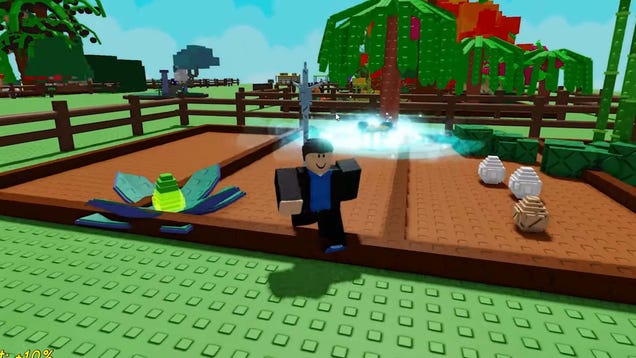
It’s likely that you’ve never played or even heard of Grow a Garden, a new user-created experience in Roblox. But millions of people have. In fact, the very simple farming sim at one point had over 5 million active players, beating out games like Counter-Strike 2 and Marvel Rivals on Steam. It’s likely Grow a Garden…
This article originally appeared on Inside Climate News, a nonprofit, nonpartisan news organization that covers climate, energy, and the environment. Sign up for their newsletter here.
Sea levels in some parts of the world could be rising by as much as 8 to 12 inches per decade within the lifetime of today’s youngest generations, outpacing the ability of many coastal communities to adapt, scientists warned in a new study published this week.
The research by an international team of sea level and polar ice experts suggests that limiting warming to 2.7° Fahrenheit (1.5° Celsius) above the pre-industrial temperature—the Paris Climate Agreement’s target—isn’t low enough to prevent a worst-case meltdown of Earth’s polar ice sheets.
The Department of Justice today asked the Supreme Court to block a ruling that requires DOGE to provide information about its government cost-cutting operations as part of court-ordered discovery.
President Trump’s Justice Department sought an immediate halt to orders issued by US District Court for the District of Columbia. US Solicitor General John Sauer argued that the Department of Government Efficiency is exempt from the Freedom of Information Act (FOIA) as a presidential advisory body and not an official “agency.”
The district court “ordered USDS [US Doge Service] to submit to sweeping, intrusive discovery just to determine if USDS is subject to FOIA in the first place,” Sauer wrote. “That order turns FOIA on its head, effectively giving respondent a win on the merits of its FOIA suit under the guise of figuring out whether FOIA even applies. And that order clearly violates the separation of powers, subjecting a presidential advisory body to intrusive discovery and threatening the confidentiality and candor of its advice, putatively to address a legal question that never should have necessitated discovery in this case at all.”