Doctor Who ‘Lucky Day’ review: Pete, I owe you an apology

Spoilers for “Lucky Day.”

When the writers for this season of Doctor Who were announced, one name in the roster put me instantly on edge. Pete McTighe may have a distinguished filmography but, in this house, he’s known as the person who wrote “Kerblam.” That’s the Chibnall-era episode summed up as “Space Amazon is great and the people protesting poor working conditions and mass-layoffs are the real villains.” Imagine then, my delighted surprise when “Lucky Day” doesn’t just get its politics right, but it does so with molotov cocktails in hand.

Image from Doctor Who
James Pardon/BBC Studios/Disney/Bad Wolf

It’s 2007 and the Doctor and Belinda land in London as the clock strikes midnight on New Year’s Day. The Doctor, Vindicator in hand, gets another set of coordinates before realizing a small boy, Conrad Clack, saw the TARDIS land. He hands Conrad a 50 pence piece and tells him it’s his “lucky day,” before the boy sprints back to his mother. But she’s not interested in his story about a magical blue box, striking the boy and saying she’s had enough of his lies.

Conrad next encounters the TARDIS 17 years later when he spots it parked down a dark alley. There’s a nearby door with a broken lock and he ventures inside to a closed down department store, where he’s stalked by an unseen monster. After a few seconds, the monster brushes past Conrad, leaving green slime on his neck — which is how it marks its prey. When the creature, the Shreek, emerges into the open ready to strike, it’s zapped away by the Doctor and Ruby.

From the shadows, Conrad watches the Doctor hand Ruby a vial of antidote as she, too, was marked as prey. He stalks them back to the TARDIS and overhears their conversation — half an hour prior, she was hanging out with the Beatles, putting this just after “The Devil’s Chord.” He snaps a picture of Ruby and puts it online, asking the internet if anyone has seen this woman.

He tracks down Ruby at some point after she stops traveling in the TARDIS, and invites her onto his podcast. Conrad tries to flirt with his guest, and a quick montage shows them date and start to get serious about each other. He even confesses he was present during that first encounter with the Shreek, and Ruby hands him a vial of antidote. She says the Shreek, which had tagged him with green slime, was preparing to return to this dimension to hunt him again. But UNIT — the Doctor’s military allies here on Earth — captured it (off-screen).

The pair go to a countryside village where Conrad introduces her to his friends in a quiet pub. But, as night draws in, the lights begin to flicker, and the blink-and-you-miss-it blurs of scary monsters appear outside. One of Conrad’s friends, Sparky, goes missing, and Ruby calls UNIT who leap into action despite no signs of a Shreek incursion. Conrad confesses to Ruby he didn’t take the antidote, wanting to prove to her he was as brave as the Doctor to win her heart.

When UNIT arrives, soldiers face off with a pair of Shreek monsters until they reveal they’re just Conrad’s stooges in rubber suits. Conrad isn’t an innocent caught up in a crisis he can’t comprehend, he’s a conspiracy theorist streamer claiming UNIT is a sham organization. He’s the type to engineer stunts and deceptively edit the resulting footage to smear his targets. I won’t name the real world figures Conrad is inspired by as we’d get angry emails from their lawyers, but I’m sure you can work out who they are.

Conrad’s encounter with UNIT was livestreamed, and there’s another montage of people talking to their generic social media followers decrying the organization. He’s arrested, but quickly released, and given a welcome press tour by the British media, including a favorable BBC News report and a joke on the UK version of The Masked Singer. Conrad even gets consoled during an interview on The One Show — a prime time talk / magazine show — by its real presenter Alex Jones (not that one).

UNIT’s overseers in the UK government and Geneva buckle to public pressure to put UNIT under close scrutiny. As its head, Kate Lethbridge-Stewart says, imagine the fate of the world if any dictator got their hands on UNIT’s arsenal of captured alien technology. Someone senior at UNIT demands the caged (and real) Shreek captured off-screen be removed from London and brought up to the helipad ready for transit. Meanwhile, Conrad has a man on the inside, who has been radicalized into believing his own employers are a sham, who helps him break into UNIT HQ.

Kate refuses to lock the building down, insisting that it’s time the issue was solved once and for all. Conrad, with a stolen UNIT rifle in hand, tries to bait Kate into attacking her on camera with some vicious slander about her father, the legendary Brigadier. Kate is happy the Doctor isn’t here, since he won’t stop her from doing what the audience has been demanding she do for the last few minutes. She opens the cage holding the Shreek and lets it go for Conrad.

Like all two-bit bullies, Conrad crumbles in the face of real danger and starts begging for mercy but Kate refuses. Sadly, Shirley hands Ruby a taser, which she uses to knock out the Shreek before it can bite Conrad’s head off. Now that his life has been saved, Conrad goes back to playing up for the livestream, boasting that UNIT’s “special effects” have gotten better. At which point the Shreek wakes up and bites his arm off.

There’s a sharp cut, and next we see Conrad waking up in a prison cell with a contraption around his arm, presumably keeping it joined to his elbow. Suddenly, he hears the TARDIS noise and is brought aboard for the Doctor to tell him that he’s a bitter, sad person who will die in prison. But Conrad is unrepentant and says he “rejects” the Doctor’s “reality.” After he’s returned to the cell, he’s visited by Mrs. Flood, who confirms what he saw was real, and that she’s letting him free as it’s his “lucky day.”

Still from
Lara Cornell/BBC Studios/Disney/Bad Wolf

It does appear as if I owe Pete McTighe a fulsome apology and must assume he isn’t at fault for all of the reactionary politics of “Kerblam.” “Lucky Day” is both a worthy sequel to “73 Yards” and a sign that, if Doctor Who is just weeks from an enforced hiatus, then it’s going out swinging. It’s got a lot of targets, including the BBC’s habitual reputation-laundering of unsavory characters. The notion of who is in “the wrong” is made explicitly clear here, too, and Conrad occupies the same political (and narrative) circles as Roger ap Gwillam (Albion TV gets a reference).

Like a lot of this year’s run, the episode feels like an overstuffed script which was then cut down to fit a specific runtime. But the structural work underpinning things feel more solid here, so while a lot of the connective tissue is absent, it’s not to the detriment of the story. Kate’s decision to unleash the Shreek may have been well-telegraphed but it’s better than the solution appearing out of nowhere because there’s five minutes left to run.

There’s an element of the show playing to its strengths, and the genre savviness of its audience here as well. If you know the beats of a girl-meets-boy romance movie, then you’ll spot this is a cracked-ish mirror version of that. And we don’t need much evidence of Conrad’s villainy — calling the Doctor, UNIT and Kate a bunch of frauds to make money from his online audience — since we know they are our heroes. Plus, anyone who slanders Brigadier Lethbridge-Stewart, after all, deserves to get what’s coming to them.

“Lucky Day” is smart about how it introduces us to Conrad, too, giving us obvious red flags from the get-go. Adult Conrad has no reservations about taking a picture of a stranger and sharing it online for the internet to identify on his behalf. There’s a hint of judgment in how he asks about her relationship to and with the Doctor, mirroring the way Alan Budd flirted with Belinda in “The Robot Revolution.” In fact, it’s an interesting counterpoint to that episode, since we get enough time with Conrad early on to learn to at least be wary of him, rather than it being a fairly unsupported third-act twist.

If there’s one downside, it’s that the episode leans on the trope that survivors of abuse perpetuate that cycle of abuse. Conrad gets hit in the head by his mother and while it’s hard to assume a pattern of behavior from one scene, it didn’t seem like it was the first time. Much as we saw in “Lux,” there are limits to the storytelling possibilities inherent in a series about an immortal science clown traveling anywhere in time and space in a blue box.

This episode is also focused on Ruby’s post-TARDIS life, which has left her in a vulnerable position. As she admits at the end of the episode, her time with the Doctor was spent in a constant state of panic and peril. She’s tired, she’s alone and the first man she tried to form a relationship with turned out to be using her. That’s bound to leave a scar, but the after effects of a trip in the TARDIS is rarely discussed in the context of the series itself. The majority of the classic series’ companions lacked detailed interior lives, while modern day ones often move on to other “exciting” things rather than back to a normal life.

Mrs. Flood Corner 

Image from
BBC Studios/Disney/Bad Wolf

It does appear as if the structure of the series isn’t just Russell T. Davies relying on a familiar rhythm but something more deliberate. “Lucky Day” is the fourth in a row that shares themes and elements with the same numbered episode in last year’s lineup. It’ll be interesting to see how much of next week’s “The Story and the Engine,” and the following week’s “The Interstellar Song Contest” shares with their counterparts from the first series.

It’s plausible that the time fracture that was featured in “The Robot Revolution” has, somehow, knocked the series off its previously-planned course. That either within the show’s fiction or in its metafiction, we’re explicitly seeing parallel versions of those previous episodes. If you recall from that episode, too, the Doctor says he was told to meet Belinda by an unknown person. What if he was chasing down Conrad’s lead, and if so, would that be enough to create a paradox (even if the TARDIS can avoid such obstacles)?

Then there’s the fact Conrad says he explicitly rejects the Doctor’s “reality,” which feels like a telling way of wording things. Especially as this season’s two-part finale is titled “Wish World” and “The Reality War,” although that title is hardly a massive clue. After all, last season’s finale was “Empire of Death,” as opposed to “The one in which it turns out Stuekh has been clinging to the TARDIS roof for God knows however long.”

I’m not sure I want to read too much into Mrs. Flood releasing Conrad since that, like last week, could simply be a topper to the story. It may be that she’s simply letting him out to wreak more havoc and undermine UNIT and the Doctor’s goals rather than anything specific. Not to mention that if Mrs. Flood is a dimension-surfing entity hell-bent on destroying the Doctor, she’s hardly going to have much use for a schmucky YouTuber.

This week, the BBC announced that “The Reality War” would not be getting its customary early in the day stream online. Instead, it’ll hit the iPlayer and Disney+ at the same time as the UK broadcast, and both episodes are being lined up for a small cinema release. That’s reserved for big event episodes, and it adds more weight to the rumor Gatwa has already left the show. Not to mention he’s starring in the play Born With Teeth from August 13 through November 11 — which would prevent him from shooting a season for 2026.

Outside the mystery box elements of the show, this season feels as if it’s having a meta conversation with itself. “Lucky Day,” for instance, takes a similar premise as “Love and Monsters,” a Doctor-lite episode focusing on one of the so-called ordinary people who are peripherally involved in the Doctor’s adventures. Conrad is initially presented as one of the lost souls who are drawn to the Doctor — you could almost describe them as fans — but who don’t shine brightly enough to get the Time Lord’s special attention.

Oh, and I can’t think of any reason beyond silly fan service that Conrad’s streaming outfit is called “Think Tank” beyond a deep cut nod to 1974’s “Robot.” After all, there’s almost nothing in common between the two entities and their goals are ostensibly in conflict.

This article originally appeared on Engadget at https://www.engadget.com/entertainment/tv-movies/doctor-who-lucky-day-review-pete-i-owe-you-an-apology-190037017.html?src=rss


A Canyon X DT Swiss collab fork, pro bodges and Paw Patrol – Traka 2025 tech gallery

The Traka is fast becoming one of the most important gravel races of the season with the 200, 360 and 560km races being hotly contested.

Forming part of the Gravel Earth Series, the Traka attracts a host of pro riders, but like so many gravel events, it’s open to all. The result is a melting pot of hacks, bodges and some of the latest gravel tech available.

Last year, the race was heavily disrupted by stormy conditions, largely clement weather greeted 2025’s participants. 

This year’s event gave us our first proper look at Canyon’s new gravel race bike, showed the divide in tyre choice and served up some questionable last minute mods.

It looks like DT Swiss has been called upon for a gravel collab – Canyon now seems to have a specific suspension fork for the Grail. Liam Cahill / Our Media
Canyon, despite being asked very nicely, was tight lipped when queried on it, but the travel looks to be in the region of 40mm. Liam Cahill / Our Media
There are other interesting design features, such as a rebound adjustment knob at the bottom of the non drive-side fork leg. Liam Cahill / Our Media
DT Swiss has also paid close attention to the aesthetics with this sleek fork crown area – could this new fork be trying to bridge the aesthetic gap between gnarlier off-road forks and road-going designs? Liam Cahill / Our Media
Danni Shrosbree was also aboard a new bike, though this Argon18 Dark Matter was launched on Monday. Liam Cahill / Our Media
The bike features some very cool tech with space for 57mm tyres front and back. There’s also a hidden mount for a front derailleur. Liam Cahill / Our Media
The key tech trend continues to be the adoption of MTB tyres and Continental’s Race King was a common sight on the start line. Liam Cahill / Our Media
Second in the women’s 200km race, Rosa Klöser, pushed her Canyon Grizl frame clearance to the limit. Liam Cahill / Our Media
Winner of the women’s 200km race, Sofia Gomez Villafane, opted for a Specialized S-Works Crux with curiously unmarked S-Works Tracer gravel tyres. Liam Cahill / Our Media
But look closely and a small ‘50mm’ marking is visible. Liam Cahill / Our Media
The Argentine’s setup was very simple – the only addition to the SRAM Red / Eagle AXS mullet drivetrain was this small chain guide. Liam Cahill / Our Media
Elsewhere, I was delighted to see riders getting inventive with some aero mods (that’s right, aerodynamics is truly a thing in gravel). This rubberised material stuck onto Klöser’s handlebar gives her a little extra grip, but also some forearm comfort when riding in an aero position. Liam Cahill / Our Media
There were plenty of road groupsets on display – Mattia Di Marchi’s Campagnolo Super Record WRL was the most beautiful (and the least likely). Liam Cahill / Our Media
His Basso Palta was resplendent under the Spanish sun, but it was these small sections of sandpaper which caught my eye, there to hold tightly onto bottles. Straight out of the Paris-Roubaix playbook. Liam Cahill / Our Media
But Harry Tanfield took things to another level, by pinching packing materials from his bike box. The idea? Exceptional. The execution? Questionable. Liam Cahill / Our Media
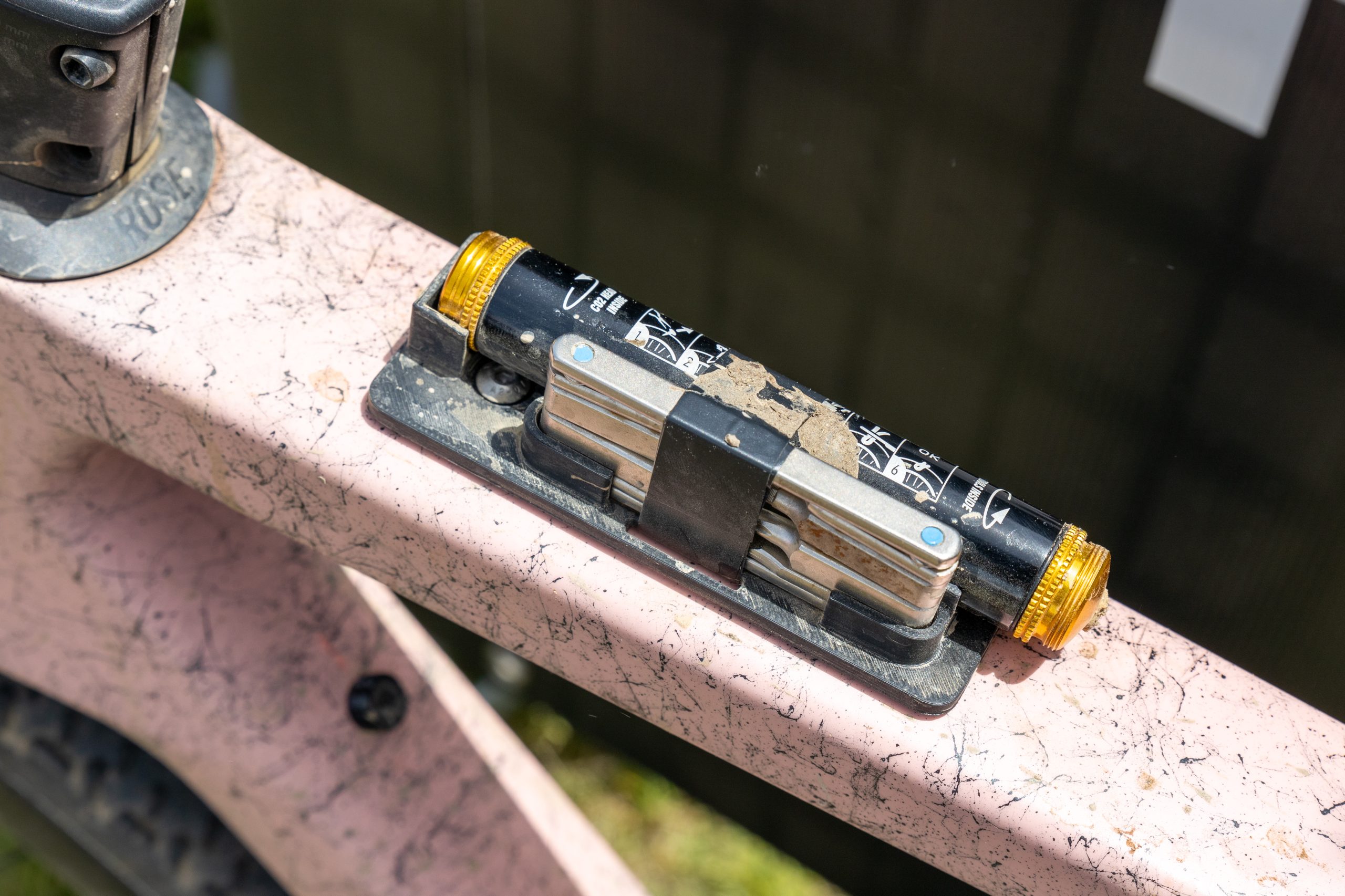
This über-neat storage of a tubeless tool and multitool was the antidote to Tanfield’s bodge. Liam Cahill / Our Media
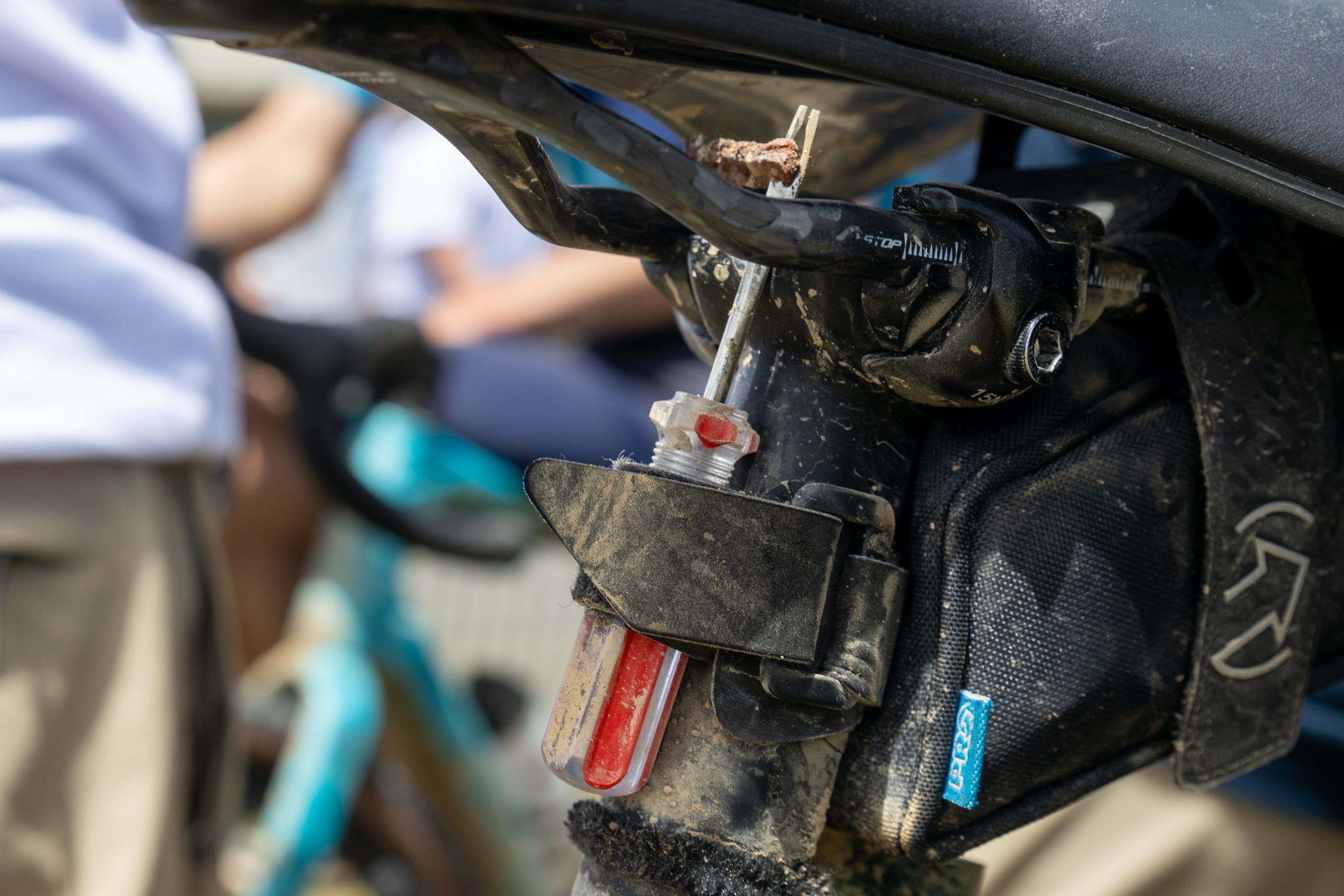
Speaking of puncture repair, riders continued to squirrel away pre-loaded tubeless plug tools in random locations. This one looks slightly… risky. Liam Cahill / Our Media
When the award for ‘most left-field bike’ is handed out, there can be only one winner. SJ and Andre will tackle the 100km route aboard this tandem. Andre took me for a quick spin and I am only slightly worried for them! Liam Cahill / Our Media
At least they’ll be fuelled well. They told me they were aiming for al dente. Liam Cahill / Our Media
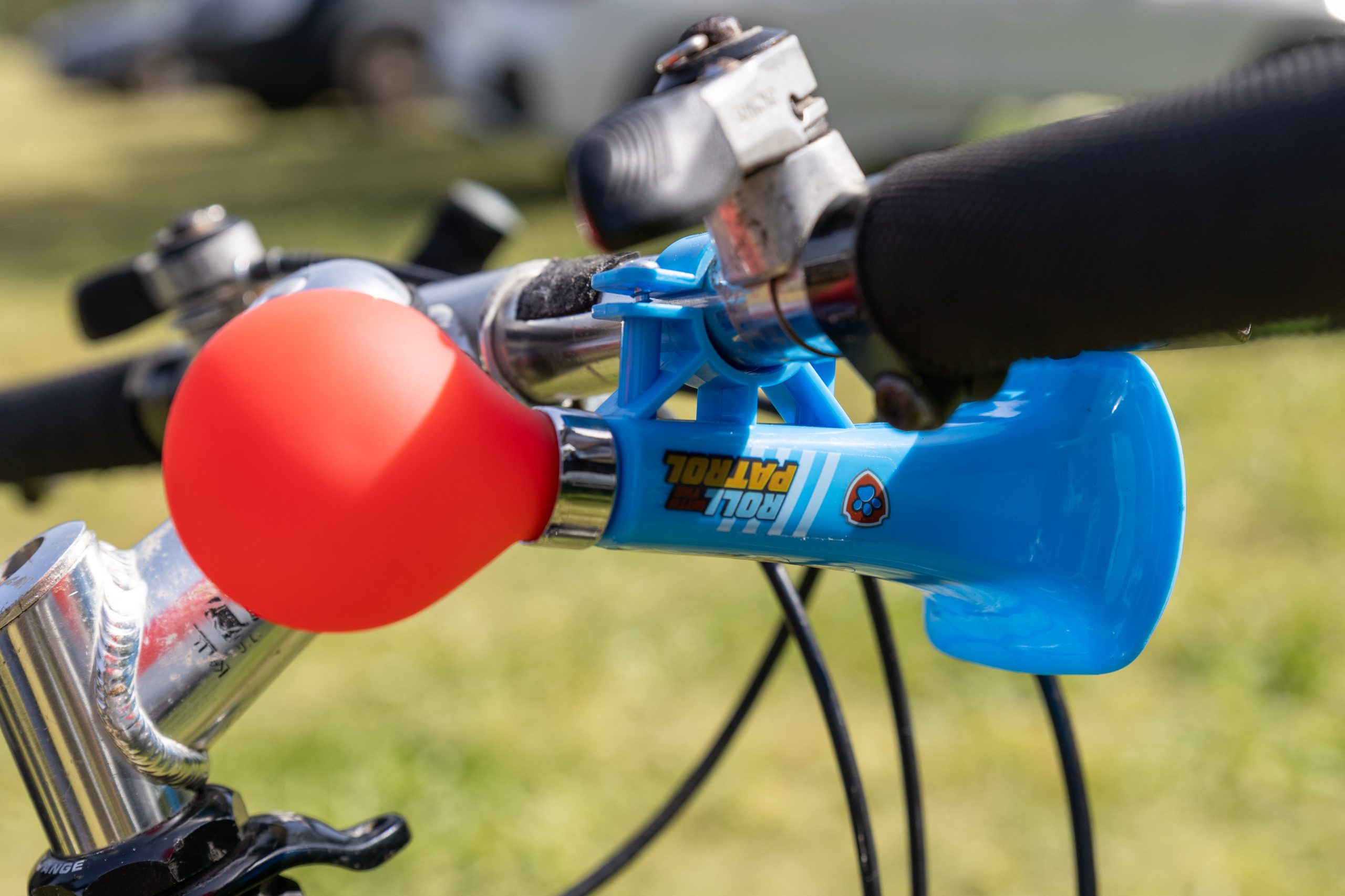
And their Paw Patrol-branded horn can sound the finish klaxon on this tech gallery. Toot! Liam Cahill / Our Media

Threads Jumps to 350 Million, Adding 30 Million Users in Three Months

Threads has now grown to over 350 million monthly active users, reports TechCrunch, citing Mark Zuckerberg’s comments on a company earnings call. That means Threads grew by 9.4% in roughly 90 days:

That’s an increase of 30 million users since the prior quarter, where Meta reported that Threads had 320 million users. The new figure represents increased growth, as Threads added 30 million in the first quarter of this year, compared with 20 million in Q4 2024.

It’s also worth noting that in a single quarter, Threads added nearly the same number of users to its network as one of its newer competitors, Bluesky. The latter, a decentralized social app, today has roughly 35 million users.

Zuckerberg also said there’s been a 35% increase in time spent on Threads, according to the article, as a result of improvements to its recommendations systems.


Read more of this story at Slashdot.

Half-Life 3 is reportedly playable in its entirety and could be announced this year

Cue a new batch of “Half-Life 3 confirmed” memes. The latest rumor surrounding Valve’s long-awaited next installment in the Half-Life series claims that the game is currently “playable, end-to-end” and could even be announced in the summer, followed by a release in winter of this year. The speculation comes from Tyler McVicker, who’s known for reporting on Valve rumors, during his latest Q&A livestream. According to McVicker, the game is currently playable from beginning to end, which he guesses could put it on track for an announcement and release this year.

Besides McVicker’s hours-long livestream, there have been other recent hints about Valve’s progress on its highly anticipated title. In March, Valve concept artist Evgeniy Evstratiy claimed that he was in the room where Valve made Half-Life 3 on CG Voices Podcast. In the same month, another Valve leaker, Gabe Follower, claimed that Half-Life 3 would be the “end of Gordon’s adventure,” potentially signaling a non-cliffhanger ending to one of gaming’s best franchises. Outside of these rumors, internet sleuths discovered code referencing HLX, which is widely thought to be the codename for Half-Life 3, in major updates to Deadlock and Dota 2.

While these rumors are unconfirmed, they are promising signs of life for Half-Life 3. McVicker said during his livestream that the HLX project won’t be another virtual reality game like Half-Life: Alyx and that there are procedural generation features that aren’t for terrain generation or roguelike mechanics. Before you get your hopes up, remember that Half-Life 2 recently celebrated its 20-year anniversary, and we still don’t have any official confirmation from Valve about a follow-up game.

This article originally appeared on Engadget at https://www.engadget.com/gaming/half-life-3-is-reportedly-playable-in-its-entirety-and-could-be-announced-this-year-183030499.html?src=rss

May is ‘Maintainer Month’. Open Source Initiative Joins GitHub to Celebrate Open Source Security

May is Maintainer Month: Celebrating those who secure Open Source

@@@@@@@@@@@@@@@@@@@@@@@@@@@@
The Open Source Initiative is joining “a global community of contributors” for GitHub’s annual event “honoring the individuals who steward and sustain Open Source projects.”
And the theme of the 4th Annual “Maintainer Month” will be: securing Open Source:

Throughout the month, OSI and our affiliates will be highlighting maintainers who prioritize security in their projects, sharing their stories, and providing a platform for collaboration and learning… Maintainer Month is a time to gather, share knowledge, and express appreciation for the people who keep Open Source projects running. These maintainers not only review issues and merge pull requests — they also navigate community dynamics, mentor new contributors, and increasingly, adopt security best practices to protect their code and users….

– OSI will publish a series of articles on Opensource.net highlighting maintainers whose work centers around security…
– As part of our programming for May, OSI will host a virtual Town Hall [May 21st] with our affiliate organizations and invite the broader Open Source community to join….
– Maintainer Month is also a time to tell the stories of those who often work behind the scenes. OSI will be amplifying voices from across our affiliate network and encouraging communities to recognize the people whose efforts are often invisible, yet essential.

“These efforts are not just celebrations — they are opportunities to recognize the essential role maintainers play in safeguarding the Open Source infrastructure that underpins so much of our digital world,” according to the OSI’s announcement. And this year they’re focusing on three key areas of open source security:

Adopting security best practices in projects and communities
Recognizing contributors who improve project security
Collaborating to strengthen the ecosystem as a whole


Read more of this story at Slashdot.

Kids under 13 will soon get supervised access to Google Gemini

Google Gemini is adding nannying to its chatbot skillset. According to a New York Times report, Google will make Gemini available to users under 13, so long as they’re under a parent-managed Google account using Family Link. In an email sent to parents, Google said that kids will get access to Gemini to “ask questions, get homework help and make up stories.” This expanded availability will come with guardrails for its new user base, Google spokesperson Karl Ryan told NYTimes, adding that it would prevent Gemini from offering up unsafe content to kids.

In the email, Google acknowledged that “Gemini can make mistakes” and recommended that parents teach their kids how to fact-check Gemini’s responses. Along with double-checking, Google suggested reminding younger users that Gemini isn’t human and to not enter any sensitive or personal data into conversations. Even with those measures, the email still warned that children could “encounter content you don’t want to see.”

With the staggering pace of AI chatbot adoption, concerns about underage users have been bubbling up to the surface thanks to instances of factually incorrect or suggestive responses. In a report published last week, Common Sense Media warned that AI chatbots were “encouraging harmful behaviors, providing inappropriate content, and potentially exacerbating mental health conditions” for users under 18. Recently, the Wall Street Journal reported that Meta’s AI chatbots were able to engage in sexual conversations with minors. On top of dodging unsafe conversations, Google said it won’t use any data from its younger Gemini users to train its AI models. For now, Google said it’s gradually rolling out access to Gemini for supervised accounts.

This article originally appeared on Engadget at https://www.engadget.com/ai/kids-under-13-will-soon-get-supervised-access-to-google-gemini-164017036.html?src=rss

Facebook’s Content Takedowns Take So Long They ‘Don’t Matter Much’, Researchers Find

An anonymous reader shared this report from the Washington Post:

Facebook’s loosening of its content moderation standards early this year got lots of attention and criticism. But a new study suggests that it might matter less what is taken down than when. The research finds that Facebook posts removed for violating standards or other reasons have already been seen by at least three-quarters of the people who would be predicted to ever see them.

“Content takedowns on Facebook just don’t matter all that much, because of how long they take to happen,” said Laura Edelson, an assistant professor of computer science at Northeastern University and the lead author of the paper in the Journal of Online Trust and Safety. Social media platforms generally measure how many bad posts they have taken down as an indication of their efforts to suppress harmful or illegal material. The researchers advocate a new metric: How many people were prevented from seeing a bad post by Facebook taking it down…?
“Removed content we saw was mostly garden-variety spam — ads for financial scams, [multilevel marketing] schemes, that kind of thing,” Edelson said… The new research is a reminder that platforms inadvertently host lots of posts that everyone agrees are bad.


Read more of this story at Slashdot.

Bandai releases Tamagotchi Paradise comic for Free Comic Book Day, and it may hint at the next device

It’s the first Saturday of May, which means Free Comic Book Day is here, and this year, even Tamagotchi is getting in on the fun. Bandai has released a limited edition comic for the event, and it sports the new moniker that’s been fueling fan speculation for months: Tamagotchi Paradise. The comic will only be available in physical form, so if you want one, you’ll have to take a trip to your local comic store to pick it up. You can find participating shops using the FCBD store locator.

Internet sleuths first spotted a trademark filing for Tamagotchi Paradise earlier this year, sparking theories about the company’s plans for an upcoming device. The comic doesn’t outright confirm anything — there’s no official statement about whether the device and previously unseen characters pictured in its pages will be brought to market — but it sure does seem to suggest that something really cool is on the way.

Per the Tamagotchi website:

For the first time, you’ll explore a new Tamagotchi Planet, a vibrant, magical world.

Meet brand-new Tamagotchi friends as they live, grow, and thrive on their home planet! You’ll discover how they navigate their everyday lives in this whimsical world, interacting with their environment, forming bonds, and experiencing their own unique challenges. It’s an inside look at their adorable existence in Tamagotchi Paradise.

I’m kind of getting Pokémon Snap vibes from it all, which would be a pretty fun and fresh approach to the Tamagotchi universe. But we don’t know for sure what any of this means yet. If the purpose of this comic was just to drum up the hype around a new version of the virtual pet toy… well, it’s working. I’m now dying to know more.

This article originally appeared on Engadget at https://www.engadget.com/entertainment/bandai-releases-tamagotchi-paradise-comic-for-free-comic-book-day-and-it-may-hint-at-the-next-device-160602490.html?src=rss

New Gold-Creating Phenomenon Confirmed in Space Using 2004 Neutron Star Flare Readings

Slashdot reader sciencehabit shares this excerpt from a new article in Science magazine:

At first, astronomers knew of only one cosmic scenario that fit the bill for the violent formation of “jewelry shop” elements [gold and sliver]: the collision of two ultra-dense stellar corpses called neutron stars.

Now, a second has stepped onto the scene.

As they report this week in The Astrophysical Journal Letters, researchers have discovered signatures of this heavy element formation — called the r-process — in a giant flare first detected from a highly magnetic neutron star in 2004. The flare, which released more energy than our Sun does in a million years as it spewed electrically charged material, has remained shrouded in mystery since its discovery 20 years ago. Researchers quickly traced the outburst to a nearby magnetar, a special breed of neutron star whose magnetic fields are trillions times stronger than Earth’s. But ten minutes after the massive flare, a second, fainter signal inexplicably came from the same star.

More r-process sources may still be looming in the dark. The new study accounts for about 10% of the Milky Way’s heavy elements, suggesting that astronomers will have to scour the cosmos for even more places where the r-process is hiding. One potential spot is a rare type of supernova that births rapidly rotating neutron stars, says says Anirudh Patel, the new study’s lead author and an astronomer at Columbia University. He hopes that with more observations, astronomers will be able to sharpen that picture…. “It’s humbling to realize that these were made in such extreme astrophysical environments.”


Read more of this story at Slashdot.

The Louvre will stop renting out Nintendo 3DS audio guides in September

In a few months, you’ll no longer be able to rent a Nintendo 3DS to guide you around the Louvre and tell you about the pieces exhibited in it. The website Nintendo Everything has spotted a notice in Louvre’s official website, stating that the Nintendo 3DS console audio guides “will go out of operation in September 2025.” It also stated that the 3DS will be replaced by a new system, but the museum has yet to reveal more details about it. Is the Louvre swapping the 3DS for the Switch or a more traditional audioguide device? Guess we’ll find out in a few months. 

The Louvre has been offering Nintendo 3DS audio guides since 2012 as a €6 rental. It can tell you about exhibits in English, French, Spanish, Italian, Portuguese, German, Japanese, Korean and Chinese. It can also tell you about the history of the palace and not just the artworks inside it, as well as give you access to high-resolution images of select artwork so you can zoom in and see the smallest details. But if you’ve ever gotten lost inside big museums, you may perhaps consider its geolocation tracking capability its best feature. The Louvre is massive, and with 782,910 square feet of space to explore, it’s very much possible to lose your way and not find an exit when you need it the most. 

Nintendo’s Satoru Iwata and Shigeru Miyamoto demonstrated how the 3DS worked as a Louvre audio guide and location tracker over a decade ago, and you can watch it below.

This article originally appeared on Engadget at https://www.engadget.com/gaming/nintendo/the-louvre-will-stop-renting-out-nintendo-3ds-audio-guides-in-september-150057520.html?src=rss

US National Security Official Caught Using ‘Less-Secure Signal App Knockoff’

Remember when U.S. National Security Adviser Mike Waltz mistakenly included a journalist in an encrypted chatroom to discuss looming U.S. military action against Yemen’s Houthis?

A recent photo of a high-level cabinet meeting caught Waltz using a “less-secure Signal app knockoff,” reports the Guardian:

The chat app Waltz was using appears to be a modified version of Signal called TM SGNL, made by a company that copies messaging apps but adds an ability to retain messages and archive them. The White House officials may be using the modified Signal in order to comply with the legal requirement that presidential records be preserved… That function suggests the end-to-end encryption that makes Signal trusted for sharing private communications is possibly “not maintained, because the messages can be later retrieved after being stored somewhere else”, according to 404 Media.

Thursday the national security adviser was removed from his position, the article points out.
He was instead named America’s ambassador to the United Nations.


Read more of this story at Slashdot.

Evidence of Controversial Planet 9 Uncovered In Sky Surveys Taken 23 Years Apart

Astronomers may have found the best candidate yet for the elusive Planet Nine: a mysterious object in infrared sky surveys taken 23 years apart that appears to be more massive than Neptune and about 700 times farther from the sun than Earth. Space.com reports: [A] team led by astronomer Terry Long Phan of the National Tsing Hua University in Taiwan has delved into the archives of two far-infrared all-sky surveys in search of Planet Nine — and incredibly, they have found something that could possibly be Planet Nine. The Infrared Astronomy Satellite, IRAS, launched in 1983 and surveyed the universe for almost a year before being decommissioned. Then, in 2006, the Japanese Aerospace Exploration Agency (JAXA) launched AKARI, another infrared astronomy satellite that was active between 2006 and 2011. Phan’s team were looking for objects that appeared in IRAS’s database, then appeared to have moved by the time AKARI took a look. The amount of movement on the sky would be tiny — about three arcminutes per year at a distance of approximately 700 astronomical units (AU). One arcminute is 1/60 of an angular degree.

But there’s an extra motion that Phan’s team had to account for. As the Earth orbits the sun, our view of the position of very distant objects changes slightly in an effect called parallax. It is the same phenomenon as when you hold your index finger up to your face, close one eye and look at your finger, and then switch eyes — your finger appears to move as a result of you looking at it from a slightly different position. Planet Nine would appear to move on the sky because of parallax as Earth moves around the sun. On any particular day, it might seem to be in one position, then six months later when Earth is on the other side of the sun, it would shift to another position, perhaps by 10 to 15 arcminutes — then, six months after that, it would seem to shift back to its original position. To remove the effects of parallax, Phan’s team searched for Planet Nine on the same date every year in the AKARI data, because on any given date it would appear in the same place, with zero parallax shift, every year. They then also scrutinized each candidate object that their search threw up on an hourly basis. If a candidate is a fast-moving, nearby object, then its motion would be detectable from hour to hour, and could therefore be ruled out. This careful search led Phan’s team to a single object, a tiny dot in the infrared data.

It appears in one position in IRAS’s 1983 image, though it was not in that position when AKARI looked. However, there is an object seen by AKARI in a position 47.4 arcminutes away that isn’t there in the IRAS imagery, and it is within the range that Planet Nine could have traveled in the intervening time. In other words, this object has moved a little further along its orbit around the sun in the 23 or more years between IRAS and AKARI. The knowledge of its motion in that intervening time is not sufficient to be able to extrapolate the object’s full orbit, therefore it’s not yet possible to say for certain whether this is Planet Nine. First, astronomers need to recover it in more up-to-date imagery. […] Based on the candidate object’s brightness in the IRAS and AKARI images, Phan estimates that the object, if it really is Planet Nine, must be more massive than Neptune. This came as a surprise, because he and his team were searching for a super-Earth-size body. Previous surveys by NASA’s Wide-field Infrared Survey Explorer (WISE) have ruled out any Jupiter-size planets out to 256,000 AU, and any Saturn-size planets out to 10,000 AU, but a smaller Neptune or Uranus-size world could still have gone undetected. Phan told Space.com that he had searched for his candidate in the WISE data, “but no convincing counterpart was found because it has moved since the 2006 position,” and without knowing its orbit more accurately, we can’t say where it has moved to.
“Once we know the position of the candidate, a longer exposure with the current large optical telescopes can detect it,” Phan told Space.com. “However, the follow-up observations with optical telescopes still need to cover about three square degrees because Planet Nine would have moved from the position where AKARI detected it in 2006. This is doable with a camera that has a large field of view, such as the Dark Energy Camera, which has a field of view of three square degrees on the Blanco four-meter telescope [in Chile].”


Read more of this story at Slashdot.

First Driverless Semis Have Started Running Regular Longhaul Routes

An anonymous reader quotes a report from CNN: Driverless trucks are officially running their first regular long-haul routes, making roundtrips between Dallas and Houston. On Thursday, autonomous trucking firm Aurora announced it launched commercial service in Texas under its first customers, Uber Freight and Hirschbach Motor Lines, which delivers time- and temperature-sensitive freight. Both companies conducted test runs with Aurora, including safety drivers to monitor the self-driving technology dubbed “Aurora Driver.” Aurora’s new commercial service will no longer have safety drivers.

“We founded Aurora to deliver the benefits of self-driving technology safely, quickly, and broadly, said Chris Urmson, CEO and co-founder of Aurora, in a release on Thursday. “Now, we are the first company to successfully and safely operate a commercial driverless trucking service on public roads.” The trucks are equipped with computers and sensors that can see the length of over four football fields. In four years of practice hauls the trucks’ technology has delivered over 10,000 customer loads. As of Thursday, the company’s self-driving tech has completed over 1,200 miles without a human in the truck. Aurora is starting with a single self-driving truck and plans to add more by the end of 2025.


Read more of this story at Slashdot.

We finally know a little more about Amazon’s super-secret satellites

The first production satellites for Amazon’s Kuiper broadband network launched earlier this week, but if you tuned in to the mission’s official livestream, the truncated coverage had the feel of a spy satellite launch.

This changed with a video Amazon posted on social media Friday, giving space enthusiasts and prospective Kuiper customers their first look at the real satellites. The 40-second clip shows the Kuiper satellites separating from their launch vehicle in the blackness of space following liftoff Monday from Cape Canaveral Space Force Station, Florida.

Since Amazon unveiled Project Kuiper in 2019, officials at the retail giant have been shy about showing even the most basic imagery of their satellites. Images released by Amazon previously provided glimpses inside the company’s satellite factory near Seattle, along with views of the shipping containers Amazon uses to transport spacecraft from Washington their launch base in Florida.

Read full article

Comments

Microsoft Appoints Deputy CISO For Europe To Reassure European IT leaders

Microsoft has appointed a Deputy CISO for Europe to address growing regulatory pressure and reassure EU leaders about its cybersecurity commitment. “The move also highlights strong fears from European IT execs and government officials that the Trump administration may exert significant influence on cybersecurity companies,” reports CSO Online. From the report: Who that Deputy CISO will ultimately be is unclear. Wednesday’s statement simply said that Microsoft CISO Igor Tsyganskiy is “appointing a new Deputy CISO for Europe as part of the Microsoft Cybersecurity Governance Council,” but the phrasing made it unclear when that would happen. However, Tsyganskiy made a separate announcement on LinkedIn that he has given the role to current Deputy CISO Ann Johnson. But he then said that Johnson, who is based at Microsoft’s head office in Redmond, Washington, will hold that post “temporarily.”

In his LinkedIn post, Tsyganskiy explained that the Cybersecurity Governance Council, which was created in 2024, consists of “our Global CISO and Deputy Chief Information Security Officers (Deputy CISOs) representing each of our technology services. This Council oversees the company’s cyber risks, defenses, and compliance across regions and domains.” “The Deputy CISO for Europe will be accountable for compliance with current and emerging cybersecurity regulations in Europe, including the Digital Operational Resilience Act (DORA), the NIS 2 Directive, and the Cyber Resilience Act (CRA),” Tsyganskiy wrote. “These laws will prove transformative not only in EU markets, but worldwide, and Microsoft is actively engaged in preparing for what lies ahead.” Microsoft said in Wednesday’s statement: “the appointment of a Deputy CISO for Europe reflects the importance and global influence of EU cybersecurity regulations and the company’s commitment to meeting and exceeding those expectations to prioritize cybersecurity across the region. This new position will report directly to Microsoft’s CISO.”

Michela Menting, France-based digital security research director at ABI Research, said when she heard on Wednesday that Microsoft was creating such a role, “I was mostly surprised that they don’t already have one.”

“GDPR has been in place for quite some time now and the fact they are only now putting in a European deputy CISO is concerning,” Menting added. “They are playing catch up.”


Read more of this story at Slashdot.

US Asks Judge To Break Up Google’s Ad Tech Business

The U.S. government is seeking to break up Google’s advertising technology business after a judge ruled the company holds an illegal monopoly over ad tools for publishers, marking the second such antitrust case following a similar request to divest Chrome. The Guardian reports: “We have a defendant who has found ways to defy” the law, US government lawyer Julia Tarver Wood told a federal court in Virginia, as she urged the judge to dismiss Google’s assurance that it would change its behavior. “Leaving a recidivist monopolist” intact was not appropriate to solve the issue, she added. […] The US government specifically alleged that Google controls the market for publishing banner ads on websites, including those of many creators and small news providers.

The hearing in a Virginia courtroom was scheduled to plan out the second phase of the trial, set for September, in which the parties will argue over how to fix the ad market to satisfy the judge’s ruling. The plaintiffs argued in the first phase of the trial last year that the vast majority of websites use Google ad software products which, combined, leave no way for publishers to escape Google’s advertising technology and pricing.

The district court judge Leonie Brinkema agreed with most of that reasoning, ruling last month that Google built an illegal monopoly over ad software and tools used by publishers, but partially dismissed the argument related to tools used by advertisers. The US government said it would use the trial to recommend that Google should spin off its ad publisher and exchange operations, as Google could not be trusted to change its ways. “Behavioral remedies are not sufficient because you can’t prevent Google from finding a new way to dominate,” Tarver Wood said.

Google countered that it would recommend that it agree to a binding commitment that it would share information with advertisers and publishers on its ad tech platforms. Google lawyer Karen Dunn did, however, acknowledge the “trust issues” raised in the case and said the company would accept monitoring to guarantee any commitments made to satisfy the judge. Google is also arguing that calls for divestment are not appropriate in this case, which Brinkema swiftly refused as an argument. The judge urged both sides to mediate, stressing that coming to a compromise solution would be cost-effective and more efficient than running a weeks-long trial.


Read more of this story at Slashdot.