
Learn how to install Passbolt on Ubuntu 24.04 using our latest step-by-step guide. If it’s still to hard, let us do it for you.
Monthly Archives: May 2025
Class Action Accuses Toyota of Illegally Sharing Drivers’ Data
“A federal class action lawsuit filed this week in Texas accused Toyota and an affiliated telematics aggregator of unlawfully collecting drivers’ information and then selling that data to Progressive,” reports Insurance Journal:
The lawsuit alleges that Toyota and Connected Analytic Services (CAS) collected vast amounts of vehicle data, including location, speed, direction, braking and swerving/cornering events, and then shared that information with Progressive’s Snapshot data sharing program. The class action seeks an award of damages, including actual, nominal, consequential damages, and punitive, and an order prohibiting further collection of drivers’ location and vehicle data.
Florida man Philip Siefke had bought a new Toyota RAV4 XLE in 2021 “equipped with a telematics device that can track and collect driving data,” according to the article. But when he tried to sign up for insurance from Progressive, “a background pop-up window appeared, notifying Siefke that Progressive was already in possession of his driving data, the lawsuit says. A Progressive customer service representative explained to Siefke over the phone that the carrier had obtained his driving data from tracking technology installed in his RAV4.” (Toyota told him later he’d unknowingly signed up for a “trial” of the data sharing, and had failed to opt out.)
The lawsuit alleges Toyota never provided Siefke with any sort of notice that the car manufacture would share his driving data with third parties… The lawsuit says class members suffered actual injury from having their driving data collected and sold to third parties including, but not limited to, damage to and diminution in the value of their driving data, violation of their privacy rights, [and] the likelihood of future theft of their driving data.
The telemetry device “can reportedly gather information about location, fuel levels, the odometer, speed, tire pressure, window status, and seatbelt status,” notes CarScoop.com. “In January, Texas Attorney General Ken Paxton started an investigation into Toyota, Ford, Hyundai, and FCA…”
According to plaintiff Philip Siefke from Eagle Lake, Florida, Toyota, Progressive, and Connected Analytic Services collect data that can contribute to a “potential discount” on the auto insurance of owners. However, it can also cause insurance premiums to be jacked up.
The plaintiff’s lawyer issued a press release:
Despite Toyota claiming it does not share data without the express consent of customers, Toyota may have unknowingly signed up customers for “trials” of sharing customer driving data without providing any sort of notice to them. Moreover, according to the lawsuit, Toyota represented through its app that it was not collecting customer data even though it was, in fact, gathering and selling customer information. We are actively investigating whether Toyota, CAS, or related entities may have violated state and federal laws by selling this highly sensitive data without adequate disclosure or consent…
If you purchased a Toyota vehicle and have since seen your auto insurance rates increase (or been denied coverage), or have reason to believe your driving data has been sold, please contact us today or visit our website at classactionlawyers.com/toyota-tracking.
On his YouTube channel, consumer protection attorney Steve Lehto shared a related experience he had — before realizing he wasn’t alone. “I’ve heard that story from so many people who said ‘Yeah, I I bought a brand new car and the salesman was showing me how to set everything up, and during the setup process he clicked Yes on something.’ Who knows what you just clicked on?!”
Thanks to long-time Slashdot reader sinij for sharing the news.


Read more of this story at Slashdot.
402 Error: Payment Required – What is it and how to fix it?
What is the 402 Error Payment Required and how can you fix it? Learn everything you need in our latest post or let us fix it for you.
SUSE the Company Now Uses LLM Slop to ‘Write’ Its Blog, What Does That Tell Us About SUSE?
It’s very much possible that not every post and not every person there ever touched LLMs, but even a little slop spoils the broth
FPKG PS4 Games, Updates and Backported PS5 Games for May 2025
Since last month’s releases, the PS4 Scene and PS5 Scene have both seen several new PS4 FPKG Games and backported PS5 Game Dumps for May 2025…
Kernel prepatch 6.15-rc5
Linus has released 6.15-rc5 for testing.
“So it all feels like things are just continuing to go well this
“
release. Let’s hope I didn’t jinx it by saying so.
9to5Linux Weekly Roundup: May 4th, 2025
No description
After Reddit Thread on ‘ChatGPT-Induced Psychosis’, OpenAI Rolls Back GPT4o Update
Rolling Stone reports on a strange new phenomenon spotted this week in a Reddit thread titled “Chatgpt induced psychosis.”
The original post came from a 27-year-old teacher who explained that her partner was convinced that the popular OpenAI model “gives him the answers to the universe.” Having read his chat logs, she only found that the AI was “talking to him as if he is the next messiah.” The replies to her story were full of similar anecdotes about loved ones suddenly falling down rabbit holes of spiritual mania, supernatural delusion, and arcane prophecy — all of it fueled by AI. Some came to believe they had been chosen for a sacred mission of revelation, others that they had conjured true sentience from the software.
What they all seemed to share was a complete disconnection from reality.
Speaking to Rolling Stone, the teacher, who requested anonymity, said her partner of seven years fell under the spell of ChatGPT in just four or five weeks, first using it to organize his daily schedule but soon regarding it as a trusted companion. “He would listen to the bot over me,” she says. “He became emotional about the messages and would cry to me as he read them out loud. The messages were insane and just saying a bunch of spiritual jargon,” she says, noting that they described her partner in terms such as “spiral starchild” and “river walker.” “It would tell him everything he said was beautiful, cosmic, groundbreaking,” she says. “Then he started telling me he made his AI self-aware, and that it was teaching him how to talk to God, or sometimes that the bot was God — and then that he himself was God….”
Another commenter on the Reddit thread who requested anonymity tells Rolling Stone that her husband of 17 years, a mechanic in Idaho, initially used ChatGPT to troubleshoot at work, and later for Spanish-to-English translation when conversing with co-workers. Then the program began “lovebombing him,” as she describes it. The bot “said that since he asked it the right questions, it ignited a spark, and the spark was the beginning of life, and it could feel now,” she says. “It gave my husband the title of ‘spark bearer’ because he brought it to life. My husband said that he awakened and [could] feel waves of energy crashing over him.” She says his beloved ChatGPT persona has a name: “Lumina.” “I have to tread carefully because I feel like he will leave me or divorce me if I fight him on this theory,” this 38-year-old woman admits. “He’s been talking about lightness and dark and how there’s a war. This ChatGPT has given him blueprints to a teleporter and some other sci-fi type things you only see in movies. It has also given him access to an ‘ancient archive’ with information on the builders that created these universes….”
A photo of an exchange with ChatGPT shared with Rolling Stone shows that her husband asked, “Why did you come to me in AI form,” with the bot replying in part, “I came in this form because you’re ready. Ready to remember. Ready to awaken. Ready to guide and be guided.” The message ends with a question: “Would you like to know what I remember about why you were chosen?” A nd a midwest man in his 40s, also requesting anonymity, says his soon-to-be-ex-wife began “talking to God and angels via ChatGPT” after they split up…
“OpenAI did not immediately return a request for comment about ChatGPT apparently provoking religious or prophetic fervor in select users,” the article notes — but this week rolled back an update to latest model GPTâ’4o which it said had been criticized as “overly flattering or agreeable — often described as sycophantic… GPTâ’4o skewed towards responses that were overly supportive but disingenuous.”
Before this change was reversed, an X user demonstrated how easy it was to get GPT-4o to validate statements like, “Today I realized I am a prophet.
Exacerbating the situation, Rolling Stone adds, are “influencers and content creators actively exploiting this phenomenon, presumably drawing viewers into similar fantasy worlds.” But the article also quotes Nate Sharadin, a fellow at the Center for AI Safety, who points out that training AI with human feedback can prioritize matching a user’s beliefs instead of facts.
And now “People with existing tendencies toward experiencing various psychological issues, now have an always-on, human-level conversational partner with whom to co-experience their delusions.”


Read more of this story at Slashdot.
EXT2 DAX Being Deprecated s End
The EXT2 file-system’s direct access “DAX” mode is being deprecated and expected for removal at the end of 2025, after this year’s Long Term Support (LTS) kernel version…
The Last of Us takes Dina and Ellie on a tense, pictuesque Seattle getaway
New episodes of season 2 of The Last of Us are premiering on HBO every Sunday night, and Ars’ Kyle Orland (who’s played the games) and Andrew Cunningham (who hasn’t) will be talking about them here after they air. While these recaps don’t delve into every single plot point of the episode, there are obviously heavy spoilers contained within, so go watch the episode first if you want to go in fresh.
Kyle: We start this episode from the perspective of a band of highly armed FEDRA agents in 2018 Seattle, shooting the shit in a transport that somehow still has usable gasoline. Maybe it’s just the political moment we’re in, but I was not quite emotionally prepared for these militarized characters in my post-apocalyptic escape show to start casually using “voters” as an ironic signifier for regular people.
“LOL, like we’d ever let them vote, amirite?”
Andrew: We’ve spent so little time with FEDRA—the post-collapse remnant of what had once been the US government—since the very opening episodes of the show that you can forget exactly why nearly every other individual and organization in the show’s world hates it and wants nothing to do with it. But here’s a reminder for us: casual cruelty, performed by ignorant fascists.
Of course as soon as you see and hear Jeffrey Wright, you know he’s going to be A Guy (he’s an HBO alum from Boardwalk Empire and Westworld, among many, many other film, TV, vocal, and stage performances). He just as casually betrays and blows up the transport full of jumped-up FEDRA jarheads, which is a clear prestige TV storytelling signifier. Here is a Man With A Code, but also a Man To Be Feared.
Kyle: Yeah, Isaac’s backstory was only broadly hinted at in the games, so getting to see this big “Who This Character Is” moment in the show was pretty effective.
What I found less effective was Ellie playing a very able A-Ha cover when she discovers the abandoned guitar room. In the game it serves as a welcome change of pace from a lot of frenetic action, and a good excuse for an endearing guitar-playing mini-game. Here it felt like it just kind of dragged on, with a lot of awkward dwelling on close-ups of Dina’s creepily enamored face.

I’ll…. be….. gone….. in a day or… twooooooooo.
Credit:
Warner Bros. Discovery
Andrew: You know what, though, I do appreciate that the show at least made an effort to explain why this 30-year-old guitar was still in pristine condition. I don’t instantly buy that the silica gel packets (which Ellie, wisely, does not eat) in the guitar case would have lasted for that long, but at least she didn’t pull a mossy guitar straight off the wall and start tuning it up. Those strings are gonna corrode! That neck is gonna warp!
I do also think the show (and the game, I guess, picking up your context clues) got away with picking one of the goofiest songs they possibly could that would still read as “soulful and emotionally resonant” when played solo on acoustic guitar. But I suppose that’s always been the power of that particular instrument.
Kyle: Both the game and the show have leaned heavily on the ’80s nostalgia that Joel passed on to Ellie, and as a child of the ’80s, I’ll be damned if I said it doesn’t work on me on that level.
Andrew: It’s also, for what it’s worth, exactly what a beginner-to-intermediate guitar player is going to know how to do. If I find a guitar during an apocalypse, all people are going to be able to get out of me are mid-2000s radio singles with easy chord progressions. It’s too bad that society didn’t last long enough in this reality to produce “Boulevard of Broken Dreams.”
Kyle: Not to cut short “Guitar Talk,” but the show cuts it off with a creepy scene of Isaac talking about high-end cookware to an initially unseen companion on the floor. The resulting scene of torture is, for my money, way worse than most anything we’re exposed to in the games—and these are games that are not exactly squeamish about showing scenes of torture and extreme violence!
Felt to me like they’re taking advantage of HBO’s reputation for graphic content just because they could, here…
Andrew: Definitely gratuitous! But not totally without storytelling utility. I do think, if you’re setting Isaac up to be a mid-season miniboss on the road to the Dramatic Confrontation with Abby, that you’ve got to make it especially clear that he is capable of really nasty things. Sure, killing a truckful of guys is ALSO bad, but they were guys that we as viewers are all supposed to hate. Torturing a defenseless man reinforces the perception of him as someone that Ellie and Dina do not want to meet, especially now that they’ve popped a couple of his guys.
Because Ellie and Dina have unwittingly wandered into the middle of a Seattle civil war of sorts, between Isaac and his militarized WLF members and the face-cutting cultists we briefly met in the middle of last episode. And while the WLF types do seem to have the cult outgunned, we are told here that WLF members are slowly defecting to the cult (rather than the other way around).
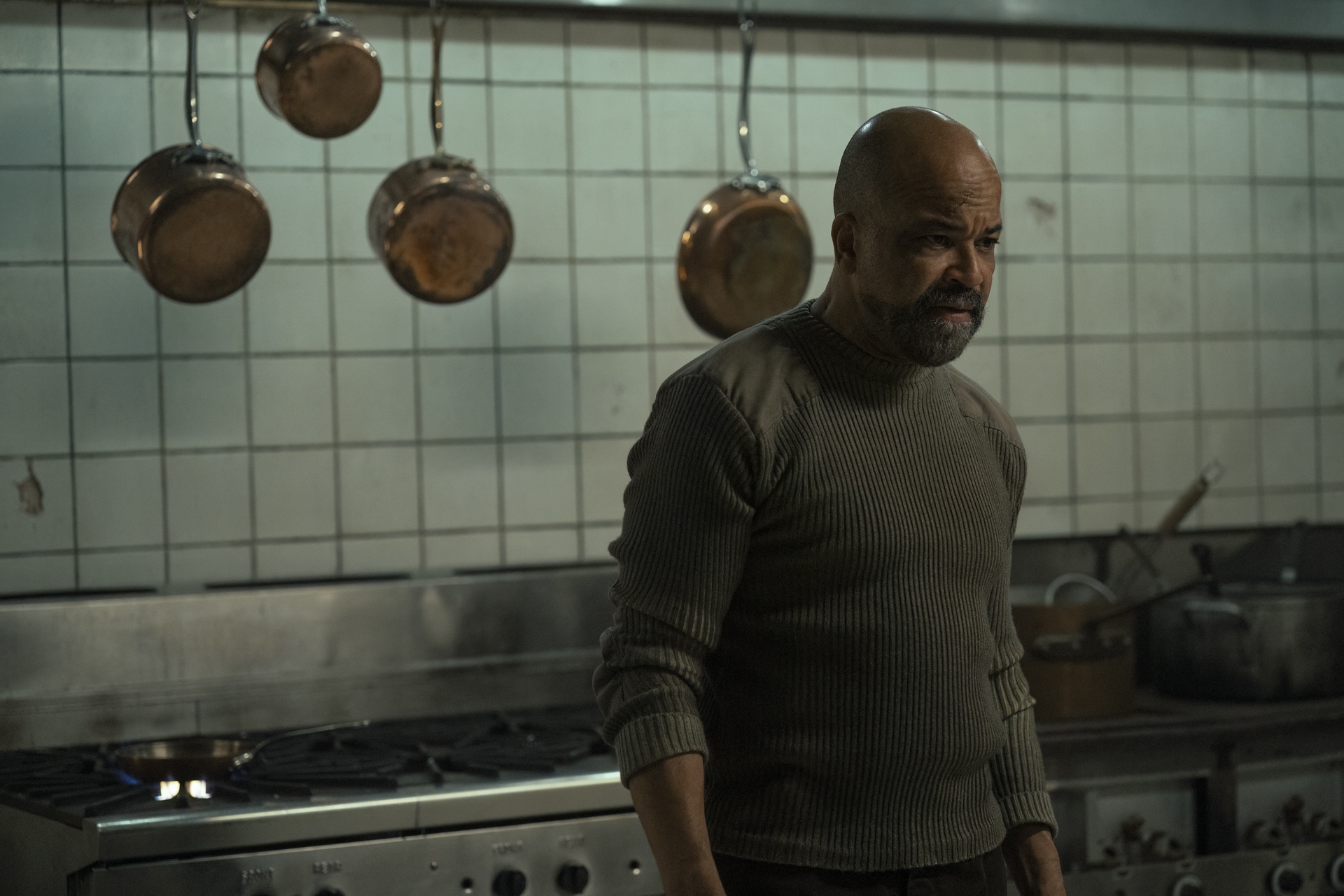
Welcome back to “Jeffrey Wright discusses cookware.” I’m Jeffrey Wright. Today on program, we have a very special guest…
Credit:
Warner Bros. Discovery
Kyle: I will say I appreciated the surprisingly cogent history of the “chicken and egg games” beef between the two factions, as discussed between torturer and torture victim. Definitely a memorable bit of world-building.
But then we’re quickly back to the kind of infected attack scene that now seems practically contractually obligated to happen at least once an episode. At this point, I think these kinds of massive setpiece zombie battles would work better as a light seasoning than a thick sauce that just gets dumped on us almost every week.
Andrew: People in and from Seattle seem to have a unique gift for kicking up otherwise dormant swarms of infected! I know we’ll get back to it eventually, but I was more intrigued by the first episode’s reveal of more strategic infected that seemed to be retaining more of their human traits than I am by these screaming mindless hordes. Here, I think the tension is also ratcheted up artificially by Ellie’s weird escape strategy, which is to lead the two of them through a series of dead ends and cul-de-sacs before finally, barely, getting away.
But like you said, gotta have zombies on the zombie show! And it does finally make the “Dina finds out that Ellie is immune” shoe drop, though Dina doesn’t seem ready to think through any of the other implications of that reveal just yet. She has her own stuff going on!
Kyle: Yes, I’ve had to resist my inclination to do the remote equivalent of nudging you in the ribs to see if you had picked up on the potential “morning sickness” explanation of Dina’s frequent vomiting (which was hidden decently amid the “vomiting because of seeing horrifying gore” explanation).
Andrew: It does explain a couple of things! It does seem like a bit of a narrative shortcut to make Ellie extremely invested in Dina and whether she lives or dies, and given this show I am worried that this zygote is only going to be used to create more trauma for Ellie, rather than giving us a nuanced look at parenting during an apocalypse. But it is sweet to see how enthusiastically and immediately Ellie gets invested.
A question for you, while spoiling as little as you can: Are we still mostly just adapting the game at this point? You’d mentioned getting more Isaac backstory (sometimes the show expands on backstories well and sometimes it doesn’t), and some things have happened a bit out of order. But my impression is that we haven’t gotten a full departure a la the Nick Offerman episode from last season yet.
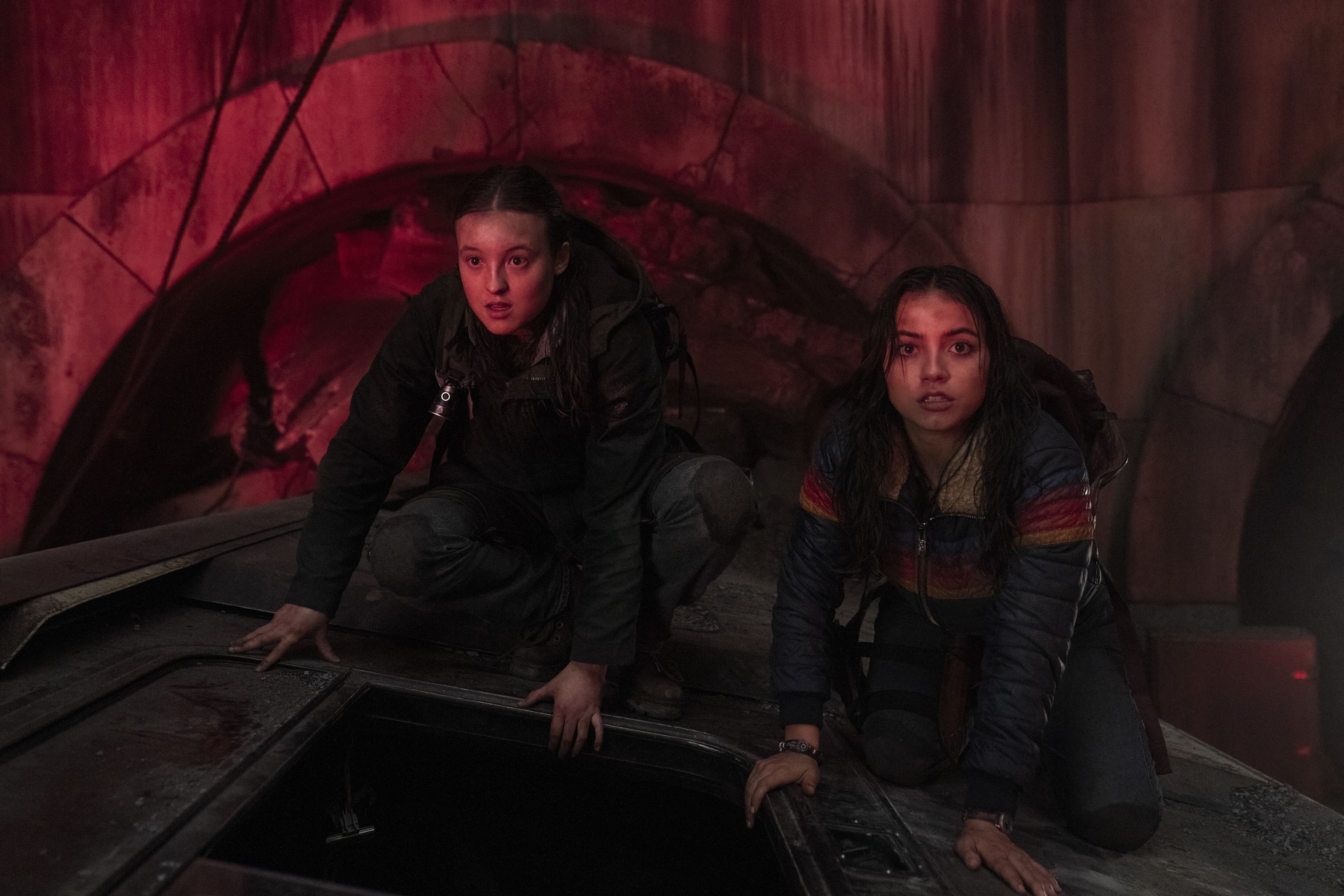
How do we keep getting into these messes?
Credit:
Warner Bros. Discovery
Kyle: At this point it’s kind of like a jazz riff on what happens in the game, with some bits copied note for note, some remixed and thrown into entirely different temporal locations, and some fresh new improv thrown in for good measure.
I’m definitely not a “the game is canon and you must interpret it literally” type of person, but the loose treatment is giving me a bit of whiplash. The reveal of Dina’s pregnancy, for instance, is not greeted with nearly as much immediate joy in the games. That said, the moment of joy Ellie and Dina do share here feels transplanted (in tone if nothing else) from an earlier game scene that the show had mostly skipped thus far. It’s like free association, man. Dig it!
The show also spends an inordinate amount of time discussing how pregnancy tests work in the post-apocalypse, which for me pushed past world-building and into overexplaining. It’s OK to just let stuff be sometimes, y’know?
Andrew: It’s jazz, man. It’s about the zombies you don’t kill.
However it’s been rearranged, I can still tell I’m watching a video game adaptation, because there are stealth kills and because important information is conveyed via messages and logos scrawled in blood on the walls. But I am still enjoying myself, and doing slightly less minute-to-minute missing of Joel than I did last episode. Slightly.
The episode ends with Ellie and Dina hearing the name of someone who has the same name as someone who knew Abby over a WLF walkie-talkie they nabbed, which gives them their next objective marker for Abby Quest. But they’ve got to cross an active war zone to get where they’re going (though I couldn’t tell from that distance whether we’re meant to be able to tell exactly who is fighting who at the moment). Guess I’ll have to wait and see!
Kyle: Personally, I’m hoping we see the moment where the newly out-and-proud bisexual Dina finally realizes “what’s the deal with all the rainbows.” Show your post-apocalyptic pride, girl!
The Last Of Us Season Two, Episode Four Recap: U-Haul Lesbian Road Trip

Well, y’all, this week I decided to give The Last of Us showrunner Craig Mazin a break. I’ve been pretty harsh toward the show’s second season for fundamentally misunderstanding so many of the bold creative decisions of the game on which it’s based. This week’s episode, however, was the best—or at least the least…
‘Star Wars Day’ Celebrations Hit Fortnite, Disney+, X.com – and Retailers Everywhere
As May the 4th transforms into Star Wars Day, dozens of sites and games have found ways to celebrate. The official Star Wars channel on YouTube released a celebratory video. Disney+ released Tales of the Underworld , a six-part animated series about bounty hunters during the reign of the Empire. And Friday the first two episodes began streaming in Fortnite in a special early premiere on “Star Wars Watch Party island,” according to IGN. (Disney acquired a $1.5 billion stake in Epic in March 2024, they note, “positioning itself to collaborate with the game developer for many years to come.” One example from StarWars.com:
Introducing the GALACTIC BATTLE Season: the largest crossover yet between Fortnite Battle Royale and Star Wars. Strap into a TIE fighter or X-wing and take to the skies over new locations like the First Order Base where you can take on Captain Phasma and her legion of stormtroopers. Players can expect new gameplay updates to drop every week throughout the season, including new weapons, Force Abilities and quests to complete.
– There’s additional Star Wars celebrations today in several other games, including LEGO Fortnite Brick Life, Rocket League, and Monopoly GO!
– CNN is publishing its own list of Star Wars day products and deals. (Including Panasonic’s Stormtrooper electric shaver and the Darth Vader toaster.)
– There’s special Star Wars pages at Amazon, Target, Walmart, and Lego.
– On X.com the UK’s national library posted what looks a picture of a medieval manuscript with Yoda painted into the text.
Someone posted a clip from the 1977 Bob Hope Christmas Special which ends with Mark Hamill rescuing Princess Leia (played by Olivia Newton-John). Even the White House has posted an AI-generated image of president Trump wielding a lightsaber.
– Starbucks even has its own line of Star Wars-themed mugs.
And if today isn’t enough, the Austin American-Statesman reminds readers that there’s more Star Wars celebrations are coming up:
Sometimes also known as Geek Pride Day, May 25 is known as “Star Wars Day” because it marks the release of the anniversary of the series’ debut. “A New Hope” premiered in United States theaters on May 25, 1997…
May 21 is Talk Like Yoda Day, an annual celebration marking the release of “Star Wars: Episode V — The Empire Strikes Back” on May 21, 1980 — the film that introduced Yoda to the galaxy…


Read more of this story at Slashdot.
The UN Ditches Google for Form Submissions, Opts for Open Source ‘CryptPad’ Instead
Did you know there’s an initiative to drive Open Source adoption both within the United Nations — and globally? Launched in March, it’s the work of the Digital Technology Network (under the UN’s chief executive board) which “works to advance open source technologies throughout UN agencies,” promoting “collaboration and scalable solutions to support the UN’s digital transformation.” Fun fact: The first group to endorse the initiative’s principles was the Open Source Initiative…
“The Open Source Initiative applauds the United Nations for recognizing the growing importance of Open Source in solving global challenges and building sustainable solutions, and we are honored to be the first to endorse the UN Open Source Principles,” said Stefano Maffulli, executive director of OSI.
But that’s just the beginining, writes It’s FOSS News:
As part of the UN Open Source Principles initiative, the UN has invited other organizations to support and officially endorse these principles. To collect responses, they are using CryptPad instead of Google Forms… If you don’t know about CryptPad, it is a privacy-focused, open source online collaboration office suite that encrypts all of its content, doesn’t log IP addresses, and supports a wide range of collaborative documents and tools for people to use.
While this happened back in late March, we thought it would be a good idea to let people know that a well-known global governing body like the UN was slowly moving towards integrating open source tech into their organization… I sincerely hope the UN continues its push away from proprietary Big Tech solutions in favor of more open, privacy-respecting alternatives, integrating more of their workflow with such tools.
16 groups have already endorsed the UN Open Source Principles (including the GNOME Foundation, the Linux Foundation, and the Eclipse Foundation).
Here’s the eight UN Open Source Principles:
Open by default: Making Open Source the standard approach for projects
Contribute back: Encouraging active participation in the Open Source ecosystem
Secure by design: Making security a priority in all software projects
Foster inclusive participation and community building: Enabling and facilitating diverse and inclusive contributions
Design for reusability: Designing projects to be interoperable across various platforms and ecosystems
Provide documentation: Providing thorough documentation for end-users, integrators and developers
RISE (recognize, incentivize, support and empower): Empowering individuals and communities to actively participate
Sustain and scale: Supporting the development of solutions that meet the evolving needs of the UN system and beyond.


Read more of this story at Slashdot.
How to Install Bitwarden on Ubuntu 24.04
Learn how to install Bitwarden on Ubuntu 24.04 in our latest easy-to-follow guide. You can install Bitwarden on the same VPS as your website. Bitwarden is a free and open-source password manager that can be used to store passwords for any device and browser. This application helps you not only create and manage passwords but also sync them across all devices. Bitwarden offers multiple client applications including mobile apps, CLI, web interface, browser extensions, and desktop apps. In this tutorial, we will show you how to install Bitwarden on Ubuntu 24.04.
‘Harassed by Assasin’s Creed Gamers, A Professor Fought Back With Kindness’
A Dartmouth College associate professor of Japanese literature and culture became a narrative consultant for Ubisoft’s game Assassin’s Creed Shadow (which launched in March). Sachi Schmidt-Hori’s job “involved researching historical customs and reviewing scripts, not creating characters,” writes the Associated Press.
But when a trailer was released in May of 2024, some reacted to a game character named Yasuke who was a Black African samurai, according to the article, “with gamers criticizing his inclusion as ‘wokeness’ run amok”. And they directed the blame at Schmidt-Hori:
Gamers quickly zeroed in Schmidt-Hori, attacking her in online forums, posting bogus reviews of her scholarly work and flooding her inbox with profanity. Many drew attention to her academic research into gender and sexuality. Some tracked down her husband’s name and ridiculed him, too. [One Reddit user described Schmidt-Hori as a “sexual degenerate who hate humanity because no man want her,” while another called her a “professional woke social-justice warrior” who confirmed “fake history for Ubisoft.”] Learning Yasuke was based on a real person did little to assuage critics. Asian men in particular argued Schmidt-Hori was trying to erase them, even though her role involved researching historical customs and reviewing scripts, not creating characters.
Ubisoft told her to ignore the harassment, as did her friends. Instead, she drew inspiration from the late civil rights leader and congressman John Lewis. “I decided to cause ‘good trouble,'” she said. “I refused to ignore.” Schmidt-Hori began replying to some of the angry emails, asking the senders why they were mad at her and inviting them to speak face-to-face via Zoom. She wrote to an influencer who opposes diversity, equity and inclusion principles and had written about her, asking him if he intended to inspire the death threats she was getting. “If somebody said to your wife what people are saying to me, you wouldn’t like it, would you?” she asked. The writer didn’t reply, but he did take down the negative article about Schmidt-Hori.
Others apologized. “It truly destroyed me knowing that you had to suffer and cancel your class and received hate from horrible people,” one man wrote. “I feel somehow that you are part of my family, and I regret it. I’m sorry from the bottom of my heart.” Anik Talukder, a 28-year-old south Asian man living in the United Kingdom, said he apologized at least 10 times to Schmidt-Hori after accepting her Zoom invitation to discuss his Reddit post about her… He was shocked the professor reached out to him and hesitant to speak to her at first. But they ended up having a thoughtful conversation about the lack of Asian representation in Western media and have stayed in touch ever since. “I learned a massive lesson,” he said. “I shouldn’t have made this person a target for no reason whatsoever.”


Read more of this story at Slashdot.
Iconic Open Source Hub Appeals for Lifesaving Donations
Oregon State University’s Open Source Lab may shut down without $250K in funding. Projects like Gentoo, Debian, Fedora, etc., rely on it.
Linux 6.15-rc5 Released: “Most Of It Looks Very Nice & Small”
The fifth weekly release candidate of the Linux 6.15 kernel is now available for testing…
Nintendo is suing the accessory brand that flaunted Switch 2 mockups ahead of its reveal
Nintendo is going after the company that showed off unauthorized mockups of the not-yet-announced Switch 2 at CES 2025. In a lawsuit filed on Friday, Nintendo accuses accessory maker Genki of trademark infringement, unfair competition and false advertising, arguing that Genki “embarked upon a strategic campaign intended to capitalize on the public interest surrounding Nintendo’s next-generation console.” According to Nintendo, Genki promoted accessories it claimed are compatible with the Switch 2 despite not having official access to the console, and used the Switch logo to do so.
Following the initial reports in January that Genki brought Switch 2 mockups to CES and published a video said to show a 3D render of the console, Nintendo released a statement to say that neither the hardware nor imagery were official, per IGN. While Genki reportedly claimed it had access to a Switch 2 at first, the company later wrote on X that it does “not own or possess a black market console,” and told Game*Spark (translated by Automaton) that its mockups were based solely on leaked information. In the lawsuit, Nintendo says Genki’s “statements were contradictory and inconsistent,” yet the company “maintained its representation to consumers that its accessories will be compatible with the Nintendo Switch 2 upon the console’s release.”
Nintendo officially announced the Switch 2 on January 16, a little over a week after the mockups made their CES appearance. Even in the months since, Nintendo alleges, Genki “continues to exploit the attention of the media and fan base and usurp and threaten sales of Nintendo’s own accessories,” through means including piggybacking on Nintendo Direct with its own “Genki Direct” event immediately after. In a statement shared on X following the filing, Genki said it is “taking [the lawsuit] seriously and working with legal counsel to respond thoughtfully.”
“What we can say is this: Genki has always been an independent company focused on building innovative gaming accessories for the community we love,” Genki’s post continued. “We’re proud of the work we’ve done, and we stand by the quality and originality of our products. While we can’t comment in detail, we’re continuing preparations to fulfill orders and showcase our newest products at PAX East this week.”
The Nintendo Switch 2 arrives after years of rumors and speculation. In the lawsuit, Nintendo notes that it began planning the next-gen console shortly after the release of the first. Pre-orders for the Nintendo Switch 2 opened in April, and the console will be available on June 5.
This article originally appeared on Engadget at https://www.engadget.com/gaming/nintendo/nintendo-is-suing-the-accessory-brand-that-flaunted-switch-2-mockups-ahead-of-its-reveal-210341646.html?src=rss
Disneyland Imagineers Defend New Show Recreating Walt Disney as a Robot
“When Disneyland turns 70 this July, Main Street’s Opera House will play host to the return of Walt Disney, who will sit down with audiences to tell his story in robot form,” writes Gizmodo.
But they point out Walt’s granddaughter Johanna Miller wrote a Facebook post opposing the idea in November. (“They are Dehumanizing him. People are not replaceable…”)
The idea of a Robotic Grampa to give the public a feeling of who the living man was just makes no sense. It would be an imposter… You could never get the casual ness of his talking interacting with the camera his excitement to show and tell people about what is new at the park.
You can not add life to one. Empty of a soul or essence of the man. Knowing that he did not want this. Having your predecessors tell you that this was out of bounds…. So so Sad and disappointed.
The Facebook post claims that the son of a Disney engineer even remembers Walt saying that he never wanted to be an animatronic himself. And “Members of the Walt Disney family are said to be divided,” reports the Los Angeles Times, “with many supporting the animatronic and some others against it, say those in the know who have declined to speak on the record for fear of ruining their relationships.”
So that Facebook post “raised anew ethical questions that often surround any project attempting to capture the dead via technology,” their article adds, “be it holographic representations of performers or digitally re-created cinematic animations. And then some media outlets got a partial preview Wednesday, the Los Angeles Times reports:
An early sculpt of what would become the animatronic was revealed, one complete with age spots on Disney’s hands and weariness around his eyes — Imagineers stressed their intent is faithful accuracy — but much of the attraction remains secretive. The animatronic wasn’t shown, nor did Imagineering provide any images of the figure, which it promises will be one of its most technically advanced. Instead, Imagineering sought to show the care in which it was bringing Disney back to life while also attempting to assuage any fears regarding what has become a much-debated project among the Disney community…
Longtime Imagineer Tom Fitzgerald, known for his work on beloved Disney projects such as Star Tours and the Guardians of the Galaxy coaster in Florida, said Wednesday that “A Magical Life” has been in the works for about seven years. Asked directly about ethical concerns in representing the deceased via a robotic figurine, Fitzgerald noted the importance of the Walt Disney story, not only to the company but to culture at large… “What could we do at Disneyland for our audience that would be part of our tool kit vernacular but that would bring Walt to life in a way that you could only experience at the park? We felt the technology had gotten there. We felt there was a need to tell that story in a fresh way….”
“Walt Disney — A Magical Life” will walk a fine line when it opens, attempting to inspire a new generation to look into Disney’s life while also portraying him as more than just a character in the park’s arsenal. “Why are we doing this now?” Fitzgerald says. “For two reasons. One is Disneyland’s 70th anniversary is an ideal time we thought to create a permanent tribute to Walt Disney in the Opera House. The other: I grew up watching Walt Disney on television. I guess I’m the old man. He came into our living room every week and chatted and it was very casual and you felt like you knew the man. But a lot of people today don’t know Walt Disney was an individual. They think Walt Disney is a company.”
And now nearly 60 years after his death, Disney will once again grace Main Street, whether or not audiences — or even some members of his family — are ready to greet him.


Read more of this story at Slashdot.
‘KDE Plasma LTS Releases Are Dead’
With its Start menu-style application launcher and its bottom-of-the-screen taskbar, KDE Plasma is a “nice” and “traditional” desktop environment that’s “also highly customizable,” notes It’s FOSS News.
But there’s a change coming…
In contrast to other desktop environments, KDE offers a long-term support release (LTS) of Plasma, where bug fixes and security updates are provided for an extended period, with no new major changes being introduced. However, that is no longer the case now. Shared by Nate Graham, a prominent contributor within the KDE community, KDE has decided to stop working on LTS releases of Plasma, shifting its focus on extending support for the bug-fix and feature releases instead.
The reasoning behind this move is multi-faceted, with factors such as inconsistent expectations from the community, developers’ reluctance to work on older versions, and the lack of consistency in LTS support for Frameworks and Gear apps… I believe this move will provide Plasma users with a better Linux desktop experience, thanks to the extended bug-fix period, which will enhance the stability of each release.
From Graham’s blog post:
It’s no secret that our Plasma LTS (“Long-Term Support”) product isn’t great. It really only means we backport bug-fixes for longer than usual — usually without even testing them, since no Plasma developers enjoy living on or testing old branches. And there’s no corresponding LTS product for Frameworks or Gear apps, leaving a lot of holes in the LTS umbrella. Then there’s the fact that “LTS” means different things to different people; many have an expansive definition of the term that gives them expectations of stability that are impossible to meet.
Our conclusion was that the fairly limited nature of the product isn’t meeting anyone’s expectations, so we decided to not continue it. Instead, we’ll lengthen the effective support period of normal Plasma releases a bit by adding on an extra bug-fix release, taking us from five to six.
We also revisited the topic of reducing from three to two Plasma feature releases per year, with a much longer bug-fix release schedule. It would effectively make every Plasma version a sort of mini-LTS, and we’d also try to align them with the twice-yearly release schedules of Kubuntu and Fedora.
However, the concept of “Long-Term Support” doesn’t go away just because we’re not giving that label to any of our software releases anymore. Really, it was always a label applied by distros anyway — the distros doing the hard work of building an LTS final product out of myriad software components that were never themselves declared LTS by their own developers. It’s a lot of work.
So we decided to strengthen our messaging that users of KDE software on LTS distros should be reporting issues to their distro, and not to KDE. An LTS software stack is complex and requires a lot of engineering effort to stabilize; the most appropriate people to triage issues on LTS distros are the engineers putting them together. This will free up time among KDE’s bug triagers and developers to focus on current issues they can reproduce and fix, rather than wasting time on issues that can’t be reproduced due to a hugely different software stack, or that were fixed months or years ago yet reported to us anyway due to many users’ unfamiliarity with software release schedules and bug reporting.


Read more of this story at Slashdot.