High-end Danish audio brand Bang & Olufsen has announced the third generation of its Beosound A1 Bluetooth speaker. The updated A1 remains as portable as its predecessor, retaining its puck-shaped design and minimalist appearance, but there are some key upgrades under its pearl-blasted aluminum shell.
Arguably the most important of these is the larger woofer, which delivers a bass of 64dB, a 2dB improvement on the second-generation model. While that admittedly sounds modest on paper, B&O claims it’s one that makes the speaker capable of comfortably filling a room with meaty sound. If you happen to have an older A1 around, you can form a stereo pair with the latest model for even more sonic muscle.
Battery life has also been increased to 24 hours, which is a sizable six hours more than its predecessor. And while it uses the slightly older Bluetooth 5.1 standard, the new A1 supports Microsoft Swift Pair and Google Fast Pair, both of which cut down on the steps required to pair devices. The previous speaker’s three-microphone setup also makes its way to the A1 3rd Gen, allowing you to take calls from the device itself.
The updated speaker has an IP67 dust and waterproof rating, and sports a modular design that allows you to replace or upgrade broken or outdated components over time. Bang & Olufsen say it’s the first speaker in the world to get a Bronze certification from Cradle to Cradle. The C2C is a globally recognized sustainability standard that assesses a product from its supply chain through to production, and coaches companies in minimizing waste. The Bronze level awarded to the Beosound A1 is the lowest on C2C’s scale, but it’s evidence that Bang & Olufsen is paying mind to sustainability.
The Bang & Olufsen A1 3rd Gen can be purchased in the same Natural Aluminium finish as its predecessor, as well as the two new “nature-inspired” colorways of Honey Tone and Eucalyptus Green. It’s available to buy today and costs $349.
This article originally appeared on Engadget at https://www.engadget.com/audio/speakers/bang–olufsens-third-gen-beosound-a1-bluetooth-speaker-has-more-battery-life-and-bass-164546063.html?src=rss
Recteq makes pellet grills, but those can’t do it all when it comes to backyard cooking. So when the company sought to create an alternative for gas grillers, without making an actual gas grill, it needed to do something radically different.
With its newly launched X-Fire Pro, Recteq may have done that. The company says that its Dual Mode Cooking combines the best of wood pellets and gas, offering a temperature range between 225 and 1,250 degrees Fahrenheit. But it wasn’t just about getting to that high level of heat. For Recteq, harmonizing the dual capabilities with an intuitive design was most important.
“Part of our development process was going after the gas grill market, attracting new users to the pellet grill universe,” Recteq’s VP of products Ben Lesshafft said. “We really felt the best way to do that was to meet them on their turf.”
Gas grills are very easy to use. They feel more familiar to most people because they function a lot like a stove and light with the press of a button. Primarily designed for higher-heat cooking, these are the grills you want for burgers, steaks and other cookout essentials when you don’t want to futz with the extra care and clean up of charcoal. Turn it on, cook your food, turn it off. What’s more, gas grills have multiple burners, which allow backyard cooks to adjust and maintain multiple temperature zones as needed.
Recteq
With the X-Fire Pro Recteq needed to create a similar two-burner/fire pot setup. Just one of those wouldn’t be enough to adequately cover the 825 square inches of cooking space on such a large grill. That’s especially true when there’s a direct heat option involved. However, the dual fire pots aren’t what’s necessary for the 1,250-degree performance. For that, the company utilizes the fire pots from its Bullseye Deluxe model that’s also capable of 1,000-degree searing.
Lesshafft walked me through how Recteq achieves this, employing a specially designed, “gasification-style” fire pot that ignites the wood gas that’s produced when the pellets burn. With a double-walled construction for this crucial component, something that works similarly to the airflow channels on a Solo Stove fire pit, the company can ignite that wood gas at temperatures above 500-600 degrees for “an accelerated amount of heat.”
Now that Recteq can reach an extreme amount of heat by fully exploiting the pellets, it needs to allow food to come in direct contact with the flames. “That’s the adjustable damper,” Lesshafft said. “You can go fully closed, partially open, almost all the way open and wide open.” The damper and an Adaptive Sear Control feature are only available on the right-side fire pot though.
On the left, there’s a perforated steel deflector covering the heat source. This allows for the hot and cold sides of the grill, or hot and not-so-hot, both of which are common cooking setups for gas grilling. You’ll need higher heat for searing a steak, but more indirect heat for bringing it fully to temperature. Or maybe you have people over who all like their steaks cooked differently. Either way, gas grills allow you to have varied heat zones and so does the X-Fire Pro’s Grill Mode.
Recteq
Of course, the X-Fire Pro also had to be a pellet grill, and that brings us back to Recteq’s area of expertise. “Nobody with a gas grill brags about pork butt, brisket and ribs,” Lesshafft quipped.
Pellet grills are better at low-and-slow smoking. Sure, you can do baking, roasting and limited searing on most models, but the bread and butter here is smoked meat, seafood and other dishes. Most pellet grills these days offer some form of connectivity — Bluetooth, Wi-Fi or both — so that you can keep tabs on progress without standing outside the entire time. This is typically done with an app that also allows you to to adjust the cooking temperature of the grill, activate certain modes or shut it down from afar.
For Smoke Mode on the X-Fire Pro, only the left fire pot runs. That perforated deflector I mentioned is designed in such a way that the heat is pushed towards the middle of the grill. It’s similar to how an offset smoker (stick burner) works. Even though the active fire pot is on the left side of the cooking chamber, “the temperature balance is remarkably stable,” Lesshafft noted.
To completely synthesize the two types of grills into a single unit, Recteq also had to design controls that would be easy to understand for both gas and pellet grill users. “We wanted to create a lot of things that were familiar to the gas consumer,” he explained. “That’s the knobs on the front, a lot of stainless [steel], and even when you turn it on, that’s the LED rings around the lights.”
There are four knobs in total. The one on the left controls the two grill modes: Smoke and Grill. When you select the latter, all of the LEDs around those knobs light up red. There are two knobs for burner/fire pot control, allowing you to select low, medium, high or maximum. There’s also an Adaptive Sear Control knob which allows you to adjust how much direct flame is coming in contact with your food.
Recteq
When it’s time for Smoke Mode, turn that far left knob and the X-Fire Pro’s controls transform the machine into a traditional pellet grill. The LEDs around the four center knobs change from red to white, and the controller that’s mounted on the side shelf turns on. Here, you’ll adjust settings for those low-and-slow cooks and monitor temperatures. If you’re unfamiliar with pellet grilling, the controller’s display will help with tips like a reminder to keep the lid closed while smoking.
Most people who’ve cooked with a pellet grill are familiar with using a phone app to track temperatures and access remote controls. Recteq offers that in Smoke Mode on the X-Fire Pro, which means no one will be babysitting a pork shoulder or brisket grillside for 8-12 hours. Like much of the competition, this runs on your home Wi-Fi network.
While the grill is designed to run in two completely separate modes, you can switch between them with ease. If you wanted to reverse sear a steak, for example, you could just smoke it first at 225 and then open the lid and change to Grill Mode. The left fire pot is already going, but this would activate the one on the right for the desired exterior finish. Going from Grill Mode to Smoke Mode “requires a little bit more patience,” Lesshafft said, since the metal chamber has gotten hot and it will take a while for the grill to cool down to the appropriate temperature.
“We really tried to design it with the ultimate amount of versatility,” he said.
Recteq
And in the end, that appears to be what Recteq did. The company put two separate grills in one machine, catering to backyard cooks who are familiar with each one individually. And in doing so, it built a unique grill that stands out from most of the competition. The X-Fire Pro isn’t a pellet grill with enough searing performance to make it passable, it’s a high-heat beast. It offers a lot more flavor than gas by burning pellets, and it’s much easier to check your fuel levels here than when you’re dealing with a tank.
“We want to deliver what they need [in a gas grill],” Lessshafft concluded. “Should you want to dip your toe in the water of some food you can’t get on a gas grill, this gives you the vehicle to do that too.”
I’ll be putting an X-Fire Pro to the test soon so see if it’s worth the steep $1,550 investment. Yes, you can find a decent gas grill to pair with a solid pellet grill for less than that. But you’d have two cooking appliances on your deck or patio, and you’d still have to contend with the anxiety of propane tank levels before each grilling session. Recteq’s new model should remedy that, and if the performance claims hold up, it will also put a novel piece of grilling gear in your backyard.
Time will tell if Recteq has truly merged the two styles of cooking.
This article originally appeared on Engadget at https://www.engadget.com/home/kitchen-tech/best-of-both-worlds-how-recteq-designed-a-pellet-grill-for-gas-grillers-163047921.html?src=rss
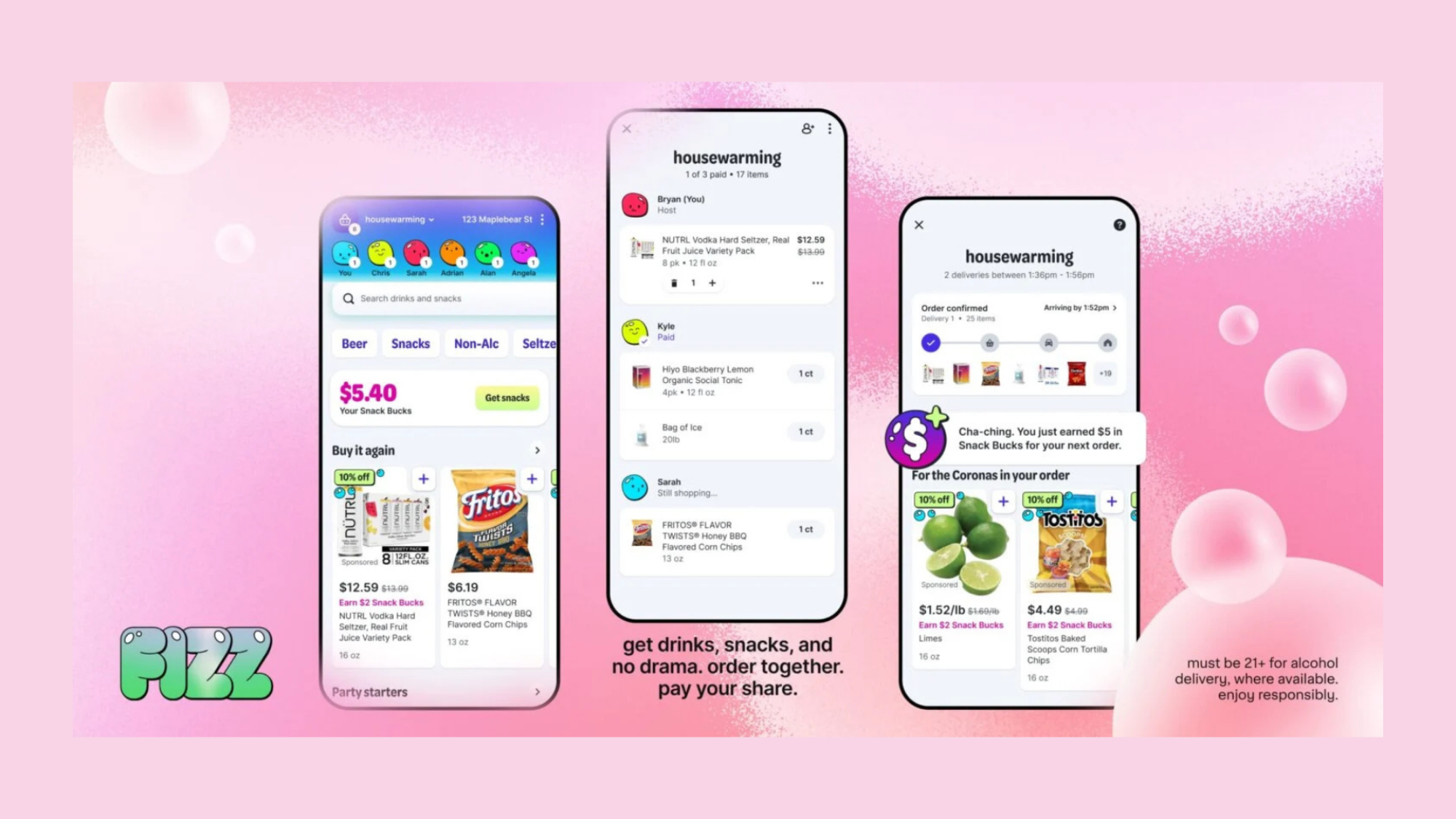
Instacart is rolling out a new app, but it’s not for ordering groceries—at least, not the essentials. Instead, Instacart sees “Fizz” as a party delivery app, designed for ordering snacks and alcoholic drinks.
Fizz isn’t the first to offer alcohol delivery, of course. Instacart itself supports alcohol delivery wherever it’s legal, as does DoorDash. But perhaps the most notorious alcohol delivery app was Drizly: The service was a popular option for ordering alcohol, but its reputation suffered following a massive 2020 data breach. Uber acquired the app the following year, then shut it down in 2024.
But Fizz isn’t a Drizly clone. Instead, the app seems more like if Drizly crossed with a party-planning app like Partiful or Apple’s Invites—not only do you order drinks and snacks, but you invite others to do so as well. In fact, Fizz is now embedded in the Partiful app, so you can use it when planning a party at large.
Instacart says after you start a “party cart,” you can share a link with friends to invite them to join. (They don’t need the Fizz app to participate.) Everyone in the group can see what’s already been ordered, and can add whatever they want. Anything you add to a party cart, you pay for yourself, which I feel mixed about. On the one hand, it’s cool to let people “bring” what they want to the party, without needing to track people down to pay for their share. But for some parties and gatherings, it makes sense to split everything evenly. It’d be nice if Fizz would at least add that as an option.
If you want to use Fizz with Partiful, you can choose to enable “Group Order” in the app. Then, everyone on the Partiful can access the Fizz link.
Credit: Instacart
As the app is made for ordering alcohol, it’s only available to users 21 and older. There’s also a flat $5 delivery fee for all orders, though that does not include a tip.
If you live in a state or area where alcohol delivery isn’t legal, you can’t use Fizz (or any alcohol delivery service). According to TechCrunch, Fizz is available in Alabama, Arizona, California, Connecticut, Florida, Georgia, Hawaii, Idaho, Illinois, Iowa, Kentucky, Louisiana (some areas), Massachusetts, Michigan, Minnesota, Mississippi, Missouri, Nebraska, New Jersey, New Mexico (some areas), New York, Nevada (some areas), North Carolina, Ohio, Oregon, Texas, Tennessee, Virginia, Washington, and Wyoming.
Nvidia will release the GeForce RTX 5060 on May 19 starting at $299, the company announced via press release today. The new card, a successor to popular past GPUs like the GTX 1060 and RTX 3060, will bring Nvidia’s DLSS 4 and Multi Frame-Generation technology to budget-to-mainstream gaming builds—at least, it would if every single GPU launched by any company at any price wasn’t instantly selling out these days.
Nvidia announced a May release for the 5060 last month when it released the RTX 5060 Ti for $379 (8GB) and $429 (16GB). Prices for that card so far haven’t been as inflated as they have been for the RTX 5070 on up, but the cheapest ones you can currently get are still between $50 and $100 over that MSRP. Unless Nvidia and its partners have made dramatically more RTX 5060 cards than they’ve made of any other model so far, expect this card to carry a similar pricing premium for a while.
RTX 5060 Ti
RTX 4060 Ti
RTX 5060
RTX 4060
RTX 5050 (leaked)
RTX 3050
CUDA Cores
4,608
4,352
3,840
3,072
2,560
2,560
Boost Clock
2,572 MHz
2,535 MHz
2,497 MHz
2,460 MHz
Unknown
1,777 MHz
Memory Bus Width
128-bit
128-bit
128-bit
128-bit
128-bit
128-bit
Memory bandwidth
448GB/s
288GB/s
448GB/s
272GB/s
Unknown
224GB/s
Memory size
8GB or 16GB GDDR7
8GB or 16GB GDDR6
8GB GDDR7
8GB GDDR6
8GB GDDR6
8GB GDDR6
TGP
180 W
160 W
145 W
115 W
130 W
130 W
Compared to the RTX 4060, the RTX 5060 adds a few hundred extra CUDA cores and gets a big memory bandwidth increase thanks to the move from GDDR6 to GDDR7. But its utility at higher resolutions will continue to be limited by its 8GB of RAM, which is already becoming a problem for a handful of high-end games at 1440p and 4K.
As you’ve probably heard, Grand Theft Auto VI just got a brand new trailer, giving us our best look yet at the world, characters, and story of Rockstar’s upcoming crime epic. The trailer tells us a lot more about the game’s leading couple, Lucia and Jason, and takes time to emphasize the atmosphere of GTA VI’s…
Last month, Nintendo and its third-party partners revealed that many of the “physical” games on the Switch 2 would be made available only as “Digital Key Cards.” Unlike traditional physical Switch games—which contain flash memory with the necessary data to play the game on the card itself—these key cards will simply enable the holder to download a copy of the game to their system and play that copy if and when the transferable key card is inserted in the system.
Already, many players are thinking ahead to what this means for their ability to play Game Key Card releases well into the future. It’s not hard to find potential Switch 2 owners publicly worrying about games “disappear[ing] into the void” or becoming “effectively a worthless piece of plastic/e-waste” when Nintendo eventually disables its Switch 2 game download servers. Some go even farther, calling a Game Key Card an “eighty dollar rental” rather than a real game purchase.
While these are valid long-term concerns, I think some players are underestimating the likely timeline for when Game Key Cards will become “useless e-waste.” As it stands, we already have an example of Nintendo supporting continued downloads of games purchased nearly two decades ago and counting.
Meta is facing its biggest existential threat in its history. Years after the Federal Trade Commission first sued the social network in an attempt to unwind its acquisitions of Instagram and WhatsApp, the trial that will shape its future is finally underway. FTC v. Meta began last month when CEO Mark Zuckerberg took the stand, and is expected to last for several weeks.
The FTC is hoping to prove to US District judge James Boasberg that Meta’s acquisitions of its one-time rivals were anticompetitive and hurt US consumers. Meta, meanwhile, has argued that Instagram and WhatsApp were only able to grow to the billion-user services they are because of its investment into them over the last decade or more.
While the case is unlikely to be fully settled anytime soon, the trial has successfully uncovered tons of new details about the inner workings of Meta and its approach to potential competitors. And testimony from former execs like Instagram cofounder Kevin Systrom and longtime COO Sheryl Sandberg have shed new light on the company’s past.
Instagram’s former CEO speaks
Facebook’s 2012 acquisition of Instagram is a central part of the FTC’s case against Meta. The government has argued that Mark Zuckerberg bought Instagram in order to neutralize it as a competitor and is trying to force Meta to divest it. So it was more than a little eyebrow raising when Instagram’s cofounder and former CEO Kevin Systrom took the stand and didn’t exactly come to Meta’s defense.
While Zuckerberg had testified that Meta had helped Instagram grow, Systrom testified that Zuckerberg saw Instagram as a “threat” to Facebook’s growth and intentionally withheld company resources as a result. “As the founder of Facebook, he felt a lot of emotion around which one was better, meaning Instagram or Facebook,” Systrom said.
Sheryl Sandberg thought Zuckerberg overpaid for Instagram
Facebook’s decision to pay $1 billion for Instagram — an app that had no revenue and just a handful of employees — seemed like an incredible sum to many onlookers at the time. Among them, though, was Zuckerberg’s former top lieutenant. The trial unearthed an exchange between the two from 2012 in which Zuckerberg asked if $1 billion was too much to pay. She replied that “yes, of course it’s way too much.”
On the stand, however, Sandberg said that she had been wrong. “I don’t think anyone today would say we paid too much for Instagram,” she said, in testimony reported byBloomberg.
Zuckerberg knew the company could face a breakup
In one notable email exchange, Zuckerberg speculated that the company could one day face antitrust action that would force the company to divest Instagram. “I’m beginning to wonder whether spinning Instagram out is the only structure that will accomplish a number of important goals,” Zuckerberg mused in a 2018 email. “As calls to break up the big tech companies grow, there is a non-trivial chance that we will be forced to spin out Instagram and perhaps WhatsApp in the next 5-10 years anyway.”
Zuckerberg considered nuking friend lists to boost engagement
In 2022, facing rising competition from TikTok, Zuckerberg apparently was growing concerned that Facebook’s “cultural relevance is decreasing quickly.” To address this, he suggested deleting users’ friends lists as often as once a year in an effort to get people to “start again.” Bizarrely, he referred to this plan as “double down on friending,” as Business Insidernoted.
Zuckerberg, apparently aware that the plan was somewhat risky, even suggested that Facebook could test out the idea in a “smaller country” first in order to gauge the effect it might have on users. However, Tom Alison, who oversees the Facebook app for Meta, quickly shot him down, according to The Verge, telling Zuckerberg the plan was not “viable.”
When asked about it directly on the stand, Zuckerberg simply stated that “we never did that.” Still, the fact that he even considered such a drastic move is telling. Zuckerberg floated the idea in 2022, at a time when TikTok’s popularity among US teens was surging and Meta was becoming increasingly alarmed at TikTok’s dominance. In the same email, Zuckerberg also questioned Alison about whether Facebook could move to a “follow model.”
Just how threatened they were by TikTok
Zuckerberg has previously talked about how Meta was “slow” to recognize the threat posed by TikTok. But the FTC trial has unearthed new details about Meta’s response to the app’s rise. In her testimony, Sandberg said that Meta was already feeling pressure from TikTok in 2018. By 2020, the company had invested more than $500 million into building its competitor, Reels, according to an internal email noted by The New York Times. That effort saw the company hire more than 1,000 new employees to bolster the company’s video efforts.
Zuckerberg also touched on TikTok, saying that the app quickly became a “highly urgent” threat to Meta. “We observed that our growth slowed down dramatically,” Zuckerberg said, referring to TikTok’s rise. That may sound surprisingly candid for Zuckerberg, but his remarks were also strategic for Meta’s defense. The company has argued that TikTok is an even bigger threat to its business than Instagram or WhatsApp ever was, and has slammed the government for claiming that TikTok isn’t a direct rival.
As the European Union has adopted stricter tech regulations over the last few years, the new laws have forced tech giants to change their products in sometimes meaningful ways. For Meta, one such change has been the addition of ad-free versions of Facebook and Instagram that are only available via subscription in the EU. The company began offering it in 2023 and has slashed the price of it more recently following legal scrutiny.
But even with a price cut, it seems ad-free subscriptions to Facebook and Instagram are unpopular. On the stand, Meta’s Chief Revenue Officer John Hegeman testified that there has been “very little interest” in the plan with only “about .007 percent” of users opting in, according to testimony reported by The Verge.
This article originally appeared on Engadget at https://www.engadget.com/big-tech/what-weve-learned-from-ftc-v-meta-antitrust-trial-162048138.html?src=rss
The ongoing war between the Trump administration and Harvard University has taken a new twist, with the government sending Harvard a letter that, amid what appears to be a stream-of-consciousness culture war rant, announces that the university will not be receiving any further research grants. The letter potentially suggests that Harvard could see funding restored by “complying with long-settled Federal Law,” but earlier demands from the administration included conditions that went well beyond those required by law.
The letter, sent by Secretary of Education Linda McMahon, makes it somewhat difficult to tell exactly what the government wants, because most of the text is a borderline deranged rant written in florid MAGA-ese. You don’t have to go beyond the first paragraph to get a sense that this is less a setting of funding conditions than an airing of grievances:
Instead of using these funds to advance the education of its students, Harvard is engaging in a systemic pattern of violating federal law. Where do many of these “students” come from, who are they, how do they get into Harvard, or even into our country—and why is there so much HATE? These are questions that must be answered, among many more, but the biggest question of all is, why will Harvard not give straightforward answers to the American public?
Does Harvard have to answer these questions to get funding restored? It’s unclear.
16 months on from Grand Theft Auto 6’s first trailer, Rockstar Games has released the second trailer for its upcoming open-world action game. And while GTA 6 is still a year away after the recent delay, we at least now have a lot screenshots and a big new trailer to look over for the next few months.
NVIDIA’s RTX 5060 finally has a release date. When the company announced the budget 50-series graphics cards last month, it gave the higher-end Ti model a firm April 19 launch but limited the base 5060 model to a vague “May” window. On Tuesday, we learned that the card with a $299 MSRP arrives on May 19.
The RTX 5060 has 8 GB of GDDR7 VRAM, 19 TFLOPS Blackwell shader cores, 5th-gen tensor cores with 614 AI TOPS performance and 4th-gen RT (ray tracing) cores that can reach 58 TFLOPS. It also has 3,840 CUDA Cores.
According to NVIDIA’s benchmarks, the RTX 5060 reaches 234 fps in Hogwarts Legacy, 148 fps in Cyberpunk 2077, 220 fps in Avowed and 330 fps in Marvel Rivals. Those numbers are all set for 1080p with maxed-out graphics and 4x frame generation.
NVIDIA
Based on today’s prices, those are impressive numbers for a $299 card. But if you can snag one at all, you’ll likely be hard-pressed to find one at that price. For that, you can thank Donald Trump. The Vergenotes that retailers jacked up graphics card prices even before his tariffs kicked in. In addition, the US president recently killed the de minimis exemption, which spared goods under $800 from extra taxes. (Remember when he said he would make America affordable again?) So, consider yourself one of the lucky few if you find one on launch day for anything close to $299.
The GeForce RTX 5060 will go on sale on May 19 at noon ET from NVIDIA’s retail partners. In addition to the standalone desktop card, the laptops with the mobile version of the RTX 5060 will launch at the same time, starting at $1,099.
This article originally appeared on Engadget at https://www.engadget.com/gaming/pc/nvidias-geforce-rtx-5060-gpu-arrives-on-may-19-160939549.html?src=rss
Lead LVFS/Fwupd developer Richard Hughes of Red Hat was at the PremDay on-premise computing conference in Paris to talk up this open-source firmware updating solution and being what customers want. The presentation video and slides are now available for those needing additional material in helping sell your organization on the benefits of LVFS/Fwupd…
Recent college graduates face the worst job market in decades, with unemployment reaching 5.8%, according to recently released New York Federal Reserve data. The “recent-grad gap” – the difference between unemployment rates of young college graduates versus the overall labor force – has hit its lowest point in four decades, indicating college graduates are facing unusual difficulties securing employment. (The New York Federal Reserve said labor conditions for recent college graduates have “deteriorated noticeably” in the past few months.)
Even graduates from elite MBA programs are struggling to find work, while law school applications have surged as young people seek shelter from the difficult job market. Economists are attributing the decline to three potential factors: incomplete recovery from pandemic disruptions, diminishing returns on college education, and possibly AI replacing entry-level positions.
“When you think about what generative AI can do, it’s the kind of things that young college grads have done,” said David Deming, a Harvard economist. “They read and synthesize information and data. They produce reports and presentations.”
John Abbott Valentine – better known to MBUK readers as John Stevenson – has died from cancer.
The outspoken Yorkshireman played a pivotal role in the early years of MBUK, joining the fledgling magazine as deputy editor in 1989, after several years working in bike shops and making his name on the UK MTB scene as a racer, team manager and event promoter.
In his own words, he “got the gig by phoning up the editor and telling him the magazine was rubbish”. Tym Manley called his bluff and gave him a job.
Although not trained as one, John had a journalist’s instincts and attention to detail, and wasn’t afraid to espouse controversial views, or call out brands or individuals for their mistakes.
Old friend Rory Hitchens, a fellow former racer turned UK cycling industry mainstay, remembers: “John was stand-out from the word go. I was drawn to his confidence, loudness and ‘couldn’t give a shit, that’s your problem mate’ way of going about life. Things always happened around John. The world is already less agitated without him, and all the more dull for it.”
John – and his trademark blond ponytail – moved with MBUK from its tiny office in Kent to the big offices of Future Publishing in Bath and went on to become international editor and then editor-in-chief of the media group’s cycling titles, which at that time included MBUK, What Mountain Bike magazine and BikeRadar.
Legendary snapper Steve Behr told us: “Very influential and much respected in the cycling world, John didn’t suffer fools gladly and wasn’t shy in letting people know when he was displeased about something or didn’t agree with something.
“Under that gruff and sometimes grumpy northern exterior, he was great company, very enthusiastic about many things, and loved to debate and discuss energetically a wide variety of topics.
“He pushed MBUK on the tech side a lot in the early years, and has influenced many people who’ve gone on to have careers in cycling journalism. He’s a good friend who’ll be greatly missed.”
Both Rob Weaver and I had the opportunity to work with John in Bath. He was kind and generous – not hesitating to circle back and give me a push after I bonked on one particularly long ride – but would quickly get worked up when people didn’t meet his (very high) standards. I can remember him getting genuinely angry about brands’ (and writers’) use of the word ‘compliance’ to describe engineered flex, arguing that it wasn’t a dictionary definition of the word.
“I’d rather be loud and wrong than quiet and right,” he once told Rob and test guru Guy Kesteven during a memorable rant at the Interbike trade show in Las Vegas. Generally, he was loud and right – although maybe not during that same trip when he drove their hire car up Boulder Canyon with the handbrake on because, “it’s a shit car and I can’t find it to take it off”.
On another memorable occasion, he yelled, “Coffee is a human right!” across the office.” Former MBUK art editor James ‘Jimmer’ Blackwell said: “He was a hard taskmaster but a top bloke, utterly unique, and his ideas were something to listen to.”
After parting ways with Future, John branched out into freelancing, worked briefly for Planet-X and then became editor at large of road cycling website Road.cc.
In 2024, he took a DNA test and tracked down his biological father, who’d sadly died five years earlier. John decided to drop the surname of his hated stepdad, which he’d used since his school days, and adopt his mum’s maiden name, Abbott, and his dad’s surname, Valentine.
A year earlier, John had been diagnosed with stage-four bowel cancer and tumours in his liver. Despite undergoing chemotherapy and various operations, the disease spread to his lungs and abdominal lymph nodes. He spent his last days with his wife, Caroline, and his beloved dogs.
Caroline announced his death on Facebook, saying: “John died overnight. It was peaceful and pain-free, as far as we could tell, after a very fast deterioration.”
Amazon has finally streamlined the process by which folks can buy books via the iOS version of the Kindle app. The iPhone and iPad apps now include a “Get Book” button with each listed title. Hitting this button will bring up the corresponding Amazon page, along with the option for a 1-Click purchase. Once finalized, it directs users back to the Kindle app for some reading.
This isn’t as seamless as a simple in-app purchase, but it’s miles better than the old method. This would require Kindle users to buy titles on their own via a web browser. There was no portal within the Kindle app or anything like that. Basically, you’d have to jot down the name of the book and head to the web version of Amazon to look it up and make a purchase.
This move is, of course, thanks to a recent court ruling that banned Apple from collecting fees for digital items bought outside of the official App Store. This forced the company to update the App Store to allow for external payment options. As such, companies like Amazon can now experiment with new purchasing methods without forking over 27 percent to Apple.
It’s worth noting that the Kindle “Get Book” button still relies on a web version of Amazon. There’s no current way to buy an e-book on the actual Amazon app. Still, this is a definite step in the right direction.
Amazon isn’t the only company making adjustments based on the recent court ruling. Spotify now lets users subscribe on iOS devices via an external link, thus evading App Store fees. Epic Games is not only bringing Fortnite back to the iOS platform, but also announced its creating standalone webshops to support out-of-app purchases.
Apple isn’t exactly thrilled with this mad dash to avoid those lucrative App Store fees. It recently appealed the aforementioned legal ruling but the grounds for this appeal are unknown. It’s going to be an uphill battle for the iPhone maker, as the judge who issued the ruling called the App Store practices “anticompetitive” and a “gross miscalculation.”
This article originally appeared on Engadget at https://www.engadget.com/big-tech/kindles-ios-app-now-has-a-button-to-make-it-easier-to-buy-books-154505235.html?src=rss
Ampere Computing last year talked up AmpereOne M for 12-channel DDR5 memory and up to 192 cores up from the 8-channel DDR5 memory found with the initial AmpereOne processors. They said at the time AmpereOne M would be shipping in Q4-2024. Now half way into 2025, it looks like they quietly announced the AmpereOne M processors…
When I wrote about adding baking soda to ground beef for better browning and moisture retention, the readership was starkly divided—those who think this chemical reaction is pure snake oil, and those who want to know immediately how to apply this technique to hamburgers. Well, for those of you mapping out your Memorial Day weekend grill game, saddle up. This very real chemical reaction is indeed perfectly suited to improving your summer burgers.
How does baking soda make meat tender?
Baking soda reacts with the proteins in meats, whether ground or not, preventing them from winding up as tightly as they normally would when cooking. This is a technique that’s been around for ages in Chinese cooking, called velveting. You’ve probably seen steak, chicken, bacon, and hamburgers that haven’t been treated with baking soda shrink dramatically after cooking. The protein network starts to squeeze and clench up as it heats, expelling the meat’s natural juices. When you bite into it, the meat feels rubbery and dry because the proteins are wound tight and the juices have been left behind in the pan or down in the charcoal pit.
Baking soda-treated meats have looser protein networks that maintain a comparatively greater amount of natural juices. To the palate, this feels like a tender, juicy, more flavorful hamburger patty with a crispy brown exterior. Oh about that: The browning gets better too.
How does baking soda improve browning?
It turns out that the Maillard reaction (the attractive and flavorful browning that happens to foods when they cook at around 300°F) happens faster in a more alkaline environment. A sprinkle of baking soda is enough to increase the PH and cause more pronounced browning to occur faster, whether it’s in banana waffles or with meat. This literally creates new flavors in your food, thus your burger will actually be more flavorful by incorporating a pinch of this basic pantry item.
To demonstrate, I split up a pound of 93% lean ground beef and added a half teaspoon of baking soda to one half of the meat. I shaped the meat into patties and griddled up both types of burgers in a light spritz of canola oil to ensure good contact with the heat. I cooked each burger to reach 140°F to 145°F degrees for medium doneness. You can see in the picture, it’s pretty easy to tell which one was treated with baking soda.
The baking soda treated burger on the right has better browning and less shrinkage occurred. Credit: Allie Chanthorn Reinmann
How to make better burgers with baking soda
This small amount of baking soda leaves no off flavors behind in your burger, and it reduces moisture loss, which keeps the shrinking to a minimum (you won’t end up with tiny burgers on huge buns). The result is tender meat, and you’ll be rewarded with a lovely brown crust. Here’s how I do it.
1. Season the ground meat
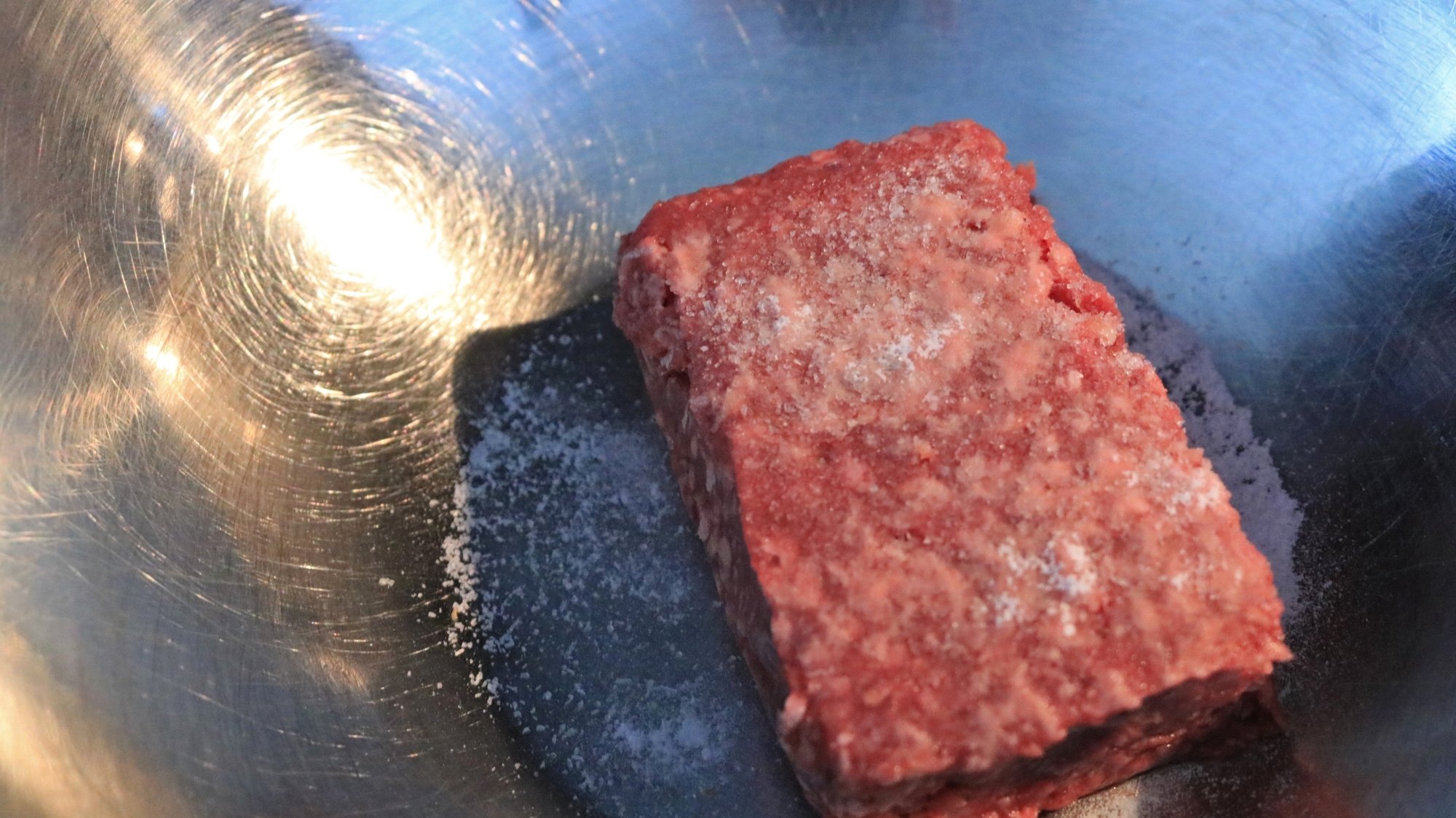
I add the ground burger meat to a large bowl and season it with salt. Go ahead and add any other seasonings you like. Then dust baking soda over the surface of the meat. For every eight ounces (half-pound) of ground meat, I used a half-teaspoon of baking soda.
Credit: Allie Chanthorn Reinmann
2. Mix it thoroughly
Then you need to get your hands dirty. I’m sure you could do this with a spoon but I find it much quicker to do it with my hands. I find that the seasoning gets more thoroughly distributed this way too. If you want to keep your hands clean, don some vinyl food-safe gloves. Squeeze and toss the meat in the bowl until it’s well mixed.
3. Shape the patties and cook
Form the patties with your hands and have them ready on a sheet pan lined with parchment paper, or a plate for a small batch. Let them rest in the fridge while you get the pan or the grill ready. Cook as usual.
I recommend testing for doneness with a meat thermometer rather than by color. With the accelerated browning of the exterior, you don’t want to remove the burger too soon. I use the Thermapen One and I love it. Try to insert the probe end at a side angle toward the center as much as possible. You want a reading for the center, not to poke through to the other side. Once done, let your burgers rest for a few minutes off the heat—which I think happens naturally as you plate them and dress them with fixin’s—and enjoy the first bite of summer grill season.
Remember when Avengers: Infinity War premiered in 2018 and Marvel made a whole marketing beat about Thanos “demanding” fans’ silence so as not to spoil the movie for others? Well, a lot can change in seven years, I guess. Marvel has made a whole marketing campaign out of spoiling the latest MCU movie, Thunderbolts*,…









 B580, AMD Radeon