New RSV vaccine, treatment linked to dramatic fall in baby hospitalizations

Far fewer babies went to the hospital struggling to breathe from RSV, a severe respiratory infection, after the debut of a new vaccine and treatment this season, according to an analysis published today by the Centers for Disease Control and Prevention.

RSV, or respiratory syncytial (sin-SISH-uhl) virus, is the leading cause of hospitalization for infants in the US. An estimated 58,000–80,000 children younger than 5 years old are hospitalized each year. Newborns—babies between 0 and 2 months—are the most at risk of being hospitalized with RSV. The virus circulates seasonally, typically rising in the fall and peaking in the winter, like many other respiratory infections.

But the 2024–2025 season was different—there were two new ways to protect against the infection. One is a maternal vaccine, Pfizer’s Abrysvo, which is given to pregnant people when their third trimester aligns with RSV season (generally September through January). Maternal antibodies generated from the vaccination pass to the fetus in the uterus and can protect a newborn in the first few months of life. The other new protection against RSV is a long-acting monoclonal antibody treatment, nirsevimab, which is given to babies under 8 months old as they enter or are born into their first RSV season and may not be protected by maternal antibodies.

Read full article

Comments

Five Ways to Get More Out of Letterboxd

Letterboxd is the best thing to happen to film nerds since IMDb, which is almost surprising given how straightforward it is. Like the Film Twitter answer to Goodreads, it is a social network/online catalogue where you can rate or review movies, pick a few of your favorites to highlight on your profile, and follow your friends and favorite critics. Yet, Letterboxd is more than just “what if social media, but for movies?” Dig a little deeper and you’ll find some useful tools for managing your cinema obsession.

If you haven’t used Letterboxd before, it’s available for Android, iOS, or on the web. Anyone can access it to browse movies, read reviews, and see user ratings, but in order to make a watchlist or leave your own reviews, you’ll need to create a (free) account. 

And that’s where the fun begins. You can assemble and share your own lists of movies group by any classification you want, from WWII movies in chronological order to movies with the highest kill counts. You can add tags to organize your collections of films you’ve watched or want to watch, get recommendations from the community, and (with a paid subscription) even customize the display page for every movie and get notified when stuff on your to-watch list arrives on streaming.

Here are five ways to get more out of Letterboxd.

Create custom watchlists

A huge part of what makes Letterboxd so appealing is that when you find a movie you want to see, you can add it to your Watchlist to remember for later. (Just press the big + button on the bottom right, then tap Watchlist.) This is also kind of the app’s biggest weakness. It’s nice at first, but as your Watchlist grows, it becomes just as difficult to choose something to watch from it as it is scrolling endlessly through Netflix.

This is where custom lists come in handy. A bit below the Watchlist button, you’ll see “Add to lists,” which lets you create your own public or private lists. Instead of dumping everything into your standard Watchlist, you should create lists for different genres, different actors, different decades, or even solely based on vibes.

I can’t recommend this practice enough. It’s a couple of extra steps, especially as you first start to create lists, but it makes Letterboxd so much more useful. My partner and I use a shared list for movies we want to watch together when we have a movie night. I keep a separate list for horror movies I know they won’t want to see, and another list for my favorite movies I know I can rewatch over and over. This simple feature turns Letterboxd into your own personal Spotify for movies, albeit one where you are in sole control of the “algorithm.”

Get better recommendations with public lists

Your own lists are a great way to organize your collection of movies you’ve watched or want to watch, but you may not even need to bother creating them, since Letterboxd users love to create their own lists and share them. If the almighty algorithm on your favorite streaming service isn’t coming up with a good recommendation, browse Letterboxd’s public lists.

When I say users love making these lists, I mean it. Take, for example, this list of movies “for when you want to feel something” that not only has great recs like Up or Parasite, but is organized by poster color. Or this creative list that pairs classic romantic films with similar modern counterparts to help you find older films you might like.

Since these public lists are created by actual humans, if you find a person whose tastes you like, you can follow them. If someone puts a ton of work into curating one list, there’s a decent chance they have others you might also like. Unlike most algorithm-controlled social media apps, Letterboxd makes it easy to see a real, human connection to another person.

Organize your collections with tags

Separate lists are better than one giant Watchlist, but for my money, tags are a superior organizing system (though they both serve their purposes). You can create your own custom tags when adding or editing a review of a movie—as many as you want—and give as many movies those tags as you deem necessary.

Tags work best for marking genres or traits movies have in common, but that don’t necessarily need their own dedicated list. For example, you might tag some of your movies as “wholesome” or “gut wrenching” depending on what happens to the dog in the end.

You can also get more creative with your tags. For example, one of my favorite tags is  “mental health metaphors,” for films that have interesting allegories for mental illness; or “eat the rich,” a very particular subgenre that is surprisingly robust. I even have the tag “haha what the f” for those movies that are just too incomprehensible to explain.

You can add tags by selecting to “Review or log” a movie, though you can leave the review text blank. As you add more tags, you can browse and sort movies with them. On your profile, you’ll find a tab for your tags, and you can browse all the tags you’ve created and see all the movies that match them.

Get notified when movies hit streaming (with a Pro subscription)

The free version of Letterboxd is pretty great, but a Pro subscription takes it a step further. The Pro tier costs $19 per year, which averages out to about $1.58 per month. (Though there’s no month-to-month option, only an annual plan.).

On the Pro tier, you won’t see any ads on the service, which is already a win—sometimes Letterboxd’s ad placement is so weird that it obscures the site’s key features. (Hot tip: scroll past the ad on your profile to find your reviews and lists!) If you use the app a lot, getting rid of ads is already worth the entry fee.

The star of the Pro show, though, is the streaming service filter: Add the streaming services you use, and any time any movie on your watchlist comes to one of those services, you’ll get a notification in the app. 

Pick your posters and get your name featured (with a Patron subscription)

One level above the Pro tier is the Patron subscription, which costs $49 a year. This is the tier you want to go with if you’re feeling Letterboxd so much you want to throw extra support to the developers. Which is fair—it’s kind of incredible how much of this app’s functionality is completely free.

On the Pro tier, you do get a couple of extra perks. You can customize the poster that is displayed for the movies you’ve logged or added to a list. These alternate posters will be visible to you, as well as any other users who have opted in to seeing different posters in their settings. You can also add backdrops to your profiles, lists, and reviews to make them look a bit flashier.

Speaking of, since this is a social site, you’ll also have a blue “Patron” label next to your username (Pro supporters get an orange “Pro” badge). It’s nothing more than a cosmetic addition, but it is a nice way to feel a part of a community of film nerds all sharing what they love. If you’re obsessed with movies and want to share that passion with everyone else, Letterboxd is for you.


ASML Might Be Speeding Up The Clock On Its Eindhoven Expansion Plans

ASML Might Be Speeding Up The Clock On Its Eindhoven Expansion Plans
When everyone is digging for gold, the best business is to sell shovels. That’s probably the motto of ASML, the Dutch company that makes the high-end litography machines for most every high-end chip maker, like TSMC, Intel, and Samsung. ASML seemingly can’t produce their systems fast enough, as it’s reportedly sped up plans to expand its Eindhoven-based

Linux Drops Support For 486 and Early Pentium Processors

An anonymous reader quotes a report from ZDNet: RIP, 486 processor. You’ve had a long run since Intel released you back in 1989. While Microsoft stopped supporting you with the release of Windows XP in 2001, Linux kept you alive and well for another 20+ years. But all good things must come to an end, and with the forthcoming release of the Linux 6.15 kernel, the 486 and the first Pentium processors will be sunsetted.

Why? Linus Torvalds wrote recently on the Linux Kernel Mailing List (LKML), “I really get the feeling that it’s time to leave i486 support behind. There’s zero real reason for anybody to waste one second of development effort on this kind of issue.” Senior Linux kernel developer Ingo Molnar put Torvalds’ remark into context, writing, “In the x86 architecture, we have various complicated hardware emulation facilities on x86-32 to support ancient 32-bit CPUs that very very few people are using with modern kernels. This compatibility glue is sometimes even causing problems that people spend time to resolve, which time could be spent on other things.” “This will be the first time Linux has dropped support for a major chip family since 2012, when Linux stopped supporting the 386 family,” notes ZDNet’s Steven Vaughan-Nichols. “Moving forward, the minimum supported x86 CPU will now be the original Pentium (P5) or newer, requiring the presence of the Time Stamp Counter (TSC) and the CMPXCHG8B (CX8) instruction. These features are absent in the older 486 and early 586 processors, such as the IDT WinChip and AMD Elan families.”

That said, you can continue running Linux on Pentium CPUs, but you’ll have to “run museum kernels,” as Torvalds pointed out in 2022 when he first floated the idea of ending support for 486.


Read more of this story at Slashdot.

This Little-Known iPhone Gesture Makes for a Great AirDrop Alternative

If you’ve had your Apple devices for a while, you probably think you know them pretty well. You have your various routines, habits, and hacks and you do what you need to do. But over the years, Apple has added a lot of features to its flagship products—including plenty of hidden gestures you might not know about. As MacRumors reminded us this week, one of those gestures is actually well-suited for sharing photos and videos across your various Apple devices, and in some cases, is probably faster than AirDrop.

The gesture itself is simple enough: Just open a photo or video, then take three fingers (your thumb, index, and middle finger) and pinch in on the image. If done successfully, you’ll see a “Copy” pop-up appear at the top of the display. (Due to the gesture, you may also dismiss the image as well, but as long as you copied it, you’re good to go.) You can also simply copy text or an image the old-fashioned way, by highlighting the text and copying it, or long-pressing on an image and tapping “Copy.”

From here, you could paste the photo or video wherever you want it to go, by either tapping a text field and choosing “Paste,” or by pinching out with three fingers instead of pinching in. However, the real convenience of this trick is to take advantage of the Apple ecosystem’s Universal Clipboard feature, which lets you copy and paste items across devices. So, you could copy a photo on your iPhone and instantly paste it on your Mac, or copy a video from your iPad and paste it to your iPhone. (This gesture unfortunately doesn’t work on Mac, even those with trackpads.)

In order for this to work, your devices need to be signed into the same Apple Account and be connected to the same wifi network with Bluetooth enabled. In addition, you need to turn on Handoff on all devices. You might already have this setting on, but just in case, go to Settings (System Settings on Mac) > General > Airplay & Continuity > Handoff.

With Handoff enabled on all devices, rinse and repeat: On your iPhone or iPad, go ahead an try a three-finger pinch on any photo or video you have loaded up. Then, paste it to another device you have open.

The next time you have a photo or video on one device you need on another, give this a shot over other methods, like AirDrop or texting yourself. Not only is it quicker to share the file, you’ll already have pasted the media where it needs to be. Win-win.

A Soviet-era spacecraft built to land on Venus is falling to Earth instead

Kosmos 482, a Soviet-era spacecraft shrouded in Cold War secrecy, will reenter the Earth’s atmosphere in the next few days after misfiring on a journey to Venus more than 50 years ago.

On average, a piece of space junk the size of Kosmos 482, with a mass of about a half-ton, falls into the atmosphere about once per week. What’s different this time is that Kosmos 482 was designed to land on Venus, with a titanium heat shield built to withstand scorching temperatures, and structures engineered to survive atmospheric pressures nearly 100 times higher than Earth’s.

So, there’s a good chance the spacecraft will survive the extreme forces it encounters during its plunge through the atmosphere. Typically, space debris breaks apart and burns up during reentry, with only a small fraction of material reaching the Earth’s surface. The European Space Agency, one of several institutions that track space debris, says Kosmos 482 is “highly likely” to reach Earth’s surface in one piece.

Read full article

Comments

Delta Air Lines Class Action Cleared For Takeoff Over CrowdStrike Chaos

A federal judge has allowed key parts of a class action lawsuit against Delta Air Lines to proceed, stemming from massive flight disruptions caused by CrowdStrike’s faulty Windows update in July 2024. The Register reports: Delta blamed its reliance on Microsoft software and the CrowdStrike incident for its woes. However, according to the plaintiffs in the action (PDF), both companies offered the airline assistance, which Delta turned down. Customers of the Atlanta-based carrier affected by the delays and cancellations claim they struggled to secure refunds and compensation from the airline. The plaintiffs allege that “although Delta offered reimbursement of eligible expenses through their website and app, Delta failed to clarify that the customer would only be receiving a partial reimbursement.”

“Furthermore, Delta did not disclose to its customers that acceptance of the partial reimbursement would release any legal claims the customer may have against Delta until after the customer ‘click[ed] on the button to accept the partial reimbursement.'” The action concerns both US domestic and international travel. The former is covered by US Department of Transportation rules, which require airline agents to “inform customers of their right to a refund … before making an offer for alternative transportation, travel credits, vouchers, or other compensation in lieu of refunds.”

The latter claims come under the Montreal Convention, which is designed to be a single, universal treaty to govern airline liability. Delta, which estimated its operational losses at around half a billion dollars due to the outage, sought to dismiss the complaint. While the US District Judge, Mark H. Cohen, granted the airline’s motion to dismiss some of the claims, he permitted others to proceed. These were Count I (breach of contract based on failure to refund) and Count XII (violation of the Montreal Convention).


Read more of this story at Slashdot.

‘Justice of the Pies’ Marries Social Impact With Damn Good Baking

We may earn a commission from links on this page.

Welcome to “Cookbook of the Week.” This is a series where I highlight cookbooks that are unique, easy to use, or just special to me. While finding a particular recipe online serves a quick purpose, flipping through a truly excellent cookbook has a magic all its own. 

My sweet tooth has been nagging me lately. I expect this is because I’ve been trying to eat more vegetables and my dopamine hormones find this to be disrespectful. I like veggies, but I’m only so powerful to resist the call of sweets. In one of my bookstore browsings, I came upon a cookbook with hefty slices of lemony-looking pie with a chocolate crust scattered across the cover and snapped it up. It’s not a new book, but that’s one of my favorite things about cookbooks: they don’t have to be new or trendy to be great. This week’s Cookbook of the Week is Justice of the Pies.

A bit about the book

Justice of the Pies is a cookbook as well as a bakery by the same name in Chicago, Illinois, with Maya-Camille Broussard at the wheel. The bakery was created to honor her late father, a criminal defense attorney and a man that brought joy to those around him with his Saturday pies. (As a big fan of puns and desserts, brava on the name.)

This book has over 85 recipes and, as expected, most of them are pies or tarts, and if they’re not, well then they’re at least circular (like whoopie pies or biscuits). Don’t expect your typical panel of pie flavors from Broussard. You thought strawberry-rhubarb was clever? How about roasted Brussels sprouts and cherry? Perhaps a slice of bleu cheese praline pear pie is more your speed? Prepare to explore your creative side with some interesting flavor combinations. 

For those who don’t think much of dessert pies, don’t fret, because not everything in here is sweet. Check out chapters like Savory Pies, Quiches, and Tarts for some savory numbers.

A great cookbook for some freakin’ positivity

There are loads of absolutely mouth-watering recipes in Justice of the Pies, complemented by moody, rich photography. Every recipe is designed to light up your taste buds, fill your belly, and satisfy that pang in your sweet tooth. I made the sweet potato praline pie (more on that in a moment) and from what I can tell in making that recipe and studying others, there is no pretense here for diet food. These are meals and desserts that have been crafted to elicit a smile or a gasp of excitement from your family and friends. (There is also a peaches and herb cobbler in here that might make you feel good in other ways if you choose to make the weed-infused butter.)

Scattered in between the recipes are human spotlight stories. They each tell an uplifting story about a person or group of people who wanted to bring positive change to their communities, whether it’s addressing food insecurity or resolving to throw birthday parties for children who are housing insecure. These stories deliver a dose of positivity and hopefully provide inspiration to support community efforts in our own ways. These stories echo back to Broussard’s own initiatives, like her I Knead Love workshops that provide food education to children right there in the bakery. It’s food with intention. 

The dish I made this week

A slice of sweet potato pie on a cookbook.

Credit: Allie Chanthorn Reinmann

Like I teased above, I made the sweet potato praline pie this week. I didn’t make it easy on myself, as this recipe has three different parts. It’s a reminder that if I plan on making more pies this summer that it’s not a bad idea to double or triple her all-butter pie dough recipe and just keep a few stored in the freezer for future use. 

The crust is a classic butter recipe with only four ingredients, so you don’t have to worry about reinventing the wheel here. There are some recipes that add an egg or drop in some vodka, and it all gets a little irritating. (I’m guilty of overcomplicating pie crust.) It turns out, pie crust just doesn’t need to be hacked.

The filling is what I was most interested in. I adore sweet potatoes at all times, but they’re especially charming when mashed up with brown sugar and loads of butter and baked into a pie shell. This pie preparation was straightforward and positively laden with those two important ingredients. I appreciated Broussard’s clear instructions and tips; they told me what to look out for without being long winded. For example, after the filling is completely mixed, it looks like a mistake. All of the butter specks separate from the mixture and I could see this breaking someone’s heart if they didn’t know any better. Broussard drops in a quick line that you’ll know it’s done mixing when you see those very specks show up.

A sweet potato pie on a baking sheet.

Credit: Allie Chanthorn Reinmann

As for the flavor, all sweet potato fans will be in tuber heaven. This recipe instructs you to mash the sweet potatoes rather than blend them, which gives the pie a little more structural integrity, rather than a baby food texture I’ve gotten with other recipes. The pie finishes with a slightly puckered look due to the butter specks melting away, and the high sugar content gives it a caramelized top. This pie is rich and sweet; perfect for a cup of coffee. I’m looking forward to that tomorrow morning. 

How to buy it

You can buy the hardcover (which is beautiful) of Justice of the Pies online, and because it’s a couple years old, you can find a good deal. For those with little book shelf space to spare, consider the ebook for five bucks. Or, if you’re a bookstore butterfly like myself (bookstore bee? Still workshopping it), check out your local Barnes & Noble, stop into Warwick’s, or call up your neighborhood independent bookstore to see if they can order it for you.

AI use damages professional reputation, study suggests

Using AI can be a double-edged sword, according to new research from Duke University. While generative AI tools may boost productivity for some, they might also secretly damage your professional reputation.

On Thursday, the Proceedings of the National Academy of Sciences (PNAS) published a study showing that employees who use AI tools like ChatGPT, Claude, and Gemini at work face negative judgments about their competence and motivation from colleagues and managers.

“Our findings reveal a dilemma for people considering adopting AI tools: Although AI can enhance productivity, its use carries social costs,” write researchers Jessica A. Reif, Richard P. Larrick, and Jack B. Soll of Duke’s Fuqua School of Business.

Read full article

Comments

Belief in fake news linked to problematic social media use

The vast majority of people these days use some form of social media, but some develop what’s known as problematic social media use (PSMU). It’s not yet deemed a clinical addiction, but it does share some symptoms with addiction and substance abuse disorders. And according to a new paper published in the journal PLoS ONE, someone who exhibits PSMU is also more likely to believe in—and share—fake news online, contributing to the rampant spread of misinformation that is the bane of the 21st-century Internet.

“If someone struggles with a substance dependency, it’s the decision-making process in their brain where they have difficulties stopping,” co-author Dar Meshi of Michigan State University told Ars. “They take their drug and have a negative outcome: get a DUI or crash their car. Most people learn from a bad outcome and don’t do it again, but someone with a substance use disorder continues to do that action.”

In the case of PSMU, someone might feel bad if they are unable to access social media for an extended period (withdrawal), or their use of social media might lead to losing a job, poor grades, or mental health issues.

Read full article

Comments

Trump admin to roll back Biden’s AI chip restrictions

On Wednesday, the Trump administration announced plans to rescind and replace a Biden-era rule regulating the export of high-end AI accelerator chips worldwide, Bloomberg and Reuters reported.

A Department of Commerce spokeswoman told Reuters that officials found the previous framework “overly complex, overly bureaucratic, and would stymie American innovation” and pledged to create “a much simpler rule that unleashes American innovation and ensures American AI dominance.”

The Biden administration issued the Framework for Artificial Intelligence Diffusion in January during its final week in office. The regulation represented the last salvo of a four-year effort to control global access to so-called “advanced” AI chips (such as GPUs made by Nvidia), with a focus on restricting China’s ability to obtain tech that could enhance its military capabilities.

Read full article

Comments

USPTO refuses Tesla Robotaxi trademark as “merely descriptive”

“We are an AI, robotics company,” Tesla CEO Elon Musk announced last April. Despite the fact that the company’s revenues are overwhelmingly derived from selling new electric vehicles, such prosaic activities hold no luster for the boss. Instead, Tesla’s future, according to Musk, depends upon a (claimed) sub-$30,000 driverless two-seater, revealed to the world last October in a staged demonstration on a film set. But Musk’s plans just hit a snag: The company must find some new names.

As spotted by Sean O’Kane at TechCrunch, the United States Patent and Trademark Office has informed Tesla that it will not be allowed to trademark the word “robotaxi” to describe the vehicle. According to the USPTO, the term is far too generic. Indeed, a Google n-gram search shows a steady growth in the use of “robotaxi” starting more than a decade ago.

According to the USPTO, the term is merely descriptive. The agency cites evidence from Wikipedia, The Verge, and the Amazon-backed autonomous vehicle startup Zoox in its denial of Tesla’s trademark application.

Read full article

Comments

When Nothing Else Works, Use the Command Prompt to Shut Down Windows

In an ideal world, you’d lead a long and happy life only ever shutting down and restarting your PC via the Start menu. Click the power icon, choose your option, and you’re done. However, life doesn’t always work out like we plan it, and sometimes you may need to trigger a restart or shutdown from the command prompt instead.

Maybe something is stopping the Start menu from working, or perhaps you find yourself on a screen where the Start menu isn’t available. One of the scenarios where I use the command prompt to shut down Windows is when I’m in the initial setup phase for the operating system and don’t want to complete it right away.

Command prompt
The shutdown command can turn off your PC on a timer.
Credit: Lifehacker

You might also have loaded the command prompt interface to try and troubleshoot a problem that’s stopping Windows from working—in which case you need to know how to power off or reboot your computer without pressing and holding the power button. (If you are having PC issues, see also this lesser-known emergency restart option.)

Using the command prompt

If you’re completely new to the command prompt, it’s the text-based interface hidden away in Windows, a remnant of the old days before computer operating systems had pointers and graphical user interfaces, and still useful for running a variety of low-level system operations.

Windows PowerShell
PowerShell doesn’t look too different to the command prompt at first glance.
Credit: Lifehacker

The command prompt is also accompanied by PowerShell, which is a more modern and feature-rich version of this interface. As far as these shutdown and restart commands are concerned, you can use either for the job, but if you ever need to run more advanced text commands, scripts, and automations, PowerShell is better set up to accommodate them.

You can launch either the command prompt or PowerShell from the Start menu: Just type the first few letters of either utility into the search box at the top to find them. There are various other options too, like right-clicking on the Start menu button and choosing Terminal, or by typing “cmd” into the search box on the taskbar and hitting Enter.

Using the “shutdown” command

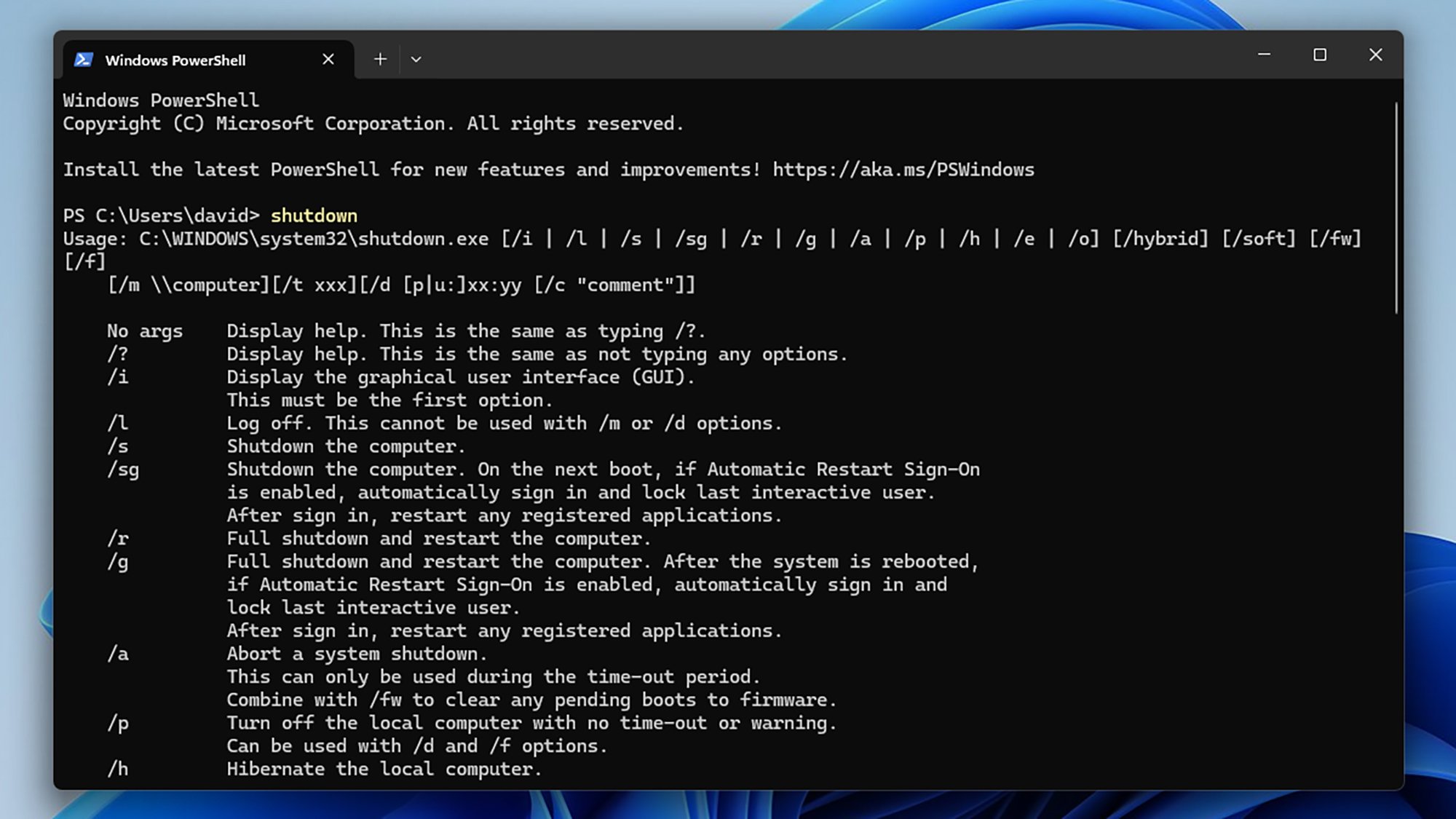
The text command you need to either shut down or restart your Windows computer is ‘shutdown’. If you type it into the command prompt or PowerShell and then hit Enter, you’ll get a full description of shutdown, and all the ways you can use it (by the way, you can add “| more” to this or any command to see a page of text at a time).

Type “shutdown /s” to trigger a standard shutdown

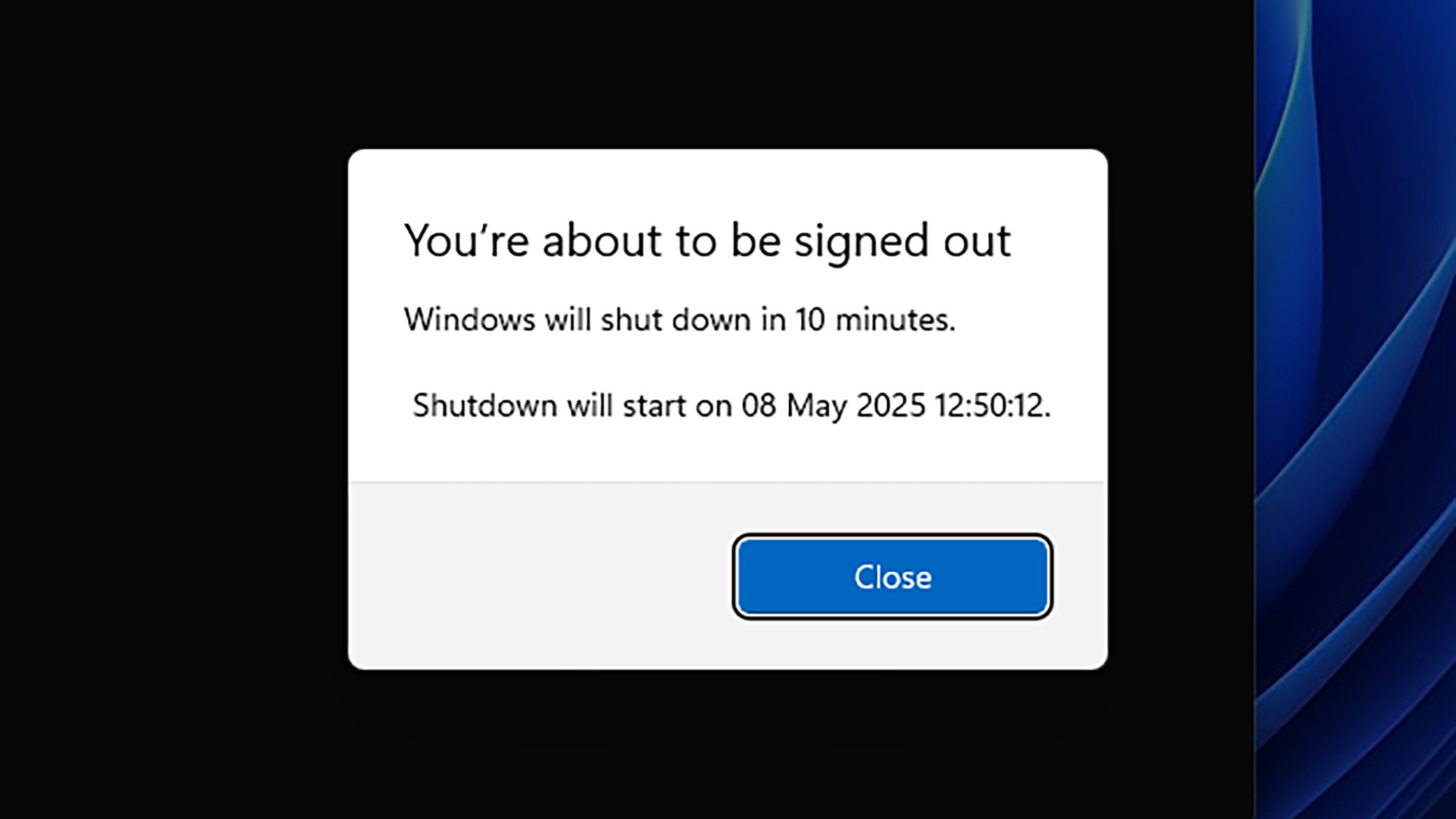
The most basic flags you’ll need are “shutdown /s” and “shutdown /r” to power off and restart your computer, respectively. In both cases you’ll see a dialog box on screen telling you what’s happening, and the action is taken in less than a minute. These commands will initiate a normal shutdown process, so you’ll be prompted to save any unsaved work in your open programs that usually do that.

Command prompt
This will restart Windows and launch the advanced boot options screen.
Credit: Lifehacker

Type “shutdown /s /f” to force a shutdown

To force all apps to close without any further prompting—perhaps if you need to make sure the shutdown or restart goes through without a hitch—add the “/f” to the end of your command (so, either “shutdown /s /f” for a shutdown or “shutdown /r /f” for a restart). You do this at your own risk though, with the risk of losing data that hasn’t already been saved, and it’s probably best left as a last resort.

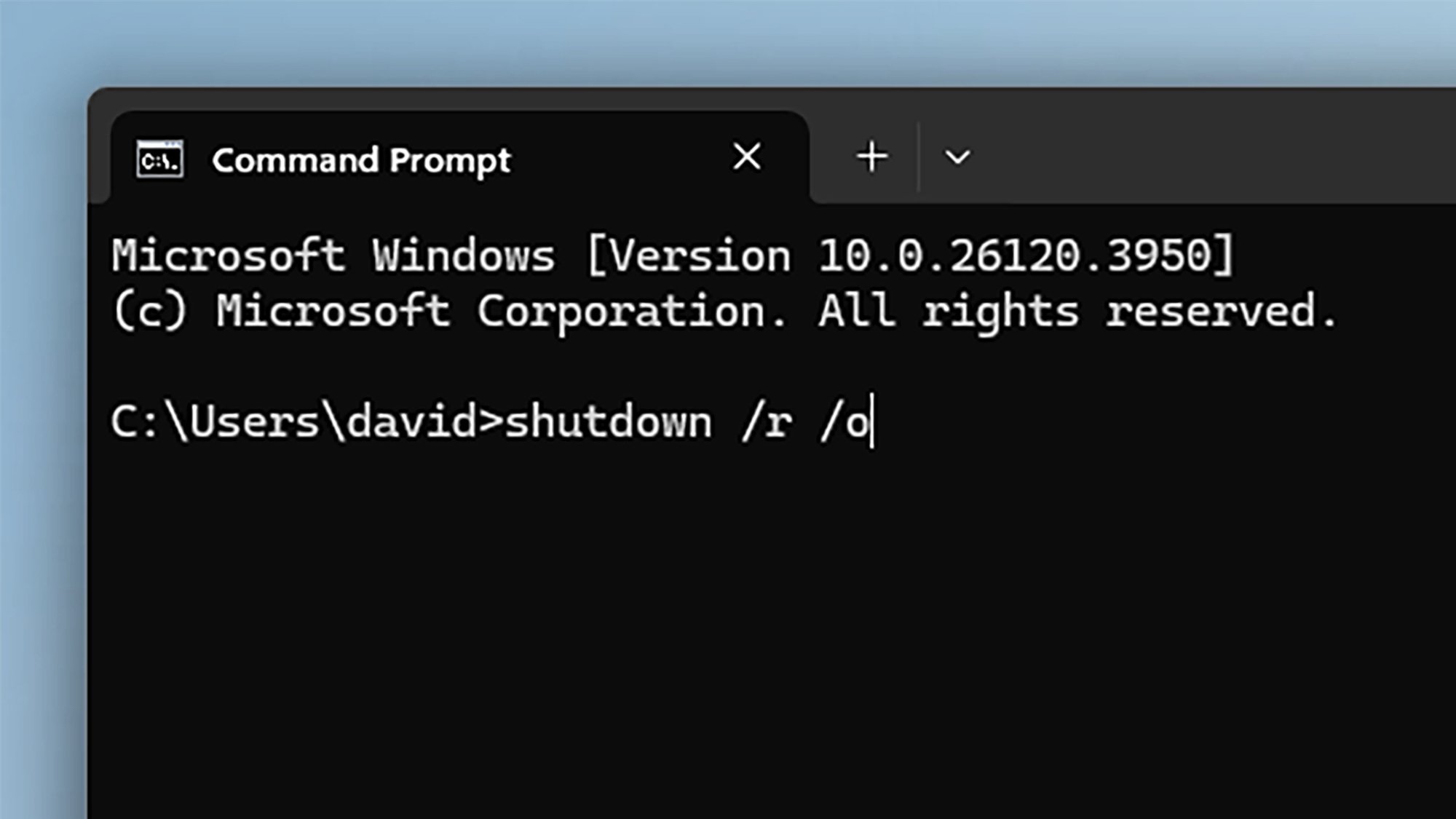
Type “shutdown /r /o” to access advanced boot options

For troubleshooting purposes, the “shutdown /r /o” command is useful because it reboots your computer into the advanced boot options screen. That’s the one that gives you access to features such as using a USB drive to recover your PC, running the built-in start-up repair utility, and rolling back recent updates to Windows. You can also get back to the command prompt from here without starting the operating system.

Cancel shutdown
The shutdown command can also be used to stop a shutdown.
Credit: Lifehacker

Time your shutdown by adding “/t”

Another flag that can be useful is the “/t” flag followed by a space and a number. This puts the shutdown or the restart on a delay, giving you time to close apps or finish downloads. The number is the number of seconds Windows should wait, and it can go from 0 (instant) all the way up to 315360000—that’s 10 years, if you were wondering. If the seconds are set to anything above zero, the “/f” flag is also applied.

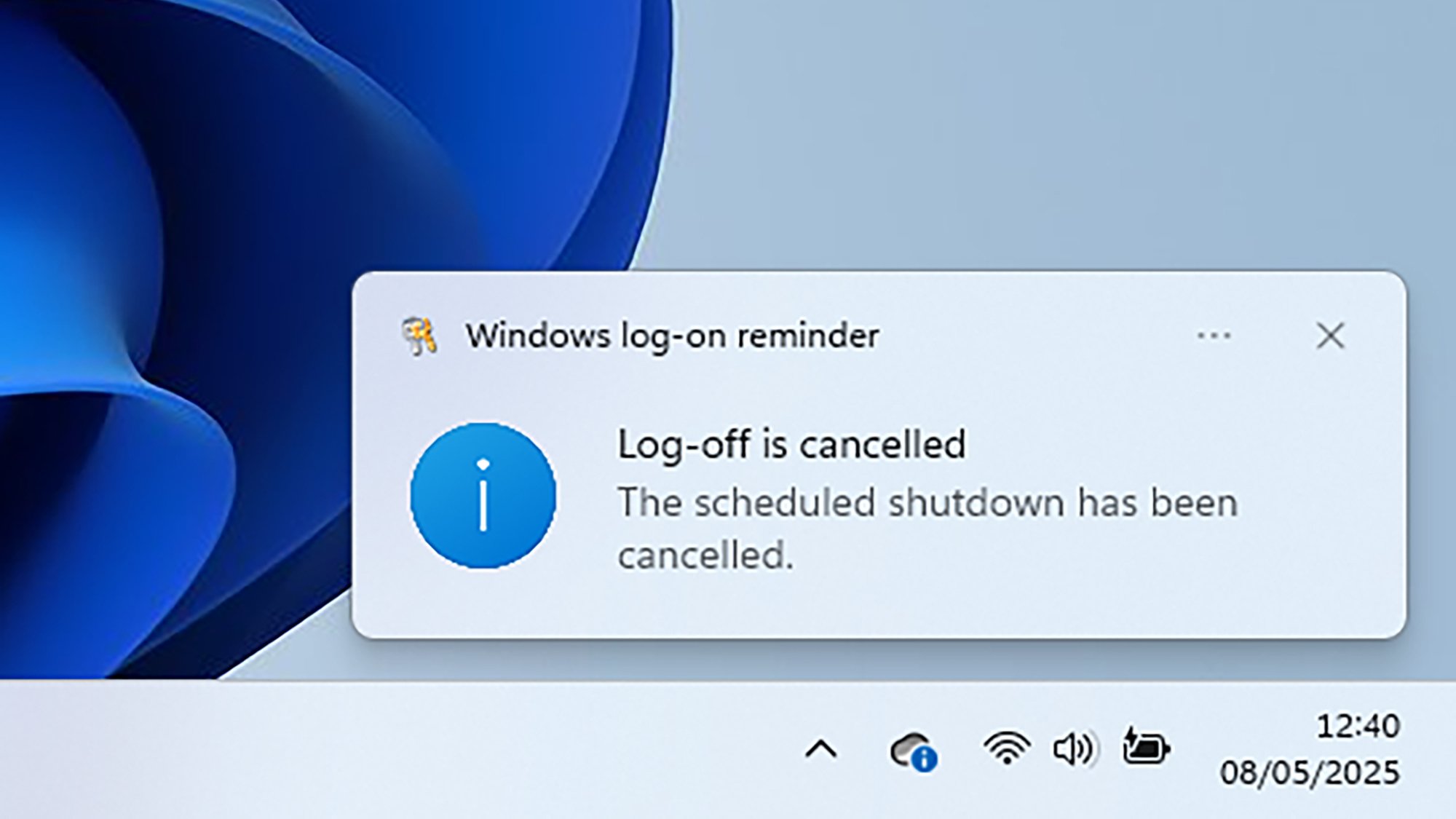
Stop a shutdown with “shutdown /a”

One final one that you might find helpful: You can use “shutdown /a” to abort a shutdown that’s currently underway (perhaps one that you’ve set on a timer). For a full rundown of all the ways you can use this command, including some advanced options for IT managers (such as remote shutdowns), check out the official Microsoft documentation.

The World’s Shortest Wheelbase Car

Modded by the Italians of Youtube channel Carmagheddon, this is what is believed to be the world’s shortest wheelbase car, a chopped FIAT Panda. The wheelbase is so short that pressing the brakes causes the car to attempt a headstand. That’s fun. And by fun I mean dangerous, which is fun for some people. Just not me, I find boredom exhilarating. When the internet goes out I’m in my prime.

Google’s Latest Android Update Patches 46 Security Flaws

Google’s latest Android Security Bulletin patches 46 security vulnerabilities impacting Android devices, one of which is a zero-day flaw in FreeType that may be under “limited, targeted exploitation.”

The security update for May includes fixes for a range of issues: most are an elevation of privilege flaws, though there are a few information disclosure and denial of service vulnerabilities and one remote code execution bug. All are considered high severity. May’s patch also addresses vulnerabilities with Qualcomm, MediaTek, Arm, and Imagination Technologies components.

One active exploit

The zero-day addressed with the latest update is a remote code execution flaw labeled CVE-2025-27363. It impacts FreeType, an open-source font rendering library, and allows attackers to exploit how the program processes certain files. The bug affects FreeType versions 2.13.0 and below and was first reported by security researchers at Facebook in March 2025, though details as to how it has been exploited have not been disclosed.

What Android users need to do

If you have an Android device, you should get a notification to install the latest security update as soon as it’s available. Google pushes patches to Pixel phones and the core Android Open Source Project (AOSP) code, while other device manufacturers—Samsung, Motorola, and Nokia—typically issue updates around the same time.

This month’s patches apply to AOSP versions 13, 14, and 15, with separate updates dated 2025-05-01 and 2025-05-05 (the latter addresses all of the flaws identified). Note that Google ended support for Android 12 as of March 31, meaning devices running this and older versions won’t receive security updates even though they may be affected by some of the vulnerabilities.

If you’re not sure whether your device has been patched, check for available updates via Settings > Security & privacy > System & updates > Security update and follow the prompts to download and install.