How Claude AI’s New Web Search Compares to Gemini and ChatGPT

AI bots want to help with your web searches as well as everything else, and Claude is the latest artificial intelligence assistant to get the ability to look up information online—whether that’s the latest news headlines or the latest prices on gadgets.

“With web search, Claude has access to the latest events and information, boosting its accuracy on tasks that benefit from the most recent data,” says developer Anthropic. The feature is available now across all paid plans, and is “coming soon” for free users.

Web search is a different kind of challenge for AI models, testing their ability to sift through and assess content published on the web, rather than embedded in its training data. Here’s how Claude gets on—and compares to Google Gemini and ChatGPT.

Using web search in Claude
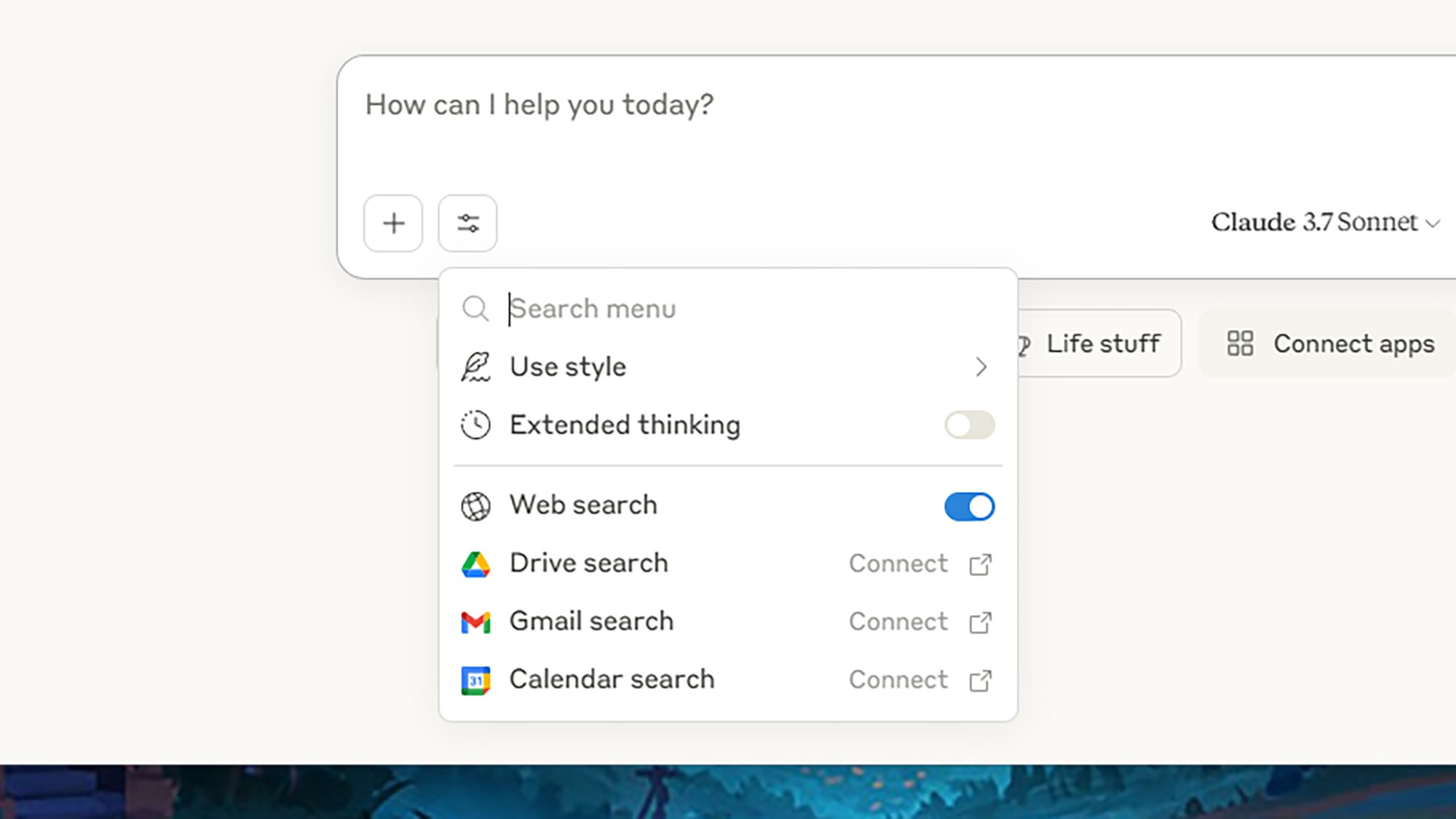
Claude AI web search
Enabling the web search feature.
Credit: Lifehacker

To give Claude web access, click the sliders button in the prompt box, and enable the Web search toggle switch. The AI bot will then refer to the web at large as and when it deems it appropriate to your query, but if you want to make sure it uses online information as part of its response, include something like “search the web” in your prompt.

When a web search is invoked, Claude will notify you as part of the response, and typically takes a little longer to come back with an answer. When the answer does appear, you get small citation buttons at the end of certain sentences, so you know where the information has come from. Click any citation to jump to that website in a new tab.

You can run just about any query you might type into Google, covering everything from weather forecasts and sports scores to deep dives into music history and help with fixing computer problems. As usual, you can then follow up with more questions about the results Claude has given you.

It’s easy to see the potential for AI to upend the way we search the web, in how it offers a more natural, nuanced experience than the standard list of links on Google. It’s not without its problems though—not least whether these AI bots can be trusted, and where they’re going to get their information from if real human beings have no incentive to publish on the web any more.

Getting the news of the day
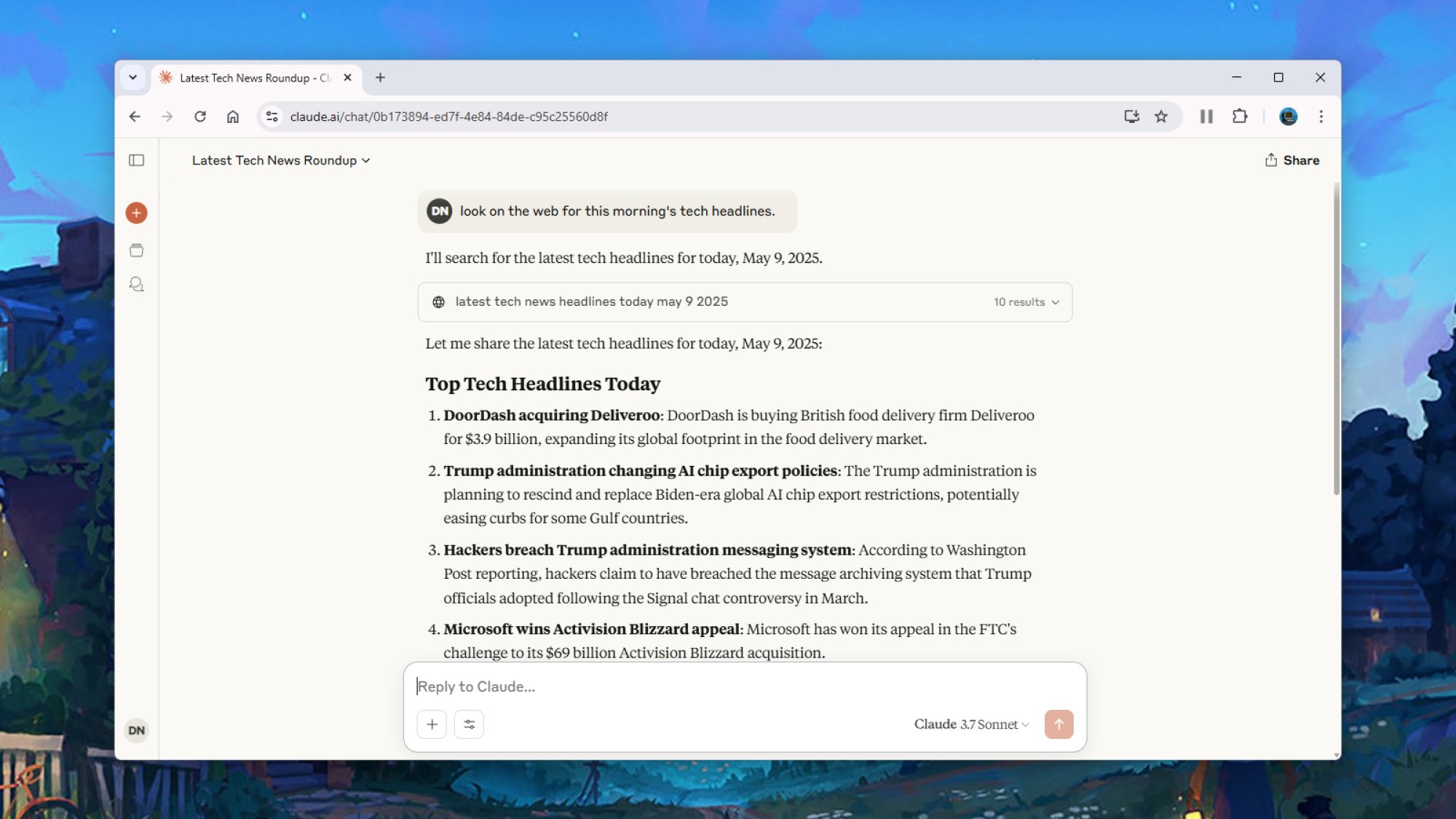
Claude AI web search
Picking out the current tech news.
Credit: Lifehacker

I tasked Claude with bringing me the tech news headlines of the day, and in fact it ran two web searches to make sure it got everything. I read the tech news every day, and Claude did an okay job, here: The stories were mostly new, and mostly relevant, though the citation links tended to go to front pages of news sites, rather than individual articles.

Gemini was about on a par with Claude, though it did manage to link to specific articles, not just news hubs. Almost every result was from the last few days, taken from a reputable source, and relatively significant in the world of tech news, though there were some misses—a new Samsung phone in India, for example, which I don’t really care about.

Over to ChatGPT, and the OpenAI bot was probably the worst of the lot when it came to returning results I cared about from sites that are the most respected in the tech news space (though you could argue that’s a subjective call). It still did fine, but I preferred the results I got from Claude and Gemini.

When asked to return the latest news from Lifehacker, Claude couldn’t do it, and ChatGPT just listed the headlines from the current home page without links. Gemini actually gave me the latest stories, complete with links, so works the best here—though the better option is probably just to open Lifehacker in your browser.

Checking facts online
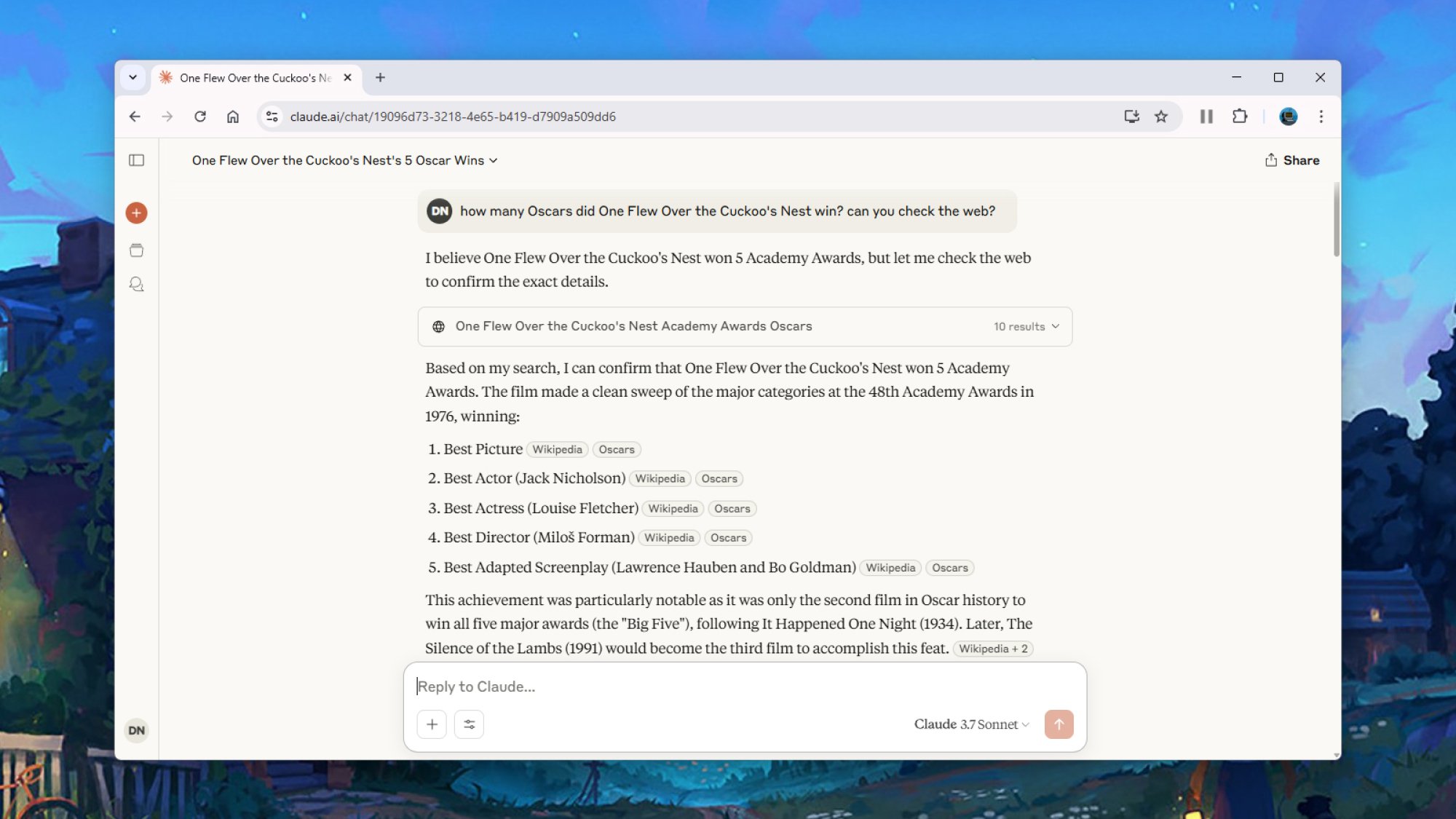
Claude AI web search
Claude knows its movies… or rather, knows to check Wikipedia.
Credit: Lifehacker

Onto fact checking: I tested Claude with a movie question I already know the answer to. How many Oscars were won by One Flew Over the Cuckoo’s Nest? It got the right answer, and the right year, and gave the context that it’s only the third film in history to get all five big Academy Awards: Best director, best actor, best actress, best picture, and best adapted screenplay (see if you can guess what the other two movies are).

Gemini also got the answers and the context of the big five win. Its sources covered a wider variety of sites and even YouTube, whereas Claude stuck to Wikipedia and the official Oscars site. It gave a shorter, more terse response than Claude, and didn’t include background information on box office takings.

As for ChatGPT, it again managed to put together an accurate answer, with the useful context about the big five success and the other movies that have managed the feat. Like Claude, it stuck mainly to Wikipedia, but it did something neither Claude nor Gemini did: It included a video from YouTube of the best picture Oscar presentation.

These kinds of web searches aren’t particularly taxing. More complex questions may pose more problems, especially if the answers aren’t readily available and the AI gets tempted to make them up. I did try and trick these AI bots into thinking Daniel Day-Lewis won two best actor Oscars in consecutive years, but all three correctly identified that this never happened.

Going shopping with AI
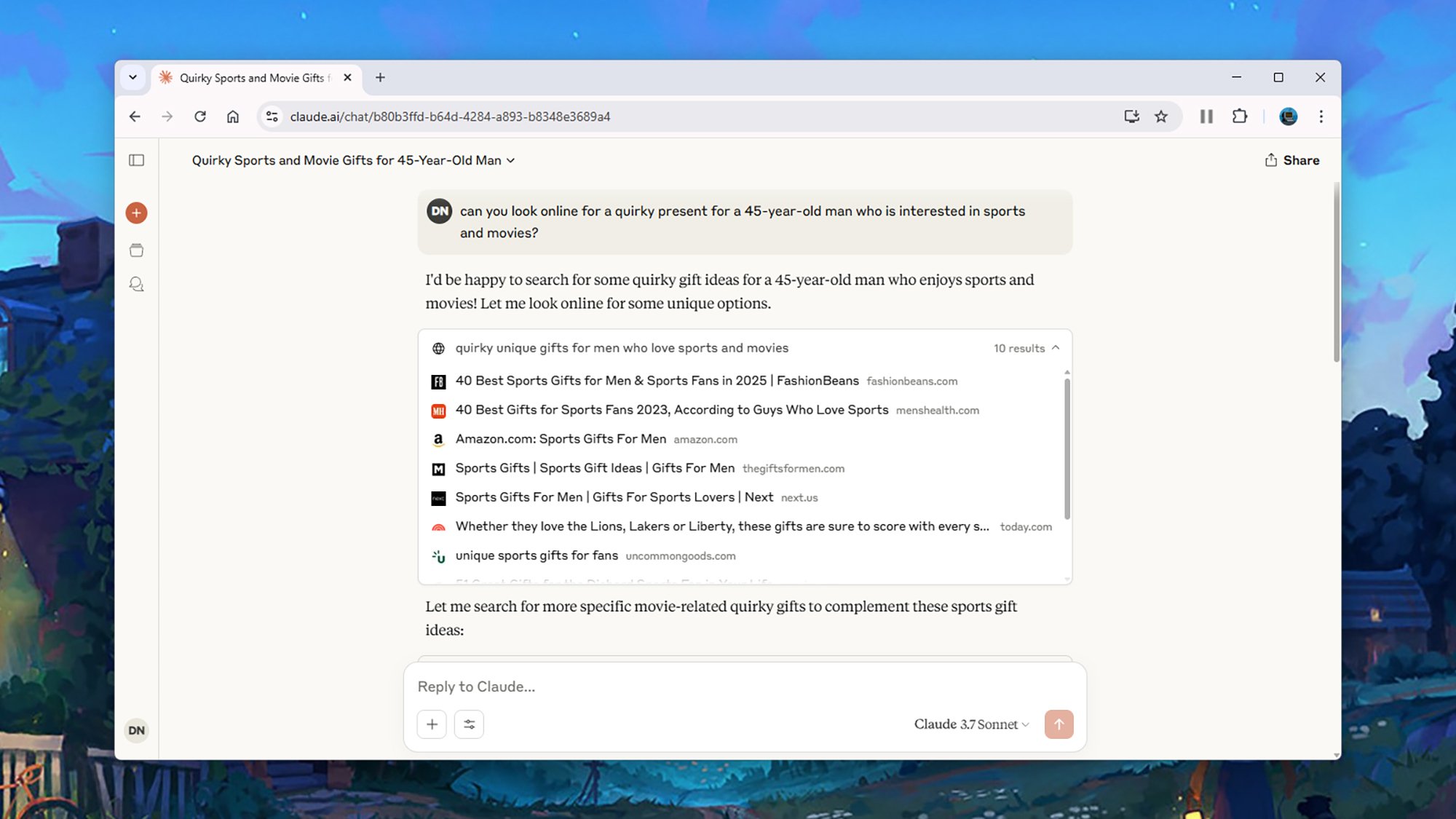
Claude AI web search
Claude isn’t much use for shopping on the web.
Credit: Lifehacker

Online shopping could be transformed by AI. While actual people will always be better than bots at picking out the right purchases, AI can quickly scrape and summarize the opinions of real human beings and package them in a clean, friendly interface while taking a cut of the sales. It’s like having a smart assistant with you, with no need to wade though masses of information or search results.

I asked Claude to recommend a quirky present for myself, based around sports or movies, and it dutifully searched for pages listing quirky sports and movie gifts. It did fine at picking out some ideas, but I think this is one query I could’ve just run myself through Google without troubling AI.

Gemini gave a more personalized, chattier response. It didn’t provide any web links in this case, perhaps because Google wants to keep you going to its main search engine for these sorts of queries: Unlike Claude or ChatGPT, Google already makes a lot of money getting users to click through on purchasing links from its shopping search results.

ChatGPT gave the most useful results here, perhaps thanks to its recent shopping upgrade. The sources it listed were similar to the ones Claude used, but it provided some distinct top picks, together with pricing and links to buy them on the web. Further down the line, this could well be one of the ways OpenAI makes back some of its money.

Web search is clearly still a work in progress for all these AI tools. In some cases it works better than a traditional Google search, but not always, and there’s always the issue of how far you can trust these confident, polished answers without checking on the original sources they’re getting their information from.

Disclosure: Lifehacker’s parent company, Ziff Davis, filed a lawsuit against OpenAI in April, alleging it infringed Ziff Davis copyrights in training and operating its AI systems.

Education Giant Pearson Hit By Cyberattack Exposing Customer Data

An anonymous reader quotes a report from BleepingComputer: Education giant Pearson suffered a cyberattack, allowing threat actors to steal corporate data and customer information, BleepingComputer has learned. Pearson is a UK-based education company and one of the world’s largest providers of academic publishing, digital learning tools, and standardized assessments. The company works with schools, universities, and individuals in over 70 countries through its print and online services. In a statement to BleepingComputer, Pearson confirmed they suffered a cyberattack and that data was stolen, but stated it was mostly “legacy data.”

“We recently discovered that an unauthorized actor gained access to a portion of our systems,” a Pearson representative confirmed to BleepingComputer. “Once we identified the activity, we took steps to stop it and investigate what happened and what data was affected with forensics experts. We also supported law enforcement’s investigation. We have taken steps to deploy additional safeguards onto our systems, including enhancing security monitoring and authentication. We are continuing to investigate, but at this time we believe the actor downloaded largely legacy data. We will be sharing additional information directly with customers and partners as appropriate.” Pearson also confirmed that the stolen data did not include employee information. The education company previously disclosed in January that they were investigating a breach of one of their subsidiaries, PDRI, which is believed to be related to this attack.

BleepingComputer also notes that threat actors breached Pearson’s developer environment in January 2025 using an exposed GitLab access token, gaining access to source code and hard-coded credentials. Terabytes of sensitive data was stolen from cloud platforms and internal systems.

Despite the potential impact on millions of individuals, Pearson has declined to answer key questions about the breach or its response.


Read more of this story at Slashdot.

AMD’s AI Ascent: Open Source, Smart Strategy and Stable Leadership Fuel Growth

Advanced Micro Devices (AMD) continues to impress, turning in another strong financial quarter that underscores its growing prowess, particularly in the white-hot Artificial Intelligence (AI) market. While often viewed as the challenger to NVIDIA’s dominance, AMD’s latest results and strategic positioning reveal a company executing brilliantly on multiple fronts, leveraging not just competitive hardware but also a crucial open-source advantage and steadfast leadership. The recent Q1 2025 earnings report, which saw AMD beat Wall Street expectations with $7.4 billion in revenue (up 36% year-over-year), confirms the momentum is real, largely fueled by its datacenter and AI endeavors.

Riding the AI Wave (and Drafting Behind the Leader)

The star of AMD’s recent performance is undoubtedly its Data Center segment, which surged an impressive 57% year-over-year to $3.7 billion. This growth is powered by strong demand for both its EPYC server CPUs and, crucially, its Instinct AI accelerator GPUs, particularly the MI300 series. While NVIDIA still commands the lion’s share of the AI accelerator market (estimated around 80%), AMD has successfully carved out a significant and rapidly growing position. Generating over $5 billion in Instinct GPU revenue in 2024 and showing continued strength in early 2025, AMD is proving its hardware is a viable, high-performance alternative. Major cloud providers and AI companies like Meta and Microsoft are deploying Instinct GPUs (CRN), validating AMD’s competitiveness. AMD is effectively slipstreaming behind the massive AI demand largely cultivated by NVIDIA, offering powerful hardware like the MI300X and the upcoming MI350 series that plugs into this burgeoning ecosystem.

The Open Source Edge: AMD’s Ace in the Hole

Perhaps AMD’s most significant long-term competitive advantage lies in its software strategy, centered on its ROCm (Radeon Open Compute platform). Unlike NVIDIA’s powerful but proprietary CUDA ecosystem, ROCm is open source. This difference is becoming increasingly important. As AI becomes more integrated into critical business functions, there’s a growing desire among enterprises and developers for flexibility, transparency and avoiding vendor lock-in. The “black box” nature of some proprietary systems can be a concern, especially when dealing with sensitive data or needing deep customization (E-SPIN Group). AMD’s commitment to an open platform resonates strongly with this sentiment. ROCm allows developers greater control, supports multiple programming languages and AI frameworks and fosters community-driven innovation. While CUDA still has a significant head start in maturity and developer adoption, AMD’s open approach is attracting partners and customers who value choice and collaboration, positioning ROCm as a compelling strategic alternative.

Beyond GPUs: Custom Silicon and Software Savvy

AMD’s strategy extends beyond just CPUs and AI GPUs. The company maintains a strong semi-custom business, famously powering consoles like the PlayStation and Xbox, although this segment is currently experiencing a cyclical downturn. More strategically, AMD has broadened its datacenter capabilities through key acquisitions. The landmark purchase of Xilinx brought powerful FPGA (Field-Programmable Gate Array) technology for adaptive computing into the fold, while the acquisition of Pensando added sophisticated DPUs (Data Processing Units) for intelligent networking. Most recently, acquiring AI software specialist Nod.ai aims to accelerate the optimization and deployment of AI models specifically for AMD hardware, further strengthening its open AI software stack. These moves allow AMD to offer more comprehensive platform solutions, integrating compute, networking and adaptability for complex datacenter and AI workloads.

The Steady Hand: Leadership Stability Matters

In the fast-moving, high-stakes semiconductor industry, stable and visionary leadership is invaluable. AMD benefits immensely from the long and highly successful tenures of CEO Dr. Lisa Su (who took the helm in 2014) and CTO Mark Papermaster. They are widely credited with orchestrating one of tech’s most remarkable turnarounds, transforming AMD from a company struggling for survival into a high-performance computing leader (NBC10 Philadelphia). Its consistent focus on technology roadmaps, strategic bets (like chiplets) and disciplined execution has instilled confidence and delivered results. This stability at the top provides a solid foundation for navigating the complexities of the AI era and stands as a significant competitive asset.

Wrapping Up

AMD’s recent success is not accidental; it’s the result of a well-orchestrated, multi-faceted strategy. The company offers increasingly competitive hardware in critical growth markets like AI and datacenters, effectively challenging established players. Its commitment to an open-source software ecosystem with ROCm provides a powerful, long-term differentiator in an industry wary of proprietary lock-in. Strategic diversification through custom silicon and shrewd acquisitions in software and networking further solidify its position. Underpinning all this is the stable, visionary leadership of Lisa Su and her executive team, who continue to execute with remarkable consistency. While challenges like export controls remain, AMD has demonstrated resilience and strategic clarity, positioning itself impressively for continued growth. Congratulations are certainly due for AMD’s excellent work and strong momentum in the age of AI.

The Amazon Fire TV Stick HD Is $20 Right Now

We may earn a commission from links on this page. Deal pricing and availability subject to change after time of publication.

If you’re looking to breathe new life into an older HD television—or even just want an affordable way to stream your favorite shows—the Amazon Fire TV Stick HD makes a strong case for itself. It’s going for $19.99 on Amazon right now.

For 20 bucks, you’re getting access to nearly every major streaming service, Alexa voice control, and support for HDR10 and Dolby Atmos. It’s a budget option, sure, but it doesn’t feel like a stripped-down version of something better. PCMag gave it their Editor’s Choice award for being the best 1080p streaming hub—praise that doesn’t come lightly.

The stick itself is a small black bar that plugs directly into your TV’s HDMI port and powers up through the included micro USB cable. And if your setup is a bit tight on space, Amazon includes a short HDMI extender to help with the fit. As for the remote, it handles everything you might need—volume controls, quick-access buttons for popular streaming apps including Netflix and Prime Video, and voice commands through Alexa. You’ll still need to press the microphone button to use voice search (no hands-free commands), but it works well enough, and it’s not always listening, which some folks might actually prefer.

That said, this isn’t the fastest Fire TV Stick on the block. It handles the basics just fine, but you might notice some lag when jumping between menus or loading up bigger libraries. It also skips out on Apple AirPlay and Google Cast, so screen mirroring from an iPhone or iPad is not an option. Also, since it runs on Wi-Fi 5 instead of Wi-Fi 6, your streaming speeds could take a hit if your network’s already busy. And while it supports HDR10 and Dolby Atmos pass-through, you’ll need a compatible TV or soundbar to actually benefit from it, notes this PCMag review. If you’re using a 4K TV or want faster performance, the Fire TV Stick 4K—at about $10 more—might be a smarter pick. But for anyone just looking to stream in HD with a familiar interface and some solid features packed in, this is a cost-effective way to get there.

Assetto Corsa EVO Update Promises Improved PC VR Performance

The latest Assetto Corsa EVO update added seven new cars and promised PC VR performance improvements.

Following an early access launch in January, Assetto Corsa EVO quickly came under fire for poor performance with its official but optional PC VR support. While short-term workarounds were offered, developer Kunos Simulazioni released an early access roadmap which confirmed that the second major update would feature performance improvements on PC VR. Now, that update has gone live.

Simply titled Update 0.2, this marks what Kunos Simulazioni calls the second step in its optimization roadmap. That notably mentions “numerous improvements to enhance stability and performance across all configurations, including VR setups and triple-screen support.”

While we’ve yet to test this new update ourselves, you can find a comparison video below from HYPEVR TV, and that’s running on an Nvidia GeForce RTX 5090.

Elsewhere, other significant changes include seven new cars; Alfa Romeo Giulia Sprint GTA, Lotus Exige V6 Cup, Porsche 911 Turbo 3.6 [964], Mazda MX-5 NA, Honda NSX-R, Maserati GT2, and the Alfa Romeo 75 1.8 Turbo Evoluzione. Austin’s Circuit of the Americas and the UK’s Donington Park are the two new circuits, and you can now create custom race weekends.

Notably, a new gameplay structure has also been introduced that’s split between ‘Open Mode’ and ‘Career Mode’. Both are playable offline and the former options provides access to all vehicles and customization options immediately. Career Mode uses a progression system with an in-game economy and driver’s academy for unlocking new options. Finally, update 0.2 added a ‘Replay Gallery’ where you can save your race footage, and new tools for adjusting AI performance.

As for what’s next, ‘Step 3’ for VR support is also mentioned in the roadmap’s 3rd major update, though what specifically that will include is unclear and a release date hasn’t been confirmed. Tyre models, a multiplayer mode and two new circuits – the Red Bull Ring circuit and Spa-Francorchamps – are also planned. You can see that in full below.

Assetto Corsa EVO – Early Access Roadmap as of May 7, 2025

Assetto Corsa EVO is available now on Steam Early Access, and the Steam FAQ confirms it’s still aiming for full release “within less than one year from the start of Early Access.”

That Online Joann Fabric and Crafts Sale Is a Scam

When a big-box store files for bankruptcy and goes out of business, there’s often an opportunity to buy its products at rock-bottom prices. But scammers are taking advantage of our love of a good deal: The Federal Trade Commission (FTC) is warning consumers about online clearance sales being advertised by fraudsters impersonating Joann Fabric and Crafts.

Joann Fabric and Crafts filed for Chapter 11 bankruptcy (twice) and in February 2025 announced plans to shutter its stores with going-out-of-business sales. On March 5, the business disabled purchases on its website, but scammers have been promoting online clearance sales using ads on social media sites and running away with customer payments.

How the Joann sale scam works

According to the FTC notice, fraudsters are posting ads for an online Joann bankruptcy sale on Facebook, Pinterest, and Nextdoor. When you click the ad, you’ll land on a fake sale site with deals listed and the ability to actually “purchase” inventory items. You’ll even get a receipt.

Unfortunately, that money is going directly into scammers’ pockets—the charge on your credit card will be something other than Joann, and you won’t receive what you ordered.

How to avoid online sale scams

Whether it’s Joann’s going-out-of-business event or another sale with supposedly great deals, use caution before buying. Scams of all kinds prey on emotions based in urgency, so don’t immediately pull out your credit card for limited-time deals or too-good-to-be-true prices.

Don’t click on ads for online sales—always go directly to the company’s website by typing in the URL to verify that a sale is real. In Joann’s case, there is a notice on the website about fraudulent online sales that states, “There are no other authorized Joann shopping sites.”

If you do shop clearance sales, pay with a credit card and keep receipts. Credit cards have more protections than debit cards in cases of fraud and non-delivery of items you paid for—you can dispute charges and receive a refund.

Notable Zwift Events for the Weekend of May 10-11

A nice mix of featured events this weekend, beginning with two beginner-friendly group rides, moving on to the first races of two new series, and finishing with Sir Chris Hoy’s charity ride. See details below!

� The HERD Thundering Turtles

✅ Beginner Friendly  ✅ Legacy Leader

If you want a more mellow long ride, the HERD offers the perfect option for those trying to build endurance. Paul, the leader, will be holding 1-1.3 w/kg for the duration of the event.

HERD is well-known for its fun and inclusive events that take place daily – we highly recommend joining one of their rides! A great team of leaders and sweepers will be present.

Saturday, May 10 @ 1:30pm UTC/9:30am ET/6:30am PT
Sign up at zwift.com/events/view/4977110

� Bikealicious Rubberband Joy Ride

✅ Banded Ride  ✅ Beginner-Friendly  ✅ Route Badge  ✅ Endurance Challenge

The friendly Bikealicious crew is leading a “keep together” group ride on the Watopia’s “The Pretzel” route (72.6km, 1361). Grab this route badge if you haven’t done so yet, which comes with 1440 of extra XP! This is a banded ride, so as long as you keep turning those pedals over, you’ll hang with the group. Ride whatever pace you’d like!

Saturday, May 10 @ 7am UTC/3am ET/12am PT
Sign up at zwift.com/events/view/4976983

� Zwift Women’s Racing Series p/b FemmeCycle Collab || Race 1

✅ Women Only ✅ Popular

Zwift’s Women’s Racing Series have always been popular, and the first series for 2025 started this week. Saturday is your last chance to race the first event, on Watopia’s Loopin Lava (32.7km, 408m).

It’s somewhat experimental, too, because for the first time ever, race groups are age-based! Learn more here >

Saturday, May 10 at 3:30pm UTC/11:30am ET/8:30am PT
Sign up at zwift.com/events/tag/zwiftwomensracingseries

� 2025 SISU Pinkki – Stage 1

✅ Stage Race  ✅ Unique Event  ✅ Popular

The team at SISU Racing is holding its first Grand Tour of 2025. Held on Saturdays and Tuesdays, it’s a 7-stage tour across the three weeks of the Men’s Giro d’Italia. And it all starts on Saturday, with a lap of Watopia’s The Big Ring (51.2km, 275m).

This is a mass-start event using Zwift Racing Score with separate results for Men and Women. Learn more here >

Saturday in several timeslots
Sign up at zwift.com/events/tag/sisu

� Sir Chris Hoy’s | Tour de 4

✅ Good Cause  ✅ Popular  ✅ Special Guests  ✅ Kit Unlock

Once again, one of the most popular rides this weekend is the open-paced Tour de 4 ride with Sir Chris Hoy (11x world champion and 6x Olympic champion). Tour de 4 is an initiative to change the perception of people living with stage 4 cancer and to raise vital funds for cancer charities across the UK.

Read all about Tour de 4 series >

Rides are 45 minutes long and held weekly on Saturdays. This week’s ride is on the Neokyo All-Nighter route.

Saturday, May 10 @ 9am UTC/5am ET/2am PT
Sign up at zwift.com/events/view/4818030

How We Make Our Picks

We choose each weekend’s Notable Events based on a variety of factors including:

  • Is the event unique/innovative in some way?
  • Are celebrities (pro riders, etc) attending/leading?
  • Are signup counts already high, meaning the event is extra-popular?
  • Does the ride include desirable unlocks or prizes?
  • Does the event appeal to ladies on Zwift? (We like to support this under-represented group!)
  • Is it for a good cause?
  • Is it just plain crazy (extra long races, world record attempts, etc)?
  • Is it a long-running, popular weekly event with a dedicated leader who deserves a shout out?

In the end, we want to call attention to events that are extra-special and therefore extra-appealing to Zwifters. If you think your event qualifies, comment below with a link/details and we may just include it in an upcoming post!

Linux 6.16 Bringing A Fix For Old Intel Haswell Graphics

With the Linux 6.15-rc6 kernel release due out on Sunday, we’re hitting the transition point where the focus on DRM kernel graphics drivers for Linux 6.16 is shifting from feature work to bug-fixing ahead of this next merge window. As such sent out today were drm-misc-next and drm-intel-gt-next pull requests focused on preparing various kernel graphics/display driver fixes for the new code coming to Linux 6.16. The Intel pull request today even contains a fix for aging Intel Haswell graphics…

Rocket Report: Rocket Lab to demo cargo delivery; America’s new ICBM in trouble

Welcome to Edition 7.43 of the Rocket Report! There’s been a lot of recent news in hypersonic testing. We cover some of that in this week’s newsletter, but it’s just a taste of the US military’s appetite for fielding its own hypersonic weapons, and conversely, the Pentagon’s emphasis on the detection and destruction of an enemy’s hypersonic missiles. China has already declared its first hypersonic weapons operational, and Russia claims to have them, too. Now, the Pentagon is finally close to placing hypersonic missiles with combat units. Many US rocket companies believe the hypersonics sector is a lucrative business. Some companies have enough confidence in this emerging market—or lack of faith in the traditional space launch market—to pivot entirely toward hypersonics. I’m interested in seeing if their bets pay off.

As always, we welcome reader submissions. If you don’t want to miss an issue, please subscribe using the box below (the form will not appear on AMP-enabled versions of the site). Each report will include information on small-, medium-, and heavy-lift rockets, as well as a quick look ahead at the next three launches on the calendar.

Stratolaunch tests reusable hypersonic rocket plane. Stratolaunch has finally found a use for the world’s largest airplane. Twice in the last five months, the company launched a hypersonic vehicle over the Pacific Ocean, accelerated it to more than five times the speed of sound, and autonomously landed at Vandenberg Space Force Base in California, Ars reports. Stratolaunch used the same Talon-A vehicle for both flights, demonstrating its reusability, a characteristic that sets it apart from competitors. Zachary Krevor, Stratolaunch’s president and CEO, said his team aims to ramp up to monthly flights by the end of the year.

Read full article

Comments

IRS Hopes To Replace Fired Enforcement Workers With AI

Facing deep staffing cuts, the IRS plans to lean heavily on AI to maintain tax collection efforts, with Treasury Secretary Scott Bessent stating that smarter IT and the “AI boom” will offset reductions in revenue enforcement staff. The Register reports: When asked by Congressman Steny Hoyer (D-MD) whether proposed reductions in the IRS’s IT budget, along with plans to cut additional staff, would affect the agencies ability to collect tax revenue, Bessent said it wouldn’t, thanks to the current “AI boom.” “I believe through smarter IT, through this AI boom, that we can use that to enhance collections,” Bessent told Hoyer and the Committee (24:29 into the video linked [here]). “I expect collections would continue to be very robust as they were this year.”

Bessent’s comments didn’t explain how the IRS intends to deploy AI. Given how much it has slashed its enforcement staff since Trump took office, the agency definitely needs to do something. […] Bessent’s comments didn’t explain how the IRS intends to deploy AI. Given how much it has slashed its enforcement staff since Trump took office, the agency definitely needs to do something. “There is nothing that shows historically that bringing in unseasoned collections agents will result in more collections,” Bessent told the Committee. “IRS already uses AI for business functions including operational efficiency, compliance and fraud detection, and taxpayer services,” the agency told The Register. “AI use cases must follow all relevant IRS privacy and security policies.”


Read more of this story at Slashdot.

‘Alien: Rogue Incursion’ is Getting a Non-VR Version Later This Year

Survios announced it’s bringing a flatscreen version of Alien: Rogue Incursion (2024) to PC and PS5 in a new ‘Evolved Edition’.

Released on PSVR 2 and PC VR headsets late last year, and then Quest 3 in early 2025, Alien: Rogue Incursion initially received mixed reviews prior to the studio’s slate of patches, which critically rebalanced Xenomoph behavior and spawn rate to make encounters feel less repetitive.

Now, Survios says the VR game has been “re-envisioned” for PC and PS5 users, and is coming to Steam and the PlayStation Store as a separate game on September 30th, 2025.

Following Zula Hendricks, an ex-Colonial Marine working to expose Weyland-Yutani’s black site experiments, you and your synth companion ‘Davis 01’ travel to the planet Purdan. Zula must infiltrate the Xenomorph-infested Gemini Exoplanet Solutions research facility using stealth and a pile of weaponry.

Like the VR version, Survios says the flatscreen release will be ‘Part One’ of two. To boot, Survios announced last year it was already working on Part Two, noting that the next installment will pit Zula “against deadlier enemies and more difficult challenges.”

It’s uncertain when Part Two will launch, or whether the studio hopes to similarly stagger its VR and non-VR releases, or otherwise package both modes into a single experience.

While Alien: Rogue Incursion was designed from the ground-up for VR interactions, it’s not the first time Survios has adapted a VR native ex post facto to the flatscreen. In 2021, the studio released Big Rumble Boxing: Creed Champions, which reimagined the physical gameplay of VR boxer Creed: Rise to Glory (2018) into an arcade-style fighting game.

The post ‘Alien: Rogue Incursion’ is Getting a Non-VR Version Later This Year appeared first on Road to VR.