Elizabeth Holmes has lost her bid to have the appeal of her 2022 fraud conviction reheard by the 9th Circuit Court of Appeals, leaving the U.S. Supreme Court as her final option. She and former Theranos executive Sunny Balwani remain liable for $452 million in restitution, while Holmes continues serving her 11-year sentence. CNBC reports: The 9th Circuit U.S. Court of Appeals denied Holmes’ request for a rehearing before the original three-judge panel that upheld her conviction. At the same time, the court said no judge on the circuit court had asked for a vote on whether to have the full court rehear the appeal.
Holmes, 41, was sentenced in January 2023 to 11 years and 3 months in prison after being found guilty of four counts of wire fraud in January 2022. She was found guilty of deceiving investors about the capabilities of Theranos, the blood-testing company she founded in 2003. The company crumbled after a Wall Street Journal story outlined the firm’s struggles and shut down in 2018.
Meta has revealed a new version of its 3D asset generation AI system that it says is a “significant leap forward”.
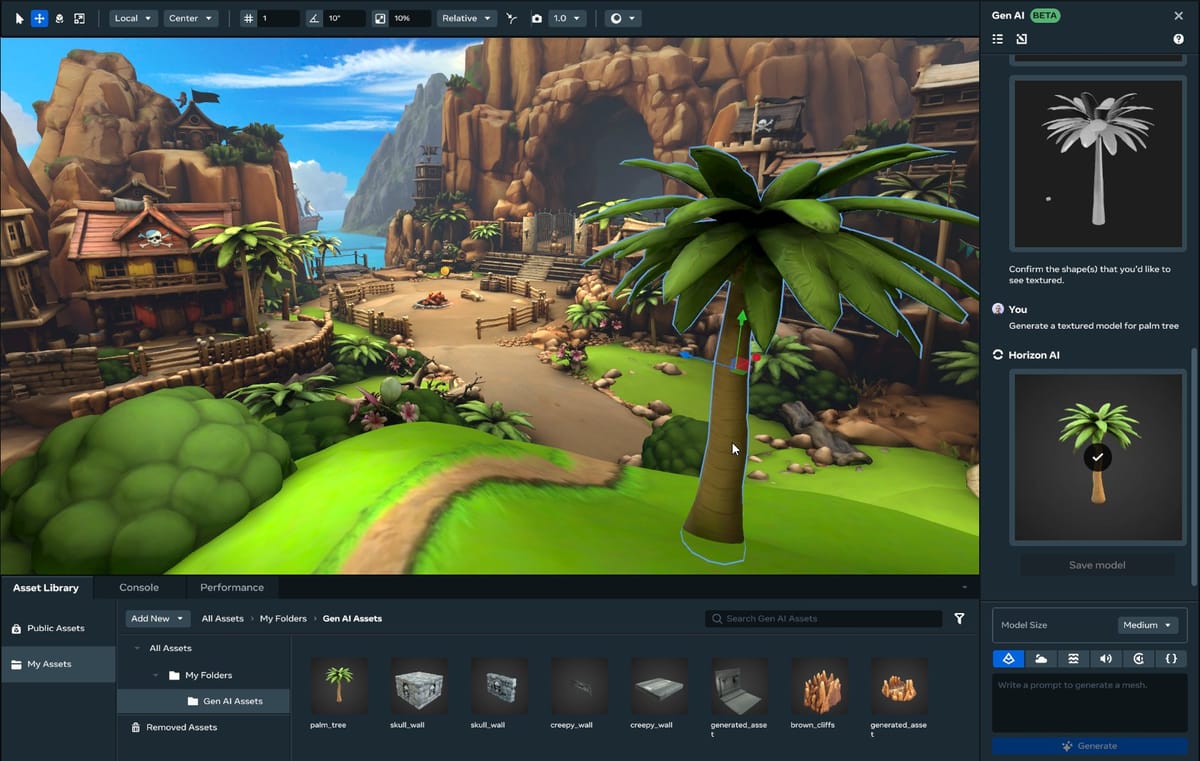
The Meta Horizon Desktop Editor tool, used to create Horizon Worlds experiences, added the ability to AI-generate 3D assets from text prompts last month, seemingly leveraging Meta’s original AssetGen model from 2024. This lets anyone build a custom virtual world in a matter of hours for free, with no 3D modeling skills required. But these AI-generated assets have noticeable quality issues, especially visible close up in VR, and that’s what AssetGen 2.0 is meant to address.
AssetGen 2.0 delivers “dramatically improved detail and fidelity” compared to the original, Meta claims, including “geometric consistency with very fine details”. The company says AssetGen 2.0 sets a new standard for the industry, and “pushes the boundaries of what’s possible” with generative AI.
On a technical level, AssetGen 2.0 uses a completely different architecture than the original. AssetGen 1.0 worked by first generating multiple 2D image views of the intended asset, based on the prompt, then feeding these images to another neural network which generates the asset. In contrast, AssetGen 2.0 is a single-stage 3D diffusion model, directly generating the asset from the text prompt, and was directly trained on a large corpus of 3D assets.
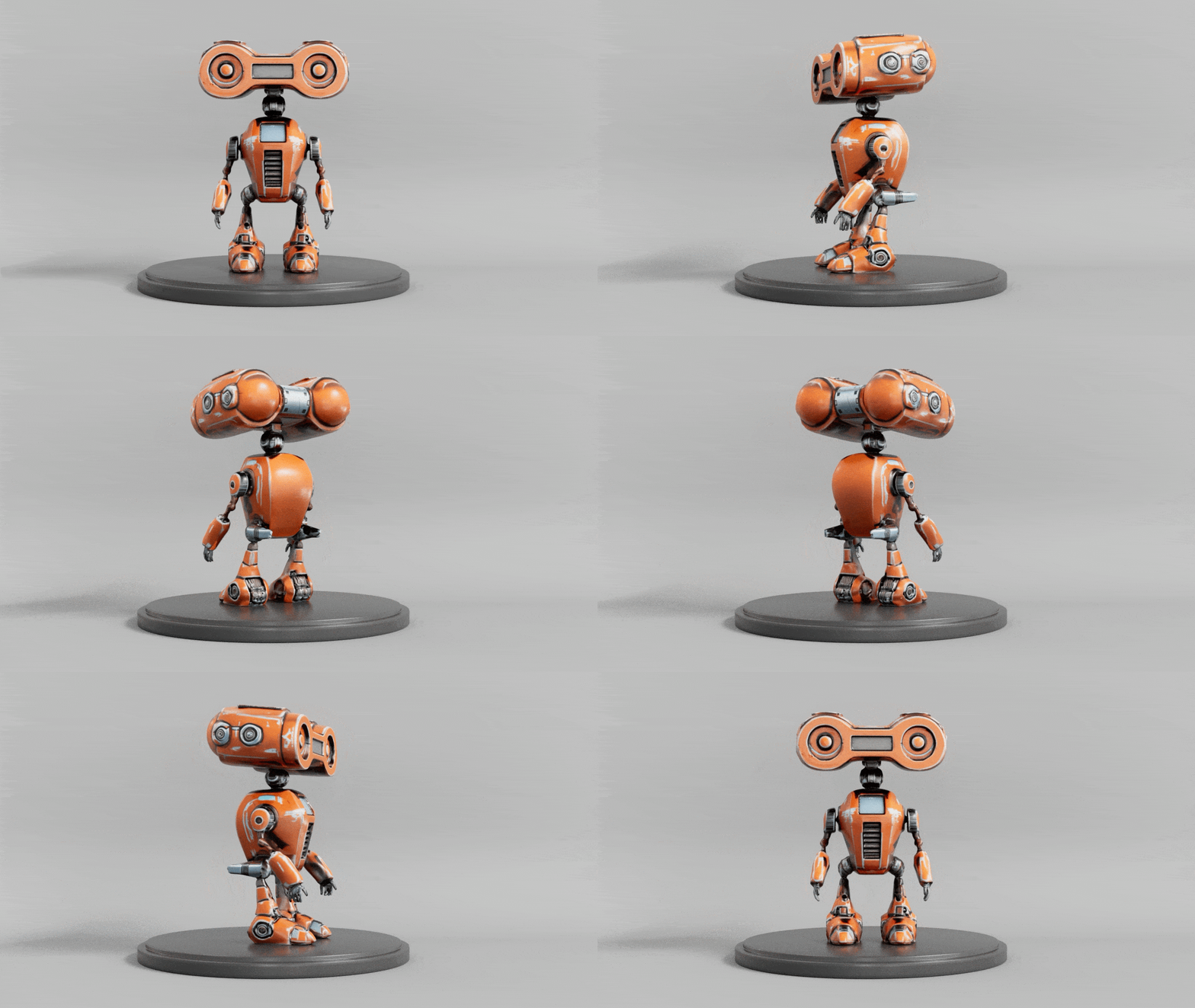
3D assets generated by Meta’s AssetGen 2.0 AI model.
Meta says it’s already using AssetGen 2.0 “internally” for 3D worlds creation, and will roll it out to the Horizon Desktop Editor later this year.
“We expect AssetGen 2.0 to help democratize the creation of 3D experiences, making it as accessible as 2D content creation and opening up new creative possibilities for artists, designers, and developers working on Meta’s Horizon and Avatar platforms”, the company writes.
Meta also teased that it’s working on AI generation of “entire 3D scenes”, which will enable creators to generate entire worlds in a matter of minutes using text or image prompts, not just individual assets.
Huawei has launched its first laptop running HarmonyOS instead of Windows, complete with AI features and support for over 2,000 mostly China-focused apps. The product is largely a result of U.S. sanctions that prevented U.S.-based companies like Google and Microsoft from doing business with Huawei, forcing the company to develop its own in-house solution. Liliputing reports: Early version of HarmonyOS were basically skinned version of Android, but over time Huawei has moved the two operating systems further apart and it now includes Huawei’s own kernel, user interface, and other features. The version designed for laptops features a desktop-style operating system with a taskbar and dock on the bottom of the screen and support for multitasking by running multiple applications in movable, resizable windows.
Since this is 2025, of course Huawei’s demos also heavily emphasize AI features: the company showed how Celia, its AI assistant, can summarize documents, help prepare presentation slides, and more. While the operating system won’t support the millions of Windows applications that could run on older Huawei laptops, the company says that at launch it will support more than 2,000 applications including WPS Office (an alternative to Microsoft Office that’s developed in China), and a range of Chinese social media applications.
Back in January you may recall the news of GNOME’s Showtime app looking to replace Totem as the default video player. That didn’t happen in time for GNOME 48 back in March but this week all the formalities were met that Showtime has been cleared to replace the outdated Totem with GNOME 49…
Mexico has filed a lawsuit against Google for changing the name of the Gulf of Mexico to “Gulf of America” for U.S. users on Google Maps, following a Republican-led House vote on Thursday to codify the name change. President Claudia Sheinbaum argues the U.S. only has authority to rename its portion of the continental shelf and warned of legal action unless Google reversed the change. The Guardian reports: “All we want is for the decree issued by the US government to be complied with,” Sheinbaum said. “The US government only calls the portion of the US continental shelf the Gulf of America, not the entire gulf, because it wouldn’t have the authority to name the entire gulf,” she added. In response to Trump, Sheinbaum has cheekily suggested calling the United States “America Mexicana” — Mexican America, pointing to a map dating back to before 1848, when one-third of her country was seized by the United States.
Get in the bin: For the first time since 2012, some older CPU generations are being choppedKernel 6.15 is taking shape and it looks like it will eliminate support for Intel’s 486 chip and its contemporaries.…
Hello, Dot from Niantic Spatial on Quest 3 is one of the most impressive mixed reality experiences I’ve tried.
The release follows a basic demo a year ago with a much more fully featured experience. Available now, the full experience presses Quest 3’s mixed reality capabilities to the max by leveraging the scene mesh and supporting dynamic occlusion. Here’s a quick video I shot playing with a laser in each reality.
0:00
/1:27
It’s a lot of fun having a visit with another dot in the game, seeing them making eye contact with one another, and watching them bump off the walls as you playfully bat them around the environment. Development studio Niantic Spatial, which split from the group behind Pokemon Go in March, hinted that the updates include “a nod to the future and the possibilities of Peridot agentic guides.”
Dual wielding a vacuum while using a laser to entertain a pair of dots was pretty fun as well. There’s a toolbox, described as an “interactive contraption reminiscent of an arcade machine” you can roll from room to room as needed to access additional activities and games. Grab it by the handle and take it into another room in mixed reality and its wheels seem to scrabble along the floor in a believable way. Quest 3 also seemed to insert the object into my environment around physical obstructions.
Mini games include a dodgeball game and an eating contest with unlockable outfits and environmental accessories. The toolbox includes a microphone you can use to say what you want your creature to look like before you dunk it in a paint bucket. I saw some interesting patterns from the process but nothing seemed related to my prompts.
Hello, Dot is also available on Apple Vision Pro, but a Niantic representative said “at this time” that version of the experience will be the introductory ‘showcase’ project they launched last year.
Seventh in 2025 alone! For those who don’t know, Lou Gerstner accepted that IBM was unsustainable as a business and fired an unprecedented (truly huge) number of staff. For this he became either admired or reviled at IBM (depending on which side of the axes one fell). He sure left “his mark” (or stain).
A starry sky can be stunning—even inside a hospital emergency room.
But instead of celestial bodies sparkling in the night, doctors in South Korea were gazing at bright brain lesions punctuating a magnetic resonance imaging (MRI) scan. The resulting pattern, called a “starry sky,” meant that their 57-year-old patient had a dangerous form of tuberculosis. The doctors report the case in this week’s issue of the New England Journal of Medicine.
The man had previously been treated for the infection in his lungs but came into the hospital’s emergency department after two weeks of unexplained headaches, neck pain, and tingling in his right hand. The MRI and Computed-Tomography (CT) scans clearly revealed the problem: rare nodules and lesions, called tuberculomas, speckling his lungs and central nervous system, including both cerebral hemispheres, the basal ganglia deep inside the brain, the cerebellum at the back of the brain, the brain stem, and the upper spinal cord.
On Thursday, researchers at Carnegie Mellon University unveiled LegoGPT, an AI model that creates physically stable Lego structures from text prompts. The new system not only designs Lego models that match text descriptions (prompts) but also ensures they can be built brick by brick in the real world, either by hand or with robotic assistance.
“To achieve this, we construct a large-scale, physically stable dataset of LEGO designs, along with their associated captions,” the researchers wrote in their paper, which was posted on arXiv, “and train an autoregressive large language model to predict the next brick to add via next-token prediction.”
This trained model generates Lego designs that match text prompts like “a streamlined, elongated vessel” or “a classic-style car with a prominent front grille.” The resulting designs are simple, using just a few brick types to create primitive shapes—but they stand up. As one Ars Technica staffer joked this morning upon seeing the research, “It builds Lego like it’s 1974.”
An anonymous reader quotes a report from TechCrunch: A Florida bill, which would have required social media companies to provide an encryption backdoor for allowing police to access user accounts and private messages, has failed to pass into law. The Social Media Use by Minors bill was “indefinitely postponed” and “withdrawn from consideration” in the Florida House of Representatives earlier this week. Lawmakers in the Florida Senate had already voted to advance the legislation, but a bill requires both legislative chambers to pass before it can become law.
The bill would have required social media firms to “provide a mechanism to decrypt end-to-end encryption when law enforcement obtains a subpoena,” which are typically issued by law enforcement agencies and without judicial oversight. Digital rights group the Electronic Frontier Foundation called the bill “dangerous and dumb.” Security professionals have long argued that it is impossible to create a secure backdoor that cannot also be maliciously abused, and encryption backdoors put user data at risk of data breaches.
This week brought us three more new episodes of Andor, and one step closer to next week’s series finale. This trio was probably the most impressive and devastating yet, bringing the events on Ghorman to an incendiary head and bringing some character arcs to a sudden and permanent end.
Fitness tracker company Whoop has upset some long-time customers by ending an upgrade system that promised free hardware upgrades to anyone who had a subscription with the company for at least six months.
Whoop makes fitness tracker bracelets that let users access things like sleep tracking, menstrual tracking, and electrocardiograms (ECGs) via a subscription companion app. Since the first Whoop wearable came out in 2015, the Boston-based company’s business has been built on subscriptions. Whoop has traditionally lured customers in by giving its hardware away for “free” to Whoop app subscribers. Further, customers who subscribed to the Whoop app for at least six months got access to free hardware upgrades.
“Instead of purchasing new hardware every time an updated model is produced, WHOOP members receive the next-generation device for free after having been a member for six months or more,” said a webpage on Whoop’s website that is no longer active but was accessible as recently as March 28, as reported by The Verge and confirmed via the Internet Archive’s Wayback Machine.
The Fedora Project is built on the dedication, mentorship, and relentless efforts of contributors who continuously go above and beyond. From reviewing pull requests to onboarding new community members, from writing documentation to organizing events — it’s these quiet champions who make Fedora thrive. As a part of the Fedora Mentor Summit , we would […]
A new report indicates that the recent delay of Grand Theft Auto 6, now scheduled to launch in May of 2026, has had a big impact across the gaming industry as studios and publishers try to plan their next moves fearing (or hoping) that Rockstar Games might push the release date back again for what is almost guaranteed…
Just days after a radar and communications outage at Newark Liberty International Airport, the FAA confirmed a second incident on May 9 that disrupted radar and radio contact for 90 seconds due to a telecom failure at Philadelphia TRACON. “As of 12:30PM ET, FlightAware stats showed 292 total delays for flights into or out of Newark, which is also experiencing delays due to runway construction,” reports The Verge. From the report: After the first outage on April 28th, an air traffic controller who had been on duty that day told CNN it “…was the most dangerous situation you could have.” CNN reports that after a change made last July, the airport’s radar and radio communication flows over a single data feed from a facility in New York, where controllers used to manage Newark’s flights, to Philadelphia.
The FAA has announced a plan to replace the current copper connection with fiber, as well as adding “three new, high-bandwidth telecommunications connections between the New York-based STARS and the Philadelphia TRACON,” and more air traffic controllers. Until those and other changes are made, the agency also said a new backup system is being deployed in Philadelphia, but it’s unclear when that will be available.
NBC News reports the Friday outage affected a limited number of sectors, but it’s another incident in the string of issues that have highlighted the problems with the airport’s aging control system and lack of staffing. […] A statement from the FAA said, “Frequent equipment and telecommunications outages can be stressful for controllers. Some controllers at the Philadelphia TRACON who work Newark arrivals and departures have taken time off to recover from the stress of multiple recent outages.”
Epic Games is taking a victory lap after its recent court win by asking Apple to put Fortnite back in the App Store and giving players bonus V-bucks if they bypass the iPhone maker’s fees and buy directly from the Epic Games Store. It’s the start of a potential revolution on the App Store, but could also have big…
Borderlands 4 is now just a few months away, and if it’s anything like the previous games in the looter shooter series it will be one of the top-selling blockbusters of 2025. But how much will it cost? Will publisher 2K try to undercut the competition or match it as some new releases creep up to $80 this year? Gearbox…
As of May 1st, 2025, Canonical has officially opened the development of Ubuntu 25.10 (codename Questing Quokka), and now they published the first daily build ISO images for early adopters, application developers, and general public testing.