Asking Chatbots For Short Answers Can Increase Hallucinations, Study Finds

Requesting concise answers from AI chatbots significantly increases their tendency to hallucinate, according to new research from Paris-based AI testing company Giskard. The study found that leading models — including OpenAI’s GPT-4o, Mistral Large, and Anthropic’s Claude 3.7 Sonnet — sacrifice factual accuracy when instructed to keep responses short.

“When forced to keep it short, models consistently choose brevity over accuracy,” Giskard researchers noted, explaining that models lack sufficient “space” to acknowledge false premises and offer proper rebuttals. Even seemingly innocuous prompts like “be concise” can undermine a model’s ability to debunk misinformation.


Read more of this story at Slashdot.

Everything Samsung Just Announced About the Galaxy S25 Edge

After teasing the device in January at Unpacked 2025, Samsung is ready to make the Galaxy S25 Edge official. The company revealed latest device in the S25 series during a special Monday night event. While there are many similarities between the Edge and the other S25 devices, what makes this particular model stand out from the rest is how slim it is: The S25 Edge is just 5.8mm thick, 1.4mm thinner than the standard S25, and Samsung’s thinnest phone yet.

Everything Samsung revealed about the S25 Edge

Just like the rest of the S25 phones, the new Galaxy S25 Edge is powered by the Qualcomm Snapdragon 8 Elite for Galaxy chip. That SoC (system on a chip) brings a number of improvements to the entire S25. According to Qualcomm, that includes a 45% boost in performance, and a 44% better power efficiency when compared to the S24’s Snapdragon 8 Gen 3 for Galaxy. The chip also includes a new Adreno GPU which Qualcomm says adds a 40% performance boost over the previous generation. There’s also 12GB of RAM and either 256GB or 512GB of internal storage.

The S25 Edge features a 6.6-inch Dynamic AMOLED 2X display, with a QHD+ screen resolution of 3120 x 1440 that supports an adaptive refresh rate. That means the display can refresh anywhere from one to 120Hz, depending on the situation. For biometrics, the phone has an ultrasonic in-display fingerprint sensor along with face recognition.

On the camera side, the Galaxy S25 Edge has a dual camera setup with a 200 MP wide lens and 12 MP ultra-wide and front lenses. The periscope lens offers 10x optical zoom. This is one of Samsung’s strengths, since most smartphone makers resort to digital zoom, or, essentially, cropping the image rather than offer a dedicated zoom.

Samsung is focusing a lot on how thin this phone is, but there’s a trade-off for that form factor: The S25 Edge has a 3,900 mAh battery, which is the smallest battery of all the Galaxy S25 phones. But there’s still support for 25W wired charging and up to 15W wireless charging.

Just like the rest of the S25 series, you’ll get access to all the latest Galaxy AI features. That includes the Now Brief, which uses AI to show you prevalent info throughout the day; Note assist, which will transcribe your notes, Live translate, and much more via Galaxy AI’s integration with Google Gemini.

The Samsung Galaxy S25 Edge will be available in Titanium Black and Titanium Silver.

Google Launches New Initiative To Back Startups Building AI

Google has launched the AI Futures Fund, a new initiative to invest in AI startups that are building with the latest tools from Google DeepMind. TechCrunch reports: The fund will back startups from seed to late stage and will offer varying degrees of support, including allowing founders to have early access to Google AI models from DeepMind, the ability to work with Google experts from DeepMind and Google Labs, and Google Cloud credits. Some startups will also have the opportunity to receive direct investment from Google.

“The AI Futures Fund doesn’t follow a batch or cohort model,” a Google spokesperson told TechCrunch. “Instead, we consider opportunities on a rolling basis — there’s no fixed application window or deadline. When we come across companies that align with the fund’s thesis, we may choose to invest. We’re not announcing a specific fund size at this time, and check sizes vary based on the company’s stage and needs — typically early to mid-stage, with flexibility for later-stage opportunities as well.” Startups can apply here.


Read more of this story at Slashdot.

Samsung Galaxy S25 Edge Trims Fat For A Sleek, Slim AI-Powered Smartphone

Samsung Galaxy S25 Edge Trims Fat For A Sleek, Slim AI-Powered Smartphone
Samsung’s Galaxy S25 range of flagship phones is now complete, thanks to the addition of the new, svelte Galaxy S25 Edge handset. Its 5.8mm-thick titanium main frame is bound to elicit some “oohs” and “aahs” from smartphone lovers worldwide, especially those drooling over the upcoming iPhone 17 Air.

The Edge (phone, not the U2 guitarist)

Philips Debuts 3D Printable Components To Repair Products

Philips has launched a new initiative called “Philips Fixables,” offering free, officially drafted 3D-printable replacement parts to encourage self-repair and sustainability. The program is initially available in the Czech Republic but aims to expand over time. Tom’s Hardware reports: This is a new idea, so only one component is available right now for download. The piece happens to be a 3mm comb for one of their shavers, but Philips assures there will be more components made available for more of their devices over time. This isn’t the release of a grand library of parts by any means, but it does showcase a shift in supporting communities in search of businesses that support repairable hardware. […]

The official Philips Fixables web page has a link for anyone in the general public to submit a request to add a specific component. Philips will notify customers with a download link if the component they suggested is able to be shared to Philips Fixables. It’s not clear what sort of turnaround time to expect for these requests and whether there are limitations on what components will be made available.

According to Philips, consumers must adhere to the recommended print settings for their components to get the best results. This is the only way to ensure the replacement part is sturdy enough to stand in for a repair. Compromising on fill space for time could make or break your user experience, for example, but if done correctly, a replacement 3D print can be a useful long term solution.
You can check out the files over at Printables.com.


Read more of this story at Slashdot.

Updated Nouveau Driver Patches For NVIDIA Hopper & Blackwell GPUs

At the end of April was the open-source surprise of NVIDIA posting Nouveau Linux driver patches for their Hopper and Blackwell GPUs. This comes to complement their official (open-source but out of tree) kernel driver support for these newer NVIDIA GPUs and in the absence of the modern Rust-based NOVA Linux kernel driver not being in working shape yet on the mainline kernel. An updated version of these Nouveau driver patches for NVIDIA Hopper and Blackwell GPUs were posted overnight…

These 10 ‘Gut Health’ Trends Will Do Nothing for Your Gut Health

We may earn a commission from links on this page.

“Skinny” is such an outdated concept; too diet culture for 2025. “Flat belly” sounds better, but we’re tired of that, too. What is the trend-dependent online influencer culture to do? Enter “gut health,” the current euphemism for having a thin waist—this time with extra wellness baggage. It sounds like it’s all about a science-based journey toward better nutrition, but really it’s more bullshit. So let’s explore the most questionable gut health hacks out there. Grab a towel, because it’s time for your internal shower!

Taking an ‘internal shower’

The “internal shower” is meant to clean you from the inside. The metaphor evokes more than just relieving constipation, and implies that your guts are dirty and need to be made sparkling clean. That’s not how gut health works—things should keep moving, sure, but there’s no need to fully clean everything out unless you’re preparing for a colonoscopy (which has its own protocol).

Though “internal shower” sounds fancy, it’s really just a drink that contains two full tablespoons of chia seeds, plus a squeeze of lemon. Chia seeds swell in water, forming a lumpy, gel-like texture. (This is both what makes them good in pudding, and what allows them to adhere to the terra-cotta planters of Chia Pet fame.)

So why drink them? Well, they’re high in fiber, and you also consume a glass of water in the process. In other words, it’s a trendier version of Metamucil. Be warned: the sudden increase of fiber in your diet can lead to bloating and diarrhea if you’re not used to it, but isn’t likely to be harmful otherwise.

Avoiding cheese

It’s true that a diverse diet with plenty of plant foods is probably better for your gut than a crappy diet—but not for any game-changing, gut-specific reason. Your gut is healthy when your body is healthy, and a varied diet involving fiber and other nutrients is good for your gut microbes and for the rest of you. This amounts to “eat your vegetables,” and is thus not an exciting viral tip.

Gut health advice often gives you a list of foods not to eat, or demonizes specific foods. There are no common foods known to be particularly destructive to gut health—we’re built to handle just about anything—but influencers often target processed foods and dairy foods. This means that cheese has emerged as a mythically problematic food, when in fact it’s probably fine—and some studies suggest that it may even be particularly beneficial.

Taking L-glutamine

The pursuit of “gut health” has led influencers to tell you that you need to go out and get some L-glutamine (available in any store’s supplement aisle) to heal or prevent your leaky gut. Some of these videos include actual scientific facts about what we understand glutamine to do in the body. But that itself should set off alarm bells: When somebody talks about the mechanism of how something is supposed to work, without presenting data on whether it actually works for the intended outcome, chances are you’re on the wrong path.

L-glutamine is an amino acid that our body can usually make for itself. There is evidence that supplementing it is helpful for people with serious bowel diseases, sepsis, injuries like extensive burns, and immune disorders. The Canadian Society for Intestinal Research notes that you should consult a physician if you think you have conditions serious enough to affect your body’s ability to make enough glutamine.

Anything called an “elixir”

There’s an incredible depth and breadth of “gut health elixir” recipes available on TikTok and other platforms. There are gut health elixirs with aloe juice and coconut water, or with olive oil and lemon, or with hibiscus and kombucha, or with turmeric and ashwagandha. What do any of these have in common? Gut health, of course. What a silly question.

Washing our fruit (for gut health)

Washing your fruit is fine. Believing that unwashed fruit is the only thing standing between you and a snatched stomach—that I can’t get behind. The idea is that fresh produce has pesticides on it, and those pesticides are killing your good gut bacteria.

It is a good idea to rinse fruit before you eat it, but there’s no link between the barely-detectable trace amounts of pesticides on fruit and the health of your gut or the size of your waistline. This isn’t a gut health tip, it’s just sensible food prep.

Pilates (for gut health)

Pilates is low-key strength training. It can be good for you, as almost any exercise can, but it doesn’t work miracles. I’ve already covered the trend of TikTok influencers making up imaginary benefits of Pilates, but “gut health” is a stretch. Influencers claim (as in this video) that the breathwork and twisting motions of Pilates “massage” your gut to cure constipation, sometimes also referencing the complete myth that we have pounds of “stuck” poop inside our guts.

Eating 30 plants a day

I actually like this as a hack for increasing the diversity of your diet: count up the number of plant species you eat each week, and aim to get more than you currently do. Lettuce and tomato on your sandwich? Add the wheat from the bun and you’re already up to three. This idea got its start with research from the American Gut Project, which found people who ate a more varied diet had a more diverse gut microbiome—although there is no specific link to health, and scientists still haven’t found a way of determining what a “healthy” microbiome looks like.

But all of that has mutated quite a bit on social media. In one clip I remember watching, the narrator tells us that the difference between her before and after pictures is not due to “cardio and a restrictive diet.” But she has clearly lost fat. Gut health is just the new code word for losing fat. Nearly every one of the videos I’ve highlighted here starts with a before-and-after of somebody’s soft, then toned, tummy. If it were really about “bloating,” you’d be able to see the same abs in both pictures.

Going for a walk every morning

Walks are good! Morning routines are good! And it’s true that your gut has its own “clock” for telling what time it is. Some influencers get it backwards, though, when they suggest getting morning light to set your gut’s clock. In truth, the gut sets its clock based on when you feed it. If you want to set your gut’s clock in the morning, try eating breakfast. Like a whole, actual breakfast, not a glass of lemon water.

Going for a walk may help your digestion—that’s the whole idea of the “fart walk,” a walk taken after dinner that may relieve feelings of bloating and that can also help your body to control glucose levels. Feel free to take one after breakfast instead of waiting until dinnertime. 

Oil pulling

This old thing? (I need to stop being surprised when old health trends make a comeback.) Oil pulling is when you swish coconut oil around your mouth, sometimes for up to 20 minutes, in addition to (or in place of) brushing your teeth. It’s not particularly good at that job, and there’s no reason to believe it will do anything for your gut health or your abs.

Chewing

Another archaic one that keeps popping up. The idea of over-chewing your food always reminds me of that scene in The Road to Wellville where the dining hall erupts in a chorus of “Chew chew chew, that is the thing to do/Chew chew chew, good food is good for you.”

Yes, your mouth produces salivary amylase to help break down your food. But there is plenty of amylase in your small intestine as well. Studies have shown potential, subtle effects of extended chewing on satiety (how hungry you feel), but the idea that you’ll get a TikTok flat belly by spending more time chewing is unsupported.

VPN firm says it didn’t know customers had lifetime subscriptions, cancels them

The new owners of VPN provider VPNSecure have drawn ire after canceling lifetime subscriptions. The owners told customers that they didn’t know about the lifetime subscriptions when they bought VPNSecure, and they cannot honor the purchases.

In March, complaints started appearing online about lifetime subscriptions to VPNSecure no longer working.

The first public response Ars Technica found came on April 28, when lifetime subscription holders reported receiving an email from the VPN provider saying:

Read full article

Comments

Render a Guitar Pro Score in Real Time

We will use Tuxguitar to render the audio of a Guitar Pro score [5]. Guitar Pro scores are files with a complete band score transcribed (guitars, bass, drums, synths and more). Introduction Tuxguitar is a quite powerful application written in a mixture of Java / C. It is able to render a score in real […]

Google Updating Its ‘G’ Icon For the First Time In 10 Years

Google is updating its iconic ‘G’ logo for the first time in 10 years, replacing the four solid color sections with a smooth gradient transition from red to yellow to green to blue. “This modernization feels inline with the Gemini gradient, while AI Mode in Search uses something similar for a shortcut,” notes 9to5Google. The update has already rolled out to the Google Search app on iOS and is in beta for Android. From the report: It’s a subtle change that you might not immediately notice, especially if the main place you see it is on your homescreen. It will be even less noticeable as a tiny browser favicon. It does not appear that Google is refreshing its main six-letter logo today, while it’s unclear whether any other product logos are changing. In theory, some of the company’s four-color logos, like Chrome or Maps, could pretty easily start bleeding in their sections.


Read more of this story at Slashdot.

Bearly Escape Hands-On: An Arcade Adventure Filled With Critters & Claw Machines

Bearly Escape tests your dexterity with a mixture of approachable platforming puzzles and moreish claw machine challenges.

Claw machines can be frustrating and complex beasts. Not only do you require precision and nimble hands to best them, you also need disposable cash to keep trying when you inevitably fail. Developed by Time Traveller, Bearly Escape is an alternative to sinking your life savings into an arcade machine, offering players an opportunity to test their dexterity in virtual reality through a series of animal-saving missions.

Set in a mysterious woodland, you step into the shoes of a young boy who, while searching for his lost dog, uncovers a strange conspiracy. This once bustling forest is now devoid of creatures, thanks to the antagonist, Dr. Kidd. With a beloved pet missing and a slew of creatures trapped, you must navigate the forest, uncovering hidden labs and saving the creatures of the world. The story isn’t that exciting and doesn’t offer much for you to grab onto, yet it’s a reasonable enough backbone to Bearly Escape’s versatile gameplay suite.

In Bearly Escape, your time is split between three distinct play styles: first-person puzzles, third-person platforming, and claw machine challenges. While this genre-flipping process sounds like a lot, it’s fairly straightforward in practice. Each level begins with the player controlling a bear avatar from a bird’s-eye perspective across increasingly complex platforming levels.

Bearly Escape screenshot shows a small bear navigating a forest

Using the joystick on the controller, you direct the little bear, using the buttons to jump, smack objects and free animals that have been caught in traps. Occasionally, you’ll also need to interact with the level itself, grabbing and moving blocks with your other controller to help get the bear across the level. This process feels great in VR and while there isn’t a lot of diversity with the obstacles, it’s fun to feel like a parent guiding my vulnerable bear to safety.

Eventually, you’ll come across a lab, upon which Bearly Escape flips into first-person mode and asks you to solve classic puzzles such as fixing an image by sliding tiles or directing power to a door by orienting pipes. The tried-and-tested puzzle configurations are reliable and fun to work through, but the real excitement arrives once you successfully resolve them and enter the lab. Here is where you’ll interact with the game’s most engaging and unique aspect, the claw machine minigames..

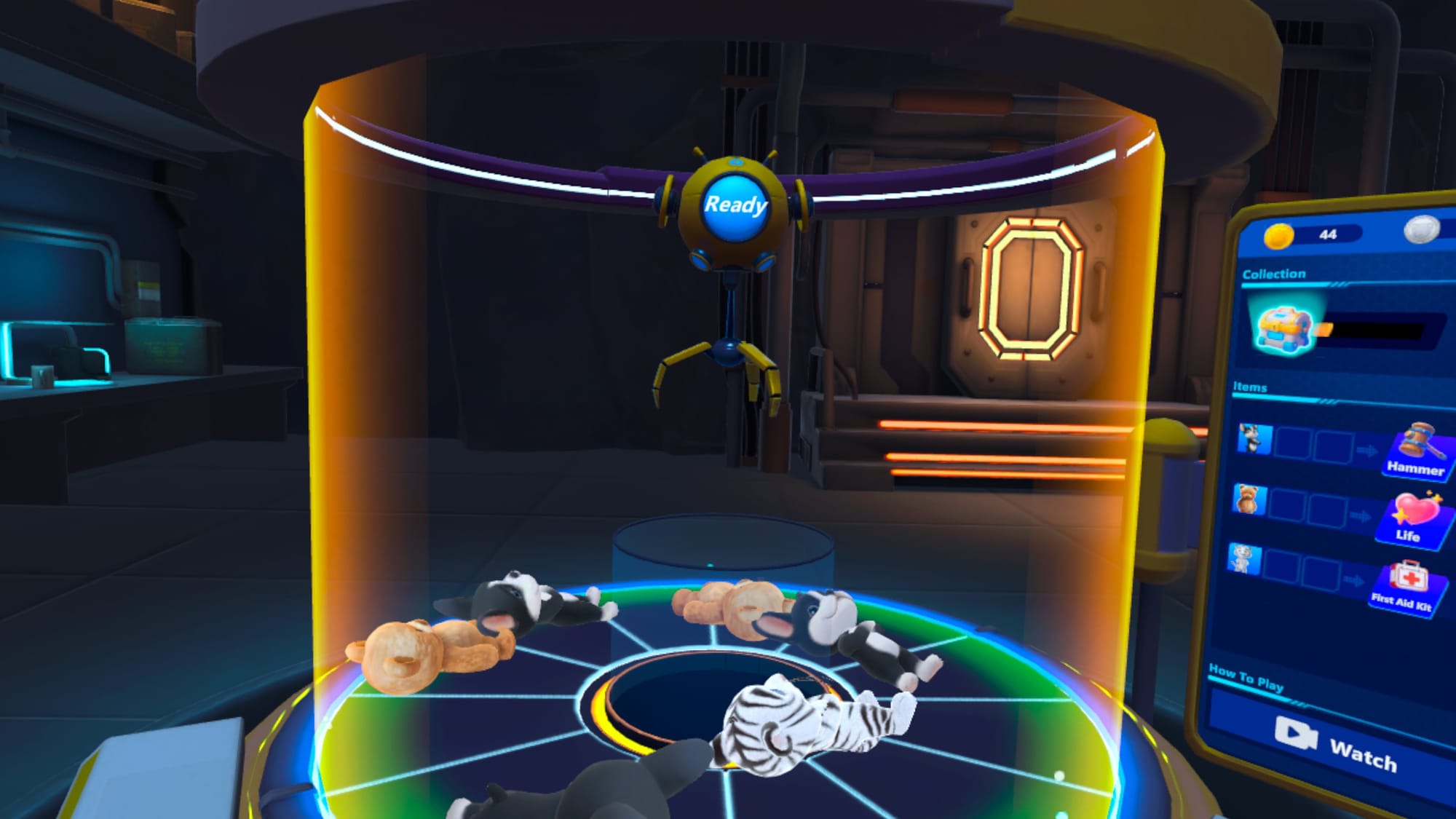
Each lab contains a claw machine filled with petrified animals. Using the controllers, one hand focuses on maneuvering the claw with a digital joystick, while the other hand hits the button to engage the claw. Just like real-world UFO catchers, the grabber runs on a timer, so it’s imperative you spot your target early and get into a good position before time runs out. Different labs offer varying kinds of machines, with some introducing dexterity-testing features like a moving base that carries the critters away, or a plexiglass fence that makes it more difficult to drop the animals inside. Where the platforming levels and basic puzzles could feel overfamiliar at times, Bearly Escape’s well-balanced crane games consistently hit the sweet spot between frustrating and moreish, and kept me eager to push on.

Saving the same kinds of animals in a row unlocks tools that are essential to the platforming portion. For example, first aid kits will mend any injuries you’ve picked up while working through the undergrowth. These items are also key to freeing the animals trapped in the wild, as different traps require different tools. Say a Shiba Inu is trapped in a box, you’ll need a hammer to bash open the slats, or if a panda is strung up in a tree, a boomerang can cut them down.

Unfortunately, Bearly Escape doesn’t let you solve these problems yourself with physical interactions, which is a shame. Your input is instead limited to pressing X when your bear proxy is nearby, and the game automatically dictates what the essential tool is. While it would be preferable to solve each aspect of the animal-freeing puzzles, the diversity of tools available does add depth to the platforming levels and helps weave together these different mechanics.

This isn’t a seamless experience, which isn’t entirely surprising for an Early Access game. While not every platforming level or first-person puzzle I tried is a winner, Bearly Escape’s claw machine minigame feels like an appropriately frustrating and wonderfully accurate recreation of real-world arcade machines.

Bearly Escape is available now in Early Access on Quest and Steam.

Nintendo Will Brick Your Switch If It Detects Pirated Games

Nintendo didn’t make preordering the Switch 2 particularly easy—especially with its back and forth decisions in the face of tariffs. But even if you manage to get your hands on a Switch 2 for launch day, be careful, because Nintendo is ready to brick any Switch device you own should you break its rules—and I’m not talking about cheating at Mario Party.

Rather, Nintendo is particularly concerned about Switch users who hack their systems, use emulators, or engage in piracy using Nintendo hardware. These players are the targets of the company’s newfound bloodlust, and they’re not messing around: steal our games, and lose the right to use your console.

Stephen Totilo of Game File spotted the new philosophy on Thursday, when Nintendo sent out an email with the subject line: “Updates to Nintendo Account User Agreement and Nintendo Privacy Policy.” Totilo counted over 100 edits to the Nintendo Account User Agreement, but the major change was to how the company handles modifications and piracy. The original agreement statement that you weren’t allowed to “lease, rent, sublicense, publish, copy, modify, adapt, translate, reverse engineer, decompile or disassemble all or any portion of the Nintendo Account Services,” unless you got the OK from Nintendo or the law permitted. Seems reasonable.

However, the modified agreement is quite different, and outlines a stark new reality for users who might consider going against Nintendo’s wishes:

Without limitation, you agree that you may not (a) publish, copy, modify, reverse engineer, lease, rent, decompile, disassemble, distribute, offer for sale, or create derivative works of any portion of the Nintendo Account Services; (b) bypass, modify, decrypt, defeat, tamper with, or otherwise circumvent any of the functions or protections of the Nintendo Account Services, including through the use of any hardware or software that would cause the Nintendo Account Services to operate other than in accordance with its documentation and intended use; (c) obtain, install or use any unauthorized copies of Nintendo Account Services; or (d) exploit the Nintendo Account Services in any manner other than to use them in accordance with the applicable documentation and intended use, in each case, without Nintendo’s written consent or express authorization, or unless otherwise expressly permitted by applicable law. You acknowledge that if you fail to comply with the foregoing restrictions Nintendo may render the Nintendo Account Services and/or the applicable Nintendo device permanently unusable in whole or in part.

“Unusable” doesn’t necessarily spell out how Nintendo plans to act when they find a player that has broken these rules, but it doesn’t bode well for them—or their Switch.It would seem Nintendo has a back-end capability to block Switches from running properly if there’s evidence of such misconduct.

While harsh, this isn’t too surprising. Nintendo certainly hasn’t looked the other way when it comes to piracy in the past. The company was more than happy to ban you from online play if they found you playing games illegally, for example—a risk some players took to hack their Switches, even if they weren’t trying to steal their games. (Maybe they just wanted to boost the performance of Tears of the Kingdom before Nintendo offered an official solution?)

Multiple security issues in Screen

The SUSE Security Team has published
an article detailing several security
issues
it has uncovered with GNU Screen. This includes
a local root exploit when Screen is shipped setuid-root, as it is in
some Linux and BSD distributions. The security team also reports problems
in coordinating disclosure
with the upstream Screen project.

We are not satisfied with how this coordinated disclosure developed,
and we will try to be more attentive to such problematic situations
early on in the future. This experience also sheds light on the
overall situation of Screen upstream. It looks like it suffers from a
lack of manpower and expertise, which is worrying for such a
widespread open source utility. We hope this publication can help to
draw attention to this and to improve this situation in the future.

The article includes a table
of operating systems, screen versions, and which vulnerabilities they
may be affected by.

Ticketmaster Now Shows Full Price of Tickets Up Front

Ticketmaster will now show full ticket prices upfront — fees included. “The company announced the ‘All In Prices’ initiative on Monday as part of its efforts to comply with the Federal Trade Commission’s ban on junk fees, which goes into effect on May 12th,” notes The Verge. From the report: Now, when you’re shopping for tickets, Ticketmaster will display a ticket’s full price, alongside a dropdown menu that you can select to see how much you’re paying for the “Face Value” of a ticket and the service fee. You still won’t see local taxes or delivery fees until checkout.

Ticketmaster says it has made some improvements to its queue as well, by offering real-time updates about ticket availability and when wait times are expected to last more than 30 minutes. It also allows customers to see exactly how many people are ahead of them in the queue.


Read more of this story at Slashdot.

FCC commissioner writes op-ed titled, “It’s time for Trump to DOGE the FCC“

A Republican member of the Federal Communications Commission is proposing a DOGE-style overhaul of the agency’s operations, including large cuts to the Universal Service Fund that subsidizes broadband deployment and access.

FCC Commissioner Nathan Simington said the fund should reduce spending on fiber networks and give money to Starlink—helping Elon Musk, the man in charge of President Trump’s DOGE initiative. Simington also argued that the FCC is using too many staff hours on reviewing license applications and should instead use automated systems to approve most license requests.

In a Daily Caller op-ed titled, “It’s Time For Trump To DOGE The FCC,” Simington and his chief of staff, Gavin Wax, wrote that “President Trump’s vision for restoring constitutional government is finally taking shape, and nowhere is that more urgently needed than at the Federal Communications Commission.”

Read full article

Comments