Sony just announced pricing for a number of upcoming products, including the Bravia Theater Bar 6 soundbar. This 3.1.2-channel system costs $650 for US consumers. It comes with a wireless subwoofer and is compatible with Dolby Atmos and DTS:X.
The soundbar includes up-mixing tech to transform stereo content to 3D sound when immersive formats aren’t available. Dialogue gets an upgrade here, thanks to a dedicated center speaker and an AI-powered tool called Voice Zoom 3.
Sony
The beefier Bravia Theater System 6 is a 5.1-channel system that costs $770. This is an all-in-one setup that comes with a soundbar, subwoofer and rear speakers. The included soundbar is not the Bar 6, despite the similar name. However, it does support both Dolby Atmos and DTS:X. The subwoofer also features a slightly different design than the one that ships with the Bar 6. This system does offer stereo up-mixing to transform content into 3D audio via Sony’s proprietary algorithm.
The Bravia Theater Rear 8 speakers are compatible with the company’s soundbars and work with its 360 Spatial Sound Mapping tech to calibrate the system to the acoustics of a specific living room. The speakers cost $450.
Having the pricing here is nice, but we still don’t have any official release dates. The current plan by Sony is to start selling these products later this spring.
This article originally appeared on Engadget at https://www.engadget.com/audio/speakers/sony-has-priced-the-bravia-theater-bar-6-soundbar-at-650-175824102.html?src=rss
Despite a recent pause on some tariffs, Apple remains in a particularly thorny spot as Donald Trump’s trade war spikes costs in the tech company’s iPhone manufacturing hub, China.
Analysts predict that Apple has no clear short-term options to shake up its supply chain to avoid tariffs entirely, and even if Trump grants Apple an exemption, iPhone prices may increase not just in the US but globally.
The US Trade Representative, which has previously granted Apple an exemption on a particular product, did not respond to Ars’ request to comment on whether any requests for exemptions have been submitted in 2025.
For many, Microsoft Edge’s only purpose is to download another browser entirely, like Chrome or Firefox. But this isn’t Internet Explorer: Edge is a competent browser in its own right, whether you have a Mac or a PC. If you do use the browser, you might be pleasantly surprised by how snappy it feels after you update it—at least, according to Microsoft.
Edge 134 and newer’s performance gains
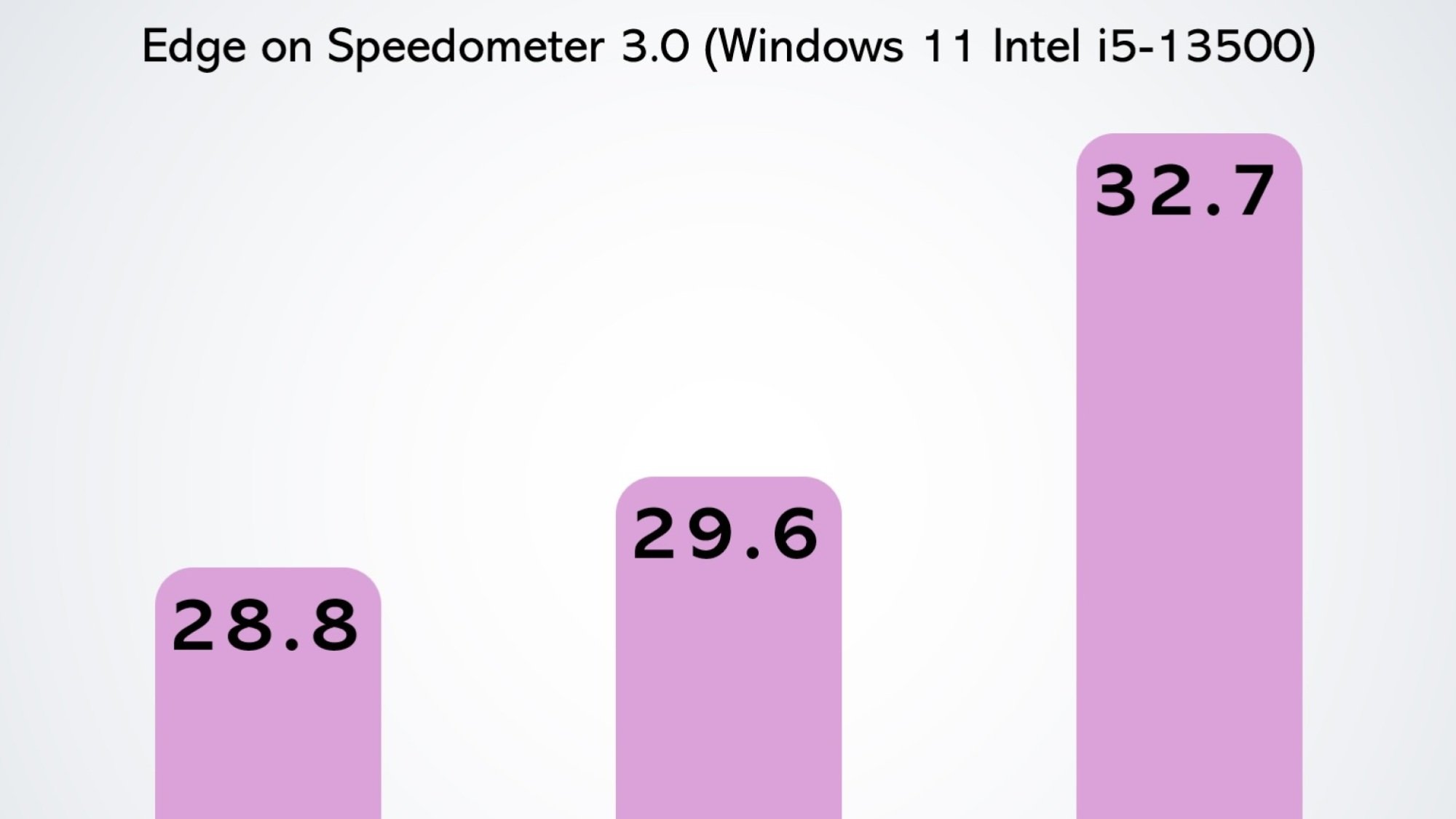
In a Thursday post on Windows Blogs, Microsoft confirmed that, starting with version 134, Microsoft Edge is a tad faster than previous iterations. In fact, Edge 134 is up to 9% faster, when you run it through Speedometer 3.0, a benchmarking tool for web browsers.
Microsoft says that when testing Edge version 134 on an Intel i5-13500 running Windows 11, the browser scores a 32.7 on the Speedometer 3.0 benchmark. The company compares it to Edge 133, which scored 29.6, and Edge 132, which scored 28.8.
Edge 132 (left), Edge 133 (center), and Edge 134 (right). Credit: Microsoft
In addition to this raw benchmark score, Microsoft touted some Edge 134 stats: The company says the latest version of the browser can navigate the web 1.7% faster; browser start is 2% faster; and web pages are 5% to 7% more responsive when compared to Edge 133. Microsoft based their results from its “field telemetry,” which simulates how someone may use the web on various devices and sites.
Microsoft didn’t point to any specific changes in Edge 134 that could contribute to this performance boost. However, the company credits code changes to Edge and Chromium (the underlying engine that powers many webs browser, Chrome included) to improved browser speeds.
Microsoft does say that these improvements may differ depending on your setup, which should go without saying: Edge 134 may vary in performance between a PC running Windows 11 and a Mac running macOS Sequoia. Similarly, an older Intel Mac may perform slower than the latest Intel chip on PC, and it’s not clear how well a Mac running Apple silicon compares to other devices. Whatever your setup, you can likely expect this latest version of Microsoft Edge to perform at least slightly better after the update.
There’s a bit more to the story
If you’re an avid Edge user, you might know that Edge 134 isn’t actually the latest version. That would be Edge 135, which dropped earlier this month. Edge 134 came out on March 6, but Microsoft didn’t acknowledge these performance gains until April 10. If you regularly keep Edge updated, you might have already been living with the speed boosts for over a month. However, not all of us are so on it: When checking my own version of Edge, I found it to still be on a version of Edge 133. Now, I’m on 135—I never even had the chance to run 134!
In my own very unofficial test running Speedometer 3.0, 135 only scored 24.4, plus or minus 0.67. That might sound low when compared to Microsoft’s tests, but the latest version of Chrome scored 22.1, plus or minus 0.28, while Safari scored 21.5, plus or minus 0.92. I suspect my various extensions could affect the scores, but I did quit all other open applications to run the test (I’m on an M1 Mac).
It’s fair to say that Peterson has had an unusual career trajectory. He worked as a line cook and an auto mechanic, and he worked on the production line of a butter factory, among other gigs, before attending culinary school in hopes of becoming a chef. However, he soon realized it wasn’t really what he wanted out of life and went to college, earning an undergraduate degree in physics from Carleton College and a PhD in mechanical engineering from the University of Michigan.
After 10 years as an engineer, he switched focus again and became more serious about his side hobby, perfumery. “Not being in kitchens anymore, I thought—this is a way to keep that little flavor part of my brain engaged,” Peterson told Ars. “I was doing problem sets all day. It was my escape to the sensory realm. ‘OK, my brain is melting—I need a completely different thing to do. Let me go smell smells, escape to my little scent desk.'” He and his wife, Jane Larson, founded Sfumato, which led to opening Castalia, and Peterson finally found his true calling.
The Federal Trade Commission now has three commissioners, and all of them are Republicans.
The FTC historically had a 3–2 partisan split, with the president’s party having a one-seat advantage. But President Trump fired FTC Democrats Alvaro Bedoya and Rebecca Kelly Slaughter last month, and the Senate yesterday confirmed Trump nominee Mark Meador to the agency’s third Republican spot.
The Senate vote was 50–46 and went along party lines. “I respect Mr. Meador’s qualifications and his prior experiences… But I cannot support the confirmation of any additional members to the FTC until Commissioner Slaughter and Commissioner Bedoya are reinstated,” Sen. Amy Klobuchar (D-Minn.) said yesterday. “President Trump’s dismissal of Commissioners Slaughter and Bedoya is not only illegal; it hurts consumers and small businesses by undermining the independence of the Agency that Congress established to protect consumers from fraud, scams, and monopoly power. An independent FTC is critical for protecting consumers and has done so in a bipartisan manner for over 110 years.”
We may earn a commission from links on this page. Deal pricing and availability subject to change after time of publication.
After Consumer Electronics Show (CES) brought some exciting new tech products this January, older flagship models began to drop in price, and TVs were no exception. A Pro version of The Frame TV was introduced, which made the 2024 versions drop in price. Fast forward to April, and those prices have dropped further for some of the sizes. The 43-inch The Frame from 2024 is on sale for $797.99 (originally $997.99), the lowest price it has been, according to price-tracking tools. The biggest size, the 85-inch series, is seeing a record discount of $1,800, currently $2,497.99 (originally $4,297.99).
Samsung’s The Frame smart TVs have come a long way since their 2017 release. Launched to appeal to the crowd that wants a big TV but doesn’t want that TV to dominate their decor, its main feature is an anti-reflection matte display that took the “framed artwork” aspect to new levels—and with 4K picture quality. As the name implies, the allure of this TV is that it can double as a digital art frame, with its anti-glare matte display and customizable frame.
I first saw the 2022 version up close when it was released, admittedly having been fooled by my brother into thinking it was an actual painting (it really does look like one). The matte screen does a good job of making the TV seem like a painting, and it’s great for bright rooms that might otherwise get a lot of glare from the screen. That version had an “average” review from PCMag due mainly to poor contrast and its price. However, the new 2024 version is the latest generation of this series and has notable improvements.
You’ll get an improved refresh rate of 120Hz, the same QLED display, and 4K resolution with a Quantum 4K processor. You can buy frames separately to your taste—and even design them with a Harry Potter theme, like this guy on TikTok did.
It hasn’t been that long since the Pixel Watch 3 dropped, but excitement is already building for the follow-up device. An industry leaker who goes by OnLeaks, whose real name is Steve Hemmerst, has partnered with 91mobiles to publish images and a video render of the upcoming smartwatch
Surprise, it looks like a Pixel Watch. It maintains the iconic circular design, though does look a bit thicker than the previous model. The screen bezels appear to be slightly slimmer. Otherwise, the design remains mostly unchanged. This isn’t necessarily a bad thing.
However, there are some minor hardware changes that allude to new features. The watch is missing the four pins at the back, which suggests that it could support wireless charging. The Pixel Watch 3 charges via a USB-C port. Also, there are two buttons on both sides of the speaker. We don’t know what they do. It’s also possible that the added thickness could be hiding a bigger battery, which would be much appreciated.
Google’s next smartwatch is expected to launch later this year, likely alongside the Pixel 10 series. We don’t have too many concrete details regarding specs, but reports have indicated that it will include a new chipset. The Pixel Watch 3 uses a Snapdragon W5 Gen 1. Some rumors have suggested that the company is developing an in-house Tensor chip for Pixel Watches, but that might not be ready until the Watch 5.
This article originally appeared on Engadget at https://www.engadget.com/wearables/the-pixel-watch-4-could-be-thicker-and-offer-wireless-charging-164555210.html?src=rss
A partnership between Anchorage Solid Waste Services and the Alaska Zoo, this is a video of a group of grizzly bears testing the bear-resistance of a new trash can. Perhaps unsurprisingly, the cans stand little chance against the massive 500+ pound bears. These aren’t those bears in the commercials that wipe with Charmin, these bears wipe with thorn bushes. My favorite part is at 0:29 when the bear just casually tosses the can like a piece of crumpled paper into a wastebasket, then right after when it wears it like a hat. Did you know in a recent survey that 6% of Americans believe they could actually win an unarmed fight against a grizzly? I vote we let them try and put the concept of survival of the delusionalist to the test.
GPT-4, OpenAI’s first big upgrade to ChatGPT months after unleashing it on the world, is on its way out. A changelog the company published on Thursday said the model will be retired from ChatGPT on April 30. GPT-4o, which has been available since last May, will fully replace it.
Despite GPT-4’s significance in modern AI’s brief but world-changing history, its sunsetting isn’t a great loss for customers. OpenAI says GPT-4o improves on it in writing, coding and STEM. Recent upgrades have boosted the newer model further, enhancing its instruction following, problem-solving and conversational flow. The company describes the multimodal GPT-4o as the “natural successor” to the soon-to-be-retired GPT-4.
Despite its upcoming removal from ChatGPT, API users will still be able to access GPT-4 after April 30.
The announcement comes as OpenAI reportedly prepares a slew of new models for launch. Reverse engineer Tibor Blaho posted images on Friday (viaTechCrunch) that seemingly confirm that o3, o4-mini and GPT-4.1 (including nano and mini offshoots) models are in the pipeline. In February, the company introduced a research preview of GPT-4.5, a better, more natural conversationalist that will serve as a stepping stone to GPT-5.
OpenAI’s release notes included a nod to the role GPT-4 played in the company’s development. “GPT‑4 marked a pivotal moment in ChatGPT’s evolution,” the notes read. “We’re grateful for the breakthroughs it enabled and for the feedback that helped shape its successor. GPT‑4o builds on that foundation to deliver even greater capability, consistency and creativity.”
This article originally appeared on Engadget at https://www.engadget.com/ai/openai-prepares-to-send-gpt-4-out-to-pasture-163643868.html?src=rss
Concerns about AI’s energy use have a lot of people looking into ways to cut down on its power requirements. Many of these focus on hardware and software approaches that are pretty straightforward extensions of existing technologies. But a few technologies are much farther out there. One that’s definitely in the latter category? Quantum computing.
In some ways, quantum hardware is a better match for some of the math that underlies AI than more traditional hardware. While the current quantum hardware is a bit too error-prone for the more elaborate AI models currently in use, researchers are starting to put the pieces in place to run AI models when the hardware is ready. This week, a couple of commercial interests are releasing a draft of a paper describing how to get classical image data into a quantum processor (actually, two different processors) and perform a basic AI image classification.
All of which gives us a great opportunity to discuss why quantum AI may be more than just hype.
One of those is Boston-based Syntis Bio, which is working on a daily pill that mimics the effects of gastric bypass—no actual surgery required. Today, the company announced early data from animals and a small group of human volunteers showing that its approach is safe and may be able to suppress hunger. The company presented the findings Thursday at the European Congress on Obesity and Weight Management.
“We’re at a stage with obesity treatment where it’s important for us to figure out, how do we now tune it to be more effective?” says Rahul Dhanda, Syntis Bio’s CEO and cofounder.
WhatsApp just rolled out a dozen new features. Most of these are small, but they add up to a fairly substantial software update. Let’s go over some of the more notable additions.
Chats now allow for tappable reactions, which is basically like adding a thumbs up to someone else’s reaction. Group chats feature an indicator that lets users know how many people are actually online. This will be right underneath the group name. Solo conversations now offer the ability to create an event, complete with an RSVP mechanic. This event can also be pinned in the chat.
There are a couple of chat tools just for iPhone users, including the ability to scan and send documents directly from the app. Users can also now set WhatsApp as the default messaging and calling app on iPhones.
Calls finally have their own dedicated tab, which is where folks go to make calls, share call links and manage their history. Users can also add someone from a video call directly from a chat thread. Video calls now offer a pinch to zoom feature, but only on iPhones. WhatsApp also says it has updated its technology for smoother video calls.
Channel admins can now record and share short videos with followers and there are voice message transcripts available on the Channels tab. Finally, admins can share QR codes that link directly to the channel.
ICYMI, here’s what’s new on WhatsApp �
→ chat themes! change up your chats with preset wallpapers and bubble colors or choose your own
→ you can now add music to your WhatsApp Status �
→ avatars got an upgrade so they look even more like you
WhatsApp says that more features and updates are on the way, so we’ll let you know when new stuff drops. The app has been busy lately. It’s been testing reply threads and has finally added a long-requested drafts feature.
This article originally appeared on Engadget at https://www.engadget.com/apps/whatsapp-just-got-a-bunch-of-new-features-including-document-scanning-151607441.html?src=rss
Maybe you’re in a position where you suddenly need a new laptop to see you through the rest of the school year. Perhaps you’ve got a bigger tax return than expected and you want to treat yourself. Or it may be that you’re a long-time Windows user and fancy a change. Whatever reason you might have for being interested in a MacBook Air, we’ve got another one. The M4 MacBook Air is back on sale for $949. That’s $50 or five percent off.
That deal is available for the sky blue and starlight colorways of Apple’s laptop. But there’s not terrible news if you prefer the midnight (black) look — that variant will run you just $5 more at $954.
This deal is for the base model of the M4 MacBook Air. It’s a 13-inch laptop with 16GB of memory and 256GB of storage.
We appreciated the light and thin design, excellent keyboard and touchpad, fast performance and the terrific battery life. The 13-inch model we tested (and the one that’s on sale here) ran for 18 hours and 15 minutes while playing HD video. Our only real qualms with the M4 MacBook Air are that it could use more ports and the display (while otherwise great) has a relatively paltry refresh rate of 60Hz.
One of the best things about the M4 MacBook Air is that Apple actually lowered the starting price for this generation of the laptop to $999 from $1,099 for the M3. That’s a very welcome change. The current $50 (or $45) discount makes things even sweeter.
Check out our coverage of the best Apple deals for more discounts, and follow @EngadgetDeals on X for the latest tech deals and buying advice.
This article originally appeared on Engadget at https://www.engadget.com/deals/the-apple-m4-macbook-air-is-back-on-sale-for-50-off-143801604.html?src=rss
We may earn a commission from links on this page. Deal pricing and availability subject to change after time of publication.
If you’ve been holding out for a 240Hz gaming monitor without blowing your budget, the Samsung Odyssey G4 is currently at its lowest price ever, according to price trackers—$179.99 (down from $279.99).
It’s a 25-inch, 1080p entry-level panel made for speed, not flash. No RGB backlighting or fancy extras here. The stand is basic and a little wobbly, and the design leans more “budget gamer” than premium setup. Still, if smooth gameplay tops your list, the G4 pulls through with a fast response time, low input lag, and both FreeSync and G-SYNC compatibility. Whether you’re on AMD or NVIDIA, you’ll get tear-free performance as long as you’re using DisplayPort.
This monitor is clearly built for PC gaming. At 240Hz with a solid response time across all refresh rates—60Hz, 120Hz, or 240Hz—you’re getting smooth motion with almost no ghosting or blur. It also includes some extra gaming features like a virtual aim point overlay (an always-on crosshair) and ultra-wide simulation mode that stretches your aspect ratio to 21:9 for a broader field of view. However, console gamers might want to skip this one. It doesn’t scale 4K or 1440p well and has poor VRR support on PS5. The Xbox Series X works a bit better, but you still won’t get full use of HDR or high-res modes. So if your gaming happens mostly on a console, this might not be worth the hassle.
The image quality is decent for the price, but far from perfect. It handles glare well and gets bright enough for daytime use, but don’t expect deep blacks or dazzling HDR—this monitor doesn’t have local dimming, and the contrast ratio is pretty weak. Blacks often look gray in a dark room. Still, for most gamers playing in well-lit rooms, it holds up fine. The viewing angles are wide enough for side-by-side co-op without major color washout. The dual HDMI 2.0 ports, a single DisplayPort, and a 3.5mm audio jack cover the basics, and you also get other features like auto source switching, blue light filtering, and power-saving modes.
When Nintendo launched the Switch 2, it also revealed that it was going release upgraded versions of several existing Switch games, including bothLegend of Zelda: Breath of the Wild and Tears of the Kingdom. It also revealed that games for the upcoming console will cost you more than what you’re usually paying for games now. If you were hoping that the $70 price tag for the upgraded Breath of the Wild will at least include its DLC Expansion Pack, though, you’re unfortunately out of luck. The company has told IGN that you will have to pay an extra $20 for the game’s DLC season pass.
“The Legend of Zelda: Breath of the Wild – Nintendo Switch 2 Edition does not include The Legend of Zelda: Breath of the Wild Expansion Pass DLC. That DLC is available as a separate purchase,” a spokesperson told the publication.
To be clear, you don’t have to buy the new version if you don’t want to. The Switch 2 has backwards compatibility, and you can play your old copy of the game if you still have it — it was released way back in 2017 — and its DLC at no additional cost. If you own a copy for the first Switch and want to enjoy the new version’s enhanced framerates and resolution, as well as HDR support, you can purchase an upgrade pack for $10. But if you’re buying the Switch 2 version new, then you’ll have to be prepared to pay $90 to get the base game and its DLC.
This article originally appeared on Engadget at https://www.engadget.com/gaming/nintendo/the-70-switch-2-version-of-breath-of-the-wild-wont-even-come-with-dlc-140032303.html?src=rss
The next time you conclude a conversation with ChatGPT, it will save what you said to memory, even if you don’t ask it explicitly to do so. “We have greatly improved memory in chatgpt — it can now reference all your past conversations!” OpenAI CEO Sam Altman wrote on Thursday in an X postspotted by The Verge. “This is a surprisingly great feature imo, and it points at something we are excited about: ai systems that get to know you over your life, and become extremely useful and personalized.”
OpenAI has been working on improving ChatGPT’s memory since 2023 when the company began testing custom instructions, a feature that allows users to set preferences that ChatGPT will consider in future conversations. For example, you can tell the chat bot you have a family of four, and it will remember that detail when you ask for it dinner recipes. At the start of last year, OpenAI began allowing users to tell ChatGPT to remember specific details from chats. With this latest update, ChatGPT will remember both you tell it to and insights it gleans from your conversations.
“The more you use ChatGPT, the more useful it becomes. New conversations build upon what it already knows about you to make smoother, more tailored interactions over time,” OpenAI says of the feature. The company is currently rolling out the update to users of its $200 per month Pro plan and $20 per month Plus tier. Team, Enterprise and Edu users can expect to gain access “in a few weeks.” OpenAI did not say when it would roll out the update to free users.
If you don’t want ChatGPT to save your conversations with it, you can disable the feature through the settings menu. “If you’ve already opted out of memory, ChatGPT won’t reference past conversations by default,” says OpenAI. You can also use the Temporary Chat feature on a case by case basis for conversations you don’t want ChatGPT to save to memory.
This article originally appeared on Engadget at https://www.engadget.com/ai/chatgpt-can-now-remember-all-your-past-conversations-134642785.html?src=rss
We may earn a commission from links on this page. Deal pricing and availability subject to change after time of publication.
The Ring Battery Doorbell Plus is currently marked down to $119.99 on StackSocial (was $149.99), and if you’ve been eyeing a smart doorbell that won’t need rewiring or a professional install, it could fit the bill. It runs on a rechargeable battery, so setup is simple—just charge it, pop it in, and connect via the Ring app. That said, you’ll still need to recharge the battery every few months, depending on how often it’s triggered. The camera’s big sell is its expanded 1536p HD+ head-to-toe view, which means you can see visitors and packages in full, not just from the chest up. That might not seem huge until you miss a delivery or can’t make out what’s left on your doorstep. The color night vision works surprisingly well, too, giving you a clear view even in low light, notes PCMag.
You can also talk to visitors through the two-way audio or let them know you’re busy with one of the preset quick replies. You can also fine-tune the motion detection zones so your phone doesn’t blow up every time someone walks past your gate. It also integrates well with Alexa-enabled devices, so if you’ve got an Echo Show, you can see who’s at the door or get alerts read out loud. Just keep in mind, there’s no support for Google Assistant or Apple HomeKit, which could be a dealbreaker if that’s what your home setup relies on. Real-time notifications come straight to your phone or tablet, and the Ring app lets you adjust settings, view footage, or trigger responses remotely.
That said, some of the more advanced features—like 180-day video history, person/package detection, and video previews—are locked behind a Ring Home subscription, which starts at $4.99/month for a single camera. You’ll still get live view and motion alerts without it, but you won’t be able to save or rewatch footage later. And if you want smarter AI features like video previews and one-tap emergency response, that price jumps to $19.99/month. So while this is a solid midrange option for those already in the Ring or Alexa ecosystem, it may not be the best pick if you want everything to work subscription-free.
The Simpsons is finally replacing one of its veteran voice actors and thankfully, no AI is involved. According to Entertainment Weekly, in the future the nefarious, beanie-wearing bully Jimbo Jones will be voiced by MadTV alum Mo Collins.
Varjo, creator of high-end enterprise MR headsets, dipped its toes into the consumer VR market with the release of the Aero headset back in 2021. But now the company says its focus is narrowing on training sims and deeper integrations focused on enterprise customer needs, making a followup to the Aero headset is unlikely.
In an interview with Road to VR, Varjo chief product officer Patrick Wyatt talked about the company’s latest focus on deeper integrations of its headsets for specific use-cases.
Training sims, especially in military and aeronautics, have become an area of growth for Varjo, Wyatt says. The company is leaning into these use cases to focus on solutions and outcomes rather than just selling headsets and leaving the buyer to figure out how to best make use of them.
That’s meant working closely with companies like Leonardo—a major helicopter manufacturer—to build the Virtual Extended Reality (VxR) helicopter pilot training system in which Varjo headsets are a core part of the system. Thanks in part to the high visual fidelity of Varjo’s headsets, the system has achieved FAA FTD Level 7 Certification, putting the system in the highest category of flight simulators. Varjo claims this is the “first-ever VR-based training system to reach this certification level.”
As Varjo goes beyond just selling its headset off-the-shelf, the company says it’s growing its “solutions engineering” capability, which means working directly with customers to conceptualize and implement solutions that leverage Varjo headsets to address existing challenges.
To build confidence in its commitment to this business model, in recent years the company has built versions of its headsets to specifically address common needs. That includes a ‘Focal Edition’ of the XR-4 which adds auto-focus for the headset’s passthrough cameras. Compared to a fixed focal length, this makes the headset more appealing for use with up-close objects, like flight controls and readouts. There’s also the ‘Secure Edition’ of the XR-4 which the company says is for “classified environments.”
Compared to the $6,000 base price of the XR-4, these specialized versions command a hefty premium: the XR-4 Focal Edition is priced at $10,000, and the Secure Edition can cost $14,000, if not more.
And now, according to Wyatt, Varjo is committing to supporting its XR-4 headset series through 2030, giving companies a long-term guarantee that its headsets will continue to do their job.
Image courtesy Varjo
With the shift toward long term headset support and helping companies build bespoke solutions, the company is clearly turning away from high-end consumer headsets.
Varjo Aero, released in 2021, was the company’s first, and possibly last, test in the consumer waters. The company had once expected Aero to become an ongoing series of headsets aimed at VR enthusiasts. But when asked about a follow-up to Aero, Wyatt tells Road to VR, “No one is gonna say ‘never’ but we’re going more and more in the other direction.”
While unfortunate for VR enthusiasts, it’s likely the right call for the company. While Varjo headsets have excelled in visual clarity, size has never been their strong suit. Enthusiast VR headsets in recent years have increasingly been focused on reducing size and weight. Recent headsets like Bigscreen Beyond and the MeganeX Superlight are tiny compared to any headset Varjo has built. Chasing that trend to meet demand in the enthusiast market would mean fundamentally rethinking the optics and capabilities of Varjo’s headsets.
Varjo says its seeing growing demand for its headsets and solutions beyond the consumer space, telling Road to VR that its business volume from military applications has doubled since the launch of XR-4 at the start of 2024.
The company also says it employs more than 200 people and claims its technology is used in 19 of the 20 largest global defense and aerospace organizations, and 25% of Fortune 100 companies.
We’ve known that in recent years older games have been monopolizing more and more of players’ time, especially on PC, but it turns out that’s also been translating to players spending more and more of their money on stuff that’s not actual games. Namely things like battle passes and Call of Duty skins. In fact,…