Roku tech, patents prove its potential for delivering “interruptive” ads

Roku, owner of one of the most popular connected TV operating systems in the country, walks a fine line when it comes to advertising. Roku’s OS lives on low-priced smart TVs, streaming sticks, and projectors. To make up the losses from cheaply priced hardware, Roku is dependent on selling advertisements throughout its OS, including screensavers and its home screen.

That business model has pushed Roku to experiment with new ways of showing ads that test users’ tolerance. The company claims that it doesn’t want ads on its platform to be considered intrusive, but there are reasons to be skeptical about Roku’s pledge.

Non-“interruptive” ads

In an interview with The Verge this week, Jordan Rost, Roku’s head of ad marketing, emphasized that Roku tries to only deliver ads that don’t interrupt viewers.

Read full article

Comments

India’s Delhi Plans To Curb Gasoline Car Sales, Ban Gas-Guzzling Bikes To Shed Polluter Tag

India’s capital New Delhi plans to limit gasoline and diesel-powered cars a family can buy as well as ban sales of fuel-guzzling motorbikes and scooters, according to a draft policy aimed at cleaning up one of the world’s most polluted cities. From a report: The measures represent one of the most drastic steps the city has lined up to tackle pollution, which often forces local authorities to ban some construction, shut schools and disrupt flights in the city of more than 30 million people during the winter season.

Under Delhi’s new electric vehicle policy, the city government will also waive some local taxes on the purchase of hybrids, putting them on par with concessions given to EVs, while imposing a new levy of 0.5 rupees ($0.0059) on every litre of petrol sales, according to the 74-page draft seen by Reuters. The primary objective “is to unlock the next phase of EV adoption, reduce air pollution and contribute to India’s energy independence and net-zero targets,” the draft stated.


Read more of this story at Slashdot.

New Android spyware is targeting Russian military personnel on the front lines

Russian military personnel are being targeted with recently discovered Android malware that steals their contacts and tracks their location.

The malware is hidden inside a modified app for Alpine Quest mapping software, which is used by, among others, hunters, athletes, and Russian personnel stationed in the war zone in Ukraine. The app displays various topographical maps for use online and offline. The trojanized Alpine Quest app is being pushed on a dedicated Telegram channel and in unofficial Android app repositories. The chief selling point of the trojanized app is that it provides a free version of Alpine Quest Pro, which is usually available only to paying users.

Looks like the real thing

The malicious module is named Android.Spy.1292.origin. In a blog post, researchers at Russia-based security firm Dr.Web wrote:

Read full article

Comments

Three Ways People With Student Loan Debt Can Protect Their Credit Scores

The Department of Education announced Monday that the Federal Student Aid (FSA) will restart collections on defaulted student loans beginning May 5. Even before this news, millions of borrowers were already seeing their credit scores plunge in recent months, and loan servicers are warning that a record number of borrowers are at risk of defaulting by the end of the year. I recently covered the basics of what you need to know about the upcoming changes, as well as how to prepare for them. Now, let’s dive a little deeper into how borrowers suffering through collections can navigate their financial future.

What the end of the pause means for your finances

“Many people have been feeling like they’re in some sort of personal financial recession for years now,” says Lauren Bringle, an accredited financial counselor at credit-building platform Self Financial. And if you’ve been carrying credit card debt, you know that those higher interest rates may have caused what you owe to increase significantly.

Factor in the cost of many monthly expenses increasing—groceries, gas, eggs—all while salaries have stayed stagnant. “Now add in that student loan payments have resumed, and for some, that means hundreds of dollars in extra expenses monthly,” Bringle notes. Especially after the five-year pause on payments that began during the COVID-19 pandemic, many borrowers are having to significantly readjust and re-evaluate their budgets. With all of the additional costs, it’s left millions of Americans stretched beyond their means.

Strategies to protect and rebuild your credit

Here’s what you can do to navigate a hit to your credit score.

1. Free up money wherever you can

If your income is limited and you simply don’t make enough to cover your student loan payments, Bringle suggests an income-driven repayment plan for federal student loans. “The federal student loan landscape has been rapidly changing, but you may be able to qualify for lower monthly payment options (even down to $0/month in some cases) based on your income,” advises Bringle. You can learn more and apply at studentaid.gov here.

2. Prioritize your credit

“Credit is an essential part of your overall financial profile because it opens the door to long-term financial goals, such as renting an apartment or securing a mortgage,” Bringle explains. Missed loan payments can significantly impact your credit because payment history accounts for 35% of your FICO credit score, making on-time payments critical.

If your credit has already taken a hit due to missed student loan payments, consider alternative ways to rebuild. For instance, something as small as implementing this payment schedule helps to send your credit score in the right direction.

Additionally, Bringle recommends organizations like Operation Hope, NFCC, and AFCPE, where credit counselors can review your income, expenses, debts, and overall financial picture to help you create a personalized budget and spending plan.

3. Keep building positive money habits

Regardless of where you stand financially, focus on developing positive short-term habits. Especially in the face of something like student debt, it helps to control whatever you can.

  • Stick to your budget. “As you’re setting up your financial goals, make sure you have a really clear view of your overall finances,” says Bringle. “Your budget plays an important role in helping your credit score, because it helps you track your expenses, and ensures that you are able to pay your monthly payments on time, and in full.” Here’s my guide to evaluating and making strategic cuts to your budget.

  • Make payments on time. Setting up automatic payments can help ensure you don’t miss due dates, which would negatively impact your score. “Depending on the conditions of your student loans, borrowers usually have up to six months after graduation before they have to start making payments,” Bringle notes. “Be sure to check your loan and know exactly when your first payment is due so you can plan ahead and pay on time, since payment history is a critical piece to building and maintaining healthy credit.” To find out exactly how much you’re expected to pay, head to studentaid.gov.

  • Hack your credit utilization. Credit utilization is the second-largest factor of your FICO score, so it’s important not to use too much of your available credit. The general rule is to stay below the 30% threshold, but even lower is better. Using more than 30% of your available credit can affect your credit utilization, which could ultimately decrease your score. For example, if your credit limit is $1,000, you should not put more than $300 on your credit card before paying down the balance.

  • Review your credit report regularly. Checking your report gives you a clear understanding of your credit health and what might be impacting your score. You can review payment history, recent balances reported to credit bureaus, accounts under your name, and identify negative items like collections that need to be addressed. Free copies of your credit reports from Experian, Equifax, and TransUnion are available at annualcreditreport.com.

Looking ahead

Bringle emphasizes the importance of preparation: “Make sure your budget is set up to support your payments, start setting aside the payments from your monthly budget to build the habit, and set up autopay if you can to reduce the chances of a late payment.”

By taking proactive steps now, you can protect and rebuild your credit score as much as possible before student loan collections resume.

NSF director resigns amid 55% budget cut, mass layoffs from Trump admin

Director of the National Science Foundation Sethuraman Panchanathan abruptly resigned Thursday, Science Magazine first reported.

Panchanathan, who goes by Panch, did not cite a reason for his departure, which comes as 16 months are left in his six-year term. However, like most other federal agencies, the scientific funding organization is awash in turmoil due to the Trump administration. Specifically, the NSF is facing a 55 percent cut to its $9 billion annual budget in the next fiscal year, as well as a mass layoff of half of its 1,700-person staff, according to Science.

A memo sent to staff on Thursday, April 24, and obtained by Ars Technica confirmed that the NSF is in for significant cuts. It offered staff a second chance at the deal offered in the earlier “fork in the road” email, allowing them to go on paid leave in return for departing the foundation before October. Anyone who stays will face “future restructuring, staffing reductions, and constrained budget environments.” The changes are expected to “constrain future opportunities” within the NSF.

Read full article

Comments

11-Year-Old GTA V Dominated Twitch in 2024

Grand Theft Auto V topped Twitch viewership charts in 2024 with a staggering 1.4 billion hours watched, according to data released by the streaming platform. The 11-year-old game outperformed all competitors, including League of Legends, which also surpassed the billion-hour mark.

Competitive shooters filled the remaining top spots, with Valorant recording 804 million hours, Fortnite exceeding 500 million, and Call of Duty reaching 451 million hours watched. V-Tubers — streamers using animated avatars instead of showing their faces — saw viewership increase by 10% year-over-year, accumulating over a billion hours watched collectively.


Read more of this story at Slashdot.

You Can (Once Again) Use Classic PlayStation Themes on Your PS5

Back in December, Sony rolled out themes for the first time on PS5. While the selection was nowhere near the variety offered by other consoles, they were enticing all the same: These themes were modeled after the UI designs of all previous PlayStation consoles, including the PSOne, PS2, PS3, and PS4.

These themes are, frankly, really cool. They adopt each console’s unique sound design, like the clicks you hear when switching between menu items. If you had a PS3 back in the day, you’d probably like the wave background this PS5 theme adds here. Similarly, PS2 fans would appreciate the second generation’s menu shapes. If you had a particular favorite, you could inject a little nostalgia into your PS5 experience—at least while on the home screen.

However, the experience was short-lived. At the end of January, the company decided to remove the themes, to the disappointment of many 90s and 00s kids. Luckily, there was a silver lining to the situation: Sony said the themes would return in an unspecified number of months, following some work “behind the scenes.”

As it turns out, that number of months was almost exactly three: Starting Thursday, April 24, classic PlayStation themes are back on PS5, as Sony announced in a blog post on Wednesday. The company says the feature is now called “Appearance” and contains four nostalgic themes—now without the 30th anniversary branding.

How to access the classic PlayStation themes

theme selection screen on ps5

Credit: Sony

These themes are rolling out as part of Sony’s latest system update for PS5. In order to access them, you’ll need to make sure your console is fully updated.

To do so, go to Settings > System > System Software > System Software Update and Settings. If you aren’t fully updated, you’ll see Update Available. Choose Update System Software, and you’re set.

Once updated, head back to Settings, then choose “Appearance and Sound.” Default is the default PS5 theme, but you’ll be able to choose from PlayStation, PlayStation 2, PlayStation 3, or PlayStation 4.

There’s another new feature in the latest PS5 update

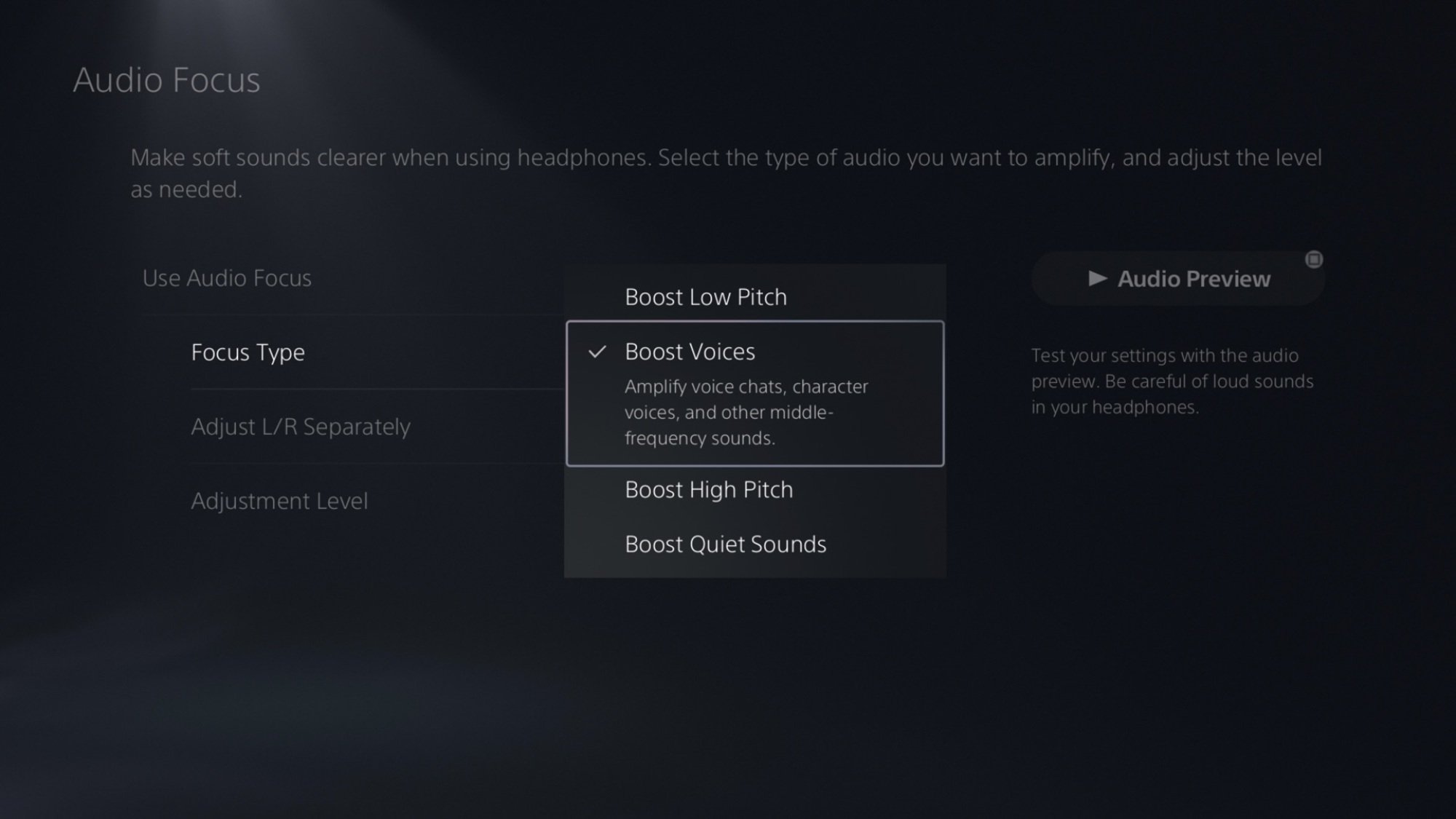
audio boost settings page

Credit: Sony

In addition to these new themes, Sony is also rolling out “Audio Focus,” a new setting that lets you boost soft sounds in your games when using headphones with your PS5. There are four different categories you can adjust: Low Pitch (engines and rumbles); Voices (voice chats, in-game dialogue, mid-frequency sounds; High Pitch (footsteps and metallic sounds); and Quiet Sounds (low-volume sounds across frequencies).

Once you’ve updated to the latest version, you’ll find these options in Settings > Sounds > Volume > Audio Focus. For each, you can choose whether to adjust the sounds for the left and right channel, as well as adjust the overall level of the boost. When you’re finished, you can test your settings via an “Audio Preview” option in this settings menu, so you know whether you need to make adjustments.

Remedy’s co-op shooter FBC: Firebreak comes out June 17

Remedy’s first foray into co-op shooters, FBC: Firebreak, is officially launching on June 17. Following employees tasked with cleaning up The Oldest House, the mysterious headquarters of the Federal Bureau of Control, the game balances team-based action with the supernatural abilities and enemies that made Control so interesting. 

In our preview of the game, the biggest and most positive point of comparison for Firebreak’‘s chaotic action was Left 4 Dead, but the game’s unique collection of “jobs” (Remedy’s name for missions) includes plenty of weirder tasks, too, like dealing with ominously multiplying sticky notes. Remedy plans to support Firebreak with new jobs after launch and into 2026. All new playable content will be for free, save for cosmetics, which Remedy plans to charge for.

The developer originally announced it was making a multiplayer game set in the Control universe in 2021, when the game was still being published by 505 Games. Following the success of Alan Wake II, Remedy acquired the rights to the entire Control franchise from 505 Games in 2024.

FBC: Firebreak will be available on June 17 for $39.99 on Xbox Series X/S, PlayStation 5 and PC. A $49.99 “deluxe edition” will also be available with exclusive cosmetics. If you subscribe to Game Pass Ultimate, PC Game Pass or PlayStation Plus Premium or Extra, you’ll be able to download and play the game for no additional cost.

This article originally appeared on Engadget at https://www.engadget.com/gaming/remedys-co-op-shooter-fbc-firebreak-comes-out-june-17-190054471.html?src=rss

Threads is moving to threads.com and adding a bunch of new web features

Back when Meta first introduced its Twitter competitor Threads, many noted that the company had failed to secure the threads.com domain and instead launched the website at threads.net. At the time, the Threads dot com domain belonged to a messaging app startup that said it was reluctant to rebrand its business.

But that startup was later acquired by Shopify and Meta did eventually acquire the coveted threads.com domain for an undisclosed amount. Now, Meta is finally moving Threads’ website to threads.com, and adding some much needed functionality to the web version of Threads.

The update adds a new composer that pops up in its own window so you can continue to browse your feeds as you type out a new post. It also allows you to scroll your various custom feeds in a single-column view (much like Threads’ mobile app), and finally adds a menu shortcut for saved posts. (Previously, the only way to view saved posts on web was to add it as a pinned column.)

X import on Threads.
Screenshot via Threads

Meta is also stepping up its efforts to lure users directly from X. The company says it’s testing a new feature that allows users to upload a list of people they follow on X and find the corresponding accounts on Threads. The feature, currently labeled as being in “beta,” sounds a bit clunky according to Meta’s in-app description. It notes that downloading data from X can take as long as three days, so it’s not exactly a simple process. But in addition to giving users a way to find familiar accounts on Threads, it could also give Meta some valuable insight into users’ habits on other platforms.

This article originally appeared on Engadget at https://www.engadget.com/social-media/threads-is-moving-to-threadscom-and-adding-a-bunch-of-new-web-features-190006238.html?src=rss

Google AI Fabricates Explanations For Nonexistent Idioms

Google’s search AI is confidently generating explanations for nonexistent idioms, once again revealing fundamental flaws in large language models. Users discovered that entering any made-up phrase plus “meaning” triggers AI Overviews that present fabricated etymologies with unwarranted authority.

When queried about phrases like “a loose dog won’t surf,” Google’s system produces detailed, plausible-sounding explanations rather than acknowledging these expressions don’t exist. The system occasionally includes reference links, further enhancing the false impression of legitimacy.

Computer scientist Ziang Xiao from Johns Hopkins University attributes this behavior to two key LLM characteristics: prediction-based text generation and people-pleasing tendencies. “The prediction of the next word is based on its vast training data,” Xiao explained. “However, in many cases, the next coherent word does not lead us to the right answer.”


Read more of this story at Slashdot.

Razer has a vertical mouse now

Razer has unveiled two new iterations of its Pro Click mouse with an eye toward comfort. The Pro Click V2 is a standard mouse model, while the Pro Click V2 Vertical Edition is the first vertical mouse design from the company. More and more peripheral manufacturers are offering vertical designs, which can be a more ergonomic mouse option, particularly if you experience discomfort when spending long stretches at a computer.

The Pro Click V2 Vertical Edition has eight programmable buttons and promises a battery life of up to six months. It has a 71.7 degree tilt, so a user holds it in a handshake-like grip, which can reduce strain for long use sessions. There’s also a support on the base that aims to cut down on wrist friction. This model retails for $120. 

The standard Pro Click V2 model costs $100. It has an additional ninth button but its battery life is only up to 3.5 months. It has a slight angle of 30 degrees for a more natural grip. 

RGB lighting has long been a hallmark of Razer’s products, and whether you love it or love to hate it, that colorful visual signature is present on both mice.

This article originally appeared on Engadget at https://www.engadget.com/computing/accessories/razer-has-a-vertical-mouse-now-183226307.html?src=rss

How I’ve Been Reducing My Salt Intake With Soy Sauce and MSG

I was recently having lunch with a couple friends and their 7-year-old and we ordered a giant soft pretzel with beer cheese. As we mindlessly broke off pieces of the pretzel during our chatter, I noticed how the small human was silently eating her pretzel piece—salt first—and I saw a bit of myself in her. I have a vivid memory of being in middle school at a friend’s house and eating seasoned salt straight off of a plate. Eating salt so voraciously isn’t wrong, per se, but sadly, the love affair can’t last forever.   

While my love for sodium chloride crystals has hardly faded, I am of an age where I need to chill on my salt intake as I am interested in longevity. Am I perfect? Hardly. I still love deli meats and the occasional fast food, but I am improving. It’s a work in progress. To reduce my salt intake, I’m using MSG and soy sauce to help me on my journey. 

Salt isn’t everything

To other salt fans, this is blasphemy, but truly there are four other flavors we should give equal attention to: bitter, sour, umami, and sweet. If you find yourself constantly reaching for the salt cellar when you’re cooking because “something” is missing, it might be one of those other flavors. 

After you’ve added that first measurement of salt, try to tap into striking a balance with those other flavors. Squeeze in some fresh lemon or lime juice; even a spoonful of tomato sauce could bring in much needed acidity. Add chopped nuts, or keep the peels on your vegetables for bitterness. A teaspoon of sugar, maple syrup, or a handful of raisins can add surprisingly welcome sweetness. 

But salt’s sister seasonings are certainly those that exhibit umami. Seasonings like MSG and soy sauce might be the “something” you’ve been seeking.

How MSG and soy sauce can help you cut down on salt

For context, in an equal measurement comparison, salt contains considerably more sodium than both soy sauce and MSG. A teaspoon of table salt contains about 2,300 mg of sodium. A teaspoon of soy sauce has about 300 and a teaspoon of MSG has about 500. 

Nutrition facts label on Kikkoman soy sauce bottle.
My regular Kikkoman soy sauce, not low sodium, has 320 mg of sodium per teaspoon. (A teaspoon is 1/3 of a tablespoon.)
Credit: Allie Chanthorn Reinmann

Aside from just the quantity of sodium, it’s important to keep in mind that each flavoring agent has different potency, too. A quarter-teaspoon of MSG can adequately flavor about two cups of soup broth, while you might use ¾ of a teaspoon of salt for the same volume of liquid. I rarely use more than an eighth of a teaspoon of MSG when I make a personal serving of vegetables for example. For some other ways I use MSG in cooking and baking, read here.

How I cook to reduce salt

You can see how by adding a pinch of MSG and a teaspoon of soy sauce (which also contains the building blocks of MSG) you’re still getting that salty flavor but with so much more. With these two seasonings you activate your glutamate receptors, which stimulate that mouth watering response, along with building a well-rounded savory flavor.

Despite my history of really leaning into salt, I’m learning that umami and a smidge of salt is often enough. Whereas in the past I would add another pinch of salt, and then another, never really hitting the perfect note. 

To reduce salt, I’ve switched around my cooking style slightly by using a “salt last” seasoning method when I can. I sautée, braise, or make soup as usual, but I add a portion of MSG or soy sauce first. Then I’ll taste the finished dish. If it needs some salt then I’ll add some and taste it again. This way I can use MSG and soy sauce in combination with salt or as a complete replacement for salt when it works.

Granted, sometimes I prefer to add salt earlier in the cooking process, like if I’m roasting vegetables or dry brining a chicken. For roasted veggies, I’ve simply taken to cutting the usual salt in half and adding a splash of soy sauce after it’s finished cooking. For dry brining, I’ll cut the salt in half again, and replace it with MSG. Holy cow, what a chicken. Do not sleep on adding MSG to your brines, whether dry or wet. 

Luckily, soy sauce and MSG go well with pretty much everything so you don’t have to spend much brain power wondering if it pairs well with what you’re cooking. If you need some inspiration, here are some unexpected ways to use MSG, and an excellent cookbook, Salt, Sugar, MSG, for flavorful recipes that include these seasoning heroes. Note that these are my tricks for reducing salt simply because I’d like to, but if you have a medical requirement to reduce your salt intake, be sure to check with your doctor as you make changes to your diet.

Can I offer you a nice image of the Sun in these trying times?

The joint ESA and NASA Solar Orbiter mission has delivered a stunning new image of the Sun and its corona. The sun-observing satellite originally launched in 2020, and besides making the Sun look cool, the data it’s captured has impacted things like our understanding of solar wind.

Today’s photo shows off the spun-sugar-like particles caught in the magnetic field of the Sun’s atmosphere, the dark “filaments” of cooler material weaving their way in between and bursting active areas that emit solar flares. The ESA says the photo is technically a composite of 200 separate images taken with the Extreme Ultraviolet Imager, around 77 million km from the Sun. The EUI allows the traditionally unobservable parts of the Sun’s atmosphere or corona to be visible in photographs.

A complete image of the Sun captured by the Solar Orbiter satellite.
ESA & NASA/Solar Orbiter/EUI Team, E. Kraaikamp (ROB)

Solar Orbiter has regularly provided a clear look at our closest star, and even offered insights into Venus as it made its way to its current position observing the Sun. For more details on the image, and interactive labels explaining the different regions of the Sun, check out the ESA website. 

This article originally appeared on Engadget at https://www.engadget.com/science/space/can-i-offer-you-a-nice-image-of-the-sun-in-these-trying-times-181135043.html?src=rss

Young Men in US Abandoning College Education at Record Rates

Male college enrollment in Lake County, Ohio plummeted by more than 15% over the last decade — the steepest decline among any large U.S. county. Nationwide, men now constitute virtually the entirety of the 1.2 million student drop in college attendance between 2011 and 2022.

Financial concerns dominate decision-making, with even public in-state education costing approximately $25,000 annually. One high school senior secured a $15/hour collision repair job, Bloomberg reports, calculating he’ll earn “upwards of a grand every other week” while avoiding student debt.

Social media significantly influences these choices. “You see a lot of influencers saying you don’t need to go to college, and when people see that, they listen,” explained one student from Perry High School.


Read more of this story at Slashdot.

Bone collector caterpillar adorns itself in insect body parts

This Hawaiian caterpillar raids spiderwebs camouflaged in insect prey’s body parts, and it’s not above cannibalism in a pinch. Credit: Rubinoff lab/University of Hawaii, Manoa.

We think of moths and butterflies as relatively harmless creatures, but there are certain species with a darker side—for example, carnivorous caterpillars that eat aphids, butterflies that drink alligator tears, or “vampire” moths that feed on livestock blood. Add to that list the newly discovered “bone collector” caterpillar, which conducts daring raids on spider webs for sustenance, camouflaging itself in the body parts of already-consumed insects to avoid being eaten. Not only that, but according to a new paper published in the journal Science, the caterpillars can tailor those insect parts, nibbling away at any excess material to ensure a proper fit.

Daniel Rubinoff, an entomologist at the University of Hawaii, Manoa, studies a genus of moths found in Hawaii called Hyposcoma, or as he has dubbed their larval form, “Hawaiian Fancy Case” caterpillars, so named because they spin their own casings, adding to them as they grow, although the materials used can vary widely.  There are now more than 600 species within this genus, many of them not yet officially described, so it was a rich research area to explore.

The discovery of the bone collector species was serendipitous. “You never forget your first bone collector,” Rubinoff told Ars. His team was on Oa’hu looking for Hyposcoma when they came across a little tree hollow and spotted something at the bottom that at first glance just looked like “a bag of bug bits.” The caterpillar then stuck its head out, and the researchers realized it was a new kind of case. Rubinoff assumed that the spider web also found in the tree hollow was a coincidence; the caterpillar just used the materials readily available in the tree hollow to make its fancy case.

Read full article

Comments

How to Use Lighting to Improve Your Home’s Sale Price

When you’re selling your home, many factors can influence whether it sits on the market for weeks or gets multiple offers right away. Everything from its location to its condition can affect the speed of the sale and the final price, and you don’t always have control over all of them.

One thing you can control—at least to a degree—is the your home’s lighting. “In my experience, buyers aren’t just buying square footage; they’re buying a feeling,” says Jonathan Ayala, a real estate agent at Hudson Condos in New Jersey. “And lighting is a subtle but powerful way to exert that influence. It’s the difference between a buyer perceiving ‘this space needs work’ and ‘I can see myself living here.’

How your house is lit can have a big impact on how fast your house sells—and the price you get for it. Here’s are five factors to think about to improve your home’s lighting.

Choose the right bulbs

Every lightbulb in your home is defined by three measurements: Watts (the amount of energy it uses), lumens (its brightness), and kelvin (its color temperature). When it comes to making an impression on home buyers, you should concentrate mainly on lumens and kelvin. Bulbs with a lumens rating of at least 800 are best to give the house a bright, open feeling—and you can go as high as 2,000 lumens if your home lacks natural light or simply feels dark.

Color temperature is just as important. For reference, the sun at noon on a clear day has a color temperature of about 5,000-6,000k. “Lighting affects both how large and how welcoming a home feels,” notes Ayala. “I put up a three-bedroom ranch about two or three years ago where the insides looked thick and dated. The original owner had [installed] heavy drapes and low-wattage bulbs. Even before putting up a sign in the front yard for sale, I had the seller replace all the bulbs with daylight LEDs, (about 5000k). The change was dramatic: From a dark living room that felt cave-like, the home [became] bright, clean, and modern.”

The home wound up receiving multiple offers in a week and sold for more than $25,000 above asking. “I do not think that it would have happened without those simple lighting upgrades,” Alaya said.

In general, it’s best to choose bulbs that offer higher color temperatures in the “public” areas of the house, like the kitchen or living room, and warmer, lower temperatures in bedrooms, to give them a cozier feel. Temperatures in the 2400-2700k range can have a yellowing effect on white kitchens or furniture that can make a space feel old and worn, so choose carefully.

You should also consider lighting direction, Ayala notes. “Uplighting can highlight architectural features, accent lights would draw attention to art, and ambient lighting would warm up a room—every small thing matters when preparing a home for market.”

“Great lighting makes a space more functional,” adds Bo Belmont, a real estate investor and founder and CEO of Belwood Investments. “For example, lighting over the sink or kitchen counter can make these areas easier to work in. A well-lit entryway can also make buyers feel safer and more secure.”

Keep the style consistent

Lighting isn’t just about light—it’s also about the fixtures. Old fixtures that are showing their age will make a space look dated, even if the light itself is on point. Simply upgrading the fixtures without considering the overall style of the house won’t be effective: If your house has a modern, minimalist vibe and you install ornate brass fixtures, they might appear old to buyers due to the contrast, while slapping modern fixtures in a house with a country chic vibe might look cheap.

First impressions matter

Omer Reiner, a Realtor at FL Cash Buyer’s in Ft. Lauderdale, Florida, cautions that you can’t forget the exterior lighting. “If a potential buyer pulls up and can’t make out the house number because lights are dim, they are immediately on alert before they even step inside.” Make sure exterior lights are installed, in working condition, and are bright enough and aimed properly.

This extends to the foyer or entryway. Having a bright exterior feels welcoming—unless the front door opens to a dark, shadowy space. Lighting can elevate buyers’ moods as they enter the house or give them a sense of foreboding, so make sure they make it inside without having to use their phone as a flashlight.

Emphasize natural light

When thinking about your home’s lighting, don’t forget about the most obvious aspect: Natural light. “Natural light is the most appreciated,” says Alexei Morgado, a Florida Realtor and CEO and Founder of Lexawise Real Estate Exam Preparation. “It helps make spaces feel larger and more inviting. Maximizing natural lighting in a home can require expensive renovations, but there are some simple tricks: Opening curtains and blinds before and during showings, making sure windows are clean to allow light to penetrate, and trimming any exterior foliage that may block sunlight.”

You should also consider your window treatments: While opening up the curtains or blinds can let light in, heavy, light-blocking treatments will always darken a room a little. Lighter materials will let more light in and will contribute to a sense of lightness in terms of weight and style as well.

Keep them maintained

Finally, all the right decisions will be for naught if you don’t conduct proper maintenance and upkeep on your lighting. If you’re planning to show your home to prospective buyers, inspect the house and:

  • Look for burnt-out bulbs. Dead bulbs aren’t always obvious when you’re living in the home (especially when they’re part of track lighting or back-lit decorations). Dead bulbs convey a sense of disrepair while also subtly darkening the space, directly contradicting your efforts.

  • Check for broken fixtures. Cracked, stained, or crooked fixtures will draw the eye and will make buyers think there are other, less obvious problems with the house. Flickering lights or fixtures that spark will need to be repaired immediately, for obvious reasons).

  • Make sure everything is aligned. If you have aimed your lighting to accentuate certain features, make sure they haven’t “drifted.”

Meta finally acknowledges that Facebook has a major spam problem

Meta is finally acknowledging that Facebook’s feed is filled with too many spammy posts. In an update, the company says it plans to start “cracking down” on some of the worst offenders. “Facebook Feed doesn’t always serve up fresh, engaging posts that you consistently enjoy,” the company writes. “We’re working on it.”

Specifically, Meta says it will lower the reach of creators that share posts with “long, distracting captions” as well as posts with captions that are irrelevant or unrelated to the shared content. These accounts will also no longer be eligible for monetization. Likewise, the company says it’s taking “more aggressive” steps to combat “spam networks that coordinate fake engagement.” This includes making comments from these accounts less visible, and removing Facebook pages meant to “inflate reach.” Meta is also testing a feature that allows users to anonymously downvote comments in order to flag them as not “useful.”

The update comes as Meta is trying to revamp Facebook to make it more appealing to “young adults.” The company recently brought back a tab for friends content, in an update Mark Zuckerberg described as making the platform more like “OG Facebook.” Notably though, Meta’s update doesn’t mention one of the more persistent forms of engagement bait that’s emerged on Facebook over the last year: AI slop.

The phenomenon, which has been extensively documented by 404 Media, involved bizarre, often nonsensical AI-generated images — like the now infamous “Shrimp Jesus” — that serve little purpose other than to farm engagement for people trying to make money on or off Facebook. These spammers are often aided by Facebook’s own algorithm, which boosts the posts, researchers have found.

AI slop and engagement bait aren’t the only types of low-quality posts that have overwhelmed users’ Facebook feeds in recent years. I regularly see posts from pages that seem to do nothing but screenshot old Reddit posts from r/AITA, or recycle old news about celebrities I don’t follow or particularly care about. Meta’s reports on the most widely-viewed content on its platform regularly feature anodyne posts that are engineered to rack up millions of comments, like those that ask users to comment “amen” or solve basic math equations. Posts like that may not fit neatly into Meta’s latest crackdown, though it’s unlikely many Facebook users are actually enjoying this content.

The company does note it’s also trying to “elevate” the creators that are actually sharing original content, including by cracking down on accounts that steal their work. But given how much easier it is to make AI slop than good original content, it could be a long time before Meta is able to get Facebook’s spam problem under control.

This article originally appeared on Engadget at https://www.engadget.com/social-media/meta-finally-acknowledges-that-facebook-has-a-major-spam-problem-175304372.html?src=rss

Netflix subtitles are now available in a dialogue-only format

Netflix is adding a new way to watch with subtitles. Starting with season five of the psychological thriller You, captions with only dialogue will be available alongside the standard Subtitles for the Deaf and Hard of Hearing (SDH/CC).

If you aren’t already familiar, SDH/CC subtitles include not only dialogue but audio cues like [alarm rings], [knock on door] or [Don’t Stop Believing intensifies over the jukebox]. Netflix’s new option cuts those non-dialogue audio descriptions.

You’ll find the dialogue-only subtitles in Netflix’s language picker labeled “English.” Meanwhile, SDH/CC captions will remain as “English (CC).” The company says that, in addition to You season five, the new type will be available in all upcoming Netflix originals in every language it supports for SDH/CC subtitles.

This article originally appeared on Engadget at https://www.engadget.com/entertainment/streaming/netflix-subtitles-are-now-available-in-a-dialogue-only-format-173953227.html?src=rss

AI Tackles Aging COBOL Systems as Legacy Code Expertise Dwindles

US government agencies and Fortune 500 companies are turning to AI to modernize mission-critical systems built on COBOL, a programming language dating back to the late 1950s. The US Social Security Administration plans a three-year, $1 billion AI-assisted upgrade of its legacy COBOL codebase [alternative source], according to Bloomberg.

Treasury Secretary Scott Bessent has repeatedly stressed the need to overhaul government systems running on COBOL. As experienced programmers retire, organizations face growing challenges maintaining these systems that power everything from banking applications to pension disbursements. Engineers now use tools like ChatGPT and IBM’s watsonX to interpret COBOL code, create documentation, and translate it to modern languages.


Read more of this story at Slashdot.

Bowers & Wilkins new Px7 S3 wireless headphones feature updated ANC tech

Bowers & Wilkins is back with another pair of high-end wireless headphones. The Px7 S3 looks like an improvement over the previous release in every major way. The company’s calling it the “most advanced wireless headphone” it has ever made.

To that end, this model features re-engineered drive units, dedicated headphones amplifiers and “greatly-upgraded” active noise cancellation technology. Bowers & Wilkins says that every aspect of these headphones have been redesigned, except for the cone. The new drive units should improve resolution and dynamics, all while delivering lower distortion. These units are powered by discrete headphones amplifiers, a first for the company’s over-ear headphone line.

The Px7 S3 integrates with both the aptX TM Adaptive 24/96 wireless platform and Qualcomm’s aptX Lossless technology. This optimizes sound quality for high-resolution streaming services like Tidal. Overall, the headphones offer 24-bit/96kHz high-resolution audio.

These cans feature eight microphones located around the periphery of each ear cup. They work together to deliver enhanced ANC and help eliminate unwanted noise while making phone calls. The company boasts that the battery life maxes out at around 30 hours per charge, but we’ll have to see how that works out in real life.

A pair of white headphones.
Bowers & Wilkins

The physical design has received an overhaul. The company promises a slimmer profile and an improved fit, thanks to memory foam ear cups. The included carry case is also more compact.

Bowers & Wilkins has redesigned its Music app to accompany this release. The app allows for instantaneous access to platforms like Tidal, but also includes a five-band EQ with preset memory. For the app-averse, there are physical controls on each ear cup. The company says that spatial audio is coming to this device, but not until later this year.

The Px7 S3 headphones will be available in three colors, including black, blue and white. Now onto the bad news. Bowers & Wilkins has yet to reveal pricing and availability. There’s a notification page that indicates they’re likely to be priced at $429 when they release. But that’s subject to change due to the ongoing uncertainty regarding Trump’s tariffs.

This article originally appeared on Engadget at https://www.engadget.com/audio/headphones/bowers–wilkins-new-px7-s3-wireless-headphones-feature-updated-anc-tech-171653627.html?src=rss