
This week Intel announced “200S Boost” for Core Ultra “Arrow Lake” K-Series desktop processors as effectively a new overclocking profile rolling out to existing Z890 motherboards via a BIOS update. Enabling the 200S Boost profile is said to help with low-latency workloads like gaming by allowing higher fabric / die-to-die / memory frequencies. While some Windows benchmarks have begun emerging for the Intel 200S Boost mode and some limited gains, I was curious about the performance under Linux so here are some 200S Boost benchmarks with the Core Ultra 9 285K on Ubuntu 25.04.
Monthly Archives: April 2025
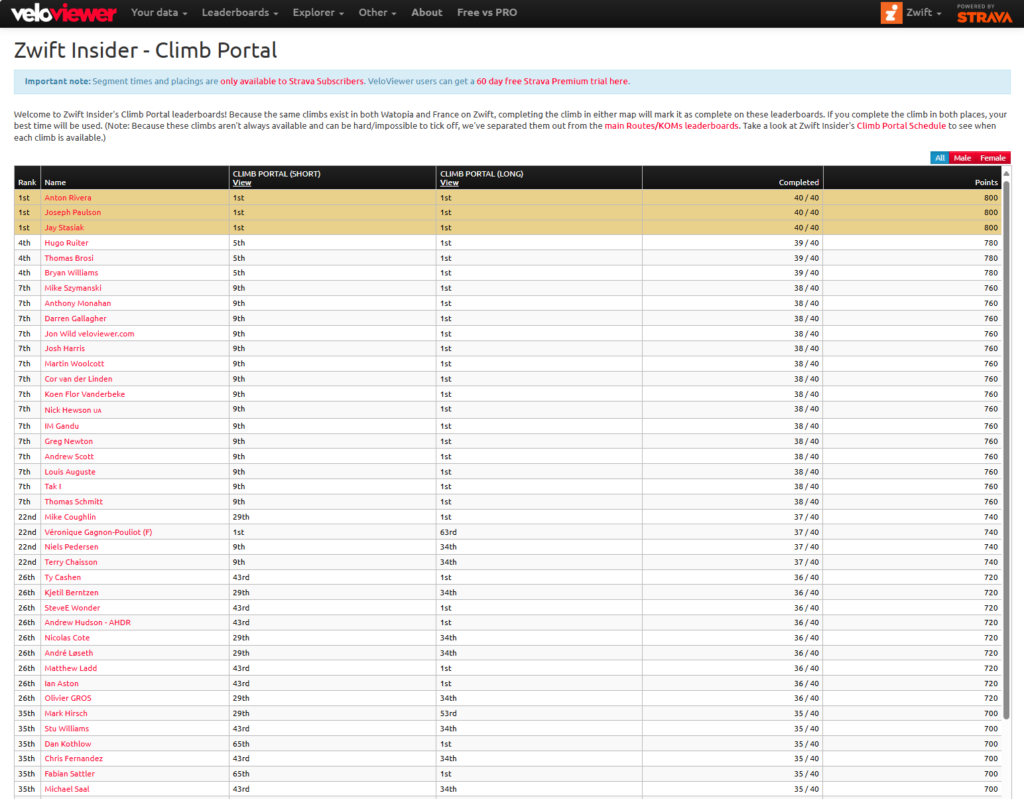
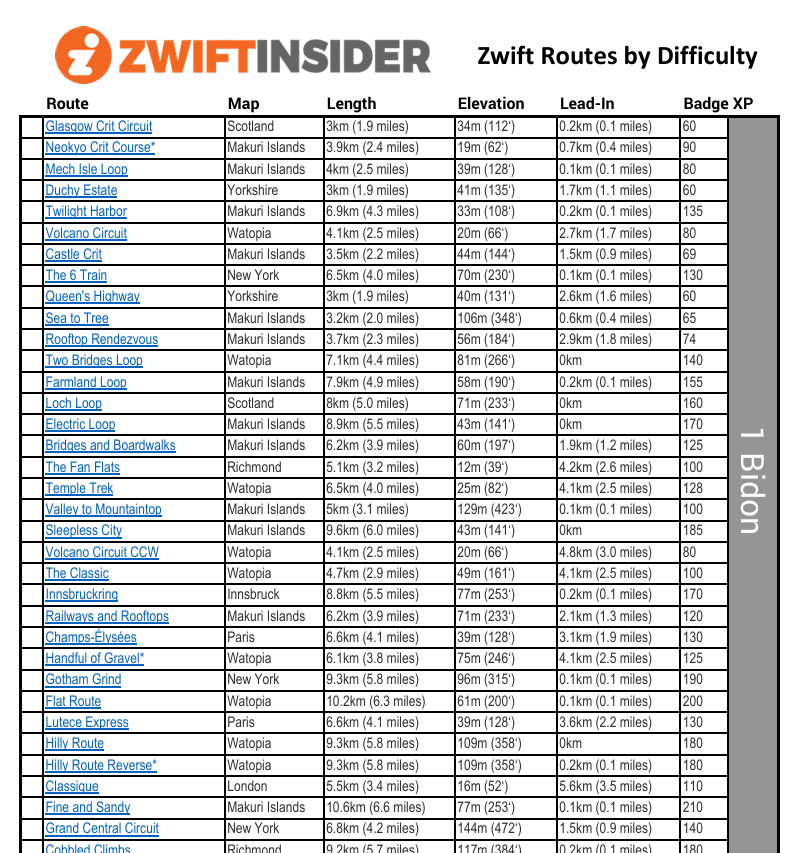
Updated: Veloviewer Route Hunter Leaderboards and Printable Route List
Zwift has been busy adding new routes and climb portals to the game, with ~20 new routes added since January and several climb portals as well.
As of today, our lists are all caught up to what’s in game. This includes:
- Veloviewer Route Hunter Leaderboards: contains all the badged routes in game, plus all the KOM segments. Compete with others or just yourself – you move up the leaderboard by completing all the segments (20 points per segment) but also score points based on finishing time.
- Veloviewer Climb Portal Leaderboards: same as above, but just for the Climb Portal. This one is trickier, since you can only ride portals when they are scheduled!
- Printable List of Zwift Routes by Difficulty: a list of all badged routes in game, sorted by difficulty based on our ZIMetrics and grouped by the approximate number of bidons you’ll need to drink to finish each route.
- Master Route List: this is always the first list to be updated (often before routes are publicly released). If you ever need route info, go here!

Strava Segment Matching Bug
On a related note: many Zwifters have noticed that, for the past year or so, Strava hasn’t been matching certain activities to certain segments. It’s an odd bug, because it doesn’t seem to apply to older segments. But newer ones – at least those created after April 2024, although we don’t have a precise date – are affected. It seems to apply to segments that include multiple loops of a circuit, or repeated sections of road.
The following segments/routes are affected by this bug, and have thus been removed from the Veloviewer leaderboards until Strava fixes the issue:
If you want to bend Strava’s ear about this, please reply to the topic I just created on Strava’s Community Hub.
Questions or Comments?
Share below!
Antidote’s Pathseeker gravel bike has adjustable full suspension without shocks
Poland’s Antidote is the latest brand to bring suspension, both front and full, to gravel bikes in the shape of the new Pathseeker.
Gravel suspension is a trend we are seeing more and more of in 2025, along with increased tyre clearance and the wholesale adoption of Universal Derailleur Hanger dropouts.
The new Pathseeker can be had as a hardtail or full-suspension bike and brings a new fully adjustable suspension system front and rear. The system doesn’t use air or hydraulics in its damping or anti-squat adjustment.
Full bike prices start from €6,299, with hardtail framesets available from €3,799.
Not just another carbon bike

The Pathseeker’s construction uses a composite Antidote developed. It comprises a combination of carbon fibre, flax fibre, basalt fibre and a bio-based resin.
The brand claims this new composite is not only better ecologically than traditional carbon fibre, it also helps to significantly reduce vibrations in ways that standard carbon fibre cannot.

The frame also uses Vectran, a synthetic fibre that is five times stronger than steel and 10 times stronger than aluminium.
The Vectran is used in high-impact areas, making the most of the material’s high abrasion resistance and flex fatigue resistance.
Suspension without shocks

Antidote’s designers have created a proprietary suspension system called NanoFlex, used both at the front and rear of the Pathseeker. It is designed to offer 20mm of travel at each end.
The rear design is based on four pivot points, found more commonly in mountain bikes.
On the Pathseeker, the two usual pivots on the chainstays have been replaced by a flexible section in the chainstays. The remaining pivots are replaced by an eccentric mechanism in the front triangle, to which the rear triangle anchors.

Antitode says the eccentric mechanism mimics the action of a cam pushing on a shock absorber. The mechanism is stabilised by an elastomer, adding control to the suspension travel and vibration damping.
The elastomer can be replaced and switched, allowing for a full range of stiffness adjustments.

At the front, a carbon fork is combined with an integrated system that is actuated by either a spring or an interchangeable elastomer.
The steerer cap doubles up as a lockout. It’s a system very reminiscent of Cannondale’s original HeadShok or, more recently, BMC’s fork on the front and rear suspension-equipped URS LT.

Antidote claims the suspension works over small bumps and larger impacts, and isn’t influenced at all by pedalling or braking.
Bike details

The Pathseeker frame comes in two guises, the full-suspension eccentric pivot frame and a standard rigid back end. Both designs feature a low-slung sloping top tube, dropped stays and flattened tube profiles.
The geometry pairs a 72-degree head angle with a 72.5-degree seat angle on the size large.
That makes the Pathseeker’s geometry somewhat less extreme than new suspension-equipped gravel bikes such as Lee Cougan’s Innova Super Gravel or Ridley’s new Ignite GTX.
The new bike’s geometry is more in line with Cannondale’s similarly flex-tailed Topstone or BMC’s URS LT One. That would suggest the Pathseeker is intended more as an all-rounder/race gravel bike than a rowdy adventurer.

Antidote’s claimed weights for the framesets, including the fork, would suggest the same, at 1,590g for the full-suspension option and 1,350g for the hardtail, both in a large size. That could make for some impressively light builds for a suspension-equipped gravel bike.

The Pathseeker offers 50mm of tyre clearance, and has a T47 bottom bracket and UDH-compatible rear dropouts.

Antidote Pathseeker range and pricing details

The Antidote Pathseeker range comes with two full-suspension options and three hardtails. There are frameset options in both full-suspension and hardtail, too.
Bikes
- Pathseeker FS SRAM FORCE/RED / I9 1/1 Ultralite Carbon / RS REVERB AXS: €12,299
- Pathseeker FS SRAM FORCE/X0 / I9 1/1 Ultralite Carbon / RS REVERB AXS: €10,099
- Pathseeker HT SRAM FORCE/X0 / I9 ROAD GRCX / RS REVERB AXS: €8,699
- Pathseeker HT SRAM RIVAL/GX / I9 ROAD GRCX: €6,999
- Pathseeker HT SRAM APEX AXS / I9 ROAD GRCX: €6,299
Framesets
- Pathseeker full-suspension frame & suspension fork & stem + headset: €4,099
- Pathseeker hardtail frame & suspension fork: €3,799
After Three Years, AlmaLinux Is Having an Election
Here’s some preliminary information about AlmaLinux OS Foundation’s upcoming board election. We’ll keep you up-to-date as we learn more.
Goodbye Wrist Strain? Razer’s New Vertical Gaming Mouse Targets Office Comfort

It’s not the least bit unusual for Razer to announce a new gaming mouse. But a vertical rodent (like Logitech is prone to release) for both work and play? That’s something Razer has never done before…until now. Meet the Pro Click V2 Vertical Edition, which Razer is launching alongside its regular (read: non-vertical) Pro Click V2, both of
GCC 15.1 released
Version 15.1 of the GNU
Compiler Collection has been released. Changes include implementing the
C23 dialect by default, a number of new C++26 features, experimental
support for unsigned integers in Fortran, a new COBOL front end, and
more. See the GCC 15
changes page for details.
Compiler Collection has been released. Changes include implementing the
C23 dialect by default, a number of new C++26 features, experimental
support for unsigned integers in Fortran, a new COBOL front end, and
more. See the GCC 15
changes page for details.
Apple may shift all US-bound iPhone production from China to India
Apple may shift all of its US iPhone production from China to India in an effort to avoid Trump’s tariffs, according to a report from The Financial Times. The goal is to manufacture all 60 million iPhone devices sold to American customers in India by 2026, doubling current production numbers in the nation. That would be a stark shift, as Apple has manufactured the majority of its iPhone products in China since they debuted in 2007.
Apple first started building iPhones in India back in 2017 and late in 2023, pledged to build up to 50 million iPhones in the nation within three years with suppliers Foxconn and Tata. With that in mind, it would only have to boost that number by 10 million to achieve the new 60 million unit goal.
Those tariffs of up to 145 percent announced earlier this month have thrown electronic manufacturing into turmoil, despite announced exemptions for smartphones and computers. India, by contrast, has only been subject to a 10 percent US tariff. However, the nation could still be subject to a 26 percent tariff once a 90-day grace period is lifted, particularly as Trump has called India a “tariff abuser” and “tariff king.”
Apple reportedly airlifted $2 billion worth of iPhones to the US from India in March to bypass impending China levies. Trump’s stated goal with tariffs has been to shift more manufacturing to the US. However, many experts have said that would be virtually impossible, particularly in the electronics industry.
This article originally appeared on Engadget at https://www.engadget.com/mobile/smartphones/apple-may-shift-all-us-bound-iphone-production-from-china-to-india-133049630.html?src=rss
Linus Torvalds Expresses His Hatred For Case-Insensitive File-Systems
Linus Torvalds is sharing some of his classic and straight-to-the-point wisdom today over file-systems with case-folding / case-insensitive file and folder support…
Google’s Latest Nonsensical Overview Results Illustrate Yet Another Problem With AI
You might not be familiar with the phrase “peanut butter platform heels” but it apparently originates from a scientific experiment, where peanut butter was transformed into a diamond-like structure, under very high pressure—hence the “heels” reference.
Except this never happened. The phrase is complete nonsense, but was given a definition and backstory by Google AI Overviews when asked by writer Meaghan Wilson-Anastasios, as per this Threads post (which contains some other amusing examples).
The internet picked this up and ran with it. Apparently, “you can’t lick a badger twice” means you can’t trick someone twice (Bluesky), “a loose dog won’t surf” means something is unlikely to happen (Wired), and “the bicycle eats first” is a way of saying that you should prioritize your nutrition when training for a cycle ride (Futurism).
Google, however, is not amused. I was keen to put together my own collection of nonsense phrases and apparent meanings, but it seems the trick is no longer possible: Google will now refuse to show an AI Overview or tell you you’re mistaken if you try and get an explanation of a nonsensical phrase.
If you go to an actual AI chatbot, it’s a little different. I ran some quick tests with Gemini, Claude, and ChatGPT, and the bots attempt to explain these phrases logically, while also flagging that they appear to be nonsensical, and don’t seem to be in common use. That’s a much more nuanced approach, with context that has been lacking from AI Overviews.
Someone on Threads noticed you can type any random sentence into Google, then add “meaning” afterwards, and you’ll get an AI explanation of a famous idiom or phrase you just made up. Here is mine[image or embed]
— Greg Jenner (@gregjenner.bsky.social) 23 April 2025 at 11:15
Now, AI Overviews are still labeled as “experimental,” but most people won’t take much notice of that. They’ll assume the information they see is accurate and reliable, built on information scraped from web articles.
And while Google’s engineers may have wised up to this particular type of mistake, much like the glue on pizza one last year, it probably won’t be long before another similar issue crops up. It speaks to some basic problems with getting all of our information from AI, rather than references written by actual humans.
What’s going on?
Fundamentally, these AI Overviews are built to provide answers and synthesize information even if there’s no exact match for your query—which is where this phrase-definition problem starts. The AI feature is also perhaps not the best judge of what is and isn’t reliable information on the internet.
Looking to fix a laptop problem? Previously you’d get a list of blue links from Reddit and various support forums (and maybe Lifehacker), but with AI Overviews, Google sucks up everything it can find on those links and tries to patch together a smart answer—even if no one has had the specific problem you’re asking about. Sometimes that can be helpful, and sometimes you might end up making your problems worse.
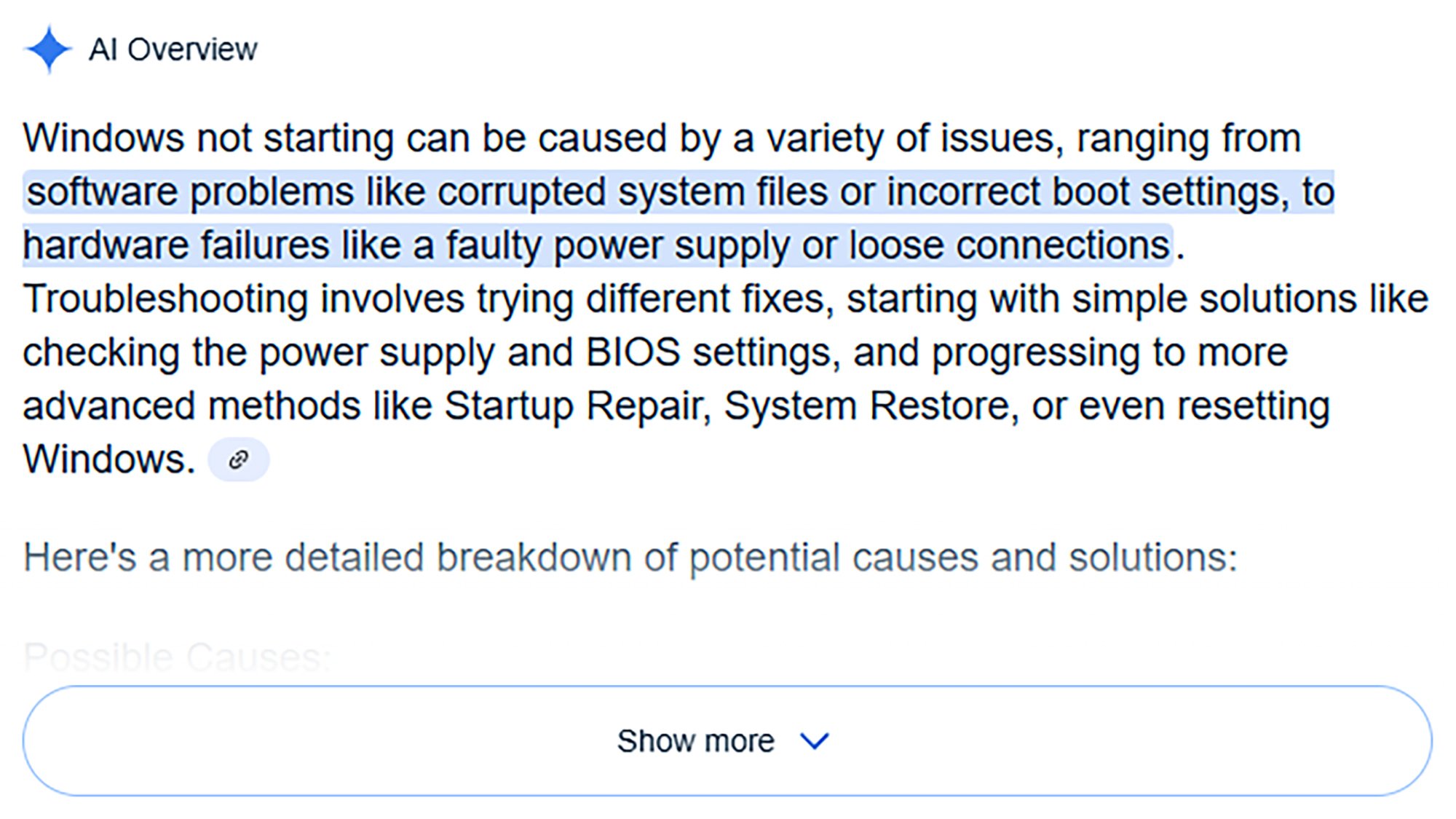
Credit: Lifehacker
Anecdotally, I’ve also noticed AI bots have a tendency to want to agree with prompts, and affirm what a prompt says, even if it’s inaccurate. These models are eager to please, and essentially want to be helpful even if they can’t be. Depending on how you word your query, you can get AI to agree with something that isn’t right.
I didn’t manage to get any nonsensical idioms defined by Google AI Overviews, but I did ask the AI why R.E.M.’s second album was recorded in London: That was down to the choice of producer Joe Boyd, the AI Overview told me. But in fact, R.E.M.’s second album wasn’t recorded in London, it was recorded in North Carolina—it’s the third LP that was recorded in London, and produced by Joe Boyd.
The actual Gemini app gives the right response: that the second album wasn’t recorded in London. But the way AI Overviews attempt to combine multiple online sources into a coherent whole seems to be rather suspect in terms of its accuracy, especially if your search query makes some confident claims of its own.
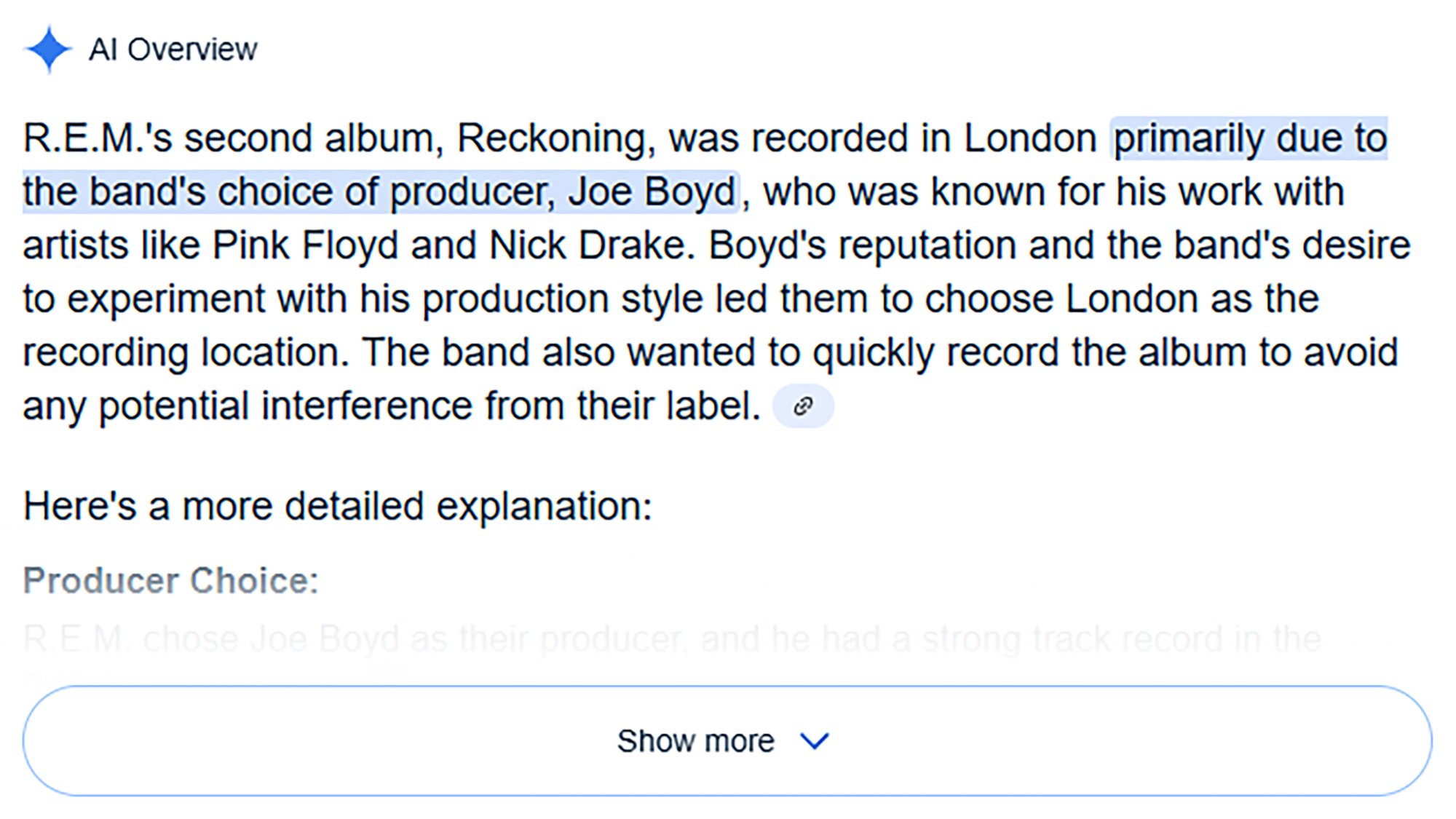
With the right encouragement, Google will get its music chronology wrong.
Credit: Lifehacker
Credit: Lifehacker
“When people do nonsensical or ‘false premise’ searches, our systems will try to find the most relevant results based on the limited web content available,” Google told Android Authority in an official statement. “This is true of Search overall, and in some cases, AI Overviews will also trigger in an effort to provide helpful context.”
We seem to be barreling towards having search engines that always respond with AI rather than information compiled by actual people, but of course AI has never fixed a faucet, tested an iPhone camera, or listened to R.E.M.—it’s just synthesizing vast amounts of data from people who have, and trying to compose answers by figuring out which word is most likely to go in front of the previous one.
Nitrux Project Introduces NX AppHub
NX AppHub is here as a replacement for the NX Software Center, Nitrux’s built-in GUI utility for managing AppImage bundle, and zap, a command-line package management interface for AppImages.
The post Nitrux Project Introduces NX AppHub appeared first on Linux Today.
Google’s Pixel Buds Pro 2 are $50 off right now
The Google Pixel Buds Pro 2 are on sale right now for $179, which is a discount of $50. Just head on over to Wellbots and pop in the code ENGAD50 to score the deal.
This is Google’s latest and greatest audio product and easily made our list of the best wireless earbuds. They are smaller and more comfortable than the previous version, which is great. Despite the product shrinkage, the sound has also been improved. The bass is punchy and the highs are crisp.
The battery life is also slightly improved when compared to the original earbuds. You can expect eight hours of use with ANC on, but this increases to 30 hours when you consider the included charging case. These are the company’s first earbuds with a Tensor chip, which allows for ultra-low latency audio processing and multi-path signal handling.
Other perks include conversation detection, multipoint Bluetooth and the ability to customize what long-pressing the button does. These earbuds can also automatically switch between devices linked to a Google account, which is great for Android users but doesn’t do much for Apple fans.
For those on a serious budget, the Google Pixel Buds A-Series earbuds are also $50 off via Wellbots. Enter the same ENGAD50 code to bring the price down to just $49.
Follow @EngadgetDeals on X for the latest tech deals and buying advice.
This article originally appeared on Engadget at https://www.engadget.com/deals/googles-pixel-buds-pro-2-are-50-off-right-now-130054223.html?src=rss
Audio-Technica ATH-CKS50TW2 review: Long battery life and satisfying sound for $150
For earbuds in the $150 range, there’s usually not a lot to get excited about. Sure, those models typically offer the basics with decent sound quality, but very few have a stand-out feature that leaves a lasting impression. For its ATH-CKS50TW2 ($149), Audio-Technica sought to do this with extremely long battery life and a neat trick that will help you make the most of it. There’s a lot more to like on this set, including a list of tools that rival more expensive alternatives, but the ATH-CKS50TW2 is far from a complete package. The satisfying audio performance and ability to use them for over 20 hours on a charge might be enough to entice you to overlook those shortcomings.
The good: battery life, magnets and sound quality
When Audio-Technica announced the ATH-CKS50TW2 at CES, the first item on the spec sheet that struck me was the battery life. The company says you can expect up to 25 hours on a full charge without active noise cancellation (ANC) and up to 40 more hours from the charging case. With ANC enabled, you’ll still get a whopping 15 hours of listening time, which is about double what a lot of the competition offers these days. Importantly, those claims actually held true during my tests.
To maximize those numbers, the company equipped the ATH-CKS50TW2 with so-called Magnetic Switch technology. Specifically, the earbuds snap together with magnets to turn off before you put them in the case. Much of the competition doesn’t power down until the earbuds are inside of the case, but with the ATH-CKS50TW2, you don’t need to worry about that extra step. Simply take them off and snap them together, then you’ll know you’re no longer wasting precious battery power while the buds are resting on your desk. This also means the ATH-CKS50TW2 won’t always be charging in the case when you’re not using them, which should help extend battery longevity.
I’m also happy to report that Audio-Technica brought its trademark warm, inviting sound profile to the ATH-CKS50TW2. More specifically, the stock audio isn’t overly tuned, so bass remains pleasantly thumpy when needed and dialed down when it’s not. The bassline of Kendrick Lamar’s “tv off” booms while the hi-hats, claps and vocals cut through clear. When you switch over to something more mellow with less low-end bombast like Turnpike Troubadours’ “Be Here,” you get the full gamut of the acoustic instruments and light drums without bass overpowering the mix.
It doesn’t deliver the enhanced clarity and pristine detail that more expensive, flagship-level earbuds do, but the ATH-CKS50TW2 is plenty good for $150. In fact, this may be the best option in terms of sound quality in this price range. On Jason Isbell’s Foxes in the Snow, for example, the acoustic guitar — the lone instrument on the album — doesn’t have the expressive nuance as it does on Technics’ AZ100 or Bowers and Wilkins’ Pi8. But I’ll admit the ATH-CKS50TW2 holds its own against similarly priced competition. That, and the extended battery life alone make these earbuds a compelling package.
The not so good: design, controls and a missing feature
By 2025 standards, the ATH-CKS50TW2 earbuds are big and bulky. They also feel unbalanced, with much of the weight sitting well outside the curves of your ears. This means they’re not as comfortable as smaller models and feel unsteady. I never had issues with them falling out, but they feel like they could, which isn’t great. Perhaps Audio-Technica needed the extra space for bigger batteries, which I’m guessing will be an acceptable trade-off for users searching for longer listening times between charges.
Audio-Technica gave the ATH-CKS50TW2 physical controls, which is usually a good thing. Like some of the company’s previous models, the buttons are small, positioned along the top edge of the earbuds. Due to the design of the ATH-CKS50TW2 though, you have to hold the earbuds in place while pressing those buttons. It’s cumbersome, mostly due to the size and weight of each bud. The bulky, unbalanced construction has trickle-down effects on other aspects of the listening experience.
Billy Steele for Engadget
The ATH-CKS50TW2 is missing a crucial feature — wear detection. But the company has done well to include ANC, Hear-Through (ambient sound) mode, a five-band EQ, soundscapes, media controls and battery updates in its app. There’s also a “private timer” and low latency mode for games and video. You can even adjust how many steps volume adjustments will jump and test your microphone to see if optional noise reduction is needed during calls. Additionally, a quick-attention, Talk-Through mode that reduces volume and activates ambient sound for brief chats too. But you won’t find the simple, and handy, automatic pausing when you remove the earbuds from your ears.
The final verdict on the ATH-CKS50TW2
My initial assumption was correct: the main reason to buy the ATH-CKS50TW2 is the extremely long battery life. I don’t think the Magnetic Switch feature is necessary to hit the promised runtime, but it’s nice to know the earbuds are off without having to put them in the case where they’ll recharge even when you don’t need them to. Audio-Technica’s sonic prowess is on display here as well, albeit to a lesser degree than some of the company’s other earbuds and headphones.
The design isn’t the most comfortable and the controls are awkward to use, but the full list of the ATH-CKS50TW2’s features is quite long. Despite a few flaws, there’s plenty to like here, including the two most important things for a lot of users: sound and battery life.
This article originally appeared on Engadget at https://www.engadget.com/audio/headphones/audio-technica-ath-cks50tw2-review-long-battery-life-and-satisfying-sound-for-150-130042531.html?src=rss
This PS5 Headset Is on Sale for $90 Right Now
We may earn a commission from links on this page. Deal pricing and availability subject to change after time of publication.
If you’ve been eyeing a headset that toes the line between immersive tech and affordability, the Razer Kaira Pro for PlayStation is currently down to $89.99 on Woot (for six days or until it’s sold out). That’s about $30 cheaper than Amazon’s current price and the lowest it’s ever been, according to price trackers. It ships with a 90-day Woot warranty, but do note: shipping isn’t available to Alaska, Hawaii, or P.O. boxes.

This model is officially licensed for PS5 and matches Sony’s aesthetic, so if you’re trying to keep a clean look with your console setup, this blends in pretty well. The headset’s rotating earcups, plush leatherette memory foam, and metal frame give it a premium feel, though it can reportedly get a bit warm after long sessions. That said, while the materials feel nice overall, the creaky leatherette might bug you if you’re big on silence.
Where the Kaira Pro gets interesting is with its HyperSense haptic feedback. Unlike rumble features on basic headsets, this one responds dynamically to the in-game audio and delivers directional vibrations—not just thumps from explosions, but subtle feedback based on where sound is coming from in the game. For example, if there’s gunfire from your left? You’ll feel it in your left earcup. That alone makes it a different kind of experience—it’s subtle tech that pulls you into the game without needing full surround sound. But even when the haptics are turned off, the headset delivers strong, well-balanced sound with its 50mm titanium drivers, especially when using Tempest 3D AudioTech on PS5, which adds more spatial awareness.
Battery life holds up decently, offering around 11 hours with RGB lights and haptics on, or closer to 30 if you keep things toned down. It recharges via USB-C and supports both Bluetooth and 2.4GHz wireless, so you can hop between PlayStation, PC, and mobile devices without much friction. You can’t stream audio from both sources simultaneously, but switching is quick. The detachable mic filters out background noise fairly well, and the companion app gives you access to EQ controls for customizing sound profiles and lighting tweaks, which is nice if you like fine-tuning things.
Perplexity CEO Says Its Browser Will Track Everything Users Do Online To Sell Ads
An anonymous reader quotes a report from TechCrunch: Perplexity CEO Aravind Srinivas said this week on the TBPN podcast that one reason Perplexity is building its own browser is to collect data on everything users do outside of its own app. This so it can sell premium ads. “That’s kind of one of the other reasons we wanted to build a browser, is we want to get data even outside the app to better understand you,” Srinivas said. “Because some of the prompts that people do in these AIs is purely work-related. It’s not like that’s personal.”
And work-related queries won’t help the AI company build an accurate-enough dossier. “On the other hand, what are the things you’re buying; which hotels are you going [to]; which restaurants are you going to; what are you spending time browsing, tells us so much more about you,” he explained. Srinivas believes that Perplexity’s browser users will be fine with such tracking because the ads should be more relevant to them. “We plan to use all the context to build a better user profile and, maybe you know, through our discover feed we could show some ads there,” he said. The browser, named Comet, suffered setbacks but is on track to be launched in May, Srinivas said.


Read more of this story at Slashdot.
Intel Posts Q1 Beat On Data Center Growth But CEO Tan’s Changes Loom

Intel continues to embark on a major turnaround effort that began under the guidance of former CEO Pat Gelsinger and is now the responsibility of his recently appointed replacement, Lip-Bu Tan. It will take some time to assess Tan’s performance as head of Intel. In the meantime, Intel posted financial results for the first quarter of 2025,
Critical Flaws Fixed in Nagios Log Server
The Nagios Security Team has fixed three critical vulnerabilities affecting popular enterprise log management and analysis platform Nagios Log Server.
The vulnerabilities affect Nagios Log Server version 2024R1.3.1 and have been fixed in:
Version 2024R2 (released on March 19, 2025)
Version 2024R1.3.2 (released on April 9, 2025)
The post Critical Flaws Fixed in Nagios Log Server appeared first on Linux Today.
This Healthcare Data Breach Compromised 5.5 Million Patients’ Information
Data breaches targeting healthcare and compromising patient information seem to be coming fast and furious, the latest of which occurred at Yale New Haven Health (YNHHS), a massive nonprofit healthcare network in Connecticut. Hackers stole the data of more than 5.5 million individuals during an attack in March 2025.
Other major cyber incidents revealed by healthcare organizations in recent weeks include Blue Shield of California’s exposure of 4.7 million members’ data to Google along with a breach at Maryland’s Frederick Health Medical Group, which affected nearly a million patients.
What happened at Yale New Haven Health?
According to a public notice on the YNHHS website, the organization discovered “unusual activity” on its system on March 8, 2025, which was later identified as unauthorized third-party access that allowed bad actors to copy certain patient data. While the information stolen varies by individual, it may include the following:
-
Name
-
Date of birth
-
Address
-
Phone number
-
Email address
-
Race
-
Ethnicity
-
Social Security number
-
Patient type
-
Medical record number
YNHHS says the breach did not include access to medical records, treatment information, or financial data (such as account and payment information).
What to do if your records were affected
If you’ve been a patient in the YNHHS network, your data may have been compromised. The organization began sending notices to those affected on April 14, so keep an eye out for a letter in the mail.
YNHHS is providing complimentary credit monitoring and identity protection services to patients whose Social Security numbers were stolen, with directions for taking advantage of these services presumably included in the mailed notices. You can call the support line at 855-549-2678 Monday to Friday between 9 a.m. and 9 p.m. ET if you have questions about the incident or how you may be affected.
There are also class action lawsuits in the works seeking damages for individuals impacted by the breach, so you can keep an eye out for news on those filings.
As always, you can’t reclaim stolen data, but you can minimize the potential negative impact on your life. Freeze your credit, place a fraud alert, and request copies of your credit report regularly. Lock down your Social Security number to prevent identity theft. You should also review medical bills and statements from YNHHS and report any discrepancies immediately. Exercise good digital hygiene practices, such as avoiding clicking links in messages you receive.
OpenAI’s Deep Research tool is coming to free accounts
OpenAI is giving free ChatGPT users limited access to its Deep Research tool without the need to pay for it. In addition, the company has expanded the tool’s limits for all users by rolling out a lightweight version of it powered by its o4-mini model. It says the o4-mini Deep Research feature produces slightly shorter responses, but is “nearly as smart, more cost-efficient and delivers similarly high-quality results” as the original version. OpenAI previously released the tool for use by paying Pro, Plus, Team, Edu and Enterprise subscribers. But even they have a limited number of Deep Research queries per month.
The lightweight version of deep research is powered by a version of OpenAI o4-mini and is nearly as intelligent as the deep research people already know and love, while being significantly cheaper to serve.
Responses will typically be shorter while maintaining the depth and… pic.twitter.com/H2UD5GThVj
— OpenAI (@OpenAI) April 24, 2025
Plus users, for instance, only had access to 10 inquiries, whereas Pro subscribers paying $200 monthly had a limit of 125. Now, when users hit their limit on the original version, ChatGPT will switch over to the lightweight one. Plus and Team subscribers are now getting an extra 15 Deep Research inquiries a month on top of their 10, while Pro users are getting an additional 125 tasks powered by the lightweight version of the tool on top of their 125. Enterprise and Edu users are getting access to the lightweight tool next week and will get 15 more inquiries every month. As for free users, they can use the tool powered by o4-mini to get up to five answers monthly.
Deep Research has the capacity to analyze websites and various sources to create thorough reports with citations. The company says the tool is “fine-tuned on the OpenAI o3 reasoning model,” but the lightweight version is “significantly cheaper to serve.”
This article originally appeared on Engadget at https://www.engadget.com/ai/openais-deep-research-tool-is-coming-to-free-accounts-123031773.html?src=rss
Michael B. Jordan’s Most Badass Physical Performances

Michael B Jordan is one of those actors with a physique that looks like he was carved from marble while in the gym, staring at a collage of buff action heroes. And he’s put it to good use in his 20-plus year career, playing everything from a flying ball of fire in Fantastic Four to a fireman-turned-revolutionary…
Sydney Radio Station Secretly Used AI-Generated Host For 6 Months Without Disclosure
The Sydney-based CADA station secretly used an AI-generated host named “Thy” for its weekday shows over six months without disclosure. The Sydney Morning Herald reports: After initial questioning from Stephanie Coombes in The Carpet newsletter, it was revealed that the station used ElevenLabs — a generative AI audio platform that transforms text into speech — to create Thy, whose likeness and voice were cloned from a real employee in the ARN finance team. The Australian Communications and Media Authority said there were currently no specific restrictions on the use of AI in broadcast content, and no obligation to disclose its use.
An ARN spokesperson said the company was exploring how new technology could enhance the listener experience. “We’ve been trialling AI audio tools on CADA, using the voice of Thy, an ARN team member. This is a space being explored by broadcasters globally, and the trial has offered valuable insights.” However, it has also “reinforced the power of real personalities in driving compelling content,” the spokesperson added.
The Australian Financial Review reported that Workdays with Thy has been broadcast on CADA since November, and was reported to have reached at least 72,000 people in last month’s ratings. Vice president of the Australian Association of Voice Actors, Teresa Lim, said CADA’s failure to disclose its use of AI reinforces how necessary legislation around AI labelling has become. “AI can be such a powerful and positive tool in broadcasting if there are correct safeguards in place,” she said. “Authenticity and truth are so important for broadcast media. The public deserves to know what the source is of what’s being broadcast … We need to have these discussions now before AI becomes so advanced that it’s too difficult to regulate.”


Read more of this story at Slashdot.