Lazarus review: Wildly stylish, but it’s no Cowboy Bebop

You could call Shinichiro Watanabe’s Lazarus a retread of his masterpiece, Cowboy Bebop. That’s not to say the show is bad — based on the five episodes I’ve seen so far, Lazarus is still an entertaining and stylish ride. But I’ve just come to expect more from a legendary creator like Watanabe.

It’s set in the year 2052, a near-future when a renowned neuroscientist released Hapna, a drug that can erase all pain. If that sounds too good to be true, it is: Hapna’s creator Dr. Skinner reveals to the world that everyone who took the drug will eventually die. And then he disappears. Like an evil Willy Wonka, he announces one hope for survival: Find him in 30 days, or humanity is doomed.

To help find Skinner, the government sets up a covert group named Lazarus made up of convicted criminals. And that’s where the similarities come in. There’s the lead, Axel Gilberto, a parkour junkie who resembles Bebop’s reckless and carefree Spike Spiegel. Rounding out the team is Christine, a gorgeous femme fatale; Eleina, a bright young hacker; and Doug, a gruff investigator who has little patience for Axel’s shit. Those are all clear analogs to the Bebop crew of Faye, Ed and Jet. The one new element of the team is Leland, a cute college student who takes on various roles during the show (perhaps he’s just an anthropomorphized version of Bebop’s adorable pup Ein).

There’s a bit of Suicide Squad in the idea of using criminals to find humanity’s greatest villain, but Lazarus doesn’t really justify why that’s the case (that may be answered later in the show’s 13-episode run). And you’d think there would be more government efforts beyond a group of misfits to accomplish a humanity-saving mission. The Lazarus crew get a few chances to bond throughout each episode, but their interpersonal dynamics feel less organic than the Bebop characters, whose relationships were enriched by the pressure-cooker environment of an interplanetery spaceship, ever-present economic struggle and compelling backstories. By episode five of Lazarus, I didn’t have any real understanding of these characters, whereas Bebop delivered the seminal episode Ballad of the Fallen Angels by then.

Like Watanabe’s Samurai Champloo, Lazarus is best enjoyed if you don’t look too closely at its plot holes or contrivances (Axel’s inhuman parkour abilities make Spike Spiegel’s antics seem tame in comparison). It’s better to sit back and enjoy the incredibly stylish vibes. That includes wonderfully fluid animation by Mappa; a catchy soundtrack by Kamasi Washington, Floating Points and Bonobo (with a great ending theme, “Lazarus” by The Boo Radleys); and bone-crunching action choreography by John Wick director Chad Stahelski. It’s hard not to appreciate all of the talent involved.

Lazarus on Adult Swim
Adult Swim

But again, I just wish the whole project felt more original. Lazarus’s premise isn’t far off from Cowboy Bebop: The Movie, which involved a terrorist plot to deploy nanomachines that would kill everyone on Mars. It’s also funny to see the show arrive alongside a more inventive show like Max’s Common Side Effects, which deals with the real-world consequences of miracle drugs that could heal any illness or injury. That show’s characters are more grounded and relatable, and it explores why pharmaceutical companies would stop at nothing to kill such a miracle drug.

“The story began with Dr. Skinner… Is he a saint or a devil?” Watanabe said on the Engadget podcast via a translator (while he relaxed in shades with a mountain of records behind him, like the absolute boss he is). “Exactly what does he want to do? That was a big initial driving part of the story. … What you initially thought of Skinner at [the] start may change throughout the 13 episodes.”

Lazarus on Adult Swim
Adult Swim

It’s not a huge spoiler to say that Dr. Skinner isn’t always portrayed as a villain in the show. Before the release of Hapna, he was a famous neuroscientist who pushed humanity to respond to the climate crisis. But instead of listening to him, the world’s countries chose to pursue profit over the future of humanity. With that in mind, it’s no shock Watanabe says the inspiration for Hapna was, in part, the opioid crisis.

Throughout flashbacks and short opening monologues, Lazarus gives us glimpses into Hapna’s effect on our main characters, all of which is more compelling than the actual quest to find Dr. Skinner. Did the pill really heal everyone’s pain, or did it just close off their ability to feel true emotions? 

I’m sure newcomers to Watanabe’s work won’t have the same reservations with Lazarus as I do, I just wish the show had the same distinctive identity as his other series. Cowboy Bebop is a jazz-soaked noir; Space Dandy is a hilarious riff on the space opera genre; and Carol and Tuesday is a touching story of two young girls pursuing a pop music career. Lazarus is basically another action thriller, but this time it’s scored to modern jazz and electronic music.

I’m holding out hope that Lazarus matures into a more thoughtful show in its second half. But even if it doesn’t, it’s still worth celebrating anything new from Shinichiro Watanabe. There aren’t many anime directors and writers with his sense of style and excellent taste in music and action cinema. Even if it’s a lesser Watanabe project, it’s still more entertaining and creative than the vast majority of shows bombarding us in the streaming TV era, anime or otherwise.

Lazarus premieres on April 5 on Adult Swim, and it’ll be available on Max the day after. Subtitled episodes will be available 30 days after their English dubbed versions.

This article originally appeared on Engadget at https://www.engadget.com/entertainment/tv-movies/lazarus-review-wildly-stylish-but-its-no-cowboy-bebop-170300198.html?src=rss
Gemini 2.5 Pro Is Google’s Most Powerful AI Model Yet, and It’s Already Free

Google has pushed out a shiny new AI model in the form of Gemini 2.5 Pro, albeit with an experimental label next to it—and it’s available for free, so you don’t need to subscribe to Gemini Advanced to get it. As with many recent AI model releases, the “reasoning” capabilities of the model are said to be the biggest upgrade here.

In artificial intelligence terms, reasoning means answers that are more thoroughly worked through. That should produce fewer mistakes, more logical responses, and a better appreciation of “context and nuance” according to Google. This capability for extra “thought” will now come as standard in future Google models.

The Pro (Experimental) release is the first variant of Gemini 2.5 to show up, and while the original blog post didn’t mention free users, less than a week later we’ve got an update saying it’s available for everyone—with rate limits applied if you’re not a Gemini Advanced subscriber (Google hasn’t specified what those rate limits are). The new model is available now through the desktop app, and coming soon to mobile.

Google Gemini benchmarks
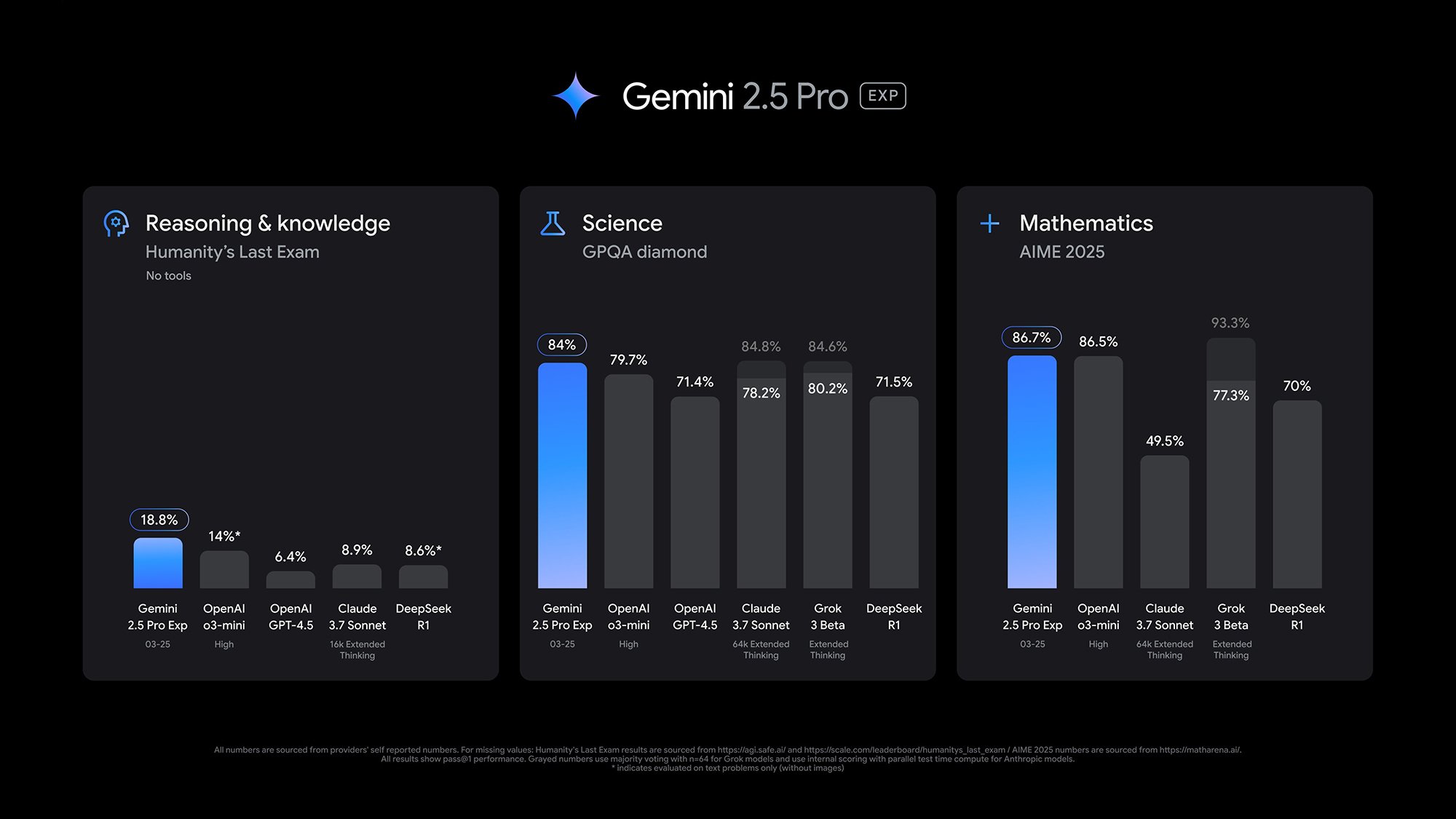
Gemini 2.5 Pro hits new levels in a variety of AI benchmarks.
Credit: Google

Google points to several benchmark tests that show the prowess of Gemini 2.5 Pro. At the time of writing it tops the LMArena leaderboard, where users give ratings on responses from dozens of AI chatbots. It also scores 18.8 percent on the Humanity’s Last Exam test—which measures human knowledge and reasoning—narrowly edging out rival models from OpenAI and Anthropic.

Also of note: the large context window. In simple terms, this is an indicator of how much data the AI model can churn through in one go, and Gemini 2.5 Pro has a context window of one million tokens, with two million “coming soon” according to Google. That compares to a context window of, for example, 200,000 tokens for ChatGPT’s o3-mini reasoning model.

As tends to be the norm with these AI announcements, there’s no mention of copyright infringement as far as training data goes, or increasing energy use. According to MIT researchers, modern-day AI models use a “staggering” amount of electricity and water, and have put us on an “unsustainable path” that needs to change direction quickly.

Putting Gemini 2.5 Pro to the test

It can be tricky to quantify improvements from one AI model to the next, which is why benchmarks like LMArena are useful. I lack the expert scientific or programming knowledge needed to really put Gemini 2.5 Pro to the test—though as with the previous model, I was able to create some simple web apps (like an online timer) in minutes.

I do know a bit about Charles Dickens’ Bleak House, so I set Gemini 2.5 Pro to work on the text. It gave me an accurate summary of the plot, and a clever assessment of the different narrative devices used (which would’ve really helped me in my study days). It also converted the book into a reasonably well done three-act structure for a movie—evidence of it holding a lot in its “mind” at once.

The older Gemini 2.0 Flash was able to answer the same Bleak House prompts accurately too, but the responses from Gemini 2.5 Pro were longer, more detailed, less generic, and smarter—evidence of that extra “reasoning” being put to work. The Gemini 2.0 Flash model also had to split the movie adaptation into three responses, perhaps due to the sheer amount of text it was trying to process.

Google has provided its own example of the capabilities of Gemini 2.5 Pro, showing how a simple endless runner game can be produced from a single prompt. While the demo video showing the code output is sped up, the game does appear to work and be pretty well-designed, which is an impressive end result from a single natural language prompt. There’s also a neat web demo of digital fish swimming around.

Elsewhere on the web, the new AI model is being extensively tested. Software engineer and independent AI researcher Simon Willison ran several tests covering image creation, audio transcription, and code generation, and came away very much liking what Gemini 2.5 Pro had been able to come up with.

The frenetic pace of AI development shows no signs of slowing down anytime soon, and we can expect more Gemini 2.5 models to appear in the near future. “As always, we welcome feedback so we can continue to improve Gemini’s impressive new abilities at a rapid pace, all with the goal of making our AI more helpful,” says Koray Kavukcuoglu, from Google’s DeepMind AI lab.

Gemini is an increasingly good chatbot, but it’s still a bad assistant

Google announced its intention to unify its generative AI efforts under the Gemini brand at the tail end of 2023, and it has been full steam ahead ever since. In 2025, Google Assistant is being phased out and replaced with Gemini. As Google, Amazon, and others move toward a world in which all virtual assistants are based on generative AI, it’s reasonable to consider if this is actually a good idea. Despite promises of “smarter” AI and ever-increasing token limits, these robots still have a fundamental flaw that may make them bad assistants: They lie.

They don’t set out to lie, of course, because they don’t know what a “lie” is. These systems attempt to generate the most plausible next token to build an output. Because of this, generative AI is non-deterministic—you can’t predict the output, and even running the same prompt multiple times will offer varying responses.

This can look impressively like thinking sometimes, but it also leads to frequent hallucinations. That’s why the iPhone said Luigi Mangione was dead and Google told people to put glue on pizza. GenAI proponents like Google and Apple have been trying to curb the chaos of confabulations, but this may always be a problem because of the nature of the underlying technology.

Read full article

Comments

TikTok’s ban deadline is coming. What happens next?

TikTok’s deadline to sell off or cede its US operations is once again approaching. The 75-day extension delaying the enforcement of a nationwide TikTok ban is set to run out Saturday, April 5, unless the company finally reaches an agreement to find a new owner. Who might buy it, and what happens if no deal is reached? Here’s the shape of things right now:

Potential buyers

President Donald Trump has suggested that “a deal” is imminent and could be reached before that deadline. What such an agreement will look like is still extremely unclear. A number of interested buyers have come forward, including YouTuber MrBeast, Reddit cofounder Alexis Ohanian and Perplexity AI. Oracle, which almost bought TikTok in 2020 and was a key part of TikTok’s earlier negotiations to address national security concerns, is also in the running.

Depending on which bid wins out, TikTok could end up looking very different. ByteDance, TikTok’s Chinese owner, won’t allow another company to take control of the app’s coveted recommendation algorithm. That means a new owner would have to rebuild TikTok’s central feature. Perplexity AI, for example, has said it would take on this task of reverse-engineering the app’s “For You” feed, making it open source and implementing some kind of Community Notes-style fact checking feature. Reddit cofounder Alexis Ohanian, who joined a group of investors known as “Project Liberty,” has hinted at a vision for TikTok that somehow ties in with blockchain technology.

Option 2

There’s also another, potentially less disruptive option on the table. The White House is also considering a deal that would allow TikTok’s existing US investors to “roll over their stakes into a new independent global TikTok company,” according to The New York Times. Under this arrangement, Oracle could also end up overseeing TikTok’s US data while ByteDance hangs onto its algorithm, as the Financial Times reported in March.

This would likely be a smoother transition than a full-on sale that would require a new owner to rebuild a significant part of the app. Aspects of it are also very similar to terms TikTok already agreed to under a previous agreement with Oracle known as Project Texas. However, this sort of deal may also not be entirely legal, as Politico recently pointed out. The Protecting Americans from Foreign Adversary Controlled Applications Act, the law passed by Congress and signed by former President Joe Biden last year, calls for a divestment of TikTok and its algorithm.

It’s also not clear whether Chinese officials would be willing to sign off on such an arrangement, though Trump has suggested he could use the threat of tariffs as negotiating leverage. “We’re dealing with China also on it because they may have something to do with it. And we’ll see how that goes,” Trump told reporters over the weekend.

No deal

So what happens if Trump’s “deal” isn’t finalized by Saturday? The answer, it seems, is… probably nothing. Trump has said he would likely extend the deadline again if the clock runs out on the current extension. (Once again, it’s not entirely clear if another extension is legal, but CNN reports that a second extension might be an uphill battle if challenged in court.) In the meantime, TikTok is unlikely to go dark like it (briefly) did in January when the ban law first went into effect.

This article originally appeared on Engadget at https://www.engadget.com/social-media/tiktoks-ban-deadline-is-coming-what-happens-next-162420478.html?src=rss

Four private astronauts launch on first human mission to fly over the poles

Four adventurers suited up and embarked on a first-of-a-kind trip to space Monday night, becoming the first humans to fly in polar orbit aboard a SpaceX crew capsule chartered by a Chinese-born cryptocurrency billionaire.

The private astronauts rocketed into orbit atop a Falcon 9 booster from NASA’s Kennedy Space Center in Florida at 9:46 pm EDT Monday (01:46 UTC Tuesday). Instead of heading to the northeast in pursuit of the International Space Station, the Falcon 9 and Dragon spacecraft departed Launch Complex 39A and arced to the southeast, then turned south on a flight path hugging Florida’s east coast.

The unusual trajectory aligned the Falcon 9 with a perfectly polar orbit at an inclination of 90 degrees to the equator, bringing the four-person crew directly over the North or South Pole every 45 minutes.

Read full article

Comments

‘Dopamine’, An Insane Entirely Beatboxed Track

Note: If time is money and you don’t have any, skip to 0:50 for the drop at 0:55 and prepare to have your mind blown �

This is a video of South Korean beatboxing champion Wing performing his single ‘Dopamine’, a song that’s entirely beatboxed and hard to believe doesn’t have any electronic wizardry behind it. Those sounds he makes aren’t human. The sound a dog makes in the middle of the night when it’s about to throw up on your comforter? Also not human, but completely different.

Study Reveals Why Credit Card Interest Rates Remain Stubbornly High

Credit card interest rates, which averaged 23% in 2023, are significantly higher than any other major loan product primarily due to non-diversifiable default risk and banks’ market power, according to research published by the Federal Reserve Bank of New York.

The comprehensive study, which analyzed 330 million monthly credit card accounts, found that while high default losses contribute to elevated rates, they explain only part of the picture. Even high-FICO borrowers pay spreads exceeding 7% above the federal funds rate. Researchers determined that credit card banks have substantial pricing power, achieved through exceptionally high operating expenses — about 4-5% of dollar balances annually — with marketing costs ten times higher than those at other banks.

“Credit card charge-off rates are highly correlated with default rates on banks’ other loans as well as on corporate bonds,” the researchers said, noting that default risk cannot be diversified away across lending markets, particularly during economic downturns. The study estimated that exposure to aggregate default risk carries a premium of 5.3% per year, which fully explains the relationship between return on assets and credit scores.

Credit cards are ubiquitous in American finance, with 74% of adults owning at least one card, and the payment method accounting for 70% of retail spending. According to the research, 60% of accounts carry balances month-to-month.


Read more of this story at Slashdot.

What You Gain (and Lose) by Using Ad Blockers

The average website seems to have more ads than content. There’s the banner at the top, the square in the sidebar, and in most cases, a few auto-playing video ads thrown in for good measure. Ad blockers can help clean things up, but experts say that installing an ad blocker does more than make the internet less cluttered: They can also help you stay safe online.

Ad blockers can protect you from scams

In a perfect world, outright scammers and cybercriminals would not be able to buy ads from massively profitable search engines. However, we do not live in a perfect world.

“Criminals have started buying ad space,” said Kim Key, senior security analyst for our sister site PCMag who has written an extensively researched list of the best ad blockers. “That means that some ads may infect your device with malware when you interact with them, or may contain links to malicious websites.”

A version of this is ads designed to mimic legitimate companies in search results, a problem common enough that in 2022, the FBI put out a statement recommending the use of ad blockers.

“Cyber criminals purchase advertisements that appear within internet search results using a domain that is similar to an actual business or service,” the statement said. “When a user searches for that business or service, these advertisements appear at the very top of search results with minimum distinction between an advertisement and an actual search result.”

The report mentions that not all ads are scams (good?) but that installing an ad blocker is one way to protect yourself from being sucked into these scams in the first place.

(Some) ad blockers can protect your privacy

I don’t think I need to tell you that online advertising is invasive—we’ve all noticed ads following us around the internet. Spend time researching shoes on Amazon and ads about the shoes you’ve looked at will pop up everywhere you go. It can feel creepy.

Ad blockers can protect you from this, but there’s a caveat: Some ad blockers prevent you from seeing ads without blocking the tracking. “If your ad blocker doesn’t block trackers, but just blocks ads, it doesn’t protect your privacy,” said William Budington, a senior staff technologist on the Electronic Frontier Foundation’s (EFF) Public Interest Team.

Janet Vertesi, associate professor of sociology at Princeton University who publishes extensive work on human computer interaction, told me this is a reason she herself doesn’t use an ad blocker. “Some ad blockers make you think you have privacy because you’re not seeing ads, but you don’t know if the sites are taking your data,” she said.

Having said that, there are options out there specifically built to block tracking. Privacy Badger, built by the EFF, wasn’t made to block ads—only tracking—but Budington told me it ends up blocking most ads anyway. “The reason why there’s such conflation of ad blockers and tracker blockers is that the vast majority of ads online are also trackers,” he said.

Vertesi told me that this distinction—blocking tracking versus blocking ads—might be behind Google’s recent ad blocker changes in Chrome.

“What made uBlock Origin such a great ad blocker is it was blocking both coming out and going in,” she said. “Chrome is a Google Product. Google is in the data-gathering business. Of course they don’t want you to use uBlock Origin.”

Which is all to say: Ad blockers can protect your privacy, but only if you’re using the right one.

Drawbacks to using ad blockers

Having said all that, there are reasons you might not want to use an ad blocker. Supporting the things you read, for one thing.

“Some content creators rely on ads for revenue, so as a supporter, you may not always want to block all of the ads,” Key said. “I recommend trying an extension like Adblock Plus in this instance, because it allows you to allow some ads while blocking others.”

And some ad blockers themselves introduce privacy problems.

“I recommend reading the ad-blocking extension’s privacy policy before installing it,” Key said. “Make sure you know what types of data the ad blocker collects from your browser, and how the company plans to store and use your personal information.”

There’s also an argument to be made that using an ad blocker makes it hard to notice when you’re being tracked.

“I don’t use an ad blocker because I am monitoring what they think they know about me,” Vertesi said. “They’re like the canary in the coal mine. I want to see those shoes following me around the internet—I need to know if my guard was let down.”

What Is a Browser Cache, Anyway?

When you use the internet on your laptop, tablet, or phone, your browser stores information about the sites you visit and how you engage with them to improve loading speed and personalize your browsing. Caching is one of these processes. Here’s how it works and why you should consider clearing it regularly.

What exactly is a browser cache?

Your browser cache is a temporary storage area for elements of websites you visit, like images, fonts, and code. When you first visit a website, your browser downloads and stores that data locally to load the next time you navigate back to that site. When you come back, your browser first checks the cache for an existing page version, but if the website has been updated since your last visit, it will download and cache whatever new information it discovers as missing or outdated. Websites can also set expiration dates for cached files, forcing your browser to download the latest version and update the cache. The primary benefit of caching is faster loading, as your browser won’t have to wait for page data to be found and re-downloaded each time you open it.

Caching differs from cookies, which are small bits of information created by sites you visit that your browser saves to personalize your experience, such as your logins, site preferences, or shopping cart items. The cache is also different from your browser history, which is simply a record of all the sites you’ve visited and when you visited them. All of this data is stored locally on your device, though.

Why you should clear your browser cache (and when to do it)

Caching enhances your overall browsing experience, as you don’t have to wait for every page element to be retrieved and downloaded each time you open a site you visit often. That said, occasionally clearing your cache can be useful for fixing loading or formatting errors that occur when old files remain stored. Of course, browsing speed may slow down temporarily, though, as your cache has to save new information for each site.

Browser caching also comes with a handful of privacy and security considerations. Hackers can use cached data to spread malware or direct users to fake websites—attacks known as cache poisoning and DNS spoofing. Your cache can also expose your browsing information to anyone accessing your device, whether a household member or someone who steals or confiscates your computer or phone.

Jacob Hoffman-Andrews, a senior staff technologist at the Electronic Frontier Foundation, recommends that users concerned about keeping their browsing data private should use device encryption so anyone with physical access to their device can’t get in. You can also clear cache if you’ve been browsing sensitive material or utilize Incognito Mode, which prevents your browser from saving information (including cookies and history) in the first place, at least on your device.

“Deleting browsing data only affects what’s on your device,” Hoffman-Andrews says. “Your ISP or government may be keeping records of what sites you visit. The sites themselves may be keeping records of which specific pages you visited.”

Most browsers let you clear cache, cookies, and browser history altogether. Still, if you want a more private browser that protects against snoops tracking your data and internet history, your best place to start is by reevaluating what browser you use.

London Mayor Axes Cyber Crime Victim Support Line

London’s mayor has axed a cyber crime helpline for the victims of online abuse, triggering a backlash from campaigners who argue that women and girls will be left struggling to access vital support. From a report: The service, which was shut down on Tuesday, assisted victims of fraud, revenge porn and cyberstalking to protect their digital identity. During its 18-months of operation it led to 2,060 cases being opened. The helpline was launched in 2023 as a one-year pilot scheme with $220,000 in funding from the Mayor’s Office for Policing and Crime (Mopac), and was later extended by six months.

Conservative London Assembly member Emma Best said an informal evaluation showed the helpline “was working” and was going to be extended for another year. However, Sadiq Khan said that the scheme would be closed. “It was a pilot and pilots are what they say on the tinâ… we will receive an end of project report, we have collected the data and the results of that report will inform our future work,” he said, speaking at Mayor’s Question Time.


Read more of this story at Slashdot.

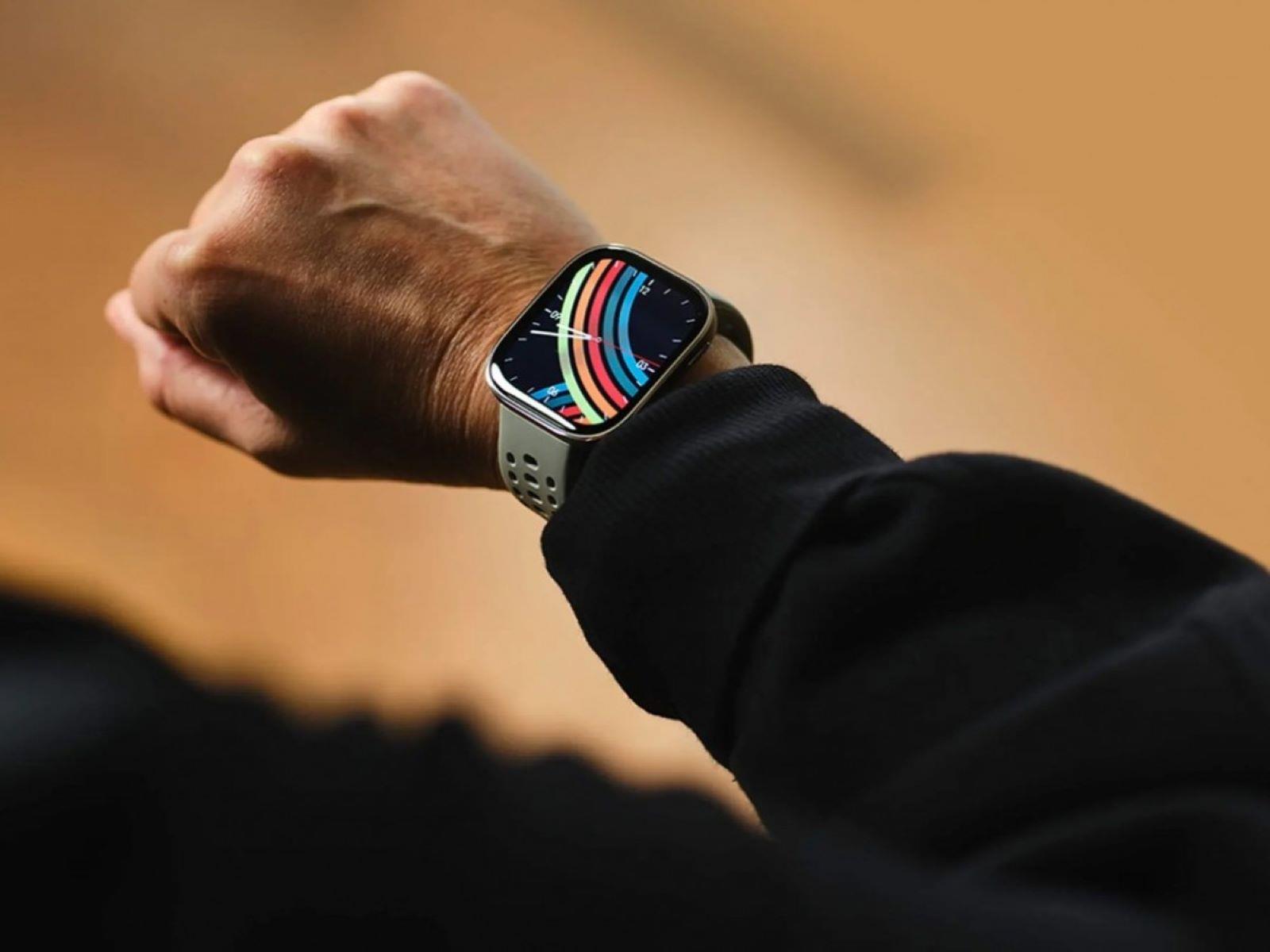
Amazfit Bib 6 Smartwatch Launches With Big Upgrades At A Wonderfully Low Price

Amazfit Bib 6 Smartwatch Launches With Big Upgrades At A Wonderfully Low Price
Leading wearable manufacturer Amazfit has launched the Amazfit 6 smartwatch. The latest iteration of the Bip lineup features a rich 1.97-inch AMOLED, two week battery life, a suite of health, sleep, and heart rate monitoring capabilities, an AI-powered fitness coach, and even offline maps for navigation off the beaten path. These all come

Apple’s Find My has finally launched in South Korea

Apple’s Find My feature has finally been enabled in South Korea, according to a company announcement translated by Apple Insider. This comes after years of public demand in which the finding network tool was absent from the country. The omission was especially odd when you consider that Apple sold AirTags throughout the region. Without Find My, they are basically just puck-shaped paperweights.

The company never explicitly stated why it limited access to Find My in South Korea, but it appeared to be related to local laws that could have allowed the government access to the location data. The service first appeared during a beta test of iOS 18.4, but the official software update makes it available to everyone in the country. Find My has long been functional in South Korea’s outlying territories like Baengnyeongdo and Ulleungdo.

“Find My is an important tool that allows users to grasp the location of the most precious things to them, such as friends, family and personal items, and I am very happy to be able to introduce this function to Korea,” said David Dorn, senior director of Apple’s service products, in a statement on the company’s local website.

The modern iteration of Find My launched in the US in 2019 as part of iOS 13. However, the tool actually dates back to a service called Find My iPhone that started in 2010. Apple recently expanded functionality to let users share the location of a lost item with other people on the network. This is helpful when negotiating the return of a lost item with a stranger.

This article originally appeared on Engadget at https://www.engadget.com/mobile/apples-find-my-has-finally-launched-in-south-korea-151437244.html?src=rss

Microsoft Expands Snapdragon’s Exclusive Copilot+ Features To AMD And Intel PCs

Microsoft Expands Snapdragon's Exclusive Copilot+ Features To AMD And Intel PCs
It took a minute (and not a New York minute), but Microsoft is taking the leash off of most of its Copilot+ features that were tethered exclusively to Snapdragon X series laptops, and letting them roam free on Copilot+ PCs powered by AMD Ryzen AI 300 series and Intel Core Ultra 200V processors. The only exceptions are a new set of Voice Access

Amazon’s new cinema plan is perfect… for the ‘80s

If you ever needed a definitive example of how money doesn’t necessarily buy you success or taste, take a look at Amazon’s studio arm. The mega-retailer’s production division, now known as Amazon-MGM, has been making movies for more than a decade. Very few of the entries in its lineup have been world-beaters, but that hasn’t deterred the outfit from persisting. The New York Times is today reporting that under its new head, Courtney Valenti, Amazon’s movie division has plans to own the in-person cinema experience.

Amazon is apparently gearing up to release “up to 14 big, broad commercial films a year to theaters nationwide and around the world.” Each film would spend 45 days in the theaters before heading to pay-per-view and then to Prime Video at some point after. The move comes in the face of shrinking box office receipts and fewer people heading to the cinema in general. Not to mention it’s also planning to produce an equal number of films that’ll go direct to Prime, which seems counter-intuitive given the desire to push people toward theaters.

That doesn’t recognize the shift in viewing habits, especially among younger people, who’d much rather sit and watch YouTube for hours at a time. Or that the box office took a hit because of COVID-19 that it never really bounced back from. Or that a lot of people would rather wait for a film to become available “for free” on a service they already pay for.

It also doesn’t take into account the fact cinemas are becoming increasingly unaffordable, and not that nice a place to sit for multiple hours. Last year, the cinema industry said it would spend $2.2 billion renovating their facilities to lure wary customers back. The planned additions included renovations for chairs and carpets, as well as the construction of ziplines and pickleball courts. Nowhere on the list was mentioned “make cinema tickets cheaper” or “don’t make viewers sit through half an hour of TV adverts before the trailers.”

At the risk of sounding obvious, that’s one hell of a lot of material for one company to put out in a year. Especially when so many competitors with better track records are putting out far fewer films and seeing success. On paper, 14 movies a year feels like the sort of strategy you could last get away with in the 1980s. After all, people had fewer options, cinemas were busier and studios could rely on the triple-whammy of the box office, rental and VHS markets.

It doesn’t help Amazon isn’t pledging to make quality movies, just lots of them, which suggests a mindset that doesn’t value scarcity. After all, there are many instances of things made and sold in small, limited quantities that garner far more attention than something mass-produced. Think about how hard it is for one of those latter-day Marvel movies to stick in the consciousness when you know there’ll be another one along in a month or two.

It calls to mind Amazon’s battles with the Broccolis, until recently the custodians of the James Bond franchise. Let’s not overthink this, they are just silly spy movies — but ones made with a level of craft and attention rarely seen in the modern era. The fact there can be a multi year gap between entries in the series means each film gets far more attention. That was in conflict with Amazon’s apparent desire to use the Bond name to push out a thousand different streaming series, game shows and movies on a regular basis.

And, at the risk of sounding uncharitable, it’s not as if Amazon’s movie slate has been a hit parade thus far. Many of the studios’ buzzier hits were picked up at film festivals rather than coming from inside, while its homegrown fare has floundered. That’s not to say its rivals are doing any better on this front — just read the reviews of The Electric State to show you how badly Netflix is throwing mad money at C+-tier projects.

I often wonder if people look at the success of Disney’s big Marvel tentpoles and assume that it’s easy to replicate. A film like Avengers: Endgame was the payoff to a decade-long plan built from the ground-up on the backs of less successful films. Across 2024, Disney put 15 films into cinemas, but even a mega-behemoth like Disney does it across its seven or eight different divisions.

In terms of attractive pitches, 14 films a year from the people who spent more than $200 million on Red One isn’t particularly compelling. Amazon’s going to have to give people a reason to get out to the theaters, but that’s going to be a challenge if the emphasis is on putting more raw material into the pipeline rather than making anything halfway considered or compelling.

This article originally appeared on Engadget at https://www.engadget.com/entertainment/amazons-new-cinema-plan-is-perfect-for-the-80s-150653674.html?src=rss

Walkabout Mini Golf’s Grip-To-Puppet Is A Really Good Time

Who needs a social network if you have a hand?

A new feature announced on April Fools’ Day in Walkabout Mini Golf means you’ll never have to be alone again in VR. Just turn your putter into a sock puppet.

I tested grip-to-puppet for real.

Double The Roleplay

Grip-to-Putt is the original Walkabout Mini Golf feature that requires the grip button on a VR controller to be pressed in order to hit the ball. It’s a useful way of ensuring you don’t accidentally lose a stroke by hitting it when you didn’t mean to.

Grip-to-Putter, meanwhile, is an accessory now in its third generation that presses that button while giving the feel of a club in your hand.

In Grip-to-Puppet, when you press that grip button/trigger Walkabout’s developers access something deep inside.

“The puppet has been inside of you all along,” Mighty Coconut 3D artist Emma Mercado explained between heaves of laughter. “So you don’t need much to access it.”

I met recently with Mercado and Mighty Coconut communications head David Wyatt, with three sock puppets featuring red stripes around their necks talking with us intermittently.

0:00

/0:10

In 2017, I reported on the idea of Puppeteering in VRChat as a cool idea. Now again in 2025, the idea resurfaces in Walkabout Mini Golf as a feature anyone can try.

My sock puppet asked Mercado: “Am I going to have a lot of options for representation?”

“This is kind of a joke that ended up not being a joke,” she replied. “And so we’re waiting to see how well it is received, but we do have other potential options if folks like it.”

During my brief time testing this with professionals Wyatt and Mercado, our puppets made sounds I’ve never heard people make in social VR before. I also laughed more than I ever have in social VR.

“You’ve got two levels of separation from whoever you’re trying to be, and so it makes it easier to just play,” Mercado explained. “And I think that’s a big part of Walkabout is just making play as accessible as possible.”

The feature has been on the back burner for years, Mercado suggested, and Walkabout’s original creator Lucas Martell explained how the new activity fits into a series of steady updates to the project over the last year.

“A majority of players spend a significant portion of their time doing an activity other than golf,” Martell wrote. “The lost balls and fox hunts have been two of the most popular aspects of the game from very early on. Even non-gamified elements like flying, riding on moving objects, or playing with the beach ball on Welcome Island have proven to be big hits. Some of the newest additions to the game have given us more ways to let players experience these worlds, whether that’s golfing in race mode, hitting some slingshot targets while you wait for your friends, or discovering the employees-only rooms throughout the game. Grip-To-Puppet in particular is a fun social experiment, and we can’t wait to see what players use it for.”

You can take a tour of one of Walkabout’s courses in our Design playlist or read Don Carson’s principles of course design for a deeper look into the ideas which shape the game as it continues to grow.

Cultivating Magic: The Art And Principles Of Walkabout Mini Golf Course Design
Mighty Coconut’s Don Carson shares the principles for course design in Walkabout Mini Golf.
UploadVRDon Carson