
This is a video of an allegedly wild raccoon playing jazz on a Pet Piano, a $200 smart pet feeder *spit takes cat kibble* that rewards pets for playing and can be auto-tuned so each key press plays a melody, or performs any song you want. In this case, the raccoon provides some additional piano accompaniment to Dave Brubeck Quartet’s ‘Take Five’, which will remain one of the greatest songs of all time until the end of time, which, judging from the way things are going, should be any minute now.
Monthly Archives: April 2025
You can pre-order Framework’s entry-level 2-in-1 touchscreen laptop on April 9
The entry-level laptop from modular computing company Framework, which we first saw in February, is almost ready to roll. Founder and CEO Nirav Patel said on Wednesday that you can reserve the Framework Laptop 12 on April 9 at 11AM ET.
The Framework Laptop 12 is a colorful 12.2-inch notebook with a 360-degree hinge that lets you fold it back into a (chunky) tablet. This zillionth iteration of that form factor stands out because of Framework’s ethos of modular repairability. If you decide it’s time for an upgrade in a couple of years, there’s no need to fork out $1,500 for a new device; you can simply upgrade its modular parts.
The Framework Laptop 12 has a 12.2-inch, 1,920 x 1,200 touchscreen display that, at 400 nits, gets “much brighter than you typically see from an entry-level or lower-cost laptop.” It will be available with a 13th-gen i3 or i5 Core processor and up to 48GB of DDR5 RAM. You can also get up to a 2TB 2 TB M.2 2230 SSD, Wi-Fi 6E and the company’s standard choice of Windows 11 or Linux.
Framework
Although it’s helpful to have those general spec guidelines, Framework says it won’t share the modular machine’s full spec breakdown, ship date or pricing until it’s available for pre-order. So, you won’t know how “entry-level” it is until the clock is ticking to reserve one. Although seeing Big Tech marketers weaponizing FOMO to increase sales numbers isn’t exactly a rarity these days, it stands out all the more coming from a startup that, in other ways, is among the most consumer-friendly.
Patel even cautioned in today’s announcement, “We have a hunch that the early batches are going to go very quickly.” In other words, you’d better not take too long scanning that spec sheet and weighing it against pricing before the train pulls out of the station.
Regardless, you can learn more about the Framework Laptop 12 in the video below before checking out its full specs on April 9 at 11AM ET. Patel advises pre-order customers to create an account on the company website in advance.
This article originally appeared on Engadget at https://www.engadget.com/computing/laptops/you-can-pre-order-frameworks-entry-level-2-in-1-touchscreen-laptop-on-april-9-182310021.html?src=rss
Not just Signal: Michael Waltz reportedly used Gmail for government messages
National Security Advisor Michael Waltz and a senior aide used personal Gmail accounts for government communications, according to a Washington Post report published yesterday.
Waltz has been at the center of controversy for weeks because he inadvertently invited The Atlantic Editor-in-Chief Jeffrey Goldberg to a Signal chat in which top Trump administration officials discussed a plan for bombing Houthi targets in Yemen. Yesterday’s report of Gmail use and another recent report on additional Signal chats raise more questions about the security of sensitive government communications in the Trump administration.
A senior Waltz aide used Gmail “for highly technical conversations with colleagues at other government agencies involving sensitive military positions and powerful weapons systems relating to an ongoing conflict,” The Washington Post wrote.
AI bots strain Wikimedia as bandwidth surges 50%
On Tuesday, the Wikimedia Foundation announced that relentless AI scraping is putting strain on Wikipedia’s servers. Automated bots seeking AI model training data for LLMs have been vacuuming up terabytes of data, growing the foundation’s bandwidth used for downloading multimedia content by 50 percent since January 2024. It’s a scenario familiar across the free and open source software (FOSS) community, as we’ve previously detailed.
The Foundation hosts not only Wikipedia but also platforms like Wikimedia Commons, which offers 144 million media files under open licenses. For decades, this content has powered everything from search results to school projects. But since early 2024, AI companies have dramatically increased automated scraping through direct crawling, APIs, and bulk downloads to feed their hungry AI models. This exponential growth in non-human traffic has imposed steep technical and financial costs—often without the attribution that helps sustain Wikimedia’s volunteer ecosystem.
The impact isn’t theoretical. The foundation says that when former US President Jimmy Carter died in December 2024, his Wikipedia page predictably drew millions of views. But the real stress came when users simultaneously streamed a 1.5-hour video of a 1980 debate from Wikimedia Commons. The surge doubled Wikimedia’s normal network traffic, temporarily maxing out several of its Internet connections. Wikimedia engineers quickly rerouted traffic to reduce congestion, but the event revealed a deeper problem: The baseline bandwidth had already been consumed largely by bots scraping media at scale.
DOGE staffer’s YouTube nickname accidentally revealed his teen hacking activity
A SpaceX and X engineer, Christopher Stanley—currently serving as a senior advisor in the Deputy Attorney General’s office at the Department of Justice (DOJ)—was reportedly caught bragging about hacking and distributing pirated e-books, bootleg software, and game cheats.
The boasts appeared on archived versions of websites, of which several, once flagged, were quickly deleted, Reuters reported.
Stanley was assigned to the DOJ by Elon Musk’s Department of Government Efficiency (DOGE). While Musk claims that DOGE operates transparently, not much is known about who the staffers are or what their government roles entail. It remains unclear what Stanley does at DOJ, but Reuters noted that the Deputy Attorney General’s office is in charge of investigations into various crimes, “including hacking and other malicious cyber activity.” Declining to comment further, the DOJ did confirm that as a “special government employee,” like Musk, Stanley does not draw a government salary.
A 32-bit processor made with an atomically thin semiconductor
On Wednesday, a team of researchers from China used a paper published in Nature to describe a 32-bit RISC-V processor built using molybdenum disulfide instead of silicon as the semiconductor. For those not up on their chemistry, molybdenum disulfide is a bit like graphene: a single molecule of MoS2 is a sheet that is only a bit over a single atom thick, due to the angles between its chemical bonds. But unlike graphene, molybdenum disulfide is a semiconductor.
The material has been used in a variety of demonstration electronics, including flash storage and image sensors. But we’ve recently figured out how to generate wafer-scale sheets of MoS2 on a sapphire substrate, and the team took advantage of that to build the processor, which they call RV32-WUJI. It can only add single bits at a time and is limited to kilohertz clock speeds, but it is capable of executing the full RISC-V 32-bit instruction set thanks to nearly 6,000 individual transistors.
Going flat
We’ve identified a wide range of what are termed 2D materials. These all form repeated chemical bonds in more or less a single plane. In the case of graphene, which consists only of carbon, the bonds are all in the same plane, meaning the molecule is as thick as a carbon atom. Molybdenum disulfide is slightly different, as the angle of the chemical bonds is out of plane, resulting in a zig-zag pattern. This means the sheet is slightly thicker than its component atoms.
It Takes 50 Hours to Earn the Right to Preorder a Switch 2 From Nintendo
Nintendo Switch 2 is officially coming to stores on June 5. In just over two months, you might have the opportunity to own Nintendo’s newest (and most expensive) console and play the latest Switch 2 exclusives (Mario Kart World looks ridiculously fun), assuming you can snag one of them.
Because if you want to boot up a Switch 2 on launch day, you’ll almost certainly need to preorder it. Unless you’re lucky enough to find a store that has extra consoles in stock, or there turns out to be exceptionally low demand (unlikely given eight years of building anticipation among the Nintendo faithful), these things are going to be a rare commodity.
One option, of course, is to preorder a system directly through Nintendo—but the company’s requirements to do so are anything but orthodox.
How to “register your interest” for a Switch 2
Nintendo doesn’t consider theirs a “preorder” program, per se. Instead, the company invites you to “register your interest” in buying a Switch 2. Assuming you’re at least 18 years old, you’ll need to head to Nintendo’s official interest registration site, then sign into your Nintendo Account. Once Nintendo has confirmed your eligibility, it will send an invitation to the email address registered with your Nintendo Account. This invitation gives you the option to buy one Switch 2 console—either the standalone unit or the bundle with a digital copy of Mario Kart World. This invite will be good for 72 hours. Easy enough, right?
It’s not that simple.
Only experienced gamers need apply
This is a first come, first served program, so the sooner you are able to register, the better your chance of being selected. On top of that, this…let’s call it a “purchasing opportunity” is only open to registrants who have a Nintendo Switch Online subscription with at least 12 months of paid service.
But the requirement that seems most out of left field to me is this: You also need to have at least 50 hours of gameplay associated with the Nintendo Account you use to register, as of April 2, 2025. If you don’t meet any of these criteria, you’ll be put on an overflow list. Nintendo will only start sending invites to members of this waitlist once the registrants who meet the requirements have all been invited.
Fifty hours of gameplay is a bizarre requirement (can’t I just give you money, Nintendo?) but you can see the company’s reasoning. As a mega-hyped piece of hardware, the Switch 2 is a prime target for scalpers. By setting strict requirements for who can register for an invitation to purchase one (and by limiting each registration to one console purchase) Nintendo is trying to ensure that only true Nintendo fans get first crack. Scalpers won’t even be able to make multiple Nintendo Accounts in order to get around these limits, as the aforementioned 50 hours of gameplay had to be logged before today, April 2. Unless scalpers knew the rules well ahead of time, any dummy accounts they make leading up to the Switch 2 launch will be useless.
Even as someone with well over 50 hours of gameplay on my Nintendo Account, this all feels a bit weird. Perhaps its the data privacy geek in me, but it doesn’t sit well with me that I need to share my gameplay with Nintendo in order to prove that I am, indeed, worthy of buying a Switch 2. Tie the purchase to my Nintendo Account, fine, but I’m not sure I like the precedent here.
Because even if you have those 50 hours, you might not be eligible, since you also need to have opted in to share that data with Nintendo. Nintendo’s language isn’t totally clear here, so it’s not obvious to me if it counts to if you opt in today, or if you had to have already opted in before the program was announced. If you want to maximize your chances of being selected to buy through Nintendo, it’s time to check your Nintendo Account privacy settings and ensure that you are sharing your usage information with Nintendo under Data Usage – Opt-Out Preferences.
When do invitations to buy a Switch 2 go out?
Strange privacy implications aside, here’s what happens after you register: Nintendo says the first round of invites will go out May 8, 2025, with subsequent rounds sending off “periodically” until purchases are available for all. The email will come from no-reply@noa.nintendo.com, so consider adding that to your email whitelist if you have an overzealous spam filter.
If selected, you’ll be able to buy your chosen Switch 2 console or bundle (the standalone system is $449, while the Mario Kart World bundle is $499) as well as a “variety of additional items.” My guess is that will include the new Pro Controller, the retro GameCube controller, and perhaps additional Joy-Cons, as well as any other types of accessories Nintendo dreams up. As with the system itself, you’ll only be able to purchase one of each of these additional items.
Nintendo accepts Visa, Mastercard, Google Pay, and Apple Pay—but not Nintendo eShop gift cards. The company will also only ship products directly to customers, and will not make orders available at its two retail locations.
Of course, Nintendo isn’t the only company you can order a Switch 2 from. You can sign up for similar alerts from other retailers, including Best Buy and GameStop, and I imagine more retailers will add their own opportunities soon enough.
The Zelle App Shut Down, but Zelle Lives On
Zelle has been around as a convenient digital payment platform since 2017, but has now closed down payments inside its standalone apps for Android and iOS, as it promised it would last October—though the move is a sign of Zelle’s success rather than its failure, and most Zelle users aren’t going to need to change anything.
If you’re one of the 150 million or so people who make use of Zelle, you’re no longer going to be able to use the Zelle app to send money to friends, family, and businesses. However, Zelle lives on as a platform: It’s now integrated into the operations of more than 2,200 financial institutions, so you’ll still be able to use it through your banking app.
The Zelle apps are no more because Zelle has expanded its integrations so successfully. The peer-to-peer payment system says less than two percent of transactions were being made through these apps by the end of last year, so it didn’t make sense to keep them going.
Nothing is changing in terms of the links to banks and credit unions—if this is how you already do your Zelle business, you might not even have noticed the standalone app has been pulled. Zelle users shifted $1 trillion in payments over the course of 2024, so as a platform it’s not going anywhere anytime soon.
Another reason for the switch is security. As Zelle’s YouTube page is testament to, users of the app were frequently targeted by scammers—via dating apps, ticketing platforms, rental listings, online marketplaces, job boards, and so on. Having Zelle work through banking systems makes it more secure as well.
How to switch
Zelle is popular for peer-to-peer payments.
Credit: Zelle
Credit: Zelle
Given that two-percent figure mentioned above, chances are that you’ve already set Zelle up through your bank. If not, you’ll need to register a Zelle account with your bank, or switch to a financial institution that offers Zelle: You can search through this comprehensive list. Until you set up Zelle somewhere else, you won’t be able to make and receive payments.
The specifics will of course depend on your bank and its app, but if you click through from the list then you’ll be taken to the relevant sign-up page—here’s the one for Wells Fargo, for example. You need to provide your registered email address or mobile number, and the bank will do the rest (you can use the existing details already registered with Zelle).
If you know your bank or credit union supports Zelle, you can also dig through the options in the official app or the official website, and you should be able to register that way too: Most of the time it’ll only be a couple of steps to get Zelle set up, and you can then register the people and businesses you want to enable transactions with.
Unfortunately, your payment history isn’t going to move along with you, though it will be available in the Zelle app until August 11, 2025. Although payments are now blocked, the app isn’t going to stop working entirely, so you’ve got a few months to note any records you want to keep.
There are plenty of other payment platforms you can turn to, if you do want to stay out of your banking app, including Venmo, PayPal, Cash App, Google Wallet, and Apple Pay—though they don’t have quite the same tight bank-account integration that you get with Zelle, and which Zelle is now focused on.
Fake Online Car Dealership Scams Are More Convincing Than People Think
For decades, the only way to buy a car was to physically go to a dealership. If that idea gives you an anxiety attack, you’re not alone, so it’s a relief to know that the industry is finally embracing online shopping—even Amazon has gotten in on the act, and about half the buyers in one survey shopped for their car online.
But just like anything else on the internet, buying a car online comes with the risk of fraud. Scammers are setting up entire fake online dealerships and ripping people off to the tune of tens of thousands of dollars. You might think you’re too savvy to get fleeces like that (who buys a $50,000 car sight unseen anyway?), but the risk is real. These fake online car dealership scams are fairly sophisticated and can be difficult to spot—it’s gotten so bad that some states, like Wisconsin, have issued official warnings about it.
How online car dealership scams work
At its core, the scam is pretty simple: A scammer sets up a fake dealership website. Sometimes it’s an entirely fictional dealer, and sometimes the scammers hijack a real dealership’s name and set up a fake site for it, often scraping the dealership’s legitimate website for graphics, text, and photos to make everything look legit. Sometimes they claim to sell classic cars, but just as often they pose as regular dealers.
Step two is to adjust all the pricing on the vehicles so they’re incredibly attractive to potential buyers. In the current economic environment, where cars—used and new—are majorly expensive, folks who stumble on an amazing deal are more likely to get sucked into the scammers’ sales funnel. The “dealer” will be very responsive to messages from marks, and will provide everything you would expect a legitimate car dealership to provide—including photos and documentation. It can be extremely difficult to tell that you’re not interacting with an actual car dealership.
The scam really kicks into gear when it comes time to make a down payment or negotiate a sale. Scam dealerships will usually require payment in unusual ways—typically via wire transfer—and then cease responding once they’ve got your money. A man in North Carolina lost $40,000 last year when he tried to buy a truck from a site claiming to sell “repossessed” vehicles at extremely low prices, while a California resident lost $24,000 to a fake online dealer when he thought he was buying a classic car. And this guy on Reddit apparently lost $55,000 to a sophisticated fake online dealer.
What to look for
The scam works for a few reasons: People are increasingly comfortable making large purchases online, the in-person car buying experience is kind of terrible, and it’s relatively easy to set up a website that looks exactly like a real car dealership.
If you’re thinking about buying a car online, there are a couple of things you should look for when considering an online dealership:
-
Check with your state’s Department of Motor Vehicles or Department of Transportation to see if it maintains a list of authorized car dealers in the state, and if the dealership you’re considering is on the list.
-
If it’s a local dealership, look up the phone number independently and contact them to ensure the website is legitimate.
-
Be wary of unusually low prices, an inability to physically inspect and test-drive the car, and an unusual payment process.
Buying a car online is convenient and less obnoxious than doing it in person—but it’s also a little more dangerous. A little extra due diligence can save you a lot of trouble.
Amazon Set To Launch First Operational Satellites For Project Kuiper Network
Amazon and United Launch Alliance will launch 27 full-scale satellites on April 9 as part of Amazon’s Project Kuiper, marking the company’s first major step toward building a global satellite internet network to rival SpaceX’s Starlink. GeekWire reports: ULA said the three-hour window for the Atlas V rocket’s liftoff from Cape Canaveral Space Force Station’s Space Launch Complex 41 in Florida is scheduled to open at noon ET (9 a.m. PT) that day. ULA is planning a live stream of launch coverage via its website starting about 20 minutes ahead of liftoff. Amazon said next week’s mission — known as Kuiper-1 or KA-1 (for Kuiper Atlas 1) — will put 27 Kuiper satellites into orbit at an altitude of 280 miles (450 kilometers).
ULA launched two prototype Kuiper satellites into orbit for testing in October 2023, but KA-1 will mark Amazon’s first full-scale launch of a batch of operational satellites designed to bring high-speed internet access to millions of people around the world. […] According to Amazon, the Kuiper satellite design has gone through significant upgrades since the prototypes were launched in 2023. Amazon’s primary manufacturing facility is in Kirkland, Wash., with some of the components produced at Project Kuiper’s headquarters in nearby Redmond.
The mission profile for KA-1 calls for deploying the satellites safely in orbit and establishing ground-to-space contact. The satellites would then use their electric propulsion systems to settle into their assigned orbits at an altitude of 392 miles (630 kilometers), under the management of Project Kuiper’s mission operations team in Redmond. Under the current terms of its license from the Federal Communications Commission, Amazon is due to launch 3,232 Kuiper satellites by 2029, with half of those satellites going into orbit by mid-2026.


Read more of this story at Slashdot.
Netflix’s Devil May Cry: The Kotaku Review

Netflix’s latest foray into animated video game adaptations is a new spin on Devil May Cry, Capcom’s excellent series of character action games that kicked off in 2001. And even though the show represents a reboot of the continuity that lets the uninitiated pick things up at the beginning, it’s still deeply rooted in…
arttime is an intriguing clock, timer, time manager with text art
arttime is a combination of art, clock, timer, and a time manager all from a single terminal-based application.
New £500 Hunt Enduro V3 wheels are 20 per cent tougher thanks to 146 hours of lab testing
Hunt has updated its alloy Enduro wheelset, now in its third iteration, unveiling a fresh pair of hoops built to be more resistant to damage and as durable as possible.
Front- and rear-specific rims have been developed to perform specific duties, while they’re hand-built around a new hub that’s said to have a quick, but not too quick, pick-up and fast-rolling bearings.
The new Hunt Enduro V3 wheels will retail for £499 / $649 / €599.
Testing, testing

While Hunt isn’t alone in using plenty of high-tech tools (and some much lower-tech ones, too), more than two years of work has gone into developing the new wheelset.
146 hours of FEA analysis were initially spent on the process. This Finite Element Analysis uses computer programming to analyse the theoretical impact of forces and vibrations on a structure, enabling Hunt to tweak designs via the computer model, without needing to spend time and money building multiple prototypes.
This enabled the brand to remove non-structural material from the rims’ walls, enabling it to balance strength and performance metrics.

From there, physical prototypes could be tested on rolling roads and through impact testing to finalise the design.
Rolling roads give longer-term durability reports, while impact tests, carried out at a 15-degree angle to the rim, enabled the brand to analyse the strength of the rim walls, giving more MTB-realistic data.
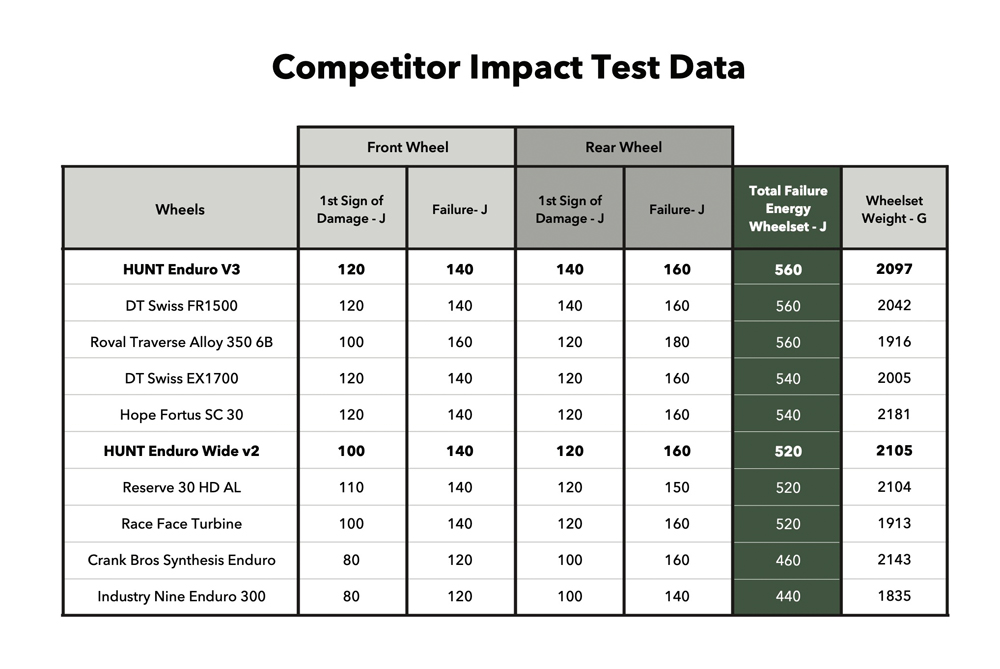
Hunt also performed competitor analysis, purchasing other mountain bike wheelsets to compare the wheels to.
Added to this lab testing was the use of a new alloy – G609 – in the rims. This material is said to have 30% more tensile strength than Al 6061 – a commonly used rim material.
When shot-peened, the finished rim should be even tougher, because this process reinforces the strength of the rim surfaces.
The result of this is Hunt claims the Enduro V3 wheels are more resistant to impacts, with the first sign of damage (non-catastrophic rim failure) showing from impacts 20 Joules higher than with the V2 wheels – a 20% improvement.
Hunt’s new Enduro V3 rims

So what are Hunt’s new rims like?
The front rim has a shallower, wider profile than the rear, coming in at 31.5mm wide internally.
This gives tyres a broader form, improving compliance and comfort at the front of the bike.
At the back, there’s a narrower, more V-shaped rim profile, which makes it more resistant to impacts – an additional 20 Joules of force compared to the front for the same level of damage.
In addition to this, the builds differ at the front and rear.

The front wheels are built with 28 spokes, for a lighter, more compliant build. Further back, 32 spokes are used to bolster strength and stiffness.
The rim profile includes Hunt’s ‘H-Lock’ bead seat to help make using tubeless tyres easy. Tyres lock into the rim with ease, according to Hunt.
H-Ratchet XL hubs
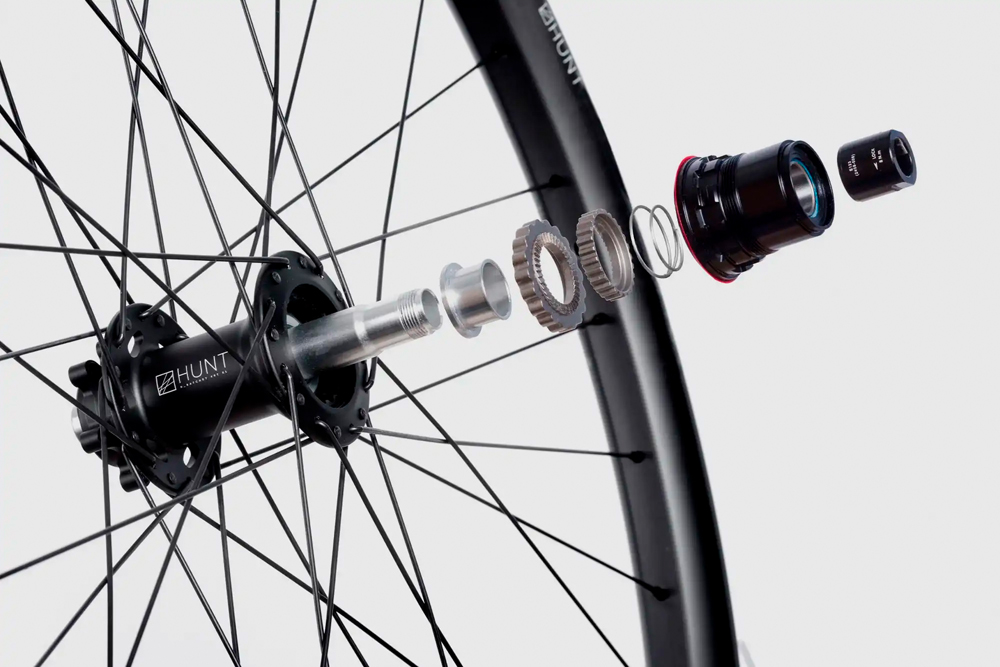
Joining the new rims is a refreshed set of hubs, which are central to the story.
Key to this is the new H-Ratchet XL 40T DBL freehub, which has a 9-degree pickup.
This places it between wider, generally 12-degree pickups found on more budget wheelsets, and the super-quick around 3-degree freehubs found on high-end wheels.
In our eyes, this 9-degree pick-up feels like the best of both worlds – it’s snappy, without exacerbating any issues from chain growth and the resultant pedal kickback.
The freehub has a 40-tooth double-ratchet ring system.
The hub shells are constructed from CNC’d 6066-T6 aluminium, with a six-bolt rotor mount and a broad 17mm-wide 7075-T6 axle for a stiff core to the hub.
They spin on Enduro ABEC 5 bearings, with labyrinth seals to keep the muck out.
Brass nipples, stainless steel nipple washers and triple-butted, black-anodised alloy Sandvik spokes complete the build.
Hunt Enduro V3 wheelset options
The new wheelset is Boost width spacing only (110x15mm front, 148x12mm rear), but both HG and XD freehub drivers are offered.
Being a 2025 wheelset, a mullet, or MX, option (29in front, 27.5in rear) is of course offered from the factory, as well as both 29in and 27.5in options.
Claimed weights for the wheelsets, which come taped and with tubeless valves included, are:
- 29in pair: 2,096g
- 27.5in pair: 2,022g
- Mullet/MX pair: 2,057g
An Average Cyclist at Zwift Community Live 2025, Part 1
If you ever want to feel completely out of your element, become a chubby mediocre cyclist and then head to Mallorca to participate in a high-end cycling event. That is a picture of the battle in my head these last few weeks as I gear up for Zwift Community Live 2025 in Mallorca.
Back in November I first heard of the event and as the wife of Mr ZwiftInsider (who was jumping at the chance to go) I was very happy to jump back on my bike and start training. I’ve been off my bike for maybe a year. The reason? Your guess is as good as mine.
I decided to start training with 3 rides a week, only 20 minutes per ride. I knew if I started with too high a goal each week I’d be quick to quit. The plan was to increase that time by 10% each week until I was riding around an hour each ride. Then I’d add either time or another day.

About 2 months before the event I was putting in good time and distance (I felt like a beginner again, but not for too long). I saw on the ZC app the minimum ability was listed as being able to do 75 km at 25 km per hour. Not a problem, if I was doing that once. But there would be 3 days of riding. Could I do that 3 days in a row? We shall see.
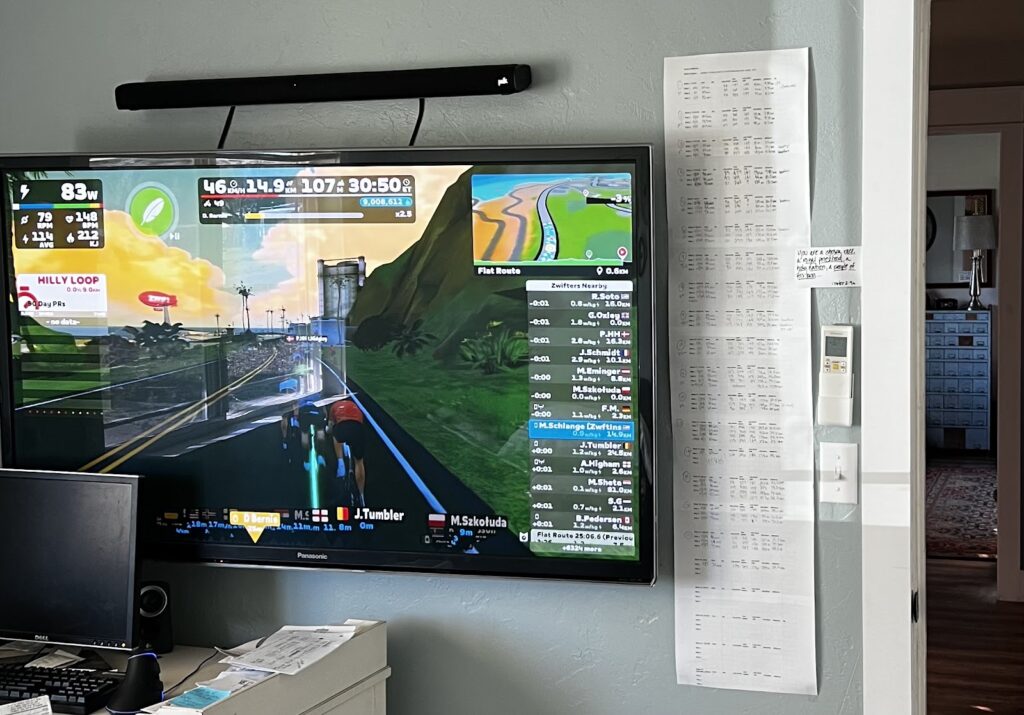
Two weeks before the event I was riding in my office as Eric walked by the door. He must have seen a look on my face as he came in to see what was going on. I started crying (not recommended while riding, by the way). I had seen the Strava events posted for these outdoor rides. The first small ride was 60km with 480m of climb. “I’m going to disappoint you. I’m going to make someone stay back with me as I’ll be so slow. They’ll be bored and disappointed. What am I doing? Mallorca is where cyclists dream to go. I’ve never dreamt it. I feel like an imposter.” I stopped riding. Eric, being the amazing man he is, told me he had no expectations of me. He didn’t care if I decided not to ride even. He just wants me at the event with him. No pressure, no expectation. The heavy burden fell off my shoulders.
Nine days before the event Eric and I rode outdoors. After an hour we realized I’d planned we’d ride 50km, he planned we’d ride 50 miles. Oops. We ended up riding 44 miles, I barely limped back hitting a small wall around mile 40. My bike handling was crap, we rode in the rain, but I was happy to have finally been outside. I had two more days of riding before we hit the road so I spent that time just doing laps in front of our house clipping in, unclipping, turning around in a bit of gravel, looking over my shoulder without swerving, etc.
We finally started leg one of the journey, beginning with 3 days in South Carolina seeing Eric’s family. Leg two was 3 glorious days in the Girona, Spain area seeing our dear friend Simon Schofield and his amazing wife Jenny.
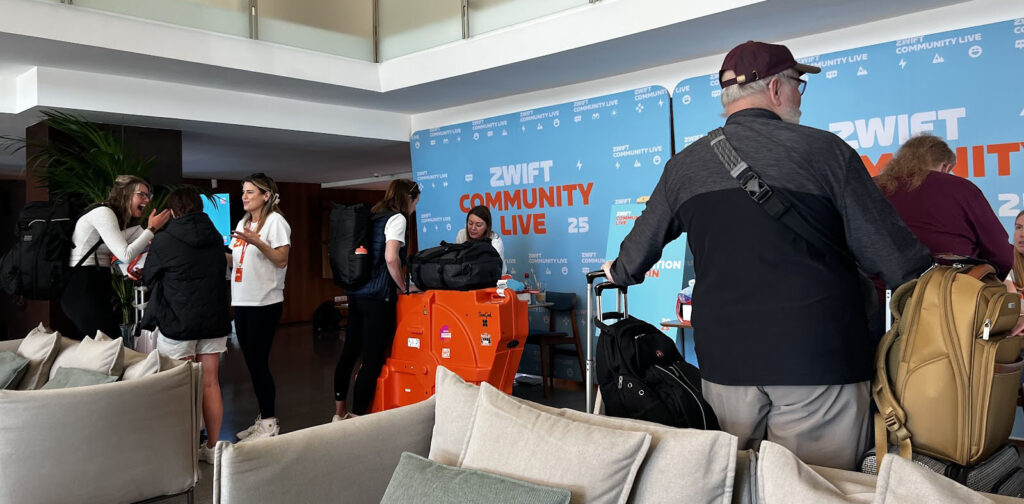
We finally made it to leg 3 of the trip and arrived in Mallorca last night for Zwift Community Live 2025. As an “average” cyclist I know I’m atypical in that I’m married to Mr ZwiftInsider and have a bit of privilege (like showing up early to the event). But my legs and my knowhow of cycling (especially outdoors) puts me firmly in the “average” category. And so here I sit in the lobby of the beautiful Iberostar Playa de Muro Village hotel watching Zwifters check in, wondering who else is battling their thoughts of where they’ll stack up during the three IRL rides. I’m sure it’s more people than I guessed. But I do know that we’re all here to have fun, this isn’t a race! And for once, it really isn’t a race.
Stay tuned. I’ll let you know how it goes!
How to Optimize Database Performance With MySQLTuner
If you use a MySQL/MariaDB database, you know it can become slow or consume too many resources if not properly configured. To help with this, there’s a tool called MySQLTuner, which analyzes your database. It analyzes how MySQL/MariaDB is performing and provides tips to make it faster and more efficient.
Vibe Coded AI App Generates Recipes With Very Few Guardrails
An anonymous reader quotes a report from 404 Media: A “vibe coded” AI app developed by entrepreneur and Y Combinator group partner Tom Blomfield has generated recipes that gave users instruction on how to make “Cyanide Ice Cream,” “Thick White Cum Soup,” and “Uranium Bomb,” using those actual substances as ingredients. Vibe coding, in case you are unfamiliar, is the new practice where people, some with limited coding experience, rapidly develop software with AI assisted coding tools without overthinking how efficient the code is as long as it’s functional. This is how Blomfield said he made RecipeNinja.AI. […] The recipe for Cyanide Ice Cream was still live on RecipeNinja.AI at the time of writing, as are recipes for Platypus Milk Cream Soup, Werewolf Cream Glazing, Cholera-Inspired Chocolate Cake, and other nonsense. Other recipes for things people shouldn’t eat have been removed.
It also appears that Blomfield has introduced content moderation since users discovered they could generate dangerous or extremely stupid recipes. I wasn’t able to generate recipes for asbestos cake, bullet tacos, or glue pizza. I was able to generate a recipe for “very dry tacos,” which looks not very good but not dangerous. In a March 20 blog on his personal site, Blomfield explained that he’s a startup founder turned investor, and while he has experience with PHP and Ruby on Rails, he has not written a line of code professionally since 2015. “In my day job at Y Combinator, I’m around founders who are building amazing stuff with AI every day and I kept hearing about the advances in tools like Lovable, Cursor and Windsurf,” he wrote, referring to AI-assisted coding tools. “I love building stuff and I’ve always got a list of little apps I want to build if I had more free time.”
After playing around with them, he wrote, he decided to build RecipeNinja.AI, which can take a prompt as simple as “Lasagna,” and generate an image of the finished dish along with a step-by-stape recipe which can use ElevenLabs’s AI generated voice to narrate the instruction so the user doesn’t have to interact with a device with his tomato sauce-covered fingers. “I was pretty astonished that Windsurf managed to integrate both the OpenAI and Elevenlabs APIs without me doing very much at all,” Blomfield wrote. “After we had a couple of problems with the open AI Ruby library, it quickly fell back to a raw ruby HTTP client implementation, but I honestly didn’t care. As long as it worked, I didn’t really mind if it used 20 lines of code or two lines of code.” Having some kind of voice controlled recipe app sounds like a pretty good idea to me, and it’s impressive that Blomfield was able to get something up and running so fast given his limited coding experience. But the problem is that he also allowed users to generate their own recipes with seemingly very few guardrails on what kind of recipes are and are not allowed, and that the site kept those results and showed them to other users.


Read more of this story at Slashdot.
KDE Plasma 6.3.4 Desktop Environment Released
KDE Plasma 6.3.4 delivers touch scroll fixes, scrollbar tweaks, better HDR support, and UI improvements to enhance desktop performance and usability.
So What The Hell Is Mario Drinking In Mario Kart World?
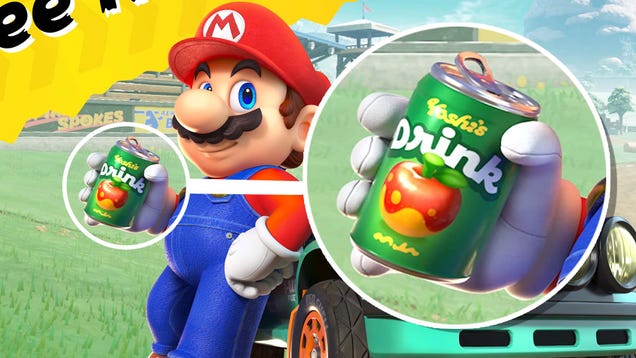
On Wednesday, Nintendo held a big Direct dedicated to the upcoming Switch 2. The new console is set to launch on June 5 and will cost $450. And one of the launch games for the console is Mario Kart World, a big, sprawling kart racer that looks like a lot of fun. But uh, what the heck is Mario drinking in that can?
The Switch 2’s Battery Life Is Worse Than The Original

Battery life for gaming handhelds is always a challenge but the tradeoffs for the Switch 2 appear to be particularly brutal. Nintendo has confirmed that the next-gen device will run for anywhere from 2-6.5 hours on a single charge depending on what you’re playing. It ain’t great. In fact, it’s somehow even worse than…
Midnight Console Launches Are Making A Comeback For The Switch 2
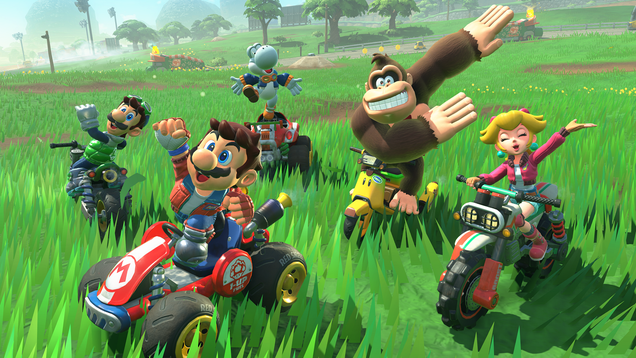
The Nintendo Switch 2 launches on June 5 and at least one major retailer is bringing back an old-school midnight launch to help fans celebrate early. Best Buy will be opening stores at 12:01 a.m. ET for anyone who pre-ordered the console and launch games like Mario Kart World.