
AMD software engineers today released AOMP 21.0-0 as the newest snapshot of their LLVM/Clang compiler downstream focused on providing the best OpenMP/OpenACC GPU offloading support to AMD GPUs and Instinct accelerators via the ROCm software stack…
Monthly Archives: April 2025
Air Conditioning, Not Data Centers, Driving Global Energy Demand Growth
Air conditioning will contribute more to rising global energy demand than data centers through 2030, according to an International Energy Agency. While attention has focused on computing power consumption, the IEA projects data centers will account for less than 10% of increased energy demand by 2030, significantly less than space cooling requirements. Global cooling degree days, a measure of air conditioning need, were 6% higher in 2024 than 2023 and 20% above the long-term average for the first two decades of the century.
China, India and the United States saw particularly sharp increases. Air conditioning represented 7% of global electricity consumption in 2022, with some U.S. regions reporting that cooling can comprise over 70% of residential energy use during peak periods. The number of air conditioning units worldwide could nearly triple from fewer than 2 billion in 2016 to approximately 6 billion by 2050, creating a growing challenge for power grids.


Read more of this story at Slashdot.
US Stock Markets See Worst Day Since Covid Pandemic
U.S. stock markets suffered their worst day since the Covid pandemic after Donald Trump announced sweeping new tariffs, triggering a global selloff and wiping out $470 billion in value from tech giants Apple and Nvidia. From a report: The tech-heavy Nasdaq fell 6%, while the S&P 500 and the Dow dropped 4.8% and 3.9%, respectively. […] Meanwhile, the US dollar hit a six-month low, going down at least 2.2% on Thursday morning compared with other major currencies and oil prices sank on fears of a global slowdown. Though the US stock market has been used to tumultuous mornings over the last few weeks, US stock futures — an indication of the market’s likely direction — had plummeted after the announcement. Hours later, Japan’s Nikkei index slumped to an eight-month low and was followed by falls in stock markets in London and across Europe.
Multiple major American business groups have spoken out against the tariffs, including the Business Roundtable, a consortium of leaders of major US companies including JP Morgan, Apple and IBM, which called on the White House to “swiftly reach agreements” and remove the tariffs. “Universal tariffs ranging from 10-50% run the risk of causing major harm to American manufacturers, workers, families and exporters,” the Business Roundtable said in a statement. “Damage to the US economy will increase the longer the tariffs are in place and may be exacerbated by retaliatory measures.”


Read more of this story at Slashdot.
Intel, TSMC Tentatively Agree To Form Chipmaking Joint Venture
Intel and Taiwan Semiconductor Manufacturing Co. have reached a preliminary agreement to form a joint venture operating Intel’s chipmaking facilities, with TSMC taking a 20% stake, The Information reports [non-paywalled source]. Intel and other U.S. semiconductor companies would hold the majority of shares in the proposed venture. Instead of capital investment, TSMC has discussed sharing chipmaking methods and training Intel personnel.
The talks face internal opposition from some Intel executives concerned about widespread layoffs and the abandonment of Intel’s own technology, according to the report. The deal could help TSMC neutralize a struggling competitor while potentially giving Taiwan more leverage with the U.S. administration, which recently imposed tariffs on Taiwanese goods excluding chips.


Read more of this story at Slashdot.
Wealthy Americans have death rates on par with poor Europeans
It’s well-established that, on the whole, Americans die younger than people in most other high-income countries. For instance, an analysis from 2022 found that the average life expectancy of someone born in Switzerland or Spain in 2019 was 84 years. Meanwhile, the average US life expectancy was 78.8, lower than nearly all other high-income countries, including Canada’s, which was 82.3 years. And this was before the pandemic, which only made things worse for the US.
Perhaps some Americans may think that this lower overall life-expectancy doesn’t really apply to them if they’re middle- or upper-class. After all, wealth inequality and health disparities are huge problems in the US. Those with more money simply have better access to health care and better health outcomes. Well-off Americans live longer, with lifespans on par with their peers in high-income countries, some may think.
It is true that money buys you a longer life in the US. In fact, the link between wealth and mortality may be stronger in the US than in any other high-income country. But, if you think American wealth will put life expectancy in league with Switzerland, you’re dead wrong, according to a study in the latest issue of the New England Journal of Medicine.
WattWise: Monitor Your Computer’s Power Usage in Real-Time
WattWise is a lightweight, opensource, command-line tool to monitor the power usage of your system in real-time.
DeepMind has detailed all the ways AGI could wreck the world
As AI hype permeates the Internet, tech and business leaders are already looking toward the next step. AGI, or artificial general intelligence, refers to a machine with human-like intelligence and capabilities. If today’s AI systems are on a path to AGI, we will need new approaches to ensure such a machine doesn’t work against human interests.
Unfortunately, we don’t have anything as elegant as Isaac Asimov’s Three Laws of Robotics. Researchers at DeepMind have been working on this problem and have released a new technical paper (PDF) that explains how to develop AGI safely, which you can download at your convenience.
It contains a huge amount of detail, clocking in at 108 pages before references. While some in the AI field believe AGI is a pipe dream, the authors of the DeepMind paper project that it could happen by 2030. With that in mind, they aimed to understand the risks of a human-like synthetic intelligence, which they acknowledge could lead to “severe harm.”
Microsoft’s Miniature Windows 365 Link PC Goes On Sale
An anonymous reader shares a report: Microsoft’s business-oriented “Link” mini-desktop PC, which connects directly to the company’s Windows 365 cloud service, is now available to buy for $349.99 in the US and in several other countries. Windows 365 Link, which was announced last November, is a device that is more easily manageable by IT departments than a typical computer while also reducing the needs of hands on support.


Read more of this story at Slashdot.
Switch 2 Has Physical Game Collectors Freaking Out, And Elden Ring Is A Perfect Example
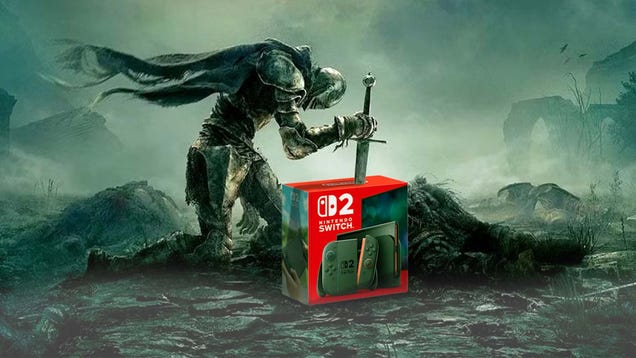
While players on PlayStation 5 and Xbox Series X/S ditched physical games in favor of digital downloads in droves, Switch fans had been holding the line. But that might change with the Switch 2, thanks to physical edition price hikes and controversial game-key cards that don’t include the full game out of the box.…
Google unveils end-to-end messages for Gmail. Only thing is: It’s not true E2EE.
When Google announced Tuesday that end-to-end encrypted messages were coming to Gmail for business users, some people balked, noting it wasn’t true E2EE as the term is known in privacy and security circles. Others wondered precisely how it works under the hood. Here’s a description of what the new service does and doesn’t do, as well as some of the basic security that underpins it.
When Google uses the term E2EE in this context, it means that an email is encrypted inside Chrome, Firefox, or just about any other browser the sender chooses. As the message makes its way to its destination, it remains encrypted and can’t be decrypted until it arrives at its final destination, when it’s decrypted in the recipient’s browser.
Giving S/MIME the heave-ho
The chief selling point of this new service is that it allows government agencies and the businesses that work with them to comply with a raft of security and privacy regulations and at the same time eliminates the massive headaches that have traditionally plagued anyone deploying such regulation-compliant email systems. Up to now, the most common means has been S/MIME, a standard so complex and painful that only the bravest and most well-resourced organizations tend to implement it.
Disney Reportedly Pauses Live-Action Tangled Remake Following Snow White Flop

The era of Disney trying to turn every animated movie into a live-action blockbuster might be coming to an end, as it’s been reported that the planned Tangled live-action remake has been “paused.” And even if more live-action remakes eventually happen, it seems that the Mickey Mouse company might be getting more…
Microsoft is reportedly walking back some data center plans
After a January announcement that it would spend $80 billion on data center construction, Microsoft may already be adjusting its future plans. Sources told Bloomberg that Microsoft has delayed or slowed data center efforts in Indonesia, the UK, Australia, Illinois, North Dakota and Wisconsin. Some of the cases meant withdrawing from negotiations, while others have involved delays on planned construction projects, according to these insiders. These data centers would be central to Microsoft’s efforts to develop more capabilities around artificial intelligence.
Despite the apparent shift in its approach, a Microsoft rep told Bloomberg that the company still plans to hold to its $80 billion spending budget on data centers during its 2025 fiscal year. Engadget has reached out for confirmation and will update if we receive comment from Microsoft. That was the figure laid out in a blog post attributed to Vice-Chair and President Brad Smith. The post, published days before President Trump’s inauguration, included some ingratiating language for the new administration. “The country has a unique opportunity to pursue this vision and build on the foundational ideas set for AI policy during President Trump’s first term,” it reads. “At Microsoft, we are excited to take part in this journey.”
Microsoft’s plans could have been influenced by looming tariffs, which had been threatened and were finally introduced this week by President Trump. The trade policy is likely to make large infrastructure plans more expensive and has already caused uncertainties on Wall Street. It could be that the company will still spend in the ballpark of $80 billion but will not be able to complete as many locations as it had previously calculated. Or it could be that in the months since presenting its forecast, Microsoft has already seen a reduction in expected demand.
This article originally appeared on Engadget at https://www.engadget.com/ai/microsoft-is-reportedly-walking-back-some-data-center-plans-210406748.html?src=rss
Traeger built a smaller Flatrock griddle for smaller outdoor spaces
Traeger’s only gas-powered grill is its Flatrock flat-top griddle. Besides this one model, everything else in the company’s lineup runs on wood pellets. Since griddles continue to be insanely popular backyard cooking tools, Traeger is expanding its Flatrock line with a smaller, two-burner option. The Flatrock 2 Zone has all of the features from the larger version, which is now called the Flatrock 3 Zone, in a griddle that takes up less space on your deck, patio or porch.
As the name suggests, the Flatrock 2 Zone has two separate cooking areas with precise heat control for each one. U-shaped burners consistently heat the entire cooking surface and an edge-to-edge, wind-blocking design helps keep the flame running smoothly without burnouts or flare-ups. Like the Flatrock 3 Zone, there are folding side shelves for resting tools and trays, plus the Pop-And-Lock (PAL) rail system allows you to add the snap-on accessories you need to complete your griddle setup. The EZ-Clean grease keg from other recent Traeger grills is here as well, making it easy to get rid of liquids and debris after cooking.
Traeger
The main appeal of the Flatrock 2 Zone is that it’s smaller than the original model. You’ll still have the ability to make breakfasts, smash burgers, fajitas and more with the griddle’s 468 square inches of cooking surface, but this new version will fit better in smaller outdoor spaces. It’s also $200 cheaper at $700. Unfortunately, there’s no word on availability just yet: Traeger says the Flatrock 2 Zone is coming “soon” to its website and retailers in the US and Canada.
If you’re looking for an alternative, Weber’s Slate griddles are well-built and offer various options depending on the size and features you’re after. Starting at $549, you can get the three-burner, 28-inch base model that comes on a basic cart similar to the company’s gas grills. Even this smallest Weber option offers more cooking area than the Flatrock 2 Zone at 504 square inches. At the top end, there’s a four-burner, 36-inch version that comes with an easy-to-read digital temperature gauge and enclosed storage for $999. What’s more, Weber offers a 30-inch size in between those two, with various storage configurations and an the option to include that battery-powered temperature gauge. This one is
This article originally appeared on Engadget at https://www.engadget.com/home/kitchen-tech/traeger-built-a-smaller-flatrock-griddle-for-smaller-outdoor-spaces-210057199.html?src=rss
OpenCL 3.0.18 Published With New Extensions & Other Updates
The Khronos Group today published the OpenCL 3.0.18 specifications as the latest incremental update to OpenCL 3.0…
How to Play Original Switch Games on the Switch 2
Around November of last year, when readers were certainly not paying attention to anything else, Nintendo briefly shared that the Nintendo Switch 2 would be backwards compatible with games for the original Nintendo Switch. Fast forward to this year, and it turns out that’s not so clear cut. According to Nintendo, the Switch 2 can play the vast majority of Nintendo Switch 1 games, but there are some caveats to keep in mind.
The Switch 2 uses emulation to play Switch 1 games
As Nintendo posted to its site yesterday and confirmed in a developer roundtable I attended, the Switch 2 does not have any Switch 1 hardware inside. This means that, unlike the Nintendo DS did with the Game Boy Advance, it can’t play Switch games “natively,” meaning it’s not able to run them exactly as they might work on original hardware. Instead, it uses what Nintendo said is a mix of hardware compatibility and software emulation to essentially trick these games into thinking they’re running on the original Switch.
This comes with both downsides and upsides. The good is that, because the Switch 2 has more powerful architecture than the original Switch, you might see some slight benefits from simply running your game on the new console, like faster loading times. The issues start to pop up when looking at game compatibility.
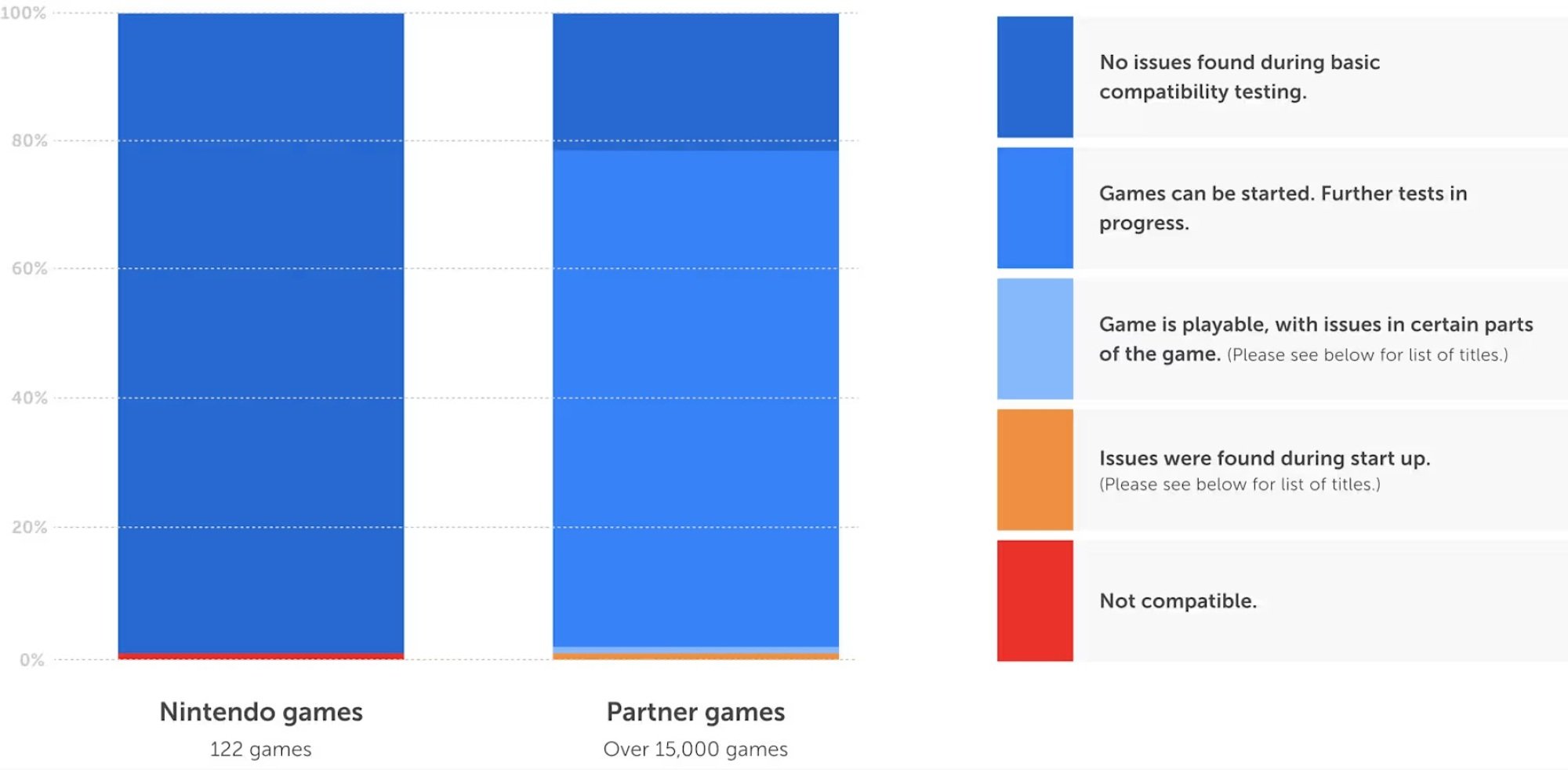
Credit: Nintendo
Not every game, it turns out, plays nice with this translation to the new device. According to Nintendo, the vast majority of Switch 1 games should work without issue, with some select games getting free patches to help bring them up to snuff, but the company has encountered problems with over 120 titles, some of which won’t even start up. These include popular games like Doom: Eternal and Rocket League, so if you depend on your Switch to play these, don’t expect the new console to be able to replace your old one right away. It’ll likely take some time for Nintendo to work out all the kinks here.
Nintendo Switch 2 Edition games
So how is Nintendo getting around these problems? Well, aside from painstakingly checking each Nintendo Switch game (more than 10,000) “one-by-one,” it’s also releasing new versions of certain Switch 1 games that are built to run on the Nintendo Switch 2 from the ground up.
These Nintendo Switch 2 Edition games will essentially be enhanced ports of certain Switch 1 titles, including The Legend of Zelda: Breath of the Wild; The Legend of Zelda: Tears of the Kingdom; Kirby and the Forgotten Land; Super Mario Party Jamboree; and even as-yet-unreleased games like Pokémon Legenda: Z-A and Metroid Prime 4: Beyond.
Switch 2 Edition games will come with improved graphics, higher resolutions, and much smoother framerates, as well as new content in the case of Kirby and Mario Party. You’ll also get new control modes when applicable, as Metroid Prime 4 will be able to use the Switch 2’s mouse controls.
The catch: you have to pay for these upgrades. While your Switch 2 should be able to play the above games just fine if you pop your Switch 1 cartridge into it, you won’t get any of the enhancements that let you use its extra power unless you pony up, and will instead be playing via the same emulation as every other Switch 1 game.
Luckily, if you already own the Switch 1 version of a game, you can get an upgrade pack (sold either at select retailers or via the Nintendo eShop) to get the Switch 2 Edition at a discount, as opposed to buying the Switch 2 Edition for full price (which, of course, is also an option). Even better—Nintendo has confirmed that your upgraded game will still be playable on Switch 1, just without the enhancements that come with the Switch 2 Edition. Plus, subscribers to the Nintendo Switch Online Expansion Pack will at least get both Zelda upgrades included with their plan.
Official pricing for these Switch 2 Editions or their upgrade packs has yet to be revealed, but keep in mind that when you’re shopping for a Switch 2, you shouldn’t necessarily bank on the system being able to “play your Switch 1 games, but better.”
How to play a Switch 1 game on Switch 2
Now that I’ve broken down the ins-and-outs of backwards compatibility on the Switch, let’s talk about how to actually play your Switch 1 games on the Switch 2.
The first method is pretty simple. If you own a compatible physical Switch 1 game cartridge, you can just put it into your Switch 2 to start playing it just like on the original console.
Alternatively, if you want to move all of your game saves, wifi details, parental control settings, and digital games over to the Switch 2, you can use a System Transfer to do just that. Specific steps for the transfer system haven’t been published yet, but you’ll be able to use it to conveniently move pretty much everything from your Switch 1 to your Switch 2 all in one fell swoop.
Credit: Nintendo
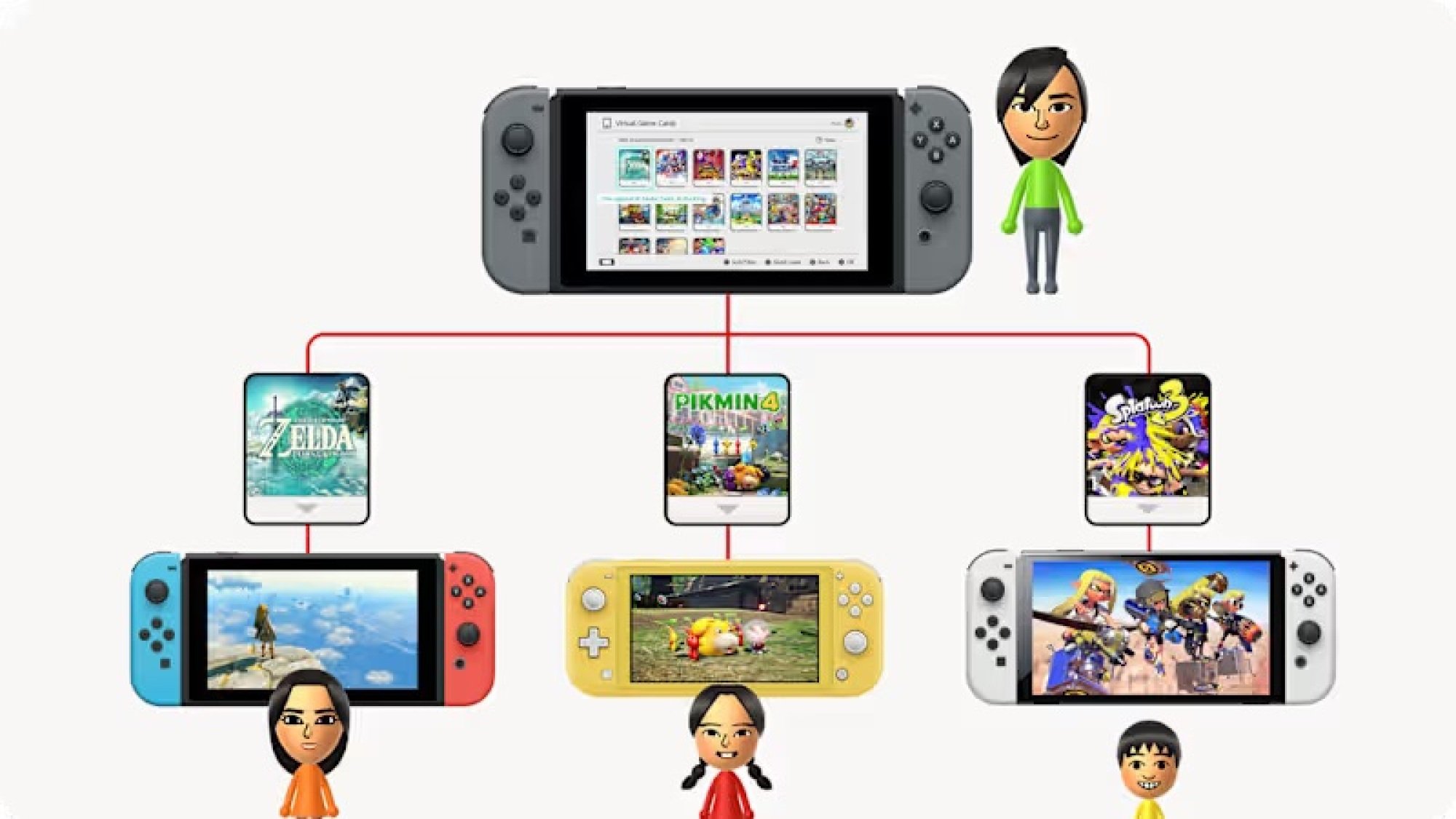
Finally, for a more piecemeal approach, there’s Virtual Game Cards. This is a new way of categorizing digital games that’s set for release in April. Essentially, it’ll add a new icon to the Switch’s home screen, where you’ll be able to see your digital games as a series of “virtual game cards.” You’ll then be able to load these cards then and there to play them on the system you’re currently using, or click “Load on Another System” to move them over to another console linked to your Nintendo Account. With that, you can move your Switch 1 games over to Switch 2 on a more case-by-case basis.
Android 16 Beta 3.2 Fixes Battery Drain, Screen Flickers And More Pixel Issues
Google just released the Android 16 Beta 3.2 patch to beta testers, which includes fixes for “minor” issues such as battery drain, screen flicker, and more.
If you’ve noticed that your Android battery drains a little faster than normal, especially when it’s not in use, Android 16 Beta 3.2 includes a fix that will address this issue. This
What’s Your Chatbot’s Carbon Footprint?
You maybe haven’t thought about it, but every time you ask your favorite generative AI platform a question, you’re pumping greenhouse gases into the atmosphere.
Bonobos’ calls may be the closest thing to animal language we’ve seen
Bonobos, great apes related to us and chimpanzees that live in the Republic of Congo, communicate with vocal calls including peeps, hoots, yelps, grunts, and whistles. Now, a team of Swiss scientists led by Melissa Berthet, an evolutionary anthropologist at the University of Zurich, discovered bonobos can combine these basic sounds into larger semantic structures. In these communications, meaning is something more than just a sum of individual calls—a trait known as non-trivial compositionality, which we once thought was uniquely human.
To do this, Berthet and her colleagues built a database of 700 bonobo calls and deciphered them using methods drawn from distributional semantics, the methodology we’ve relied on in reconstructing long-lost languages like Etruscan or Rongorongo. For the first time, we have a glimpse into what bonobos mean when they call to each other in the wild.
Context is everything
The key idea behind distributional semantics is that when words appear in similar contexts, they tend to have similar meanings. To decipher an unknown language, you need to collect a large corpus of words and turn those words into vectors—mathematical representations that let you place them in a multidimensional semantic space. The second thing you need is context data, which tells you the circumstances in which these words were used (that gets vectorized, too). When you map your word vectors onto context vectors in this multidimensional space, what usually happens is that words with similar meaning end up close to each other. Berthet and her colleagues wanted to apply the same trick to bonobos’ calls. That seemed straightforward at first glance, but proved painfully hard to execute.
Hori’s Piranha Plant Switch 2 camera is a work of art
Yesterday, we learned a lot about the Switch 2 we didn’t know before, including the fact Nintendo that will offer a webcam alongside the new console. As far as accessories go, the $50 Switch 2 Camera looks boring, and judging from the footage the company shared on Wednesday, not particularly great at its intended purpose of, you know, capturing moving pictures.
The good news? Nintendo is allowing third-party manufacturers to make their own webcams for the new console. Enter the Hori Piranha Plant Camera.
Hori
Hori’s Switch 2 camera has a couple of features you won’t find on Nintendo’s first-party offering. First, the pot the Piranha Plant sits in functions as both as a stand and USB extension for the device. The part of the Piranha that houses the webcam can detach from the pot, allowing you to, ahem, plant it directly on the top of the Switch 2. In that way, you can take your new buddy on the road. Want to trash talk your friends over video in GameChat while on a domestic flight? With the Piranha Plant and in-flight Wi-Fi, you can.
Second, the Piranha Plant camera has a built-in privacy shutter. You can simply close its mouth to obscure the lens. If that’s not clever, functional design, I don’t know what is.
Hori
Hori has yet to list the Piranha Plant camera on its US website, but over in Germany, retailer Media Markt has the accessory priced at €40 or €20 less than the official Switch 2 Camera from Nintendo. Practical, stylish and affordable, what’s not to love?
This article originally appeared on Engadget at https://www.engadget.com/gaming/nintendo/horis-piranha-plant-switch-2-camera-is-a-work-of-art-194430377.html?src=rss
KFC Fried Chicken Flavored Toothpaste
Because who wouldn’t want to go to bed at night with a taste in your mouth that makes you feel like you didn’t brush your teeth, dental care company and novelty toothpaste manufacturer Hismile teamed up with KFC to make a fried chicken flavored toothpaste (not an April Fools’ prank, but currently sold out). That’s…something. Something to make your dogs love your breath. Still, call me old fashioned, but I prefer my toothpaste the same flavor it’s always been: bubble gum.