
APT 3.0 has been officially released as the first stable version following an interesting development cycle. APT 3.0 has been dedicated to the late Steve Langasek with his many Debian and Ubuntu contributions over the years…
Monthly Archives: April 2025
Resources 1.8 Released As A Great System Resource Monitor For GNOME
In addition to all the KDE Plasma activity this week, GNOME developers have also been quiet busy working on a variety of improvements to the open-source desktop on their side of the pond…
LACT 0.7.3 Further Enhances This GPU Configuration & Monitoring Tool
LACT 0.7.3 is out this weekend as the newest feature update to this Linux GPU configuration and monitoring tool. LACT helps make up for the lack of any official GUI-based GPU configuration tool on Linux provided by AMD or Intel. It also works on NVIDIA GPUs too for providing a nice unified app for GPU configuration from all three major GPU vendors…
FEX 2504 Ships More Optimizations For Running x86_64 Linux Binaries On ARM64
FEX 2504 is out with its newest monthly feature update for this open-source emulator that allows running x86/x86_64 binaries on AArch64 Linux hosts. This alternative to QEMU and Box64 continues focusing on new performance optimizations to further enhance the appeal and speedy potential of this x86_64-on-ARM64 emulator…
Intel Open Image Denoise Adds Support For AMD RDNA4 & NVIDIA Blackwell
Intel’s Open Image Denoise library that is part of their oneAPI Rendering Toolkit as a set of open-source, high performance denoising filters for ray-traced images is out with a new release. Open Image Denoise is used by applications like Blender and with this version 2.3.3 release is expanded GPU support…
KDE Plasma Lands More Crash Fixes This Week, Refines Its Crash Reporting Wizard
It’s been a busy start to April for KDE Plasma developers as they continue working toward the Plasma 6.4 feature release. There have been yet more crash fixes along with other polishing and stability enhancements to kick off the new month…
HTTP 406 Not Acceptable Status Code: What is it and how to fix it?
This tutorial will explain everything about the HTTP 406 Not Acceptable status code. The HTTP 406 Not Acceptable is an HTTP response or status code belonging to 4xx client errors. This means that the page cannot be reached, is unavailable, or the request has bad syntax.
XR weekly round-up: High-end VR headset released, eye tracking gets more precise & Meta builds expensive smart glasses
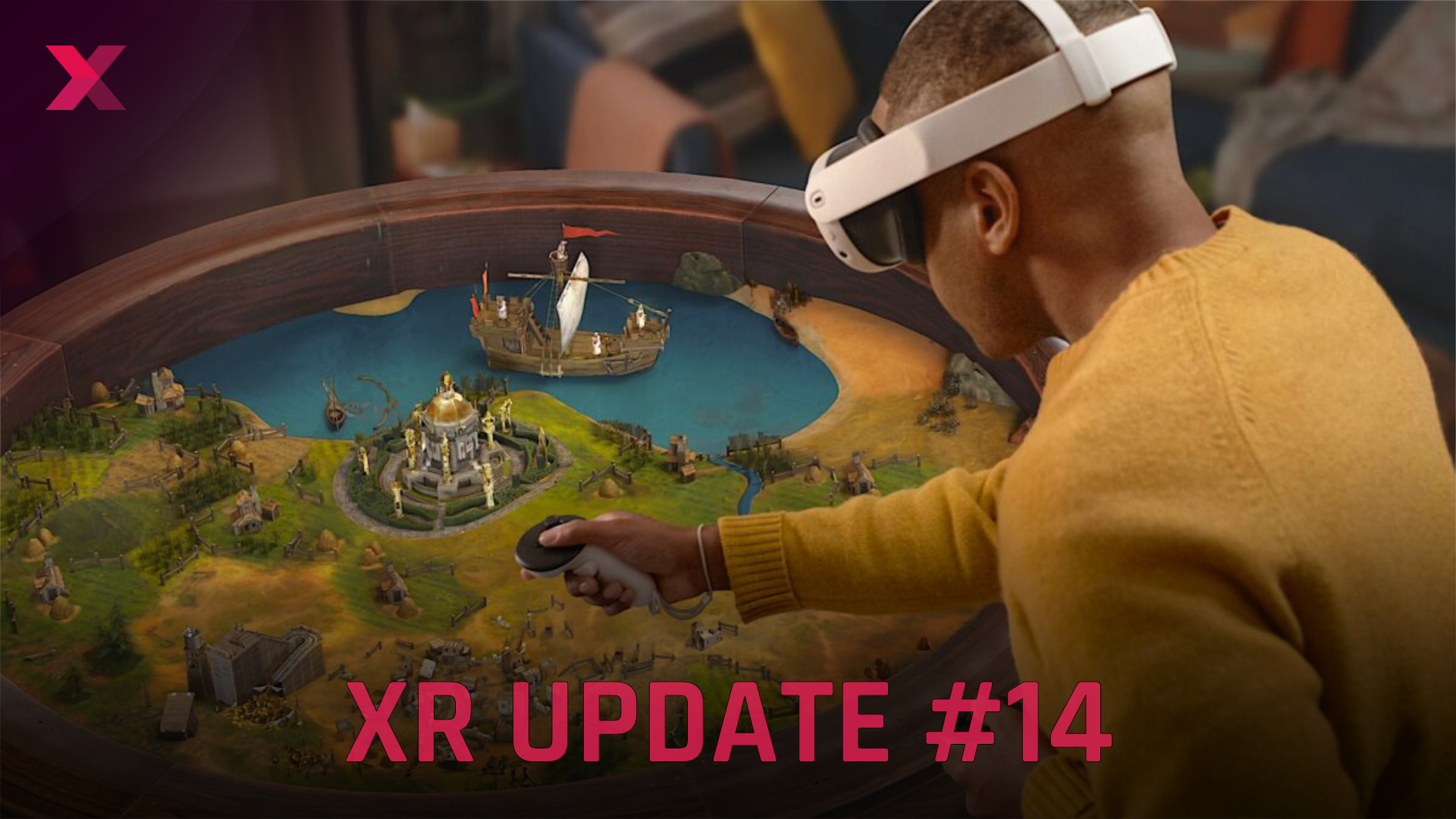
Pimax Crystal Super launches, Meta’s new smart glasses get expensive, and Civilization is looking great in VR — the XR news of the week.
The post XR weekly round-up: High-end VR headset released, eye tracking gets more precise & Meta builds expensive smart glasses appeared first on MIXED Reality News.
Ubuntu 25.04 beta takes flight – but this Plucky Puffin is still molting
‘Pudgy’ might be more apt given the download size. The beta version of Ubuntu 25.04, the next interim release of this Linux OS, has arrived.…
Scientists Warn Indonesia’s Rice Megaproject Faces Failure
Indonesian President Prabowo Subianto’s ambitious plan to create 1 million hectares of new rice farms in eastern Merauke Regency faces strong criticism from scientists who have warned it will fail due to unsuitable soils and climate. Military “food brigades” are currently guarding bulldozers clearing swampy forests in Indonesian New Guinea for the project, which aims to boost food self-sufficiency for the nation’s 281 million people.
Soil scientists warn that Merauke’s conditions could lead to acidic soils unable to support economically viable rice farming, potentially resulting in abandoned fields vulnerable to wildfires. “Farmers will get no profit at all,” said Dwi Andreas, a soil scientist at Bogor Agricultural University who tested 12 rice varieties in similar soils with poor results.
The initiative mirrors past failed megaprojects, including a 1990s attempt to convert 1 million hectares of Borneo peatlands to rice paddies and a 2020 onion and potato farming expansion in North Sumatra that saw 90% of fields abandoned. A previous 2010 attempt to expand rice farming in Merauke also failed, destroying forests that Indigenous Papuans relied on and increasing childhood malnutrition, according to anthropologist Laksmi Adriani.


Read more of this story at Slashdot.
Celluloid 0.28 Video Player Brings UI Redesign, Lua Modules Support
Celluloid 0.28 open-source video player is out with a refreshed interface, playlist duration display, and playlist navigation via next/previous buttons.
With new contracts, SpaceX will become the US military’s top launch provider
The US Space Force announced Friday it selected SpaceX, United Launch Alliance, and Blue Origin for $13.7 billion in contracts to deliver the Pentagon’s most critical military to orbit into the early 2030s.
These missions will launch the government’s heaviest national security satellites, like the National Reconnaissance Office’s large bus-sized spy platforms, and deploy them into bespoke orbits. These types of launches often demand heavy-lift rockets with long-duration upper stages that can cruise through space for six or more hours.
The contracts awarded Friday are part of the next phase of the military’s space launch program once dominated by United Launch Alliance, the 50-50 joint venture between legacy defense contractors Boeing and Lockheed Martin.
Two Teenagers Built ‘Cal AI’, a Photo Calorie App With Over a Million Users
An anonymous reader quotes a report from TechCrunch: In a world filled with “vibe coding,” Zach Yadegari, teen founder of Cal AI, stands in ironic, old-fashioned contrast. Ironic because Yadegari and his co-founder, Henry Langmack, are both just 18 years old and still in high school. Yet their story, so far, is a classic. Launched in May, Cal AI has generated over 5 million downloads in eight months, Yadegari says. Better still, he tells TechCrunch that the customer retention rate is over 30% and that the app generated over $2 million in revenue last month. […]
The concept is simple: Take a picture of the food you are about to consume, and let the app log calories and macros for you. It’s not a unique idea. For instance, the big dog in calorie counting, MyFitnessPal, has its Meal Scan feature. Then there are apps like SnapCalorie, which was released in 2023 and created by the founder of Google Lens. Cal AI’s advantage, perhaps, is that it was built wholly in the age of large image models. It uses models from Anthropic and OpenAI and RAG to improve accuracy and is trained on open source food calorie and image databases from sites like GitHub.
“We have found that different models are better with different foods,” Yadegari tells TechCrunch. Along the way, the founders coded through technical problems like recognizing ingredients from food packages or in jumbled bowls. The result is an app that the creators say is 90% accurate, which appears to be good enough for many dieters. The report says Yadegari began mastering Python and C# in middle school and went on to build his first business in ninth grade — a website called Totally Science that gave students access to unblocked games (cleverly named to evade school filters). He sold the company at age 16 to FreezeNova for $100,000.
Following the sale, Yadegari immersed himself in the startup scene, watching Y Combinator videos and networking on X, where he met co-founder Blake Anderson, known for creating ChatGPT-powered apps like RizzGPT. Together, they launched Cal AI and moved to a hacker house in San Francisco to develop their prototype.


Read more of this story at Slashdot.
Zwifters in Mallorca, Day 1: Cap de Formentor (The Mega Pretzel)
Hundreds of Zwifters have arrived here in Mallorca for a few days of quality riding and IRL hangouts at Zwift Community Live 2025. With so many people to meet and new roads to ride, each person’s daily experience at this event will be unique and personal…. but here’s mine.
The Warmup
Before diving into Day 1, let me give you a few highlights from the days leading up to it:
- My wife Monica and I spent two lovely nights at the home of Simon Schofield (creator of the Zwiftcast), just south of Girona. Simon and his wife Jennie were, of course, incredible hosts, and I even got a ride in with Simon in which he put me to work chasing his ebike’s wheel up the local climb! See it on Strava >
- We arrived in Mallorca a few days before the official first day of ZCL, because Zwift had invited members of the media out for a “This Season on Zwift” presentation (read the details of what was announced here.) New roads, Zwift Ride crank length options, more HUD data, fitness metrics and outdoor rides giving us XP… it was a lot of good news!
- I rode out to Cap de Formentor (the lighthouse!) along with Nathan Guerra, Shane Miller, DC Rainmaker, DesFit, Eric Min, and other media and Zwift HQ folks. It was a great ride with incredible views and just enough climbing, wind, and goats to make it interesting. See it on Strava >
- The day before Day 1 (Thursday), Zwift held a meeting with key Club leaders to discuss upcoming features and here from leaders about how Zwift could help them build their communities even more. It was a really fun conversation, and the chattiness in the room made it easy to see why all these folks were good at building communities on Zwift.
- The night of Day 0 featured the first of our fireside chats, hosted by Matt Stephens. It was a sort of kickoff chat that featured Zwift CEO Eric Min plus the VP of Product at Zwift, Mark Cote. They spoke of the importance of community at Zwift, some goals for ZCL, and generally set the tone for the event.
Pride Goes Before a Fall
On the flight into Mallorca, I had joked with Monica, “How long into this event will we go before the first Zwift crashes their bike?” (Because the joke is, of course, that Zwifters can’t handle their bikes outside.)
It turns out, not long at all.
Before the epic Cap de Formentor outing on Wednesday afternoon, I was 20 minutes into my first ride in Mallorca, testing the rental bike and shaking out my legs with Nathan Guerra.
It started to rain just a bit… then a bit more… and soon enough, it was a full-on downpour. As we went through a roundabout I felt my rear wheel lose traction, and I quickly hit the deck, body and bike sliding across the entire lane.
So I got the honor of being Zwift’s first “incident report” for the event. Happily, a few scrapes and some soreness weren’t enough to hamper any ride plans. The bibs weren’t even torn through. Ride on!
Breakfast
Now, let’s get into Day 1.
It began with breakfast. Without giving a full review of all the food we eat at ZCL, let me just say that the folks at Iberostar Playa de Muro Village do it right! The food is amazing. A huge variety of high-quality, tasty options are served for breakfast and dinner in a massive buffet style aided by attentive and courteous waitstaff.
I made a granola bowl with fruit and yogurt, and also had a beet-based smoothie, two small pastries, and a cappuccino. Fuel for the fight.
In the dining room everyone was chatting about their ride plans for the day: are you doing the Uber? The Mega? The Pretzel? Which pace group? (Each of ZCL’s three days centers on a bike ride, and attendees have the option of three different ride lengths, aptly named the Uber Pretzel, Mega Pretzel, and The Pretzel. Each ride also has three pace options, and all the groups are led by qualified ride leaders.)
The Mega Pretzel
I went with the Mega Pretzel – the medium-length ride – for two reasons:
- It went out to the Cap de Formentor lighthouse again, and I had really enjoyed the ride two days earlier. I wanted to tackle it again now that I had knowledge of how the roads (climbs) layed out.
- My left wrist was sore and swollen from the crash, and I wasn’t sure how it would hold up on the longer Uber Pretzel.
Here’s the route we had planned:
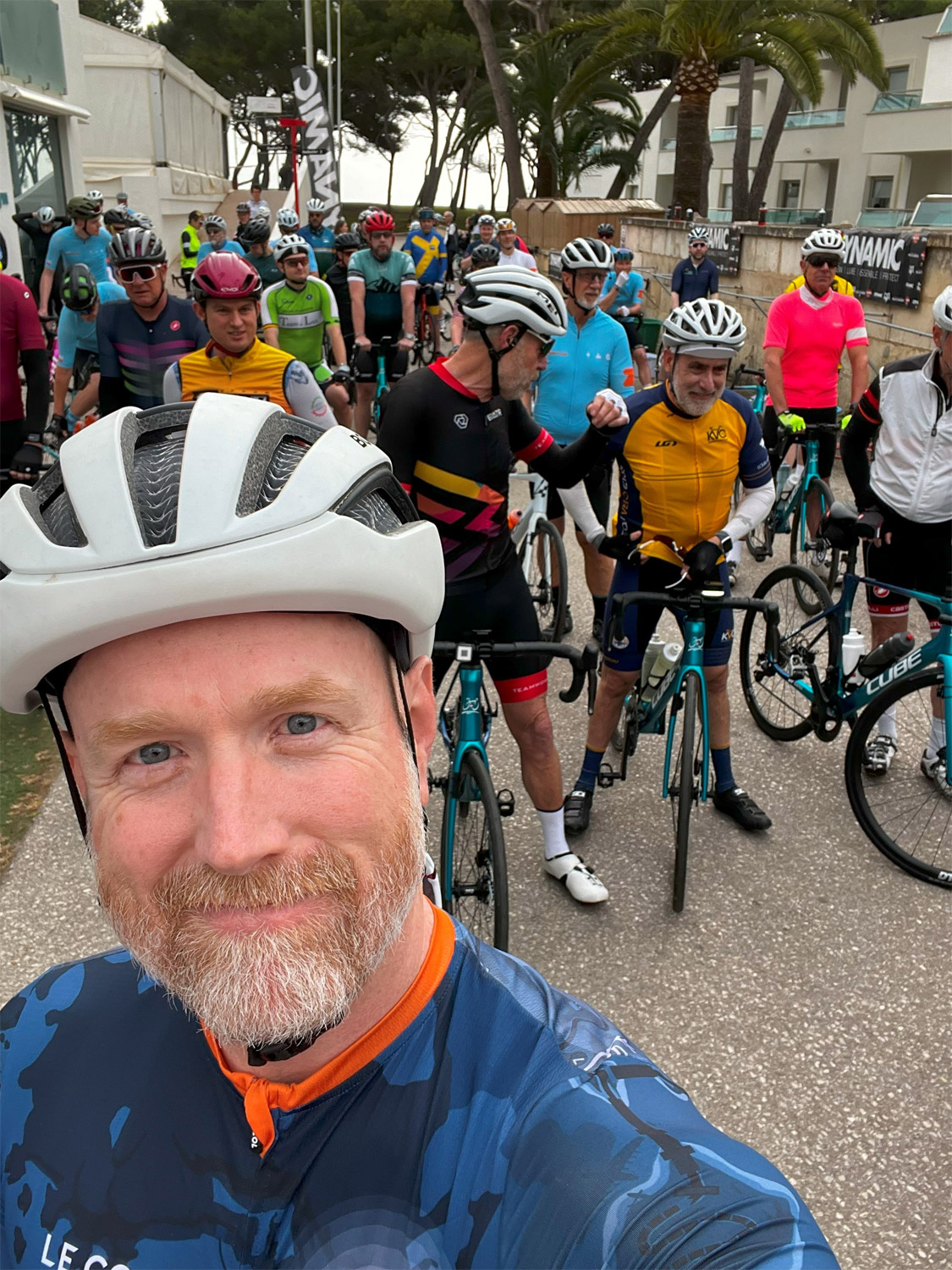
The Uber riders had left an hour earlier, and the Mega riders (the largest group) were slated to leave at 9:30am. We started by breaking into groups of ~12 riders, each with a leader. Dave Towle was on hand to send each group out, and soon enough we were off!
The Lead-In
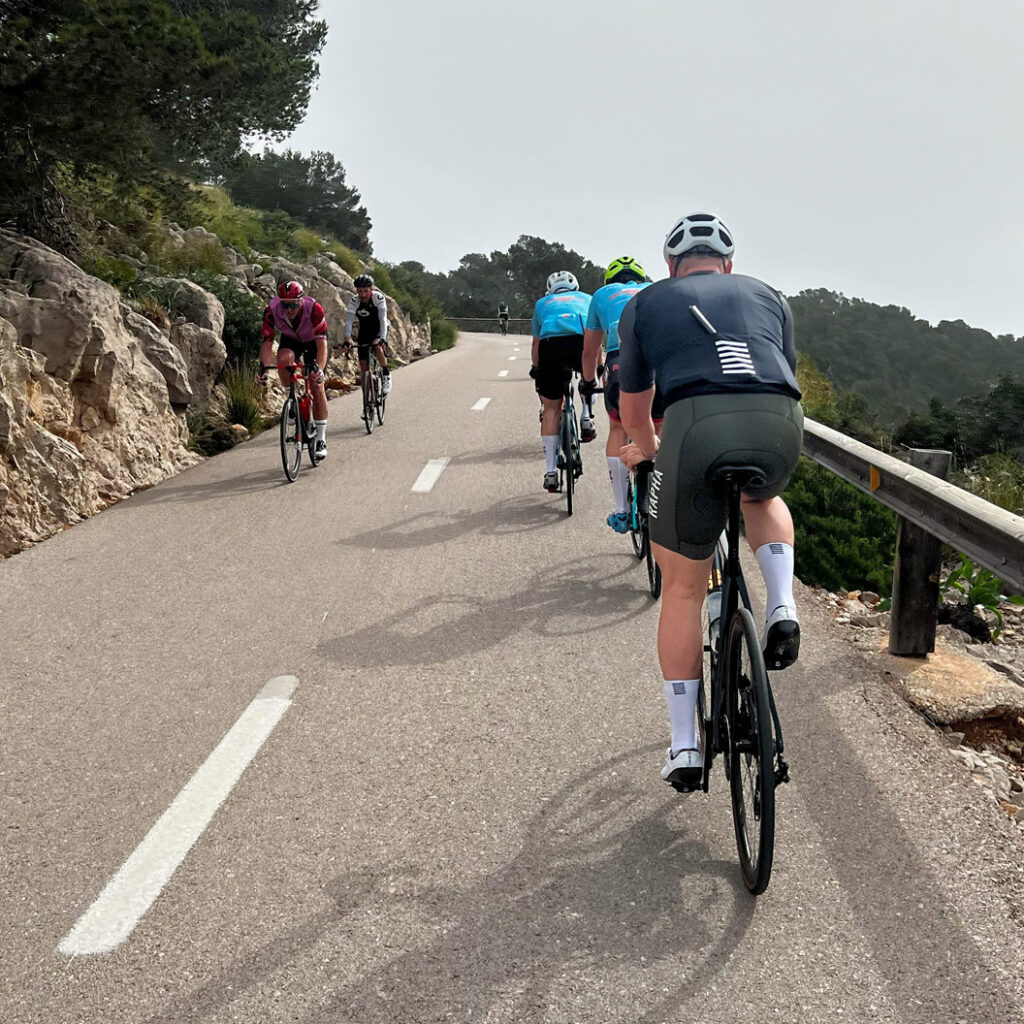
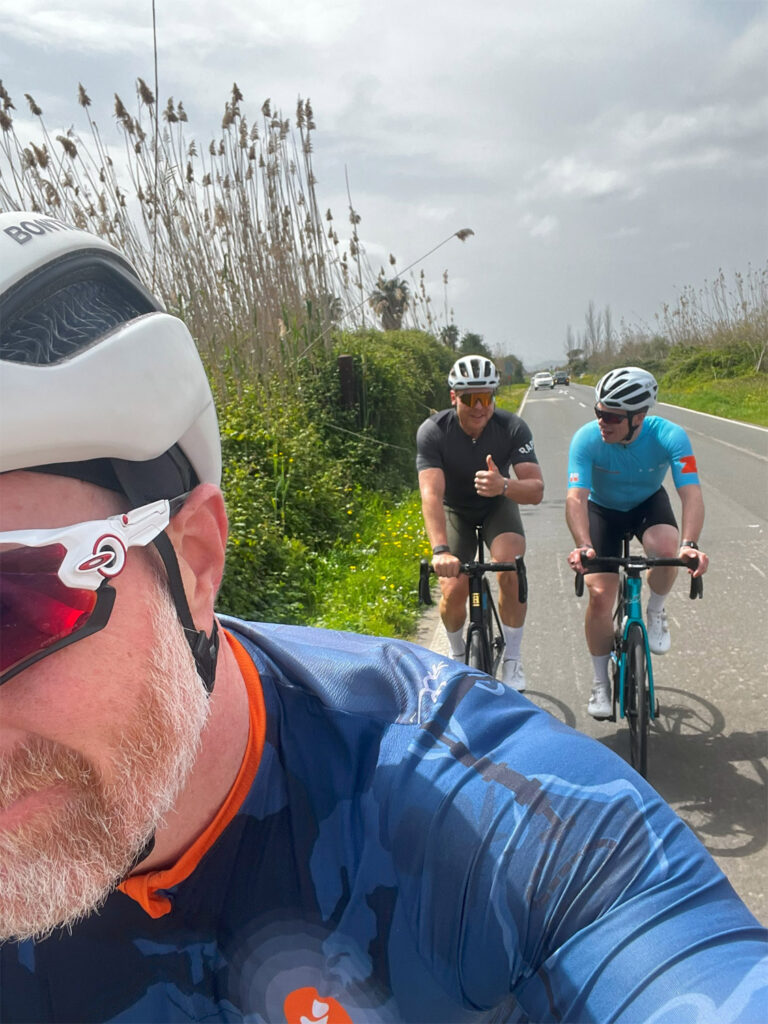
The ride begins with a flat lead-in to the pitchy road that takes you out to the lighthouse. We rode two abreast, keeping an easy speed of ~30kph, then turned onto the first climb of the day: Coll De Sa Creueta. This is the biggest climb on the route, and I had already decided I wanted to hammer it a bit and beat my time from two days prior. And I did! 325W for 11:18 got me to the top, the “first lookout”, around 70 seconds faster than before.
A Star-Studded Cast
As we continued to make our way toward the lighthouse, I spotted various recognizeable Zwifters: Tim “Bacon” Searle, Shane Miller, Florence Nakagwa from Canyon/SRAM Generation, Tim Perkin (Mountain Massif organizer), and others.
I was pushing fairly hard up one climb, passing lots of riders on my right, when a big guy flew past me on my left. He was in the saddle, undoubtedly churning out big watts, but looked beautiful doing it with ease and perfect form. “Who is this cycling Adonis?” I said to myself. I hammered a bit to catch his wheel, and soon discovered it was Sir Chris Hoy himself, here to deliver a fireside chat later in the week.
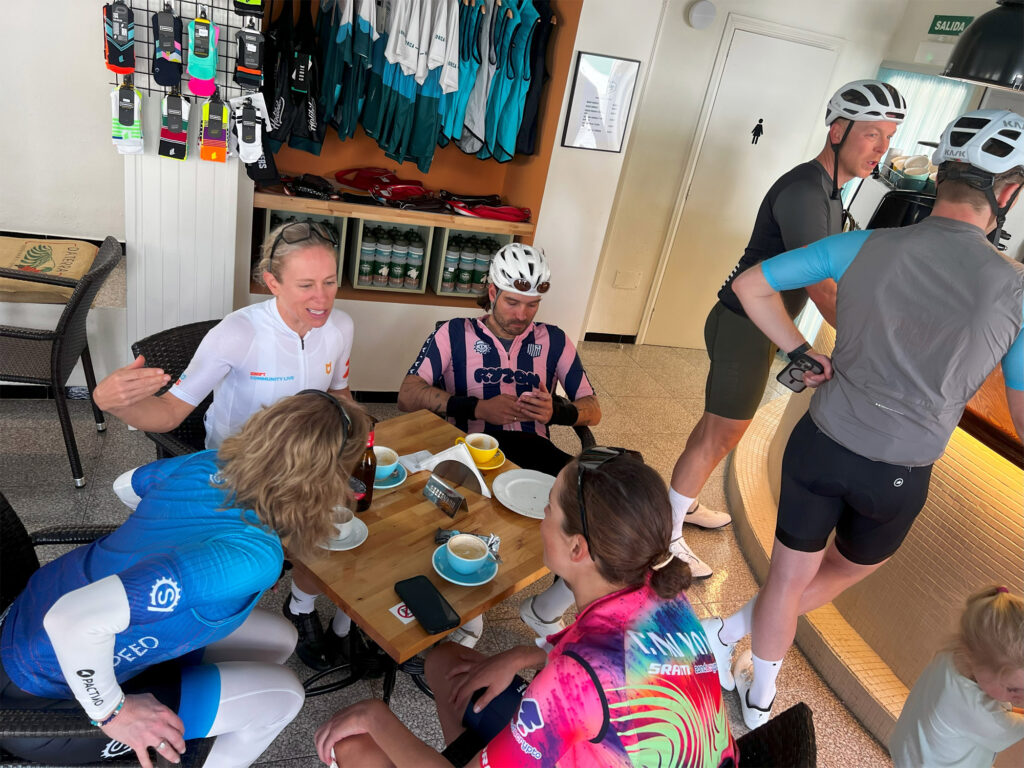
Near the end of the ride, we made our scheduled coffee stop at a cafe along with a few other 12-member ZCL groups. As I stood in line, I looked around and marveled at everyone in the room: Matt Stephens, Leah Thorvilson, two Canyon/SRAM riders, Rick Zabel, Sir Chris… and lots of “ordinary” Zwifters too. What a crowd!
The Long and Windy Road

The road out to the lighthouse is twisty, with epic views around every corner, and (at least in my experience) stiff winds as you near the turnaround point at the lighthouse. Once you’re on the more exposed final few kilometers of tarmac leading up to the point, the views are wild, the winds are high, and all the senses are firing. Amazing. Highly recommended.
Wrapping Up the Ride
Once we came back from the lighthouse on the same road we’d gone out, it was time to finish up with ~30k of rolling/flat roads back to our base in Platja de Muro. Easy peasy.
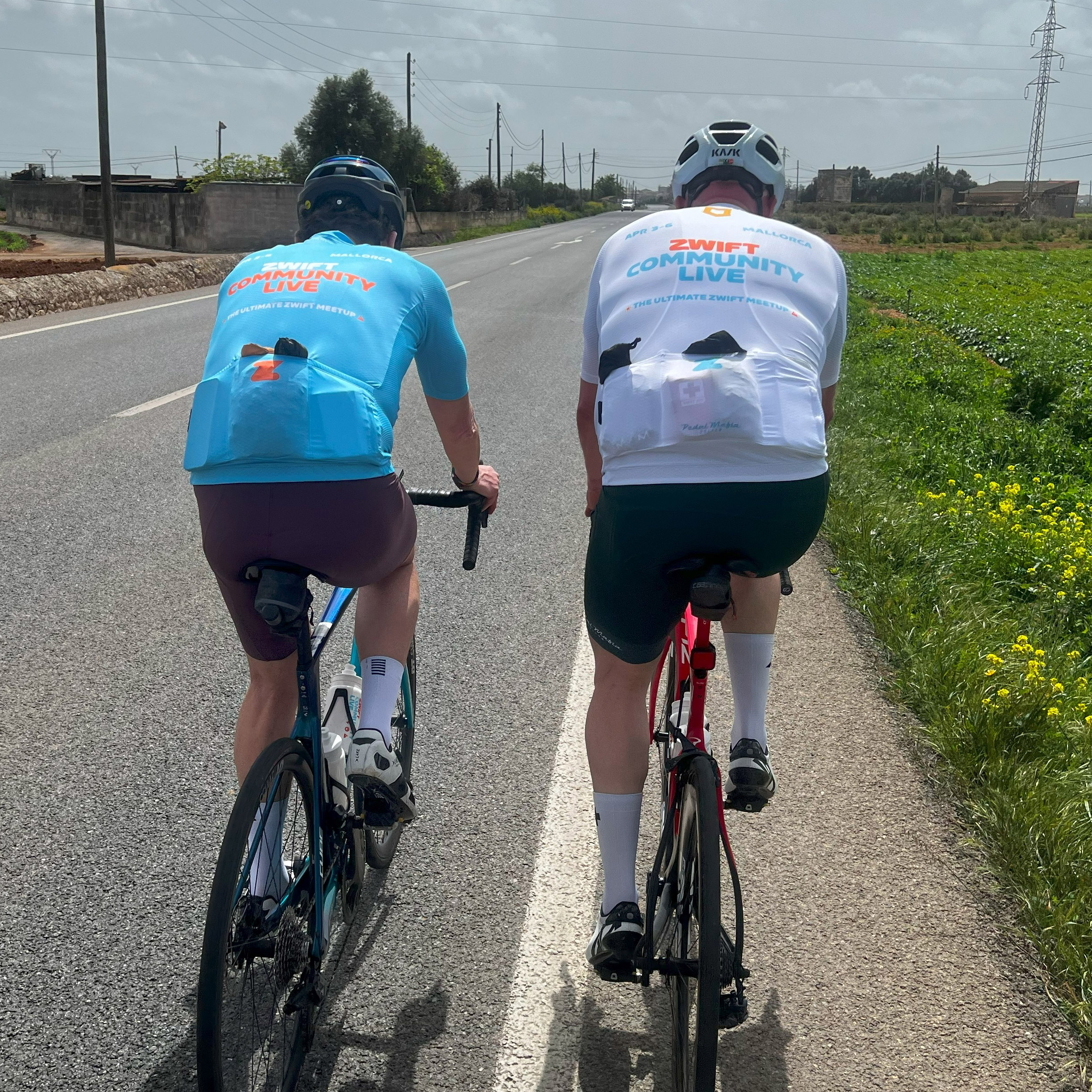
We heard that Chris Hoy was behind our group along with Zwift’s Chris Snook, as Sir Chris had suffered a bit of a mechanical. We were getting close to home and our group didn’t want to wait around for the Chrises to close the 10-minute gap, but I decided I did.
It turned out to be a good call. Riding and chatting with those two was more interesting than sitting in the larger group and cruising home. Sir Chris shared stories of his early years, riding in Mallorca as an 18-year-old. And before we knew it, were were back at the hotel. 84km with 1028 meters of elevation done and dusted! See it on Strava >
Finishing the Day: Recovery, Race Meeting, Dinner, and a Fireside Chat
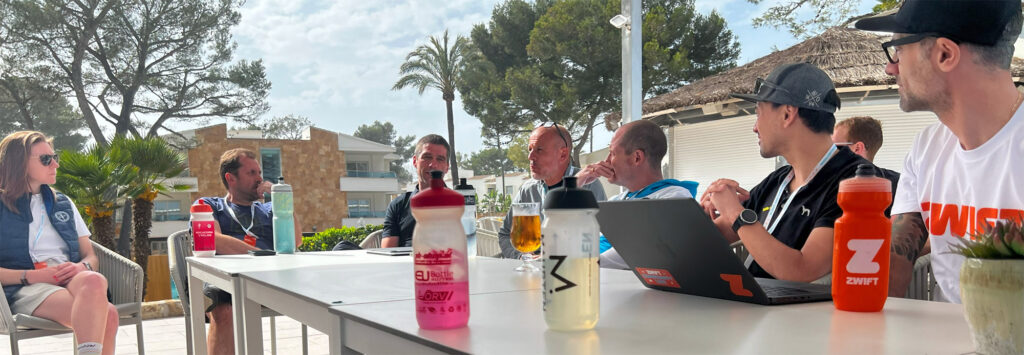
I arrived back at the hotel around 3 in the afternoon, meeting Monica who had finished her ride a bit earlier.
The day ended with:
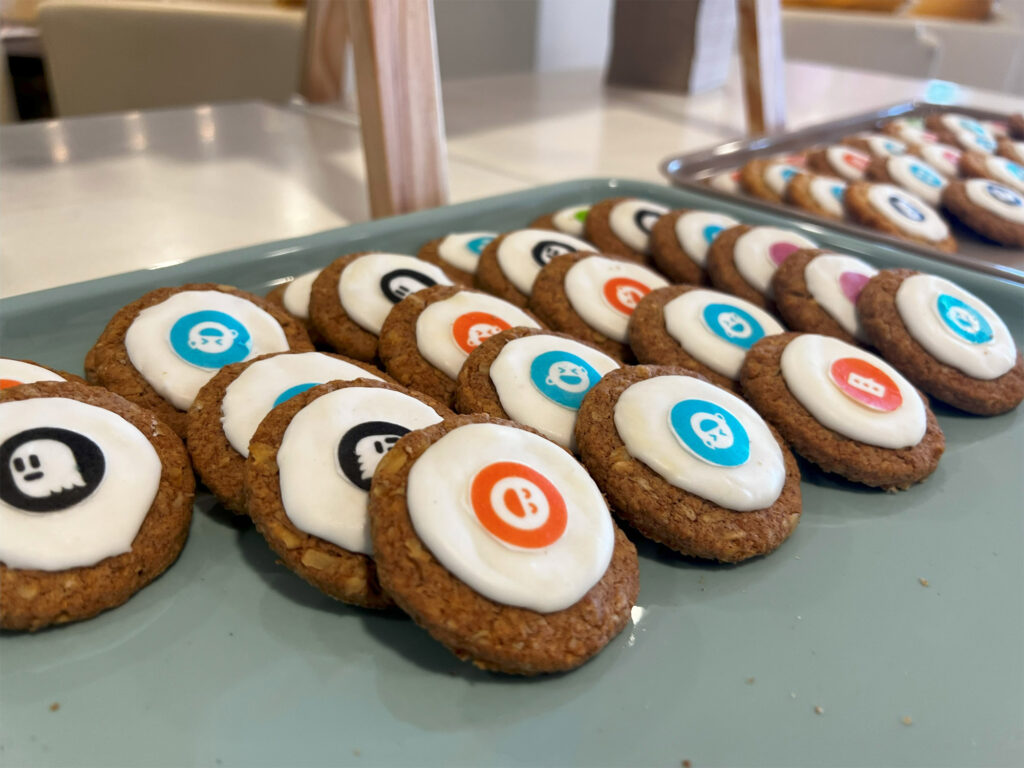
- Kickstarting our recovery with powerup cookies and Normatec boots
- A brainstorming session with ~15 of the top race organizers on Zwift and members of Zwift HQ
- An amazing dinner
- Everyone gathering for a hilarious and inspiring fireside chat with Kristin Armstrong (3x Olympic gold medalist and level 51 Zwifter) hosted by Dave Towle and Matt Stephens. Kristin talked about coming to Mallorca where everyone trains, and how now… we’re everyone.

Coming Up Tomorrow
Today’s ride was lovely, and it was great to sit in and chat with lots of Zwift community members. My wrist felt good, too, so I’m looking for something a bit more challenging tomorrow. It’s time to jump into the Uber Pretzel group! Here’s the planned route:
Watch this space to learn how it goes…

Git on Linux: A Beginner’s Guide to Version Control and Project Management
Version control is a fundamental tool in modern software development, enabling teams and individuals to track, manage, and collaborate on projects with confidence. Whether you’re working on a simple script or a large-scale application, keeping track of changes, collaborating with others, and rolling back to previous versions are essential aspects of development. Among various version control systems, Git has emerged as the most widely used and trusted tool — especially on Linux, where it integrates seamlessly with the system’s workflow.
Hitman: World Of Assassination Trilogy (PS VR2) Review – A Redeemed Experience
Fourth time’s the charm, you might say.
Following in the footsteps of three previous lukewarm attempts, IO Interactive is back to take another stab at adapting Hitman: World of Assassination Trilogy in VR. This time, the game has been reworked for PlayStation VR2, and aims to finally put to rest Hitman’s cursed history with virtual reality.
In Hitman: World of Assassination Trilogy, you play as Agent 47, an expert assassin who jets off to various parts of the world to eliminate his targets. Each level is a large sandbox environment, in which you can use disguises to access restricted areas and random everyday items as weapons or tools.
Although the series has mostly been a flatscreen experience, several VR releases on the original PSVR, PCVR, and Quest 3 were met with mixed reception. But right off the bat, it’s clear the PS VR2 version of Hitman: World of Assassination Trilogy has learned all the right lessons from those previous iterations.
The Facts
What is it?: A VR adaptation of Hitman’s sandbox stealth gameplay for PS VR2.
Platforms: PS VR2
Release Date: Out now
Developer: IO Interactive
Price: $39.99 (VR edition), $9.99 (VR access upgrade)
While the Quest 3 port was widely criticized, its dual-wielding mechanics felt like the right step forward for the game. Here, dual-wielding returns with much more freedom and maneuverability to use both arms on the go.
This means full ambidexterity, allowing you to multitask different interactions at once, or attack two different enemy targets at the same time. Using two pistols to shoot is fun, of course, but bonking two guards on the head simultaneously using cans of spaghetti sauce is a level of comedy that can only be found in a game like this.
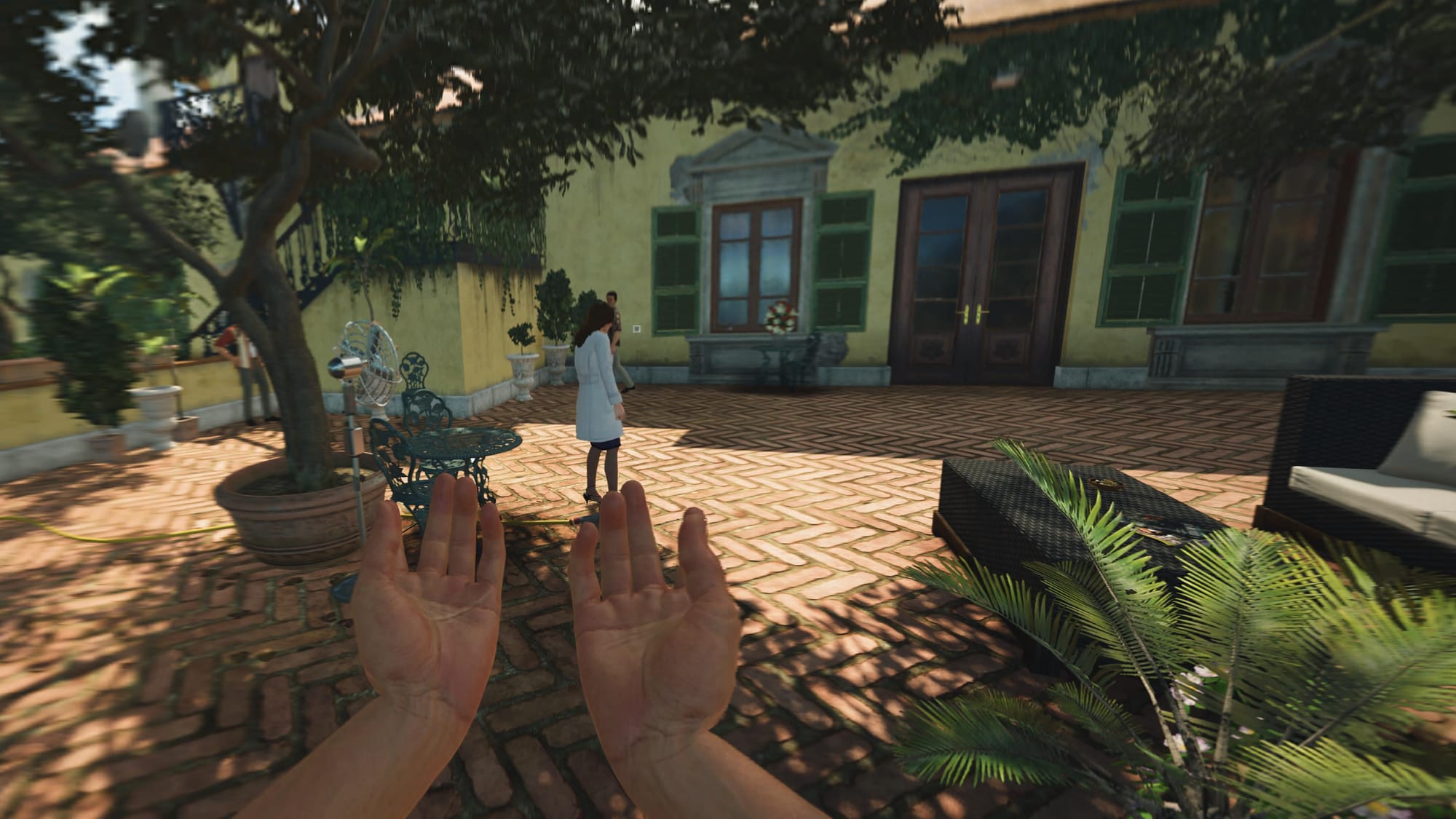
That’s not the only improvement either. In an effort to trim down on the number of button presses that featured heavily in the Quest 3 version, Hitman: World of Assassination Trilogy on PS VR2 has full physical interactions with the environment. That means actually being able to swipe a keycard into the reader, poisoning food by dropping a vial of poison onto it, and opening a closet by pulling at the handle.
Throwing items can also be done with the flick of a wrist, and thanks to the aim assist setting you can adjust how tricky it is to hit targets with it. It’s intuitive and really helps to immerse you in the role of Agent 47. Altogether, it’s clear IO Interactive has really taken everything into consideration when it comes to turning Hitman into a VR experience.
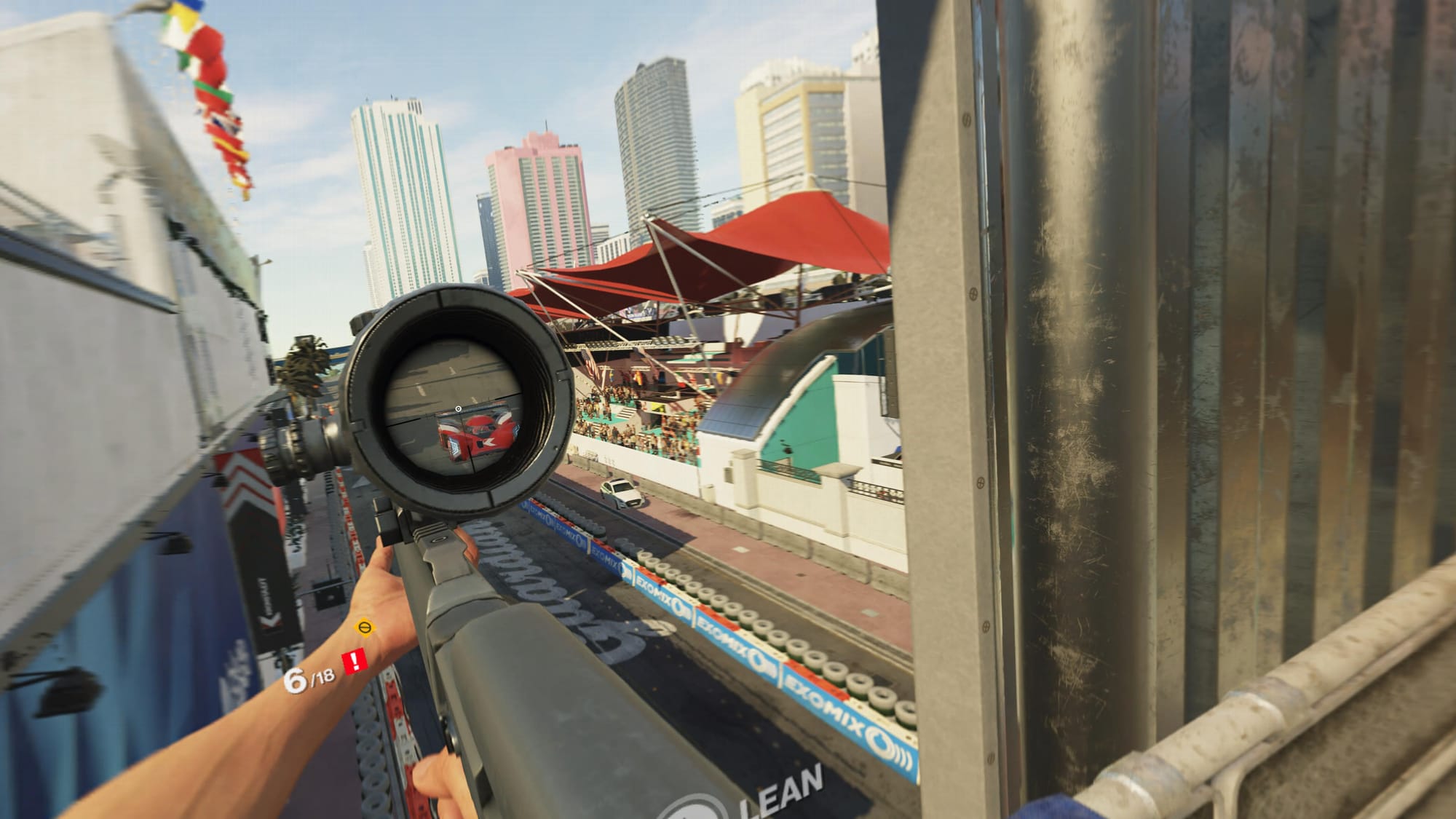
This extends to weapon handling too, which features holstering on both sides of your body, dynamic sniper scopes, as well as manual reloading where you have to physically insert a new magazine into your gun. Compared to the previous versions, where reloading was handled automatically via a button press, this really helps the game to feel a lot more like it was built for VR from the ground up.

This isn’t perfect though, as there remain moments where the game doesn’t feel as dynamic. For example, vaulting over walls or climbing ladders is still only operated by pressing one of the face buttons. It also puts you into a third-person perspective until you complete the interaction, which can be really distracting and even interrupt your momentum in some cases.
Nearly every cutscene is also presented in flatscreen, but there are some very rare occasions where IO Interactive has taken the time to keep you in the game when a cutscene starts playing, as opposed to hitting you with a flat video. The game menu is also flat, and this feels like a missed opportunity to utilize the safe house from Freelancer to load up missions or check equipment.
You’re bound to have the odd moment or interaction that just doesn’t translate well in a VR game that was originally in flatscreen. I disliked every moment where it felt like control was being taken away from me. Luckily, it doesn’t happen as much as it did in previous versions of Hitman in VR, and certainly not enough to be a nuisance. But it can feel awkward when you are faced with it.
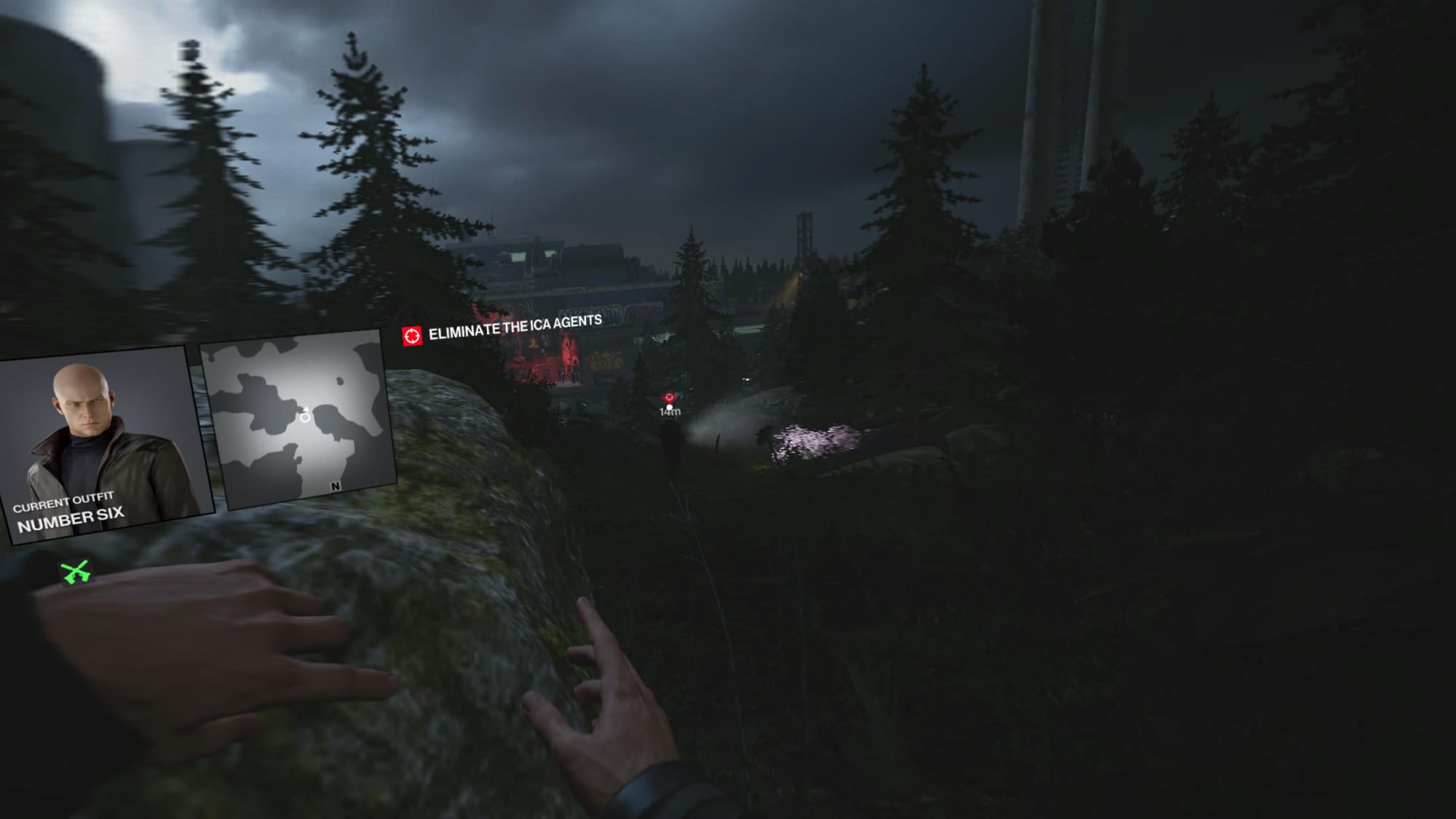
You may also notice the graphics are improved here too over the Quest 3’s downgraded visuals. Everything is crisper and more realistic, more similar in art style and graphical fidelity to the original flatscreen version on PlayStation 5. Using the power of the console, it’s out with the cel-shaded murky visuals, and in with the smooth, authentic textures. It’s a beautiful canvas to look at, and really made me want to stay in the game much longer.
These graphics improvements also give way to more details in the environment and props. While the game is still clearly using textures and items from the flatscreen version, being able to pick them up and inspect them up close gives you a new perspective on them compared to before. Now you can pick up keys, letters, books, clipboards, and much more, with each item having details on it that simply were too small to be seen in the third-person game.
With it making up three games altogether, the campaign in Hitman: World of Assassination will take you about 20 hours or so to finish if you’re a slow methodical player. Each mission can take you up to an hour if you’re the type of person who likes to explore and find hidden secrets. But one of the series’ biggest strengths is for you to experiment with different routes and methods when eliminating your target. So, that 20-hour playtime suddenly becomes a hundred hours if you’re so inclined.
Either way, that’s still a long time you’re spending with Hitman’s sandbox stealth gameplay. It’s essentially a puzzle game, where you have an end goal in sight, and just need to figure out the right way to reach it. Assassinating targets using a variety of disguises and weapons feels so distinct to this series that no other game in the genre quite does the same way. And experimenting with different methods each time you replay it makes it far more fun to try and uncover everything on offer.
Comfort
Hitman: World of Assassination Trilogy has several comfort options available. The option to turn on blinders and adjust the strength helps with motion sickness. You can also toggle a laser pointer to help navigate menus.
You can also toggle head-based movement, which allows you to move forward based on the direction you’re facing rather than the character. The option to change your dominant hand is also present.
Movement is limited to stick-based locomotion, but you can swap between snap and smooth turning, along with tweaking the speed or degree of these settings. Given the slow pace of the game, it’s not too bad, but it’s a shame to see no option for teleportation-based movement.
Because IO Interactive encourages experimentation here, it’s wise to save your game often. What’s a shame is that quicksaves don’t appear to be supported in the VR version. So, any time you want to pull off a risky move or an interesting feat, you’re pretty much required to pause the game and save progress in one of the manual save slots, which can slow down and interrupt the experience.
Similarly, the slow-paced nature of the gameplay means you may occasionally be waiting around for long periods of time for something to happen.NPCs typically walk around on a loop, so if you’re waiting for a character to be in a specific place, it could be over 10 minutes before they’re where you want them to be. If you’re like me and don’t like waiting around bored in VR for too long, this can make the experience a little uncomfortable.
This is what drew me more to Hitman’s action gameplay in VR. As someone with about a thousand hours in the flatscreen version of Hitman, it’s always been quite disappointing that the combat has left much to be desired. When playing with a controller or mouse and keyboard, it just feels quite janky and awkward, so I’ve tended to ignore that side of the game in the past.
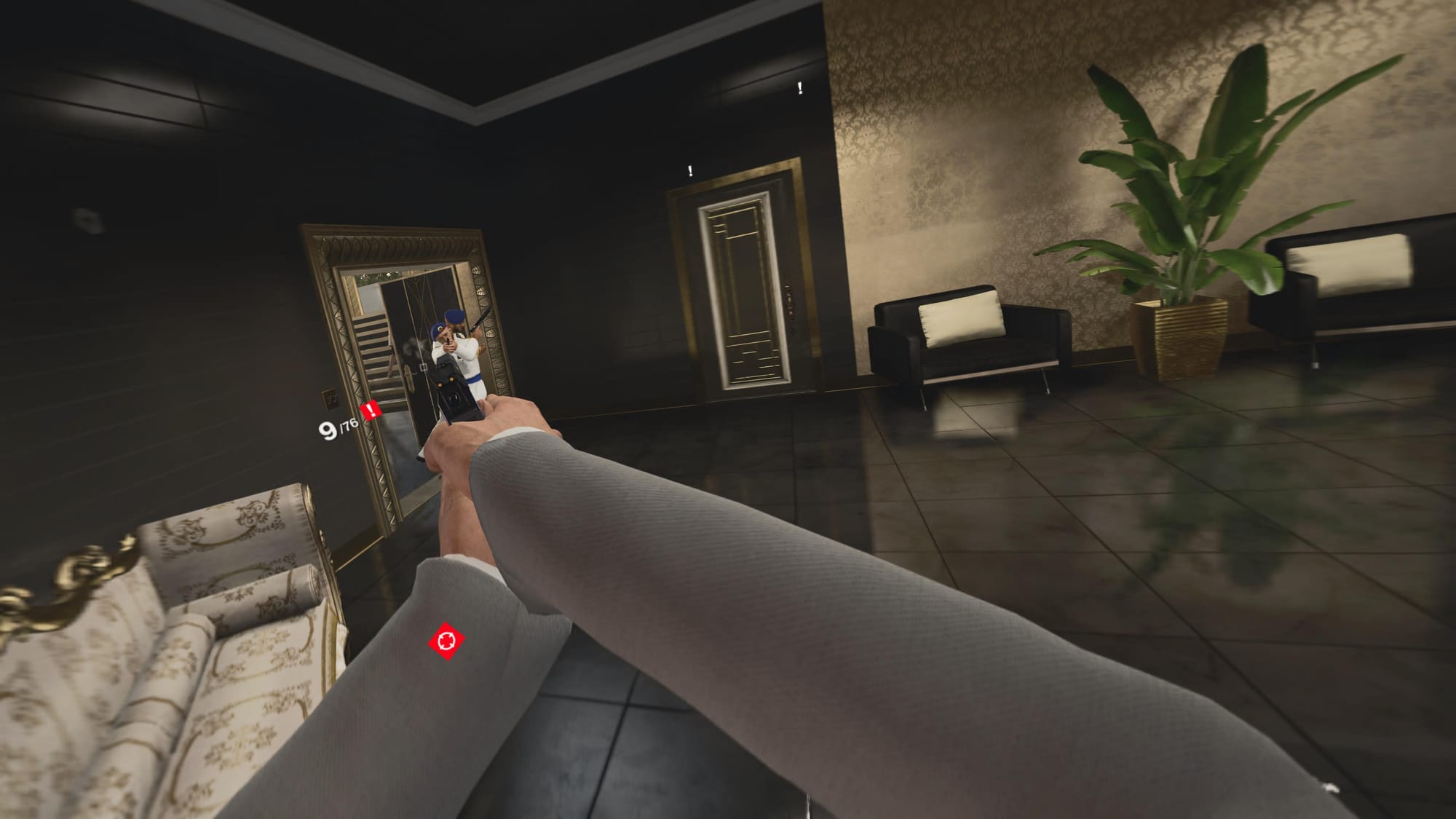
However, with the improvements to shooting and contextual interactions, IO Interactive has really improved on the combat for the PS VR2. Now, it feels incredibly badass to pull out a pistol and shoot two guards in the face as they’re trying to arrest you. Then the commotion alerts more guards, and before you know it, you’re pinned down in a hallway with dozens of enemies firing on you. Your only choice is to blast your way out. It changes the game from a methodical stealth puzzler to what is essentially a John Wick simulator.
Just like the previous iterations of Hitman’s VR attempts though, it’s disappointing to see that a lot of the side content is still not available. Many of the bonus missions and escalations aren’t available to play in VR, and the Contracts and Sniper Assassin modes are completely disabled.
What’s more is my favourite game mode, Freelancer, is also unavailable in VR. Considering the roguelite structure of Freelancer, VR suits itself well to the short sessions and unpredictable sandbox gameplay that mode offers. There’s a small sliver of hope IO Interactive could support these modes in updates later down the line, but for now you’re essentially stuck with the main campaign and a handful of bonus levels.
Hitman: World of Assassination Trilogy PS VR2 – Final Verdict
Altogether, the PlayStation VR2 version of Hitman: World of Assassination might just be the most refined VR experience for this game we have. It’s a shame it took four iterations to get here, but IO Interactive has redeemed itself to where we can say this is a VR port worth checking out. While occasionally rough around the edges, IO Interactive has done a great job at translating Hitman’s sandbox gameplay into a VR space.

UploadVR uses a 5-Star rating system for our game reviews – you can read a breakdown of each star rating in our review guidelines.
Wikimedia Drowning in AI Bot Traffic as Crawlers Consume 65% of Resources
Web crawlers collecting training data for AI models are overwhelming Wikipedia’s infrastructure, with bot traffic growing exponentially since early 2024, according to the Wikimedia Foundation. According to data released April 1, bandwidth for multimedia content has surged 50% since January, primarily from automated programs scraping Wikimedia Commons’ 144 million openly licensed media files.
This unprecedented traffic is causing operational challenges for the non-profit. When Jimmy Carter died in December 2024, his Wikipedia page received 2.8 million views in a day, while a 1.5-hour video of his 1980 presidential debate caused network traffic to double, resulting in slow page loads for some users.
Analysis shows 65% of the foundation’s most resource-intensive traffic comes from bots, despite bots accounting for only 35% of total pageviews. The foundation’s Site Reliability team now routinely blocks overwhelming crawler traffic to prevent service disruptions. “Our content is free, our infrastructure is not,” the foundation said, announcing plans to establish sustainable boundaries for automated content consumption.


Read more of this story at Slashdot.
An Interactive-Speed Linux Computer Made of Only 3 8-Pin Chips
Software engineer and longtime Slashdot reader, Dmitry Grinberg (dmitrygr), shares a recent project they’ve been working on: “an interactive-speed Linux on a tiny board you can easily build with only 3 8-pin chips”: There was a time when one could order a kit and assemble a computer at home. It would do just about what a contemporary store-bought computer could do. That time is long gone. Modern computers are made of hundreds of huge complex chips with no public datasheets and many hundreds of watts of power supplied to them over complex power delivery topologies. It does not help that modern operating systems require gigabytes of RAM, terabytes of storage, and always-on internet connectivity to properly spy on you. But what if one tried to fit a modern computer into a kit that could be easily assembled at home? What if the kit only had three chips, each with only 8 pins? Can it be done? Yes. The system runs a custom MIPS emulator written in ARMv6 assembly and includes a custom bootloader that supports firmware updates via FAT16-formatted SD cards. Clever pin-sharing hacks allow all components (RAM, SD, serial I/O) to work despite the 6 usable I/O pins. Overclocked to up to 150MHz, the board boots into a full Linux shell in about a minute and performs at ~1.65MHz MIPS-equivalent speed.
It’s not fast, writes Dmitry, but it’s fully functional — you can edit files, compile code, and even install Debian packages. A kit may be made available if a partner is found.


Read more of this story at Slashdot.
Mastering Linux File Permissions and Ownership
In the world of Linux, where multi-user systems and server security are foundational principles, understanding file permissions and ownership is crucial. Whether you’re a beginner exploring your first Linux distribution or a seasoned system administrator managing critical servers, knowing how permissions work is key to ensuring the integrity, privacy, and functionality of your system.
AT&T Email-To-Text Gateway Service Ending
Longtime Slashdot reader CyberSlugGump shares a support article from AT&T, writing: On June 17th, AT&T will stop supporting email-to-text messages. That means you won’t be able to send a text message to an AT&T customer from an email address. You can still get in touch with AT&T customers using SMS (text), MMS, and standard email services.


Read more of this story at Slashdot.