WordPress.com has released an AI-powered site builder in early access that constructs complete websites with generated text, layouts, and images. The tool operates through a chatbot interface where users input specifications, resulting in a fully formed site that can be further refined through additional prompts.
While WordPress.com claims the builder creates “beautiful, functional websites in minutes,” it currently cannot handle ecommerce sites or complex integrations. Users need a WordPress.com account for the free trial, but publishing requires a hosting plan starting at $18 monthly (less with annual subscriptions). The builder only works with new WordPress instances, not existing sites.
This launch comes as parent company Automattic recently cut 16% of its workforce and faces a lawsuit from hosting company WP Engine, which offers competing site-building tools.
The major upgrade The Frame Pro offers over the original The Frame is a 4K Neo QLED display and the Wireless One Connect Box. Samsung’s Neo QLED displays use MiniLEDs to offer improved brightness and local dimming. To better sell the illusion that The Frame Pro is a picture frame, the Wireless One Connect Box lets you hide the cables you’d normally plug into your TV in a cabinet, and wirelessly transmit their inputs directly to your display. For those upgrades, plus the included NQ4 AI Gen3 Processor, The Frame Pro is $2,199 for a 65-inch model, $3,199 for a 75-inch model and $4,299 for the 85-inch model. Samsung says an 83-inch model will be available at a later date.
Samsung
The changes to The Frame are more modest. The TV now sports a refresh rate of up to 144Hz and also comes with the NQ4 AI Gen3 processor. The chip powers video upscaling on top of AI-powered features like “Click to Search,” the ability to look up an actor’s bio while watching something, and “Live Translate,” the ability to generate real-time captions of whatever you’re watching in another language. If you want The Frame, you’ll pay $899 for the 43-inch model, $1,099 for the 50-inch model, $1,299 for the 55-inch model and $1,799 for the 65-inch model.
The updates to Samsung’s more traditional OLED TVs vary depending on the series and size you purchase, but all of the new TVs support Samsung’s AI-powered features. The S95F comes with the NQ4 AI Gen3, a new glare-free display, Samsung’s “brightest-ever OLED screen” and the Motion Xcelerator 165Hz feature for smooth gameplay during demanding video games. The S90F gets the same chip and Motion Xcelerator 144Hz (for a slightly lower refresh rate) and the S85F uses the NQ4 AI Gen2 processor and Motion Xcelerator 120Hz. The S95F starts at $2,299, with sizes that range from 55 inches to 75 inches. The S90F starts at $1,299 for the 42-inch model and can go up to 83 inches. The S85F, meanwhile, starts at $1,499 for the 55-inch model and also goes up to 83 inches.
All of Samsung’s new TVs are available to order today, and the company is guaranteeing seven years of software updates to the TVs’ One UI Tizen operating system when you purchase.
This article originally appeared on Engadget at https://www.engadget.com/home/home-theater/samsung-is-not-selling-the-frame-pro-for-cheap-185607096.html?src=rss
Sony is beefing up the PlayStation Plus Game Catalog for Extra and Premium subscribers with a bevy of new additions for April. The headliner here is Hogwarts Legacy. This is one of the biggest blockbusters of the past couple of years, even in the face of J.K. Rowling doing her darndest to destroy her personal Hogwarts legacy with anti-trans nonsense.
For the uninitiated, it’s an open-world action RPG set at Harry Potter’s favorite wizarding school. However, the game takes place in the 1890s, over a hundred years before Potter and his buds careened around the campus. The game hits the service on April 15.
Also on the docket this month is the puzzler Blue Prince. This is actually a day-one launch for the platform. The reviews of this one have been particularly effusive, with most people praising the clever puzzles, the atmospheric game world and the addition of roguelike mechanics. It’ll be available for download on April 10.
The second installment of Don’t Nod’s Lost Records: Bloom & Rage will also be available on April 15 for subscribers as a day-one launch. This follow-up concludes the time-twisting narrative adventure that’s set in both 1995 and 2022. This is generally considered a spiritual successor to the iconic Life is Strange.
Other games dropping this month include EA Sports PGA Tour and the restaurant management sim PlateUp! PS4 players are also getting a little treat, as Battlefield 1 will be available from April 15.
This article originally appeared on Engadget at https://www.engadget.com/gaming/playstation/hogwarts-legacy-and-blue-prince-come-to-playstation-plus-game-catalog-in-april-175501864.html?src=rss
Some elements of Microsoft’s Copilot assistant in Windows 11 have felt like a solution in search of a problem—and it hasn’t helped that Microsoft has frequently changed Copilot’s capabilities, turning it from a native Windows app into a web app and back again.
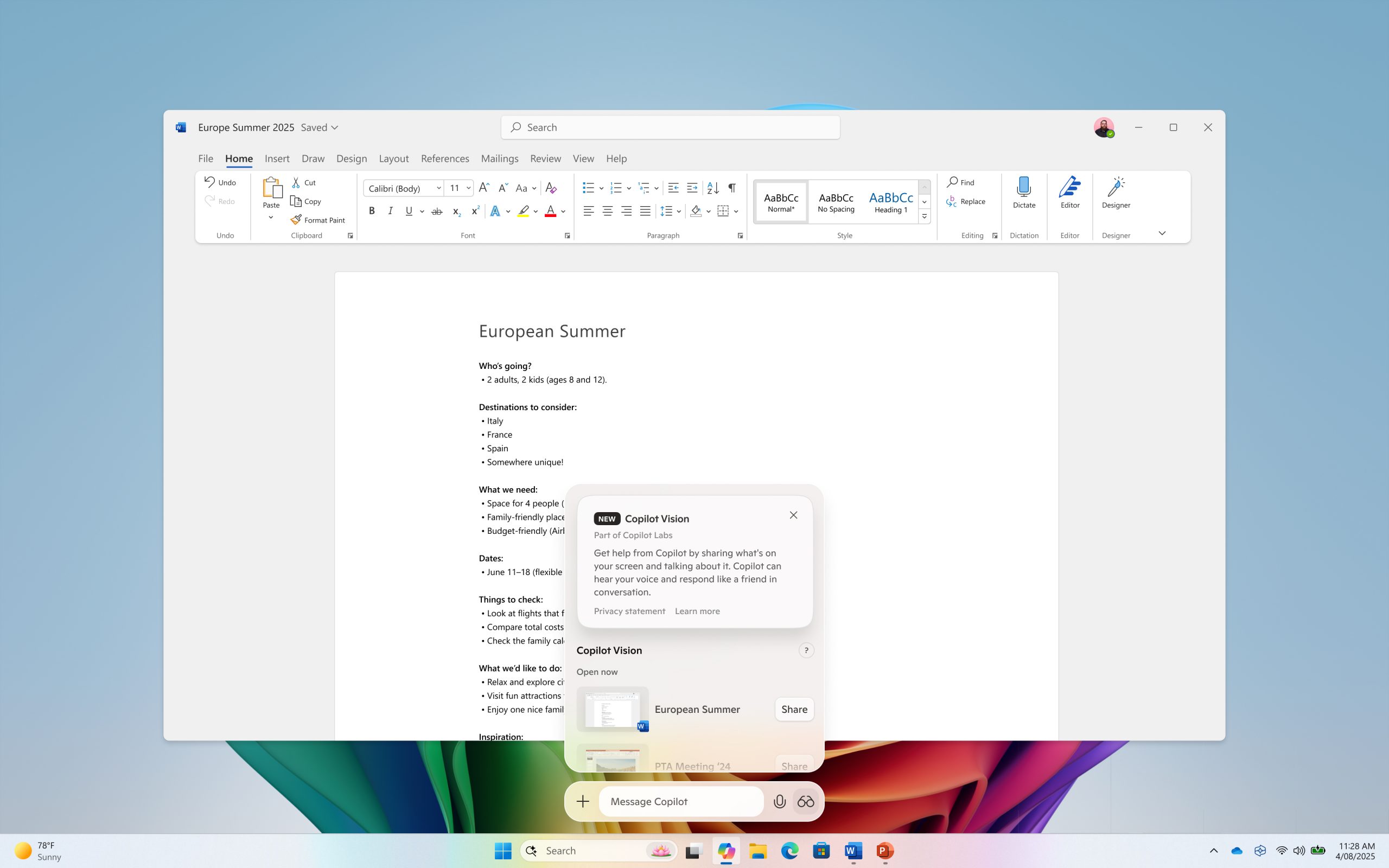
But I find myself intrigued by a new addition to Copilot Vision that Microsoft began rolling out this week to testers in its Windows Insider program. Copilot Vision launched late last year as a feature that could look at pages in the Microsoft Edge browser and answer questions based on those pages’ contents. The new Vision update extends that capability to any app window, allowing you to ask Copilot not just about the contents of a document but also about the user interface of the app itself.
Microsoft’s Copilot Vision update can see the contents of any app window you share with it.
Credit:
Microsoft
Provided the app works as intended—not a given for any software, but especially for AI features—Copilot Vision could replace “frantic Googling” as a way to learn how to use a new app or how to do something new or obscure in complex PC apps like Word, Excel, or Photoshop. I recently switched from Photoshop to Affinity Photo, for example, and I’m still finding myself tripped up by small differences in workflows and UI between the two apps. Copilot Vision could, in theory, ease that sort of transition.
Alexander Skarsgård stars in the sci-fi thriller Murderbot.
A rogue cyborg security (SEC) unit gains autonomy and must learn to interact with humans while hiding its new capability in the trailer for Murderbot, Apple TV+’s new 10-episode sci-fi comedic thriller starring Alexander Skarsgård. It’s based on the bestselling book series The Murderbot Diaries by Martha Wells. And judging from the trailer, Murderbot looks like it will strike just the right balance between humor and action.
There are seven books in Wells’ series thus far. All are narrated by Murderbot, who is technically owned by a megacorporation but manages to hack and override its governor module. Rather than rising up and killing its former masters, Murderbot just goes about performing its security work, relieving the boredom by watching a lot of entertainment media.
In the first book, All Systems Red, Murderbot saves a scientific expedition on an alien planet when they are attacked by a giant alien creature. During the ensuing investigation, the cyborg uncovers a plot against the expedition, as well as a second team, by yet another team intent on killing their rivals for some reason. Murderbot joins the humans in foiling those murderous plans but escapes onto a cargo ship at the end rather than give up its hard-earned autonomy.
Last week, Nintendo made the unprecedented move of delaying US Switch 2 preorders to “assess” the impact of Donald Trump’s massive tariffs on the countries where the console is produced. Before most of those tariffs were recently delayed for 90 days, many were wondering if the company may be mulling a last-minute increase in the Switch 2’s $450 asking price to account for those import taxes.
While industry analysts think that kind of immediate price increase is unlikely, they warn that Trump’s tariffs could have longer-term impacts on Switch 2 pricing and supplies in the US for years to come.
Already baked in
DFC Intelligence CEO David Cole, for instance, said in a recent analyst note that the company is currently modeling “a 20 percent price increase over the next two years” across all video game hardware thanks to “broader macroeconomic challenges.” In the case of the Switch 2, though, Cole clarified that “we believe much of the 20 percent increase was already baked into the $450 price,” which Nintendo is “not likely” to raise at this point.
Later today, a former Facebook employee, Sarah Wynn-Williams, will testify to Congress that Meta executives “repeatedly” sought to “undermine US national security and betray American values” in “secret” efforts to “win favor with Beijing and build an $18 billion dollar business in China.”
In her prepared remarks, which will be delivered at a Senate subcommittee on crime and counterterrorism hearing this afternoon, Wynn-Williams accused Meta of working “hand in glove” with the Chinese Communist Party (CCP). That partnership allegedly included efforts to “construct and test custom-built censorship tools that silenced and censored their critics” as well as provide the CCP with “access to Meta user data—including that of Americans.”
Wynn-Williams worked as Facebook’s Director of Global Public Policy from 2011 to 2017. She left at the height of the Cambridge Analytica scandal, just before Mark Zuckerberg got grilled by Congress over misinformation and election interference on its platform.
The battle for AI talent is so hot that Google would rather give some employees a paid one-year vacation than let them work for a competitor. From a report: Some Google DeepMind staff in the UK are subject to noncompete agreements that prevent them from working for a competitor for up to 12 months after they finish work at Google, according to four former employees with direct knowledge of the matter who asked to remain anonymous because they were not permitted to share these details with the press.
Aggressive noncompetes are one tool tech companies wield to retain a competitive edge in the AI wars, which show no sign of slowing down as companies launch new bleeding-edge models and products at a rapid clip. When an employee signs one, they agree not to work for a competing company for a certain period of time. Google DeepMind has put some employees with a noncompete on extended garden leave. These employees are still paid by DeepMind but no longer work for it for the duration of the noncompete agreement.
Several factors, including a DeepMind employee’s seniority and how critical their work is to the company, determine the length of noncompete clauses, those people said. Two of the former staffers said six-month noncompetes are common among DeepMind employees, including for individual contributors working on Google’s Gemini AI models. There have been cases where more senior researchers have received yearlong stipulations, they said.
Google is opening up its Google Maps Platform data so that cities, developers, and other business decision makers can more easily access information about things like infrastructure and traffic. The Verge: Google is integrating new datasets for Google Maps Platform directly into BigQuery, the tech giant’s fully managed data analytics service, for the first time. This should make it easier for people to access data from Google Maps platform products, including Imagery Insights, Roads Management Insights, and Places Insights.
What kind of person would you be in the face of a disaster that’s beyond explanation? Would you help distressed neighbors and open your home even to sketchy-looking strangers in the hope that there’s strength in numbers, or go it alone regardless of how heavily the odds are stacked against you? Would you still brush your teeth every day?
The horror in Francis Coulombe’s RPG Look Outside is all encompassing. There is the cosmic element: something incomprehensible is happening beyond the walls of your apartment building and it’s in your best interest to not even look outside, let alone go there. And as you quickly learn, anyone who has looked or been outside is transformed in unimaginable ways, making for some extreme (and extraordinarily creative) body horror. But in much of the game leading up to its multiple climactic endings, the unease also stems from how it makes you look inside — at the choices you’ve made and the person you’ve become in order to survive.
Despite trying to take an empathetic approach, I still found myself in situations that left my character (and me) wracked with guilt. There is a gnawing sense of doubt that grows over the course of the game, repeatedly making me question whether I’d, say, made a bad call and been too quick to kill that neighbor whose entire head is teeth, or if my hand was really forced into making a very upsetting sacrifice.
After a while, the most unnerving thing is looking in the mirror. And you have to do that a lot in this game, because hygiene affects your stats.
Francis Coulombe/Devolver Digital
It all begins with your character, Sam (you can change the name, if you want), waking up after a strange dream with a strong urge to look outside. You are immediately given the choice between satisfying your curiosity and listening to your gut, and you’ll find yourself grappling with that dilemma time and time again.
At this point, you also meet Sybil, the mysterious next-door neighbor who only speaks to you through the wall, with one glaring eyeball peering out of a large crack. Sybil, whom it’s unclear if you should trust, tells you that everything will blow over in 15 days if you just wait it out. You need to scavenge for resources if you’re going to make it that long, though, and once you leave your apartment and get a chance to talk to some other neighbors, you may decide you want to take a more active role in getting to the bottom of the catastrophe.
Some neighbors, particularly a few robed amateur astronomers who appear to be in a cult, seem to know quite a bit about what’s going on, and it’s insinuated that doing tasks for them will help you figure out the how and why of the phenomena around you. Others are more focused on addressing their immediate needs and will try to rope you into their causes: locating missing people, picking up laundry, cleaning the messes left behind by eldritch horrors, etc. There’s a full on war happening somewhere in the building, which you can choose to play a part in if you’re so inclined. Your landlord will unsurprisingly still demand you pay him rent despite the circumstances.
If you choose to play in Normal mode, like I did, Sybil is your only save point, so you’ll have to return home regularly. Easy mode autosaves.
All interactions are turn-based, and as you explore the apartment building, you’ll run into tons of enemies and potential allies — but the line between the two isn’t always easy to distinguish. Sometimes you can only attack or try to escape, which answers the question for you, but other times, you have the opportunity to talk and ask questions. The turn-based nature allows you to take a moment and evaluate each new encounter, but there’s always an air of ambiguity about everyone’s trustworthiness. Even when you’re back at your apartment, where you can shower, rest, do some cooking and crafting, and play video games, people will come along and knock on your door, and you’ll have to make up your mind about whether you should let them in.
The thing is, surviving can be pretty difficult once you really get going if you’re on your own. Enemies will outnumber and overpower you. That’s where it becomes helpful to have a few allies. With as many as three other people in your party, the scale tips heavily in your favor. I took the trusting approach, for better or worse. This resulted in me having a pretty solid group of fighters on my side, but a pair of those same allies kicked me out of my own bedroom and complained about my cooking.
The creature designs come disgustingly, beautifully alive in the pixel art style. Body horror can be really hard to stomach, and something is often lost for me in the process of consuming it when it’s intended to seem realistic — either because I’m hiding behind my hands and only taking tiny peeks through my fingers, or because it ends up achieving the opposite effect and just looks ridiculous without meaning to. But Coulombe’s art equally embraces the horrifying and the absurd, and the effect of that balance is powerful.
Nothing was ever so disturbing that I couldn’t look straight at it, but there were certainly moments that gave me a genuine scare or made my skin crawl. Even the characters that aren’t being transformed, like the protagonist, look a little grotesque, which adds to how unsettling everything feels. But just when the dread would reach a fever pitch, something overtly silly would be thrown in almost as if to splash some cold water on the whole thing and say, yes this is the apocalypse but we’re still human, we still have a sense of humor.
Francis Coulombe/Devolver Digital
So much of the joy of playing this game is discovering all the tricks it has up its sleeve, so I won’t get into any descriptions of bosses, puzzles or the building itself, other than to say that the latter has a whole House of Leaves thing going on that is unbelievably frustrating at times, but in a way that only adds to the brilliance of it all. There is no map to guide you, either. The soundtrack, composed by Eric Shumaker, keeps in perfect step with every emotion the environment evokes, and I could probably write an entire separate review about how good it is.
All of this builds up to an absolute cosmic gut-punch of an ending (or endings, there are several) that completely changed the way I felt about the game up until that point. In the end, it becomes something much, much bigger than it once seemed, and the feelings were almost overwhelming. I can’t stop thinking about it.
By now I’ve played Look Outside many hours beyond what a typical run would be, just picking apart every detail and turning over every stone to try and figure out all the secrets, reach all the conclusions. I have died in all sorts of strange ways, and lived to see wildly different fates pan out.
I went into this only with the expectation of cool art and a relatively unique approach to survival horror, and came away shook from what turned out to be one of the best cosmic horror games I’ve played in a while, maybe ever. Look Outside, published by Devolver Digital, is only available on Steam for now, but I sure hope it makes its way to other platforms soon so more people can experience it.
This article originally appeared on Engadget at https://www.engadget.com/gaming/look-outside-is-an-unexpected-cosmic-horror-masterpiece-that-shook-me-to-the-core-171542211.html?src=rss
Anthropic is joining the ranks of OpenAI in offering a more expensive tier of its flagship chatbot. On Wednesday, the company announced Max Plan. Starting today, you can either pay $100 or $200 per month to use Claude up to 5x or 20x more than you can with Anthropic’s existing Pro plan. The company told Engadget it’s introducing the Max tier in response to the popularity of Claude 3.7 Sonnet. The new hybrid reasoning model, which excels at coding tasks, has been so popular with users, many are asking to use it as much as they want.
With tokens for Claude 3.7 Sonnet costing significantly more than what Google and others charge for access to their lightweight models, Anthropic isn’t quite ready to offer unlimited usage of the new model. However, you’ll find even OpenAI’s $200 per month Pro plan has its own set of restrictions, with monthly limits imposed on “very compute intensive” features like Deep Research.
Part of the reason Anthropic is offering two different price points at the Max tier is so that it can give flexibility to customers as their needs change. Additionally, those same users will gain priority access to new models and capabilities as Anthropic releases them.
This article originally appeared on Engadget at https://www.engadget.com/ai/anthropics-max-plan-offers-nearly-unlimited-claude-usage-for-200-per-month-170032710.html?src=rss
Heart Machine knows how to make a stylish game, so it’s no surprise that the studio’s latest project, Possessor(s), is sexy as hell. I mean, just look at Rhem, the cosmic demon with a chiseled jawline, aquamarine horns and a fine-cut suit unbuttoned down to his navel, who alternately encourages and negs you throughout the game. Stupid sexy Rhem.
“It’s just fun to have hot characters at the end of the day,” Heart Machine founder Alx Preston said at GDC 2025. Preston and three other Heart Machine developers — producer Myriame Lachapelle, narrative director Tyler Hutchison and writer Laura Michet — played through Possessor(s) while we chatted about the game and the studio.
Hutchison continued the hot-characters conversation by praising Heart Machine concept artist Sophie Medvedeva and adding, “Since we were kind of building out this visual novel, I was trying to leverage the expertise I brought from Dream Daddy to be like, well, let’s make sure these characters are very hot.”
Sometimes, it’s as simple as that.
Possessor(s) is a sidescrolling sci-fi action game set in the ruins of Sanzu, a corporate megalopolis that’s been ripped apart by interdimensional horrors. Sanzu was once a company town controlled by the tech firm Agradyne, but three years ago, a flood of demons escaped the city’s underground laboratories, possessing its citizens and transforming most of them into vicious, mutated creatures. The game spans desolate skyscrapers and abandoned aquariums, and it looks like a daydream of a 1990s anime, splattered in neon and shimmering with a sickly green VHS aura.
It stars Luca, a possessed-but-lucid 16-year-old who’s searching the urban wasteland for any signs of her mother and best friend. The “hot” descriptor in this game is reserved for the demons, but Luca is stylish, with an iridescent coat, slender metal legs and two horns of her own. Luca is bursting with teenage angst and she has an uneasy relationship with Rhem, the demon who’s invaded her consciousness. He’s the only thing keeping her alive, and he needs her in order to finally return home.
“Luca is missing her mom and her best friend, who both got lost when the demons escaped to destroy the city,” Michet said. “So she’s resentful Rhem won’t let her take some time off to find all the people important to her.”
Heart Machine
Together, Luca and Rhem explore Sanzu, investigate the true nature of Agradyne and search for Luca’s loved ones. Levels are littered with evil creatures to battle and puzzles to solve, and throughout the game, Luca masters an arsenal of improvised weapons like kitchen knives, a guitar, a hockey stick and a corded computer mouse. Her whip, a power provided by Rhem, allows her to swing across gaps, rapidly reposition and pull in heavy objects and enemies.
Combat in the demo seemed to flow smoothly; it was heavy on visual flourishes, leaping airborne attacks and satisfying slashing moves, with Luca bounding seamlessly across floors, walls and platforms. A few frames of line-drawn placeholder art flashed across the screen at one point, but these were the only indication that Possessor(s) isn’t actually complete yet. It’s due to hit PC and PS5 this year.
“The original premise was something more like Smash Bros., where you can do directional inputs and kind of build out your loadout to feel more like a different character,” Preston said. “Where we’ve ended up is still a bit Smash Bros.-y, in that there’s juggling and bouncing enemies on surfaces and things like that. But we’ve found the spirit of Luca and her character, and what she wants to do.”
Heart Machine
Possessor(s) is eye-catching and combat-focused, and it also has a narrative that’s supremely relevant for our times. Boiled down, the premise is that capitalistic megacorporations with an iron grip on society are bad, and young people fighting the system are rad. Interdimensional beings with chiseled pecs and a devastating smoking habit are the hot twist that makes the story uniquely Heart Machine’s.
“I mean, it sucks to live in a hierarchical corporate society where your value is determined by your value to the business,” Michet said. “And Luca will discover this from her teenager perspective.”
The story in Possessor(s) is branching, with multiple paths to follow and a quarantined city of characters to meet. This is a new mechanic for Heart Machine — in fact, the entire game is composed of firsts for the studio, and Possessor(s) is purposefully different from its previous games, Hyper Light Drifter, Solar Ash and Hyper Light Breaker. Hyper Light Drifter‘smoody, 16-bit-inspired isometric actionput Heart Machine on the map even before its release in 2016. Solar Ash followed in 2022 and it was a third-person, 3D platformer. Hyper Light Breaker hit the market this January as a third-person, online roguelite with stylized 3D graphics. Meanwhile, Possessor(s) is a hand-drawn, 2.D side-scroller with touches of horror and visual-novel mechanics.
Heart Machine
This progression aligns with a mentality of curiosity that Preston outlined to Engadget in 2021. At the time, Heart Machine had fewer than 30 developers and they were still building Solar Ash, unsure of how the switch to 3D would be received. Back then, Preston said the following:
“Hyper Light was a way for me to get started, it was a way for me to be more grounded and put together a crew and understand, can I do this? Can I actually make games? And so having answered that question, then the natural next step for me was something in 3D. Can I put something out there that really opens up the world and makes you feel like you can truly escape into something, a creation that is otherworldly, that you otherwise wouldn’t have the experience of?”
Since 2021, Heart Machine has endured layoffs and launched a Patreon, and today it has 58 people on staff. Preston remains at the studio’s core, still testing new concepts.
At GDC 2025, he said, “We’ve done overhead stuff with Drifter back in the day, and then fully 3D was a big jump. I wanted to do something sidescrolling, because there’s a lot of different, unique challenges there that are fun to tackle. That perspective for how we do art, and mixing our 3D stuff with a 2D plane, there’s a lot of cool opportunities there. Something like Inside was a good point of inspiration, seeing what a smaller team can do with atmospheric chops. And we’re pretty good on those fronts.”
Possessor(s) is due to hit PC and PS5 in 2025, published by Devolver Digital.
This article originally appeared on Engadget at https://www.engadget.com/gaming/possessors-is-a-game-about-hot-demons-and-other-things-170016014.html?src=rss
Fret not, Fireflies, The Last of Us will continue on HBO beyond its second season. Just before the hit adaptation of Naughty Dog’s games returns to the network and Max for its next batch of episodes, HBO has officially greenlit a third season of the show.
It would have been a major shock if TLOU wasn’t going to return beyond this latest seven-episode stint. Season two doesn’t cover all of the shocking events of The Last of Us Part 2. The show’s creators and showrunners, Neil Druckmann of Naughty Dog and Craig Mazin, have long been adamant that it would take at least two seasons to adapt that overly long misery simulator (still a very good game, though). Plus, the first season was a huge success, as tens of millions of people watched Joel and Ellie fend off infected and other enemies as they trekked across the remnants of America.
“We approached season two with the goal of creating something we could be proud of,” Mazin said in a statement. “The end results have exceeded even our most ambitious goals, thanks to our continued collaboration with HBO and the impeccable work of our unparalleled cast and crew. We look forward to continuing the story of The Last of Us with season three!”
HBO hasn’t given a timeline for when we can expect the third season, but there should hopefully be a smaller gap between seasons this time around. Season two was delayed by the Hollywood writers’ and actors’ strikes in 2023. Plus, it’s hard to imagine that viewers will be willing to wait so long to find out what happens after [redacted].
Speaking of which, season two of TLOU premieres on HBO and Max this Sunday, April 13. Engadget’s Nathan Ingraham reviewed the season, and found it did an admirable job of adapting (at least some of) the non-linear source material while resolving certain issues from the first season.
This article originally appeared on Engadget at https://www.engadget.com/entertainment/tv-movies/the-last-of-us-will-return-for-a-third-season-163801196.html?src=rss
“Tariff” might be the defining word of 2025. The Trump administration’s crusade to tariff trading partners around the world has upended markets and shaken trust in the United States. The situation isn’t resolving anytime soon, either: Following the U.S.’s decision to impose a 104% tariff increase on Chinese goods, China reciprocated by raising its tariffs on American goods from 34% to to 84%.
In short? It’s a mess, and no one can predict where we go from here. Markets, of course, loathe uncertainty, so when the global economy gets this shaky—especially when that instability is the direct result of one administration’s actions—companies act to protect their interests.
If you, like me, are an American, it’s our country that’s throwing these tariffs at nations around the world. As such, it shouldn’t come as a huge surprise to see companies pause sales and business in the U.S. for the time being. While there aren’t a ton of organizations running with this playbook, there are some notable names that have done so already.
That’s no longer the case. Following the tariffs, Nintendo announced Switch 2 preorders were delayed in the U.S., though the console’s official June 5 release date remained unchanged. It’s not clear if or when Nintendo plans to make preorders available to Americans, or whether the company will hike the price of the Switch 2, but seeing as the console alone starts at $450, any increases will make this an expensive handheld.
Framework
Framework makes laptops you can easily mod and upgrade yourself—the antithesis of most tech companies these days. Unfortunately, U.S. customers are going to have a hard time getting these machines in the near future.
Following Nintendo’s lead, Framework announced on Tuesday a pause on sales for specific laptops. The company says that, following the April 5 tariffs, they will not sell some of the base-model Framework Laptop 13 machines in the U.S., including the Ultra 5 125H and Ryzen 5 7640U models.
Then on Wednesday, the company announced a pause on U.S. preorders for the new Laptop 12. Framework is also holding back on announcing a price for this machine, as it will likely cost more than originally intended.
Razer
Razer, a major laptop manufacturer, has taken things even further: The company has essentially stopped all laptop sales to the U.S., and has paused sales on some of its accessories as well. If you browse the various laptops for sale on the company’s site, you’ll only find “Notify Me” buttons, rather than any option to purchase.
You can still purchase Razer laptops from other vendors, but I imagine those machines could sell out quickly given the company’s sales pause, or even jump in price.
Jaguar Land Rover Automotive
If you’re in the market for a luxury vehicle, you might want to hold off on buying a Jag or a Land Rover. Jaguar Land Rover Automotive is pausing shipments of vehicles to the U.S., following Trump’s 25% import tax on vehicles entering the country.
Basic Fun
You might not know the name Basic Fun, but you probably know its products. The company makes toys like Care Bears, Lincoln Logs, K’nex, and Tonka Trucks, but has paused shipments of its products that are made in China. The company’s chief executive, Jay Foreman, told the New York Post that he “cannot risk putting any product on the water that might incur [high] tariffs as implemented and threatened by the president.”
Swiss watches
The Post also reports that Swiss watchmakers, such as Audemars Piguet, Breitling, and Rolex, are pausing shipments as well. For context, Trump imposed a 31% tariff on Switzerland.
Small businesses
The big-name businesses like Nintendo will make headlines, and will be easy to track when they pause sales or preorders to the U.S. But what’s more difficult to identify are the number of small business pausing or stopping their sales due to these tariffs.
In general, these tariffs are going to hit the smaller players in our economy hardest. These companies don’t have the capital to either pay the higher fees on goods they’ve purchased from other countries, or to stop sales while they figure out their next moves. They’ll have to raise prices to stay afloat, but then contend with consumers who may be hesitant to shop, since, well, everything is getting more expensive.
Many of these companies have placed orders before the tariffs went into effect, but by the time the goods arrived in the U.S., multiple rounds of tariffs ballooned the fees. Sarah Wells, founder of Sarah Wells Bags, owed an additional $15,000 just to get her goods from customs. On the other hand, Emily Ley, owner of Simplified, has sued the Trump administration over these tariffs. Ley says the tariffs will cost her an extra $630,000 in fees this year.
This is an ongoing situation. I will continue to add companies to this list as they announce pauses in sales and business.
The Guinness World Record for largest display of carved eggs was recently awarded to Chinese artist Ma Chao for the 1,040 intricately carved eggshells he’s produced. The eggs feature characters from the 1986 television series Journey To The West (adapted from Wu Cheng’en’s 16th-century novel of the same name), and Chao carved one egg a day for roughly the last four years. I wonder how many breaks he had during that time. Both eggs and mental. Personally I had at least a couple dozen of each in that time.
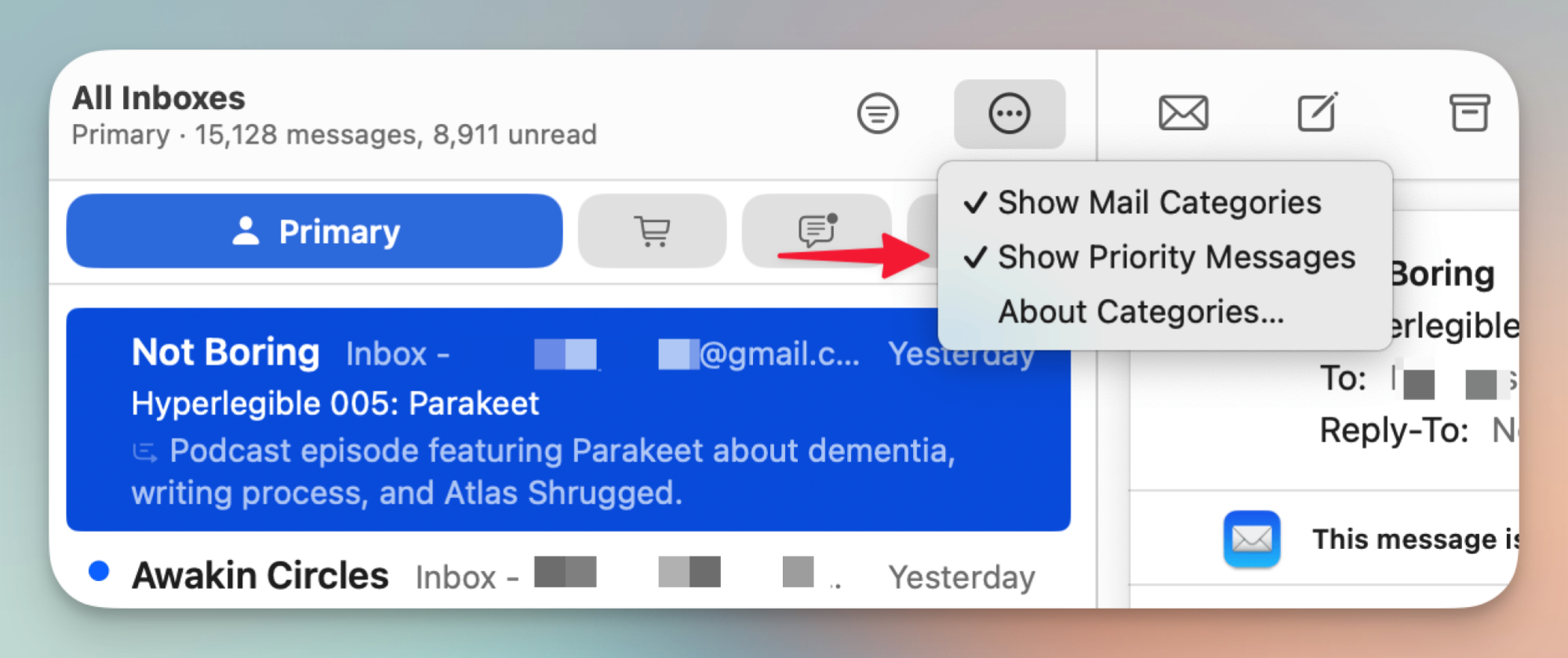
With macOS Sequoia 15.4, Apple fully rolled out all of its new Apple Intelligence features to the Mail app. As such, when you open Mail after updating to the latest OS, the app will look quite different. You’ll see new “Mail Categories,” a Priority Messages box, and email summaries, the latter two of which are powered by AI. It’s not something many asked for, and you might be longing for the Mail app you’re used to. But there’s good news here: If you don’t like these features, you can easily disable or customize them to suit your needs.
How to disable Mail Categories on Mac
Credit: Khamosh Pathak
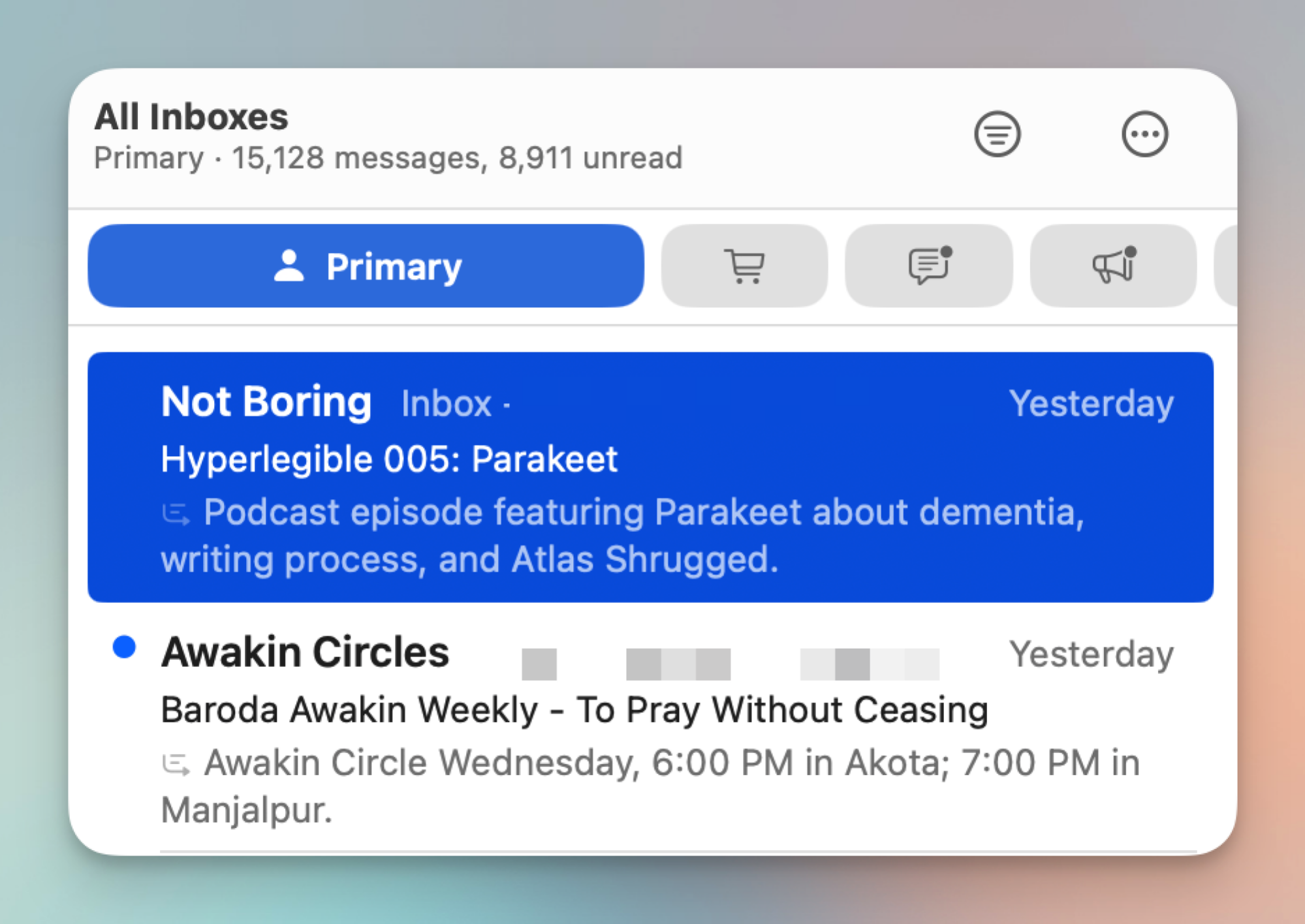
Apple first added Mail Categories to the iPhone back in iOS 18.2. After a few rounds of updates, it’s now front and center on the Mac, too. This feature automatically sorts all your emails into four neat boxes: Primary, Transactions, Updates, and Promotions.
Apple’s positioning for this feature is a bit weird. While Apple is using on-device processing to sort out these emails, it’s not actually an Apple Intelligence feature. So, turning off Apple Intelligence on the Mac won’t instantly get rid of this feature, either.
The idea is that Apple does all the heavy lifting to figure out which emails are most important and useful, and presents them to you in the Primary box. It mostly works, but it isn’t always accurate.
Credit: Khamosh Pathak
If you want to see all your emails at any given time, swipe right on the trackpad or Magic Mouse while hovering on the Categories tab to switch to the All Mail tab. This tab presents your messages in chronological order, as you’re used to.
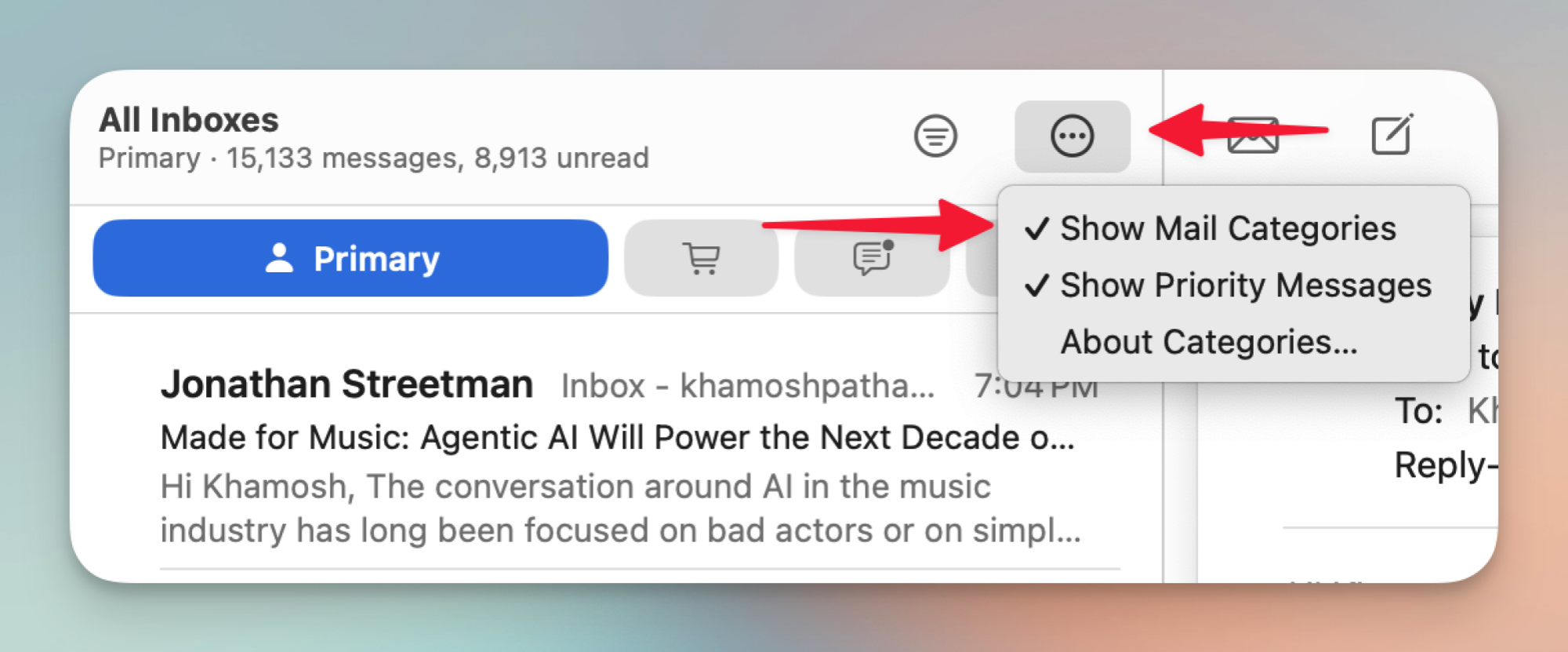
But that might not be enough. If you want to disable the Categories view altogether, click the three dotted Menu button at the top of the Mail list, then uncheck Show Mail Categories. After that, the Mail list will be back to how it used to be.
How to recategorize email
In case you do like this feature and want to keep it around, here’s a tip for when things go a bit wrong. In case the Mail app incorrectly categorizes an email, you can take a bit of manual control and point the app in the right direction.
Credit: Khamosh Pathak
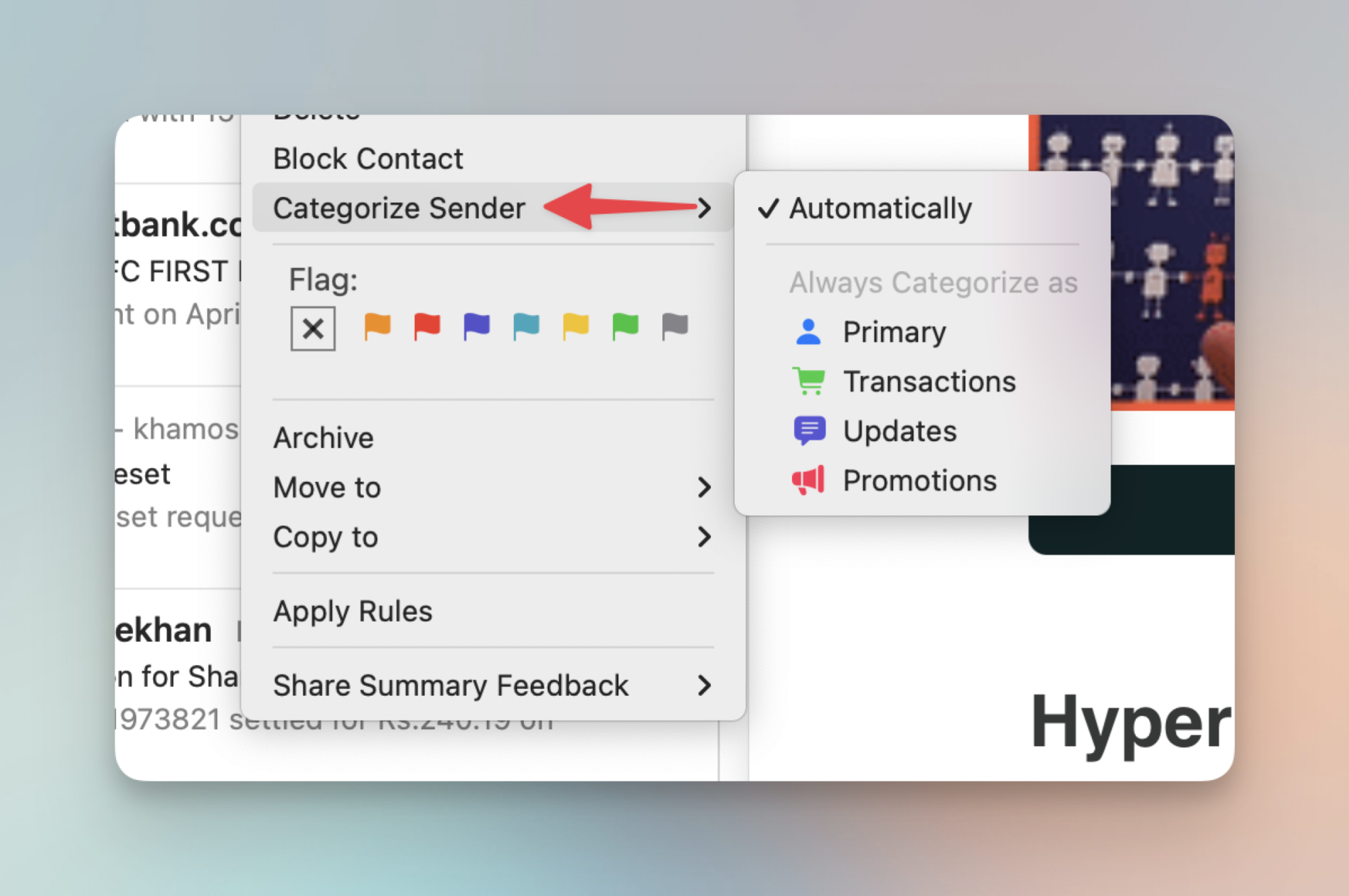
Right-click on an email in the Mail list, then choose Categorize Sender. Here, choose the category where you want the email to end up in.
How to disable Priority Messages
When you receive a time-sensitive email, or something that Apple deems significant (like an email from your company, or your family member) it will show up in a new Priority box on top of the Mail list.
Credit: Khamosh Pathak
If you don’t like this feature, there’s a quick way to disable it as well. Click the three-dotted Menu button on top of the Mail window, then uncheck Show Priority Messages.
How to disable AI summary previews
Credit: Khamosh Pathak
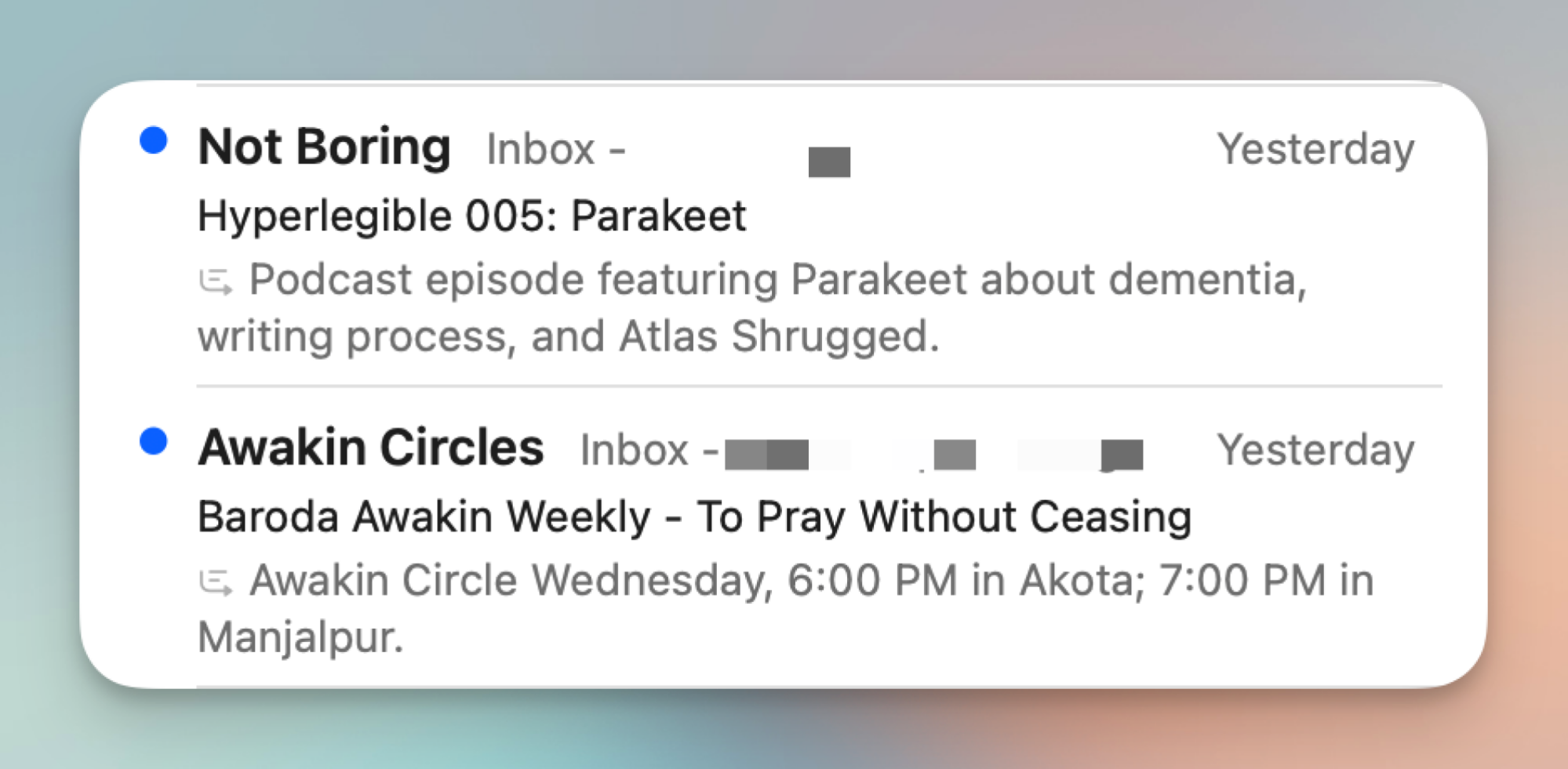
Apple now provides a short summary for each email instead of showing you the first couple of lines. This too, is hit or a miss. Just like Notifications Summaries on iPhone, these Mail summaries can sometimes go horribly wrong, as the app changes the meaning of the message completely.
Credit: Khamosh Pathak
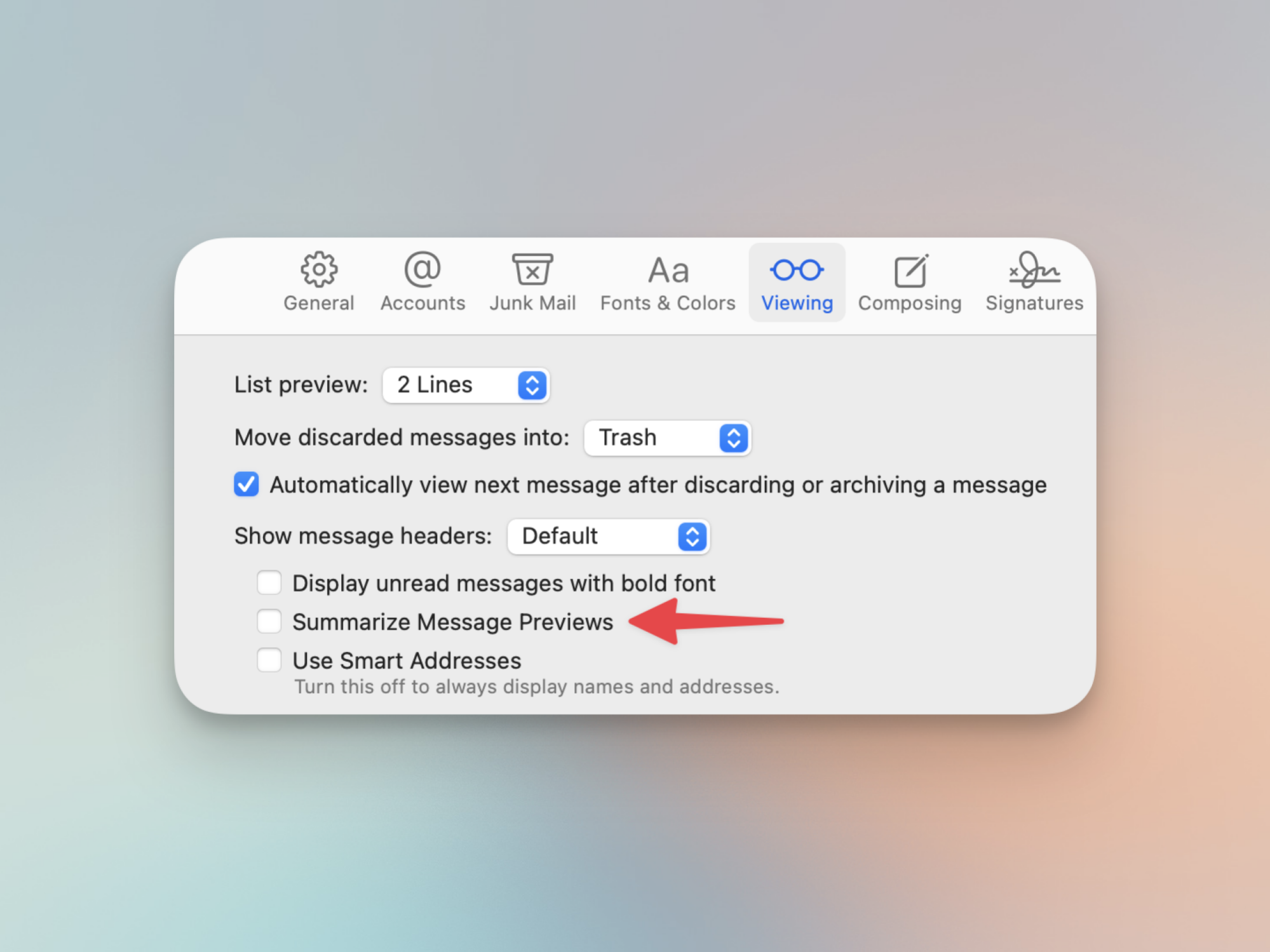
If you don’t like this feature, here’s what to do: Go to Mail > Settings (Command + Comma) from the menu bar, and switch over to the Viewing tab. Here, uncheck Summarize Message Previews to get rid of Mail summaries.
How to disable all Mail AI features
Lastly, there’s the nuclear option. To turn off all AI features in Mail, you can simply disable Apple Intelligence on your Mac. In one fell swoop, you can get rid of the Priority mail box, AI summaries, and the Summary button in emails, as well as hidden features like Apple Intelligence Writing Tools and Smart Replies options.
Credit: Khamosh Pathak
To do this, open System Settings, go to Apple Intelligence & Siri and disable the Apple Intelligence toggle. From the popup, click Turn Off Apple Intelligence to confirm.
Of course, when you do this, you’ll also miss out on the new Siri design, Writing Tools, Gemmoji, Image Playground and more. But if you don’t care for these AI features anyway, better to just keep them off completely.
We may earn a commission from links on this page. Deal pricing and availability subject to change after time of publication.
Bose makes speakers that have been dominating their space since their release—and when it comes to portable mid-size rugged speakers, the Bose New Soundlink Flex has been one of the best since its release in 2021, and is still very competitive three years later. Right now, you can get it for $119 (originally $149), the lowest price it has been according to price-tracking tools.
The Bose New SoundLink Flex is the middle sibling between the oldest (but smallest) Bose SoundLink Micro, and the youngest (but biggest) Bose SoundLink Max. The Flex also strikes a good middle ground between them as far as portability and sound, making it the best portable speaker for most people.
The Flex has an IP67 rating, which means you get complete water and dust-proof protection. The speaker even floats in the water, so you can bring it with you in the pool. While it doesn’t have full EQ customization in its companion app, the sound it offers is clear with rich bass depth and clear highs out of the box, according to PCMag’s review. It also has a speakerphone, so you can take calls with it and even speak to it, thanks to its microphone. Although it’s older, it comes with a USB-C charger, so it will charge quickly. At 3.6 by 7.9 by 2.1 inches (HWD) and 1.3-pound, it is light and portable. The Bluetooth 4.2 supports SBC codec, but not AAC or AptX, so it is more suitable for Android users than for Apple users, but either works.
The SoundLink Flex is perfect for those who want to take their speaker with them anywhere, thanks to its small size and light weight. And for the price, it offers some of the best audio available.
Instagram is testing a feature that locks Reels behind a secret code and a provided hint, according to a report by TechCrunch. This looks like a novel way for creators to interact with fans, as they can share exclusive reels with people who are more likely to know the answer to these clues.
As an example, a creator could lock a Reel with a hint like “my favorite food” and rabid fans would, of course, know the answer. The Meta-owned social network has been testing the feature on its Design account. It shared a locked Reel that prompts viewers to enter a secret code based on a hint that read “1st # in the caption.”
Meta / Screenshot from Engadget
The first hashtag mentioned in the caption was “Threads.” Upon entering the correct code, viewers access a Reel that announces that the Design account is launching a profile on Threads.
This could be used by brands to advertise new products or by creators trying to amp up engagement. Personally, I could see it as a place to hide in-jokes with friends, but maybe that’s just me.
Engadget has reached out to Instagram for more information regarding this feature. We’ll update this post if we find out anything regarding availability. This could be just a test, with no actual plans for a general rollout.
This is also quite similar to another Instagram tool called Reveal. This feature lets creators post a hidden Story for followers to uncover by sending a DM.
This article originally appeared on Engadget at https://www.engadget.com/social-media/instagram-is-testing-reels-that-are-locked-behind-a-secret-code-162142807.html?src=rss
Last year, Sony rebranded its portable speaker lineup under the ULT umbrella with new models classified as either Field or Tower. The former are the more “traditional” Bluetooth options while the latter are the party box, karaoke machine sort of devices. Just like 2024, the company has three new entries in the ULT lineup this time around with the ULT Field 3, ULT Field 5 and ULT Tower 9. Those first two fill the mid-range gap between the current ULT Field 7 and ULT Field 1 while the last item is a smaller alternative to the ULT Tower 10.
The ULT Field 3 will replace the SRS-XE300. As the name suggests, Sony’s ULT button is among the updates, a control that adds instant access to ULT1 mode for bass boost. The company also expanded the customizable EQ and added its Sound Field Optimization. Inside, a single woofer and a tweeter are angled slightly in the center while two passive radiators are positioned at the ends of the speaker. The ULT Field 3 works in both vertical and horizontal orientations where the XE300 was only vertical.
There’s a new Party Connect button to easily sync with other Sony speakers and you can charge your devices via the USB-C port. The company kept the 24-hour battery life the same as the XE300 but improved the quick-charge feature to give you two hours of use in 10 mins. The ULT Field 3 remains IP67 waterproof, dust proof and shock proof like its predecessor, however this new speaker is also rust proof. A removable shoulder strap is among the additions too, but there’s one major item Sony retained. The ULT Field 3 is the same price at the XE300 at $200.
ULT Field 3
Sony
The ULT Field 5 isn’t quite at large as the ULT Field 7, but it’s still hefty. This speaker will replace the SRS-XG300 in Sony’s arsenal, clocking in at $330 — $20 less than that predecessor. Here you’ll get a single woofer and two tweeters angled in the middle of the unit with passive radiators at either end. You’ll also be able to use a second ULT mode, ULT2, that “emphasizes powerful sound” in addition to the ULT1 bass boost. A 10-band EQ and Sound Field Optimization help maintain sound quality and that new Party Connect button is on this larger speaker too. Like the ULT Field 3, you can use the ULT Field 5 in either vertical or horizontal positions, and similarly there’s a removable shoulder strap.
Battery life remains up to 25 hours on the ULT Field 5, just like the XG300. Once again, Sony improved quick charging to give you 30 more minutes of use in a 10-minute session. This speaker has lights at the ends though, which can impact longevity. Sony says you’ll reach that 25-hour mark using ULT modes with the lights off, but using both will drop that figure to 10 hours. There are three different light modes though, so there are options available. On the back of the ULT Field 5, there’s a panel with aux input, USB-C charging in/out, a battery care button and a switch for the lights. That’s protected by a sealed flap, which helps the speaker achieve its IP67 rating.
That brings us to the ULT Tower 9. The party box joins the ULT Tower 10 on Sony’s current roster, replacing the SRS-XV900. Expanded EQ, Sound Field Optimization and two ULT modes are among the additions here, as are a redesigned handle and wheels for better portability. Sony improved the lighting for 360-degree projection as well as making the top control panel splash proof. Besides the Party Connect button from the new ULT Field speakers, the ULT Tower 9 has a dedicated option for a stereo pair. The top panel also houses controls for lighting, volume, power and two inputs for microphones (one of which can be used for a guitar).
ULT Tower 9
Sony
Like the XV900, you can use Sony’s TV Sound Booster feature to enhance living room audio on the ULT Tower 9. The speaker has that ULT button, which gives you two modes for either bass boost or “powerful sound.” The driver arrangement inside includes four tweeters, two of which are pointing out the back of the speaker, along with two mid-range units and a single woofer. The wireless version of the ULT Tower 9 is the same price as its predecessor at $900, but Sony is also offering a wired option that must remain plugged into an outlet for $750. If you opt for wireless, battery life is the same on that Tower 9 as the ULT Field 5: up to 25 hours with only ULT mode and up to 10 hours with both ULT mode and lighting active.
Lastly, Sony revealed the ULT Mic, which is a $150 set of two wireless microphones and a transmitter that are designed to be used with the company’s party speakers. This new accessory pack works with both the newer ULT Tower speakers in addition to the ULT Field 7. You can also use it with any older Sony speakers that support a microphone jack and receiver (like the XV900, XV800, XV500, XP700 and XP500). The mics are rechargeable with up to 20 hours of battery life and they feature a shock proof design. What’s more, the company equipped these devices with noise reduction for hands, breath and wind, plus there’s a Duet Assist tool to compensate for uneven vocal volumes.
The ULT Field 3, ULT Field 5, ULT Tower 9 and ULT Mic are all available now.
This article originally appeared on Engadget at https://www.engadget.com/audio/speakers/sony-adds-three-more-speakers-to-its-ult-lineup-bass-boost-button-included-160008038.html?src=rss
Even the tiniest of living things are capable of some amazing forms of locomotion, and some come with highly sophisticated sensor suites and manage to source their energy from the environment. Attempts to approach this sort of flexibility with robotics have taken two forms. One involves making tiny robots modeled on animal behavior. The other involves converting a living creature into a robot. So far, either approach has involved giving up a lot. You’re either only implementing a few of life’s features in the robot or shutting off most of life’s features when taking over an insect.
But a team of researchers at Harvard has recognized that there are some behaviors that are so instinctual that it’s possible to induce animals to act as if they were robotic. Or mostly robotic, at least—the fruit flies the researchers used would occasionally go their own way, despite strong inducements to stay with the program.
Smell the light
The first bit of behavior involved Drosophila‘s response to moving visual stimuli. If placed in an area where the fly would see a visual pattern that rotates from left to right, the fly will turn to the right in an attempt to keep the pattern stable. This allowed a projector system to “steer” the flies as they walked across an enclosure (despite their names, fruit flies tend to spend a lot of their time walking). By rotating the pattern back and forth, the researchers could steer the flies between two locations in the enclosure with about 94 percent accuracy.