California bill would force ISPs to offer 100Mbps plans for $15 a month

A proposed state law in California would force Internet service providers to offer $15 monthly plans to people with low incomes. The bill is similar to a New York law that took effect in January but has a higher minimum speed requirement: The proposed $15 plans for low-income California residents would have to come with download speeds of 100Mbps and upload speeds of 20Mbps.

Broadband lobby groups fear that many states will enact such requirements after New York won a multiyear court battle to enforce its law. The Supreme Court has rejected telecom industry challenges to the New York law twice.

The California bill was proposed in January by Democratic Assemblymember Tasha Boerner, but the original version simply declared an intent to require affordable home Internet service and contained no specifics on required speeds or prices. The requirement for specific speeds and a $15 price is being added to the bill with an amendment that was provided to Ars today by Boerner’s office. The amendment should be in the official record by early next week, a Boerner spokesperson said.

Read full article

Comments

Perplexity AI says it would rebuild TikTok’s algorithm and add Community Notes features

Earlier this year, with a TikTok ban looming, Perplexity AI threw its hat into the increasingly crowded ring to take over the embattled social media company. Now, the maker of the AI search engine is outlining its vision for TikTok if its bid were to win out.

In a blog post, the company made a lengthy pitch for “rebuilding TikTok in America,” an effort that would see the AI company rebuild the app’s signature algorithm, add Community Notes, and integrate the shortform videos into its search engine.

Of the many potential buyers, it’s not clear how seriously Perplexity’s bid is being considered. On Friday, the Financial Times reported that ByteDance’s existing US investors are “exploring a deal alongside software giant Oracle” in an effort to “appease” President Donald Trump. The story also notes that ByteDance “strongly prefers” this arrangement.

Still, Perplexity is making the case that it is best suited to own the platform.

Perplexity is singularly positioned to rebuild the TikTok algorithm without creating a monopoly, combining world-class technical capabilities with Little Tech independence. Any acquisition by a consortium of investors could in effect keep ByteDance in control of the algorithm, while any acquisition by a competitor would likely create a monopoly in the short form video and information space. All of society benefits when content feeds are liberated from the manipulations of foreign governments and globalist monopolists.

The AI company also says it would rebuild TikTok’s “black box” recommendation algorithm from scratch and would make the “For You” feed open source. Perplexity also suggests it would add “Community Notes features” as well as the citations used by its own search engine in an effort “to turn TikTok into the most neutral and trusted platform in the world.” That would be a significant departure from TikTok’s current fact-checking program, which relies on international media organizations.

This is the first time Perplexity has publicly discussed its vision for TikTok in detail. It’s also notable that some of its plans — like open-sourcing the “For You” feed and adding Community Notes — feel ripped straight from Elon Musk’s playbook for X. In any case, the White House will likely need to make a decision about TikTok’s future soon. Trump’s executive order that temporarily saved the app from a ban is set to expire April 5, although the president has indicated he would “probably” extend it if necessary.

This article originally appeared on Engadget at https://www.engadget.com/social-media/perplexity-ai-says-it-would-rebuild-tiktoks-algorithm-and-add-community-notes-features-200449390.html?src=rss

Italy demands Google poison DNS under strict Piracy Shield law

Italy is using its Piracy Shield law to go after Google, with a court ordering the Internet giant to immediately begin poisoning its public DNS servers. This is just the latest phase of a campaign that has also targeted Italian ISPs and other international firms like Cloudflare. The goal is aimed at preventing illegal football streams, but the effort has already caused collateral damage. Regardless, Italy’s communication regulator praises the ruling and hopes to continue sticking it to international tech firms.

The Court of Milan issued this ruling in response to a complaint that Google failed to block pirate websites after they were identified by the national communication regulator, known as AGCOM. The court found that the sites in question were involved in the illegal streaming of Series A football matches, which has been a focus of anti-piracy crusaders in Italy for years. Since Google offers a public DNS service, it is subject to the site-blocking law.

Piracy Shield is often labeled as draconian by opponents because blocking content via DNS is messy. It blocks the entire domain, which has led to confusion when users rely on popular platforms to distribute pirated content. Just last year, Italian ISPs briefly blocked the entire Google Drive domain because someone, somewhere used it to share copyrighted material. This is often called DNS poisoning or spoofing in the context of online attacks, and the outcome is the same if it’s being done under legal authority: a DNS record is altered to prevent someone typing a domain name from being routed to the correct IP address.

Read full article

Comments

Valve Deckard Proof Of Concept Had 2K LCD Panels & Snapdragon 8 Gen 3 Chip

A Valve Deckard proof of concept model had 2K LCD panels and a Snapdragon 8 Gen 3 chipset, though this doesn’t mean the shipping Deckard will.

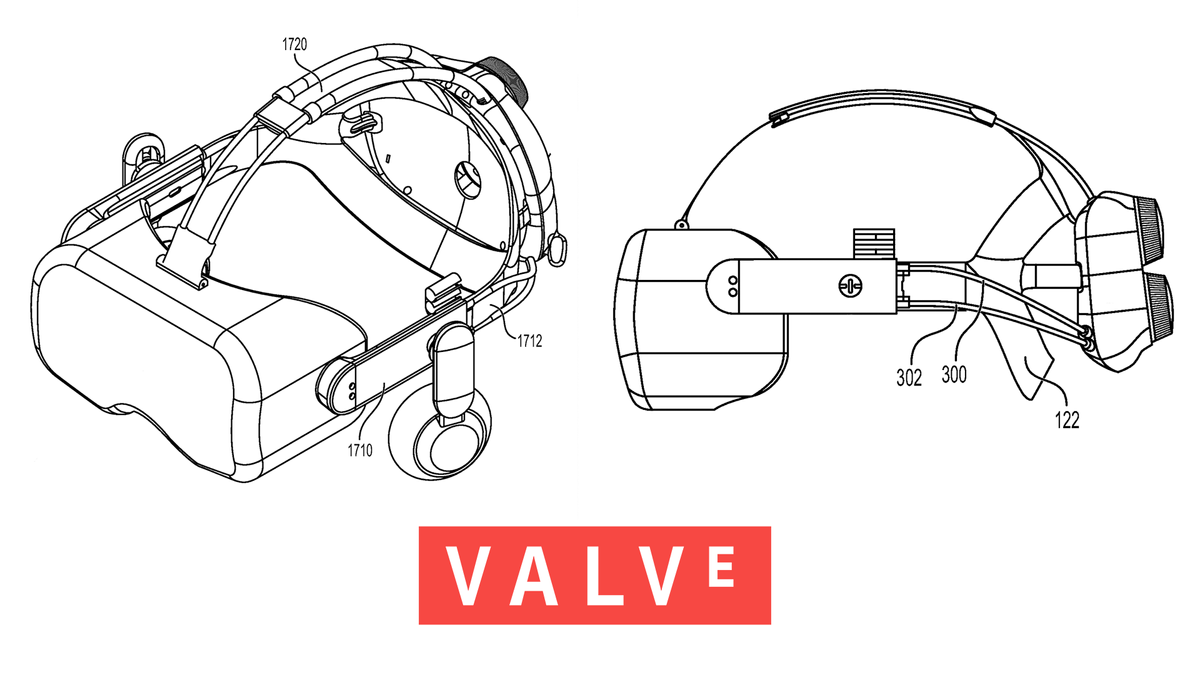
Over the past four years Valve has repeatedly confirmed that it’s working on a new headset, strongly hinting that it will have a focus on wireless streaming from your PC, and a job listing mentioned it having inside-out tracking, camera passthrough, environment understanding, eye tracking, and hand tracking. In this time, many references to a Valve headset called “Deckard” have been found in the code of SteamVR by VR enthusiast Brad Lynch’s Discord datamining group.

Valve Hints At Its VR Plans In Steam Deck OLED Interview
Valve hinted at its future plans for VR in an interview about Steam Deck OLED.
UploadVRDavid Heaney

Now, Lynch’s datamining group has discovered a reference to seven pre-production models of Deckard in SteamVR code: POC-A, POC-C, Mini-D, POC-E, POC-F, EV1, and EV2. POC stands for proof of concept, EV stands for engineering validation, and it’s unclear what Mini-D means.

Deckard POC-A and POC-C were first discovered in the SteamVR code almost four years ago, Mini-D three years ago, and EV2 a few weeks ago, charting Valve’s progression from early prototypes to near-final hardware. But what’s more notable is that Lynch’s team has also discovered code revealing the specific display panels, tracking cameras, and Qualcomm chipset that were used in Deckard POC-F.

Deckard PoC-F used a Qualcomm SM8650 SoC for development. Also known as the Snapdragon 8 Gen 3 which has a GPU one generation newer than GPU In the XR2 Gen 2

It used 2.8” lpm026m648c LCD panels from JDI. 2160×2160 @ 120hz

It also had two eye tracking cameras, and 4 SLAM cameras https://t.co/kJtBqLqF2W pic.twitter.com/Lr0949JZLk

— SadlyItsDadley (@SadlyItsBradley) March 21, 2025

Deckard POC-F used two 2160×2160 LCD panels with 120Hz refresh rate, had four world-facing tracking cameras, two internal eye tracking cameras, and was powered by Qualcomm’s Snapdragon 8 Gen 3, the findings reveal.

That resolution is roughly equivalent to Meta Quest 3’s 2064×2208, and significantly lower than Apple Vision Pro’s 3660×3200, while also lacking the contrast and richness of Vision Pro’s micro-OLED.

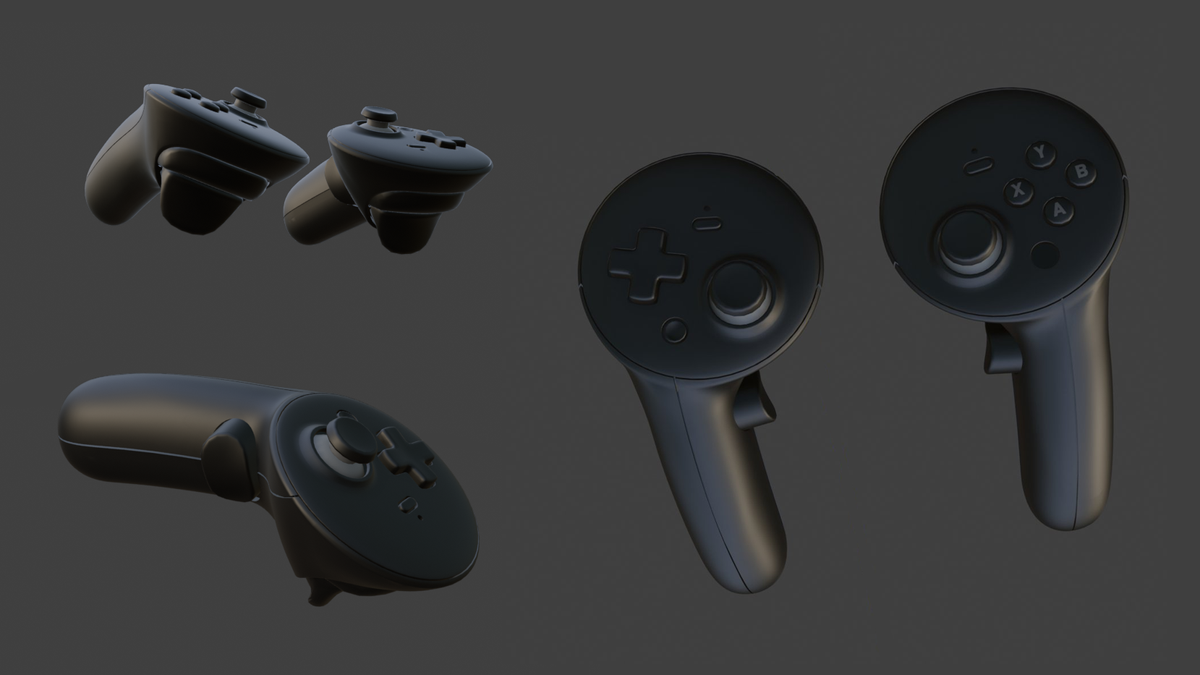
As for the tracking cameras, this would be a similar setup to PlayStation VR2 or Quest Pro. The findings come four months after 3D models of Deckard’s “Roy” controllers were discovered in SteamVR files, with a design that strongly suggests they are tracked by the headset’s cameras in the same way as Quest 3’s Touch Plus controllers.

Arguably more interestingly, the Snapdragon 8 Gen 3 chipset has a newer GPU than the XR2 Gen 2 used in Quest 3, Quest 3S, and Pico 4 Ultra, with 25% faster performance and 25% improved efficiency. While Deckard will likely focus on leveraging your gaming PC for the highest fidelity VR experience, the use of this more advanced GPU could also let it render slightly improved graphics completely standalone.

Valve Deckard ‘Roy’ Controller Models Discovered In SteamVR
Models of Valve Deckard’s ‘Roy’ controllers were discovered in SteamVR driver files, revealing their design and inputs.
UploadVRDavid Heaney

However, we must once again stress that a proof of concept model having these specifications does not in any way mean that the shipping Deckard will too. Deckard POC-F could be years old by now, and Deckard EV2 could be a fundamentally different device.

Speaking of the shipping Deckard, a recent rumor from a Valve leaker with a solid track record suggests it could arrive later this year for $1200, and include first-party “games or demos”.

We’ll keep a close eye on the Valve datamining and leaking community, and the company itself, in the coming weeks and months for any further hints of the features and specifications of what may be the most highly anticipated headset in the industry.

Leaker Claims Valve Deckard Set To Launch This Year At $1200
A Valve leaker claims the Valve Deckard headset is set to launch by the end of this year at $1200, including first-party “games or demos”.
UploadVRDavid Heaney

“Infantile amnesia” occurs despite babies showing memory activity

For many of us, memories of our childhood have become a bit hazy, if not vanishing entirely. But nobody really remembers much before the age of 4, because nearly all humans experience what’s termed “infantile amnesia,” in which memories that might have formed before that age seemingly vanish as we move through adolescence. And it’s not just us; the phenomenon appears to occur in a number of our fellow mammals.

The simplest explanation for this would be that the systems that form long-term memories are simply immature and don’t start working effectively until children hit the age of 4. But a recent animal experiment suggests that the situation in mice is more complex: the memories are there, they’re just not normally accessible, although they can be re-activated. Now, a study that put human infants in an MRI tube suggests that memory activity starts by the age of 1, suggesting that the results in mice may apply to us.

Less than total recall

Mice are one of the species that we know experience infantile amnesia. And, thanks to over a century of research on mice, we have some sophisticated genetic tools that allow us to explore what’s actually involved in the apparent absence of the animals’ earliest memories.

Read full article

Comments

Joint studies from OpenAI and MIT found links between loneliness and ChatGPT use

New studies from OpenAI and MIT Media Lab found that, generally, the more time users spend talking to ChatGPT, the lonelier they feel. The connection was made as part of two, yet-to-be-peer-reviewed studies, one done at OpenAI analyzing “over 40 million ChatGPT interactions” and targeted user surveys, and another at MIT Media Lab following participants’ ChatGPT use for four weeks.

MIT’s study identified several ways talking to ChatGPT — whether through text or voice — can affect a person’s emotional experience, beyond the general finding that higher use led to “heightened loneliness and reduced socialization.” For example, participants who already trusted the chatbot and tended to get emotionally attached in human relationships felt lonelier and more emotionally dependent on ChatGPT during the study. Those effects were less severe with ChatGPT’s voice mode, though, particularly if ChatGPT spoke in a neutral tone. Discussing personal topics also tended to lead to loneliness in the short-term, and interestingly, speaking to ChatGPT about more general topics was more likely to increase emotional dependence.

The big finding from OpenAI’s study was that having emotional conversations with ChatGPT is still not common. “Emotionally expressive interactions were present in a large percentage of usage for only a small group of the heavy Advanced Voice Mode users we studied,” OpenAI writes. That suggests that even if MIT’s findings are as concerning as they are unsurprising, they’re not exactly widespread outside a small group of power users. 

There are important limitations to MIT Media Lab and OpenAI’s research, like both studies covering a short period of time (one month for MIT, 28 days for OpenAI) and MIT not having a control group to compare to. The studies do add more evidence to something that seemed intuitively true for a while now — talking to AI has a psychological impact on the humans doing the talking. Given the intense interest in making AI a compelling conversation partner, whether its in video games or as a way to simplify the job of YouTube creators, its clear that MIT Media Lab and OpenAI are right to want to understand what’ll happen when talking to AI is the norm.

This article originally appeared on Engadget at https://www.engadget.com/ai/joint-studies-from-openai-and-mit-found-links-between-loneliness-and-chatgpt-use-193537421.html?src=rss

Okay, But What If Severance Ended Here?

The most surprising thing for me about the end of Severance’s second season was how few questions I still had when it was all over. Apple TV’s dystopian workplace thriller is a mystery box show, and yeah, there are still plenty of unsolved puzzles on the Lumon severed floor, but when the credits started rolling, I…

Read more…

Anthropic’s new AI search feature digs through the web for answers

On Thursday, Anthropic introduced web search capabilities for its AI assistant Claude, enabling the assistant to access current information online. Previously, the latest AI model that powers Claude could only rely on data absorbed during its neural network training process, having a “knowledge cutoff” of October 2024.

Claude’s web search is currently available in feature preview for paid users in the United States, with plans to expand to free users and additional countries in the future. After users enable the feature in their profile settings, Claude will automatically determine when to use web search to answer a query or find more recent information.

The new feature works with Claude 3.7 Sonnet and requires a paid subscription. The addition brings Claude in line with competitors like Microsoft Copilot and ChatGPT, which already offer similar functionality. ChatGPT first added the ability to grab web search results as a plugin in March 2023, so this new feature is a long time coming.

Read full article

Comments

Seven Things You Didn’t Know You Could Do With Your Garmin Watch

We may earn a commission from links on this page.

Garmin watches like my beloved Forerunner 265S have so many features buried in their menus that you may not have discovered some of the best ones. Here are some of the best underrated features of Garmin watches (available on Forerunners and other models), as well as convenient shortcuts you’ll find yourself using all the time. 

Shortcuts for getting around your Garmin watch

flashlight and sunrise/sunset apps
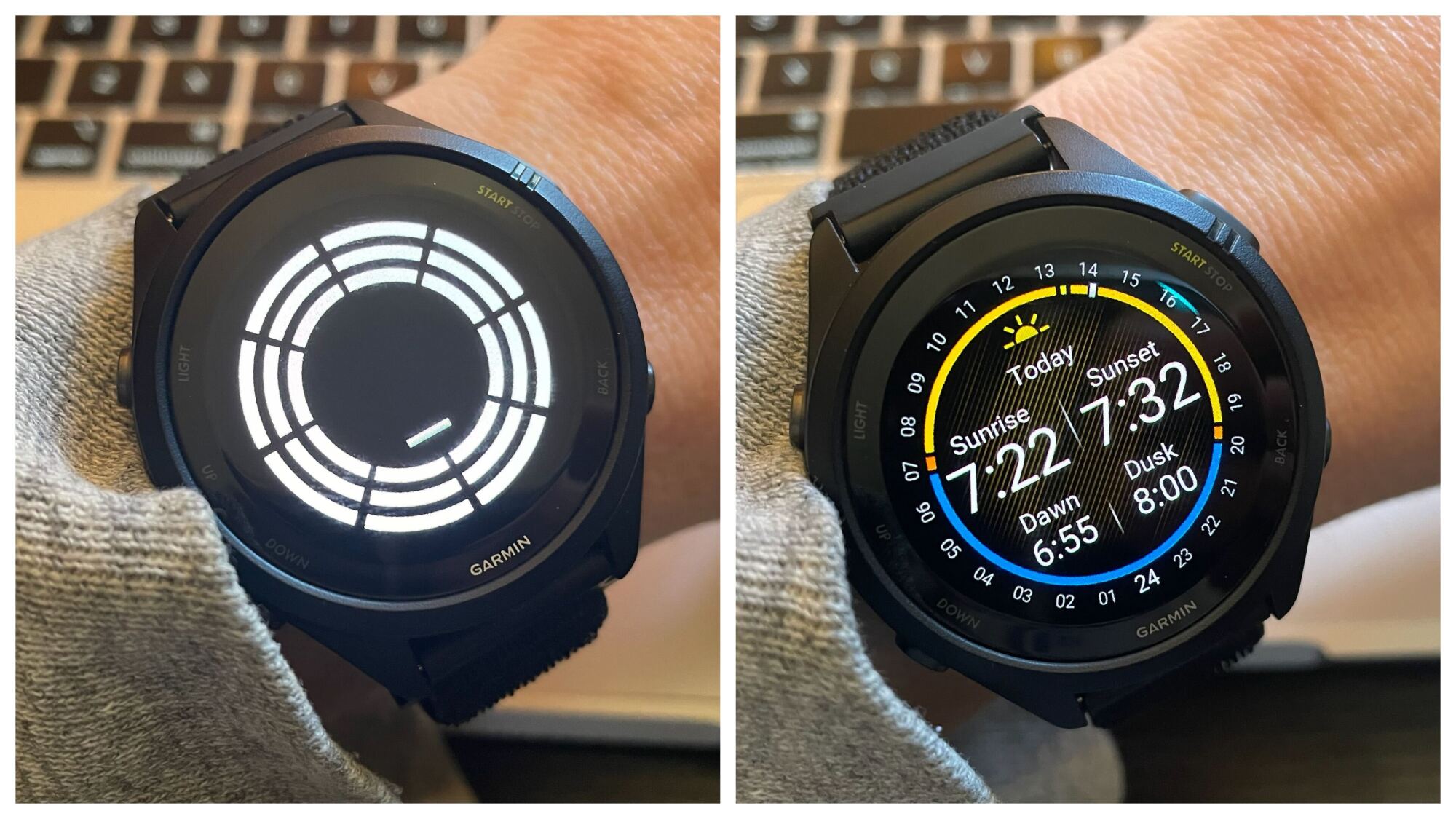
Left is the flashlight (it’s brighter in the dark, I promise). Right is what you get when you long press on the sunset time complication.
Credit: Beth Skwarecki

Quickly get back to the home screen

This works on all the touchscreen watches: Wherever you are, no matter how many menus deep, just cover the screen with your palm. The screen will go dark, and when you activate it again (by tapping the touchscreen, flicking your wrist, or hitting the top left “light” button), it will be back at the home screen.

Pull up a flashlight

Double press the light button (top left). Even if your watch isn’t equipped with an LED flashlight, this will turn on the flashlight app that displays bright white pixels to provide a soft light. It’s handy for going to the bathroom in the middle of the night, or getting out of your kid’s room at bedtime without stepping on a LEGO. Oh—and you can quickly turn it off by putting your palm over the screen.

Long press your watch face complications

Unlike on an Apple Watch, you can’t tap a complication to get more information about it. I assumed that meant the complications weren’t interactive. But no—you need to long press the complication, and then you get the info. My sunrise/sunset complication pulls up a circular chart with sunrise, sunset, dusk, and dawn times (and an option to look at different dates or locations). You can also use this to get more information on complications that were on by default and you never quite figured out what they are. 

Garmin Share

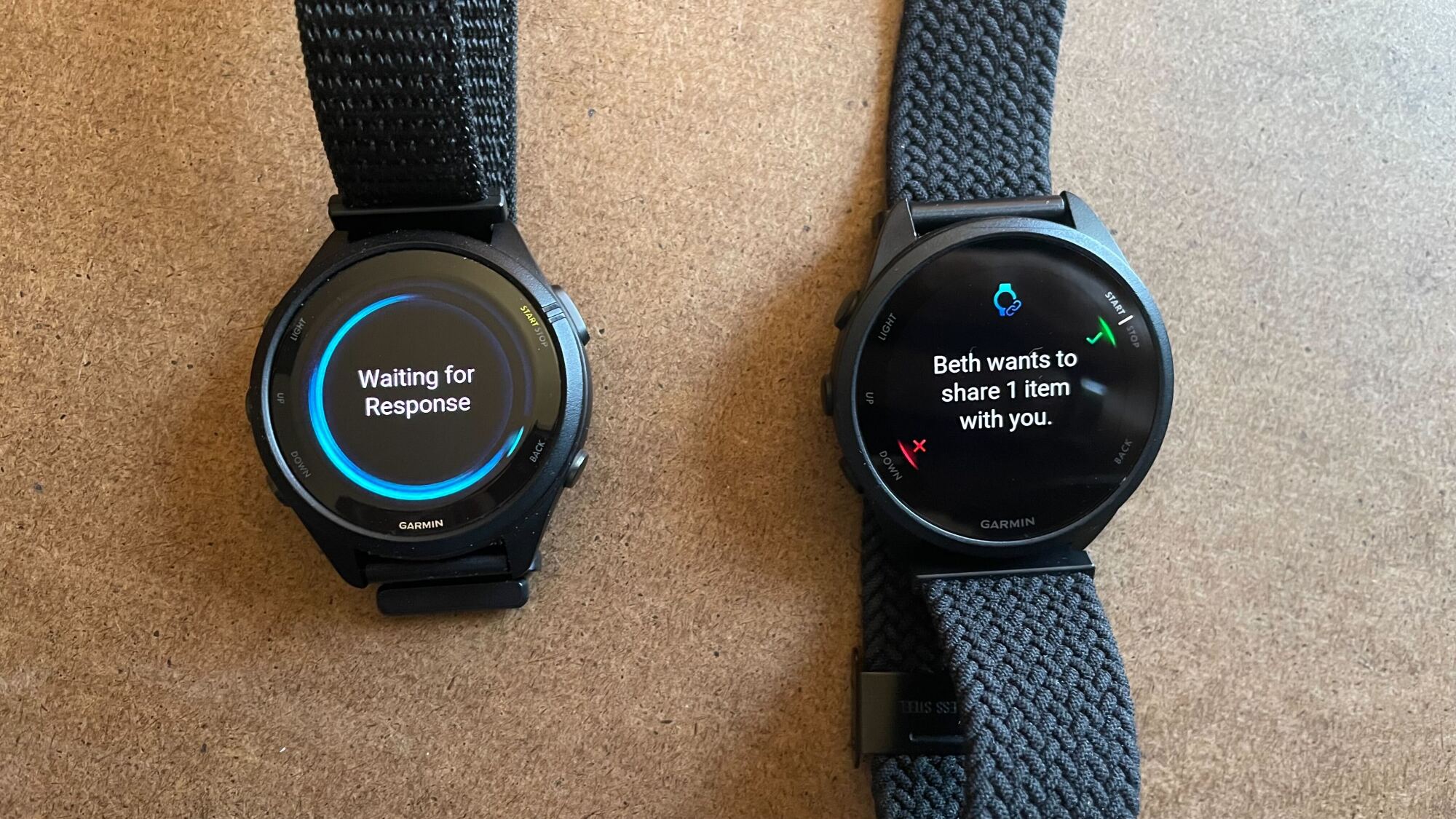
Two watches transferring a workout file
The watch on the left is sending a workout to the watch on the right.
Credit: Beth Skwarecki

If you run with others, or like to discuss workouts with a friend who also uses Garmin, you’ll love the Garmin Share feature, which allows you to beam a workout (or course map) to another person’s watch. “What’s a Norwegian 4×4?” my husband might say. “Here, I’ll send it to you,” I can answer, and he’ll have it in his on-watch workout library in seconds. 

How to send items with Garmin Share: 

  1. Hit the Start button as if you were going to start an activity. 

  2. Scroll down until you see Garmin Share as an option. Select it.

  3. You’ll see a screen that says Ready to Receive. Scroll down to see all your shareable items (workouts, courses, etc) and choose one. 

  4. Your watch will say “Looking for devices.” If your friend has opened up the receiving screen, their watch model and their name will become available to select.

How to receive a workout with Garmin Share: 

  1. As above, go to the Start button, scroll down, and select Garmin Share.

  2. You’ll see a screen that says Ready to Receive.

  3. When they share the file, you’ll get an option to say yes or no to downloading it.

You can also share a workout by finding it on your watch (as if you were going to do the workout) and then selecting Share instead of Do Workout.

Sunset alerts

You can set all kinds of alerts on your watch. One day I was poking around the menus, just curious about what was in there, when I noticed a “sunset” option. 

I have this habit of going out for an evening trail run without checking how much time I’ve got until the sun goes down. It’s a recipe for regret: Either I’ll wish I brought a flashlight, or I’ll wish I had just started my run a little earlier in the day. 

But now, that’s a problem of the past. I went into Settings > Notifications and Alerts > System Alerts > Til Sunset, and set the time to one hour (1:00:00). Now, I get a little buzz on my wrist when I have an hour before the sun sets. If I’m dressed for a run but have been dawdling on getting out the door, that’s my cue. And if I realize I’m not going to make it back before dark, I grab a flashlight on my way out.

Set hot keys for features that would otherwise be buried in a menu

A hot key is a shortcut—something like, long press the START button (top right) to turn sleep mode on or off. 

To set up hot keys, go into settings > System > Hot Keys. There are seven you can use: holding the start, back, or down buttons, or pressing two buttons at once (start and down, start and up, back and light, or back and up). 

Some of the handy features you can map to a hot key include: 

  • Lock the device (great if you have a toddler who likes to play with your watch)

  • Broadcast heart rate (so that you can see your HR on gym equipment) 

  • Change sport (if you’re running on the track, but want to switch to a regular run when kids storm the field for soccer practice)

  • Turn the touchscreen on or off

  • Bring up a stopwatch or timer

Find my phone

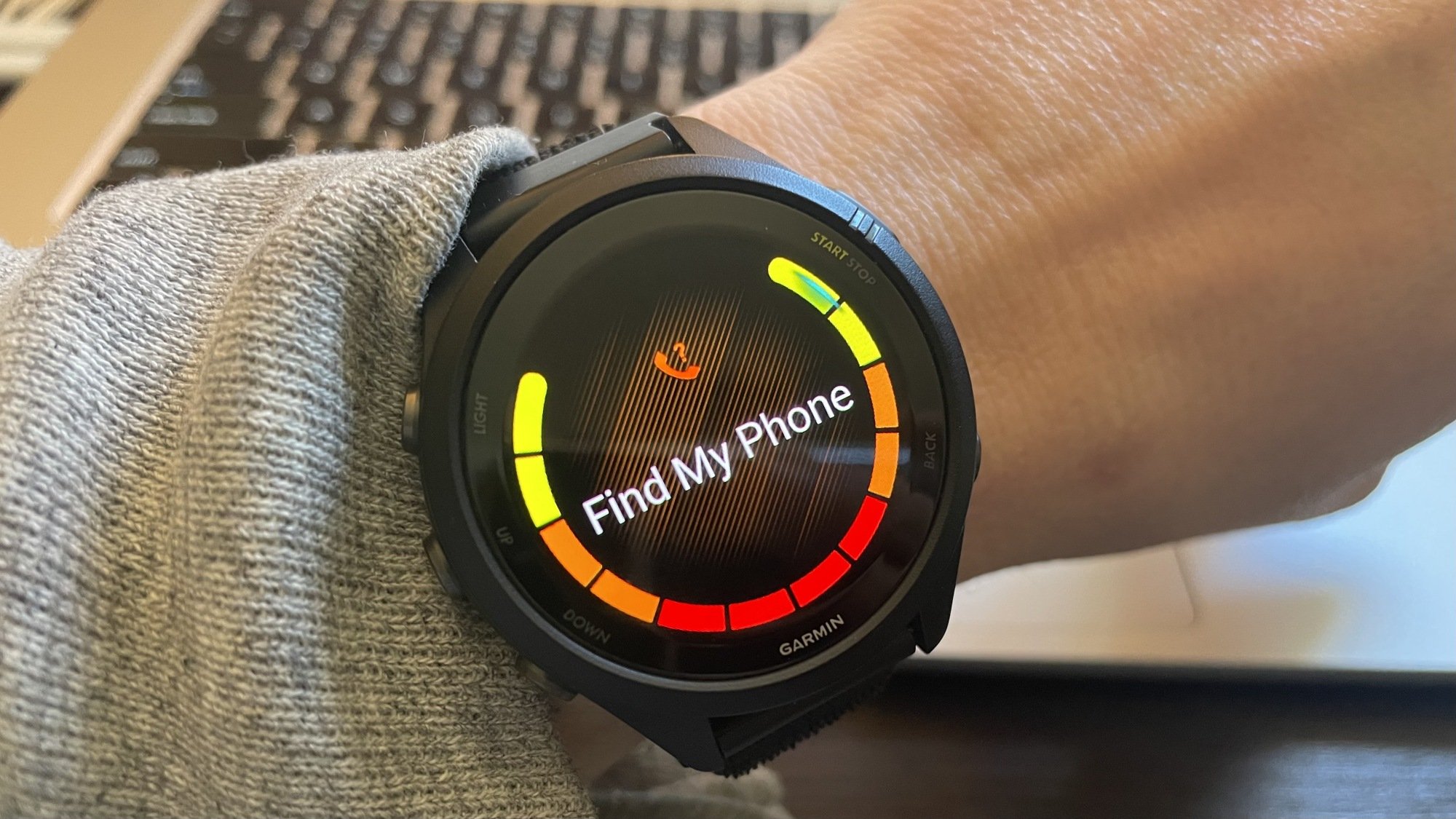
find my phone screen on Garmin watch

Credit: Beth Skwarecki

This is a standard smartwatch feature these days, but I keep seeing people discover it for the first time, so here’s your public service announcement: Hold the LIGHT button (top left) to get that wheel of little shortcut things. Select Find My Phone, and it will.

OpenAI Study Finds Links Between ChatGPT Use and Loneliness

Higher use of chatbots like ChatGPT may correspond with increased loneliness and less time spent socializing with other people, according to new research from OpenAI in partnership with the Massachusetts Institute of Technology. From a report: Those who spent more time typing or speaking with ChatGPT each day tended to report higher levels of emotional dependence on, and problematic use of, the chatbot, as well as heightened levels of loneliness, according to research released Friday. The findings were part of a pair of studies conducted by researchers at the two organizations and have not been peer reviewed.

San Francisco-based OpenAI sees the new studies as a way to get a better sense of how people interact with, and are affected by, its popular chatbot. “Some of our goals here have really been to empower people to understand what their usage can mean and do this work to inform responsible design,” said Sandhini Agarwal, who heads OpenAI’s trustworthy AI team and co-authored the research. To conduct the studies, the researchers followed nearly 1,000 people for a month.


Read more of this story at Slashdot.

SpaceX could soon have more control over Texas public road and beach closures

SpaceX could soon have greater control over the recreational activities of South Texas residents. The Houston Chronicle (via Gizmodo) and San Antonio Express-News report that a pair of state senate bills introduced earlier this month would give officials at the likely Starbase city the authority to decide when a nearby beach shuts down for weekday launch activities. Meanwhile, a third bill floated on Wednesday would take the company’s control a step further, making it a criminal offense for people on the beach not to comply with SpaceX’s evacuation orders.

The bills are possible because of an upcoming election that will almost certainly give SpaceX officials control of the area. On May 3, voters will decide if Starbase becomes a Texas city, something Elon Musk first proposed in 2021. Given that the area near the rocket site is populated mainly by SpaceX employees (after previous homeowners in Boca Chica Village moved, often after being bought out by the company), let’s just say the election’s outcome won’t likely be a toss-up.

Republican state senator Adam Hinojosa’s first bill, SB 2188, would let Starbase city officials (assuming the municipality establishment bill passes) decide when Boca Chica Beach is closed for weekday rocket tests and flights. An identical bill, HB 4660, was introduced in the state house by Republican Janie Lopez. Cameron County officials, who control the closures now, would maintain control on Friday afternoons and weekends.

Texas state senator Adam Hinojosa scowling in a photo.
Texas state senator Adam Hinojosa
Campaign for Adam Hinojosa

Meanwhile, Hinojosa’s second senate bill (SB 2230) would make it a Class B misdemeanor for people on the beach not to comply with Starbase’s evacuation orders. The freshman state senator said the bill would give the commercial spaceport “real teeth” to “compel people to do the right thing.” (Fittingly, Hinojosa’s election website touts his belief that “we don’t need more government in business — we need more business in government.”)

The Houston Chronicle reports that the FAA’s Environmental Assessment shows that SpaceX has moved much of its testing to a site that doesn’t require the closure of State Highway 4. A SpaceX flight test in April 2023 closed the road for over 24 hours, while another shuttered it for nearly eight hours last June. The company can close State Highway 4 for up to 500 hours each year for standard operations and up to 300 more hours to address incidents like an exploding rocket.

On the other hand, environmental groups have argued that SpaceX’s activities are damaging the area. Last year, the Center for Biological Diversity, American Bird Conservancy and other groups sued the FAA for allegedly rushing SpaceX’s permitting process without a full environmental review. And the Environmental Protection Agency fined the company for allegedly dumping pollutants into Texas wetlands adjacent to the Rio Grande River. 

Craig Nazor, conservation chair for the Sierra Club’s Lone Star chapter, testified to the state senate on Wednesday that SB 2188 would “put beach closures directly in the hands of SpaceX.” He also expressed concern that the second senate bill could put folks who are unaware of an upcoming launch into legal trouble. “[SB 2230] could potentially make a criminal out of someone who’s out there and lost track of exactly what may be going on at the launch pad,” he said.

This article originally appeared on Engadget at https://www.engadget.com/big-tech/spacex-could-soon-have-more-control-over-texas-public-road-and-beach-closures-184526421.html?src=rss