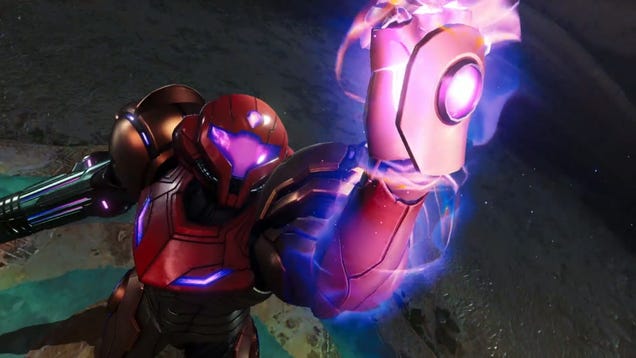
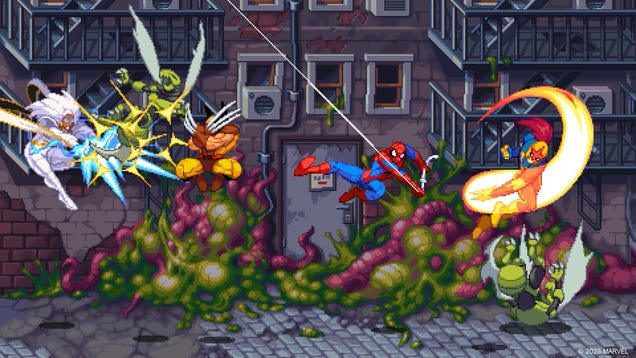
Marvel and Dotemu just announced Marvel Cosmic Invasion, a co-op, ‘90s-inspired beat ‘em up starring famous comic book characters and set to launch later this year. The cool-looking brawler is from the same studio that brought us 2022’s very, very good TMNT: Shredder’s Revenge.
The original AirFly Pro is a fantastic little device that lets you stream wireless audio from any standard 3.5mm headphone jack. This made it a great tool for inflight entertainment systems, treadmills, CD players and any other old-school gadgets that lack Bluetooth. Manufacturer Twelve South just announced a follow-up, the AirFly Pro 2, that brings even more features to the table.
The AirFly Pro 2 doesn’t reinvent the wheel. It’s still a dongle that connects to headphone jacks to provide wireless audio via Bluetooth. This new release offers improved sound quality, thanks to the Qualcomm QCC3056 audio processor. The company says this upgraded processor “optimizes sound quality and latency, making movies, music and games sound even better.” It also helps reduce background noise.
There’s a dedicated volume control button right on the dongle, which is a nice touch. This device offers multipoint connectivity, so two people can stream audio simultaneously. Twelve South says that the AirFly Pro 2 should also connect to headphones faster than previous models.
It’s available to purchase right now for $60. This is a small bump from the first AirFly Pro, which cost $55.
This article originally appeared on Engadget at https://www.engadget.com/audio/headphones/the-airfly-pro-2-wireless-headphone-dongle-offers-improved-sound-and-volume-control-155811522.html?src=rss
Switch players who buy their games on physical cards are used to being able to share those games with other players simply by handing them the card. Now, Nintendo is planning a process to allow players to share their digital Switch purchases in a similar way.
The new “virtual game card” system—which Nintendo announced today ahead of a planned late April rollout—will allow players to “load” and “eject” digital games via a dedicated management screen. An ejected digital game can’t be played on the original console, but it can be digitally loaded onto a new console and played there without restriction by any user logged into that system.
While an Internet connection is required when loading and ejecting digital games in this way, the Internet will not be required to play the shared digital game after that initial process is complete. And while both Switch consoles will need to be synced up via a “local connection” the first time such sharing is done, subsequent shares won’t require the consoles to be in physical proximity.
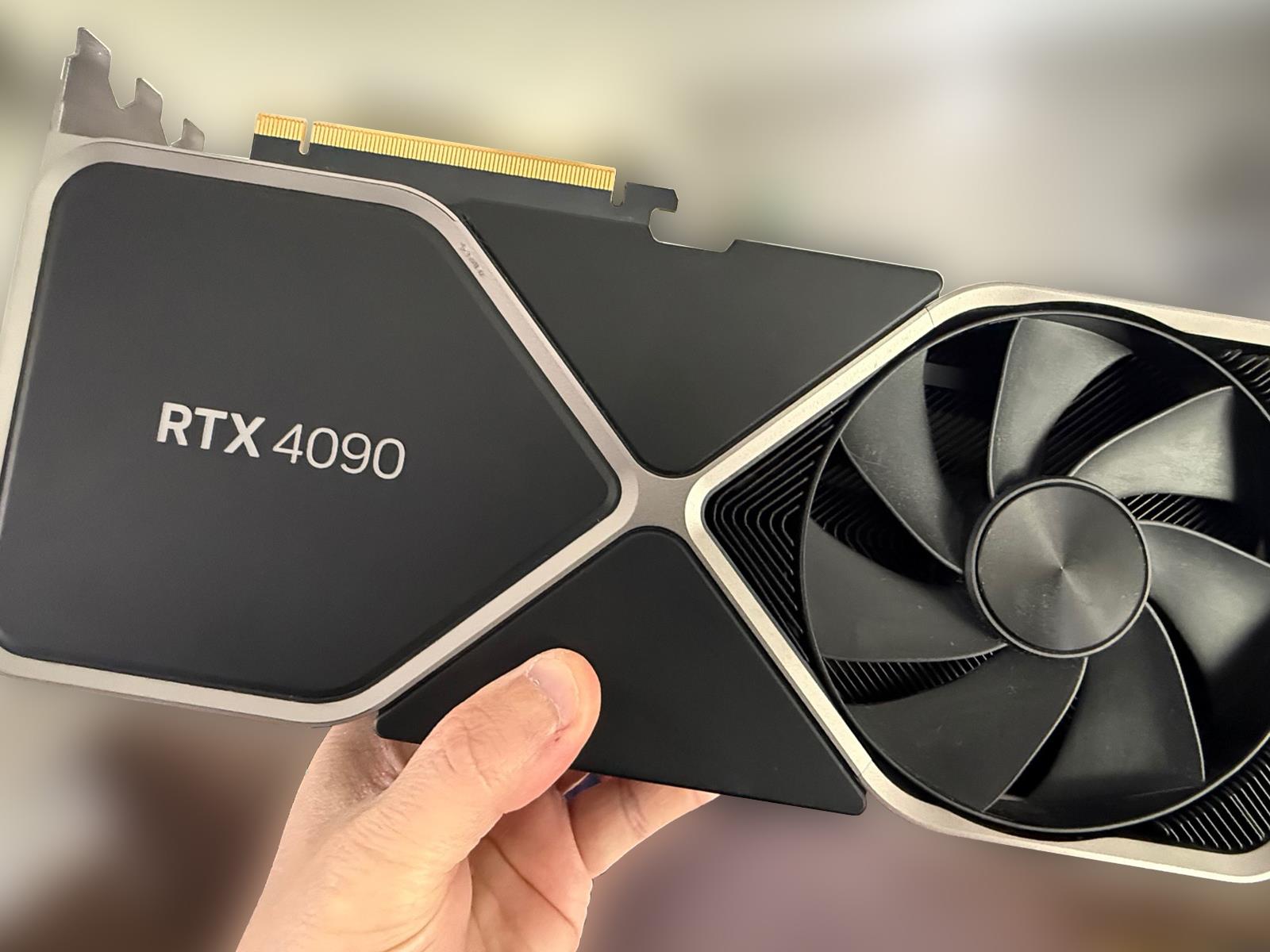
Find me a scammer with scruples and I’ll show you where to buy ocean front property in Arizona. Neither exists and I was reminded of this after selling a graphics card on eBay. Selling anything online, be it through eBay, Facebook Marketplace, Craigslist, or wherever else is always a headache (or series of headaches) in my experience, and
Arthur Cohen has posted a massive series of patches in four parts
(part 1, part 2, part 3, part 4)
upstreaming all of the recent work on the GCC Rust front end. These
changes include the Polonius borrow checker, the foreign-function
interface, inline assembly support, if-let statement handling,
multiple built-in derive macros, for loops, and more.
It’s been a while since Engadget has highlighted a Humble Bundle, but the latest one is just too good to ignore. The Dice and Destiny collectionbrings together six incredible RPGs in support of CARE, an NGO that fights hunger and poverty globally. For about $15, you get Broken Roads, Citizen Sleeper, Disco Elysium, Pillars of Eternity, Pillars of Eternity II: Deadfire, Roadwarden and a coupon for 15 percent off of Citizen Sleeper 2: Starward Vector.
Having played most of the games in this bundle, I can safely say they’re all well-worth your time, but a few stand out. Disco Elysium needs no introduction. It was one of the most critically acclaimed games of 2019, and if you haven’t played it yet, this is great way to get Disco Elysium for cheap. But it’s not my favorite game in the collection. That distinction is shared by Citizen Sleeper and Roadwarden.
In tone, they’re very different games. Citizen Sleeper is set in a dystopian far future, while Roadwarden is a dark fantasy RPG that fans of The Witcher series will love. However, both feature incredible writing, music and art, and if you love games where your decisions matter, few will scratch that itch like Citizen Sleeper and Roadwarden.
This article originally appeared on Engadget at https://www.engadget.com/gaming/pc/the-latest-humble-bundle-brings-together-six-must-play-rpgs-154850448.html?src=rss
We may earn a commission from links on this page. Deal pricing and availability subject to change after time of publication.
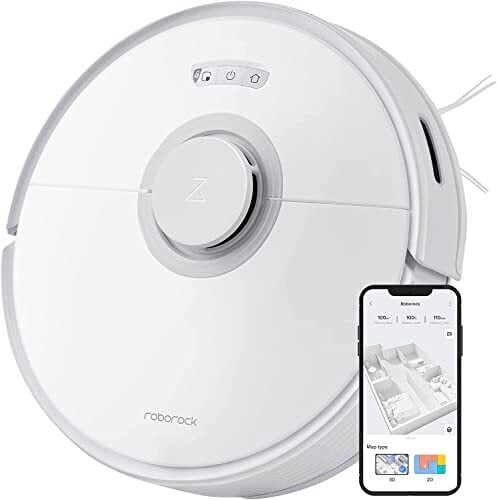
Roborock is the maker of many fine robot vacuums (and vacuum/mop combos). They are so fine, in fact, that even when they’re on sale, as many of them have been for the past few days during Amazon’s Big Spring Sale, they can cost you several hundred dollars. One Roborock vacuum-and-mop combo, however, is really discounted right now: The Q7 Max is $189.99 (Amazon lists its regular price as $299.99 and the Roborock website shows the original price as a whopping $599.99).
The Roborock Q7 Max specs
Roborock Q7 Max Robot Vacuum and Mop
So, what do you get for $189.99? The Q7 Max comes with 4,200Pa of suction, which is modest but powerful. (Some Roborocks ratchet the suction power up to 10,000Pa, but if you’re dealing with a standard amount of household dust, this should suffice.) This device also vacuums and mops simultaneously, saving time and effort. Like other models, you get 30 adjustable water flow levels, which means you can customize what the robot does based on your own preferences and flooring materials. It’s not self-cleaning when it’s in its dock, so you will need to empty the dust and water tanks periodically.
One of the key selling points of this brand’s vacuums is its Lidar navigation, which enables the vacuums to create 3D maps of your space over time. From there, the machine will figure out the most efficient cleaning route and learn to avoid obstacles. It detects stairs, automatically returns to its charging dock when it needs to, and comes with a feature that allows you to lock it in using the mobile app so your kids and pets can’t mess with it.
It’ll run for up to 180 minutes on one charge and can cover over 3,200 square feet in that time. This model uses a rubber brush that stays low to the floor to pick up dirt and hair, both from flat surfaces and out of crevices. All that being said, it only runs on 2.4G wifi, so don’t try to connect it to anything heavier-duty.
AI Limit is a challenging new soulslike title from SenseGames that I’d argue punches well above its asking price of only $35. But there’s a lot to take in during its opening hours, from fairly in-depth gameplay mechanics and button combinations to exploring locations densely packed with secrets to uncover. I don’t…
The growing energy use of AI has gotten a lot of people working on ways to make it less power hungry. One option is to develop processors that are a better match to the sort of computational needs of neural networks, which require many trips to memory and a lot of communication between artificial neurons that might not necessarily reside on the same processor. Termed “neuromorphic” processors, this alternative approach to hardware tends to have lots of small, dedicated processing units with their own memory and an extensive internal network connecting them.
Examples like Intel’s Loihi chips tend to get competitive performance out of far lower clock speeds and energy use, but they require a lot of silicon to do so. Other options give up on silicon entirely and perform the relevant computation in a form of phase change memory.
A paper published in Nature on Wednesday describes a way to get plain-old silicon transistors to behave a lot like an actual neuron. And unlike the dedicated processors made so far, it only requires two transistors to do so.
We may earn a commission from links on this page. Deal pricing and availability subject to change after time of publication.
If you’re a developer, hobbyist, or just someone trying to keep up with modern programming tools without emptying your wallet, this deal might catch your eye: Microsoft Visual Studio Professional 2022 is currently going for $27.97 on StackSocial—down from its usual $499. That’s a one-time payment for lifetime access. Once you buy, the redemption code gets emailed to you instantly, and you have 30 days to activate it. There are no recurring fees, just a fully loaded development environment with features that make coding faster, cleaner, and less of a headache.
This version of Visual Studio marks a shift—it’s their first 64-bit IDE that handles larger projects without choking. If you’ve ever waited for your code editor to stop freezing while dealing with massive workloads, that’s less of a concern here. It supports cross-platform app development through .NET MAUI, so you’re covered whether you’re building for Android, iOS, or desktop. Plus, features like Live Share make collaboration less chaotic. You can co-code in real time, control what collaborators see, and even carry over your custom settings. There’s also IntelliCode, which is basically AI that learns your coding habits and fills in the blanks intelligently. It can finish lines of code or suggest the next logical move based on your style and context. It’s a little eerie, but it works. You can also build, test, and deploy to Azure right from the IDE, which is great if you’re cloud-focused.
There are some things to keep in mind. This is for Windows users only. If you’re working on a Chromebook, iPad, or even a 32-bit system—this won’t work. It’s compatible with Windows 10 and 11, and you’ll need at least 4GB of RAM (though more is better). Depending on how many features you install, it also takes up anywhere from 850MB to 210GB of storage.
Robinhood might have broken into the zeitgeist as a platform for trading meme stocks and cryptocurrencies, but now it’s following through on long-held ambitions in the hope of becoming a one-stop shop for all your finance needs. Starting this fall, it will offer banking services.
Those with a Gold subscription will have access to Robinhood Banking, billed as a private banking offering with individual and joint checking and savings accounts as well as luxury benefits on offer. There will be the option to send money to others in more than 100+ countries and, handily for those who are tired of traipsing to an ATM, you can have cash delivered to your door the same day you request it (depending on your location).
Features include access to estate planning and tax advisors, round-the-clock support, instant transfers between Robinhood accounts and up to $2.5 million in FDIC insurance through partner institutions. From the jump, there will be accounts for kids with spending controls and allowance options. You can have a debit Mastercard for your spending needs. Robinhood already offers a credit card. There will be the ability to link external bank accounts so you can better track your total net worth too.
As for those perks, Robinhood says it will offer the likes of “tickets to exclusive events like the Met Gala, Oscars, F1 Monaco Grand Prix, The Masters and more, as well as private jet travel, global private chauffeurs, luxury helicopter rides and members-only vacation clubs.” Some of those seem like lofty promises. The Met Gala or the Oscars don’t exactly just let anyone in, no matter how deep their pockets may be.
Robinhood has also revealed other notable updates. Robinhood Strategies is open to Gold members today and other users will get access next month. This is billed as a low-cost wealth management service. The annual management fee is 0.25 percent but that’s capped at $250 per year for Gold members with at least $100,000 in investments (Gold costs $5 per month or $50 per year). Portfolio offerings include single stocks and exchange-traded funds (ETFs), with your risk tolerance, time horizon and other factors taken into account.
Later in 2025, the platform will debut an AI-powered investment feature called Robinhood Cortex. The aim here is to provide real-time market analysis and insights, such as what may be impacting changes to a stock price. The tool will offer trading suggestions based on your goals as well.
This article originally appeared on Engadget at https://www.engadget.com/big-tech/robinhood-is-moving-into-banking-services-with-luxury-perks-and-same-day-cash-delivery-152523887.html?src=rss
Nintendo has announced plans to introduce Virtual Game Cards for its Switch console in late April, allowing users to share digital games across multiple systems, the Japanese gaming company said during its Nintendo Direct event. The new feature will enable players to virtually load and eject digital games between Nintendo Switch consoles, mimicking the flexibility of physical game cartridges.
Users can play a single digital title on up to two systems, requiring only a one-time local connection between devices. The company has also confirmed that Virtual Game Cards will be compatible with both current and next-generation hardware. The system will also feature a family sharing option, allowing users to lend digital games to family members for two-week periods before automatically returning to the owner’s account.
Because I was just thinking the real world should be more like the music video for A-ha’s ‘Take On Me’, these are a handful of videos from California artist Joshua Vides, who wraps vehicles and paints them to look like they’re pen and ink drawings reminiscent of pop-art comics. The results are uncanny, and I want that Porsche. Or any Porsche, really. I imagine young me is probably sick to his stomach right now knowing I haven’t been able to make that happen yet.
With the era of the original Switch just about to set below gaming’s horizon, Nintendo has hit the internet with a curtain call of a Direct for the portable console.
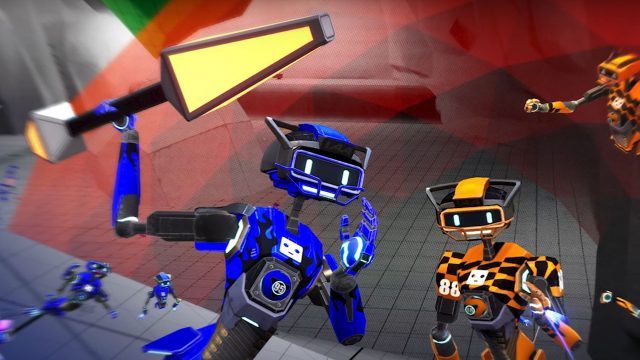
Gorilla Tag studio Another Axiom announced Orion Drift is getting its first big update since early access launch last month, bringing to the sprawling space station a new mini-game called ‘Capture the Beacon’ (CTB).
Like capture the flag, CTB is all about moving a rod-shaped beacon to your team’s base, although the twist is Orion Drift isn’t capping player numbers, and sets no time limit to the game, meaning anyone can jump into the action at any time.
The studio says there is “a ton more to this update,” although they haven’t revealed exactly what else is coming alongside the new mini-game. We’re sure to learn more when the update drops tomorrow, March 28th at 10AM PT (local time here).
Released on Quest in early access for free in late February, Orion Drift leverages Gorilla Tag’s locomotion, letting players move throughout the sprawling space station by physically pumping their arms, propelling them forward.
Outside of CBT, the game already has a number of activities, including its flagship game ‘Drift Ball’—essentially the spiritual successor to now-defunct sports game Echo VR, albeit more similar to a low-gravity game of handball.
There are other mini-games across the station’s various districts, including a parkour for Gorilla Tag-style climbing, practice arenas to hone your Drift Ball skills, golf and basketball mini-games, and lounges to watch ongoing matches across multiple arenas.
At this point, the game supports up to 75 players per-server, although Another Axiom says it’s aiming to bump that number to 200 players eventually. Filling out its selection of mini-games feels like a big step in that direction, although it’s still early days for Orion Drift.
While largely following Gorilla Tag’s playbook of offering engaging, drop-in social games, Orion Drift still hasn’t garnered the same sort of viral success as its predecessor. At the time of this writing, the free game has only generated around 3,300 user reviews, and also hasn’t managed to break the 50 top-selling Quest games; the top three are Animal Company, Yeeps, and Gorilla Tag.
The US Space Force celebrated its fifth birthday last year, when it boasted an annual budget of $29 billion, about 3.5 percent of the Pentagon’s overall funding level.
On March 15, President Donald Trump signed a stopgap spending bill that set the Space Force’s budget for fiscal year 2025 at $28.7 billion. This was the first cut to the Space Force’s budget since Trump created the military’s newest service branch in 2019.
Gen. Chance Saltzman, the top general in the Space Force, worries that the budget crunch will hamstring the military’s ability to match China’s fast-growing space architecture. The Space Force is charged with developing and operating satellites, ground systems, and weapons that the Pentagon could use to track and target enemy forces on the ground and in space.
Nintendo is cutting out the middle man (us). In Thursday’s Nintendo Direct presentation, the company announced its new smartphone app, Nintendo Today!, that will provide daily updates on games, characters and events. These tidbits might show up as videos, comic strips or quick break downs.
The app also has an animated calendar that is customizable to themes from some of Nintendo’s biggest titles, like The Legend of Zelda, Super Mario and Animal Crossing. Plus, it will include a schedule of events based on categories you choose or your favorite games. Similarly, you can add a widget to your home screen and then add art from one of Nintendo’s game series.
These news blasts will soon include more information on the Nintendo Switch 2. The company is holding a separate Nintendo Direct on April 2 just for the new system and will subsequently share updates on it and its games on the app.
Anyone with a Nintendo account can access Nintendo Today! app on an iOS or Android device. It should be available to download today.
This article originally appeared on Engadget at https://www.engadget.com/gaming/nintendo/nintendo-today-app-will-provide-updates-on-games-events-and-the-switch-2-150808151.html?src=rss
Today’s Nintendo Direct provided a surprising bit of software news. The company just announced something called Virtual Game Card, which is a way to make playing and sharing downloaded titles more convenient.
As the name suggests, this system creates a digital simulacrum of a physical game card. This means that multi-Switch households will easily be able to start a game on one console and transfer to another without any real hassle. Nintendo says they want to make digital games as easy to use as physical game cards.
Sure, starting something on a regular Switch before moving over to the OLED model is a nice feature, but that’s not the only hook. Nintendo, a company that famously loves money, is going to let us lend out digital games. This is pretty darned cool.
There are some caveats. You can only loan games to up to eight people on the same Nintendo Family Account, so it’s really for families and tight-knit groups of friends. Also, the systems have to be able to connect locally via the same wireless network. So you can’t loan out a game to someone on the other side of the country.
You can only lend one game out at a time and it lasts for two weeks. This functionality will be available at the end of April. Don’t worry. It’s also coming to Switch 2.
This article originally appeared on Engadget at https://www.engadget.com/gaming/nintendo/nintendo-just-introduced-a-way-to-loan-out-digital-games-to-friends-and-family-150733308.html?src=rss
Pico 4 Ultra OS 5.13.0 brings free window positioning, 3D screen recording, 2D to 3D image conversion, and more.
The update arrives around six months after the launch of Pico 4 Ultra, and greatly enhances its spatial computing capabilities.
ByteDance’s Pico 4 Ultra is arguably the only direct competitor to Quest 3, and the only other headset on the market to use the Snapdragon XR2 Gen 2 chipset. But like its predecessor, Pico 4 Ultra is not available in North America.
Free Window Positioning
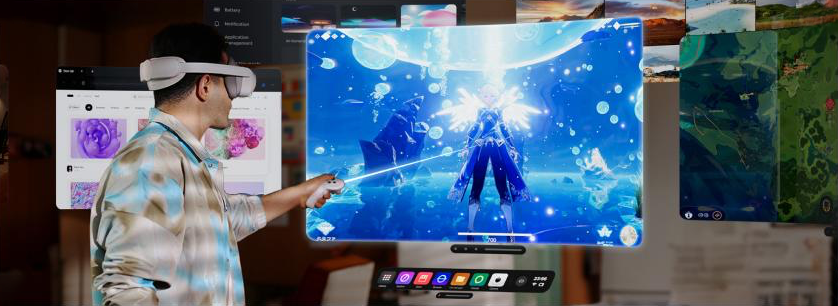
While Apple’s visionOS has let you freely position 2D windows since Vision Pro’s launch, and Meta’s Horizon OS for its Quest headsets has since last year, Pico OS until now took a different approach. You could only move them along the surface of an invisible 360° bubble centered on your position, meaning every window was at the same distance from you, and we criticized this in our hands-on impressions.
Now, with Pico OS 5.13.0, this restriction is gone. As with visionOS and Horizon OS, you can freely position windows exactly where you want them, including adjusting their distance.
2D To 3D Image Conversion
Pico 4 Ultra can now convert any image in your gallery into a 3D image, including batch conversion of many at once.
Apple Vision Pro got this feature in visionOS 2 in September.
Pico OS 5.13.0 also adds the ability to view Spatial Photos taken with your iPhone 16, something currently only possible on Apple Vision Pro.
3D Screen Recording
Pico OS 5.13.0 adds the ability for Pico 4 Ultra to screen record in 3D. The headset could already capture 3D videos from the passthrough cameras, but this now includes VR and mixed reality objects and interfaces.
This is a unique and interesting feature that we haven’t seen on any other headset.
Override Graphics & Performance Options
Pico OS 5.13.0 adds the ability to override key graphics and performance options normally set by each app via a new app called Performance Tuner.
This includes the screen refresh rate, render resolution, CPU and GPU levels, fixed foveated rendering extremity, and more.
Performance Tuner is intended for developers, and requires developer mode to be enabled.
Improved Passthrough & Hand Tracking
With Pico OS 5.13.0, ByteDance says it has improved the quality of passthrough in low-light conditions.
It also says it has improved hand tracking, with the following improvements:
• Reduced latency and false touch occurrences. • Improved tracking stability in low-light conditions. • Enhanced gesture accuracy and fidelity. • Improved alignment between virtual hand models and real hands in Seethrough mode. • Fixed an issue where hand rotation would interrupt dragging.
Improved Motion Tracker Body Tracking
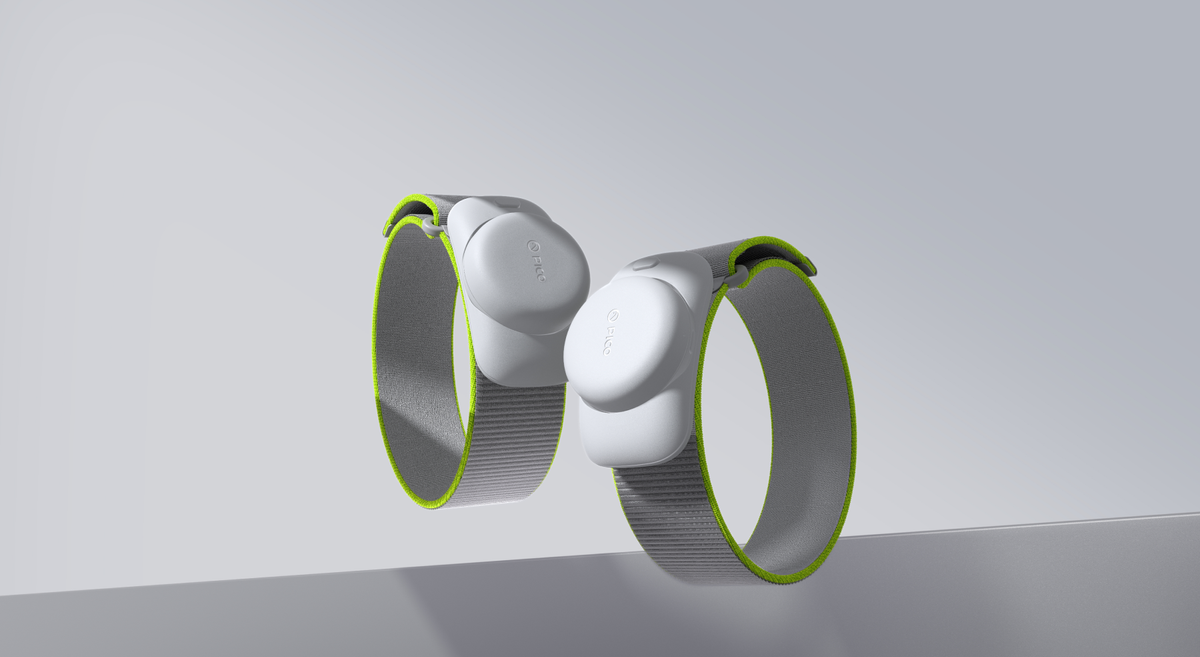
Pico OS 5.13.0 also brings improved body tracking quality. Body tracking on Pico is driven by the Pico Trackers accessory, which by default you strap to your ankles.
Here are the improvements ByteDance says it has made:
• Enhanced posture stability during prolonged periods of sitting or lying down, reducing virtual character drifting and standing errors. • Increased update frequency of full-body motion tracking data, improving motion smoothness. • Improved flexibility and accuracy of complex lying positions, providing a better experience when used with the waist tracker.




 ( vee – dez )
  (@joshuavides)