Integrating generative AI into introductory programming classes

Generative AI (GenAI) tools like GitHub Copilot and ChatGPT are rapidly changing how programming is taught and learnt. These tools can solve assignments with remarkable accuracy. GPT-4, for example, scored an impressive 99.5% on an undergraduate computer science exam, compared to Codex’s 78% just two years earlier. With such capabilities, researchers are shifting from asking, “Should we teach with AI?” to “How do we teach with AI?”


Photo of Leo Porter (UC San Diego)
Leo Porter from UC San Diego
Photo of Daniel Zingaro (University of Toronto)
Daniel Zingaro from the University of Toronto

Leo Porter and Daniel Zingaro have spearheaded this transformation through their groundbreaking undergraduate programming course. Their innovative curriculum integrates GenAI tools to help students tackle complex programming tasks while developing critical thinking and problem-solving skills.

Leo and Daniel presented their work at the Raspberry Pi Foundation research seminar in December 2024. During the seminar, it became clear that much could be learnt from their work, with their insights having particular relevance for teachers in secondary education thinking about using GenAI in their programming classes

Practical applications in the classroom

In 2023, Leo and Daniel introduced GitHub Copilot in their introductory programming  CS1-LLM course at UC San Diego with 550 students. The course included creative, open-ended projects that allowed students to explore their interests while applying the skills they’d learnt. The projects covered the following areas:

  • Data science: Students used Kaggle datasets to explore questions related to their fields of study — for example, neuroscience majors analysed stroke data. The projects encouraged interdisciplinary thinking and practical applications of programming.
  • Image manipulation: Students worked with the Python Imaging Library (PIL) to create collages and apply filters to images, showcasing their creativity and technical skills.
  • Game development: A project focused on designing text-based games encouraged students to break down problems into manageable components while using AI tools to generate and debug code.

Students consistently reported that these projects were not only enjoyable but also responsible for deepening their understanding of programming concepts. A majority (74%) found the projects helpful or extremely helpful for their learning. One student noted that.

“Programming projects were fun and the amount of freedom that was given added to that. The projects also helped me understand how to put everything that we have learned so far into a project that I could be proud of.“

Core skills for programming with Generative AI

Leo and Daniel emphasised that teaching programming with GenAI involves fostering a mix of traditional and AI-specific skills.
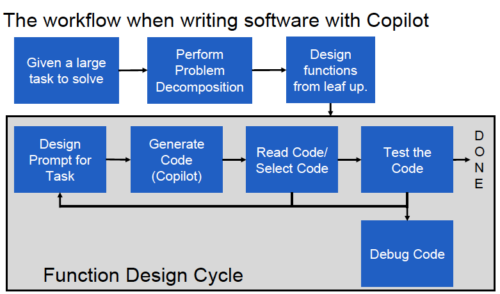
Infographic highlighting a workflow when writing software with Copilot.
Writing software with GenAI applications, such as Copilot, needs to be approached differently to traditional programming tasks

Their approach centres on six core competencies:

  • Prompting and function design: Students learn to articulate precise prompts for AI tools, honing their ability to describe a function’s purpose, inputs, and outputs, for instance. This clarity improves the output from the AI tool and reinforces students’ understanding of task requirements.
  • Code reading and selection: AI tools can produce any number of solutions, and each will be different, requiring students to evaluate the options critically. Students are taught to identify which solution is most likely to solve their problem effectively.
  • Code testing and debugging: Students practise open- and closed-box testing, learning to identify edge cases and debug code using tools like doctest and the VS Code debugger.
  • Problem decomposition: Breaking down large projects into smaller functions is essential. For instance, when designing a text-based game, students might separate tasks into input handling, game state updates, and rendering functions.
  • Leveraging modules: Students explore new programming domains and identify useful libraries through interactions with Copilot. This prepares them to solve problems efficiently and creatively.

Ethical and metacognitive skills: Students engage in discussions about responsible AI use and reflect on the decisions they make when collaborating with AI tools.
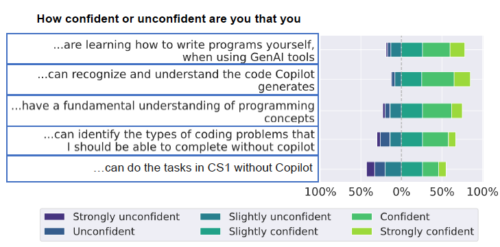
Graphic depicting students' confidence levels regarding their programming skills and their use of Generative AI tools.

Adapting assessments for the AI era

The rise of GenAI has prompted educators to rethink how they assess programming skills. In the CS1-LLM course, traditional take-home assignments were de-emphasised in favour of assessments that focused on process and understanding.
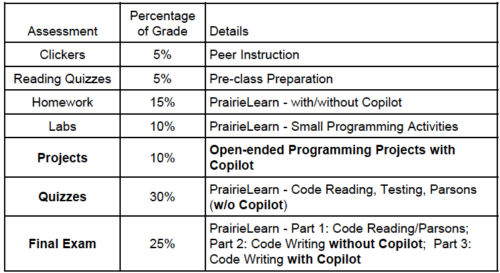
Table highlighting the different types of assessments involved in Leo and Daniel's course.
Leo and Daniel chose several types of assessments — some involved having to complete programming tasks with the help of GenAI tools, while others had to be completed without.
  • Quizzes and exams: Students were evaluated on their ability to read, test, and debug code — skills critical for working effectively with AI tools. Final exams included both tasks that required independent coding and tasks that required use of Copilot.
  • Creative projects: Students submitted projects alongside a video explanation of their process, emphasising problem decomposition and testing. This approach highlighted the importance of critical thinking over rote memorisation.

Challenges and lessons learnt

While Leo and Daniel reported that the integration of AI tools into their course has been largely successful, it has also introduced challenges. Surveys revealed that some students felt overly dependent on AI tools, expressing concerns about their ability to code independently. Addressing this will require striking a balance between leveraging AI tools and reinforcing foundational skills.

Additionally, ethical concerns around AI use, such as plagiarism and intellectual property, must be addressed. Leo and Daniel incorporated discussions about these issues into their curriculum to ensure students understand the broader implications of working with AI technologies.

A future-oriented approach

Leo and Daniel’s work demonstrates that GenAI can transform programming education, making it more inclusive, engaging, and relevant. Their course attracted a diverse cohort of students, as well as students traditionally underrepresented in computer science — 52% of the students were female and 66% were not majoring in computer science — highlighting the potential of AI-powered learning to broaden participation in computer science.

A girl in a university computing classroom.

By embracing this shift, educators can prepare students not just to write code but to also think critically, solve real-world problems, and effectively harness the AI innovations shaping the future of technology.

If you’re an educator interested in using GenAI in your teaching, we recommend checking out Leo and Daniel’s book, Learn AI-Assisted Python Programming, as well as their course resources on GitHub. You may also be interested in our own Experience AI resources, which are designed to help educators navigate the fast-moving world of AI and machine learning technologies.

Join us at our next online seminar on 11 March

Our 2025 seminar series is exploring how we can teach young people about AI technologies and data science. At our next seminar on Tuesday, 11 March at 17:00–18:00 GMT, we’ll hear from Lukas Höper and Carsten Schulte from Paderborn University. They’ll be discussing how to teach school students about data-driven technologies and how to increase students’ awareness of how data is used in their daily lives.

To sign up and take part in the seminar, click the button below — we’ll then send you information about joining. We hope to see you there.

The schedule of our upcoming seminars is online. You can catch up on past seminars on our previous seminars and recordings page.

The post Integrating generative AI into introductory programming classes appeared first on Raspberry Pi Foundation.


Richie’s Plank Experience & Max Mustard “Unilaterally” Delisted From Quest Store By Meta

Richie’s Plank Experience and Max Mustard have been delisted on Quest under the “Platform Abuse Policy”, with the developer calling this a “unilateral” decision from Meta.

Yesterday we noticed that both of Toast Interactive’s games were no longer available to buy on Quest’s Horizon Store. The store pages still exist, but the games cannot be purchased, and a ‘This app is out of compliance with Meta’s Platform Abuse Policy” notice is visible at the top.

At first, we thought this might be a technical or administrative issue, perhaps the studio forgetting the Data Use Checkup, an oversight that has seen a good few games temporarily delisted in the past.

But now, Toast Interactive has made a public statement on its social media pages, saying that Meta “unilaterally” took the decision, and that it feels “betrayed and powerless on many levels”.

Here’s the full statement:

“Unfortunately, Meta has unilaterally chosen to remove Toast and its two games, Max Mustard and Richies Plank Experience from their store. We feel betrayed and powerless on many levels. We are sorry to all customers who missed out buying Richies Plank and Max Mustard on Meta Quest. We invite you to continue buying our games on Steam, Pico and PlayStation VR in the future. Please express your grievances about Meta’s removal of Toast’s games directly to Meta to help give a voice to the small game developers like us. That’s all we can say at this time, but look forward to sharing our story with you all in the near future. Thank you for your support.”

Meta’s Platform Abuse Policy covers infractions like employing malicious code, using copyrighted content, impersonation, fraud, platform restrictions manipulation, and general illegal activity.

In a reply on X to a comment suggesting the developer has “done something shady”, Toast Interactive stated it “can assure you we did not.”

In another reply, Toast Interactive says Meta has given it a reason for delisting the games, but that it “can’t talk about it yet”.

We’ve reached out to Meta for an official comment, or any context it can provide, and we’ll update this story once we learn more.

The delisting of Toast Interactive’s two games from Quest follows last month’s news that the Australia-based studio had laid off the majority of its team and closed its office. Calling that a “heartbreaking decision,” Toast Interactive advised it would continue working on both games while highlighting issues with the Quest ecosystem that the studio claims affected its sales.

Richie’s Plank Experience and Max Mustard remain available to purchase on PlayStation VR2, Pico, and Steam.

Toast Interactive Closes Office As ‘Majority’ Of Staff Are Made Redundant
Toast Interactive, best known for Richie’s Plank Experience and Max Mustard, has closed its office and laid off the majority of its staff.

India Grants Tax Officials Sweeping Digital Access Powers

India’s income tax department will gain powers to access citizens’ social media accounts, emails and other digital spaces beginning April 2026 under the new income tax bill, in a significant expansion of its search and seizure authority.

The legislation, which has raised privacy concerns among legal experts, allows tax officers to “gain access by overriding the access code” to computer systems and “virtual digital spaces” if they suspect tax evasion.

The bill broadly defines virtual digital spaces to include email servers, social media accounts, online investment accounts, banking platforms, and cloud servers.

“The expansion raises significant concerns regarding constitutional validity, potential state overreach, and practical enforcement,” Sonam Chandwani, Managing Partner at KS Legal and Associates, told Indian newspaper Economic Times.

Read more of this story at Slashdot.

How to Hash a File on Linux

Hashing files is a critical process in the realm of data integrity and security. In this article, we will discuss how to hash a specific file, linuxconfig.txt, using various hashing algorithms available in Linux. Additionally, we will explore how to restore the file based on its hash, ensuring you can verify its integrity over time.

Goldman Sachs: Why AI Spending Is Not Boosting GDP

Goldman Sachs, in a research note Thursday (the note isn’t publicly posted): Annualized revenue for public companies exposed to the build-out of AI infrastructure increased by over $340 billion from 2022 through 2024Q4 (and is projected to increase by almost $580 billion by end-2025). In contrast, annualized real investment in AI-related categories in the US GDP accounts has only risen by $42 billion over the same period. This sharp divergence has prompted questions from investors about why US GDP is not receiving a larger boost from AI.

A large share of the nominal revenue increase reported by public companies reflects cost inflation (particularly for semiconductors) and foreign revenue, neither of which should boost real US GDP. Indeed, we find that margin expansion ($30 billion) and increased revenue from other countries ($130 billion) account for around half of the publicly reported AI spending surge.

That said, the BEA’s (Bureau of Economic Analysis) methodology potentially understates the impact of AI-related investment on real GDP by around $100 billion. Manufacturing shipments and net imports imply that US semiconductor supply has increased by over $35 billion since 2022, but the BEA records semiconductor purchases as intermediate inputs rather than investment (since semiconductors have historically been embedded in products that are later resold) and therefore excludes them from GDP. Cloud services used to train and support AI models are similarly mostly recorded as intermediate inputs.

Combined, we find that these explanations can explain most of the AI investment discrepancy, with only $50 billion unexplained. Looking ahead, we see more scope for AI-related investment to provide a moderate boost to real US GDP in 2025 since AI investment should broaden to categories like data centers, servers and networking hardware, and utilities that will likely be captured as real investment. However, we expect the bulk of investment in semiconductors and cloud computing will remain unmeasured barring changes to US national account methodology.

Read more of this story at Slashdot.

Utah Passes First US App Store Age Verification Law

Utah has become the first U.S. state to pass legislation requiring app store operators to verify users’ ages and obtain parental consent for minors downloading apps.

The App Store Accountability Act adds to a wave of children’s online safety bills advancing through state legislatures nationwide. Similar legislation has faced legal challenges, with many being blocked in courts. A comparable federal bill failed last year amid free expression concerns.

The approach shifts verification responsibility to mobile app stores rather than individual websites, a move supported by Meta, Snap, and X in a joint statement urging Congress to follow suit. “Parents want a one-stop shop to verify their child’s age and grant permission,” they stated. Critics, including Chamber of Progress, warn the law threatens privacy and constitutional rights. A federal judge previously blocked a similar Utah law over First Amendment concerns.

Read more of this story at Slashdot.

Amazon Tests AI Dubbing on Prime Video Movies, Series

Amazon has launched a pilot program testing “AI-aided dubbing” for select content on Prime Video, offering translations between English and Latin American Spanish for 12 licensed movies and series including “El Cid: La Leyenda,” “Mi Mama Lora” and “Long Lost.” The company describes a hybrid approach where “localization professionals collaborate with AI,” suggesting automated dubbing receives professional editing for accuracy. The initiative, the company said, aims to increase content accessibility as streaming services expand globally.

Read more of this story at Slashdot.