Five Reasons You Might Qualify for Lower Car Insurance Premiums

Like homeowners insurance, auto insurance is getting significantly more expensive: Data show that policy costs rose 11% last year, likely due to factors like climate change, rising accident rates, and higher repair costs. Under certain circumstances, you may be able to offset or at least keep your car insurance premium stable, if not reduce it.

If you go through any of the following life changes, it may be time to call your insurance company about lowering your policy premium.

You’ve moved

A move is a major life transition—and one that could impact your auto insurance policy for the better in a few ways. First, insurers factor where you park your car into your rate, so living in a lower density or safer neighborhood can potentially save you some money. Moving also gives you the chance to bundle your renters or homeowners insurance policy with your auto policy if you haven’t already, which typically reduces the cost of both. Finally, moving can change your driving habits, which we’ll get into next.

You’re driving less

Let’s say your move has put your closer to work, or you’ve changed jobs or begun working remotely more frequently, or another shift in your routine has cut the number of miles you drive on a regular basis. Insurance companies consider annual mileage when calculating premiums, so a significant drop could save you some money.

Your family size has changed

If you’ve had a teenager on your policy who now has their own vehicle or own policy and no longer lives at home, removing them from yours can save you a significant amount of money on your premiums (potentially cutting the cost by half). On the flip side, combining your policy with a new spouse’s could reduce the cost per person.

You’ve taken a defensive driving course

One of the many discounts available on auto insurance is for taking a defensive driving course—in fact, some states require insurers to offer this discount. Typically, these discounts are good for several years before you need to retake the class. Discounts range from 5% to 20% off your premium.

Your coverage is about to renew (or expire)

Re-upping your policy won’t save you money specifically, but it is a good time to call your current insurer about options for reducing your premium as well as to shop around for cheaper options.

Other ways to lower your car insurance premium

Even if you don’t have a life change that could qualify you for a lower insurance premium, there are other ways to reduce the cost of your policy:

  • Increase your deductible: Raising your deductible (the amount you’ll pay out of pocket before your policy kicks in) can lower your premium. Most policies have a $500 deductible, but bumping that up to $1,000 can potentially save you 25% on your policy cost, according to Consumer Reports. However, you’ll want to consider whether you have an emergency fund to cover the added potential cost.

  • Decrease certain types of coverage: Collision and comprehensive coverage may be optional in your state, and dropping one or both can reduce your policy premium. Collision may be an unnecessary expense if your car’s value is especially low (and if your premium is more than 10% of that value).

  • Ask about discounts: Many insurers offer policy discounts for things like setting up autopay or paperless statements, paying your premium upfront, maintaining a clean driving record, and bundling with other policies.

  • Drive a cheaper car: This may not be a change you can make immediately, but when you’re in the market for a vehicle, consider a make and model that’s cheaper to insure.

  • Look for usage-based policies: Usage-based insurance calibrates your policy to your real-life driving habits, so low-risk drivers pay less. However, this typically requires you to have a tracking app that sends data to your insurance company, which raises privacy concerns, and risky driving can actually increase your policy cost.

Musk’s Starlink stands to benefit from changes to a broadband equity program

Another day, another move from the Trump administration that will benefit Elon Musk — shocking. The US Department of Commerce has announced an overhaul of 2021’s Broadband Equity, Access, and Deployment (BEAD) program and its $42.5 billion that will funnel work to Musk’s Starlink. 

The BEAD program was originally designed to give states funding for fiber-optic cable installation, increase Wi-Fi networks and free broadband internet access for some individuals. Fiber-optic broadband provides the fastest internet speeds, but the new mandate will get rid of BEAD’s preference for it. 

“The Department is ripping out the Biden Administration’s pointless requirements,” said US Secretary of Commerce Howard Lutnick in a statement. “It is revamping the BEAD program to take a tech-neutral approach that is rigorously driven by outcomes, so states can provide internet access for the lowest cost.” 

The writing on the wall is clear: Musk, the richest person in the world, leader of a department to reduce government waste (read: cut many critical jobs and programs) and an unelected right hand to what can best be described as an authoritarian government, is about to make even more money.

Under the Biden administration in 2023, Starlink received a rejection from the Federal Communications Commission for nearly $900 million in subsidies. The FCC stated that Starlink’s application, which was part of the Rural Digital Opportunity Fund program, failed to meet the program’s requirements. 

This article originally appeared on Engadget at https://www.engadget.com/big-tech/musks-starlink-stands-to-benefit-from-changes-to-a-broadband-equity-program-132521582.html?src=rss

Massive botnet that appeared overnight is delivering record-size DDoSes

A newly discovered network botnet comprising an estimated 30,000 webcams and video recorders—with the largest concentration in the US—has been delivering what is likely to be the biggest denial-of-service attack ever seen, a security researcher inside Nokia said.

The botnet, tracked under the name Eleven11bot, first came to light in late February when researchers inside Nokia’s Deepfield Emergency Response Team observed large numbers of geographically dispersed IP addresses delivering “hyper-volumetric attacks.” Eleven11bot has been delivering large-scale attacks ever since.

Volumetric DDoSes shut down services by consuming all available bandwidth either inside the targeted network or its connection to the Internet. This approach works differently than exhaustion DDoSes, which over-exert the computing resources of a server. Hypervolumetric attacks are volumetric DDoses that deliver staggering amounts of data, typically measured in the terabits per second.

Read full article

Comments

Eric Schmidt Argues Against a ‘Manhattan Project for AGI’

In a policy paper, former Google CEO Eric Schmidt, Scale AI CEO Alexandr Wang, and Center for AI Safety Director Dan Hendrycks said that the U.S. should not pursue a Manhattan Project-style push to develop AI systems with “superhuman” intelligence, also known as AGI. From a report: The paper, titled “Superintelligence Strategy,” asserts that an aggressive bid by the U.S. to exclusively control superintelligent AI systems could prompt fierce retaliation from China, potentially in the form of a cyberattack, which could destabilize international relations.

“[A] Manhattan Project [for AGI] assumes that rivals will acquiesce to an enduring imbalance or omnicide rather than move to prevent it,” the co-authors write. “What begins as a push for a superweapon and global control risks prompting hostile countermeasures and escalating tensions, thereby undermining the very stability the strategy purports to secure.”

Read more of this story at Slashdot.

The best action cameras for 2025

If you’re into kite surfing, skiing, rock climbing or other adventure sports and want to film your activities, an action camera is the only way to go. In the past, GoPro was uniquely associated with this type of first-person action filming. But now, buyers now have more choice, with models also available from DJI and Insta360. Each company has its own strength, with Insta360 specializing in 360-degree video, DJI known for low-light video quality and GoPro making solid all-around cams with a wide choice of accessories.

That raises the question, which one has the best features for your personal exploits? Engadget has been testing action cameras for more than 16 years and with that experience, we can help you find the right model for your budget and needs.

Action cameras have certain traits that separate them from regular cameras or smartphones. The most important is ruggedness that makes them resistant to water, dust and shocks. Most action cameras are now waterproof without the need for a separate enclosure. At the same time, you can purchase housing accessories to make them waterproof to even greater depths.

Video quality is also key. Every model we recommend goes to at least 4K 60fps, but some models like GoPro’s latest Hero 13 boost resolution up to 5.3K 60fps, or even 8K 30p with the Insta360 Ace Pro 2. That allows you to crop in on shots and capture vertical video at higher resolutions for social media. Another nice feature is log video that improves dynamic range when filming on sunny, contrasty days. And if you film in dim environments, you’ll want the largest sensor possible for the best low-light performance.

For activities with bumps and jolts like mountain biking, stabilization is incredibly important. You want your video to look smooth, but still need to convey the thrill and speed of the action. The Hero 13 is still the best in this regard, delivering jolt-free video that makes the viewer feel like they’re going down the bike trail or ski slope, with no annoying digital artifacts. DJI and Insta360’s products are good, but not quite at that level yet.

Some action cameras are easier to handle and use, so take that into account as well. You’ll want bright and colorful displays both front and back, buttons you won’t have to fumble to find and easy-to-use menus. Remote control is another factor that can ease operation. And you’ll want to check which software is available to improve stabilization, edit video, remove selfie sticks and more.

Then there’s the area of accessories. Do you need helmet or chest mounts, waterproof housings or battery charger? GoPro has the largest number of those, but DJI makes handy wireless mics that connect directly with its cameras. And of course, battery life is critical for action shooting as it’s hard to change one when you’re out surfing.

This article originally appeared on Engadget at https://www.engadget.com/cameras/best-action-camera-130017459.html?src=rss

This Simple Text Document Could Replace Your Calendar App

Gina Trapani, founder of the website you’re reading right now, popularized a plaintext format for to-do lists way back in 2006 (please excuse any weird formatting on that nearly 20-year-old article). Called Todo.txt, it is used by many people to this day, in part thanks to an ecosystem of applications built around the format.

I recently stumbled on Calendar.txt, by author and teacher Tero Karvinen. It’s a text document based on a similar philosophy—a stripped down, just-the-basics take on your overloaded calendar app. It’s a concept worth considering. We’re at least a decade into the “using a separate app for everything” era, and sure, a lot of those apps are pretty great. I’ve spent years recommending software-based tools for everything from managing tasks to making drinks, and I don’t plan to stop anytime soon.

But not everyone needs a bespoke app for everything they do. Productivity is personal, and everyone has different needs. I’ve known several highly technically competent people who still use paper day planners to track their appointments and tasks—a simple notebook is flexible in a way that no app can match.

One line of text per day

I view plaintext tools like Calendar.txt in a similar light. This specific tool is about as simple as it gets: It uses one line of text for every day. You can download a pre-made file with lines for dates that stretches through the year 2033, or you can just make your own.

Every line starts with the date, followed by the week number, followed by a three-letter week name. The idea is that you write your appointments after that, by simply writing the time, followed by the name of the event. Events are simply added, in order, to the line.

So, for example, a line for today, with one appointment/task (me cleaning the house this afternoon) would look like this:


2025-03-06 w10 Thu 14 cleaning the house


There are many shortcomings to this approach. There’s no built-in tool for reminding you of events, for one thing, and there’s no way to invite others to your appointment. But this simple approach might work for you.

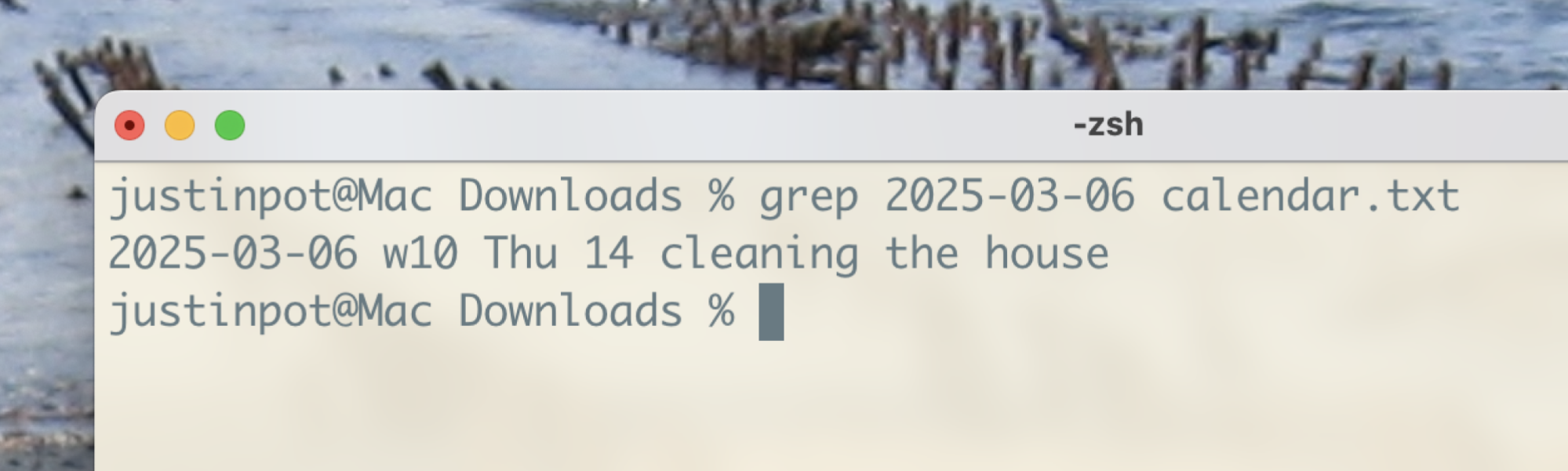
And, as todo.txt demonstrated two decades ago, there are benefits to using plaintext files. Plaintext is versatile, can be opened on any device, and your files won’t disappear because some software company decides it wanted to change its priorities. If you’re familiar with the command line, you can use existing tools in all kinds of interesting ways. For example, the calendar.txt documentation shows how you can use grep, a tool for searching text documents, to pull up today’s appointments:


grep 2025-03-06 calendar.txt


You could use the same command to search for events by the day.

A Mac terminal. The command "grep 2025-03-06 calendar.txt" pulls up the appointments for that day: "2025-03-06 w10 Thu 14 cleaning the house"

Credit: Justin Pot

Again, this approach won’t seem useful to everyone—especially if you never open the command prompt—but not every tool needs to be for every user. Only you can decide which tools work best for you.


Off-Road Racer EXOcars Makes Its PlayStation VR2 Debut Today

EXOcars takes the off-road racing game to PlayStation VR2 today.

Developed by Xocus, EXOcars is a physics-based racing simulator that puts players behind the wheel of a buggy, racing on tarmac tracks and navigating across off-roading expeditions. The experience previously launched on Steam and Quest, though the studio encountered repeat delays over certification issues before reaching PlayStation VR2.


0:00

/0:59


The PS VR2 launch will arrive with post-launch updates previously released on Steam and Quest. That includes a Training Mode that allows players to test their builds before attempting competitive races. For those wanting to try out their curated cars under pressure, EXOcars now includes enemy bots to race against in both standard races and in combat mode.

However, the game won’t launch with a multiplayer mode on PS VR2 due to requested fixes by Sony’s QA, though Xocus confirmed this feature will arrive by the end of March. In a press release for the launch, the studio also reaffirmed that EXOcars will be cross-platform, so anyone on Quest and Steam can play with PS VR2 players when multiplayer goes live.

We enjoyed EXOcars in our review last year, saying, “[EXOcars] provides a visceral, arcade-y, physics-based experience full of the thrilling moments we’re all looking for when we step behind the virtual wheel of a race car.”

EXOcars is now available on PS VR2, Quest and Steam.

EXOcars Review: A Shining Example Of The Racing Genre
EXOcars blends physics-based arcade racing with enjoyable gameplay design, and it’s out tomorrow on Steam and Quest.

Blender’s Vulkan Renderer Is Making Great Progress To Production Readiness This Year

With the release of Blender 4.3 last November an experimental Vulkan back-end was added and it continues to be improved upon for modernizing this 3D creation suite for digital artists and serving a variety of other purposes. The upcoming Blender 4.4 release will further refine the Vulkan support while later in the year it should be reaching production readiness…

FreeBSD Continues Working On 802.11n/802.11ac WiFi & Other Laptop Improvements

The FreeBSD Foundation paired with resources committed by AMD, Dell, and Framework are working to improve FreeBSD laptop support. In recent months there have been FreeBSD development efforts to improve the power management support with modern laptops as well as a strong focus on enhancing the WiFi driver support. A status update was issued yesterday for highlighting the latest FreeBSD laptops efforts…

Meta Delists ‘Max Mustard’ & ‘Richie’s Plank Experience’ from Quest, Citing Violation of Platform Abuse Policy

Toast Interactive announced their VR games Max Mustard (2024) and Richie’s Plank Experience (2017) have been removed from the Horizon Store for Quest. For now, it’s unclear precisely why, however the veteran indie studio says the move has left them feeling “betrayed and powerless.”

“Unfortunately, Meta has unilaterally chosen to remove Toast and its two games, Max Mustard and Richies Plank Experience from their store,” the studio says in a post on X. “We feel betrayed and powerless on many levels.”

While temporary delisting can happen by mistake, this doesn’t appear to be the case. There is a reason, however Toast Interactive says it can’t talk about it yet, separately noting the studio “look[s] forward to sharing our story with you all in the near future.”

In a Reddit post, Toast Interactive says the reason will “blow everyone’s minds. But I’ve been firmly advised not to.”

On both the Max Mustard and Richie’s Plank Experience Horizon Store pages, the reason listed is the apps are “out of compliance with Meta’s Platform Abuse Policy,” although there’s no information on specifically how it fell out of compliance.

Image captured by Road to VR

The company’s platform abuse policy covers a wide range of offenses, such as pirated content, security exploits, or deception of any kind, however it also covers more nebulous areas that are likely left up to interpretation.

Not following developer documentation, or “any other provisions of the Meta Platforms Technologies Terms of Service or Code of Conduct for Virtual Experiences, or any other Meta Platforms Technologies terms, policies or guidelines” can also get an app removed with or without warning, Meta says in its Platform Abuse Policy.

Notably, both games are still available across their other supported platforms, with Max Mustard supporting PC VR, PSVR 2 and Pico headsets, and Richie’s Plank Experience supporting PC VR, the original PSVR and Pico headsets.

This comes at one of the most inopportune times for Toast Interactive. Last month the Gold Coast, Australia-based studio announced it was closing office and laying off a majority of staff.

This follows a first layoff round in November 2024, which affected 10 employees. At the time, the studio maintained that while Max Mustard was “one of the highest-rated games on both PSVR 2 and Meta Quest, it sadly can’t sustain a large indie team.”


This story is breaking: we’ve reached out to Meta for more clarity on the situation and will report back when/if we receive a response, or as more information arises.

The post Meta Delists ‘Max Mustard’ & ‘Richie’s Plank Experience’ from Quest, Citing Violation of Platform Abuse Policy appeared first on Road to VR.