Microsoft Quantum Computing ‘Breakthrough’ Faces Fresh Challenge

An anonymous reader shares a report: A physicist has cast doubt on a test that underlies a high-profile claim by Microsoft to have created the first ‘topological qubits’, a long-sought goal of the company’s quantum computing effort. The critique comes amid mounting speculation about the validity of Microsoft’s claim.

Microsoft announced the breakthrough, which could lead to a quantum computer more resistant to information loss than with other approaches, on 19 February. Without a peer-reviewed paper backing up the claim, some researchers were sceptical. An accompanying paper in Nature described a method to measure the read-out from future topological qubits, but did not offer proof of their existence.

In the latest critique, posted as a preprint, Henry Legg, a theoretical physicist at the University of St Andrews, UK, raises concerns about a test that Microsoft uses to look for Majoranas, so-far undiscovered quasiparticles arising from the collective behaviour of electrons that are needed for the topological qubits to work.

Known as the topological gap protocol (TGP), the test is not mentioned in the 19 February Microsoft announcement. But the company has subsequently indicated to Nature’s news team, and in a comment online, that it created the topological qubits using the TGP. “Since the TGP is flawed, the very foundations of the qubit are not there,” says Legg. Business Insider, separately reports: On February 19, Microsoft unveiled a new quantum processor called Majorana 1. […] On the same day, Simone Severini, Amazon’s head of quantum technologies, emailed CEO Andy Jassy casting doubt on Microsoft’s claims, according to a copy of the email obtained by Business Insider.

Severini wrote that Microsoft’s underlying scientific paper, released in Nature, “doesn’t actually demonstrate” the claimed achievement and only showed that the new chip “could potentially enable future experiments.”

[…] Oskar Painter, Amazon’s head of quantum hardware, stressed the need to “push back on BS statements like S. Nadella’s,” likely in reference to the Microsoft CEO Satya Nadella’s social media post proclaiming major advancements with the Majorana chip. Further reading:
Scientists Question Microsoft’s Quantum Computing Claims.

Read more of this story at Slashdot.

Trump says bitcoin reserve will change everything. Crypto fans aren’t so sure.

Ahead of the first-ever White House Crypto Summit Friday, President Donald Trump signed an executive order establishing a strategic bitcoin reserve that a factsheet claimed delivers on his promise to make America the “crypto capital of the world.”

Trump’s order requires all federal agencies currently holding bitcoins seized as part of a criminal or civil asset forfeiture proceeding to transfer those bitcoins to the Treasury Department, which itself already has a store of bitcoins. Additionally, any other digital assets forfeited will be collected in a separate Digital Assets Stockpile.

But while Trump likely anticipates that bitcoin fans will be over the moon about this news—his announcement of the reserve and looser crypto regulations helped send bitcoin’s price to its all-time high of $109,000 in January, Reuters noted—some cryptocurrency enthusiasts were clearly disappointed that Trump’s order confirmed that the US currently has no plans to buy any more bitcoins at this time.

Read full article

Comments

Apple’s M2 MacBook Air with 16GB of RAM drops to a new low of $699

One of the best things about Apple upgrading one of its devices is that you can find better deals on older, still very capable models. Just days after the company announced the M4-powered MacBook Air, a version of the laptop with the M2 chipset has dropped to a new record low of $699. That’s $300 off the regular price.

This is a variant with 16GB of RAM rather than the base model’s 8GB. That’s really the bare minimum of RAM you should be looking for these days (and we were pleased to see Apple start giving the MBA 16GB of RAM as standard). You’ll also get 256GB of SSD storage in this system.

This discount is quite transparently an effort to clear out M2 MBA stock ahead of the M4-powered model’s impending arrival. And while we currently rank the M3 MBA as the best MacBook and best laptop overall, the M2 version isn’t anything to sniff at — especially at this price.

In our 2022 review, we called the M2 MBA “a near-perfect Mac” and awarded it a score of 96. We liked the performance (which of course has been surpassed by the M3 system), thin form factor and terrific display and audio.

The M2 MBA should still be more than capable of handling most everyday tasks. It also supports Apple Intelligence features, for those who are interested in that sort of thing. So this is a great deal on a killer, if a little older, laptop.

Check out our coverage of the best Apple deals for more discounts, and follow @EngadgetDeals on X for the latest tech deals and buying advice.

This article originally appeared on Engadget at https://www.engadget.com/deals/apples-m2-macbook-air-with-16gb-of-ram-drops-to-a-new-low-of-699-154743334.html?src=rss

[$] Hash-based module integrity checking

On January 20, Thomas Weißschuh shared a new

patch set
implementing an alternate method for checking the integrity of
loadable kernel modules. This mechanism, which checks module integrity based
on hashes computed at build time instead of using cryptographic signatures,
could enable reproducible kernel builds in more contexts. Several distributions
have already expressed interest in the patch set if Weißschuh can get it
into the kernel.

DuckDuckGo Is Getting Into AI Search Results, Too

After months of beta testing, DuckDuckGo’s AI integrations are going live for everyone and getting some upgrades at the same time: They’re free to use (with certain limits), and stay in line with DuckDuckGo’s commitment to user privacy (you don’t have to create an account to use them, and your searches aren’t tracked).

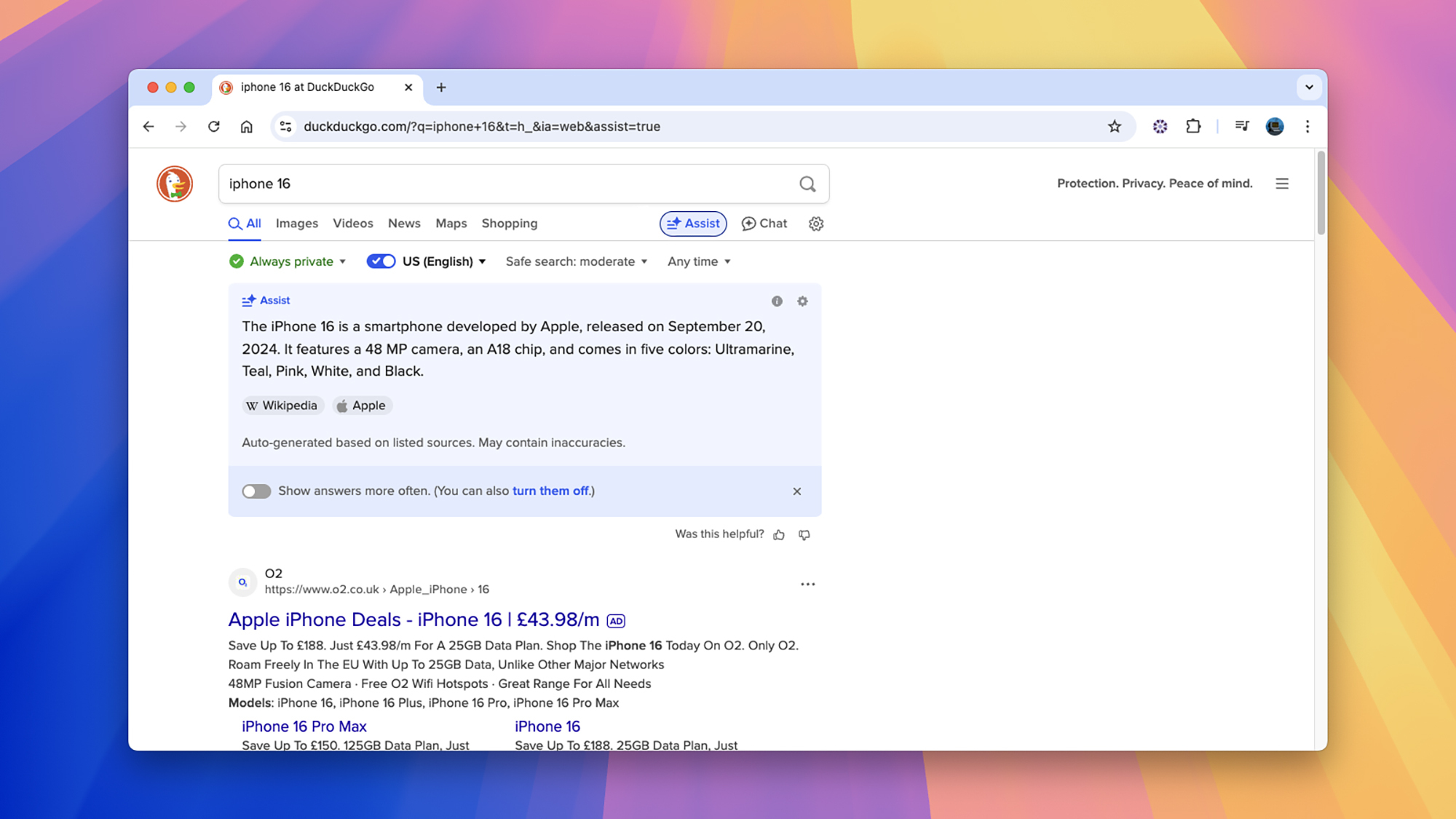
As with Google, Bing, ChatGPT, and others, you can now get AI answers to your web searches at DuckDuckGo. They appear in a small box with an Assist label attached, but they aren’t as prominent and don’t show up as often as they do on Google or Bing—DuckDuckGo is aiming for a less-is-more approach to the feature.

DuckDuckGo AI
You can decide how much AI you see.
Credit: Lifehacker

“We’re not making AI features just for the sake of making AI features,” writes DuckDuckGo CEO Gabriel Weinberg. “They have to be actually useful in everyday use, starting with helping people get faster, high-quality answers to their questions.”

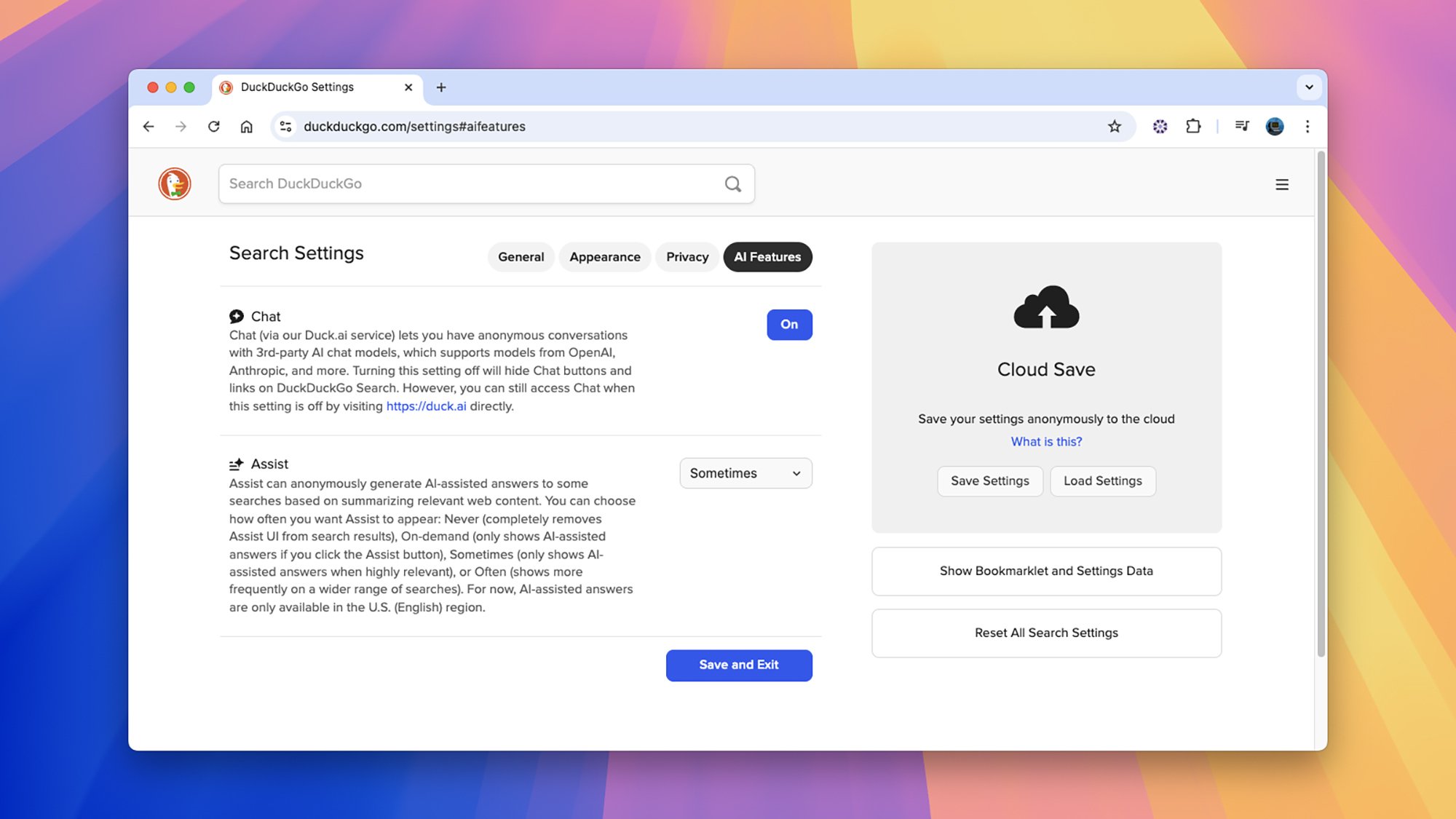
With this in mind, you can tune down the amount of AI you see—head to the DuckDuckGo settings page, and under AI Features, there’s a drop-down menu that lets you choose between Never, On-demand, Sometimes, and Often. If you choose either of the latter two, the search engine uses its best judgment as to which queries might benefit from AI answers and which won’t.

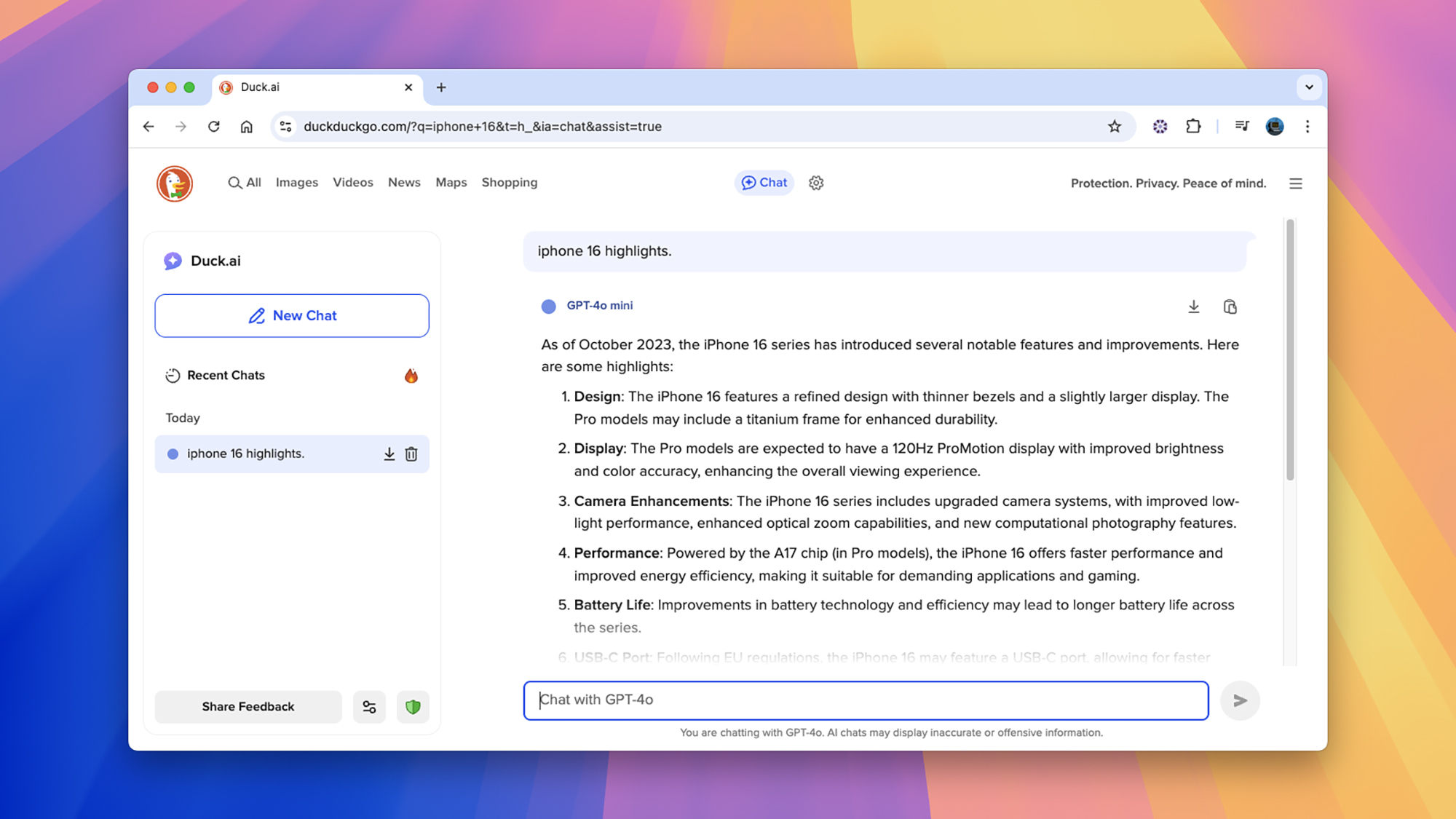
The second part of DuckDuckGo’s AI offering is the Duck.ai chatbot. You can ask follow-up questions of the bot whenever you see an AI Assist response in search results, and you can also access it via its own web portal: You’ve got access to multiple AI models here, including GPT-4o mini, Llama 3.3, and Claude 3 Haiku.

DuckDuckGo AI
How the AI Assist box looks at the top of results.
Credit: Lifehacker

Chats are never saved on DuckDuckGo servers, or used to train AI models, and you can wipe all chats from the record using the flame icon in the toolbar on the right. Ideally, DuckDuckGo wants you to use a combination of web search, AI Assist, and AI chat to help you get the answers you’re looking for.

If you’re wondering how all of this stays free without any tracking, DuckDuckGo makes its money from advertising—it’s just that the ads aren’t as targeted as they are on Google, because DuckDuckGo doesn’t know anywhere near as much about you. The company is also exploring the idea of a paid plan for access to more advanced AI models and for extra chats with AI (there’s already a $10-per-month pro-level subscription, which includes a VPN and some other extras).

Testing out the DuckDuckGo AI

I spent some time playing around with the new AI features, and on the whole they follow the general DuckDuckGo ethos: Everything is simple, straightforward to use, cleanly presented, and accessible without having to jump through multiple hoops just to get started with these tools.

With an AI Assist level of Sometimes, DuckDuckGo usually makes the right call about whether or not AI should get involved. The reason why these search engines are rushing to implement AI is that queries like “how does DNA work?” or “how do I fix a PC that won’t boot?” are often better answered by a bot than the traditional list of links—especially if you can ask follow-up questions for clarification.

DuckDuckGo AI
You can quickly get to Duck.ai from the search results.
Credit: Lifehacker

For more traditional searches, like “Eiffel Tower” or “intermittent fasting,” DuckDuckGo sticks to the standard approach (AI models have never been to France, or tried dieting). If you’re looking for an AI response and one doesn’t appear, you can click the Assist button to generate it.

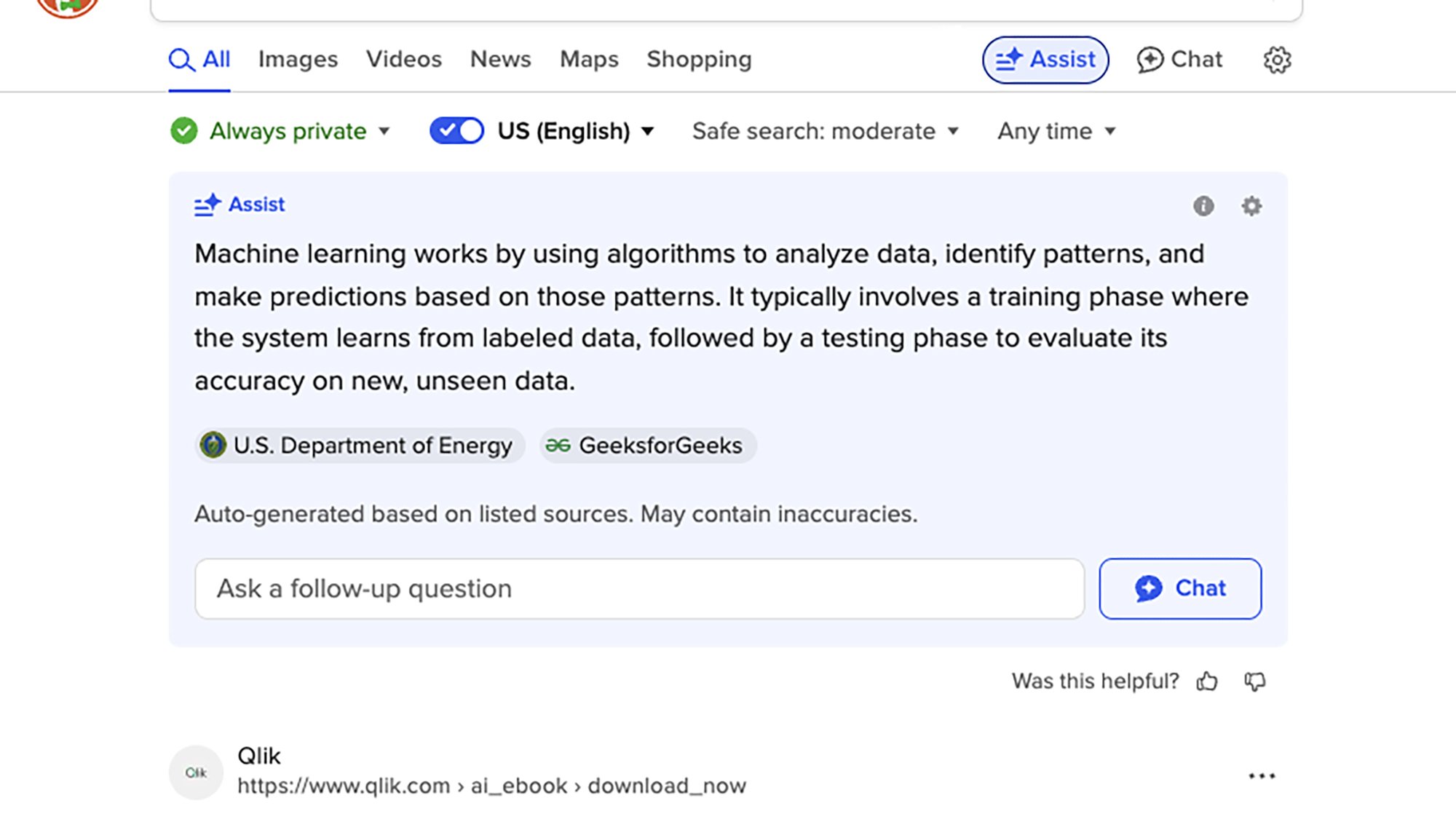
AI companies are often vague and dismissive when it comes to accuracy, so it’s good to see DuckDuckGo addressing the issue: The AI Assist answers are “as reliable as the sources from which they are drawn,” with measures in place to avoid spammy or satirical sites, and user feedback adding an extra level of verification. The web sources for AI answers are always clearly displayed, so you can click through to see the actual websites.

All of the AI answers I received seemed fully accurate: I ran some tests with tech questions; the AI Assist tool picked some well-respected online publications to pull information from, and presented it accurately. There is the question of where we get to when AI is answering everything, and humans are no longer bothering to put enough information online for AI to scrape, but that’s a topic for another day.

DuckDuckGo AI
You can ask follow-up questions within the search results themselves.
Credit: Lifehacker

I found the Duck.ai chatbot didn’t appear as often as I would’ve liked, to ask follow-up questions. It’s easy enough to switch to the chatbot manually, but then you find yourself bumping up against the knowledge cut-off points of these various models—they rely on historical training data rather than the latest information online. More work needs to be done on integrating live web search with AI here.

On the whole, DuckDuckGo seems to have the balance right, if you want to avoid AI overload: The AI Assist feature doesn’t always appear, and doesn’t dominate the search results when it does show up. Answers are brief and accurate, and while there’s a lot of competition out there, the privacy-first approach is reassuring.

‘Electrician Simulator’ Arrives on All Major VR Headsets This Month, Trailer Here

Take IT Studio, the developer behind Electrician Simulator (2022), is bringing a VR version of the game to Quest, PSVR 2 and PC VR headsets this month.

Electrician Simulator VR is getting things up to code by letting you go hands-on as a Sparky, tasking you with everything from repairing outlets and switches, laying cables in walls, to connecting electrical appliances.

Take IT Studio says each mission in the VR version was “created from scratch,” which are based on missions introduced in the flatscreen version of the game. You’ll also encounter (sometimes fickle) customers, who can surprise you with extra requirements and also story or two.

In addition to regular missions, Electrician Simulator VR is also slated to include a challenge mode, tasking you with completing three additional tasks on each mission—maybe a little less conventional than you were expecting, and requiring a little more thought in execution.

Electrician Simulator VR is slated to release March 21st, which you can wishlist today across Quest 3/S, PSVR 2, and SteamVR headsets.

The post ‘Electrician Simulator’ Arrives on All Major VR Headsets This Month, Trailer Here appeared first on Road to VR.

Nate Silver on the Demise of FiveThirtyEight

FiveThirtyEight founder Nate Silver, on the site’s demise: Last night, as President Trump delivered his State of the Union address, the Wall Street Journal reported that ABC News would lay off the remaining staff at 538 as part of broader cuts within corporate parent Disney. Having been through several rounds of this before, including two years ago when the staff was cut by more than half and my tenure expired too, I know it’s a brutal process for everyone involved. It’s also tough being in a business while having a constant anvil over your head, as we had in pretty much every odd-numbered (non-election) year from 2017 onward at 538/FiveThirtyEight. I don’t know all of the staffers from the most recent iteration of the site, but the ones I have met or who I overlapped with are all extremely conscientious and hard-working people and were often forced to work double-duty as jobs were cut but frequently not replaced. My heart goes out to them, and I’m happy to provide recommendations for people I worked with there.

[…] The basic issue is that Disney was never particularly interested in running FiveThirtyEight as a business, even though I think it could have been a good business. Although they were generous in maintaining the site for so long and almost never interfered in our editorial process, the sort of muscle memory a media property builds early in its tenure tends to stick. We had an incredibly talented editorial staff, but we never had enough “product” people or strategy people to help the business grow and sustain itself. It’s always an uphill battle under those conditions, particularly when it comes to recruiting and retaining staff, who were constantly being poached by outlets like the New York Times and the Washington Post.

Read more of this story at Slashdot.

GCC 15 Now Enables AArch64 Early Scheduling For -O3/-Ofast Modes

The GCC “-fschedule-insns” option allows for reordering of instructions to eliminate execution stalls when required data is unavailable. This early scheduling option can be beneficial for systems with slow floating point performance or costly memory load instructions. With the upcoming GCC 15 release, AArch64 will be enabling this early scheduling optimization at the -O3 optimization level and higher…

GeForce NOW Adds Monster Hunter Wilds To Slay Beasts In The Cloud

GeForce NOW Adds Monster Hunter Wilds To Slay Beasts In The Cloud
Having trouble finding a newfangled GPU in stock? Join the club. Alternatively, you can join NVIDIA’s GeForce NOW cloud gaming service, at least until things calm down at retail (and perhaps grow a killer 5-foot beard while you wait — sigh). All that aside, GeForce NOW is actually a capable service and it’s gaining one of the hottest games

Maserati kills electric version of MC20 supercar for lack of demand

Electric motors are, in so many ways, much better than internal combustion engines. They don’t waste most of the energy you put into them as heat and sound, they’re easy to control, and they make huge amounts of torque almost instantly. Having recently driven BMW’s 430i and i4 back to back over the course of two weeks, the electric version was easier in traffic and more responsive on a twisty road. Electric wins, then. Except at the very high end, it seems.

Because even though electric motors can pack a punch, people paying big money for super- and hypercars are increasingly disinterested in those cars being electrified. So much so that Maserati has canceled the all-electric version of the MC20.

The MC20 debuted in 2020. No longer associated with Ferrari after that brand was spun out and IPO’d, the MC20 could offer a full carbon-fiber monocoque and an engine with very clever F1-derived combustion technology, undercutting its now-independent Italian competitor to the tune of more than $100,000 in the process.

Read full article

Comments