NASA officials undermine Musk’s claims about ‘stranded’ astronauts

Over the last month there has been something more than a minor kerfuffle in the space industry over the return of two NASA astronauts from the International Space Station.

The fate of Butch Wilmore and Suni Williams, who launched on the first crewed flight of Boeing’s Starliner spacecraft on June 5, 2024, has become a political issue after President Donald Trump and SpaceX founder Elon Musk said the astronauts’ return was held up by the Biden White House.

In February, Trump and Musk appeared on FOX News. During the joint interview, the subject of Wilmore and Williams came up. They remain in space today after NASA decided it would be best they did not fly home in their malfunctioning Starliner spacecraft—but would return in a SpaceX-built Crew Dragon.

Read full article

Comments

Microsoft Reportedly Develops LLM Series That Can Rival OpenAI, Anthropic Models

Microsoft is reportedly developing its own large language model series capable of rivaling OpenAI and Anthropic’s models. SiliconANGLE reports: Sources told Bloomberg that the LLM series is known as MAI. That’s presumably an acronym for “Microsoft artificial intelligence.” It might also be a reference to Maia 100, an internally-developed AI chip the company debuted last year. It’s possible Microsoft is using the processor to power the new MAI models. The company recently tested the LLM series to gauge its performance. As part of the evaluation, Microsoft engineers checked whether MAI could power the company’s Copilot family of AI assistants. Data from the tests reportedly indicates that the LLM series is competitive with models from OpenAI and Anthropic.

That Microsoft evaluated whether MAI could be integrated into Copilot hints the LLM series is geared towards general-purpose processing rather than reasoning. Many of the tasks supported by Copilot can be performed with a general-purpose model. According to Bloomberg, Microsoft is currently developing a second LLM series optimized for reasoning tasks. The report didn’t specify details such as the number of models Microsoft is training or their parameter counts. It’s also unclear whether they might provide multimodal features.

Read more of this story at Slashdot.

Meta To Recommend Using Unity & Unreal’s Built-In OpenXR Support From Next Week

Meta will recommend that developers use the built-in OpenXR support of Unity and Unreal from next week.

What Is OpenXR?

OpenXR is the open standard API for AR/VR/MR, supported by the vast majority of the industry. The ideal of OpenXR is that developers can build apps that run on any headset, without needing to use vendor-specific core APIs for different hardware.

Almost every headset and runtime supports OpenXR today, except for Apple Vision Pro and PlayStation VR2 on PS5.

Meta is a founding member of OpenXR, and continues to be the biggest contributor to the standard’s development.

The news comes shortly after we reported on developer frustration that Meta’s Unity and Unreal integrations, which are described as using OpenXR, block other PC VR headsets. Developers using these integrations, which Meta had been recommending and promoting, need to implement a separate subsystem to support other PC VR headsets, the problem that OpenXR was supposed to solve.

Meta’s Unity & Unreal “OpenXR” Integrations Block Other PC VR Headsets
Meta’s Unity and Unreal “OpenXR” SDKs block other PC VR headsets, going against the spirit of the standard, and developers aren’t happy about it.

Now, in a new blog post seemingly in response to these concerns, Meta announced that starting from v74 of its SDKs, releasing next week, “the built-in OpenXR path for all major game engines will be a recommended path for development”.

  • For Unity, the company says that version 1.14 of Unity’s own OpenXR Plugin has “achieved feature and performance parity” with the Oculus XR Plugin. In addition to this, developers will still be able to “utilize Horizon OS-specific features through extensions and the Meta XR Core SDK, and continue optimizing their content to take advantage of all our platform features.”, Meta writes.
  • For Unreal Engine, the situation is somewhat more complicated. Unreal has its own OpenXR support, which Meta’s documentation currently doesn’t mention, and Meta offers its own integration with more Quest-focused features. Separately, Meta maintains its own fork of Unreal, with the source code available to developers, which it to date “strongly recommends”. Meta says it will offer “more details” on its future recommendations for Unreal engine next week, including a “trade-off table” it says it will publish.
  • For Godot, the free and open-source alternative to Unity & Unreal, the path to supporting Quest already leveraged its built-in OpenXR support, which Meta funded Godot veterans to improve, and support for Quest features not yet part of the core OpenXR standard can be activated through the Godot OpenXR Vendors plugin, which enables the specific features of headsets from other companies too.

Meta Funding Godot Veterans To Improve Its Quest & OpenXR Support
Meta is funding a group of Godot veterans to improve the engine’s OpenXR and Quest SDKs support and build high-quality samples and documentation.

In what appears to be a response to the allegations from some in the industry of Meta intentionally not upholding the spirit of OpenXR, Meta notes that it has “played a major role” in developing, adopting, and advancing the standard since 2016. Here’s the company’s statement from the blog post:

“Since ensuring that our OpenXR runtimes for Meta Quest and PC were 100% OpenXR compliant in 2019, we have pushed to continue advancing OpenXR as a viable cross-device solution. We are continuously creating new XR technologies to enable unique and immersive experiences, exposed as OpenXR extensions. We also build libraries to support these new extensions. As part of our commitment to OpenXR, we contribute these advancements back to the community, allowing other companies to adopt and build upon them.

In fact, Meta has contributed to 33 (~67%) of Khronos and cross-vendor extensions, as well as 61 vendor-specific extensions. Among those vendor-specific extensions, many of them (e.g. SpaceWarp, foveation, passthrough, etc.) are adopted by other OpenXR vendors for the better interoperability with apps that were originally developed for Meta devices. These contributions have been adopted by other vendors who recognize Meta’s dedication to advancing the industry and contributing back to the standard.”

“As early adopters of OpenXR, Meta has contributed significant resources to both expanding the standard and enabling OpenXR support in popular game engines. We remain committed to OpenXR and will continue to invest in the success of OpenXR and our developers.”

Signal President Calls Out Agentic AI As Having ‘Profound’ Security and Privacy Issues

Signal President Meredith Whittaker warned at SXSW that agentic AI poses significant privacy and security risks, as these AI agents require extensive access to users’ personal data, likely processing it unencrypted in the cloud. TechCrunch reports: “So we can just put our brain in a jar because the thing is doing that and we don’t have to touch it, right?,” Whittaker mused. Then she explained the type of access the AI agent would need to perform these tasks, including access to our web browser and a way to drive it as well as access to our credit card information to pay for tickets, our calendar, and messaging app to send the text to your friends. “It would need to be able to drive that [process] across our entire system with something that looks like root permission, accessing every single one of those databases — probably in the clear, because there’s no model to do that encrypted,” Whittaker warned.

“And if we’re talking about a sufficiently powerful … AI model that’s powering that, there’s no way that’s happening on device,” she continued. “That’s almost certainly being sent to a cloud server where it’s being processed and sent back. So there’s a profound issue with security and privacy that is haunting this hype around agents, and that is ultimately threatening to break the blood-brain barrier between the application layer and the OS layer by conjoining all of these separate services [and] muddying their data,” Whittaker concluded.

If a messaging app like Signal were to integrate with AI agents, it would undermine the privacy of your messages, she said. The agent has to access the app to text your friends and also pull data back to summarize those texts. Her comments followed remarks she made earlier during the panel on how the AI industry had been built on a surveillance model with mass data collection. She said that the “bigger is better AI paradigm” — meaning the more data, the better — had potential consequences that she didn’t think were good. With agentic AI, Whittaker warned we’d further undermine privacy and security in the name of a “magic genie bot that’s going to take care of the exigencies of life,” she concluded. You can watch the full speech on YouTube.

Read more of this story at Slashdot.

BBC Radio’s Streaming Changes Leave Long-Time Listeners In the Lurch

New submitter grandrollerz writes: Despite streaming online since the RealAudio days of the late 1990s, the BBC has announced that most of its radio stations will become unavailable to international users later this year. Starting in Spring 2025, only talk news stations BBC World Service and BBC Radio 4 will remain accessible outside the UK. This change is due to rights issues and the launch of a new BBC audio website and app that will replace BBC Sounds for international users. The BBC Sounds app will be available exclusively to UK audiences, although UK users traveling abroad for short periods will still be able to use it. This move has disappointed many long-time international listeners who will lose access to their favorite BBC radio stations. It follows a similar move to further commercialize its services where in 2024 the BBC and Amazon Music struck a global deal to make BBC podcasts available on Amazon Music outside the UK, but only for subscribers to Amazon’s Prime and Amazon Music Unlimited services.

Read more of this story at Slashdot.

The X-37B spaceplane lands after helping pave the way for “maneuver warfare”

The US military’s robotic mini-space shuttle dropped out of orbit and glided to a runway in California late Thursday, ending a 434-day mission that pioneered new ways of maneuvering in space.

The X-37B spaceplane touched down on Runway 12 at Vandenberg Space Force Base, California, at 11:22 pm local time Thursday (2:22 am EST Friday), capping its high-flying mission with an automated reentry and landing on the nearly three-mile-long runway at the West Coast’s spaceport.

The Space Force did not publicize the spacecraft’s return ahead of time, keeping with the Pentagon’s policy of secrecy surrounding the X-37B program. This was the seventh flight of an X-37B spaceplane, or Orbital Test Vehicle, since its first foray into orbit in 2010.

Read full article

Comments

Trump Signs Order To Establish Strategic Bitcoin Reserve

President Trump has signed an executive order to establish a strategic reserve of cryptocurrencies by using tokens already owned by the government. Reuters reports: A “Strategic Bitcoin Reserve” will be capitalized with bitcoin owned by the federal government that was seized as part of criminal or civil asset forfeiture proceedings, the White House crypto czar, billionaire David Sacks, said in a post on social media platform X. The order kept open the possibility of the government buying bitcoin in future. The U.S. commerce and treasury secretaries “are authorized to develop budget-neutral strategies for acquiring additional bitcoin, provided that those strategies impose no incremental costs on American taxpayers,” a factsheet on the White House website said. “This is the most underwhelming and disappointing outcome we could have expected for this week,” Charles Edwards, founder of bitcoin-focused hedge fund Capriole Investments, wrote in a post on X. “No active buying means this is just a fancy title for Bitcoin holdings that already existed with the Govt. This is a pig in lipstick.”

Read more of this story at Slashdot.

What does “PhD-level” AI mean? OpenAI’s rumored $20,000 agent plan explained.

The AI industry has a new buzzword: “PhD-level AI.” According to a report from The Information, OpenAI may be planning to launch several specialized AI “agent” products including a $20,000 monthly tier focused on supporting “PhD-level research.” Other reportedly planned agents include a “high-income knowledge worker” assistant at $2,000 monthly and a software developer agent at $10,000 monthly.

OpenAI has not yet confirmed these prices, but they have mentioned PhD-level AI capabilities before. So what exactly constitutes “PhD-level AI”? The term refers to models that supposedly perform tasks requiring doctoral-level expertise. These include agents conducting advanced research, writing and debugging complex code without human intervention, and analyzing large datasets to generate comprehensive reports. The key claim is that these models can tackle problems that typically require years of specialized academic training.

Companies like OpenAI base their “PhD-level” claims on performance in specific benchmark tests. For example, OpenAI’s o1 series models reportedly performed well in science, coding, and math tests, with results similar to human PhD students on challenging tasks. The company’s Deep Research tool, which can generate research papers with citations, scored 26.6 percent on “Humanity’s Last Exam,” a comprehensive evaluation covering over 3,000 questions across more than 100 subjects.

Read full article

Comments

70% of Large VMware Customers Bought Broadcom’s Biggest Bundle

Broadcom’s VMware acquisition has significantly boosted revenue, largely driven by high-priced VMware Cloud Foundation bundles adopted by the majority of its top customers. The Register reports: Broadcom’s acquisition of VMware appears to be a big success, on the balance sheet at least, after the company announced a big majority of its top 10,000 customers have decided to acquire its Cloud Foundation stack and posted strong growth. The chips-and-code company today announced its results for the quarter ended February 2nd, its first for FY 2025. Revenue of $14.92 billion represented 25 percent year-on-year growth. Net income of $5.5 billion was a 315 percent increase on the result from Q1 2024.

Broadcom no longer breaks out VMware revenue: sales of Virtzilla’s wares are all now lumped into its infrastructure software business unit, which posted $6.7 billion revenue for Q1, up from $4.55 billion for the same quarter last year. Direct comparisons of those numbers are not wise as Broadcom owned VMware for four fifths of Q1 2024. Consider, instead, the $1.97 billion Q4 2023 and $7.6 billion FY 2023 software revenue that Broadcom recorded before it acquired VMware.

Know, also, that Broadcom’s software sales grew by just three percent in FY 2023 and four percent in FY 2022. That slow growth means the jump from $1.97 billion software revenue in Q4 2023 to $6.7 billion in Q1 2025 is likely due to VMware, which in its last quarter as an independent company reported $3.4 billion revenue. It therefore looks a lot like Broadcom has added around $1 billion to quarterly VMware revenue in a little over a year.

Read more of this story at Slashdot.

I Tried Prime Video’s New AI Dubbing, and I Have Thoughts

We may earn a commission from links on this page.

When you watch a piece of media produced in a language you don’t speak, you have a couple of options. You can, of course, turn on subtitles and follow along by reading. But in some cases, you can switch the audio track to whichever language you speak. This is called the “dub,” and it usually requires voice artists to record the lines in this new language—in a way that matches the original tone of the show or movie.

This requires time and money, something studios aren’t always willing to part with. As such, not everything has a dub. But what if it could?

On Wednesday, Amazon announced “AI-aided dubbing” for Prime Video. On select titles, viewers can choose to play an AI-generated dub of the script in either English or Latin American Spanish. Amazon says there are 12 titles that support this feature at this time, but only named three: El Cid: La Leyenda; Mi Mamá Lora; and Long Lost. The company also says “localization professionals” work with AI to “ensure quality control.” It’s not clear what that means, other than there are humans checking these AI dubs to make sure they aren’t mistranslating or making other mistakes due to hallucinations.

I have Prime Video, so I was interested to check out these dubs for myself to see how Amazon’s AI compared to, you know, human beings. In my search, I couldn’t find Mi Mamá Lora, but I could find the other two titles. In order to use the feature, you need to go into the language selector on the compatible title and choose the “AI beta.” Then, you can experience what I experienced.

El Cid: La Leyenda

There are a few titles on Prime Video going by the name of El Cid, but the only one that supports AI dubbing is this specific option: a 63 minute-long documentary about Rodrigo Díaz de Vivar, otherwise known as El Cid. I wasn’t watching El Cid: La Layenda to learn more about this ruler from medieval Spain—I wanted to hear how well an AI bot would handle the English dubbing of a movie produced in Spanish.

The results are interesting, to say the least. Most of the speaking in the documentary happens via voiceover, which is extremely hit or miss. (“Hit” may be too generous.) When you know the voice is AI-generated, you pick out the bland or odd inflections. It’s classic AI-generated speech: items in a list are spoken in inconsistent tones; some words are slurred or artificially slowed down, as if the bot has had a drink or two. But in all honesty, I was expecting worse. This isn’t like watching a documentary narrated by the TikTok AI voice. It isn’t great (it’s not even good), but it does offer a bit more emotion than I expected.

The issues extend to the AI dubs of the documentary’s interviewees. In many cases, the voice is quite awkward, stilted, and full of the inconsistencies mentioned above. At times, the voice is completely devoid of any emotion, and does sound more like a voiceover tool from years past, rather than the “high quality” AI voices we’ve come to expect.

To Amazon’s credit, it does sound like the AI uses a different voice for each person it is dubbing. That makes it a bit easier to distinguish between the different speakers, and spares you from having to listen to the same mediocre AI voice for the entire movie.

Long Lost

Long Lost is a little more difficult to judge: The movie, originally produced in English, has an AI dub in Spanish. Since I don’t speak Spanish, it’s not as easy to pick out the robotic quirks your ear picks up on when you know the language.

Still, Long Lost offered a different experience than El Cid, since this is a movie: You get to hear how the AI handles dubbing over actors. Like the AI voiceover in the documentary, these AI actors aren’t as bad as I expected. I was anticipating AI voices delivering their lines totally flat, but there is some emotion here at times. No robot is winning an Oscar here, mind you: In fact, the voices can be quite awkward and lacking, reading the script too loudly, abruptly, or plainly. But, for some lines, I’m not sure I would assume these were AI voices if I didn’t already know ahead of time.

Even in more intense scenes, the AI does “try.” When the character screams, the AI raises its voice. It’s far from perfect, but it’s an interesting experiment to see what the AI can do:

In one scene, two characters compete in a game of “Chubby Bunny,” in which each has to continue adding marshmallows to their mouths while still being able to say “chubby bunny.” At times, the AI actually sounds muffled, and while it isn’t “realistic,” it’s a nice touch. (Perhaps this is where the human intervention comes into play.) At other times, however, the AI sounds totally normal, while the actors’ mouths are clearly full of marshmallow.

Another interesting quirk: One of the characters starts speaking in French, so the AI track cuts out and the original audio comes in. It’s jarring, because you can hear the difference immediately—not just the different languages, of course, but the difference in how the movie’s actual audio sounds when compared to the sterile AI output.

I’d like to try this feature again on a movie produced in Spanish with an AI English dub. I imagine it would be easier for me to pick out the issues, and to know whether more (or all) of the voices would sound totally fake.

Is the future of dubbing AI?

Look, there is no way I would genuinely enjoy watching an entire movie or series with an AI dub. Personally, I’m not a huge fan of human-generated dubs, so I have zero interest in one that, at times, sounds like a robot gunning for the EGOT.

But I have to admit, the tech isn’t terrible. At some points, the voices sound realistic enough for me to get the gist, especially when the voiceover would also be monotone and informative—such as during a documentary. And it’s interesting that these AI dubs can incorporate elements from the show or movie, like muffled speech during a game of Chubby Bunny.

I don’t want to see any voice actors put out of work here. They deserve to get paid for their labor and audiences deserve a high-quality dub on the shows and movies they pay to watch. However, I do think AI dubbing could offer a compromise for the times when no dub is on its way at all: If a studio isn’t going to pay for a dub anyway, it would be helpful to have a dub at all—even if it’s on the robotic side. That would certainly help visually impaired viewers, who might not be able to take advantage of subtitles.

Of course, it’s naive to think studios will only use this tech for those specific uses, rather than eliminate an entire human profession to save some cash. To that end, I’d be happy if the whole AI dubbing practice ends here and now: It’s interesting, but it’s not good, so please don’t replace real voice actors.

Measles outbreak hits 208 cases as federal response goes off the rails

The measles outbreak in West Texas and New Mexico has reached 208 cases.

Texas officials reported 198 confirmed cases across nine counties as of Friday, with 23 people requiring hospitalization since the outbreak exploded at the end of January. Most of the cases continue to be in children and teens, with 153 of the 198 cases being between the ages of 0 and 17. Eleven cases have no confirmed age listed. All but five cases are in people who are unvaccinated or have no vaccination record.

Texas officials have so far reported one death in the outbreak in an unvaccinated school-aged child with no underlying health conditions. Media reports have identified the child as being a 6-year-old.

Read full article

Comments

How to watch Games Done Quick’s Frost Fatales speedrunning event from March 9

Games Done Quick’s next weeklong charity speedrunning shindig kicks off this weekend. Frost Fatales, one of GDQ’s two events celebrating women and femmes, runs from March 9 to 16, raising money for the nonprofit National Women’s Law Center.

Frost Fatales is the winter installment of the pair of events organized by GDQ’s Frame Fatales speedrunning community. (Its summer counterpart is Flame Fatales.) Last year’s Frost Fatales raised $155,000 for the same nonprofit, which fights for gender justice in issues central to the lives of women and girls. Since the first Frame Fatales event in 2019, the biannual speedruns have raised over $1 million for charity.

Gameplay screenshot from Cuphead. Boss fight.
Studio MDHR

This year’s festivities dive right into the deep end with a run of the charmingly punishing Cuphead at 1PM ET on Sunday, followed by Super Mario Odyssey a mere hour later. Anyone who can beat Cuphead in that time deserves a Medal of Honor.

Other notable runs from the week include the OG Legend of Zelda on Sunday, the Wii reboot of Punch-Out!! on Monday, a “girl squad” three-way race in Final Fantasy X-2 on Wednesday and a race to defeat Ganon (again) in Breath of the Wild on Saturday. The week wraps up with a one-handed (say what?) speedrun of the indie platforming classic Celeste later that night.

You can check out GDQ’s schedule for the full lineup of games. The weeklong event streams exclusively on the GDQ Twitch channel (also embedded below), starting with that must-see Cuphead run at 1PM ET on Sunday.

This article originally appeared on Engadget at https://www.engadget.com/gaming/how-to-watch-games-done-quicks-frost-fatales-speedrunning-event-from-march-9-220017343.html?src=rss

The First Three Settings to Change on Any Boox E-Ink Tablet

While they will never have the name recognition of the Amazon Kindle, e-ink devices from Chinese tech company Onyx International—sold under the slightly silly “Boox” brand name—are gaining a cult following in the U.S. I’ve reviewed three of its e-readers and digital notebooks over the past year, and I’m a huge fan. And if you’re reading this article, you probably are too (or soon will be).

I love Boox devices not only because they’re well built and full-featured (though if you want more of my thoughts there, check out my assessments of the Boox Palma, Note Max, and Note Air 4C). I also can’t get enough of their customizability. Nothing makes me crazier than trying to do something simple with a device, only to be stymied due to locked down software that doesn’t want to let me. From side-loading books onto a Kindle to doing—well, basically anything unsanctioned on an iPad, big companies seem determined to only let me do with my devices what they want me to do.

Boox devices are different: They run on an open version of Android that lets you do pretty much whatever you want. You can download any app in the Google Play Store, so you aren’t tied to one e-reading platform. If you want to sideload apps, feel free: Plug the device into your laptop and it will mount right to the desktop. If you’re truly ambitious, you can even install your own launcher to completely change things up.

While all this freedom is nice, it also means Boox devices have a bit more of a learning curve than, say, a plug-and-read Kindle. So if you are the new owner of one of these fantastic devices—whether an e-reader or a full-fledged digital notebook—here are five settings you should change right away to get the most out of it.

Set a one-touch refresh

Like any e-ink tablet, Boox devices suffer from occasional “ghosting,” or visible afterimages once you’ve turned a page. While the device will automatically refresh itself after a certain number of taps (touching the screen, basically), I like to set up a one-touch refresh that I can trigger whenever I want to. Depending on your device, there are a few ways to do this: a button or a gesture.

Setting a manual refresh on a Boox device with buttons

Action button settings on Boox Palma 2

Credit: Screenshot by Joel Cunningham

If you’ve got a Boox Palma or another device with page turn/volume buttons, you can map one of them to a screen refresh. For the Palma, it makes the most sense to use the Smart Button for this—that’s the button on the left hand side of the device, which can do different things based on whether you press it once, twice, or hold it down. On my own device, I’ve mapped a manual refresh to a single Smart Button press, as it’s the thing I find myself doing most often. However, you can also map a refresh to the volume buttons if you like (though I prefer to use those for page turns).

To remap your Smart Button, open the settings app and tap Smart Button. Tap your preferred option (Short-press Function, Double-click Function, or Long-press Function) and select Full-refresh.

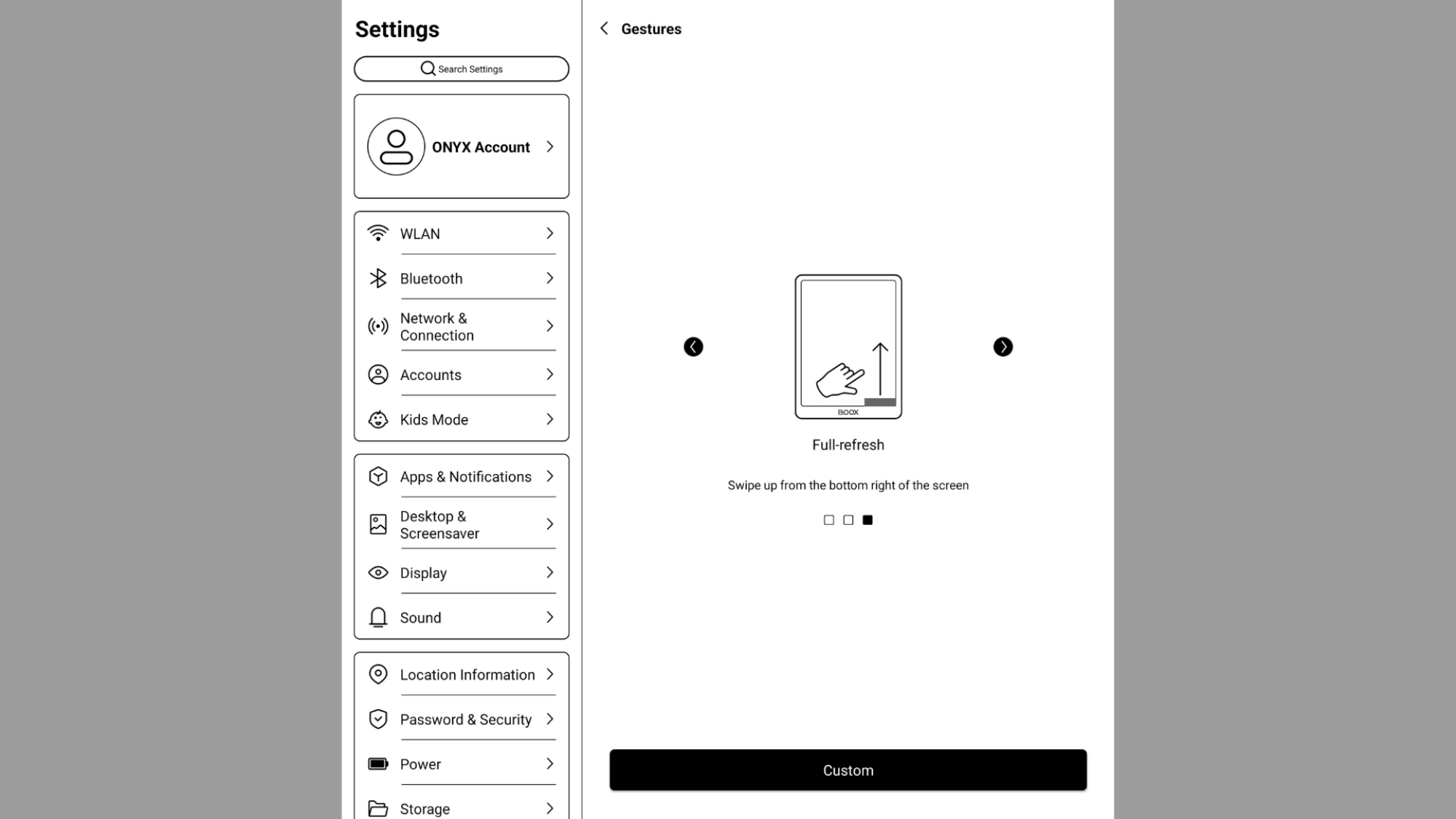
Setting a manual refresh with a gesture

Genture menu on Boox Note Max

Credit: Screenshot by Joel Cunningham

Not all Boox devices have buttons, so if yours doesn’t, you’ll need to map a manual refresh to a gesture. (Though you can also do this on the Palma, if you like.)

To get started, open Settings and scroll down to System Navigation. Under Bottom Navigation, tap More Settings. Choose the area of the screen you’d like to map the refresh to by swiping between the left, center, or right side options. Tap Custom and then choose Full-refresh from your list of options.

Choose your cloud storage option

Boox devices tend to have generous onboard storage, but you’ll get more out of them by linking your preferred cloud storage service on the system level. This will let you move files on and off the device without the need to plug it in to your computer.

To start, open Settings, then Accounts. Tap Move to Cloud Storage in Library, then select your preferred option from the list. You have a bunch of choices, including Dropbox and Google Drive. Tap the one you want, then log in.

Change your lock screen image and screensaver

A wallpaper on a Boox Palma featuring a line drawing of Hobbes from Calvin and Hobbes

Credit: Joel Cunningham

Boox devices have some handsome preset lock screen images, but if you want to make the device your own, you can set your own screensaver and wallpaper. This one is pretty straightforward: Choose Desktop & Screensaver in the Settings app—but if you want a custom image, you’ll first have to get it saved to the right spot.

The easiest way to do this is to find an image you like while browsing the internet using your Boox device. Long press on it and choose Download, which will save it to your downloads folder (naturally). Next, open up the Gallery app, tap your Download folder, and then tap the image you want. In the lower right, tap More and then Set as. You can choose to set it as the Screensaver, the Wallpaper, or the Power-Off image.

Alternately, you can plug the device into a computer and manually add the images to your Pictures folder. And here’s another helpful hint: If you want to create your own wallpaper image in Photoshop or Canva, the dimensions are 824×1648 for the Boox Palma. For the Note Max or Note Air 4C, 1404 x 1872 should serve you well.