Firmware update bricks HP printers, makes them unable to use HP cartridges

HP, along with other printer brands, is infamous for issuing firmware updates that brick already-purchased printers that have tried to use third-party ink. In a new form of frustration, HP is now being accused of issuing a firmware update that broke customers’ laser printers—even though the devices are loaded with HP-brand toner.

The firmware update in question is version 20250209, which HP issued on March 4 for its LaserJet MFP M232-M237 models. Per HP, the update includes “security updates,” a “regulatory requirement update,” “general improvements and bug fixes,” and fixes for IPP Everywhere. Looking back to older updates’ fixes and changes, which the new update includes, doesn’t reveal anything out of the ordinary. The older updates mention things like “fixed print quality to ensure borders are not cropped for certain document types,” and “improved firmware update and cartridge rejection experiences.” But there’s no mention of changes to how the printers use or read toner.

However, users have been reporting sudden problems using HP-brand toner in their M232–M237 series printers since their devices updated to 20250209. Users on HP’s support forum say they see Error Code 11 and the hardware’s toner light flashing when trying to print. Some said they’ve cleaned the contacts and reinstalled their toner but still can’t print.

Read full article

Comments

Fire Risk Recall May Explain That Controversial Pixel 4a Battery Update

At the end of last month, The Google Pixel 4a got a software update that rendered the device nearly unusable for some people, for seemingly unknown reasons. The update included “battery management features” that left some people with phones that couldn’t hold a charge for more than 30 minutes. Google explained the problems in a support document and offered a few solutions, but again, it didn’t explain the root cause of the issue. But now, there appears to be one possible explanation for the problem—overheating batteries—as mentioned in a Pixel 4a recall issued in Australia, spotted first by Android Authority.

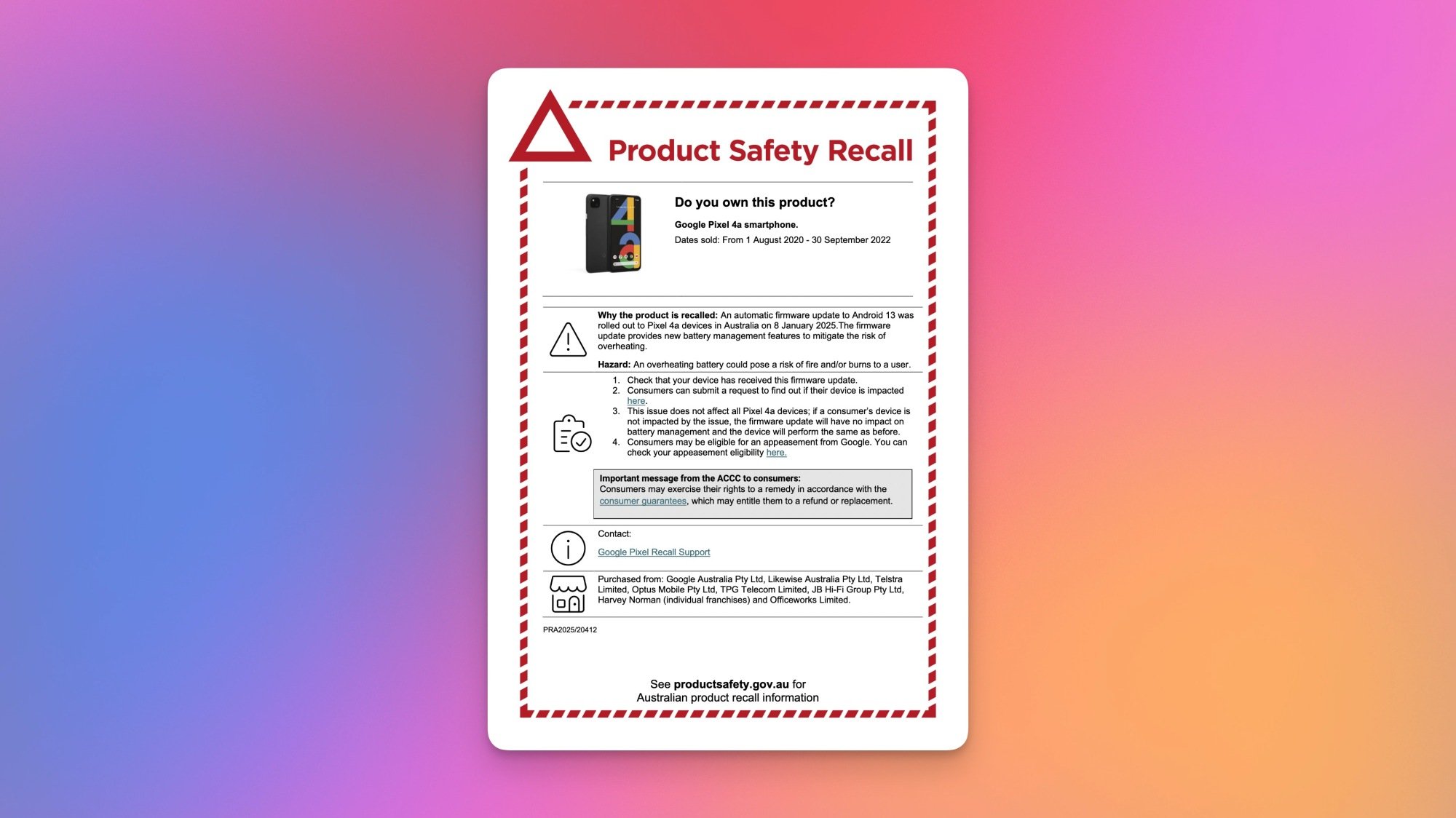
The Australian Competition and Consumer Commission (ACCC) issued the recall notice on March 7, saying in a supporting document that some Pixel 4a units are currently at risk of fire due to overheating batteries. The notice clarifies that this doesn’t affect all Pixel 4a units and it goes on to say that if your device is unaffected by this issue, the January software update will have no impact on its battery or performance, implying that Google pushed out the update to reduce the risk of fire on impacted phone.

When Google issued the software update, its support document also mentioned that the software update will only update the battery management in certain devices. The company had additionally cited a potential degradation in lithium-ion batteries as a reason for the update.

If the ACCC’s notice is accurate and overheating batteries are indeed the reason behind the January software update for the Pixel 4a, it could offer a potential explanation of why the update was rushed out so quickly. Usually, Pixel phones receive big software updates as a part of Pixel Drops that are released every few months. Outside of that, Google usually only issues stability and security updates that don’t usually get their own blog posts. In this case, the company rolled out a big update with a detailed support document, possibly because the issue was so potentially serious.

I’ve reached out to Google for a comment and will update the story once the company responds.

The recall notice for the Pixel 4a in Australia.

Credit: ACCC

But long story short, when faced with a potential fire risk, it looks like Google is choosing to limit the capacity of the battery in affected devices rather than court disaster.

Check if your Pixel 4a is impacted

In case you haven’t done so already, you can check if your Pixel 4a is impacted by going to this Google Support page and following the on-screen steps. If it is, Google offers three options—a free battery replacement, a credit of $100 towards another Pixel phone, or a one-time cash settlement of $50.

TCL’s new Mini LED TV offers higher peak brightness and better contrast than earlier models

TCL just unveiled a new TV in its Precise Dimming Series. The QM7K is a Mini-LED TV and a follow-up to the recently-released QM6K. It uses the company’s Halo Control Technology Suite, which is kind of a catch-all name for a bunch of tweaks the company has made to the dimming and picture quality of its Mini LEDs.
The company says the QM7K offers higher peak brightness than its predecessors and a new anti-reflective panel. TCL also promises “enhanced color accuracy, gray scale accuracy” and “virtually no blooming.” This is thanks to the company’s Super High Energy LED Chip, which combines high brightness with increased light efficiency, and the Super Condensed Micro Lens, which uses a “narrower light path for more precise” control.

TLC

Additionally, newly-enhanced technology minimizes the optical distance between the backlight and the diffuser, which eliminates blooming, reduces the halo effect and avoids LED light overlap. The new features, in conjunction with the anti-reflective panel, create a picture with a better contrast and deeper blacks.
On the software side of things, there’s a new color optimization algorithm for improved accuracy. The Halo Control System also adds a bi-directional 23-bit backlight controller, which allows for granular control of over 65,000 levels of brightness for each and every LED. There’s also a new algorithm that “intelligently optimizes” incoming SDR signals at “near HDR level.”
The QM7K features Bang & Olfusen speakers and select sizes ship with a pedestal stand. Sizes range from 55-inches all the way up to 115-inches. Prices fluctuate from around $1,300 for the smallest one to a whopping $20,000 for the 115-inch monster. Traditional sizes are availright right now at retailers nationwide, with the large models coming soon. Some purchases come with a $500 Visa gift card, which is a nice bonus.

This article originally appeared on Engadget at https://www.engadget.com/home/home-theater/tcls-new-mini-led-tv-offers-higher-peak-brightness-and-better-contrast-than-earlier-models-175237076.html?src=rss

Orange Pi RV2 – A $30+ RISC-V SBC powered by Ky X1 octa-core SoC with a 2 TOPS AI accelerator

While the Orange Pi RV RISC-V SBC introduced at the Orange Pi Developer Conference 2024 last year is yet to be launched (should be up in a few days), the company has just launched the Orange Pi RV2 powered by the Ky X1 octa-core RISC-V SoC with a 2 TOPS AI accelerator, up to 8GB LPDD4X, optional eMMC flash moduyle, two M.2 sockets for storeage, dual gigabit Ethernet, WiFi 5, and more.

Last of Us S2 trailer features wintry war with the zombies

Pedro Pascal returns as Joel in The Last of Us S2.

HBO released a one-minute teaser of the hotly anticipated second season of The Last of Us—based on Naughty Dog’s hugely popular video game franchise—during CES in January. We now have a full trailer, unveiled at SXSW after the footage leaked over the weekend, chock-full of Easter eggs for gaming fans of The Last of Us Part II.

(Spoilers for S1 below.)

The series takes place in the 20-year aftermath of a deadly outbreak of mutant fungus (Cordyceps) that turns humans into monstrous zombie-like creatures (the Infected, or Clickers). The world has become a series of separate totalitarian quarantine zones and independent settlements, with a thriving black market and a rebel militia known as the Fireflies making life complicated for the survivors. Joel (Pedro Pascal) is a hardened smuggler tasked with escorting the teenage Ellie (Bella Ramsay) across the devastated US, battling hostile forces and hordes of zombies, to a Fireflies unit outside the quarantine zone. Ellie is special: She is immune to the deadly fungus, and the hope is that her immunity holds the key to beating the disease.

Read full article

Comments

Sony Says It Has Already Taken Down More Than 75,000 AI Deepfake Songs

Sony has removed more than 75,000 AI-generated deepfake songs mimicking artists including Harry Styles and Beyonce from online platforms, the company revealed in a submission to the UK government, adding this likely represents just a fraction of fake songs circulating online.

The proliferation of these unauthorized AI replicas has caused “direct commercial harm to legitimate recording artists, including UK artists,” Sony stated. The company’s intervention comes as Britain considers new copyright legislation that would permit AI companies to train models using artist material, a proposal that would require rights holders to opt out rather than requiring permission.

Read more of this story at Slashdot.

Yes, you get used to the grille: The 2025 BMW 430i Gran Coupe review

Like life itself, BMWs seemed less complicated last century. You didn’t need a crib sheet to understand the badge, and body styles were mostly just sedans, with a smattering of station wagons, two-door coupes, and convertibles. That was before it helped kickstart the SUV craze; now instead of 3, 5, 7, the series run 2–8 and X1 through X7. And don’t get me started on individual model names. Like the 2025 430i xDrive Gran Coupe.

At first glance, if you’re middle-aged like the average Ars reader, your brain probably says “this is a 3 Series sedan.” After all, it has a pair of doors on either side. But there is no requirement for a coupe to only have two doors: the name is derived from the French “couper,” meaning cut. And indeed, the roofline is cut down more than 2 inches lower than the actual 3 Series.

There’s also a hatch at the rear, rather than a trunk lid. So, technically it’s a fastback body style, which BMW has decided to call Gran Coupe the way it calls station wagons Tourings. Pedantic pigeonholing of body style will probably take a back seat to discussion of the front grille, though.

Read full article

Comments

How to Track Your Sleep With an Apple Watch

We may earn a commission from links on this page.

The Apple Watch has a built-in sleep tracker, but it can be hard to find. Here’s how to access it, how to set it up so that it properly records how much sleep you’re getting, and how to understand the results. 

Does my Apple Watch support sleep tracking? 

Sleep tracking was introduced with WatchOS version 7 (released in 2020). That version of WatchOS works on watches from Series 3 and newer, paired with an iPhone 6S or newer, with iOS 14 and newer. 

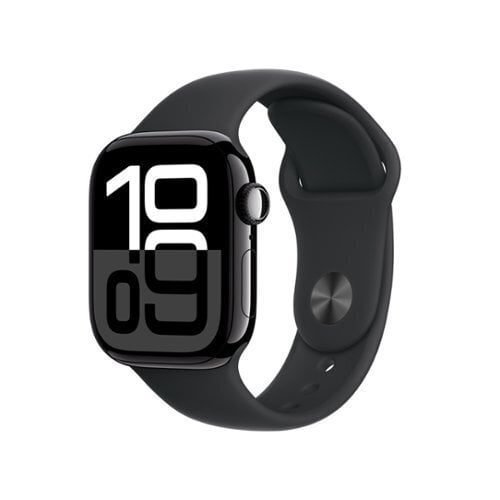
In other words: The oldest devices that will work are a 2015 phone, a 2017 watch, and 2020 releases of the software that run on them. As long as your Apple Watch isn’t truly ancient, it should support this. (If you’re looking to buy a new Apple Watch, though, we recommend the Series 10 as the best Apple Watch for most people.)

Where to find the Apple Watch Sleep app

You’ll need to navigate to four different places to access all of the sleep-related features of your Watch and iPhone. (Three of them are on the phone.)

On the Apple Watch

Finding the Sleep app on Apple Watch

Credit: Beth Skwarecki/Apple

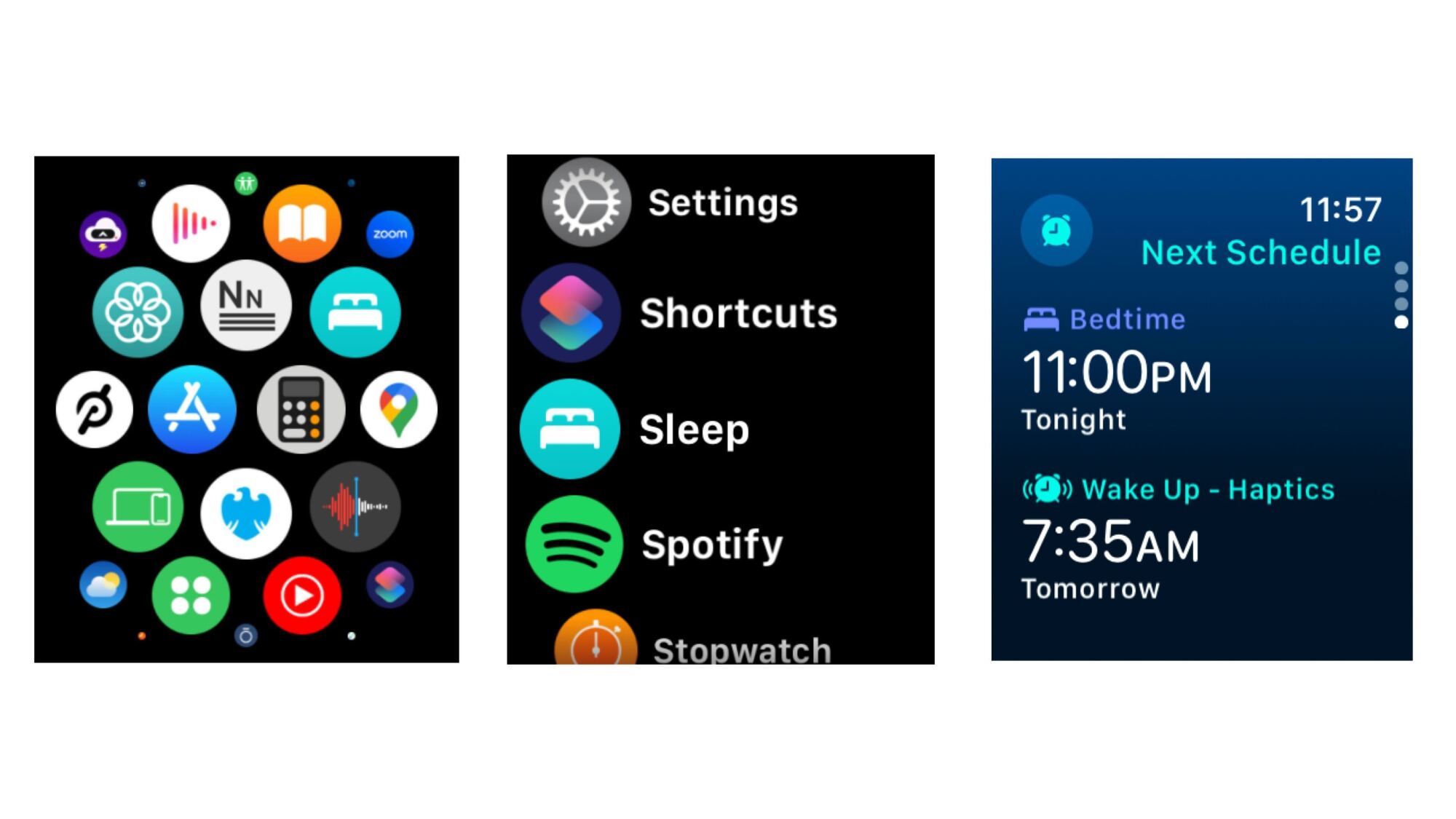
On your Watch, look for a bed icon with a greenish-blue background. (Pro tip: You can change this screen to use the names of apps, alphabetized, rather than having to play hide and seek with little icons.) When you open the Sleep app, scroll down to check (or set) your sleep schedule. That’s all you need to do with this app for setup; the Apple Watch will track your sleep automatically even if you never open this app again.

In the Health app

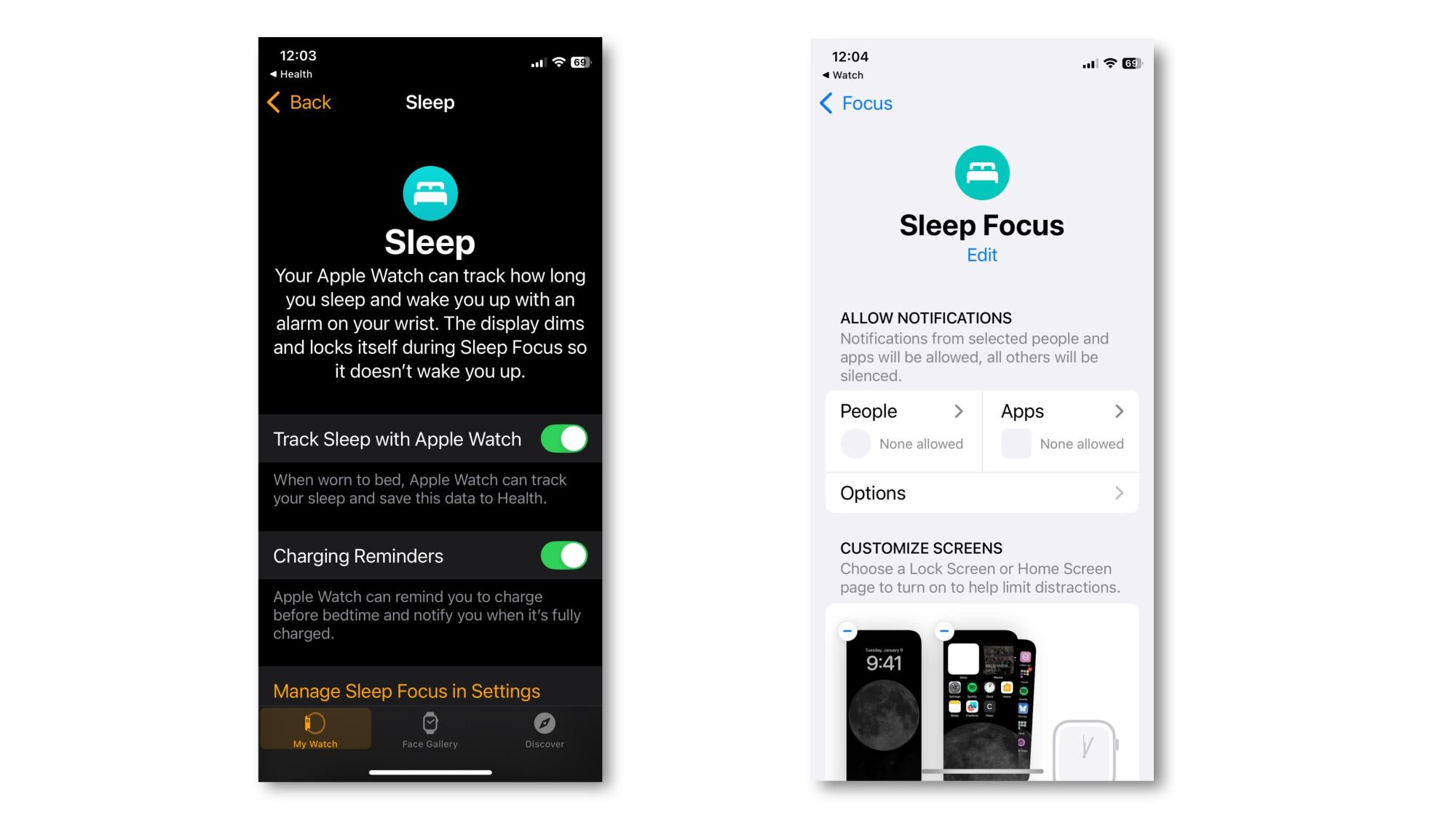
Sleep settings in the Health app

Credit: Beth Skwarecki/Apple

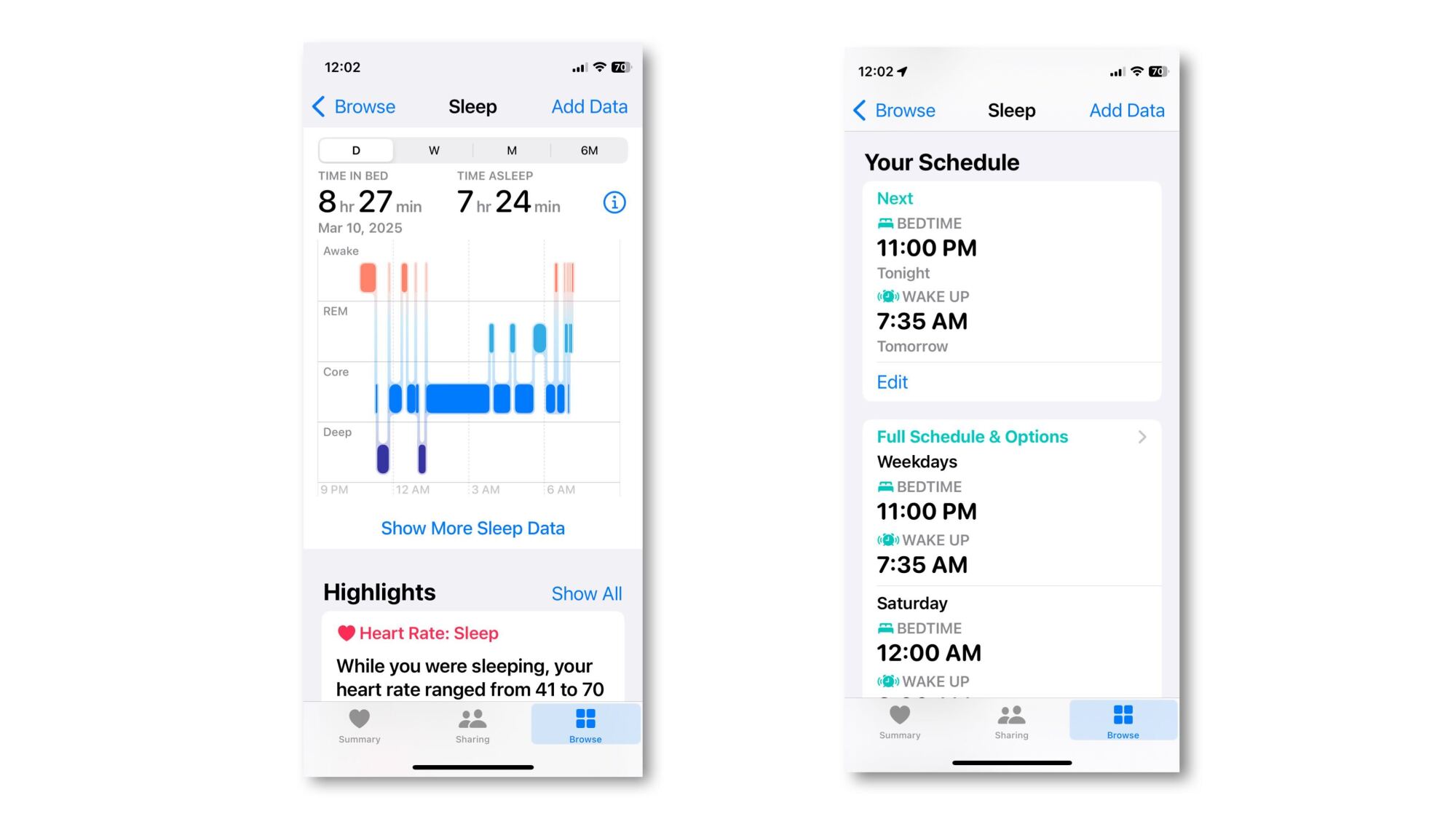
On your iPhone, the sleep functions are part of the Health app. (There is no dedicated Sleep app.) Open the Health app, tap Browse, then tap Sleep. From here, you can view data on recent nights of sleep, and set your sleep schedule for the future.

At the bottom of this screen, you can edit your next sleep schedule or your full sleep schedule (the one that repeats daily and weekly). This tells your phone when you’re planning on sleeping. Tap Full Schedule & Options to set that schedule, and scroll down to the bottom for the next step.

In the Watch app

Watch app and Sleep Focus settings

Credit: Beth Skwarecki/Apple

To make sure your watch will track your sleep, you need to configure your Watch-specific sleep settings in the Watch app. The easiest way to access this from the Health app (tap Full Schedule & Options from the Sleep screen), and at the bottom of that screen, there’s a link to Manage Sleep in the Apple Watch App. Tap that, and you’ll go straight to those Watch settings. 

Turn on “Track Sleep with Apple Watch” to enable tracking, and turn on “Charging Reminders” so the Watch can notify you to charge it before bedtime if your battery is low in the evening.

In the Settings app

We’re not quite done. In the Settings app, you can set up your Sleep Focus. This is optional for tracking, but it gives you access to specialized home screens and notification settings that will turn on at bedtime. There is a link from here back to the settings app. (Hey, this may be confusing, but at least it’s easy to navigate from each app to the others.) 

How to set up your Apple Watch to record your sleep

You can fully explore all the sleep-related features through the apps I mentioned above, but here is the short version. Do these things and you’ll have your Watch recording your sleep tonight:

  1. Set up a Sleep schedule (Health app > Sleep > Full Schedule & Options).

  2. Tap Manage Sleep With Apple Watch at the bottom of that screen. (This sends you to the Watch app.)

  3. Turn on Track Sleep with Apple Watch.

  4. Wear your Apple Watch to bed. It should be unlocked, and if you have a passcode, you’ll want wrist detection turned on. 

The Apple Watch will use the sleep schedule (or Sleep Focus, which you can turn on manually) to know when you might be sleeping. During this time, it uses your movements and your phone use, to detect whether you’re sleeping, and to estimate when you are in each stage of sleep. 

How to read your results from the Apple Watch sleep app

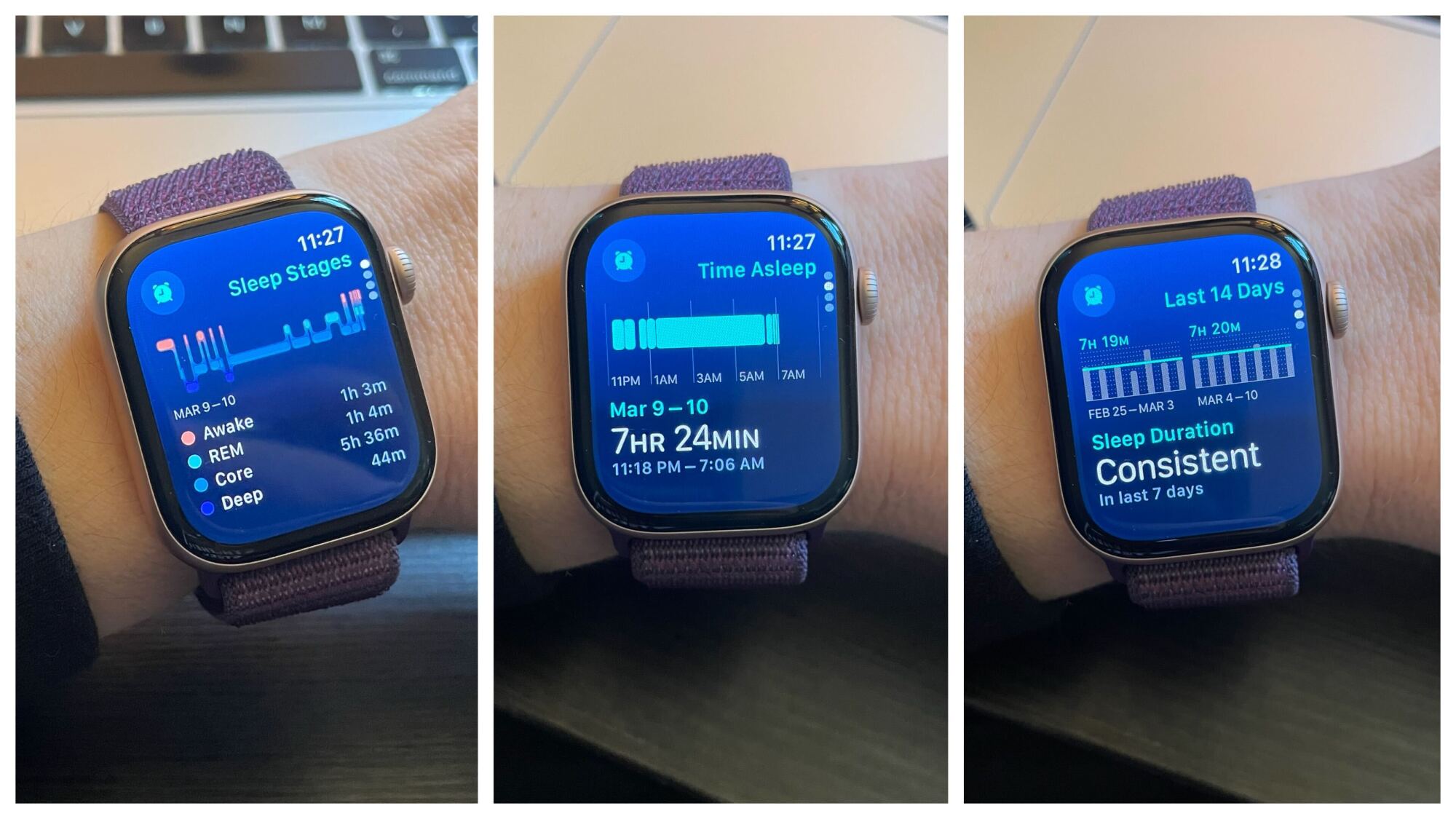
To see your sleep on your watch, scroll down from the main watch face (using the digital crown, or swipe up with your finger) and you’ll see a card in your Smart Stack with the previous night’s sleep. Tap this to open the Sleep app, which will show you your sleep stages, time asleep, last 14 days’ sleep, and your sleep schedule settings.

Photos of Apple Watch showing sleep data

Credit: Beth Skwarecki

You can also see this information anytime you visit the Sleep app on your watch, or the Sleep section of the Health app on your phone. (If you wake up before your sleep schedule ends, you may need to wait until your scheduled sleep time is finished before the data becomes available.) 

Your sleep data, on either the watch or phone, will show your sleep stages represented with deep sleep at the bottom in purple, “core” (that is, light) sleep in the middle in blue, REM higher up in lighter blue, and awake in orange at the top. (That said, no wearable is going to be completely accurate when it comes to sleep stages, so don’t read too much into these.)

The app will also show you your heart rate during the night, your sleep trend (mine says “You slept an average of 7 hr 22 min over the last 7 days”), and monthly and yearly highlights showing whether you’re getting more or less sleep than in the past. 

Developer convicted for “kill switch” code activated upon his termination

A 55-year-old software developer faces up to 10 years in prison for deploying malicious code that sabotaged his former employer’s network, allegedly costing hundreds of thousands of dollars in losses.

The US Department of Justice announced Friday that Davis Lu was convicted by a jury after “causing intentional damage to protected computers” reportedly owned by the Ohio- and Dublin-based power management company Eaton Corp.

Lu had worked at Eaton Corp. for about 11 years when he apparently became disgruntled by a corporate “realignment” in 2018 that “reduced his responsibilities,” the DOJ said.

Read full article

Comments

The Last of Us season two promises a lot more action alongside devastating drama

Season two of HBO’s The Last of Us is just a month away, and as such the hype cycle kicked into full gear this past weekend. A full trailer finally arrived on Saturday during a panel at SXSW with the show’s creators and cast (not to mention an in-depth preview in Variety), and both that trailer and the panel discussion reinforced at least one major change coming this season: more action.
That could fix one of the bigger complaints fans had about season one, which garnered tons of praise from critics and fans alike. While season one brought the Infected to life in terrifying fashion, there were long stretches of the show where they simply weren’t around, making them feel like less of an ever-present threat. The new trailer shows off the town of Jackson, where Joel and Ellie settled at the end of season one along with his brother Tommy, under a massive siege of Infected, the kind of battle that might take up an entire episode. And show creators Craig Mazin and Neil Druckmann hinted that Infected would play a bigger role this season, not just in numbers.

“It was important to us to always move the ball forward with the infected,” Mazin said during the SXSW panel. “It’s not a question of just more, but something else that is meaningful to what is going on so they don’t just become NPCs. So definitely an escalation, we’re careful about it because we know we have space yet to go [in future seasons].” And in response to the panel’s moderator noting the balance between action and drama, Druckmann pointed out that, for the showrunners, “everything is drama, even the action scenes. They all have to be character-driven.”
To that end, the trailer showed off a new-but-old way for the infection to spread that wasn’t present in the first season: spores. Anyone who played the games noted the absence of spores as a transmission for infection in the first season, but Mazin exclaimed “spores? They’re back!” when talking about how the Infected were evolving for the new season. “There had to be a dramatic reason to introduce [spores] now,” Druckmann said, “and now there is.” Unsurprisingly, he wasn’t more forthcoming about the details.
I didn’t really object to the lack of spores in season one; it felt more like a game mechanic than something crucial to the plot. But there are a few story beats in The Last of Us Part II that I can recall where having spores around leads to a crucial plot reveal, and I’m looking forward to seeing how they get integrated here, and what the on-screen excuse will be for not seeing them before now. Similarly, I chalked the smaller number of Infected up to changes made to translate a video game to a show, though I feel like the first season could have had one more big throw-down — but I feel like season two will answer those complaints and then some.

Druckmann also said part of the reason the Infected weren’t more present was simply that the showrunners “weren’t exactly sure what we were doing.” That’s not in terms of the story, but specifically in terms of showing the Infected on screen. “What should Infected look like? How much should be practical effects? How much can be VFX? Now, we know what we’re doing and we swung for the fences,” he said. “In the game, we talk about how Jackson has had these attacks, but now we get to show it. And the reason we do it is we show you what’s at stake, not for individuals but for an entire community.”
The notion of community plays into the overarching story that Mazin and Druckmann want to tell in season two. Druckmann said that the first season followed Joel and Ellie and was a lot about them against other communities, like the group in Kansas City or David’s flock of followers late in the first season. “Now, we get to see them settled in Jackson, that’s their home, and there’s a love there for a community,” Druckmann explained. “That gets us into tribalism… what happens when you go against another group and you don’t see the humanity in them and how far will that take you, especially when they hurt someone you love.”
HBO
Mazin followed that up by noting that the show has tried to investigate “the cost of love” and is now trying to create a sense of a larger, communal love and how a smaller, tighter group can fit into it. “What happens if someone in your tight group is taken from you, and you feel alone? One thing Ellie said in season one was the thing she’s most afraid of is ending up alone,” Mazin said. “So all these characters have to face this potential threat of being alone, and without a tribe, and then what do you do?”
The other big theme that came out of the panel focused on how new cast members Kaitlyn Dever (Abby), Isabela Merced (Dina) and Young Mazino (Jesse) would fit in with returning stars Bella Ramsey (Ellie), Pedro Pascal (Joel) and Gabriel Luna (Tommy).
“Yes, [the new cast] came in like badasses,” said Pascal before then turning to Ramsey. “But you make it so easy, and so welcoming. I think we all really looked to Bella this time around as far as the cast is concerned. And this kind of open permission to be ourselves and to partner together in the scenes… I think it is the sort of unspoken leadership that made it such an easy, horrifying place to step into.” With his ever-present Dad-style humor, Pascal followed that by saying “The story was horrifying. Not Canada.”
“They’re not new to me, because we’ve lived all this time together and it was seamless… and I feel rather protective of you guys, and I love you guys, and you gave us everything,” Mazin said. “Not a weak link in the chain,” Druckmann interjected before Mazin went on to say how much he was looking forward to shooting with them yet again.
Ramsey spoke to how well the new cast integrated itself during season two’s filming. “I think it’s such a hard thing to do, to come into a world and a show that’s already really established, it must be so intimidating and these people just came in and made it their own and fit in so well,” they said. “Izzy brought a lot of joy and laughter and made everyone laugh consistently… it’s just a joy to work with all three of these guys.”
HBO
Kaitlyn Dever owned up to the anxiety the shoot produced, saying that stepping into a world that was so beloved was “nerve-wracking and anxiety-inducing” — and that’s without mentioning the online hate that the character she’s portraying (and its voice actor) received in 2020 when The Last of Us Part II was leaked two months before its release. Dever didn’t get into that specific hornet’s nest during the panel, but did say that “there are so many expectations going into this, and it’s just a matter of balancing that and also coming to it with my own ideas and building the character with Craig and Neil.”
The cast was an undeniable highlight of the first season of The Last of Us — everyone on the show absolutely killed, regardless of whether they were in six episodes or were on the screen for six minutes. Projecting familial friendliness during a press tour is one thing, but the love and respect the actors have for each other as well as Mazin and Druckmann has been continually obvious over the last few years, particularly between Ramsey and Pascal.

A fan shot a clip of Pascal watching the season two trailer during the panel, and he clearly gets emotional at the end of it, leaning over and giving Ramsey a big bear hug. As much as the show might be, on the surface, about fungal zombies, it only works because of the relationships between the characters on screen, whether that’s Joel and Ellie or now Ellie and Dina or Abby and her WLF crew. Assuming everyone gets that right in season two, the show should satisfy again — regardless of how many Infected are on screen.This article originally appeared on Engadget at https://www.engadget.com/entertainment/tv-movies/the-last-of-us-season-two-promises-a-lot-more-action-alongside-devastating-drama-170044014.html?src=rss

Microsoft Admits GitHub Hosted Malware That Infected Almost a Million Devices

Microsoft has spotted a malvertising campaign that downloaded nastyware hosted on GitHub and exposed nearly a million devices to information thieves. From a report: Discovered by Microsoft Threat Intelligence late last year, the campaign saw pirate vid-streaming websites embed malvertising redirectors to generate pay-per-view or pay-per-click revenue from malvertising platforms. âoeThese redirectors subsequently routed traffic through one or two additional malicious redirectors, ultimately leading to another website, such as a malware or tech support scam website, which then redirected to GitHub,â according to Microsoft’s threat research team.

GitHub hosted a first-stage payload that installed code that dropped two other payloads. One gathered system configuration info such as data on memory size, graphics capabilities, screen resolution, the operating system present, and user paths. Third-stage payloads varied but most “conducted additional malicious activities such as command and control (C2) to download additional files and to exfiltrate data, as well as defense evasion techniques.”

Read more of this story at Slashdot.

What’s behind the recent string of failures and delays at SpaceX?

It has been an uncharacteristically messy start to the year for the world’s leading spaceflight company, SpaceX.

Let’s start with the company’s most recent delay. The latest launch date for a NASA mission to survey the sky and better understand the early evolution of the Universe comes Monday night. The launch window for this SPHEREx mission opened on February 28, but a series of problems with integrating the rocket and payloads have delayed the mission nearly two weeks.

Then there are the Falcon 9 first stage issues. Last week, a Falcon 9 rocket launched nearly two dozen Starlink satellites into low-Earth orbit. However, one of the rocket’s nine engines suffered a fuel leak during ascent. Due to a lack of oxygen in the thinning atmosphere, the fuel leak did not preclude the satellites from reaching orbit. But when the first stage returned to Earth, it caught fire after landing on a droneship, toppling over. This followed a similar issue in August, when there was a fire in the engine compartment. After nearly three years without a Falcon 9 landing failure, SpaceX had two in six months.

Read full article

Comments

Apple’s AirPods Pro 2 are down to $170 at Amazon

Now’s a good time to pick up a pair of AirPods Pro 2 earbuds. Amazon has them on sale for $170, which is just about the lowest price we’ve seen them this year. The all-time low hit back during Black Friday last year, but if you missed them then, you have another opportunity now to grab them for a good sale price. This purchase comes with the earbuds, four pairs of silicone tips in different sizes, a charging case, a lanyard loop and a USB-C cable.
We heaped a fair amount of praise on these earbuds in our official review, calling them “a worthwhile update.” The sound is better-than-ever, thanks to new drivers, amplifiers, transducers and audio algorithms. The transparency mode is absolutely stellar, largely helped by the company’s proprietary H2 chip.

The ANC is solid, particularly for earbuds. This is also thanks to that H2 chip, which allows the AirPods Pro to cancel twice as much noise as the first-gen model. These earbuds are made for Apple devices, so there’s seamless switching between, say, iPhones, iPads and Macs.
The touch gesture controls are neat, but there’s a learning curve. Give it a few days before throwing in the towel. The battery life is just average, but the charging case helps keep the music going. The primary downside here is age. The AirPods 2 Pro earbuds came out in 2022, so a refresh is likely on the horizon.
Check out our coverage of the best Apple deals for more discounts, and follow @EngadgetDeals on X for the latest tech deals and buying advice.This article originally appeared on Engadget at https://www.engadget.com/deals/apples-airpods-pro-2-are-down-to-170-at-amazon-180055702.html?src=rss