
lowfi is billed as an extremely simple lofi player. Listen to ambient music designed for chilling, sleeping, and working. No subscriptions!
Monthly Archives: March 2025
Bluesky CEO Jay Graber Pokes Fun At Mark Zuckerberg With Latin Phrase T-Shirt
An anonymous reader quotes a report from TechCrunch: When Bluesky CEO Jay Graber walked on stage at SXSW 2025 for her keynote discussion, she wore a large black T-shirt with her hair pulled back into a bun. At first glance, it might appear as though she’s following the same playbook that so many women in tech leadership have played before: downplaying her femininity to be taken seriously. The truth is way more interesting than that. What might look like your average black T-shirt is a subtle, yet clear swipe at Mark Zuckerberg, a CEO who represents everything that Bluesky is trying to work against as an open source social network.


The Meta founder and CEO has directly compared himself to the Roman emperor Julius Caesar. His own shirt declared Aut Zuck aut nihil, which is a play on the Latin phrase aut Caesar aut nihil: “Either Caesar or nothing.” Graber’s shirt — which directly copies the style of a shirt that Zuckerberg wore onstage recently — says Mundus sine caesaribus. Or, “a world without Caesars.” With the way Bluesky is designed, Graber is certainly putting her money where her mouth (or shirt) is. As a decentralized social network built upon an open source framework, Bluesky differs from legacy platforms like Facebook in that users have a direct, transparent window into how the platform is being built. “If a billionaire came in and bought Bluesky, or took it over, or if I decided tomorrow to change things in a way that people really didn’t like, then they could fork off and go on to another application,” Graber explained at SXSW. “There’s already applications in the network that give you another way to view the network, or you could build a new one as well. And so that openness guarantees that there’s always the ability to move to a new alternative.”
Read more of this story at Slashdot.
Major Developers Are Already Using Quest’s Passthrough API
Meta will host Niantic, Creature, and Resolution to “showcase real-world examples of developers who are already leveraging our latest Passthrough Camera API” at GDC next week.
The revelation comes from a listing for a GDC 2025 Meta Developer Summit called Merge Realities, Multiply Wonder: Expert Guidance on Mixed Reality Development. Here’s its description:
Join our experts as they share their hands-on experience and insights from developing and launching Spaceship Home, a groundbreaking Mixed Reality experience on Meta Quest. You’ll gain valuable guidance on designing immersive MR experiences that captivate and inspire.
Next, we’ll give you an exclusive look at some of the exciting upcoming roadmap items that will revolutionize MR development. Discover how these new features will make it easier to create stunningly realistic and engaging MR experiences.
Finally, we’ll showcase real-world examples of developers who are already leveraging our latest Passthrough Camera API to take their apps to the next level. See how they’re using this powerful tool to create seamless and interactive MR experiences that blur the lines between reality and fantasy.
Don’t miss this opportunity to learn from the experts and stay ahead of the curve in MR development. Join us for an informative and inspiring session that will help you unlock the full potential of Mixed Reality!
Takeaway
The developers will gain insights from developers that have deployed MR as to how to make their game more playable and engaging across a wide variety of rooms. They will be introduced to the new Passthrough API which support real-time use of customized computer-vision to be deployed in games.
Quest Passthrough API Imminent, Meta Support Page Suggests
Meta’s support website now describes a “headset camera” permission for Quest headsets, suggesting the Passthrough API is launching soon.
 David Heaney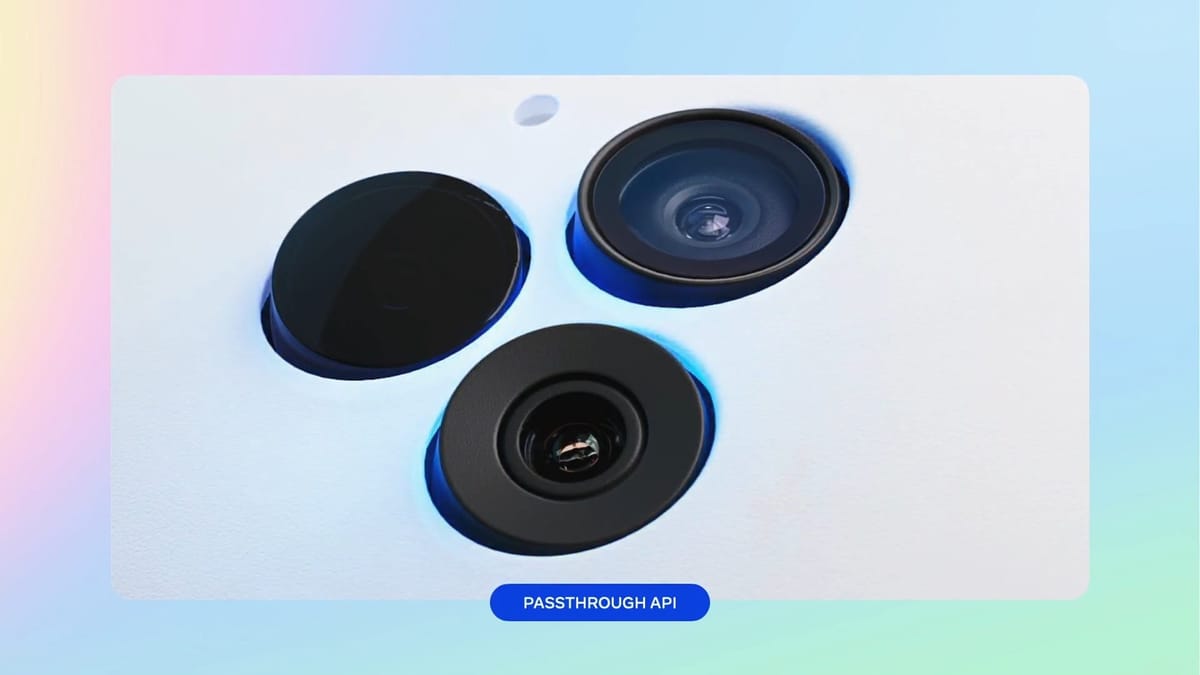
The summit listing comes a week after a Meta support page went live describing a “headset camera” permission which “allows an app to access the real-time passthrough camera feed from the front of your headset”.
Meta announced the Passthrough API at Connect 2024 back in September, saying that it will “enable all kinds of cutting-edge MR experiences”.
The Meta support page that emerged last week gives three examples of how Quest apps could leverage the passthrough view:
• Object recognition. Developers can create apps that recognise and use specific objects within your real-environment. For example, a digital board game that incorporates physical game pieces or boards.
• Location recognition. Developers can create experiences that respond differently depending on where the camera feed shows you are located . For example, indoors or outdoors, at a famous landmark, or in a specific type of room.
• Other machine learning functionality. Developers are able to run custom machine learning models against data from the real-time camera feed. This could be used for retexturing/shading, games involving participants who are not wearing headsets, person/animal detection, or any number of custom industrial/training use-cases.
Android XR Will Let Apps Access The Passthrough Camera View, Google Confirms
Android XR will let apps access the passthrough camera view to, for example, run custom computer vision models, Google confirmed.
 David Heaney
Meanwhile, Google confirmed last month that Android XR, its upcoming OS set to debut in Samsung’s standalone headset, will let apps access the passthrough camera view at launch.
What Is Passthrough Camera Access?
While headsets like Quest 3 and Apple Vision Pro use cameras to let you see the real world, today only the system software gets raw access to these cameras. Third-party developers can use passthrough as a background, sure, but they don’t actually get access to it. They instead get higher-level data derived by the system, such as hand and body skeletal coordinates, a 3D mesh of your environment with bounding boxes for furniture, and limited object tracking capabilities. That means they can’t run their own computer vision models, which severely limits the augmentation capabilities of these headsets.
The exception is that on visionOS 2, Apple is now giving enterprise companies raw access to Vision Pro’s passthrough cameras for non-public internal apps, but this requires a special licence from Apple and is restricted to “in a business setting only”.
Immersed Now Says Visor Mass Production Will Begin “After Summer”
Immersed now says mass production of Visor will begin “after summer”.
Who Is Immersed? What Is Visor?
Since 2020 Immersed has offered a free app now available on Meta Quest, Apple Vision Pro, Vive Focus, and Pico that shows your PC monitor in VR and lets you spawn entirely virtual extra monitors, for up to 5 monitors in total if you pay. The Immersed app supports Windows, Mac, and Linux.
Visor is a new headset fully designed around this use case, a lightweight streamlined device rather than a generalized headset for gaming.
Like Apple Vision Pro, it has a tethered battery and is primarily intended to be used seated. The battery also contains the Wi-Fi and Bluetooth antenna.
Immersed says Visor features the XR2+ Gen 2 chipset, 4K micro-OLED displays, color passthrough, as well as eye tracking and hand tracking for a Vision Pro style gaze-and-pinch input system.
When it first announced Visor back in 2023, Immersed said the headset would ship some time in 2024. But after revealing the actual design and demoing barely functional units at the September 2024 event that we attended, Immersed’s founder Renji Bijoy admitted that general preorders wouldn’t ship until April at the earliest.
Now, the timeline has slipped further.
Hands-On: Immersed Demos Barely Functional Visor Headset
Immersed claims Visor is the future of remote work. Critics claim it’s a scam. Today we attended the first demo event in search of the truth.
 David Heaney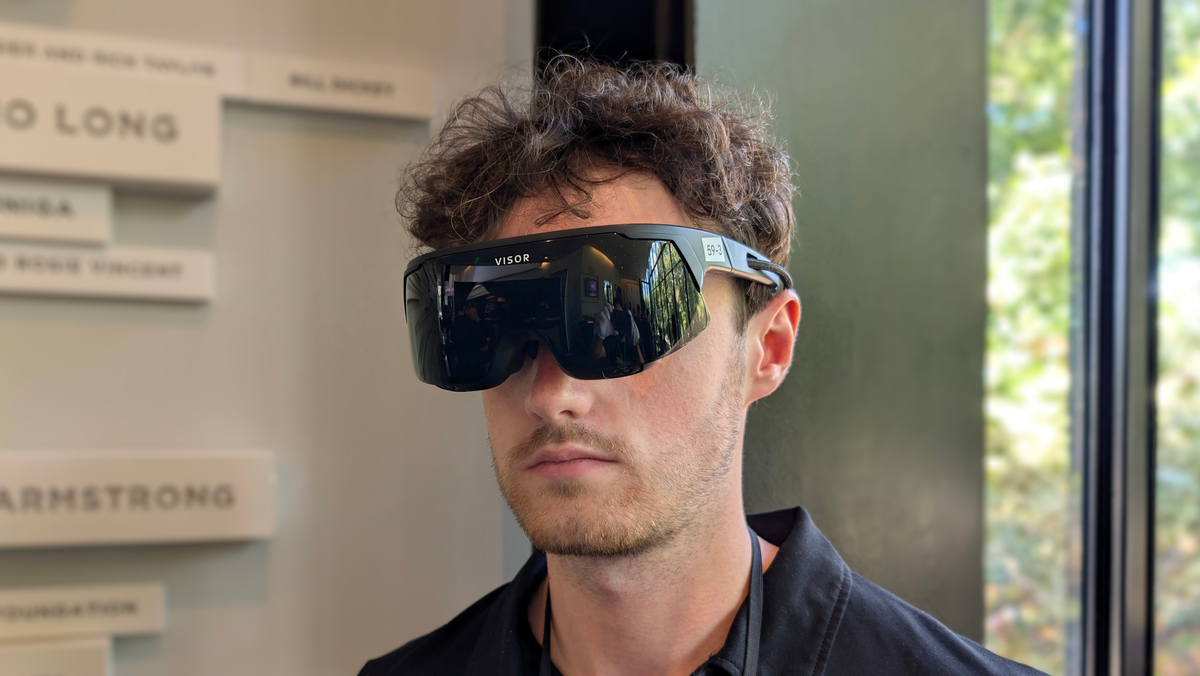
In a new blog post, Immersed told customers that a “handful” of Founder’s Edition units are already “out in the wild”, and that it expects to ship the rest “on the order of weeks, not quarters”.
Once the Founder’s Edition units have been fulfilled, Immersed says it will “shift our focus to mass production” of general preorders “in the following quarter(s)”, which it says means “after summer”.
The company ascribes this delay to “a few small but important refinements needed to achieve the level of performance we’re targeting—such as enhancing the buttons, headstrap, nose piece, and soft materials”.
Immersed Shows 3 Minute Walkthrough Of Visor’s OS
Immersed showed a 3 minute walkthrough of Visor’s software features seemingly working.
 David Heaney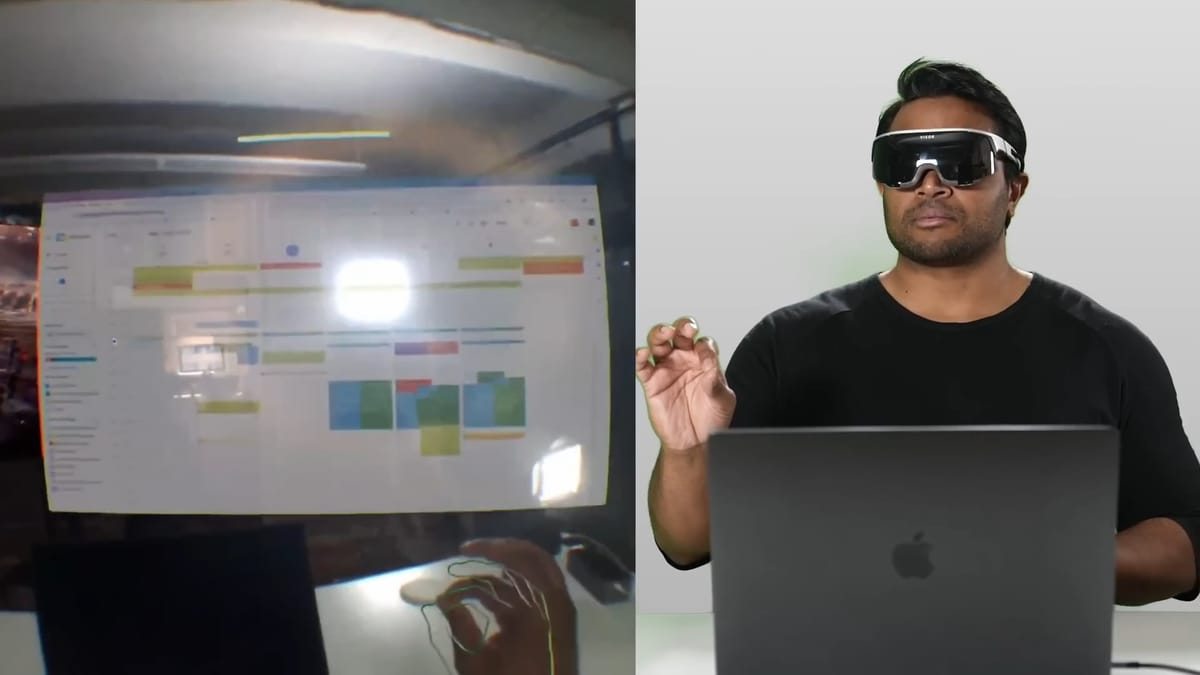
Shortly after my September barely-functional demo, my colleague Ian Hamilton tried a “partially functional” demo where the headset was cooled by an iced coffee. This followed Immersed publicly sharing videos of the headset’s core features like passthrough and hand tracking working, as well as a three minute walkthrough of the system software.
Immersed has demonstrated that Visor is a working device with system software, not a mockup. But given its continually slipping shipping timeline, we continue to recommend against preordering Visor, and suggest you wait for reviews of mass produced units, however long it takes for that to happen.
Internet Shutdowns At Record High In Africa As Access ‘Weaponized’
Internet shutdowns in Africa hit a record high in 2024, with 21 shutdowns across 15 countries. The previous record was 19 shutdowns in 2020 and 21. The Guardian reports: Authorities in Comoros, Guinea-Bissau and Mauritius joined repeat offenders such as Burundi, Ethiopia, Equatorial Guinea and Kenya. Guinea, Nigeria, Senegal and Tanzania were also on the list. But perpetrators also included militias and other non-state actors. Telecommunication and internet service providers who shut services based on government orders are also complicit in violating people’s rights, said Felicia Anthonio, the #KeepItOn campaign manager at Access Now, citing the UN guiding principles on business and human rights.


The details showed that most of the shutdowns were imposed as a response to conflicts, protests and political instability. There were also restrictions during elections. […] At least five shutdowns in Africa had been imposed for more than a year by the end of 2024, according to Access Now. As of early 2025, the social network Meta was still restricted in Uganda, despite authorities engaging with its representatives. On the Equatorial Guinean island of Annobon, internet and cell services have been cut off since an August 2024 protest over environmental concerns and isolation from the rest of the country. The increase in shutdowns led the African Commission on Human and Peoples’ Rights to pass a landmark resolution in March 2024 to help reverse the trend.
Read more of this story at Slashdot.
VR Roguelike Quantum Threshold Makes Your Wheelchair Your Greatest Strength
Quantum Threshold is an accessibility-focused VR roguelike shooter that turns your wheelchair into your greatest weapon.
Created by Finnish studio Vaki Games, Quantum Threshold promises a cyberpunk-themed narrative using wheelchair-based locomotion designed specifically for seated play. With this post-apocalyptic world overrun by rogue AI “Techno Wraiths,” you portray a surviving wheelchair user who seeks an escape across “ever-evolving” levels.
0:00
/1:06
Both traversal and battles use an upgradeable wheelchair, where you can unlock “game-breaking” weapons and modules inspired by Risk of Rain 2 and Left 4 Dead. Loot is randomized across each run, enemies will gradually evolve, while permanent upgrades are also obtainable.
“We wanted to prove that seated VR can deliver the same adrenaline rush—no compromises. Your wheelchair isn’t a limitation; it’s your greatest weapon,” said Teemu Jyrkinen, Creative Director at Vaki Games in a prepared statement.
Quantum Threshold arrives on May 22 on the Meta Quest platform and PC VR. The studio also confirmed that a limited-time closed beta sign-up will open at a later date for select platforms.
NCI employees can’t publish information on these topics without special approval
This story was originally published by ProPublica.
Employees at the National Cancer Institute, which is part of the National Institutes of Health, received internal guidance last week to flag manuscripts, presentations or other communications for scrutiny if they addressed “controversial, high profile, or sensitive” topics. Among the 23 hot-button issues, according to internal records reviewed by ProPublica: vaccines, fluoride, peanut allergies, autism.
While it’s not uncommon for the cancer institute to outline a couple of administration priorities, the scope and scale of the list is unprecedented and highly unusual, said six employees who spoke on the condition of anonymity because they were not authorized to comment publicly. All materials must be reviewed by an institute “clearance team,” according to the records, and could be examined by officials at the NIH or its umbrella agency, the US Department of Health and Human Services.
Someone Give Us $17 Million So We Can Buy This Original Anime Art

Studio Ghibli, Gundam, Pokémon, Akira, Dragon Ball Z, Sailor Moon—it’s all here and more.
What will happen to TikTok? A look at the potential buyers.
TikTok may be back online and in app stores, but its future in the United States is still far from certain. President Donald Trump’s executive order delaying enforcement of the ban was only a temporary reprieve for the company.
While ByteDance was once resistant to the idea of selling TikTok’s US business, that seems to have changed since Trump took office. A ByteDance investor said early this year that striking a deal to keep TikTok in the US is “in everybody’s interest.” Officials in China also suggested they were “open” to a deal, according to The Wall Street Journal.
A number of people and companies have signaled some interest in TikTok. Trump himself has said he would like to see a “bidding war” for the app and that the US government should own a stake in the company. What an eventual deal may look like, though, is unclear. These are the offers we currently know about. On March 9, Trump said the administration was “dealing with four different groups” on a potential deal, though he didn’t name names.
Trump’s executive order gave the company 75 days to come to an agreement, though he has recently said he would “probably” extend the deadline if a deal isn’t reached by April 5.
Oracle
NPR reported in January that Oracle was working with Trump Administration officials on “a plan to save TikTok that involves tapping software company Oracle and a group of outside investors to effectively take control of the app’s global operations.” Under this arrangement, ByteDance “would retain a minority stake in the company” but Oracle would oversee “the app’s algorithm, data collection and software updates.”
Headed up by Trump pal Larry Ellison, TikTok has an existing partnership with Oracle. The cloud company already hosts TikTok’s US user data and the company was a key part of TikTok’s original negotiations to remain operational in the US under a plan called Project Texas. (Those negotiations abruptly fell apart in 2022.)
Trump also previously signed off on a deal for Oracle and Walmart to acquire a 20 percent stake in TikTok in 2020, when the president tried to ban the app during his first term. That deal never materialized. Now, Trump’s position on Oracle is unclear. He told reporters that Oracle was not among the “many people” with whom he had discussed a deal for TikTok. (Ellison, notably, has been at the White House in recent days. He joined Trump and OpenAI CEO Sam Altman for the announcement of the Stargate Project.)
Microsoft
Microsoft is reportedly also interested in playing a role in TikTok’s future, according to the same NPR story, which said Microsoft was among the “other potential investors” involved in the talks with Oracle. Trump seemingly confirmed this. When asked directly if Microsoft was interested in buying TikTok, Trump responded “I would say yes.”
As with Oracle, this isn’t the first time Microsoft has attempted to acquire the social media company. Microsoft was in talks to buy TikTok in 2020 and take over its US business, but the deal abruptly fell apart. Microsoft CEO Satya Nadella later described it as “the strangest thing I’ve ever sort of worked on.”
Perplexity AI (and maybe the US government)
Just before TikTok briefly went offline, Perplexity AI threw its hat into the ring, offering a deal to ByteDance that “would “create a new entity combining Perplexity, TikTok US and New Capital Partners.”
Since then, Perplexity has reportedly tweaked its proposal. According to the Associated Press, the AI company floated a plan that calls for the “U.S. government to own up to half of that new structure once it makes an initial public offering of at least $300 billion.” Under this plan, ByteDance would keep a minority stake in the company and “would contribute TikTok’s U.S. business without the proprietary algorithm that fuels what users see on the app.”
Project Liberty
Another set of investors that’s proposed a bid to buy TikTok is a group known as Project Liberty. Led by investor Frank McCourt, it includes Kevin O’Leary of Shark Tank fame. The group initially came forward before the ban took effect.
In March, Reddit cofounder Alexis Ohanian announced that he was joining the Project Liberty bid to acquire TikTok’s assets. “I’d love to see an app where users actually own their data and where creators have real control,” he wrote in a short post on X that hinted at a potential tie-in with… the blockchain. “Imagine bringing all those users seamlessly onchain…” An accompanying video referenced the possibility of “decentralized distribution,” but disn’t offer details.
O’Leary previously told CNBC that deals involving a government stake may not comply with the law. “That 50/50 deal, I would love to work with Trump on, so would every other potential buyer … But the problem with some of these ideas is they are inconsistent with the ruling of the Supreme Court,” he said. “I would love to do a deal, if the law provided for it, but I don’t have the luxury of breaching the order of Congress.” Later, he said that the deal “changes by the hour,” writing on X that “it’s clear to me now that we’re going to have to do a dance between the original owners, the founders of ByteDance itself, and interpreting the law of what Congress and Supreme Court has upheld.”
MrBeast
YouTuber MrBeast, also known as Jimmy Donaldson, joked on X about buying TikTok ahead of the initial ban. He later said that “so many billionaires” had reached out to him about making an offer that he was going to try to actually pull it off.
Okay fine, I’ll buy Tik Tok so it doesn’t get banned— MrBeast (@MrBeast) January 14, 2025
At least one group has already confirmed his involvement, along with other “high-net-worth individuals” looking to make an “all-cash offer.” That group, led by employer.com founder Jesse Tinsley also reportedly includes Roblox CEO David Baszucki. According to Bloomberg, together they have put together “significantly” more than $20 billion for a bid, though it’s not clear how seriously their offer is being considered. Bloomberg noted that there’s also a possibility that MrBeast may attach himself to other bids.
What’s next?
So where does all this leave TikTok? For now, the company is still in limbo. Yes, it’s available in the App Store and Google Play, but the app’s service could be interrupted again if the company is unable to reach some kind of a deal. For now, though, it seems both the government and ByteDance are much more willing to negotiate than they have been in the past, though it’s not at all clear what terms both sides may actually agree on.
Update, March 10, 2025, 6:55PM ET: This story has been updated to add new statements from President Trump, as well as to add details about Reddit founder Alexis Ohanian joining the Project Liberty bid.This article originally appeared on Engadget at https://www.engadget.com/social-media/what-will-happen-to-tiktok-a-look-at-the-potential-buyers-000110723.html?src=rss
Wine Releases Framework Mono 6.14
Today marks the release of Framework Mono 6.14, the first major Mono release in five years and the first under WineHQ’s stewardship. This update includes long-awaited improvements such as native macOS ARM64 support, enhancements to System.Windows.Forms for X11, better COM interface support, and various stability fixes. Phoronix reports: In addition to the native macOS ARM64 support and System.Windows.Forms improvements for X11, some of the other Mono 6.14 improvements carried out over the past half-decade include improved support for generated COM interfaces, many warning fixes, addressing common cases where processes would hang on exit, and more.


As for the “Framework Mono” name rather than just Mono, the release announcement explains: “Framework Mono is the project previously hosted at https://github.com/mono/mono, which was then simply called Mono. I have made this change to distinguish it from ‘monovm’ and ‘Wine Mono’, which are different projects. Framework Mono is a cross-platform runtime compatible with .NET Framework.” You can download and learn more about the release here.
Read more of this story at Slashdot.
How Trump’s EPA hopes to avoid greenhouse gas regulations
A document that was first issued in 2009 would seem an unlikely candidate for making news in 2025. Yet the past few weeks have seen a steady stream of articles about an analysis first issued by the Environmental Protection Agency (EPA) in the early years of Obama’s first term: the endangerment finding on greenhouse gasses.
The basics of the document are almost mundane: greenhouse gases are warming the climate, and this will have negative consequences for US citizens. But it took a Supreme Court decision to get written in the first place, and it has played a role in every attempt by the EPA to regulate greenhouse gas emissions across multiple administrations. And, while the first Trump administration left it in place, the press reports we’re seeing suggest that an attempt will be made to eliminate it in the near future.
The only problem: The science in which the endangerment finding is based on is so solid that any ensuing court case will likely leave its opponents worse off in the long run, which is likely why the earlier Trump administration didn’t challenge it.
Sony Experiments With AI-Powered PlayStation Characters
Sony is working on a prototype AI-powered version of at least one its PlayStation game characters. The Verge: An anonymous tipster has shared an internal video from Sony’s PlayStation group with The Verge that demonstrates an AI-powered version of Aloy from Horizon Forbidden West. The video is narrated by Sharwin Raghoebardajal, a director of software engineering at Sony Interactive Entertainment who works on video game technology, AI, computer vision, and face technology for Sony’s PlayStation Studios Advanced Technology Group.


Raghoebardajal demonstrates an AI-powered version of Aloy that can hold a conversation with a player through voice prompts during gameplay. Aloy can be seen responding to queries with an AI-powered synthesized voice and facial movements, both in a demo setting and within the full Horizon Forbidden West game. Raghoebardajal makes it clear this is just a prototype that has been developed alongside Guerrilla Games to demonstrate the technology internally at Sony.
Read more of this story at Slashdot.
Bluesky adds 3-minute video uploads and inbox management features
Bluesky continues to beef up its video capabilities. The app’s latest update adds support for uploads of up to 3 minutes, a notable expansion from its previous limit of one minute. The change should give video creators on Bluesky much more flexibility in what they can post. It will also likely be appreciated by fans of Flashes, the new Bluesky-based photo and video app.
The update also brings some much needed inbox-management tools to Bluesky DMs, with the addition of a new “requests” section for incoming messages from users you don’t know. You’ll also now be able to reject incoming chats, which should help reduce the number of spammy DMs that have been flooding many users’ inboxes in recent weeks.
The latest Bluesky update rolled out as CEO Jay Graber appeared onstage at SXSW for a keynote about the growing decentralized social media platform, which has just under 33 million users. Graber, who was wearing a t-shirt emblazoned with a Latin slogan “mundus sine caesaribus” (a world without Caesars) — an apparent play on Mark Zuckerberg’s affinity for Roman Empire-inspired attire — spoke about why Bluesky is “billionaire-proof” compared with other apps.
Zuckerberg’s shirt translates to “All Zuck or all nothing.” Graber’s says “A world with no Caesars.” Screenshot via X
“If a billionaire came in and bought Bluesky or took it over, or I decided tomorrow to change things in a way that people really didn’t like, then they could fork off and go on to another application,” she said. “That openness guarantees that there’s always the ability to move to a new alternative, still using the same network. There’s much less tolerance in the ecosystem for a very heavy-handed change.”
She also opened up about how Bluesky is thinking about its business model and generative AI. On the business side, she once again said the company is “exploring subscriptions” as well as paid “developer services” for those who build experiences on top of Bluesky. In a similar vein, she also said the company was considering how it could eventually turn some of its features, like moderation services or custom feeds, into a “marketplace” where the company may get a cut of potential transactions.
When it comes to large language models, she said the company was “working with some partners on developing a framework for user consent, for how they want their data to be used for generative AI.”This article originally appeared on Engadget at https://www.engadget.com/social-media/bluesky-adds-3-minute-video-uploads-and-inbox-management-features-220317950.html?src=rss
The first Xbox handheld might not come from Microsoft
It took a few years of dealing with poorly optimized handheld PCs, but Windows Central reports Microsoft may finally be working on an Xbox handheld. The company could announce an Xbox-branded portable device as early as this year, though it sounds like it won’t come from Microsoft directly.
Instead, the company is partnering with a PC maker already working in the gaming space to build a handheld, Windows Central writes. The device, codenamed “Keenan,” will feature Xbox design elements, an “official Xbox guide button” and will likely run Windows 11. Given the clunky experience of navigating Windows on the handhelds you can buy today, the real hope is that Xbox’s take will include a launcher or new way of using the desktop OS that’s fit for a controller instead of a mouse. The big advantage SteamOS has over Windows is that you never have to interact with a desktop environment if you don’t want to.
These rumored plans might line up with what Microsoft’s VP of “Next Generation” Jason Ronald shared at an AMD and Lenovo event from CES 2025 called “The Future of Gaming Handhelds.” According to The Verge, Ronald said that Microsoft wants to bring “the best of Xbox and Windows together.” The company hopes to simplify Windows and make it using it more console-like for handhelds. “I think we’ll have a lot more to share later this year,” Ronald said.
Phil Spencer, CEO of Microsoft Gaming, has expressed interest in handheld devices before and said the company was experimenting with prototypes. It seems like at least for now, though, Microsoft is borrowing Valve’s approach and making a handheld-friendly version of its operating system available for other PC makers to use.
That doesn’t mean there won’t be a first-party handheld in the future. Windows Central’s report mentions that there’s a successor to the Xbox Series X, new internet-connected controllers and an official Xbox gaming handheld, all tentatively slated for 2027.This article originally appeared on Engadget at https://www.engadget.com/gaming/xbox/the-first-xbox-handheld-might-not-come-from-microsoft-220043843.html?src=rss
No One Asked for It, but There’s Now a Steamboat Willie Vs. Pooh Horror Movie

The public domain horror trend is now borrowing from another age-old trope: the crossover film.
The Latest Pixel Update Is Filled With Glitches, but There’s a Fix for at Least One of Them
Software updates are supposed to introduce new features while improving the stability of the operating system. Occasionally, however, additional bugs and glitches can slip through the cracks. That’s the case with the latest Pixel update: While Google added a number of new features to Android and patched 43 security vulnerabilities, users who have installed it are complaining of strange glitches on their Pixel phones.
March 2025 Pixel drop glitches: Brightness, vibrations, and more
First up, as spotted by 9to5Google, some Pixel users are experiencing brightness variations while using their phones—without touching the brightness settings themselves. The issue seems to be limited to video playback, where the brightness will dip or flicker at random. This user reports it happens in just about every video app they use, including Netflix, Prime Video, VLC, or Google’s built-in player. 9to5Google confirmed the bug on a Pixel 9, though the brightness glitch happened inconsistently.
In addition to this brightness glitch, you may also experience changes with your device’s vibrations. This thread represents a wide range of experiences with the issue: Some users are complaining that haptics are much stronger than they were before the update, with one user describing the change as a “spring instead of a thump.” On the other hand, another user says the vibrations of their Pixel are now weaker than they were before. Regardless, many seem to feel vibrations are “different” following the update.
These are the bugs that have made the most buzz on forums since the Pixel Drop. However, there could be other issues that aren’t quite as widespread. One r/GooglePixel user rounded up the bugs they’ve experienced so far, and, in addition to the brightness bug, they’re also experiencing audio issues, including an issue with EQ settings, and a problem where song volume is much louder than video volume. That last point would make it quite annoying to jump between, say, Spotify and Netflix: Stranger Things will launch too quiet, and will make your brightness go berserk.
How to fix the brightness glitch on Pixel phones
While Google is likely working on patches for the biggest bugs from the latest Pixel drop, there’s currently a workaround for the brightness glitch: drop your phone’s refresh rate. It appears that flickering and dimming problems only occur at this time when watching videos with 120Hz. Drop the refresh rate to 60Hz, and the brightness issues appear to dissipate.
To change the refresh rate, head to Settings > Display, then disable the toggle next to Smooth Display.
Linuxiac Weekly Wrap-Up: Week 10 (Mar 3 – 9, 2025)
Catch up on the latest Linux news: Firefox & Thunderbird 136, Garuda “Broadwing,” Tails 6.13, PipeWire 1.4, Wine 10.3, KeePassXC 2.7.10, Xen 4.20, and more.
The Nintendo Alarmo Sound Clock Actually Gets Me Up in the Morning
We may earn a commission from links on this page.
For many years, I’ve depended on my phone to get me out of bed in the morning, and I’ve hated it. I’d easily snooze or catch myself doom scrolling instead of starting my morning routine. That all changed after my brother gifted me perhaps the best Christmas present I’ve received over the last few years: a Nintendo Sound Clock: Alarmo, which you can now get on Walmart or Target for $99.99. It was previously only available on the Nintendo store.
Display: Digital, Power type: Corded Electric, Alarm clock type: Projection Alarm Clocks.
Nintendo Sound Clock: Alarmo (Walmart)
$99.00
at Walmart
$317.50
Save $218.50
Save $218.50

$99.00
at Walmart
$317.50
Save $218.50
Save $218.50
Display: Digital, Power type: Corded Electric, Alarm clock type: Projection Alarm Clocks.
Nintendo Sound Clock: Alarmo
$99.98
at Target

$99.98
at Target
The Alarmo is a digital alarm clock that needs to be connected to an outlet with a USB cable to be powered on. You no longer need a Switch Online membership to buy (or use it). It comes with many built-in themes you can choose from, including Super Mario Odyssey, The Legend of Zelda: Breath of the Wild, Splatoon 3, Pikmin 4, and Ring Fit Adventure. Nintendo says you can expect to download more in the future for free, including Mario Kart 8 Deluxe and Animal Crossing: New Horizons. The Alarmo uses a motion sensor to detect that you’re getting out of bed to stop the alarm from going off.
I’ve been using the The Legend of Zelda: Breath of the Wild theme since I set it up and have been using it for months with great results. Because I need to get up to stop the alarm, and I don’t want the alarm to wake up my fiancée, it’s been effective. I never thought Nintendo would be the one to fix my morning issues and over-dependence on my phone.
Something to note is that although there is no snooze feature, it is designed to temporarily stop the music when you move, essentially snoozing. But it’s not a pleasant snooze since the music will keep on playing, progressively getting louder. You can also easily unplug it to turn it off completely since there’s no battery, but it has been working great for me regardless.
Apple Pulls iPhone 16 Ad Showing Off ‘More Personal Siri’
Apple has pulled an iPhone 16 ad featuring a “more personal Siri” after delaying Apple Intelligence features originally planned for iOS 18. The now-private video starred actor Isabella Ramsey demonstrating contextual awareness capabilities. Apple stated the delayed features, including personal context and improved app integration, will release “in the coming year,” while Bloomberg reports some Apple AI staff believe these features might be completely rebuilt.


Read more of this story at Slashdot.
Hidden Backdoor Discovery Could Expose 1 Billion Bluetooth Devices To Hackers

Researchers have uncovered a proprietary undocumented command in Chinese manufacturer Espressif’s ESP32 chips that could be exploited to the detriment of billions of users.
The ESP32 chip allows connectivity through Wifi or Bluetooth and can be found in millions of the Internet of Things (IoT) devices. At RootedCON, a notable Spanish cybersecurity