
Excuse me, can I make a complaint, OSI? Or are you paid to excuse “Open Source” violations by Microsoft?
Monthly Archives: March 2025
Why Extracting Data from PDFs Remains a Nightmare for Data Experts
Businesses, governments, and researchers continue to struggle with extracting usable data from PDF files, despite AI advances. These digital documents contain valuable information for everything from scientific research to government records, but their rigid formats make extraction difficult.
“PDFs are a creature of a time when print layout was a big influence on publishing software,” Derek Willis, a lecturer in Data and Computational Journalism at the University of Maryland, told ArsTechnica. This print-oriented design means many PDFs are essentially “pictures of information” requiring optical character recognition (OCR) technology.
Traditional OCR systems have existed since the 1970s but struggle with complex layouts and poor-quality scans. New AI language models from companies like Google and Mistral now attempt to process documents more holistically, with varying success. “Right now, the clear leader is Google’s Gemini 2.0 Flash Pro Experimental,” Willis notes, while Mistral’s recent OCR solution “performed poorly” in tests.


Read more of this story at Slashdot.
20 Plagues Y Combinator Unleashed on the World Over the Last 20 Years

On the foundational startup incubator’s 20th birthday, let’s remember some of the worst things it’s done.
Eero Pro 7 review: Paying to be sold a subscription
Many years ago, I reviewed the Eero Pro 6E, which was a delightfully easy device to get along with. The hardware was powerful, unobtrusive and fit into my home pretty well, to the point where I had no complaints about living with it. But all of the good was undone by Eero’s constant arm-twisting to get you to pay for its monthly subscription. With an app that exists as little more than an advertisement and with so many basic features paywalled, I couldn’t in all good conscience recommend it. Thankfully, the advent of Wi-Fi 7 and the new Eero Pro 7 means Eero has a shot to make good on its previous errors and turn my opinion around. Which, it’ll take, right?
For Engadget’s mesh Wi-Fi testing methodology, please read our mesh Wi-Fi buyer’s guide.
Hardware
Daniel Cooper for Engadget
Since its birth, Eero has built its Wi-Fi nodes as rounded-off boxes that sit unobtrusively on side tables and bookshelves. Sadly, the sheer volume of stuff required to make Wi-Fi 7 work is bigger than the traditional body will allow. (The vanilla Eero 7 is actually lacking 6GHz support, which is why it’s in the older chassis, but has some gall pretending it’s a proper Wi-Fi 7 device.) Consequently, the Pro 7 ditches the classic body for the same casing found on Eero’s super-flagship Max 7. The vertical design is better for keeping the components cool without a fan, but it is noticeable, especially with prominent branding, defeating the point of making the gear anonymous.
Each node is identical, clad in piano gloss white and measuring 7.1 inches tall and 5.8 inches wide. Turn it around and you’ll find the USB-C power jack, reset button and two 5G ethernet ports with a theoretical top speed of 4.7 Gbps. The coterie of wireless radios (2×2 2.4Ghz, 2×2 5GHz and 2×2 6GHz) promise to reach the heights of 3.9 Gbps. Tucked inside are the usual smart home integrations including Zigbee, Thread, Matter, Amazon Connected Devices, Alexa and Bluetooth LE 5.0
Installation
Eero’s promise of “frustration-free setup” isn’t an empty one, and it remains the easiest mesh system to set up. Download the Eero app, hand over your Amazon login and plug in your cable modem, and everything else is taken care of within minutes. Each node was up and running two minutes after being plugged in, and most of the 15-minute set-up time was schlepping between rooms.
Once each node is ready, you’ll get a notification telling you your placement is good for signal strength. This is useful since some meshes won’t, and just expect you to troubleshoot the poor performance down the line. The app did tell me I’d get faster speeds if I moved the nodes closer to each other, but given the layout of my home, that would mean placing them all in the same damn room.
Performance
Eero’s bread and butter performance is never an issue, especially once the mesh has settled down after the first day or so. Much of what worked with previous versions remains in place here, and for home use, it’s excellent. My office, which is some distance away from any node, was still able to pull down 250 Mbps in artificial speed tests. The smart TV in this room was able to stream a 4K movie without any lag or buffering, letting me dance past the pre-roll ads.
I can’t imagine anyone wanting to throw out their Wi-Fi 6E system in favor of this, because you won’t see a massive uplift in performance. When I tested the Eero Pro 6E, I was easily getting speeds in my office around the 250 Mbps mark anyway. There are noticeable improvements in lag and reliability that can’t be sniffed at, but you’ll only notice them if you’re upgrading from really old gear.
If you are upgrading from an older Eero system, it’s worth keeping hold of that hardware to bolster your network. Every Eero node is capable of integrating with its older peers, even if you may find performance is degraded as a consequence. I grabbed a Pro 6E node and placed it in a notorious signal dead spot at the end of my home, just for the hell of it. Naturally, the older nodes are slower but, even so, the loss isn’t that painful. When I’d connected to the 6E node and ran speed tests, I was still pulling down 200 Mbps.
App and Eero Plus
When I wrote Engadget’s mesh Wi-Fi buyer’s guide, I spent months testing hardware from all the big names. Some were easy, some were fussy and some were designed for network engineers with no consideration for general users. None of them, however, irked me as much as Eero’s app, which is a textbook case in seizing defeat from the jaws of victory. Essentially, half of the splash screen is an ad for Eero Plus, the company’s subscription product. And Eero puts so many basic features behind a paywall that it’s impossible to recommend. But I’m getting ahead of myself.
Eero’s app is tidy and well-designed, offering a single pane listing each node and its signal strength. The icons signify how well the nodes are connected to each other, but there’s no sense of the network’s topography. Below it is a pane that tells you what devices are on the network right now, although it struggles to name many common products (including those owned by Amazon). You’re also unable to set traffic priorities for your device, which would be useful when I’m recording a podcast or on a Zoom call.
Daniel Cooper for Engadget
Take a look at this screenshot of the Activity Pane, and notice how empty it is, showing you just the top speeds and quantities of data up- and downloaded. Each one links to another pane with some more detailed information, but even so, the visualizations are more or less pointless. This speaks to the big issue with Eero’s software setup and business model more generally.
I imagine Engadget readers break into two camps: People who know DHCP has something to do with their internet but wouldn’t touch it for fear of breaking something, and the people who have 192.168.1.1 burned into their fingers’ muscle memory. Eero’s pitch probably irritates both since it robs you of even your most basic agency to run your own damn Wi-Fi.
For instance, you can set your Wi-Fi name and password, and set the same for your guest Wi-Fi but beyond that, oh boy. You can collect devices into groups, letting you set time limits for, say, your kids’ consoles or computers. You can set your DHCP to manual or Bridge mode, set a reservation or port forward and deactivate support for IPv6. And, uh, that’s about it.
That is, unless you spring $9.99 a month or $100 a year for Eero Plus, which then opens up the toolkit. For that, you get the ability to set a mobile hotspot as an internet backup if your Wi-Fi should go down. Subscribers will also get access to parental controls, historical data, ad and app blocking, the company’s advanced security suite, DDNS and content filters. Plus, you’ll get a subscription to Guardian VPN, Malwarebytes and 1Password thrown in, too.
Look, I get it. All hardware companies — even ones owned by Amazon — need to ensure they have multiple revenue streams to keep the lights on. And I’m sure there are lots of people who feel the added charges are probably worth it for peace of mind. But you need to know that Eero’s competition offers these features without asking for more money. Google’s Nest Wi-Fi includes parental controls and security updates in addition to guest networks. Though Nest hasn’t launched a Wi-Fi 7 product yet, so it’s not an equivalent comparison, the Eero Pro 6E was similarly limited with Amazon pushing a Plus subscription. If a company wants to charge me $700 for a product and then hold basic features back to wring another $100 a year out of me, I’m hostile by default.
Price and the competition
The Eero Pro 7 is available in one, two or three-node packs, priced at $300, $550 and $700 respectively. Wi-Fi 7 systems are currently priced for early adopters, and you’ll spend big at whichever company you opt to buy from. I’m not going to do a direct apples-to-apples comparison here as there are a number of notable spec differences between various Wi-Fi 7 routers. For instance, Netgear’s Orbi 770 has a longer broadcast range and faster wireless speed but slower ethernet ports and can only handle half as many connected devices as the Pro 7. At this early stage, you’ll be looking at what specs to prioritize depending on your home’s specific needs. So I can’t say if the $900 Orbi 770 is a better fit for you than the $700 Eero Pro 7.
If you’re looking to upgrade and have your heart set on Eero, then it might be worth looking at last-generation hardware. At the time of writing, a three-pack of Eero Pro 6Es are priced at $550, and the performance it offers is pretty darn impressive. It has the same issues as its successor, but the backwards-and-forwards compatibility is a useful bonus. And Wi-Fi 6E is a major upgrade over whatever Wi-Fi you’re probably using at home right now.
Wrap-up
There are so many things to like about Eero’s mesh Wi-Fi systems that it galls me so much I can’t recommend them. They’re really easy to set up, really easy to use and the performance you get out of them, in terms of both speed and reliability, is staggeringly good. I’m quite fond of the hardware design, even if they are a bit more attention-grabbing than the older models. And I do think $700 for a whole-home Wi-Fi 7 system is pretty good when other companies are asking for a grand or more right now. That’s especially true for folks who aren’t interested in messing with every knob and dial to fine-tune their internet to the nth degree. This hardware passes the “would you be able to hand this to your technophobe family member” test with flying colors.
Unfortunately, I cannot get over how aggressive the nickel-and-diming is, to the point of holding back features that I’d say should be free. I’d argue that every router should offer at the very least, basic parental controls and some sort of URL blocking or content filtering. Even if you don’t use them, that those features would be held back to milk recurring revenue out of you is rough. If you were standing at a car dealership and someone tried to sell you a sedan with three wheels — the fourth is thrown in with CarSubscriptionPlus for just $9.99 a month! — you’d walk away in disgust.
This article originally appeared on Engadget at https://www.engadget.com/home/smart-home/eero-pro-7-review-paying-to-be-sold-a-subscription-171502767.html?src=rss
Paradox Interactive Announces VR Strategy Game Surviving Mars: Pioneer
Surviving Mars: Pioneer is a VR reimagining of the strategy game, and it’s entering early access later this year.
Based on the top-down strategy game Surviving Mars, Surviving Mars: Pioneer tests your grit as you attempt to establish a new civilization among the stars. In the original game, players would control a Martian landscape from a top-down perspective, constructing futuristic domes and guiding eager citizens. Developed by Bolverk Games (Genotype), the VR adaptation gives you a more central and personal role, mining for materials and placing solar panels on the red planet’s surface in first person.
0:00
/0:34
Surviving Mars was originally launched in 2018. Here, players took on the role of an overseer tasked with building up a Martian colony from the dust. With a rocket full of resources and sponsorship from an earthly organization, surviving the vastness of space requires balancing human needs like water and air with the fiscal needs of society and your sponsor. This port looks to pull from those basic principles, allowing players to feel like even more of an active participant in their burgeoning cityscape.
Surviving Mars: Pioneer is entering early access on PC VR and Quest later this year, and a PlayStation VR2 version will arrive “at a later date.”
Trump’s Dismantling of NASA Has Officially Begun

Newly announced layoffs highlight the troubling impact of DOGE on the space agency and federal workers as a whole.
Upcoming Atmospheric Horror Game Out Of Sight Is Getting A VR Port
Upcoming horror puzzler Out of Sight is getting a full VR port.
Developed by The Gang, Out of Sight is an eerie puzzle game that asks players to control a blind girl called Sophie from the viewpoint of her cuddly teddy. Set throughout a menacing mansion, players control Sophie and carry around the toy to gain better vantage points on confounding contraptions. To escape, you must avoid the ire of Sophie’s captors and unravel the mystery surrounding her. Announced during the VR Games Showcase, here’s the trailer.
0:00
/0:55
The VR port sees players embody Sophie’s cuddly companion, expanding their line of sight by controlling Sophie and moving around the bear they inhabit – closely mirroring the gameplay seen in the flatscreen version. Across the tense trailer, we got a look at some gameplay mechanics, which included Sophie moving a wheeled block onto a pressure plate and climbing on a waiter’s trolley to pull down a lever. That’s all from the static viewpoint of the bear.
Out of Sight VR comes courtesy of Flat2VR Studios, the notable developer who helps officially translate flatscreen games for VR platforms. The studio’s previous work includes the hilarious rhythm game Trombone Champ: Unflattened, alongside upcoming titles like FlatOut and Wrath: Aeon of Ruin.
Out of Sight VR is coming to Steam first alongside its flatscreen counterpart, while PlayStation VR2 and Quest versions will follow later. A release date is unconfirmed.
Meta Is Ready to Rock Nvidia’s Boat With Its In-House AI Chip

Gradually, then suddenly, the big tech companies are replacing Nvidia’s pricey AI chips.
Deep Cuts Offers A Compelling Cinematic Sandbox
Deep Cuts delves into the magic of movie making, letting you become the protagonist in a myriad of genres.
The elusive world of the seventh art is one that fascinates me, telling stories from a unique perspective that evokes emotions like few other things in life can. Movies, and the filmmaking process, are at the heart of Deep Cuts, pun intended. It takes you behind the scenes to create your own action-packed scenes as eccentrically as you wish them to be. And, spoiler alert, it’s as wacky as it is fun.
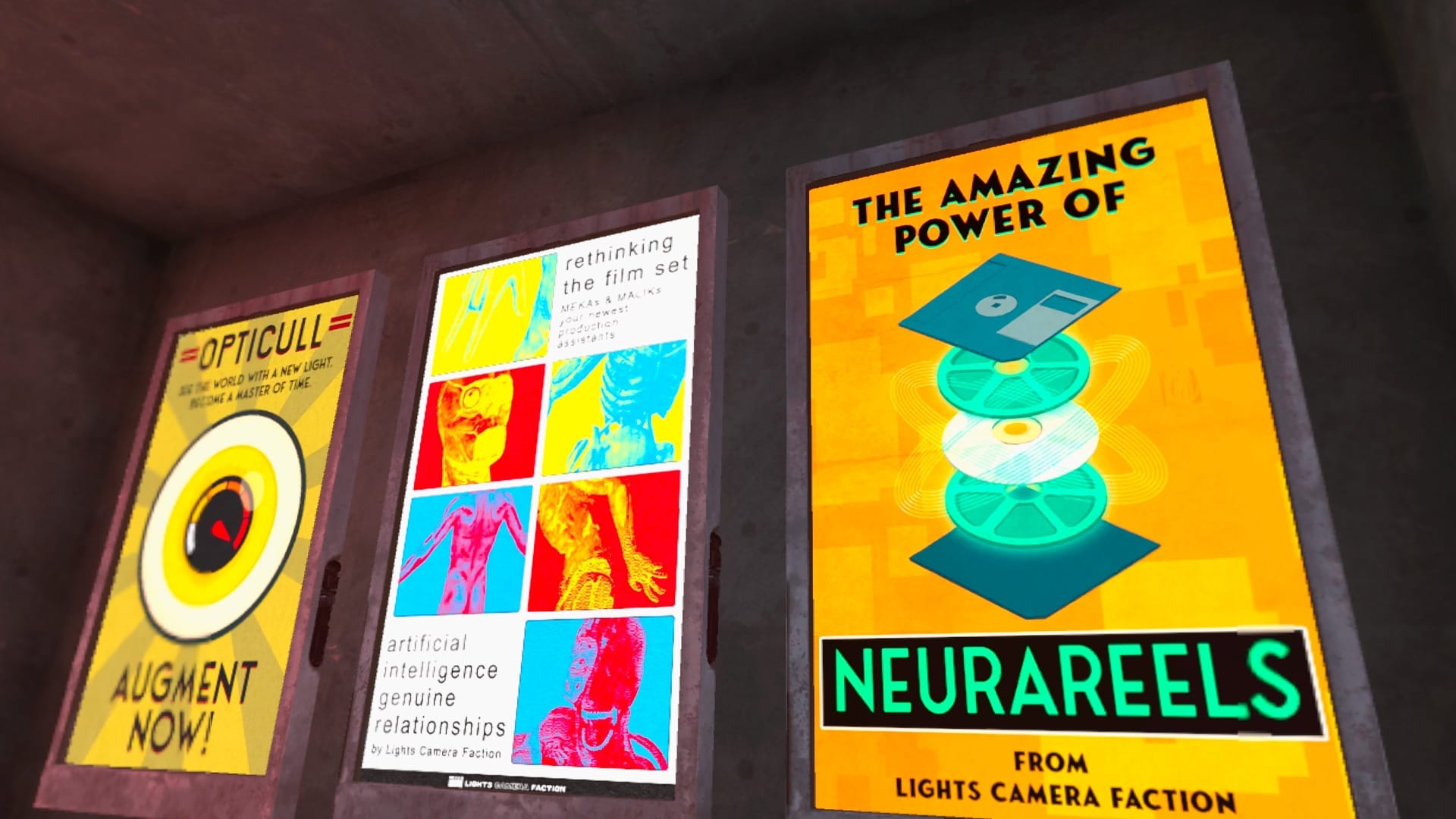
A decaying movie studio called Lights, Camera, Faction sets the scene well, as film producer Elise searches for her collaborator Malcolm to complete a film that just might save their business. What’s particularly clever is how she can directly go inside different movies thanks to a technology called Neurareel, letting the game present classic setups like a sheriff in a western, a kaiju’s assault in a big city, or the final frontier, space.
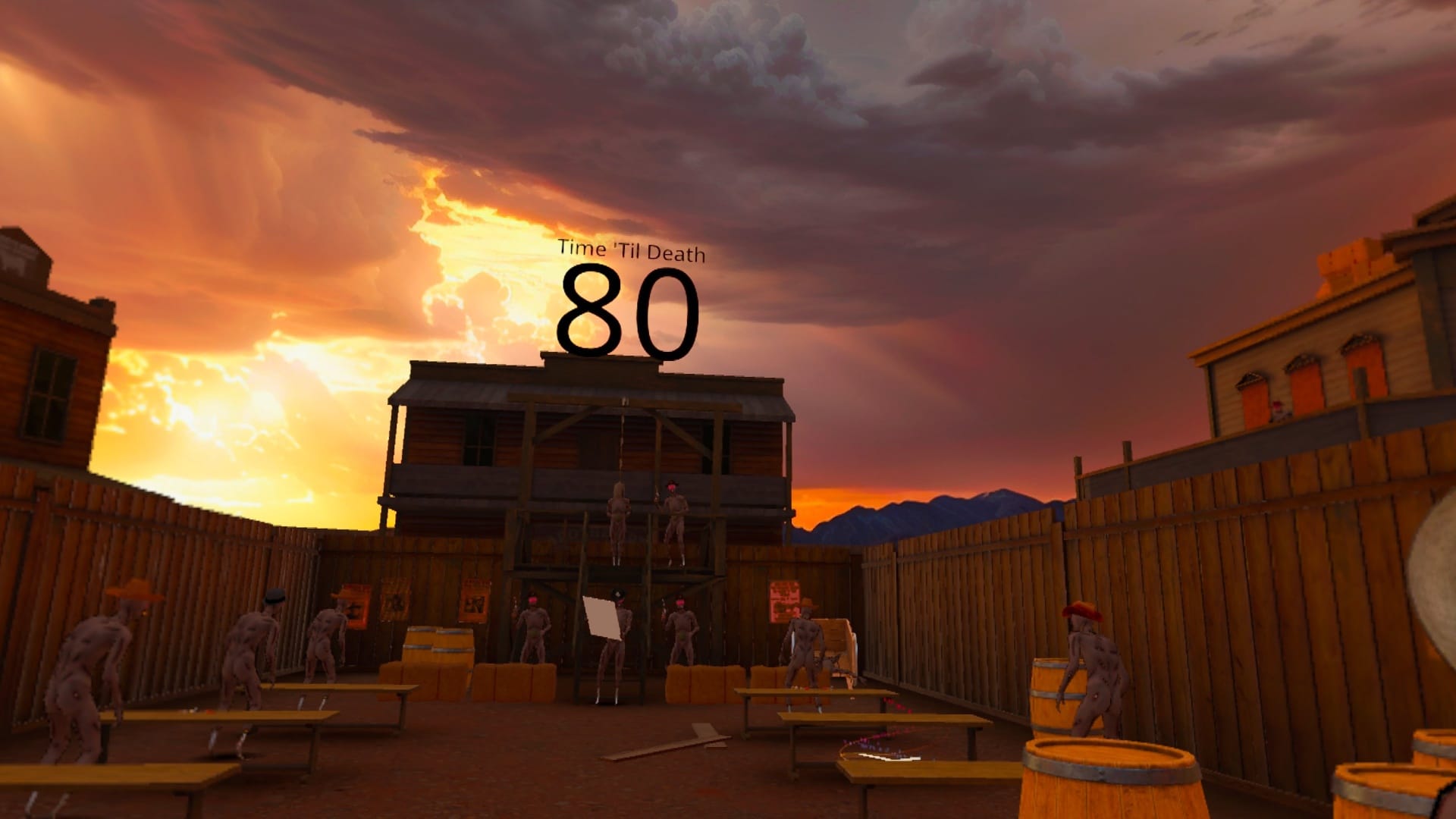
Showing an extreme farce of the movie making business with multiple references from the get-go, Deep Cuts, as its name suggests, takes players on a wild ride where they must shoot 5 scenes in every set. No two scenes are ever the same, keeping things fresh throughout. Some revolve around shooting outlaws and leaving a bloodbath, while others like winning a hot dog competition have a layer of unseriousness that adds welcome mission variety.
Acting as a shop on the go, a convenient weapon called the Bodegun from which you can spawn weapons, ammo, health, explosives, and even enemies. This useful invention requires credits scattered across the LCF building in drawers or on movie sets. Not every weapon is available immediately, but as you progress, chaos will be at your beck and call with laser beams, miniguns, and rocket launchers, opening up the approach to each scene smoothly.
The physics-based nature of Deep Cuts is where it shines the most. Almost every object can be interacted with. While you can shoot your way through most situations, getting up close and personal is an option too. As the game measures your velocity, most of them will be on the floor within three hits and you will have gained a workout. Feeling adventurous, grabbing a chair and knocking them out American-wrestling style never ceases to amuse.
Comfort
Accessibility features are a bit lacking. An option to toggle instead of holding weapons, which you have on you at all times, should be available. There’s no option for seated play, and there’s no movement vignette available for those who suffer from motion sickness. Otherwise, the usual features of smooth and snap camera turning, choosing left or right dominant hand, and subtitles can be accessed via your wristwatch.
Although billed as “a twisted movie-inspired world overrun by nightmarish creatures”, to my relief, this VR narrative adventure decidedly falls into the action category. Sure, there is a mission where you go through a haunted house, but it never feels like a full-on horror game. More than anything, Deep Cuts strikes as a parody of that trope, not taking itself too seriously and delivering a lighthearted romp at heart.

Giving unfettered player freedom via physics-based breakable items never gets old. With quick access to an endless array of explosives, weapons you can dual-wield and abilities such as a slow motion effect, there is a commitment to making the player feel cool. In that sense, Deep Cuts accomplishes its goal of living out entertaining film-based set pieces. Setting the stage for the player to run wild with their imagination means endless replayability, especially for those craving cinematic action.
Roboquest VR Shows Off Co-Op Gameplay In New Trailer
Fast-paced FPS roguelike Roboquest VR showed off a co-op mode in today’s new gameplay trailer.
Originally developed by Starbreeze, Roboquest is a high-octane roguelike that pits players against an onslaught of frenzying ballistic bots. In a post-apocalyptic 2700, players become Guardians, upgrading their loadout and skills to advance against a menacing metallic force. Alongside platforming challenges and bullet-hell battles, Roboquest also features boss battles that bookend bouts of tense exploration.
0:00
/1:38
The VR version of Roboquest is being made by Flat2VR Studios, the notable studio that helps officially port popular flatscreen games, like Trombone Champ, over to virtual reality platforms. Today’s new trailer offers a closer look at Roboquest VR’s techy cel-shaded world that includes its player hub, which features a Workshop, Class Area and Gadgets Rack players can access for upgrades. There’s also a Shooting Range to test out weapons.
While much of the trailer featured single-player gameplay, the final moments gave players a peek at the two-player co-op mode currently in development. In the trailer, we saw tandem Guardians grinding on rails and unleashing their loadout on the enemy robots. In co-op, you can revive fallen allies and combine abilities for team attacks.
While the announcement stated that Roboquest is coming to PS VR2, PC VR, and Quest this fall, the Quest page lists an August 22 release date.
The controversial cult shooter Postal 2 is coming to Virtual Reality
Flat2VR Studios announce several VR ports during the VR Games Showcase, including the controversial classic shooter Postal 2.
The post The controversial cult shooter Postal 2 is coming to Virtual Reality appeared first on MIXED Reality News.
Hitman World of Assassination VR: New trailer shows dual-wielding on Playstation VR 2
![[ALT-TEXT] Person with Sony VR headset, two pistols in his hands, world map in the background, futuristic atmosphere.](https://www.prime-wow.com/wp-content/uploads/2025/03/Hitman-World-of-Assassination-PSVR-2.jpg)
IO Interactive has released a new gameplay trailer for the upcoming VR version of Hitman World of Assassination for Playstation VR 2.
The post Hitman World of Assassination VR: New trailer shows dual-wielding on Playstation VR 2 appeared first on MIXED Reality News.
TikTok will try instituting a 10pm curfew on most teens
TikTok — at least according to the bevy of civil and federal lawsuits against it — is not known for being a safe place for children. In part it has has leaned on parents to do the policing through its Family Pairing tool, which allows guardians to limit teens’ screen time and block certain content. Now, TikTok is introducing additional features that allow a paired adult to see their teen’s connections and choose when the app is even accessible.
The first new feature, Time Away, lets parents set specific times that TikTok is available on their teen’s devices. For example, they can turn off access during a weekend trip or during dinner time, rather than just setting a screen time limit. They can also set a recurring schedule if they want to keep it simple each week. Teens, however, can request extra time, but their parent must approve it.
Parents can also now see exactly who their teen is following or is followed by, along with accounts they’ve blocked. TikTok claims this will make parents “better equipped to have ongoing conversations and help their teens develop the digital literacy skills they need.” Not a small task by any means.
Lastly, TikTok is adding an unusual feature to limit screen time. Anyone under 16 using the platform after 10PM will have their screen taken over and calming music will play (it can be dismissed to continue using the app.) In the coming weeks, TikTok will also test adding meditation exercises to these pop-ups.
This article originally appeared on Engadget at https://www.engadget.com/social-media/tiktok-will-try-instituting-a-10pm-curfew-on-most-teens-165416916.html?src=rss
Huge maps, 32-player battles, and jet skis: Newly announced VR shooter Forefront has big plans

Triangle Factory has announced the VR online shooter Forefront, which promises huge virtual battles with up to 32 players.
The post Huge maps, 32-player battles, and jet skis: Newly announced VR shooter Forefront has big plans appeared first on MIXED Reality News.
Flat2VR Tests Mature VR Conversion With 2003’s Postal 2
2003 shooter Postal 2 is being “fully rebuilt” for VR on Quest, PC VR, and PlayStation VR2.
Originally released in 2003 by Running With Scissors, Postal 2 takes place in the fictional town of Paradise, Arizona. Playing as “The Postal Dude,” this involves completing various tasks across your in-game week while choosing how violently to respond. Your actions then influence the town’s dynamic AI, which can cause riots or other violent events.
0:00
/2:17
The original game faced considerable criticism for its depiction of violence, stereotyping and more, leading to its ban in New Zealand. This upcoming adaptation includes manual weapon handling, gesture-based NPC interactions, and physics-driven melee combat. Your inventory, mini-map, and bodily function mechanics are also fully interactive.
The upcoming port is being handled within Flat2VR Studios by Team Beef, best known for its work on id Software conversions like Doom and Quake. Presently, it’s unknown if the Postal 2 conversion will include the game’s various expansions, and the 2003 shooter isn’t the only announcement from Flat2VR Studios at today’s VR Games Showcase.
Other reveals include a new gameplay trailer for Roboquest VR, which also revealed a co-op mode, while upcoming horror puzzle game Out of Sight is getting a VR edition. The company is also publishing 2022’s Shadowgate VR: The Mines of Mythrok on PS VR2, and it’s on co-publishing duties for Surviving Mars: Pioneer with Paradox Interactive.
A release date hasn’t been confirmed, though Postal 2 VR is coming to Quest, PC VR and PlayStation VR2.
Only Seven Countries Worldwide Meet WHO Dirty Air Guidelines, Study Shows
Nearly every country on Earth has dirtier air than doctors recommend breathing, a report has found. From a report: Only seven countries met the World Health Organization’s guidelines for tiny toxic particles known as PM2.5 last year, according to analysis from the Swiss air quality technology company IQAir. Australia, New Zealand and Estonia were among the handful of countries with a yearly average of no more than 5ug of PM2.5 per cubic metre, along with Iceland and some small island states.
The most polluted countries were Chad, Bangladesh, Pakistan, the Democratic Republic of the Congo and India. PM2.5 levels in all five countries were at least 10 times higher than guideline limits in 2024, the report found, stretching as much as 18 times higher than recommended levels in Chad. Doctors say there are no safe levels of PM2.5, which is small enough to slip into the bloodstream and damage organs throughout the body, but have estimated millions of lives could be saved each year by following their guidelines. Dirty air is the second-biggest risk factor for dying after high blood pressure.


Read more of this story at Slashdot.
‘Memoreum’ is Bringing ‘Dead Space’ Vibes to Quest Later This Year, New Trailer Here
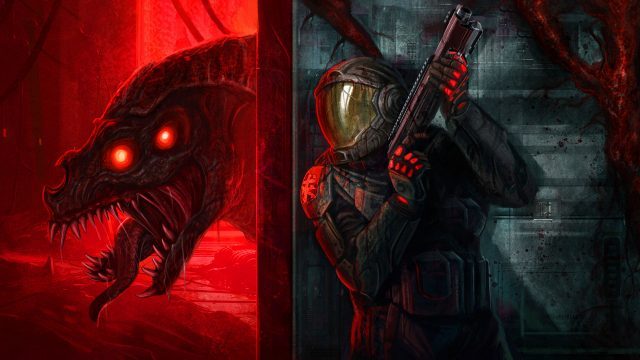
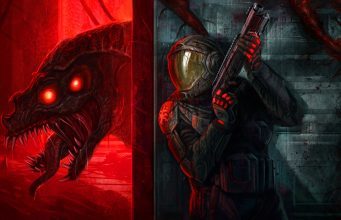
During the VR Games Showcase today, Patient 8 Games announced it’s bringing its long-awaited sci-fi action horror game Memoreum to Quest in September.
Patient 8 Games is best known for its hit Half Life: Alyx mod, ‘Return to Rapture’, which mashed up Bioshock levels with Half-Life lore.
Ever since we heard about how the studio was aiming to similarly recreate Dead Space in Half-Life: Alyx mod, but later pivoted to launch it as a standalone title built in Unity, we’ve been waiting patiently to learn more about the game, which took on the name Memoreum.
As the studio’s first ‘ground-up’ VR release, Memoreum puts you in the shoes of Dr. Otto Hudson, who must fight to unravel the mystery of the Ichor Infection, and how it’s taken over humanity’s last ship.
Here’s how the studio describes the action:
The year is 2311. Ripped from your stasis pod, you find a very different ship from the one you left behind. The inhabitants have lost any shred of humanity, and your only hope comes from a scrambled voice, guiding you through the darkness. Is this reality, or just another symptom?
Take up arms against those you swore an oath to save, build an arsenal of unique and powerful weapons to face the monstrosities of the Ichor Infection, and scavenge what you can to survive. But as you adapt, the infected will do the same…
The studio says Memoreum is initially targeting Quest 2 and above, releasing in September 2025. Patient 8 also plans to launch on PSVR 2 and PC VR headsets at a later date. In the meantime, you can wishlist the game on Quest here.
The post ‘Memoreum’ is Bringing ‘Dead Space’ Vibes to Quest Later This Year, New Trailer Here appeared first on Road to VR.
‘Roboquest’ VR Port Shows New Look at Gameplay and Confirms Co-op Support


Flat2VR Studios today showed off some fresh gameplay footage of Roboquest VR, its upcoming port of the titular fast-paced roguelite shooter.
Like the original flatscreen Roboquest (2023) from RyseUp Studios, Flat2VR also confirmed Roboquest VR will similarly feature two-player co-op in addition to single player campaign.
Set in a vibrant, cel-shaded world, Roboquest throws players into procedurally generated levels filled with hordes of robotic enemies. Players take on the role of a Guardian, a combat robot fighting alongside a human companion in a post-apocalyptic future where AI has taken over.
That means plenty of weapon upgrades, baddies and bosses making their way to VR courtesy of the flatscreen hit, which garnered the game an ‘Overwhelmingly Positive’ user review on Steam.
Targeting Quest, PSVR 2, and PC VR, the studio hasn’t tipped their hand on a specific release date just yet beyond the announced ‘Fall 2025’ launch window.
In the meantime, you can wishlist the game on Steam, where it is listed as a separate game, and not a ‘VR mode’ as such.
The post ‘Roboquest’ VR Port Shows New Look at Gameplay and Confirms Co-op Support appeared first on Road to VR.
‘HITMAN World of Assassination’ Comes to PSVR 2 This Month, A Chance at Redemption After Quest Blunder
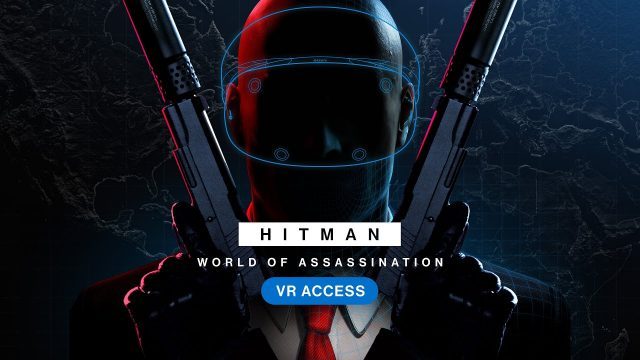
Hitman World of Assassination is coming to PSVR 2, and we just got a fresh look at the action during the VR Games Showcase today, showing off some promising graphics that (hopefully) eclipses the series’ disastrous launch on Quest.
Hitman World of Assassination—the bundle including HITMAN 1, HITMAN 2 and HITMAN 3—was initially supposed to arrive on PSVR 2 in December, although developer IO Interactive delayed the release to March 27th, 2025—likely for good reason.
Hitman 3 VR: Reloaded was widely panned when it launched on Quest 3 and 3S late last year, owing to its inherent bugginess and very apparent graphical downgrade. Notably, IO Interactive wasn’t responsible for the port, which was handed off to XR Games, the studio known for Starship Troopers Continuum, Zombieland: Headshot Fever, and the upcoming VR port of Rebellion’s Zombie Army. Just the same, players want to see flawless execution (pun intended) on the PSVR 2 version of the game.
The upcoming PSVR 2 launch also has another legacy to beat, albeit less contentious. Originally released on the original PSVR via PS4, the new version is doing away with the disappointing gamepad-based controls, instead adopting proper motion controller support via PSVR 2′ Sense Controllers ala the PC VR version of the game.
Notably, the PSVR 2 version will support the original main campaign’s 22 unique locations and adds a variety of immersive VR-specific mechanics. Thanks to Sense Controller support, you’ll be able to dual wield, pick locks, interact with objects, and knock out guards with weapon or fist alike.
Starting March 27th, players who already own Hitman World of Assassination on PS5 can access an upgrade pack to the PSVR 2 content, priced at $9.99 / €9.99 / £8.99.
If you’re just looking to jump in, players will be able to get access to the PSVR 2 supported version through HITMAN WOA Part One – VR2 Edition, which includes access to HITMAN Part One and the PS VR2 Upgrade Pack, priced at $39,99 / €39,99 / or £32.99.
The post ‘HITMAN World of Assassination’ Comes to PSVR 2 This Month, A Chance at Redemption After Quest Blunder appeared first on Road to VR.
RFK Jr.’s Measles Cure? Cod Liver Oil and a Whole Lot of Other Nonsense

In a recent Fox News interview, the newly enshrined Health and Human Services secretary touted the benefits of supplements and steroids for measles.