Learn About Upcoming Frame and Wheelset Performance Changes on Zwift

Early one morning back in October 2024, I drove down to Morgan Hill, California to join a small team from Zwift at the Specialized Win Tunnel. The goal? To spend two days testing various frames and wheelsets in the tunnel in order to establish a realistic delta between the slowest and fastest frames and wheels in Zwift.

You can read all about our tunnel time if you’d like, but you’ll get to experience the result of those tests soon enough: Zwift is rolling out performance changes to frames and wheels in next week’s big update!

Zwift Insider has published mountains of speed tests over the years, so Zwift was nice enough to send over a pre-release game build that allowed us to run our standard tests and publish the results a few days before the release. That’s the post you’re reading now. Let’s dive in!

Why the Change?

Zwifters might wonder: why tweak the performance of all the frames and wheels now, 10+ years into the Zwift journey? It’s a fair question. There are two key reasons why this is happening now:

  1. Those wind tunnel tests in October showed that the aero performance delta between the slowest and fastest road frames on Zwift was too small, while the delta between the slowest and fastest wheels was too large. This change will make the universe of bikes perform more in line with real-world physics (more on this below).
  2. With the Bike Upgrades feature releasing soon, Zwift’s game team wanted to make sure they avoided the unrealistic situation of an upgraded slow frame like the Zwift Steel outperforming a fast frame like the Specialized Venge S-Works.

With that out of the way, let’s dive into fresh speed test data for all the road bike frames in Zwift. (We’ll publish separate posts about TT, mountain, and gravel frames in the near future.)

Test Methodology Notes

The following results are from tests done using our standard parameters: a 75kg rider, 183cm tall, without drafting, riding at 300 watts (4 W/kg) steady. If you ride at lower power (and most do!), the time gaps you’ll experience between different frames and wheels will typically be larger than what is shown below.

Flat tests were done on Watopia’s Tempus Fugit since it’s Zwift’s flattest route, while Climbing tests were done on Alpe du Zwift since it’s a long-steady climb.

If you’re interested in comparing these new performance numbers to what’s currently in game, check out our Frame and Wheel data chart pages.

Lastly, an important note about the accuracy of these results. While we present time data with tenths-of-a-second precision, it’s important to understand there is a 1-second margin of error in these results, so it’s probably not worth obsessing over fractional seconds.

Frame Performance Data

Time Savings Over 1 Hour

How many seconds does a frame save over an hour of riding compared to the basic Zwift Carbon frame? (Astute observers may notice that this is a different way of presenting data than our old style of simply displaying raw test results. We think showing the 1-hour time gap is more intuitive.)

Charts are sorted from the best-performing frames to the worst, and you can sort based on flat performance or climb performance.

Sort Chart By:

Flat Performance
Climb Performance

The following bikes are not included in this chart, because they performed worse than the baseline Zwift Carbon frame: Zwift Steel, Zwift Safety, Zwift Atomic Cruiser, Zwift Buffalo Fahrrad.

The following bikes are not included in this chart, because they performed significantly worse than the baseline Zwift Carbon frame: Zwift Steel, Zwift Safety, Zwift Atomic Cruiser, Zwift Buffalo Fahrrad.

Stacked Percentile Rank

This format lets you easily see how frames comparatively perform across both flats and climb. This is useful for selecting the best bike frame for a given race course.

Frame Changes Summarized

The difference between basic and fast frames has increased dramatically in our flat tests with this performance update. Previously (see data here) the fastest frames gained around 19 seconds spread out over an hour. Now, they gain around 75 seconds!

This isn’t because the most aero frames have gotten faster. Rather, Zwift kept the fast frames around the same performance level, but slowed down the mid-range and slower frames.

The performance gap between the basic and best climbing frames, on the other hand, has narrowed a bit. The fastest climbers used to gain about 70 seconds over an hour of climbing, but now they gain 54 seconds.

While most frames didn’t move dramatically in terms of percentile ranking, you may notice a few that did. Two of these are especially notable:

  • The Specialized Tarmac SL7 is now a much faster climber, in keeping with the frame’s real-world performance
  • The Uranium Nuclear has dropped out of the “fast four” grouping of top aero frames

Wheel Performance Data

Time Savings Over 1 Hour

How many seconds does a wheelset save over an hour of riding compared to the basic Zwift 32mm Carbon wheels?

Charts are sorted from the best-performing wheels to the worst, and you can sort based on flat performance or climb performance.

Sort Chart By:

Flat Performance
Climb Performance

Stacked Percentile Rank

This format lets you easily see how wheels comparatively perform across both flats and climb. This is useful for selecting the best wheelset for a given race course.

Wheel Changes Summarized

In terms of aero performance, the difference between basic and fast wheels has narrowed a bit, from around 72 seconds over an hour (see previous data) to 52 seconds. One big reason for this is Zwift’s new treatment of disc wheels on road bikes, which leads to an interesting performance change you can’t easily spot in the charts above.

Zwift has decided to make all disc wheelsets perform worse on road bikes than they do on TT bikes. They’re still pretty fast on road bikes, as long as climbing isn’t involved. But they are faster on TT bikes. (We’ll unpack this more in future posts.) It’s Zwift’s way of encouraging roadies to use more traditional wheels, while leaving the discs to the time trialists. As it should be.

When it comes to climbing, the difference between basic and fast climbing wheels has halved, from around 16 seconds over an hour to just 8. Zwift has adjusted wheelset weights based on manufacturer’s specifications, so this time gap should be a better reflection of what you’d see IRL.

While most wheels didn’t move dramatically in terms of percentile ranking, you may notice a few that did. Here are the wheelsets we caught that moved up in rank significantly (winners) and down (losers):

  • Winners:
    • Mavic Cosmic Ultimate UST
    • ROVAL CLX64
    • ENVE SES 6.7
    • Shimano C40
    • Shimano C60
    • Zwift Tri Spoke
  • Losers:
    • DTSwiss ARC 62

Price Changes

Next week’s big update includes a raft of price changes, and most of those are price increases. Frame prices are holding steady for the most part, but many wheelsets are going up in price.

So if you’ve had your eye on a particular wheelset, you may want to purchase it now – especially if its performance looks strong in the updated charts above.

(On the other hand, there are some new, fast frames being released next week. So you may just want to hold onto your Drops!)

Wrapping It Up

Whew… that’s a lot to digest, right?

There are two things I like about these performance changes. First, I like that we have several high-end bikes to choose from, and their performance varies just enough to make it interesting. Zwift clearly doesn’t want “one bike to rule them all,” and these changes show that.

Secondly, I love that the performance of in-game frames and wheels was modified based on the results of the team’s findings at the Win Tunnel. That means Zwift frames and wheels are performing more in line with their IRL counterparts, which I think is generally what Zwifters want to experience.

We’ll be working on additional posts that dig into the performance of top racing frames and wheels (including their comparison to the Tron bike) in the coming days. Stay tuned, because there’s a lot of news just up the road in regards to bike performance and upgrades.

Questions or Comments?

What do you think of all these performance changes? Got questions or comments? Share below!

To avoid the Panama Canal, Relativity Space may move some operations to Texas

As he consolidates control over Relativity Space, new owner and chief executive Eric Schmidt is planning significant changes at the launch company, including a likely move to the Lone Star State.

Schmidt’s recent acquisition of the California-based company, which has largely evolved away from its 3D-printing origins to becoming a more conventional rocket developer, has solved Relativity’s primary need. The company has been in a cash crunch for months, and being acquired by one of the 50 wealthiest people on the planet provides financial stability.

One source said Schmidt has made a “mega” investment in Relativity, but the company has not publicly stated the size. It is likely to be at least $1 billion, if not more. Schmidt is also taking an active hand in operations.

Read full article

Comments

Fujifilm teases a medium-format version of its viral X100 VI compact camera

Fujifilm appears to be working on a camera that could combine the best of its medium-format shooters, like the GFX 100S II, with the massively popular X100 series, based on a new teaser video spotted by Digital Camera World.

The video, titled “X Summit in Prague is going to be special, Fujifilm fam��” shows a pair of hands producing a XV100 VI and GFX 100S II out of thin air and bringing the cameras together, before cutting to the silhouette of the new camera the company presumably plans to announce. The suggestion being that Fujifilm wants to create something that has traits of its more compact, fixed-lens X100 series while reaping the benefits of a medium-format sensor.

It’s hard to really gauge what the new camera will look like based on the brief clip in the video, but it definitely looks larger (and more square) than the X100 VI, with a smaller lens than you’d normally see on a camera in Fujifilm’s GFX 100S II. That certainly bodes well for anyone looking to up their photography game after getting hooked on one of the X100 cameras.

Fujifilm first struck gold with the X100 V, which became popular on social platforms because of its size, design and ability to digitally mimic multiple types of analog film. The X100 VI was released in 2024 to capitalize on the sudden popularity, gaining things like in-body stabilization and a lower native ISO. For all intents and purposes, it’s a fantastic camera.

We’ll have to wait until Fujifilm’s X Summit on March 20 to see if this new camera has the potential to have the same crossover appeal, but history is definitely on the company’s side.

This article originally appeared on Engadget at https://www.engadget.com/cameras/fujifilm-teases-a-medium-format-version-of-its-viral-x100-vi-compact-camera-174117388.html?src=rss

11 Ways to Automate Your Life (and Get Back More Free Time)

We may earn a commission from links on this page.

We lose time in small increments. Simple, everyday tasks and chores might only take a few minutes, but those minutes add up and can have a serious impact on your stress levels. But take heart: We’re living in the future, and you can easily automate a wide range of many everyday tasks, gaining back precious minutes and even hours.

Automate grocery shopping

If your grocery list is pretty stable—you buy the same things in the same quantities every time you stock the pantry—you can automate it to a large extent. Amazon Fresh allows you to set up repeat items that get added to your shopping cart and automatically delivered during your selected window. You can put together a standard weekly list and Amazon will deliver your groceries to you on the selected day, without you having to think about it. You can make adjustments at any time, so if you’re not eating those cornflakes as fast as you thought you can change the quantity or the frequency of the delivery.

If you don’t want to give Amazon any more of your money, most grocery chains offer similar services through their web sites and apps. Acme Markets, for example, offers a Schedule and Save feature that operates the same way: You set up a “subscription” for items with a regular schedule and the items are delivered to you automatically until you make changes.

Start automatically saving

It can be a struggle to save money—most people couldn’t scrape together $1,000 if they had to, which is not an ideal place to be. If you’ve tried to save money and repeatedly failed to reach your savings goals, try automating it by simply adjusting your direct deposit or scheduling automatic transfers from one account to another. Changing your direct deposit is usually a matter of filling out a form (you may even be able to do it online through a portal, if your employer has one), and you can set up automatic transfers through your banking app at any time. Even a relatively small transfer will add up, and you won’t have to remind yourself to do it.

Put your bills on an automatic payment schedule

If you’re currently spending some time every week keeping up with your bills, it’s time to set up automatic payments for most things. Most companies and vendors these days offer the option of setting up automatic payments, so setting this up for just about every bill that comes your way should be relatively easy.

Of course, you will still need to track those payments and make sure you’re being billed correctly, and you should make sure the vendor offers an easy way to stop automatic payments if you ever change your mind. You can always revoke their access to your bank account if this proves difficult, but it’s best to check their policies before you dive in.

Use pharmacy services to automate prescriptions

If you have any regular prescriptions, you know that managing refills can be a real time-suck. Many pharmacy chains like CVS and online pharmacies like Express Scripts let you easily set up automatic refills—when your medications run low, they’ll process the next refill and deliver a fresh supply to you automatically (and even contact your doctor if you’re out of refills).

Have a robot clean the floors

If you hate cleaning your place you might have already hired professional cleaners to come in on a regular basis and make it look like a civilized human being lives there. If not, you can automate some of the cleaning by setting up not just a robot vacuum, but a robot vacuum and mop (like this one, or this one). It will patrol the floors, sucking up grit and dust, and when it encounters a spill or a stain it spritzes the area with a cleaning solution and mops up—while you do other things with your time.

Automate your pool maintenance

If you have a pool, you know that keeping it clean can take up several hours of your week. You can automate a lot of that by investing in a pool-cleaning robot that will do all that dirty work for you, leaving you more time to actually enjoy your pool.

But wait! There’s more: You can automate just about every aspect of pool maintenance, from monitoring (and adjusting) chemical and water levels to surface skimming. Once you have everything set up, you can just, you know, enjoy your pool.

Let a robot mow your lawn

If you have a lawn, you probably spend about eight hours a year mowing it. That might not sound like a lot, but imagine what you could do with an extra eight hours—that’s about half an hour each week you get back. Setting up a robotic lawn mower along with a sprinkler system on a timer will automate the bulk of your lawn maintenance, giving you a chance to finally break in that hammock.

Use AI-powered tools to job search

Looking for a new job is probably the biggest time sink known to man. Sifting through hundreds of listings, tweaking your resume, filling out applications, writing mission statements and cover letters—it’s an exhausting grind. And that’s before you even get an interview.

Using AI-powered tools like Sonara, Massive, LazyApply, and LoopCV all work similarly: You load up your resume and set some parameters, then they scour the internet looking for job descriptions that match. Then they automatically fill out applications and send in your resume while you’re busy doing other things. While your job search still won’t be quite “set it and forget it,” you can automate the tedious parts to gain back some free time (and reduce your job search-related stress).

Install smart window treatments

Carve out little bits of time every day by installing smart window treatments (like these automatic shades) that can be programmed to rise and fall on a set schedule, so you won’t have to think about maximizing your light situation anymore.

Set up a meal service

Cooking can take a fair amount of time out of your day, even if you don’t include the grocery shopping. Setting up an automated, oven-ready meal service like Home Chef means that prepared meals are delivered to your house, in their own oven-safe tin. All you do is pop them into the oven, pop them out, and eat.

Use a laundry service

If you spend a lot of your time doing (and folding) laundry, you can automate this by finding a laundry service in your area that will pick up, clean, and deliver—a lot of dry cleaners and laundromats offer the service. If you can’t find a local place to do it, you can check if a national service like Poplin works in your area. Most will pick up your dirty clothes and return them to you—washed and folded—within a day. What you do with the time you’re not doing laundry is entirely up to you.

‘No One Knows What the Hell an AI Agent Is’

Major technology companies are heavily promoting AI agents as transformative tools for work, but industry insiders say no one can agree on what these systems actually are, according to TechCrunch. OpenAI CEO Sam Altman said agents will “join the workforce” this year, while Microsoft CEO Satya Nadella predicted they will replace certain knowledge work. Salesforce CEO Marc Benioff declared his company’s goal to become “the number one provider of digital labor in the world.”

The definition problem has worsened recently. OpenAI published a blog post defining agents as “automated systems that can independently accomplish tasks,” but its developer documentation described them as “LLMs equipped with instructions and tools.” Microsoft distinguishes between agents and AI assistants, while Salesforce lists six different categories of agents.
“I think that our industry overuses the term ‘agent’ to the point where it is almost nonsensical,” Ryan Salva, senior director of product at Google, told TechCrunch. Andrew Ng, founder of DeepLearning.ai, blamed marketing: “The concepts of AI ‘agents’ and ‘agentic’ workflows used to have a technical meaning, but about a year ago, marketers and a few big companies got a hold of them.” Analysts say this ambiguity threatens to create misaligned expectations as companies build product lineups around agents.


Read more of this story at Slashdot.

Used Tesla prices tumble as embarrassed owners look to sell

Tesla has a real image problem. Once, it was the beloved brand for the environmentally aware car buyer; more than that, it was the hottest thing in town. Hundreds of thousands of fans paid thousand-dollar deposits and then waited for up to two years for a chance to buy a Model 3, with others paying hefty markups to people at the front of the queue. Back then, of course, Tesla CEO Elon Musk claimed to care about climate change—now he seems more likely to be found helping to undo work on climate change.

That has hurt Tesla’s new car sales, which have cratered in Europe and declined to a lesser degree in China (where Musk’s political activities have less bearing, and decline is more stiff competition from local brands and the lack of a real model range). It has dented the reality-distortion field that surrounds the company’s share price, if perhaps only to where it was six months ago. And it has also affected the prices of used Teslas here in the US.

Being a Tesla driver is starting to carry some stigma, and owners are unused to the opprobrium they are now facing for their choice of electric vehicle. “Two weeks ago, I was called a Nazi in the parking lot at Kroger,” one owner told The New York Times. The YouTuber Vegas Tesla Family just posted a video explaining that he was selling his Tesla “because of Elon Musk.” And more than one Ars commenter has sold their Tesla in recent weeks as a direct result of Musk.

Read full article

Comments

US measles outlook is so bad health experts call for updating vaccine guidance

With measles declared eliminated from the US in 2000 and national herd immunity strong, health experts have recommended that American children get two doses of the Measles, Mumps, and Rubella (MMR) vaccine—the first between the ages of 12 and 15 months and the second between the ages of 4 and 6 years, before they start school.

Before 12 months, vulnerable infants in the US have been protected in part by maternal antibodies early in infancy as well as the immunity of the people surrounding them. But if they travel to a place where population immunity is unreliable, experts recommend that infants ages 6 to 11 months get an early dose—then follow it up with the standard two doses at the standard times, bringing the total to three doses.

The reason they would need three—and the reason experts typically recommend waiting until 12 months—is because the maternal antibodies infants carry can interfere with the vaccine response, preventing the immune system from mounting long-lasting protection. Still, the early dose provides boosted protection in that 6-to-11-month interval.

Read full article

Comments

Social VR/MR Sandbox DigiGods Overhauls Gunplay With Warzone Update

DigiGods, the free-to-play social VR/MR sandbox, received its “most ambitious” patch yet with the upcoming Warzone update.

Out now on Quest, the Warzone update for DigiGods promises to fully revamp the sandbox game’s gunplay system. Developer Squido Studio states this latest content update provides “an enhanced weapon feel, precision controls, and heightened satisfaction,” promising improvements to ballistics and weapon recoil. Further adjustments include other new weapons and destructible building blocks.

0:00

/1:03

This update also introduces three paid Warzone bundles at $15 each, each of which comes with 5,000 K-OS premium currency. The Assault Bundle adds an assault rifle variant with a tactical operator cosmetic kit, while the Sniper Bundle features a laser rifle with stealth-inspired cosmetics. Finally, the Medic Bundle provides a “specialized support weapon” and battlefield medic outfit.

DigiGods is available now for the Meta Quest platform.

My Favorite Amazon Deal of the Day: The Apple AirPods 4

We may earn a commission from links on this page. Deal pricing and availability subject to change after time of publication.

Prior to September 2024, any Apple user interested in active noise-canceling (ANC) AirPods would’ve had to shell out $250 for the AirPods Pro. With the release of the ANC AirPods 4, the tech is much more affordable—and you can currently grab a pair of these $179 earbuds for $148.99. Apple also has a more budget-friendly version of the AirPods 4 without ANC; that model is currently for $99.99, down from $129.

Both of these prices mark record lows, according to price-tracking tools. While the discounts aren’t mind-blowing, the fact we’re seeing any price reductions on newly released AirPods makes them a good deal, relatively speaking—especially outside of the typical Prime Day/Black Friday sales window.

The AirPods 4 have updated USB-C charging. Both models are powered by Apple’s H2 chip, so you’ll get Personalized Spatial Audio (so you can hear sounds seemingly coming from different directions as you move your head) and the ability to use head gestures to tell Siri “yes” or “no” (this also works for answering or denying calls). It’s also likely Apple will add a live translation feature to both models when iOS 19 rolls out later this year.

If you spring for the ANC AirPods 4, you’ll get a charging case with a built-in speaker, which you can use with Find My to locate it if you lose them. You’ll also get features like Conversation Awareness, which lowers your music volume when your AirPods detect that you’re talking to someone; Transparency Mode, which lets you better hear your surroundings while your earbuds are in; and Adaptive Audio (combines ANC and Transparency mode to adjust ANC levels based on the noise around you). Keep in mind that since these are open style earbuds, lacking a silicone tip to better block out noise, the ANC will not be as good as what you can get from AirPods Pro or Beats Fit Pro.

Both versions are rated IP54 for dust and water resistance, offer up to five hours of listening per charge (up to 30 hours with the charging case), and can handle automatic switching with your other Apple devices. You can read more about the non-ANC AirPods in PCMag’s “excellent” review, and more about the ANC AirPods in PCMag’s “outstanding” review.

‘Sultans Of Swing’ Bass & Medley Played Simultaneously On Double Harp Guitar

Because some people presumably can pat their head and rub their stomach at the same time, this is a video of musician Pat Hinds performing Dire Straights’ ‘Sultans of Swing’ on a double harp guitar, with one hand performing the guitar medley, and the other the bass line on the harp. At least to me, that’s extremely impressive, but the last time I tried clapping I gave the guy next to me at the concert a black eye.

Quest’s Passthrough Camera API Is Out Now, Though Store Apps Can’t Yet Use It

Quest’s highly anticipated “Passthrough Camera API” is now available for all developers to experiment with, though they can’t yet include it in store app builds.

The new capability was announced at Meta Connect 2024 in September as coming this year. Now it’s here, as an experimental release for Quest 3 and Quest 3S. That means any developer can experiment with it, and even distribute APKs using it on platforms like SideQuest, but they can’t yet include it in Meta Horizon Store apps. Meta has taken this approach for new APIs multiple times in the past, and typically makes the feature available for use in store apps within a few months at most.

Select developers have had early access to experiment with the capability for a while now, and Meta will host Niantic, Creature, and Resolution to discuss it at GDC next week.

What Is Passthrough Camera Access?

While headsets like Quest 3 use cameras to let you see the real world, until now only the system software got raw access to these cameras. Third-party developers could use passthrough as a background, sure, but they didn’t actually get access to it. They instead got higher-level data derived by the system, such as hand and body skeletal coordinates, a 3D mesh of your environment with bounding boxes for furniture, and limited object tracking capabilities. That meant they couldn’t run their own computer vision models, which severely limited the augmentation capabilities of these headsets.

The exception was that on visionOS 2, Apple is gives enterprise companies raw access to Vision Pro’s passthrough cameras for non-public internal apps, but this requires a special licence from Apple and is restricted to “in a business setting only”.

For the “Passthrough Camera API” to work, you as the user need to grant the app permission to access your headset cameras, just as you would the microphone. If granted, the app gets access to the forward-facing color cameras, including metadata like the lens intrinsics and headset pose, which it can leverage to run custom computer vision models.

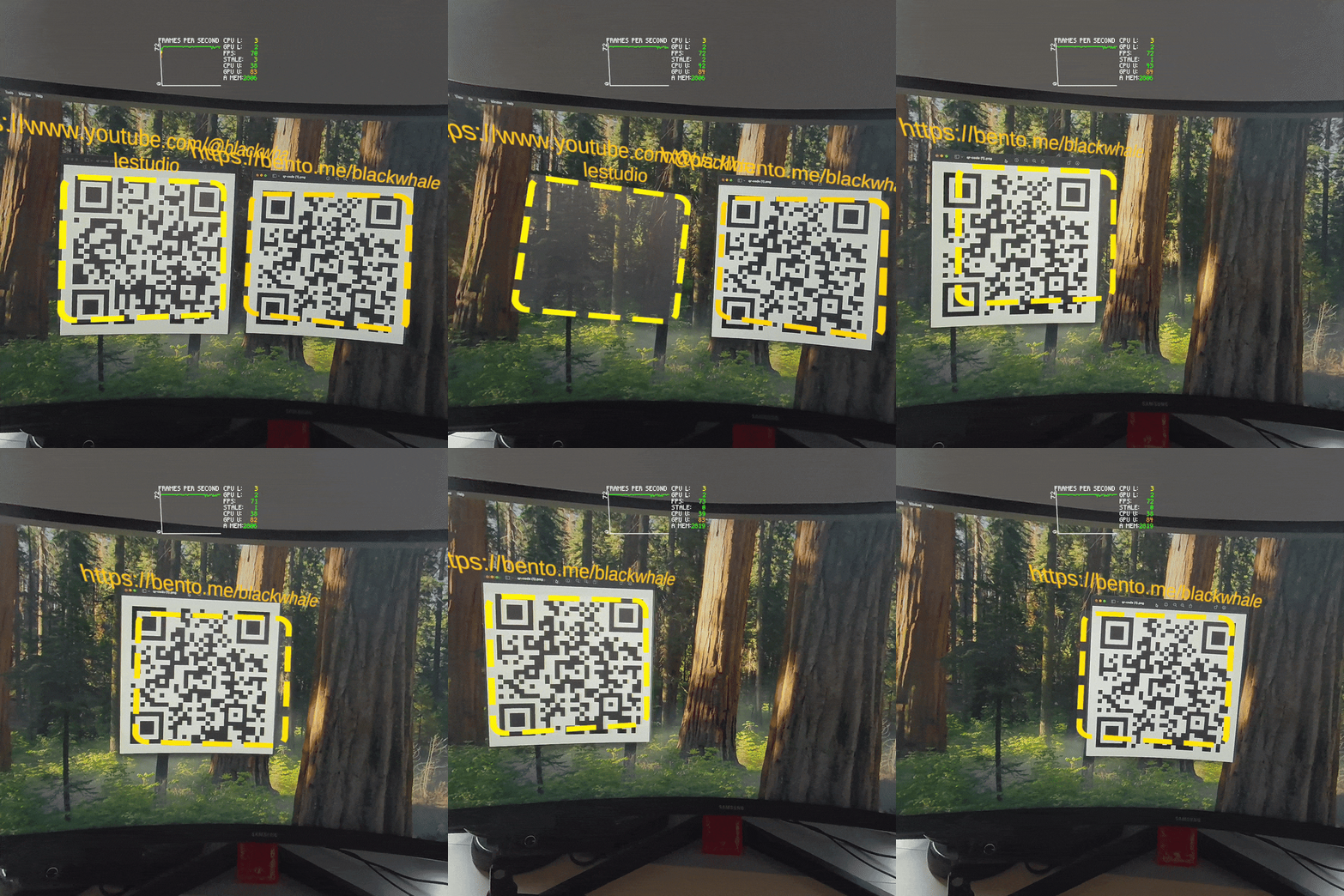
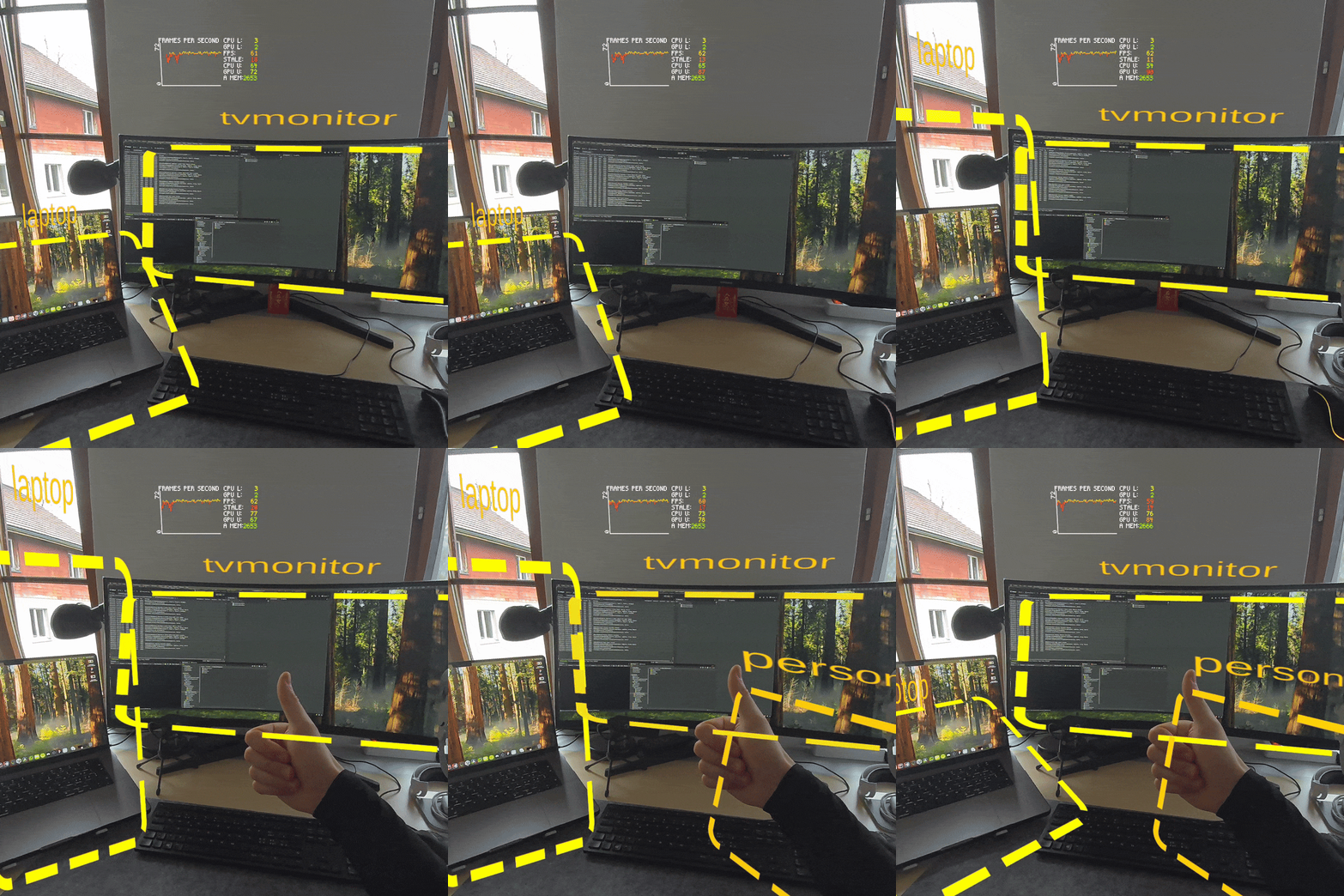
Examples of how apps could use this include scanning and tracking QR codes, detecting a game board on a table to add virtual characters and objects to it, detecting physical objects for enterprise guide experiences, or integrating the visual AI functionality of cloud-hosted large language models (LLMs). Developers are only limited by which real-time computer vision models can run on the XR2 Gen 2 chipset performantly, or which cloud-hosted image models they’re willing to pay for.

Meta software engineer Roberto Coviello’s QuestCameraKit samples.

The passthrough camera stream is provided to the app with up to 1280×960 resolution at 30FPS, with a stated latency of 40-60 milliseconds. That means it isn’t suitable for tracking fast moving objects, such as custom controllers.

Technically, at a base level, there is no specific Meta Quest Camera Passthrough API, nor is it an extension to OpenXR. Developers do need to request a Horizon OS specific Headset Cameras permission, but otherwise Quest’s passthrough camera access leverages Android’s existing Camera2 API to also return the headset pose, obtained with OpenXR, and this is what developers of custom engines, or source code for Unreal or Godot, use for it. This is also means the same code will work on Google’s upcoming Android XR platform, set to debut in Samsung’s headset, with only the permission request being different.

For Unity, developers access the cameras through Unity’s WebCamTexture API, which is how they already access phone, tablet, and PC cameras and webcams in the engine. A limitation here, however, is that Unity’s WebCamTexture API only supports one camera at a time, not both.

Interested developers can find Quest passthrough camera access documentation here: Unity / Native Android.

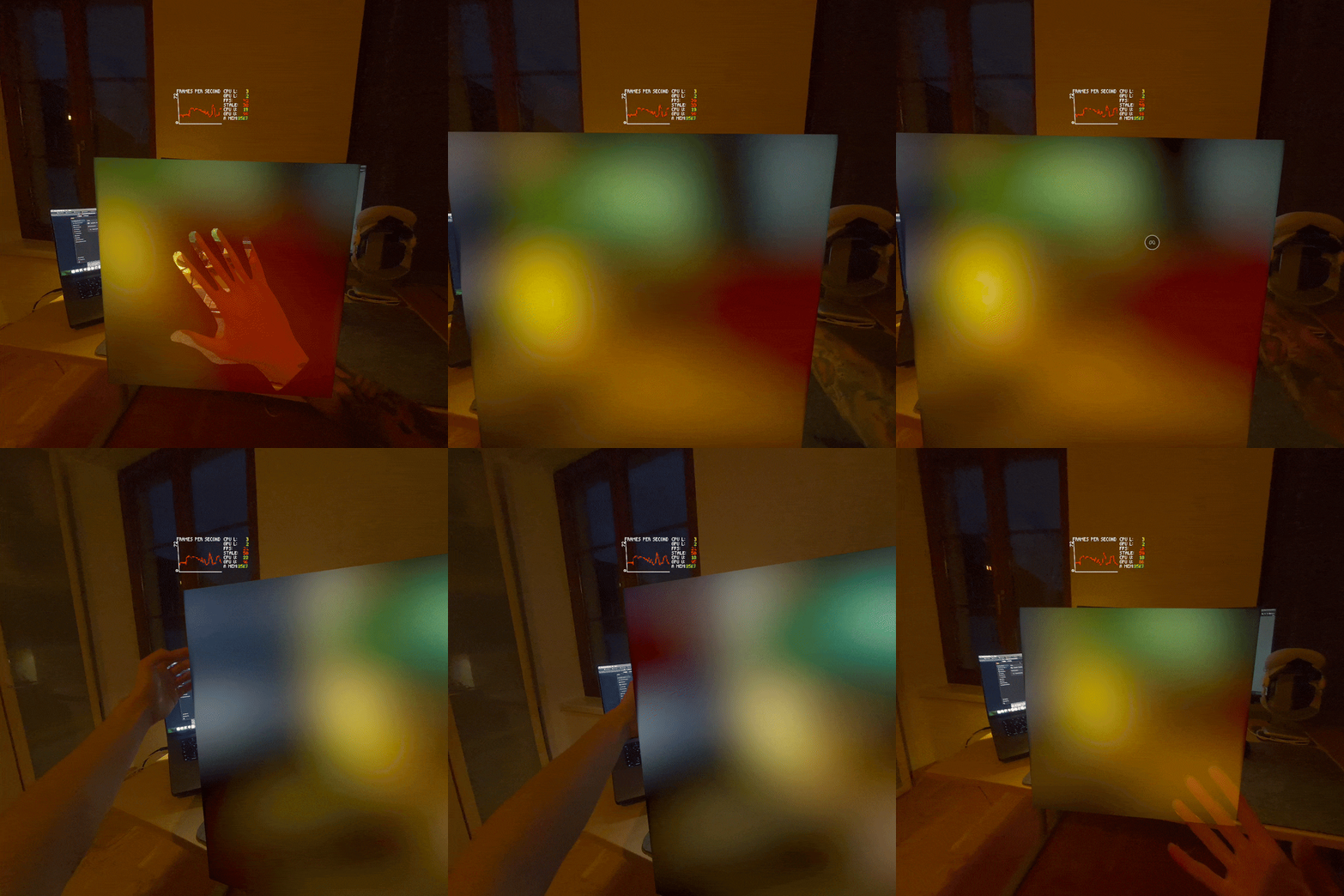
Meta has published five official Unity samples on GitHub: CameraViewer, CameraToWorld, BrightnessEstimation, MultiObjectDectection, ShaderSample. Meta software engineer Roberto Coviello has separately published QuestCameraKit on GitHub, a collection of five further samples: Color Picker, Object Detection with Unity Sentis, QR Code Tracking with ZXing, Frosted Glass Shader, and OpenAI vision model.

Google agrees with OpenAI that copyright has no place in AI development

In spite of sky-high costs and little in the way of profits, generative AI systems continue to proliferate. The Trump administration has called for a national AI Action Plan to guide America’s burgeoning AI industry, and OpenAI was happy to use that as an opportunity to decry the negative effect of copyright enforcement on AI development. Google has also released its policy proposal, which agrees with OpenAI on copyright while also prompting the government to back the AI industry with funding and policy changes.

Like OpenAI, Google has been accused of piping copyrighted data into its models, but content owners are wising up. Google is fighting several lawsuits, and the New York Times’ lawsuit against OpenAI could set the precedent that AI developers are liable for using that training data without permission. Google wants to avoid that. It calls for “balanced copyright rules,” but its preference doesn’t seem all that balanced.

The dearth of available training data is a well-known problem in AI development. Google claims that access to public, often copyrighted, data is critical to improving generative AI systems. Google wants to be able to use publicly available data (free or copyrighted) for AI development without going through “unpredictable, imbalanced, and lengthy negotiations.” The document claims any use of copyrighted material in AI will not significantly impact rightsholders.

Read full article

Comments