
That mission, and the 2020 Chang’e-5 robotic mission before it, are the first to return lunar rocks to Earth since the 1970s. Together they are building on what scientists learned from Apollo-era missions, helping to unravel mysteries about how the Moon was formed and why it looks the way it does today, and providing clues about our solar system’s history.
But big puzzles remain, such as why the far side of the Moon—the half that always faces away from Earth—is so radically different from the near side. And what is behind the surprising finding that lunar volcanoes may have been active much more recently than previously thought? “The more we look at the Moon, the more we’ve discovered—and the more we realize how little we know,” says Clive R. Neal, a geologist at the University of Notre Dame who specializes in lunar exploration.
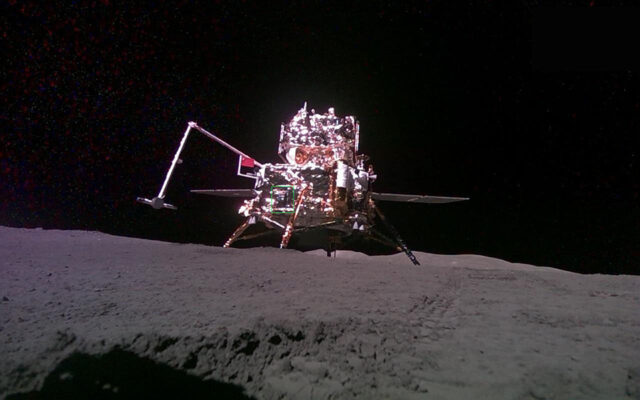
China’s 2024 Chang’e-6 robotic lander mission brought more than four pounds of rocks from the far side of the Moon back to Earth.
Credit:
CNSA / CAS
With NASA planning to send astronauts back to the Moon’s surface in 2027 for the first time since 1972, geologists are excited about what rocks they might find there and the scientific secrets those samples could reveal—along with what resources could be mined for a future Moon base, or for renewable energy back home on Earth.
Origin story
The samples brought home from the Moon in the 1970s by the Apollo missions and the Soviet Union’s Luna missions cleared up quite a lot about the Moon’s history. Because the lunar samples shared strong similarities with Earth rocks, this added weight to the idea that the Moon was formed when a Mars-sized object called Theia collided with the proto-Earth roughly 4.5 billion years ago.
Debris from the impact was thrown into orbit around Earth and eventually coalesced into the Moon. In its early days, the Moon was entirely molten. As the magma ocean cooled over hundreds of millions of years, the Moon formed a crust and a mantle below. Giant pools of lava filled impact craters and settled into the lunar lowlands, or maria (Latin for “seas”), while highlands and volcanic domes loomed above them. Eventually, the volcanism died out.
Without plate tectonics or weather, the only things left to alter the Moon’s cold, dead surface were meteorites. A lot of the Apollo-era samples were found to have formed from the heat and pressure of impacts around 3.9 billion years ago, suggesting that they were the result of a short period of intense pummeling by space rocks called the Late Heavy Bombardment.
But research since the 1970s has refined or changed this picture. Higher-resolution orbital images have revealed plenty of large impact craters that seem far older than 3.9 billion years, for example. And meteorites found on Earth, thought to have been ejected from various areas of the Moon during big impacts, have been found to span a huge range of ages.
All this work together suggests that the asteroid bombardment didn’t happen in one dramatic spike but rather over an extended period lasting from perhaps 4.2 billion to 3.4 billion years ago. In this scenario, the Apollo samples dated to 3.9 billion years likely all came from just one huge impact that spewed rock over a very wide area that happened to include the Apollo-era landing sites.
The Moon: Dead or alive
Greater mysteries surround volcanism on the Moon. “The canonical thing I learned in school was that the Moon had been geologically dead for billions of years,” says Samuel Lawrence, a planetary scientist at NASA’s Johnson Space Center in Houston.
The long-held theory was that a small body like the Moon should have lost its heat to space relatively quickly—and a frigid, extinguished Moon shouldn’t have widespread volcanic activity. Apollo-era samples suggested that most of this volcanism stopped 3 billion years ago or earlier, supporting the theory. But research over the past two decades has overturned that view.
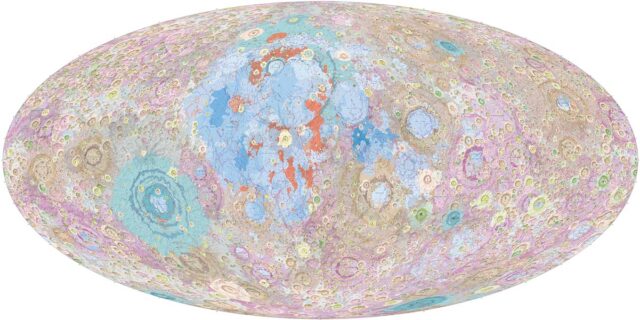
This geologic map of the Moon released in 2022 by China is the most detailed global map yet published and includes information gleaned from the 2020 Chang’e-5 mission.
Credit:
J. JI ET AL / THE 1:2,500,000-SCALE GEOLOGIC MAP OF THE GLOBAL MOON 2022.
In 2014, Lawrence and colleagues posited that some patches of irregular terrain in the middle of the dark plains, or mare, spotted by the NASA Lunar Reconnaissance Orbiter were the result of volcanism that kept going until less than 100 million years ago. “That is totally, totally surprising,” says cosmochemist Qing-Zhu Yin of the University of California, Davis.
The latest sample-return missions added more concrete evidence for recent volcanism. In 2020, the Chang’e-5 robotic mission landed in Oceanus Procellarum (the Ocean of Storms) — a spot picked in part because it looked geologically young given how few craters had accumulated there. Sure enough, the volcanic rocks brought home by that mission were found to be 2 billion years old, the youngest ever retrieved from the Moon. “That was big news,” says planetary geoscientist Jim Head of Brown University, who worked on NASA’s Apollo missions.
On top of this, when researchers trawled through thousands of glass beads found in the Chang’e-5 soil samples, most of which are thought to have been created by impacts, they identified three that were volcanic—and only 120 million years old. This finding was published just last year and still needs to be verified, but if such recent dates hold up, they suggest that the Moon might still be capable of producing deep magma even today, Yin says.
All this indicates that the Moon might not have cooled as fast as everyone thought it did. It’s also possible that some of the younger volcanism could have been powered by radioactive elements underground, which can generate enough heat to form magma and are known to be prevalent in certain patches of the Moon. This could explain the 120-million-year-old volcanic glass beads, for example. But not all the early volcanism can be explained this way: The Chang’e-5 volcanic rocks, along with some 2.8-billion-year-old volcanic rock brought back from the far side by Chang’e-6, came from source rocks not enriched with these elements.
“It throws up more questions than it answers,” Neal says. “It’s job security for people like me — we now have new questions to address.”
Fwupd 2.0.6 Adds Support for HPE Gen10 and Gen10+ Devices Using Redfish
Intel Killer E5000 Ethernet Support For Linux 6.15
Btrfs-Progs 6.13 Released With “mkfs.btrfs –compress” Support
134k Lines Of Code Posted As Latest Effort For COBOL Support Within GCC
This Solar-Powered Reactor Sucks CO2 From the Air and Turns It Into Fuel

Researchers have created a solar-powered reactor that collects CO2 by night and turns it into a useful gas by day.
(Updated) NanoKVM-USB: 4K HDMI Loopback, USB 3.0, and Integrated Keyboard/Mouse Control
A workaround for Final Fantasy VII Rebirth on Linux with NVIDIA GPUs has been found
Are Fast Programming Languages Gaining in Popularity?
In fact on February’s version of the index, the top ten looks mostly static. The only languages dropping appear to be very old languages. Over the last 12 months C and PHP have both fallen on the index — C from the #2 to the #4 spot, and PHP from #10 all the way to #14. (Also dropping is Visual Basic, which fell from #9 to #10.)
But TechRepublican cites another factor that seems to be affecting the rankings: language speed.
Fast programming languages are gaining popularity, TIOBE CEO Paul Jansen said in the TIOBE Programming Community Index in February. Fast programming languages he called out include C++ [#2], Go [#8], and Rust [#13 — up from #18 a year ago].
Also, according to the updated TIOBE rankings…
– C++ held onto its place at second from the top of the leaderboard.
– Mojo and Zig are following trajectories likely to bring them into the top 50, and reached #51 and #56 respectively in February.
“Now that the world needs to crunch more and more numbers per second, and hardware is not evolving fast enough, speed of programs is getting important. Having said this, it is not surprising that the fast programming languages are gaining ground in the TIOBE index,” Jansen wrote. The need for speed helped Mojo [#51] and Zig [#56] rise…
Rust reached its all-time high in the proprietary points system (1.47%.), and Jansen expects Go to be a common sight in the top 10 going forward.


Read more of this story at Slashdot.
Linux Networking Protocols: Understanding TCP/IP, UDP, and ICMP
Python and Microsoft: Pandas Should Have Known OpenDocument Format (ODF) and Microsoft Excel Are Different and Competing Things
AI Bugs Could Delay Upgrades for Both Siri and Alexa
Last June, Apple touted three major enhancements coming to Siri:
– the ability to tap into a customer’s data to better answer queries and take actions.
– a new system that would let the assistant more precisely control apps.
– the capability to see what’s currently on a device’s screen and use that context to better serve users….
The goal is to ultimately offer a more versatile Siri that can seamlessly tap into customers’ information and communication. For instance, users will be able to ask for a file or song that they discussed with a friend over text. Siri would then automatically retrieve that item. Apple also has demonstrated the ability for Siri to quickly locate someone’s driver’s license number by reviewing their photos… Inside Apple, many employees testing the new Siri have found that these features don’t yet work consistently…
The control enhancements — an upgraded version of something called App Intents — are central to the operation of the company’s upcoming smart home hub. That product, an AI device for controlling smart home appliances and FaceTime, is slated for release later this year.
And Amazon is also struggling with an AI upgrade for its digital assistant, reports the Washington Post:
The “smarter and more conversational” version of Alexa will not be available until March 31 or later, the employee said, at least a year and a half after it was initially announced in response to competition from OpenAI’s ChatGPT. Internal messages seen by The Post confirmed the launch was originally scheduled for this month but was subsequently moved to the end of March… According to internal documents seen by The Post, new features of the subscriber-only, AI-powered Alexa could include the ability to adopt a personality, recall conversations, order takeout or call a taxi. Some of the new Alexa features are similar to Alexa abilities that were previously available free through partnerships with companies like Grubhub and Uber…
The AI-enhanced version of Alexa in development has been repeatedly delayed due to problems with incorrect answers, the employee working on the launch told The Post. As a popular product that is a decade old, the Alexa brand is valuable, and the company is hesitant to risk customer trust by launching a product that is not reliable, the person said.


Read more of this story at Slashdot.
Zed Editor Introduces Open-Source “Zeta” Edit Prediction Model
How to Install Fast API with MongoDB on Ubuntu 24.04
Ask Slashdot: What Would It Take For You to Trust an AI?
Then they wondered if there’s also government censorship:
It’s like the accountant who gets asked what 2 plus 2 is. After locking the doors and shading all the windows, the accountant whispers in your ear: “What do you want it to be…?” So let me start with some questions about DeepSeek in particular. Have you run it locally and compared the responses with the website’s responses? My hypothesis is that your mileage should differ…
It’s well established that DeepSeek doesn’t want to talk about many “political” topics. Is that based on a distorted model of the world? Or is the censorship implemented in the query interface after the model was trained? My hypothesis is that it must have been trained with lots of data because the cost of removing all of the bad stuff would have been prohibitive… Unless perhaps another AI filtered the data first?
But their real question is: what would it take to trust an AI? “Trust” can mean different things, including data-collection policies. (“I bet most of you trust Amazon and Amazon’s secret AIs more than you should…” shanen suggests.) Can you use an AI system without worrying about its data-retention policies?
And they also ask how many Slashdot readers have read Ken Thompson’s “Reflections on Trusting Trust”, which raises the question of whether you can ever trust code you didn’t create yourself. So is there any way an AI system can assure you its answers are accurate and trustworthy, and that it’s safe to use? Share your own thoughts and experiences in the comments.
What would it take for you to trust an AI?


Read more of this story at Slashdot.
FreeBSD 13.5 Overcomes UFS Y2038 Problem To Push It Out To Year 2106
Calibre 7.26 Update Brings Enhanced Web Search, Metadata Fixes
Despite Plans for AI-Powered Search, Reddit’s Stock Fell 14% This Week
And yet Reddit’s stock fell 14% this week. CNBC’s headline? “Reddit shares plunge after Google algorithm change contributes to miss in user numbers.”
A Google search algorithm change caused some “volatility” with user growth in the fourth quarter, but the company’s search-related traffic has since recovered in the first quarter, Reddit CEO Steve Huffman said in a letter to shareholders. “What happened wasn’t unusual — referrals from search fluctuate from time to time, and they primarily affect logged-out users,” Huffman wrote. “Our teams have navigated numerous algorithm updates and did an excellent job adapting to these latest changes effectively….” Reddit has said it is working to convince logged-out users to create accounts as logged-in users, which are more lucrative for its business.
As Yahoo Finance once pointed out, Reddit knew this day would come, acknowledging in its IPO filing that “changes in internet search engine algorithms and dynamics could have a negative impact on traffic for our website and, ultimately, our business.” And in the last three months of 2024 Reddit’s daily active users dropped, Yahoo Finance reported this week. But logged-in users increased by 400,000 — while logged-out users dropped by 600,000 (their first drop in almost two years).
Marketwatch notes that analyst Josh Beck sees this as a buying opportunity for Reddit’s stock:
Beck pointed to comments from Reddit’s management regarding a sharp recovery in daily active unique users. That was likely driven by Google benefiting from deeper Reddit crawling, by the platform uncollapsing comments in search results and by a potential benefit from spam-reduction algorithm updates, according to the analyst. “While the report did not clear our anticipated bar, we walk away encouraged by international upside,” he wrote.


Read more of this story at Slashdot.
What is the ERR_CONNECTION_RESET Error and how to fix it?
China’s ‘Salt Typhoon’ Hackers Continue to Breach Telecoms Despite US Sanctions
TechRadar reports that the Chinese state-sponsored threat actor is “hitting not just American organizations, but also those from the UK, South Africa, and elsewhere around the world.”
The latest intrusions were spotted by cybersecurity researchers from Recorded Future, which said the group is targeting internet-exposed web interfaces of Cisco’s IOS software that powers different routers and switches. These devices have known vulnerabilities that the threat actors are actively exploiting to gain initial access, root privileges, and more. More than 12,000 Cisco devices were found connected to the wider internet, and exposed to risk, Recorded Future further explained. However, Salt Typhoon is focusing on a “smaller subset” of telecoms and university networks.
“The hackers attempted to exploit vulnerabilities in at least 1,000 Cisco devices,” reports NextGov, “allowing them to access higher-level privileges of the hardware and change their configuration settings to allow for persistent access to the networks they’re connected on… Over half of the Cisco appliances targeted by Salt Typhoon were located in the U.S., South America and India, with the rest spread across more than 100 countries.”
Between December and January, the unit, widely known as Salt Typhoon, “possibly targeted” — based on devices that were accessed — offices in the University of California, Los Angeles, California State University, Loyola Marymount University and Utah Tech University, according to a report from cyber threat intelligence firm Recorded Future… The Cisco devices were mainly associated with telecommunications firms, but 13 of them were linked to the universities in the U.S. and some in other nations… “Often involved in cutting-edge research, universities are prime targets for Chinese state-sponsored threat activity groups to acquire valuable research data and intellectual property,” said the report, led by the company’s Insikt Group, which oversees its threat research.
The cyberspies also compromised Cisco platforms at a U.S.-based affiliate of a prominent United Kingdom telecom operator and a South African provider, both unnamed, the findings added. The hackers also “carried out a reconnaissance of multiple IP addresses” owned by Mytel, a telecom operator based in Myanmar…
“In 2023, Cisco published a security advisory disclosing multiple vulnerabilities in the web UI feature in Cisco IOS XE software,” a Cisco spokesperson said in a statement. “We continue to strongly urge customers to follow recommendations outlined in the advisory and upgrade to the available fixed software release.”


Read more of this story at Slashdot.