Martha Wells’ award-winning sci-fi book series will soon be a streaming series, co-created by Chris and Paul Weitz and starring Alexander Skarsgård.

Martha Wells’ award-winning sci-fi book series will soon be a streaming series, co-created by Chris and Paul Weitz and starring Alexander Skarsgård.
When Apple first revealed Apple Intelligence, its slate of generative AI features, a huge part of that announcement was a super-charged Siri. No longer would Apple’s digital assistant be lagging behind competitors like Google: With the power of AI, the new Siri might actually be useful.
When Apple Intelligence drops in full, Siri will reportedly be much more contextually aware, and be able to scan what’s on your phone to understand and answer questions you ask. If your friend sends you their new address, you can ask Siri “add this address to their contact card.” You don’t need to specify which address or which contact, because the assistant will, according to Apple, be able to understand that by what’s currently on-screen. Another huge feature is the ability to ask Siri to take action for you: You can ask Siri to send an email you have in your drafts, edit an image on your behalf, or add a photo to a specific note.
If your iPhone is compatible with Apple Intelligence, you might have assumed it supports this new Siri. iOS 18 has been out for a bit, after all, and Apple has been pushing Apple Intelligence (and the new Siri) hard, including with a campaign featuring Bella Ramsey. Some Apple Store employees even started a chant about AI during the iPhone 16 launch.
The thing is, the new Siri isn’t here yet. Apple did upgrade Siri a bit with iOS 18.1, and its the first wave of new AI features: That includes Siri’s new design, which glows around the edges of the display; the ability to type to Siri by double-tapping on the bottom of the screen; Siri’s ability to understand requests even when you misspeak; and a new feature that turns Siri into impromptu tech support (e.g., “How do I turn off Do Not Disturb?”).
But iOS 18.1 came and went without any further updates to Siri. iOS 18.2 added more Apple Intelligence features, including ChatGPT integration, but no major Siri changes. iOS 18.3 was a smaller update (Apple even disabled notification summaries for certain alert types), but, again, skipped any upgrades for Siri.
Anyone hotly anticipating Siri’s AI promise might need to keep waiting. For the longest time, it seemed like these upgrades would come as part of either iOS 18.3 or iOS 18.4. Following 18.3’s absence of Siri updates, of course, those predictions turned to iOS 18.4.
Bloomberg’s Mark Gurman reported back in September that Apple was planning on rolling out most of Siri’s big features by this update. However, last week, Gurman said issues and bugs are plaguing the engineering team, and, as a result, Siri may be delayed even further.
We’ll find out soon enough, it seems. Apple now says in fine print that additional Apple Intelligence features (as well as additional language support) are coming in early April. The company doesn’t specify, but those features are likely a part of iOS 18.4. Before the company releases that update in early April, they’ll need to beta test it, which means we should see 18.4’s first beta sooner rather than later. When it arrives, we’ll know whether Apple plans to roll out big Siri changes now, or whether they’ve put those upgrades on the back-burner once again.
While Apple supports iPhone as old as the XS with iOS 18, not many iPhones will actually get these new Siri features. That’s because Apple Intelligence is limited to iPhone 15 Pro, iPhone 15 Pro Max, and the iPhone 16 series—including the new iPhone 16e. If you have an iPhone 15 or older, you won’t see these new upgrades, even when you update to iOS 18.4, or whichever update contains the AI-overhauled Siri.
A little over a month after SpaceX’s large Starship launch ended in an explosion over several Caribbean islands, the company is preparing its next rocket for a test flight.
According to a notice posted by the Federal Aviation Administration, the eighth test flight of the Starship vehicle could take place as early as February 26 from the Starbase launch site in South Texas. The launch window extends from 5:30 pm local time (23:30 UTC) to 7:09 pm (01:09 UTC).
Company sources confirmed that this launch date is plausible, but it’s also possible that the launch could slip a day or two to Thursday or Friday of next week.

Get smarter faster with unlimited lifetime access to over 1,500 book summaries and save 80% at StackSocial, plus an extra 20% with the code LEVELUP20.

Nearly a decade ago, Brendan Greene’s obsession with battle royales fundamentally reshaped gaming. Now the designer, best known by his online moniker “PlayerUnknown,” is toiling away on a new set of projects that could change much more than that if they’re successful. PUBG: Battlegrounds redefined online gaming.…
Jining First People’s Hospital in Shandong leads with more than 5% of its research output from 2014-2024 being retracted — over 100 papers. The hospital had disciplined 35 researchers for publication fraud in late 2021 amid a broader Chinese government crackdown on paper mills selling fake manuscripts.
The analysis, based on data from three research integrity firms, found that about 60% of retracted articles over the past decade had authors affiliated with Chinese institutions. Other retraction hotspots include universities in Saudi Arabia, India, Pakistan and Ethiopia.
While retractions remain rare globally, affecting fewer than 0.1% of published papers, rates have tripled over the past decade. In 2023, over 10,000 papers were retracted, mostly from journals owned by publisher Wiley’s now-closed Hindawi subsidiary following widespread peer review fraud. The surge in retractions partly reflects increased scrutiny from research integrity experts who spot problematic papers, rather than definitively indicating which institutions produce fraudulent work, according to Ivan Oransky, co-founder of Retraction Watch.


Read more of this story at Slashdot.
We are effectively living in a post-horsepower world. As the roster of production cars offering quadruple-digit output figures continues to expand and a growing number of garden-variety vehicles now offer straight-line acceleration that would have been exclusively supercar territory a decade ago, serious thrust is quickly becoming an expectation rather than a rarefied experience.
This trend might seem like an existential dilemma for an automaker with a legacy built on face-melting performance, but Lamborghini has never really been the type to obsess over the numbers. Sure, the Aventador SVJ set a production car lap record at the Nürburgring Nordschleife in 2018, but the company has always championed emotional impact above all else.
At the press launch for the Aventador SVJ, Maurizio Reggiani—Lamborghini’s chief technical officer at the time—made a point of telling the assembled journalists that despite increasing headwinds from emissions regulations, Lamborghini would continue to produce a supercar with a naturally aspirated V12 for as long as it possibly could. “I will fight it to the end!” he declared to boisterous applause.
The Google Pixel 8a mid-tier smartphone is back on sale for $399 via Amazon. This is close to a record-low price and represents a discount of 20 percent. Even better? The sale applies to multiple colorways, including mint green, light blue and white. This deal is for the 128GB model.
This device topped our list of the best mid-range smartphones, and with good reason. It’s a well-designed phone that gets the job done. It features a powerful Tensor G3 chip, offers support for Google Gemini AI tools and includes an excellent camera system. The 120Hz OLED display is gorgeous and the battery life is on point.
We called the Pixel 8a “one of the best values of any phone on sale today” in our official review, and that was at the original $499 asking price. It’s especially well-valued with today’s sale. We even enjoyed gaming with this device, which isn’t always the case with mid-range phones. The 8a also comes with IP67 dust and water resistance and 7.5-watt Qi wireless charging.
There aren’t any major downsides to this phone, though we do have a couple of nitpicks. The wireless charging, while convenient, is pretty slow. The display bezels are also on the thicker side, so you lose some precious screen real estate. Other than that, this is a near-perfect mid-range phone. It’s also a full $200 cheaper than Apple’s just-announced “budget” smartphone, the iPhone 16e.
Follow @EngadgetDeals on Twitter and subscribe to the Engadget Deals newsletter for the latest tech deals and buying advice.
This article originally appeared on Engadget at https://www.engadget.com/deals/googles-pixel-8a-drops-to-399-at-amazon-163059224.html?src=rss
On Wednesday, Apple officially revealed the iPhone 16e, the spiritual successor to the iPhone SE. While the second and third-generation SEs borrowed from the design language of the iPhone 8, this new iPhone looks just like an iPhone 14. There are a lot of perks that come with that decision, but in doing so, Apple has also done something pretty drastic: It has officially killed off the Home button.
With the launch of the iPhone 16e, no iPhone, nor any iPad Apple currently sells, ships with a Home button. (The iPod touch was killed off a long time ago.) This is, definitively, the end of an era, and I come not to mourn the Home button, but to praise it. Let’s take a look at the life of Apple’s Home button—what it did right, what it did wrong, and where we go from here.
When Steve Jobs introduced the iPhone in 2007, a lot of attention was given it its “giant” touch screen—as Jobs described the iPhone’s 3.5-inch display. But while touch controls certainly stole the spotlight, it wasn’t the iPhone’s only unique feature to get a shoutout.
Here’s what Jobs had to say when addressing the Home button for the first time: “And on the front, there’s only one button down there. We call it the ‘Home’ button: [It] takes you home from wherever you are.”
And at that point in time, that’s all the Home button did. Want to leave an app? Hit the Home button. Welcome home.
But that simplicity didn’t last forever. Very quickly, simply clicking the Home button to go home wasn’t enough: Users expected more from their smartphones, and Apple had to adapt.
One of the first non-home functions of the Home button was to take screenshots. Anyone who has used an iPhone with a Home button knows how it works: You press the Sleep/Wake button and the Home button together, and presto: screenshot. (The functionality on today’s Face ID iPhones is similar, but now you use the Side button with the Volume up button.) All of a sudden, the Home button had more than one purpose.
Next came Voice Control. Not Siri, mind you: Voice Control is a rudimentary version of Siri that launched on the iPhone 3GS in 2009. (Fun fact: It still exists on iOS!) As you might expect, to activate Voice Control, you hold down the Home button, wait for the Voice Control UI to appear, then ask it to complete a task (e.g. “Call Mom,” or “play a song.”)
With the release of iOS 4 in 2010, Apple introduced app switching: By clicking the Home button twice, you could reveal a new menu at the bottom of your screen with all of your recently-used apps. Tap one, and you could switch to it, without needing to go to your Home Screen first to find the app you were looking for.
Of course, the real revolution came in 2011, with the iPhone 4S and Siri. Apple took the Voice Command control and assigned it to Siri. With a long-press of the Home button, you could call upon the digital assistant to help answer questions and complete tasks. (The utility of asking Siri to do anything has been a point of contention ever since.)
The Home button’s next milestone came with the iPhone 5s. For this model, Apple outfitted the button with a fingerprint reader. It was the era of Touch ID. Gone was the iconic rounded square icon in the center of the Home button, replaced by solid glass. Users could now scan their fingerprints using the button and unlock their iPhones without having to punch in a passcode.
Perhaps the Home button’s final development was when it ceased to be a true button at all. With the iPhone 7 series, Apple replaced the physical button with a capacitive one. Just as with its MacBooks, a Taptic Engine underneath the bottom bezel of the iPhone provides a clever vibration each time you “press” on the button. In effect, it creates the illusion a click, even though the “button” never moves at all. (There was nothing quite like the feeling of the Home button going dead when your iPhone ran out of charge at the worst possible moment.)
For a number of years, the Home button was a key component of most Apple products—minus the Mac. Whether you bought an iPhone, iPad, iPod touch, even a particular iPod nano, you were using a Home button. But nothing lasts forever.
The Home button took up a lot of screen real estate, if you recall: As other smartphones pushed their displays to the edge of the device, the iPhone still sported the same general design for about 10 years. Sure, the overall device looked different, and the screens got much larger, but the display was still sandwiched between a large top and bottom bezel—the latter of which held the Home button.
When Apple was looking to overhaul the iPhone’s design for the iPhone X while pushing the display to its physical limits, there was only one thing to do: nix the Home button. The iconic button was pushed out, in favor of Face ID, so Apple could present its “10th anniversary iPhone” with an edge-to-edge (-ish) display.
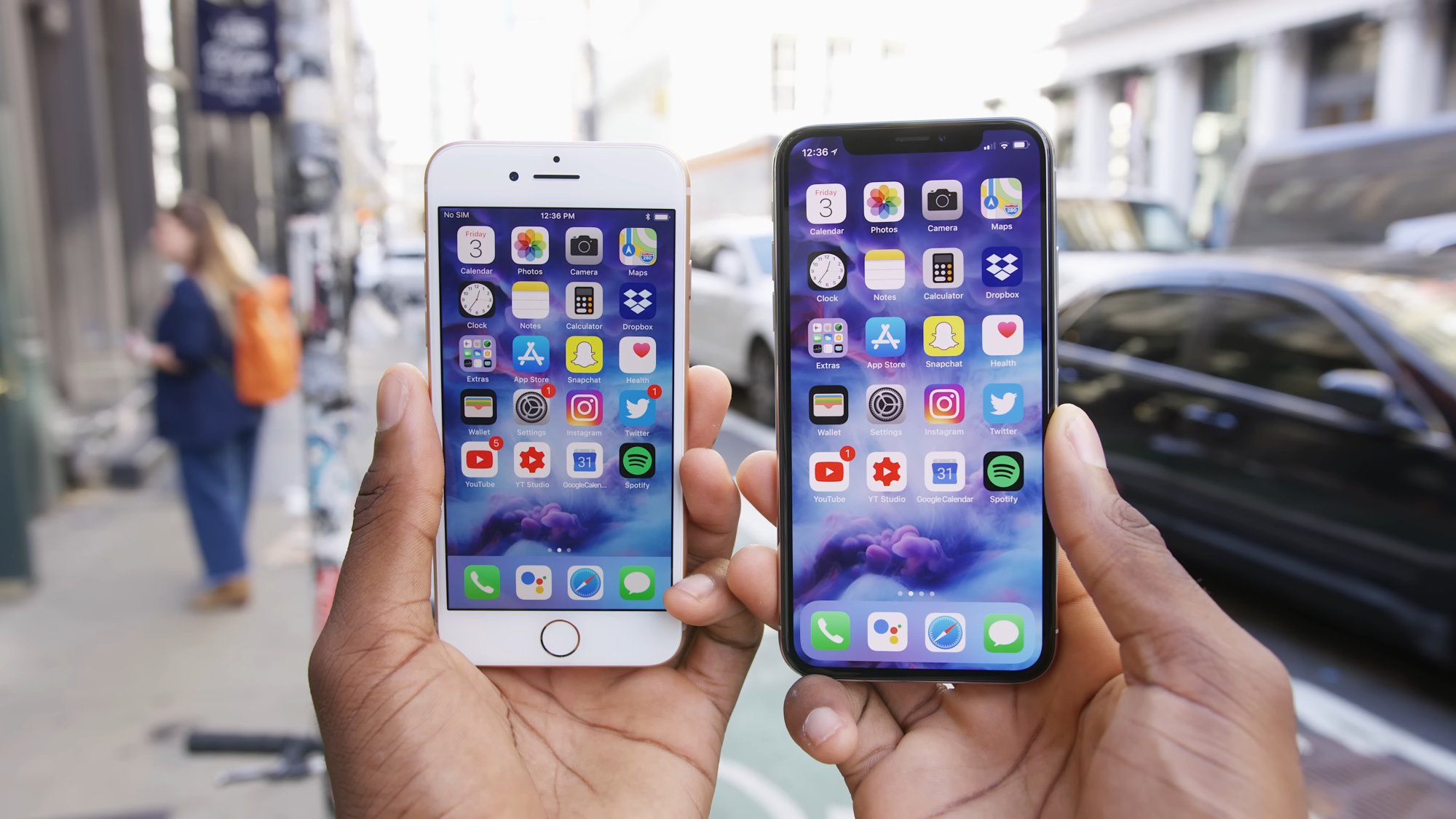
The Home button wasn’t totally eliminated, of course—along with the iPhone X, Apple released the iPhone 8 and 8 Plus, which included the same capacitive Home button as the iPhone 7 and 7 Plus. But by the following year, Apple’s entire lineup of flagship phones—the iPhone XS, XS Max, and XR—had all ditched the Home button.
Since then, only the iPhone SE line has offered a Home button—at least in the iPhone space. Apple kept the Home button alive on iPad for a while, until the third-generation iPad Pro (2018), fourth-generation iPad Air (2020), sixth-generation iPad mini (2021), and 10th-generation iPad (2022). And as of the iPhone 16e, the Home button is gone from Apple’s lineup.
It’s not that gesture controls aren’t great—they are! Swiping around iOS feels intuitive and, in many ways, is objectively better than getting around using the Home button.
But the Home button had some undeniable perks. It’s tough to remember for those of us with Face ID iPhones, but there was a time when it was much simpler to unlock your iPhone in the morning without resorting to using your passcode. You didn’t need to contort your face in the right position away from your pillow in order to authenticate yourself: Touch ID works however you’re lying down. (Touch ID also works when your face is all puffy from sleep.) That ease extends to however you unlock your iPhone: As long as you can physically touch the Home button with the correct fingerprint, you’re in. Just try to unlock a Face ID iPhone while it’s resting on your desk without moving your face towards it. And don’t get me started on what it was like unlocking a Face ID iPhone while wearing a mask during the pandemic: Before Apple issued an update making it easier, that was a nightmare.
More simply, the Home button was a button, and buttons are great! Devices in general seem to be moving away from buttons in favor of touch or voice controls, and while those can certainly be effective, physical buttons are kind of the best. There’s a satisfaction in clicking something and seeing an action as a result. Swiping is perfectly fine: I’m used to swiping up to go home, or swiping up and over to access my app switcher. But clicking once to go home, or clicking twice to pull up my open apps, still works really well—as does clicking the button without purpose, just because it’s there.
You could also have some fun with the Home button that you can’t with Face ID. Touch ID settings let you save five fingerprint scans on each device, but most of us have ten fingers. So, when setting up each fingerprint, you’d alternate fingers until a scan was complete—which effectively registered two fingers on one scan. Repeat that five times, and you could use any finger to authenticate yourself. (This still works on Macs with Touch ID.)
Here’s the problem with buttons, though: they can break. I never had a Home button break on me, but plenty of others did, for one reason or another. And if your Home button broke, it was a real pain in the ass. It’s possible to fix a Home button yourself—iFixit sells a kit at a reasonable price—but if you want Touch ID to keep working, you need to take it to the Apple Store, which will likely charge you hundreds of dollars for the privilege.
While Touch ID is superior to Face ID in some ways, it falls short in many others. Are your hands wet? Your fingerprint will not scan until they’re dry. Do you suffer from dry skin in the winter? Ge used to using your passcode for a few months. Wearing gloves? Better take them off. Not to mention, Face ID is way more secure than Touch ID, at least according to Apple: The company claims the former has less than a one in a million chance of unlocking when someone else uses your phone, while Touch ID has a one in 50,000 chance of the same failure.
The extra screen real estate the removal of the bottom bezel affords is also an undeniable plus. The largest Home button iPhone had a 5.5-inch display, while the smallest Face ID iPhone Apple currently sells has a 6.1-inch display. It’s hardly a contest. I will say, I don’t see those advantages for watching videos: I don’t like cropping out my content to fill my iPhone’s display, so on a Pro Max iPhone, the overall video size is about the same as it would be on, say, an 8 Plus. But for everything else on iOS? Those bezels are hardly missed.
The Home button may be gone from Apple’s lineup, but it won’t soon be forgotten. It was an iconic attribute of the iPhone for the first 10 years of the product’s life: Many phones had a similar design to the iPhone, but only one had that distinct rounded Home button.
It also isn’t dead. There are still plenty of Home button iPhones in use right now. Apple still supports the second and third-generation iPhone SE, as well as a number of Home button iPads, so the company will still need to keep Home buttons in mind when developing its software for some time.
And while Apple itself won’t sell you a new iPhone with a Home button, you can still easily buy one elsewhere. You can find new and used iPhone SEs through many retailers, and while I wouldn’t recommend doing so if you care about your device’s longevity, you can even pick up a used iPhone 8 or 8 Plus for less than $100. The point is, for a long time, the Home button mattered. And until Apple drops support for all Home button devices entirely, it still does.

The Human Torch is joining the Marvel Rivals roster tomorrow, February 21, and before the fire-flinging hero has even joined the scrap, fans are already scared. Part of Marvel Rivals’ appeal is that its heroes are powerful, destructive, and unconcerned with the petty matters of balance and fairness. The Human Torch…

Avatar: Seven Havens will follow the story of Aang and Korra’s successor in a new 26-episode series.
While there’s a new iPhone that’s surely soaking up the attention of many Apple fans, it’s often worth keeping an eye on the company’s other products as you might find a decent deal. If you’ve been on the lookout for a discount on the latest Mac mini, you’re in luck. The M4 Mac mini is back on sale as it has dropped to $549.
The deal is for the base model with 16GB of unified memory and 256GB of SSD storage. It’s not the lowest price we’ve seen for this Mac mini — it was $100 off during the Black Friday period. But with a $50 discount, this is the best price we’ve seen so far this year.
If you’d like more built-in storage, you might want to opt for a configuration with a 512GB SSD. That’ll currently run you $719, which is $80 off the regular price. However, it’s worth bearing in mind that you can connect an external SSD to your Mac mini if Apple’s internal storage upgrade prices are too pricey for you to justify.
We gave the Mac mini (albeit one equipped with a more powerful M4 Pro chipset) a score of 90 in our review. That said, the base M4 model should be zippy enough for most people’s needs. For instance, those who like to play games on Mac should find that the GPU is fast enough to support 60 fps gameplay at a resolution of 1080p on many titles.
Follow @EngadgetDeals on Twitter and subscribe to the Engadget Deals newsletter for the latest tech deals and buying advice.
This article originally appeared on Engadget at https://www.engadget.com/deals/apples-m4-mac-mini-is-back-on-sale-for-549-161512511.html?src=rss

Whether you tackle it solo or with a friend in local co-op, Big Helmet Heroes is no doubt the closest thing to a Castle Crashers sequel we’ve seen. This exciting 3D brawler features a fairly lengthy campaign filled with hilarious antics and thrilling combat. So if that sounds up your alley, hop in and check it out.…

This Eufy Robot Vacuum 11S Max is compact, quiet, and going for 44% off.
The assessment, led by scientists from the University of Edinburgh and the University of Zurich, found that so far this century, glaciers have lost approximately 5% of their total volume. Regional losses were highly variable; the Antarctic and subantarctic islands lost 2% of their volume but central Europe’s glaciers lost 39%.
“These numbers are staggering. They serve as a reminder that things are changing fast in some regions,” said Prof Noel Gourmelen, the co-lead author of the study and personal chair of Earth observation at the University of Edinburgh’s school of geosciences. A stark contrast in the amount of ice lost each decade was also discovered, with 36% more ice having melted between 2012 and 2023 compared with the previous decade.


Read more of this story at Slashdot.
On the Friday after Christmas, OpenAI published a blog post titled “Why OpenAI’s structure must evolve to advance our mission.” In it, the company detailed a plan to reorganize its for-profit arm into a public benefit corporation (PBC). In the weeks since that announcement, I’ve spoken to some of the country’s leading corporate law experts to gain a better understanding of OpenAI’s plan, and, more importantly, what it might mean for its mission to build safe artificial general intelligence (AGI).
“Public benefit corporations are a relatively recent addition to the universe of business entity types,” says Jens Dammann, professor of corporate law at the University of Texas School of Law. Depending on who you ask, you may get a different history of PBCs, but in the dominant narrative, they came out of a certification program created by a nonprofit called B Lab. Companies that complete a self-assessment and pay an annual fee to B Lab can carry the B Lab logo on their products and websites and call themselves B-Corps. Critically, B Corp status isn’t a designation with the weight of law, or even an industry-wide group, behind it — it’s a stamp of approval from this specific nonprofit.
As a result, B Lab eventually felt the certification program “was not enough,” says Professor Michael Dorff, executive director of the Lowell Milken Institute for Business Law and Policy at UCLA. “They wanted something more permanent and more rooted in the law.” So the organization began working with legal experts to create a model statute for what would become the benefit corporation. B Lab lobbied state legislatures to pass laws recognizing benefit corporations as legal entities, and in 2010, Maryland became the first state to do so. In 2013, Delaware enacted its own version of the law. To make things somewhat confusing, the state went with a different name: the public benefit corporation.
Delaware is arguably the most important state for corporate law in the US, thanks to the Delaware Chancery Court and its body of business-friendly case law. As of 2022, 68.2 percent of all Fortune 500 companies, including many tech giants, are incorporated in the state despite largely operating elsewhere. Delaware is also the state where OpenAI plans to reincorporate its for-profit as a PBC.
The basic idea behind public benefit corporations is that they’re business entities that impose a constraint on their board to balance profit maximization, a public benefit that’s stated in the charter of the company, and the concerns of people impacted by its conduct.
“It’s a bit of a paradigm shift,” says Professor Dammann, but don’t confuse a PBC with a nonprofit. “The key characteristic of a nonprofit is what we call a non-distribution constraint, meaning if a nonprofit makes a profit, they can’t distribute it to their shareholders,” Professor Dammann says. “If you form a public benefit corporation, there’s no such non-distribution constraint. At its heart, a PBC is still a for-profit corporation.”
First and foremost, a PBC structure — whether it’s private or selling share on the open market — would get OpenAI out from under that non-distribution constraint. But there are likely some other considerations at play.
OpenAI hasn’t publicly said this, but it appears some of its employees believe a PBC structure could protect the company from a hostile takeover if it were to go public. In a recent Financial Times report, a source within the company said a PBC structure would give OpenAI a “safe harbor” if a rival firm were to try to buy the company. It “gives you even more flexibility to say ‘thanks for calling and have a nice day’,” the person said.
The specific threat OpenAI likely wants safe harbor from is what’s known as the Revlon doctrine, which is named after a 1986 Delaware Supreme Court case involving the cosmetics company Revlon Inc. and now defunct supermarket chain Pantry Pride, then led by CEO Ronald Perelman. “The Revlon doctrine holds that if you’re a publicly traded corporation [incorporated in Delaware] and somebody stages a takeover attempt, then under certain conditions, you have to sell to the highest bidder,” says Professor Dammann.
The underlying rationale behind Revlon is that a for-profit company’s sole function is to generate profits, so the board is forced to make whatever choice will return the most money to shareholders.
“We don’t know for sure, but we’re fairly confident that the Revlon doctrine doesn’t apply to public benefit corporations,” says Professor Dammann. Theoretically, PBC boards may have the flexibility to reject a takeover bid if they believe a buyer won’t adhere to the social values the company was founded on. However, because “none of this has been litigated,” according to Professor Dorff, it remains a purely hypothetical defense.
Moreover, it’s unclear if reorganizing as a PBC would offer OpenAI more protection against a hostile takeover attempt than what it already has as a nonprofit. “I don’t think this has been tested with this particular kind of structure, but my sense is that the nonprofit would not be obligated to sell even in a Revlon moment,” says Professor Dorff.
Publicly, OpenAI has said it needs to secure more investment, and that its current structure is holding it back. “We once again need to raise more capital than we’d imagined,” OpenAI wrote in December, two months after securing $6 billion in new venture funding. “Investors want to back us but, at this scale of capital, need conventional equity and less structural bespokeness.”
Unpacking what the company likely means by “structural bespokeness” requires a short history lesson. In 2019, when OpenAI originally created its for-profit arm, it organized the company using a unique “capped-profit” structure. The company said it would limit investor returns to 100x, with excess returns going to the nonprofit. “We expect this multiple to be lower for future rounds as we make further progress,” OpenAI added.
It’s fair to be critical of the company’s claims. “You’d have to ask the investors, but I have to say that 100x is an exceptional rate or return, so the idea that you cannot get investment because of a 100x cap seems rich to me,” says Professor Dorff. In fact, there are suggestions OpenAI was already making itself more attractive to investors before announcing its reorganization plan in December. In 2023, The Economist reported that the company changed its cap to increase (and not decrease as OpenAI had originally said it would) by 20 percent per year starting in 2025. At this time, OpenAI does not expect to be profitable until 2029, and racked up about $5 billion in losses last year.
“We want to increase our ability to raise capital while still serving our mission, and no pre-existing structure we know of strikes the right balance,” OpenAI said in 2019. At that point, Delaware’s PBC legislation had been law for nearly six years. However, the company is now arguing that a PBC structure would “enable us to raise the necessary capital with conventional terms like others in this space.”
In OpenAI’s defense, calling its current structure convoluted would be an understatement. As you can see from the company’s own org chart, there are two other entities under the OpenAI umbrella, including a holding company that’s an intermediary between the nonprofit and for-profit. Engadget was able to find at least 11 different Delaware companies registered to OpenAI. George R.R. Martin, Jodi Picoult and other members of the Author’s Guild probably described it best in their copyright lawsuit against the company, calling OpenAI “a tangled thicket of interlocking entities that generally keep from the public what the precise relationships among them are and what function each entity serves within the larger corporate structure.”
OpenAI did not respond to multiple requests for comment from Engadget.
OpenAI’s nonprofit arm does essentially two things: controls the for-profit side’s business, and exists as a “vehicle” to develop “safe and broadly beneficial AGI” (artificial general intelligence).
According to the company, its current structure does not allow its nonprofit arm to “easily do more than control the for-profit.” If it were freed of that responsibility — by say, handing it off to investors — OpenAI suggests its nonprofit could focus its resources on charitable initiatives, all while becoming “one of the best-resourced nonprofits in history.”
To remedy the situation, OpenAI’s board says the nonprofit should give up absolute control over the for-profit and take whatever degree of control comes with the amount of stock it’s granted through the reorganization process. “The nonprofit’s significant interest in the existing for-profit would take the form of shares in the PBC at a fair valuation determined by independent financial advisors,” OpenAI says of this part of its plan.
Professor Dorff argues who controls OpenAI is critical to the company maintaining its mission. The move to reorganize the for-profit as a PBC is not controversial. “Companies do it all the time; there’s a straightforward and clear process to do that,” he tells me. “What is controversial is what they’re trying to do to change the nature of the nonprofit’s ownership interest in the for-profit.”
At the risk of oversimplifying things, OpenAI’s board of directors wants to divest the company’s nonprofit of two of its most important assets: control of the for-profit and its rights to the profits from AGI. “You can’t just do that,” says Professor Dorff. “The assets of the nonprofit must remain dedicated to the purpose of the nonprofit.” There are rules that allow nonprofits to modify their purpose if their original one is made defunct, but those won’t apply to OpenAI since we’re not living in a world with safe (or any) AGI.
Think of it this way, what is the value of artificial general intelligence? It’s not a traditional asset like real estate or the EVs sold by Tesla. AGI, as defined by OpenAI, doesn’t yet and may never exist. “One could imagine it’s worth all the labor of the economy because it could eventually replace human labor,” says Professor Dorff. Whatever the eventual value of the technology, Professor Dorff says he’s unsure “any number would enable the nonprofit to do what it’s supposed to do without control.”
No matter how OpenAI spins it, any version of this plan would result in a massive loss of control for the current nonprofit entity and its board.
Something the experts I spoke to agreed on was that the laws governing PBCs aren’t very effective at ensuring companies stick to their social purpose. “The legal constraints aren’t very strict,” Professor Dammann says, adding, “the problem with a very broad public benefit is that it’s not so constraining anymore. If you’re dedicated to a very broad version of the public good, then you can always defend every decision, right?”
“The dual goal of profit and public purpose doesn’t really tell you how a company is going to manage those objectives,” says Jill Fisch, professor of Business Law at the University of Pennsylvania Law School. “To the extent that public purpose sacrifices profits, and it doesn’t have to, but to the extent that it does, how much of a sacrifice is contemplated?”
“What matters a lot in PBC governance is what the private arrangements are,” Professor Dorff adds. “That is, what do the documents say?” A company’s certificate of incorporation, shareholder agreements and bylaws can provide “very robust” (or very few) mechanisms to ensure it sticks to its social purpose. As Professor Dorff points out, OpenAI’s blog post said “nothing about those.”
Contrast that with when OpenAI announced its “capped profit” plan. It gave us a glimpse of some of its paperwork, sharing a clause it said was at the start of all of its employee and investor agreements. That snippet made it clear OpenAI was under no obligation to generate a profit. Right now, there’s a lot we don’t know about its restructuring plan. If the company is still serious about its mission of “ensuring artificial general intelligence benefits all of humanity” it owes the public more transparency.
Elon Musk’s recent $97.4 billion bid to buy the nonprofit’s assets complicates OpenAI’s plan. In this situation, the nonprofit isn’t obligated to sell its assets to Musk under Revlon or anything else — the company simply is not for sale. However, as part of OpenAI’s reorganization plan, the for-profit will need to compensate the nonprofit for its independence. Musk’s bid likely an attempt to inflate the price of this transaction to one higher than what Sam Altman and the rest of OpenAI’s board of directors had in mind. To say Musk and Altman have had a contentious relationship since the former left OpenAI would be an understatement on a grand scale, and having an enemy who not only has the most money of any human on the planet, but also broad and largely unchecked control of the United States’ executive branch data, may frustrate plans.
OpenAI also faces a ticking clock. According to documents seen by The New York Times, the company has, under the terms of its latest investment round, less than two years to free its for-profit from control of the nonprofit. If it fails to do so, the $6.6 billion it raised in new funding will become debt.
This article originally appeared on Engadget at https://www.engadget.com/ai/why-openai-is-trying-to-untangle-its-bespoke-corporate-structure-160028589.html?src=rss