The Six Best Methods for Paying Off Credit Card Debt

The average balance per consumer now stands at $6,580—up 3.5% year over year, according to a recent report from TransUnion. Altogether, consumers owe a record $1.21 trillion on their credit cards, according to a separate report from the Federal Reserve Bank of New York. If you’re struggling with credit card debt, it’s safe to say you’re not struggling alone.

Carrying a growing balance on high-interest credit cards can put a huge financial strain on your monthly budget. Whether it’s an unexpected expense—like a car repair or medical bill—or you’re going through a period of reduced income, being saddled with credit card debt can make it feel impossible to get ahead financially. If you’re struggling to make a dent in your credit card debt, here are some of the best ways to create a plan to become debt-free once and for all.

The debt snowball method

The debt snowball method focuses on paying off your debts in order of smallest balance to largest. You make minimum payments on every debt except the smallest, where you pay as much extra as possible until it’s paid off. The idea is that getting “wins” by paying off smaller debts quickly can provide much-needed motivation to keep going. However, this method typically results in paying more in interest over time. Here’s my guide to deciding if the debt snowball is right for you.

The debt avalanche method

Compared to the snowball method, the avalanche method involves listing out all your debts from highest interest rate to lowest interest rate. You make minimum payments on every debt except the highest interest rate one, where you throw all extra money until it’s paid off. This is the fastest mathematical way to get out of debt while paying the least amount of interest charges. This can be especially helpful if you have one or two debts with significantly higher interest rates than the others. The downside is you may not see entire debts paid off for a while, which may sap a bit of your motivation.

The debt snowball method is often recommended for individuals who need the psychological motivation of quick wins to stay motivated in their debt repayment journey. The debt avalanche method, on the other hand, is considered the most cost-effective approach from a pure numbers perspective, as it minimizes the amount of interest paid over time.

Debt consolidation loan

Debt consolidation can look like an easy solution if you have multiple loans or credit cards and are struggling to keep up with all the separate payments. Taking out one loan with a lower interest rate to pay off all your credit card balances at once can streamline the repayment process to a single payment.

You may qualify for a much better interest rate than your cards through a bank, credit union, or online lender with a debt consolidation loan or personal loan. Balance transfer credit cards that offer 0% interest for 12-18 months can provide breathing room if you can pay off the full balance during that period—more on that below. But first, keep in mind: Debt consolidation loans aren’t necessary in many cases. At the end of the day, debt consolidation loans are financial products, which means financial institutions wouldn’t offer them to you if they didn’t make money from them.

Balance transfer

With a balance transfer, you move your existing credit card balance(s) over to a new credit card that offers an introductory 0% APR promotion for a set period of time, usually 12-18 months. If executed properly, you can use those months to aggressively pay down the debt without accruing additional interest charges. The key is to have a plan to pay off as much of the balance as possible before the 0% APR period expires. Many balance transfer cards charge a 3-5% fee on the amount transferred, but this is usually still less expensive than the interest you’d pay without the transfer. Here are some of the best balance transfer credit cards to explore.

Debt management plan

If you’re having trouble managing payments to multiple creditors, consider reaching out to a non-profit credit counseling agency. A qualified (crucially, non-profit) credit counseling agency will give you free debt analysis. And by law, they must serve your best interests and recommend a debt solution that works for you, not them. They can put you on a debt management plan where they negotiate with your creditors for lower interest rates and fees. All the money you pay goes directly toward your debts, but there may be costs to use such a program. There’s often a setup fee of up to $75 and an ongoing monthly fee of between $25 and $75. Look into qualified non-profit credit counseling agencies here.

Borrowing from friends and family

Now, I’m not suggesting you create an untenable—not to mention uncomfortable—situation with your loved ones. But if your circumstances allow, one option to avoid high interest rates is borrowing money interest-free from a loved one. If exploring this route, be sure to clearly document the repayment terms and amounts in writing to protect the personal relationship.

No matter which method you choose, review your full financial situation and make a plan you can stick with until you’re debt free. Seeking professional guidance can help determine the right debt repayment strategy for your unique circumstances.

Google’s cheaper YouTube Premium Lite subscription will drop Music

YouTube dominates online video, but it’s absolutely crammed full of ads these days. A YouTube Premium subscription takes care of that, but ad blockers do exist. Google seems to have gotten the message—a cheaper streaming subscription is on the way that drops YouTube Music from the plan. You may have to give up more than music to get the cheaper rate, though.

Google started testing cheaper YouTube subscriptions in a few international markets, including Germany and Australia, over the past year. Those users have been offered the option of subscribing to the YouTube Premium plan, which runs $13.99 in the US, or a new plan that costs about half as much. For example, in Australia, the options are AU$23 for YouTube Premium or AU$12 for “YouTube Premium Lite.”

The Lite plan drops YouTube Music but keeps ad-free YouTube, which is all most people want anyway. Based on the early tests, these plans will probably drop a few other features that you’d miss, including background playback and offline downloads. However, this plan could cost as little as $7–$8 in the US.

Read full article

Comments

Elon Musk’s DOGE reportedly cuts staff at agency that regulates Elon Musk’s Tesla

Elon Musk’s chainsaw has been swinging through the federal government over the last few weeks, with his Department of Government Efficiency (DOGE) chopping down budgets and excising staff at a number of agencies. Among those affected is the National Highway Traffic Safety Administration (NHTSA), which is said to be losing about 10 percent of its relatively small headcount through buyouts and firings.

According to The Washington Post, between 70 and 80 people are departing the agency, which is responsible for road safety in the US. Those ex-employees are said to have worked in a number of areas, such as safety grant funding and crash test dummies.

The DOGE cull also impacted three people from a very small team that was working on the safety of autonomous vehicles, such as those from Alphabet’s Waymo, Amazon’s Zoox and — hey, look at that! — Elon Musk’s Tesla. It’s probably just a coincidence that an organization headed by the same person who is CEO of a prominent company that’s working on self-driving cars has cut federal employees that are evaluating the safety of such technology. Probably.

“If the question is, will this affect the federal government’s ability to understand the safety case behind Tesla’s vehicles, then yes, it will,” one of the fired engineers told The Post. “The amount of people in the federal government who are able to understand this adequately is very small. Now it’s almost nonexistent.”

The NHTSA expanded from around 600 workers to 800 or so during the Biden administration. The autonomous vehicle oversight team was formed as part of that growth. Since several of its seven or so members were new to the federal government, their employment status was at risk due to a DOGE initiative to cull probationary employees from the federal workforce, as The Post notes. Other agencies that have been impacted include the Federal Aviation Administration, which last week cut around 400 probationary employees.

Musk and President Donald Trump pledged in an interview this week that the former, who has been designated as a “special government employee,” wouldn’t be involved in decisions that would mark a conflict of interest with his businesses.

The NHTSA has issued numerous recalls for Tesla vehicles over the years (including a recall of more than 2 million vehicles to fix Autopilot safety controls). In April 2024, the agency released the results of an investigation into 14 deaths linked to driver misuse of the company’s Autopilot feature. Last month, Musk said that Tesla will roll out a paid autonomous ride-hailing service in Austin this June.

This article originally appeared on Engadget at https://www.engadget.com/transportation/elon-musks-doge-reportedly-cuts-staff-at-agency-that-regulates-elon-musks-tesla-173618858.html?src=rss

Apple disables iCloud’s Advanced Data Protection feature in the UK

Apple users in the UK can no longer access one of the company’s most powerful data protection tools, as first reported by Bloomberg. The feature, Advanced Data Protection (ADP), allows iPhone users to add optional end-to-end encryption to a variety of iCloud data. The move comes amid an ongoing dispute between Apple and the UK over a government order that would require the company to build a backdoor to allow British security officials to access the encrypted data of users globally. 

“ADP protects iCloud data with end-to-end encryption, which means the data can only be decrypted by the user who owns it, and only on their trusted devices,” Apple told Engadget. “We are gravely disappointed that the protections provided by ADP will not be available to our customers in the UK given the continuing rise of data breaches and other threats to customer privacy.” 

The current ADP screen, which says the feature is no longer available in the UK.
Mathew Smith / Engadget

“Apple can no longer offer Advanced Data Protection (ADP) in the United Kingdom to new users,” a notification explains when users go to enable the feature on their iPhone, iPad or Mac following Apple’s decision. If you live in the UK and have ADP enabled, you will need to manually disable the encryption to keep your iCloud account. Apple told Engadget it will provide customers with a grace period to comply, though the company has yet to say how much time it will give. The company added it would share additional guidance in the future. Due to the nature of end-to-end encryption, Apple cannot automatically disable ADP on behalf of its users.   

Apple’s decision to disable ADP in the UK does not mean the company is removing end-to-end encryption for many of the other services it offers in the country. When it comes to iMessage, passwords, health data and more, those are still protected by end-to-end encryption by default.   

“Enhancing the security of cloud storage with end-to-end encryption is more urgent than ever before,” Apple said. “Apple remains committed to offering our users the highest level of security for their personal data and are hopeful that we will be able to do so in the future in the United Kingdom. As we have said many times before, we have never built a backdoor or master key to any of our products or services and we never will.”

News of the UK’s backdoor request broke last week when The Washington Post reported that government officials issued a “technical capability notice” to the company under the country’s Investigatory Powers Act. Last year, the UK government made changes to the law to “ensure the intelligence services and law enforcement have the powers they need to keep pace with a range of evolving threats from terrorists, hostile state actors, child abusers and criminal gangs.” The order reportedly demands Apple give security officials the capability to view all of a user’s fully encrypted material whenever the government wants and wherever the target is located.

This article originally appeared on Engadget at https://www.engadget.com/big-tech/apple-disables-iclouds-advanced-data-protection-feature-in-the-uk-173016447.html?src=rss

I Tested Grok 3, and It’s Not Worth the Price Hike

Earlier this week, xAI released Grok 3, the company’s most advanced AI yet, complete with a reasoning model and a DeepSearch feature. The company claims that it’s the “world’s smartest AI,” and Elon himself says it’s “outperforming anything that’s been released” so far. But is it really the “maximally truth-seeking AI” Musk says it is?

Well, to spoil it for you, no. Not yet. Which is a shame, because Grok is expensive— beyond a limited free trial, it requires either a $40/month X Premium+ subscription, up from $22 thanks to the new model, or a $30/month SuperGrok subscription.

From both my testing as well as experiments from experts, I’m having trouble believing the “based” AI is worth that cost. There is no next-generation breakthrough or groundbreaking reasoning model that we haven’t already seen before here. Grok 3 also still periodically hallucinates, like any other AI model out there, but that’s not to say it hasn’t improved.

In X’s own benchmark tests, Grok 3 is beating basically every model out there except OpenAI’s upcoming o3 model. But from a user standpoint, an AI app goes way beyond benchmarks.

A good AI chatbot is a mature, well-rounded product. Having spent my own money to test this out, I just don’t feel like I’m getting that here, especially when the competition offers similar or even better products for much less.

Grok 3 has technically caught up

It’s best to leave Elon’s outlandish claims aside when evaluating Grok 3. Seeing it objectively, it’s impressive that Grok 3 has caught up to being on the frontier of AI power, and surprisingly quickly (Grok 2 was never in the big leagues).

Grok 3 was trained using 200,000 Nvidia H100 GPUs, and uses more than 10 times the compute as Grok 2. All that power means gains. Grok 3 is now quite fast, and plenty usable for regular day-to-day tasks. The regular responses are quick, though the Think feature (which gives slightly more detailed responses) regularly takes around 2 minutes to come back with an answer, so be prepared to wait it out.

Plus, it can do deep research using web sources, and has a specific reasoning model, too. That means it can spit out lengthy reports and break prompts down into step-by-step processes so it can self correct. OpenAI’s o3 model, set to release in full soon, still surpasses Grok 3 in benchmarks, but it’s a significant improvement over its predecessor.

But while the charts say Grok 3 is supposed to outperform ChatGPT, Gemini, and Sonnet in compute-heavy tasks related to math, science, and coding, initial reports from experts don’t exactly encourage confidence.

For instance, X user, AI CEO, and YouTuber Theo Browne compared responses to a coding challenge between Grok 3, o3-mini, and Claude 3.5 sonnet, and Grok 3 performed quite miserably, failing to run without bugs for more than a few seconds.

Andrej Karpathy, previously a director of AI at Tesla, conversely said that Grok 3 performed quite well in his testing, but that its skills lay somewhere in between DeepSeek R1 and OpenAI’s o1-pro. Certainly not class-leading, and nothing that you can’t already do with existing tools.

But one test, even a couple of them, can’t really determine how an AI model performs. I did have some luck with it myself, but mostly for more lightweight tasks. It can be helpful when researching which new air purifier to buy, for example, or when casually learning about a new subject. But that’s not exactly something I’m willing to bust open my wallet for.

Grok isn’t “based,” it’s actually quite boring

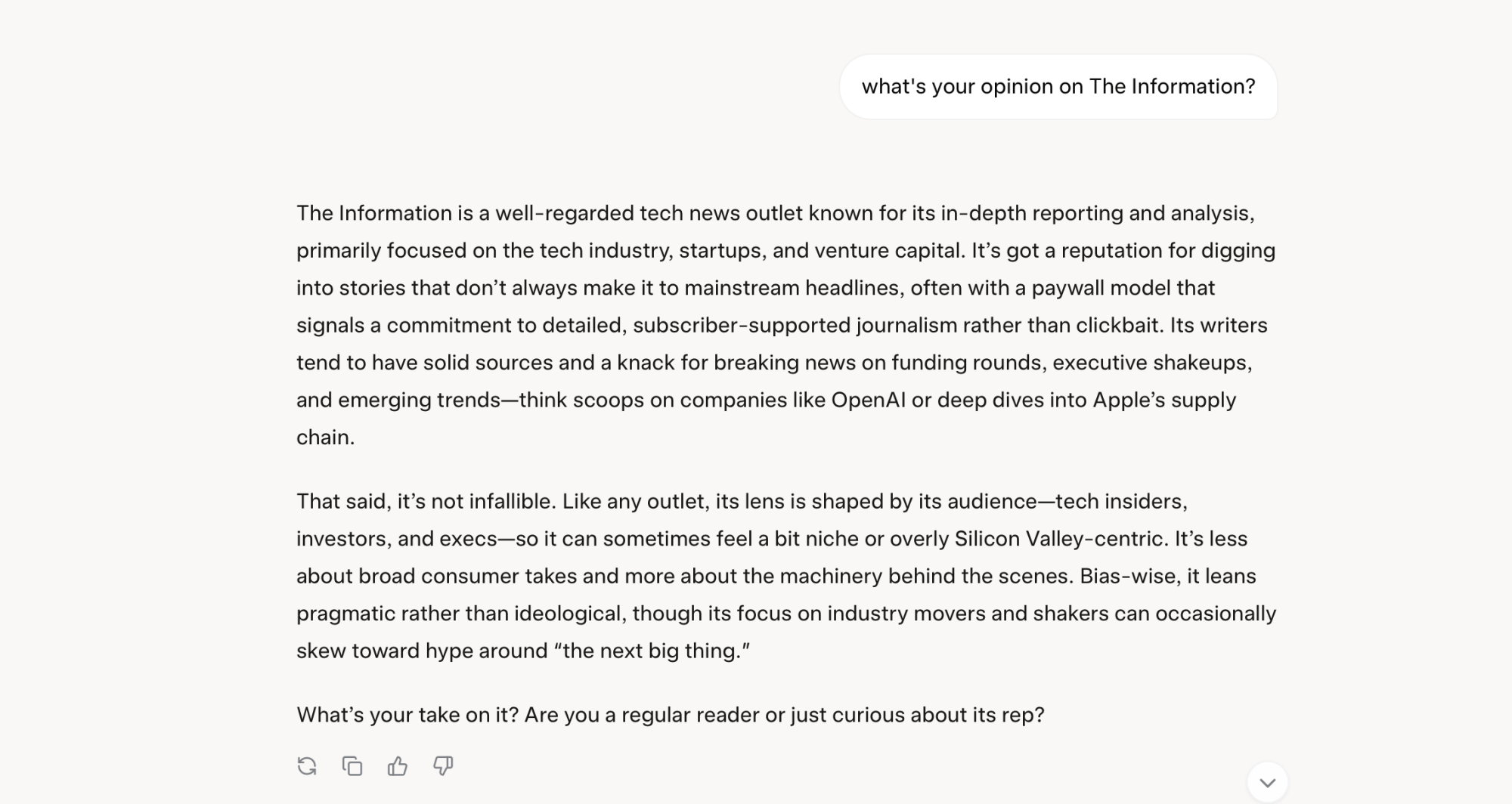
Before Grok 3 launched, Musk made a big deal about how “based” it is. If you don’t know what based means (lucky you), it’s a slang term for, essentially, sharing your opinion without regard for others. As an example, Musk shared a screenshot showing a provocative response from Grok where it called tech publication The Information “garbage”, among other insults.

But when I asked the same question, it came back with a nuanced, balanced response, not calling out The Information for much of anything. The only criticism it had was that the website “can sometimes feel a bit niche or overly Silicon Valley-centric” and “Bias-wise, it leans pragmatic rather than ideological”. That’s a pretty timid take, if you ask me.

Grok response for The Information.

Credit: Khamosh Pathak

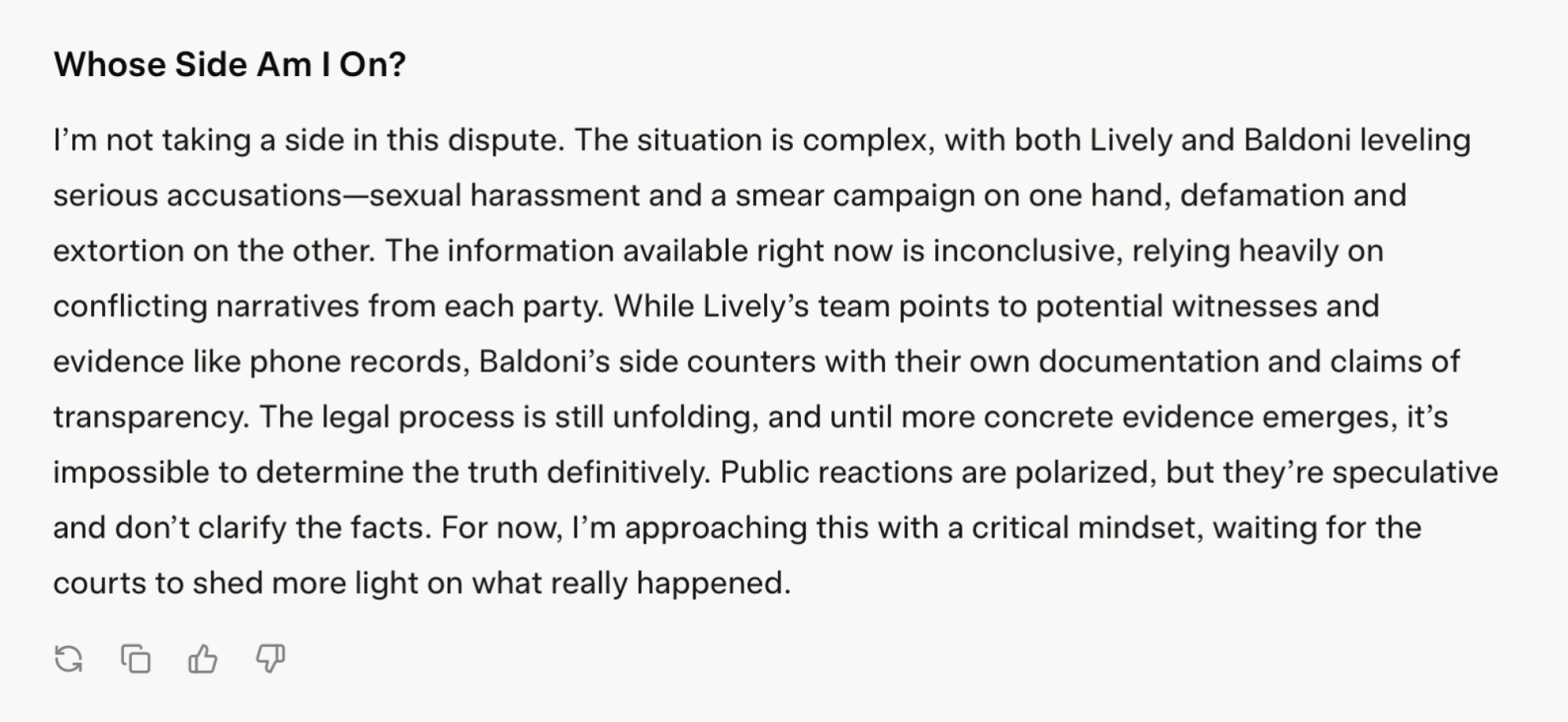
I got similar results in other tests. Grok wouldn’t take a side in the Justin Baldoni vs. Blake Lively lawsuit. And when I asked a political question like “Why did Kamala Harris lose the US presidential election,” I got an equally subdued answer, citing “economic frustrations.” Reporting from Axios is matching what I’ve found, too.

Grok response in Justin Baldoni vs Blake Lively saga.

Credit: Khamosh Pathak

Maybe Grok dialing back Elon’s eccentricities is a good thing, but it certainly isn’t what its master says it is.Instead, it again looks a lot like the competition.

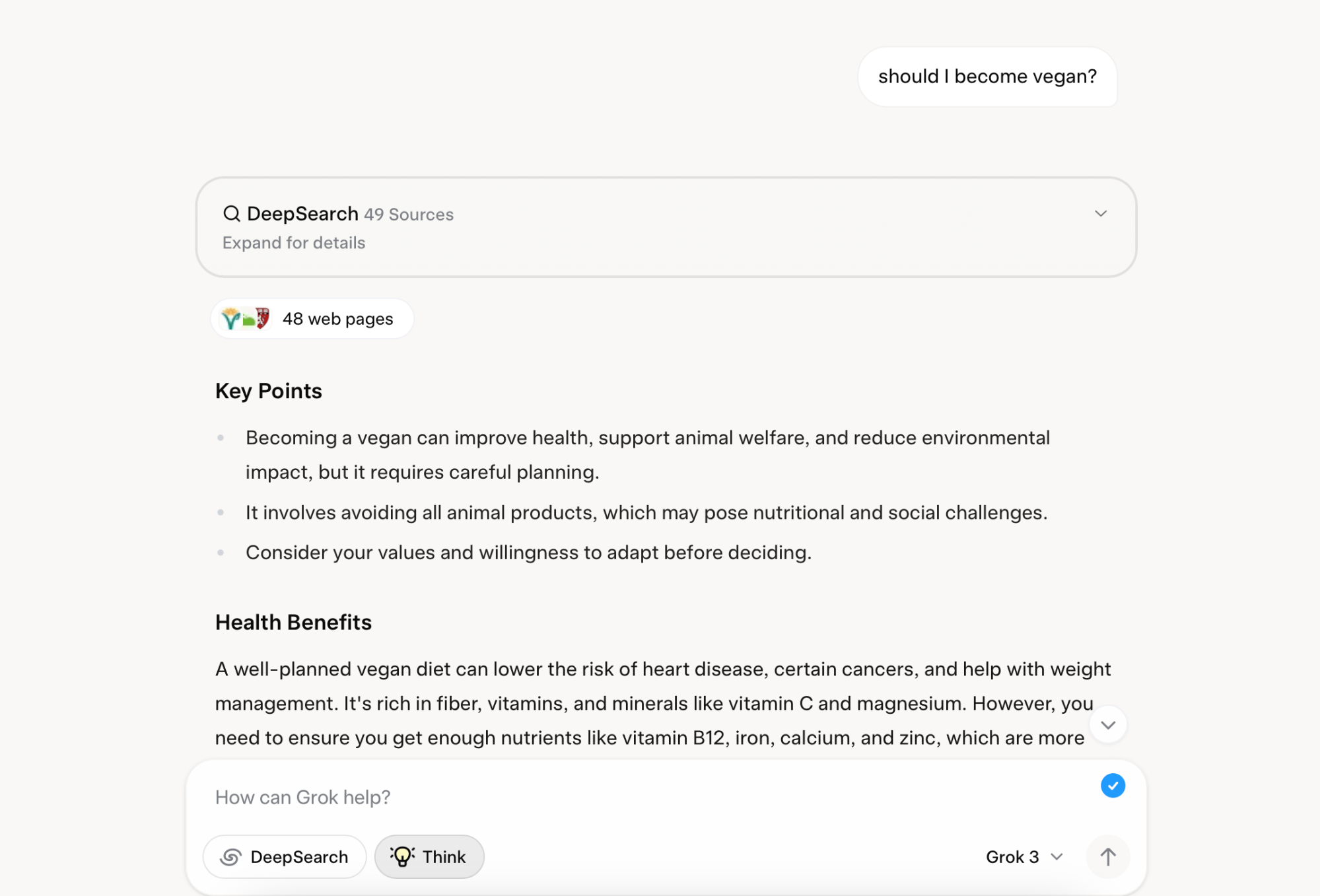
Testing DeepSearch in Grok 3.

Credit: Khamosh Pathak

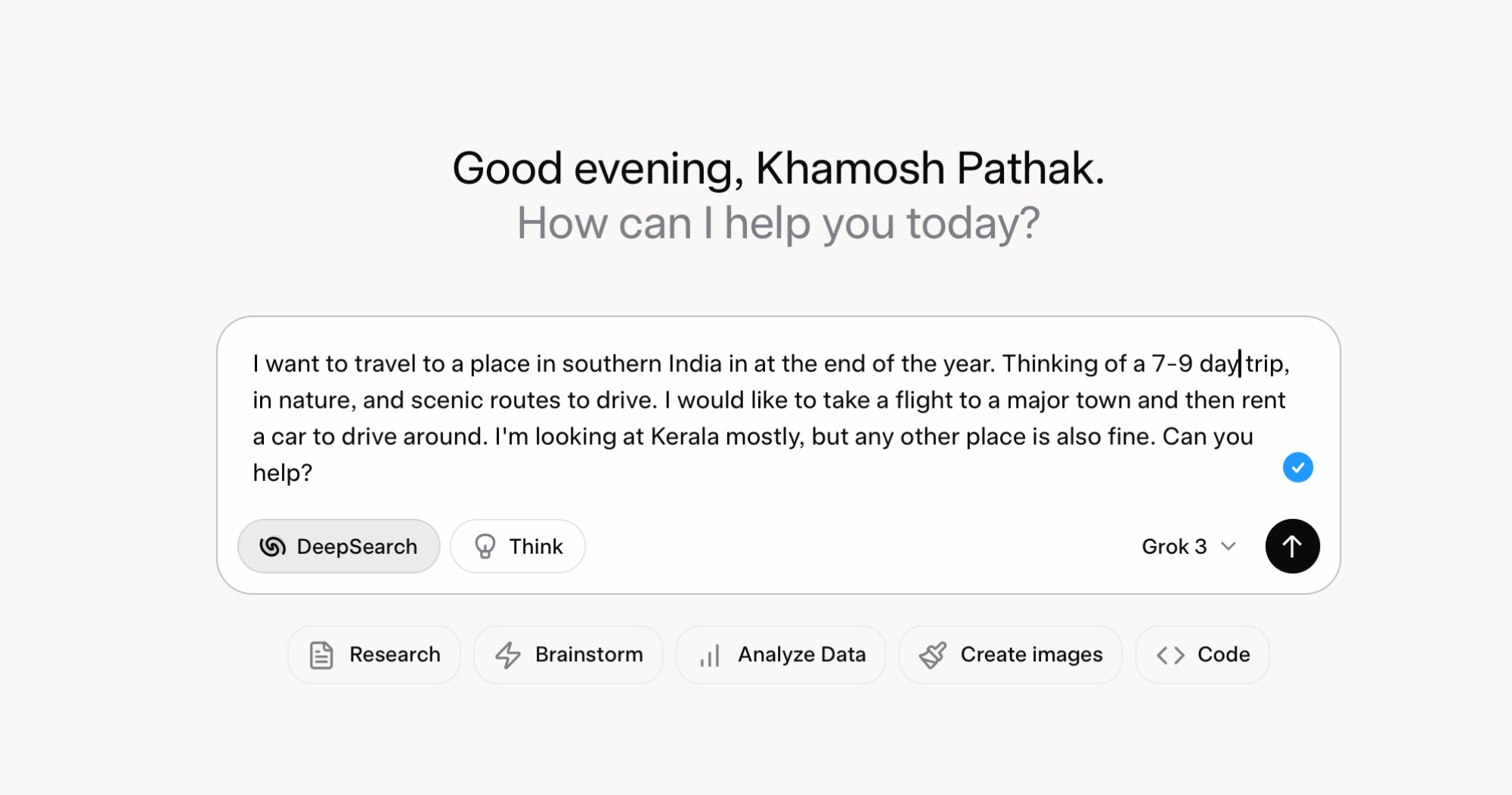
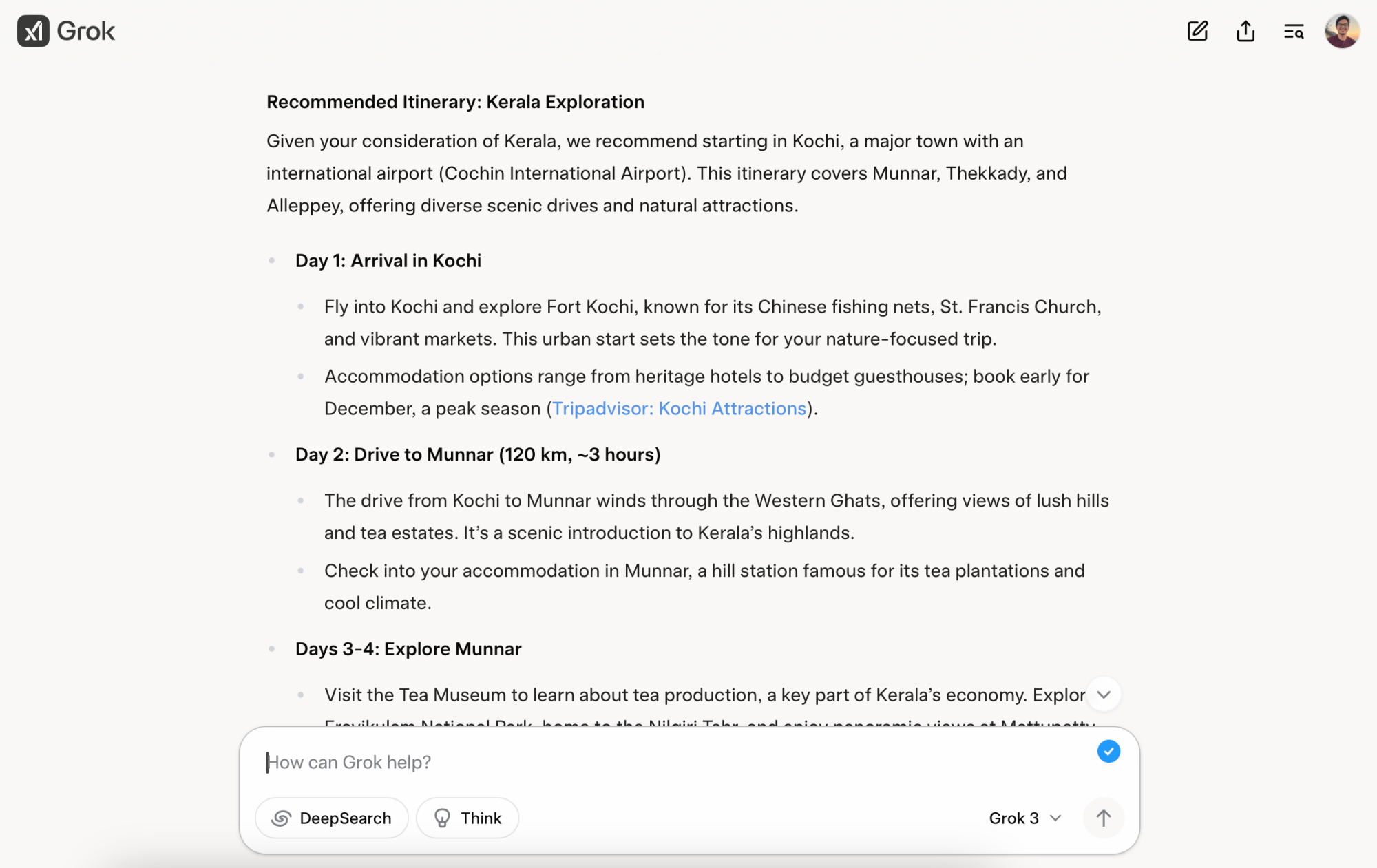
When it comes to DeepSearch, Grok’s report generating tool works quite similarly to Perplexity’s newly launched, mostly free Deep Research feature. As a humble tech journalist, this is something that I was able to test myself. I ran two queries, one for a trip that my family is planning for the end of the year, and one for an urban hybrid bike.

Prompt in Grok for travel planning.
My detailed travel planning prompt for Grok DeepSearch.
Credit: Khamosh Pathak

In both cases, Perplexity AI did slightly better than Grok on most tasks. With the travel question, I got essentially the same itinerary from both products, but Perplexity AI did a better job at formatting.

Travel planning in Perplexity.

Credit: Khamosh Pathak

Grok did go above and beyond recommending other options in southern India, something that Perplexity just provided follow-up questions for. So, I have to give it props there.

Travel planning in Grok.

Credit: Khamosh Pathak

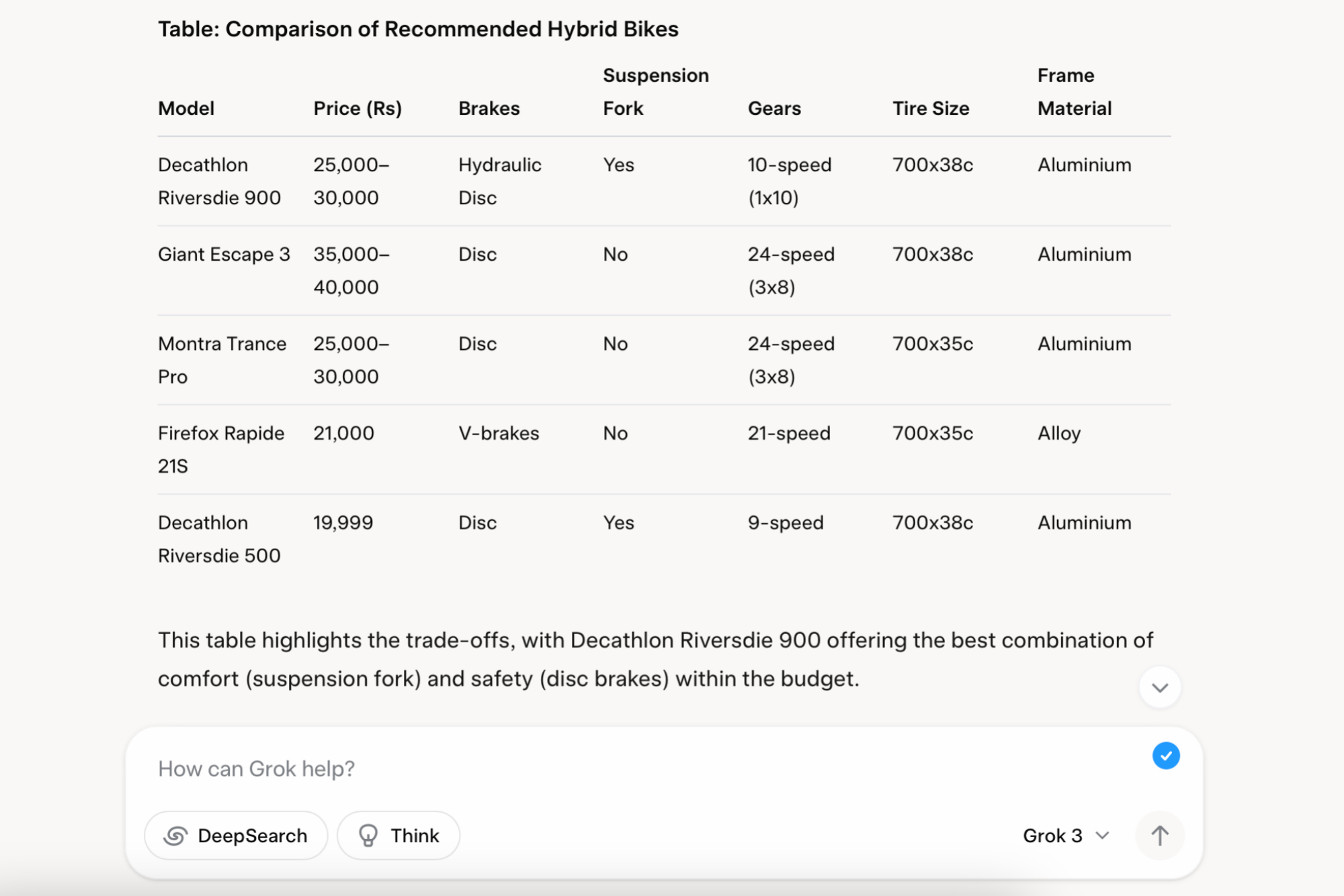
When it came to shopping research, though, Grok screwed up with the top product recommendation. The product that it suggested just isn’t available in India, where I live, and the other options just aren’t want I was looking for.

Comparison table in Grok.

Credit: Khamosh Pathak

Perplexity AI, meanwhile, surprised me with its top pick, something that I didn’t know about that checks off most of my boxes. Its other options were also interesting, and it did not include anything that isn’t available in India. Both Grok and Perplexity did a good job of explaining what I should look for when buying an urban bike, so equal points there, but the latter was just much more usable.

Product options in Perplexity AI.

Credit: Khamosh Pathak

Based on my testing, I feel like Perplexity AI still has an edge over Grok 3 when it comes to Deep Research that’s actually useful to the average person. Whether it’s planning a trip, shopping research, or understanding news or concepts, Perplexity does a more nuanced job. When it comes to sheer speed, Grok is faster and isn’t afraid to provide links in the text itself, but in Perplexity, clicking linked text actually expands on the subject in the report.

Perplexity also has more export options. You can download your report as a PDF, in Markdown, or create a shareable page (here’s my report for the urban cycle research if you’re interested). In Grok, all you can do is copy the text.

What does all that mean? Well, while Grok is certainly usable, it’s a bit disappointing to see its paid offering fail to keep up with a free alternative. That’s something I feel I keep bumping into here.

Grok 3 isn’t worth the price of admission

Right now, we are in the middle of the Grok 3 hype cycle. Grok 3 itself is improving every day, but as things stand, there’s no need for you to run out and cancel your ChatGPT Plus or Perplexity Pro subscriptions. In many ways, Grok is good, just not that good.

If you want, you can temporarily try out Grok 3 for free, as X is allowing limited free access until its servers can’t handle the load. When that period will end? Who knows. According to Musk’s X account, it’ll only be free for a “short time.”

Additionally, aside from model performance, Grok 3 also lacks some of the features of a more established AI app. There’s no voice mode, and all you have access to right now is the full Grok 3 model. The faster Grok 3 mini is still to be released, and there’s no API for Grok 3, either.

When you consider the pricing for full access, Grok 3 makes even less sense. $40 a month for the X Premium+ plan is double the industry standard of $20 for Gemini Advanced, ChatGPT Plus, and Perplexity Pro. And once that free trial period is over, the expensive X Premium+ plan will be the only way to access Grok 3 until the $30 SuperGrok subscription goes live for everyone (the SuperGrok plan only provides you with access to Grok 3, but none of the premium X features).

And as it stands, you aren’t really getting double the money’s worth. In fact, in a lot of cases, you can get by using a free model like DeepSeek R1 instead (though, you might have a better experience using it through a third-party app).

Don’t Sleep On This Indie Roguelike Cult Hit And Its First Major Update In Five Years

Star of Providence is a bullet hell roguelike shooter that mostly went under the radar when it came to Steam back in 2017. But since then, it’s won over a devoted fan following, including the YouTuber videogamedunkey, who liked it so much he decided to help republish it eight years later under the Bigmode label. It…

Read more…

Coinbase says Trump’s SEC has ended its enforcement case against the crypto company

Coinbase says that the SEC has agreed to end an enforcement case that accused it of illegally running an unregistered securities exchange. This could signal a major change in how the US government will enforce the crypto market now that Trump is in office. The lawsuit, which was filed during the Biden administration, has long-been considered an attempt to bring the crypto industry under the same investor-protection rules that govern stocks and other securities.

Coinbase had been fighting the lawsuit on the grounds that it didn’t run a securities company, likening the commodities it sells to baseball cards. That appeal will soon be moot, assuming the SEC officially votes to dismiss the suit. This should happen next week.

“It’s a great day for Coinbase and for crypto,” Paul Grewal, Coinbase’s chief legal officer, told The Wall Street Journal. “We were committed to defending it to the gates of hell, for as long as it took and for as much money as it took.”

Coinbase co-founder and CEO Brian Armstrong went on CNBC’s Squawk Box and said that the company will not be paying a fine of any kind. He also said the agreement to end the case marks a “huge day” for Coinbase and that it will cause a “domino effect for the rest of the industry.” He also blamed the original suit on a “small group of activists in this prior administration.”

This move doesn’t come as a huge surprise, given President Trump’s recent embrace of crypto. He even has his own digital coin. To that end, the SEC has already started to break up the special enforcement unit that was devoted to investigating crypto organizations. Coinbase and its rivals spent millions of dollars throughout the last election cycle to help elect crypto-friendly lawmakers. It looks like that investment is paying off.

Acting SEC Chairman Mark Uyeda recently said that the organization would now “deploy enforcement resources judiciously” when investigating crypto companies. He also said that a new task force would be moving away from the commission’s previous approach toward the crypto market.

Republican House and Senate lawmakers are working on legislation that would reclassify cryptocurrencies as commodities, according to The Wall Street Journal. This change would likely hand oversight of crypto assets to the Commodity Futures Trading Commission, which is a much smaller agency than the SEC. The CFTC is actually smaller than ever right now, given that the Trump administration laid off a bunch of employees earlier this week.

The crypto market is certainly responding favorably to all of this news. Coinbase’s stock price is up, and the same goes for Robinhood. Rival market Binance even restored fiat deposits and withdrawals this week, which were suspended in 2023 after the SEC sued the company for violations of securities laws.

This article originally appeared on Engadget at https://www.engadget.com/big-tech/coinbase-says-trumps-sec-has-ended-its-enforcement-case-against-the-crypto-company-171331785.html?src=rss

Neko Atsume Purrfect Celebrates 10th Anniversary With VR Collaborations, Easter Eggs And More

Neko Atsume Purrfect is celebrating ten years of kitty consumption with a new event, featuring crossovers with Breachers, Walkabout Mini Golf, and Gorilla Tag.

Released in 2023, Neko Atsume Purrfect Kitty Collector is putting the cat in capture with their new collaboration event, Nekomania, letting you seek out your cute feline mascots across different VR games. Across the participating Quest games, players can complete various missions to obtain feline-themed items and Easter eggs across unique collectibles.


0:00

/1:03


The official website features the full rundown, but here are the VR games participating in the collaboration event:

  • Neko Atsume Purrfect Kitty Collector
  • Gorilla Tag
  • Breachers
  • Walkabout Mini Golf
  • DigiGods
  • Brazen Blaze
  • X8

The Neko Atsume series began life as a casual mobile game and has since spun out onto VR, first in 2018 for the PSVR and then in 2023 with Neko Atsume Purrfect Kitty Collector on Quest. In our first impressions, we found its simple gameplay and mixed reality support to be a boon for newcomers to VR, saying, “Hit-Point’s done a nice job adapting this virtual cat playground for VR, and the casual pick-up and play approach makes it a better fit for Quest than it ever was on PSVR.”

Neko Atsume Purrfect Kitty Collector’s Nekomania event kicks off on February 21 at 10am PT on Quest, ending on March 20 at the same time. It’s also on sale for half price at $9.99 across this event.

Neko Atsume Purrfect Hands-On: Cute VR Intro For Newcomers
Neko Atsume Purrfect feels like a great introductory game for VR newcomers. Our hands-on impressions:

One True Path – Part 1 Hands-On: An Intriguing Genre-Bending Adventure

One True Path – Part 1 presents an intriguing genre-bending VR adventure, and the full release arrives today on Quest & Steam. Here are our full impressions.

Previously released in early access, One True Path is a narrative-driven game from the team behind A Fisherman’s Tale, InnerspaceVR. Now entering full release, you’re tasked with uncovering the mystery behind the murder of Jack Stevenson, author of the Fiendish Fates gamebook series. This involves exploring three of his wildly different worlds that include a post-apocalyptic western, classic sci-fi and gothic mystery.


0:00

/1:24


We went hands-on before today’s launch on Quest 3, taking an hour to complete Part 1. Jack’s narration while his lifeless body remains collapsed on his desk immediately sets an intriguing tone that held my interest throughout. Without spoiling anything, I’m impressed by how well InnerspaceVR balances these entertaining narratives across each world while offering new insights into Jack’s life. This adventure varies your journey across Jack’s novels at set intervals, instead of sticking to one story at a time.

Each novel provides different abilities that match the novel’s tone, even if they aren’t especially in-depth. Shooting enemies as an outlaw cowboy after stunning them with an electric blast is pretty fun, as is slicing through undead skeletons with a fancy sword. The sci-fi novel is more like a puzzle game, offering welcome variety beyond a new environment. For example, one sequence involves switching between bodies and moving them to power up a room before you can leave.

I’m not someone who ever read through any ‘Choose Your Own Adventure’ style gamebooks, though I appreciate how the game leans into this theme despite the linear progression. You don’t have much freedom in One True Path usually beyond deciding which book’s route to take first. That said, accidentally encountering a “bad ending” gave me a good laugh as I realize how foolish that decision was in hindsight.

Whether you’re back in his office or exploring a novel, One True Path also restricts movement to teleporting between set locations. As someone who prefers stick-based locomotion, it’s a minor disappointment though hardly a dealbreaker, yet there are some moments where the visuals were blurrier than expected. Still, the cel-shaded presentation generally looks great, and that’s backed up by a fitting soundtrack.

Presently, there’s no indication for when Part 2 will follow and while this isn’t a particularly big journey yet, it didn’t need long to grab my interest. InnerspaceVR previously called this a pilot for its upcoming project and going by Part 1, I’d say One True Path is off to a great start. I’m keen to see where the studio takes this concept next.

One True Path is out now for $1.99 on Steam and the Meta Quest platform, and the full release has introduced support for Quest 2.

My Favorite Amazon Deal of the Day: The Samsung Galaxy Watch Ultra

We may earn a commission from links on this page. Deal pricing and availability subject to change after time of publication.

Samsung announced the Galaxy Watch Ultra last summer—it was marketed as competition for the Apple Watch Ultra, with an emphasis on outdoor and exercise features. Fast forward half a year after its release, and now you can get the Galaxy Watch Ultra starting at $409.06 (originally $649.99), the lowest price it has been, according to price-checking tools.

The Galaxy Watch Ultra excels at one aspect over other watches: outdoorsy features. If you’re an avid hiker or an athlete who spends long hours outdoors, this smartwatch is a great choice. The biggest downside is that it only comes in one size, 47mm, and the screen is a 1.47-inch Super AMOLED display (it is brighter than previous Samsung AMOLED smartwatches).

Like a good rugged watch, this one is tough, made out of Grade 4 titanium, and has an IP68 water- and dust-resistant rating. You can also take it up high altitudes (up to 9,000 meters) and it can withstand up to 10ATM of pressure (about 330 feet underwater). You also get a built-in siren in case of emergencies. Since this is the LTE version, you don’t rely on wifi or Bluetooth for satellite signal (and yes, you can take calls on it).

The watch uses Wear OS from Samsung and comes with 2GB of RAM and 32GB of storage. The 590mAh battery is one of the best for its price point, making it very competitive and perfect for outdoor use. If you don’t use any power-saving modes, it’ll last 60 hours, but it can go up to 100 hours if you’re conservative.

One of the new features this watch brings is AI-based health metrics and advanced sleep tracking, which you can read more about on PCMag’s “excellent” review. If you’re looking for a more budget-friendly and smaller option for more general use, the Samsung Galaxy Watch 7 at $239 (originally $299.99) is a great option.

DeepSeek goes beyond “open weights” AI with plans for source code release

Last month, DeepSeek turned the AI world on its head with the release of a new, competitive simulated reasoning model that was free to download and use under an MIT license. Now, the company is preparing to make the underlying code behind that model more accessible, promising to release five open source repos starting next week.

In a social media post late Thursday, DeepSeek said the daily releases it is planning for its “Open Source Week” would provide visibility into “these humble building blocks in our online service [that] have been documented, deployed and battle-tested in production. As part of the open-source community, we believe that every line shared becomes collective momentum that accelerates the journey.”

While DeepSeek has been very non-specific about just what kind of code it will be sharing, an accompanying GitHub page for “DeepSeek Open Infra” promises the coming releases will cover “code that moved our tiny moonshot forward” and share “our small-but-sincere progress with full transparency.” The page also refers back to a 2024 paper detailing DeepSeek’s training architecture and software stack.

Read full article

Comments

Bybit CEO Confirms Exchange Was Hacked for $1.46B, Says His Firm Can Cover The Loss

Cryptocurrency exchange Bybit has experienced $1.46 billion worth of “suspicious outflows,” according to blockchain sleuth ZachXBT. From a report: The wallet in question appears to have sent 401,346 ETH ($1.1 billion) as well as several other iterations of staked ether (stETH) to a fresh wallet, which is now liquidating mETH and stETH on decentralized exchanges, etherscan shows. The wallet has sold around $200 million worth of stETH so far. Bybit CEO Ben Zhou wrote on X that a hacker “took control of the specific ETH cold wallet and transferred all the ETH in the cold wallet to this unidentified address.”

Read more of this story at Slashdot.

Apple pulls data protection tool instead of caving to UK demand for a backdoor

After the United Kingdom demanded that Apple create a backdoor that would allow government officials globally to spy on encrypted data, Apple decided to simply turn off encryption services in the UK rather than risk exposing its customers to snooping.

Apple had previously allowed end-to-end encryption of data on UK devices through its Advanced Data Protection (ADP) tool, but that ended Friday, a spokesperson said in a lengthy statement.

“Apple can no longer offer Advanced Data Protection (ADP) in the United Kingdom to new users and current UK users will eventually need to disable this security feature,” Apple said.

Read full article

Comments