It’s not clear that anyone was asking for a company to build a muscular, sinewy robot or to see a video of it dangling, helpless from a hook, but life is full of surprises and this YouTube video of Clone Robotics’ “Protoclone” is here all the same.
The Protoclone appears to be a prototype version of the “Clone” robot the aptly named Clone Robotics is working to build. The video shows the Protoclone flexing its arms and legs, with visible artificial muscle fibers moving underneath its white “skin.” Based on Clone Robotic’s video description, the impressive part here is that fact that the Protoclone has “over 200 degrees of freedom, over 1,000 Myofibers, and over 200 sensors,” and also that the robot is “faceless,” for some reason.
The end goal for the startup is to build an android that’s anatomically correct, with synthetic nervous, skeletal, muscular and vascular systems powering its movement. The “Myofibers” included in the Protoclone are a custom Clone Robotics creation with “the desirable qualities of mammalian skeletal muscle.” For the eventual Clone robot’s purposes, those qualities are the ability to “respond in less than 50 ms with a bigger than 30 percent unloaded contraction” and “at least a kilogram of contraction force for a single, three gram muscle fiber,” according to Clone Robotics’ website.
That the Protoclone is dangling in the video rather than roaming around of its own accord is a reflection of its prototype nature. Robots are often hung or propped up with a support arm until they can support their own body weight, something that can be hard to achieve without all of the right materials.
Clone Robotics is not unique in pursuing a human-like robot that could theoretically replace human workers. Figure is exploring a similar idea, minus the muscles. Tesla started off on the wrong foot with a person in a spandex suit, but it’s serious about robots, too. Even the largest of tech companies have turned their attention to robots: Both Meta and Apple are reportedly exploring robotics as a future product category. It’s fair to say Clone Robotics is winning when it comes to posting videos of muscular robots, though.
This article originally appeared on Engadget at https://www.engadget.com/science/can-somebody-let-this-robot-down-222011506.html?src=rss
Spring is almost here. I can practically feel it quietly blossoming between the 25-degree overnight lows and the desperate last flurry of snowflakes coating my driveway this week. Until then, we’re feasting on 2025’s early bounty of games ahead of some heavy hitters that will be rounding out the winter.
According to The Information (paywalled), OpenAI plans to shift most of its computing power from Microsoft to SoftBank-backed Stargate by 2030. TechCrunch reports: That represents a major shift away from Microsoft, OpenAI’s biggest shareholder, who fulfills most of the startup’s power needs today. The change won’t happen overnight. OpenAI still plans to increase its spending on Microsoft-owned data centers in the next few years.
During that time, OpenAI’s overall costs are set to grow dramatically. The Information reports that OpenAI projects to burn $20 billion in cash during 2027, far more than the $5 billion it reportedly burned through in 2024. By 2030, OpenAI reportedly forecasts that its costs around running AI models, also known as inference, will outpace what the startup spends on training AI models.
You might suspect that a one-line bill about Bigfoot that bears the number “666” is a joke, but AB-666 is apparently a serious offering from California Assemblymember Chris Rogers. Rogers represents a California district known for its Bigfoot sightings (or “sightings,” depending on your persuasion—many of these have been faked), and he wants to make Bigfoot the “official cryptid” of the state.
His bill notes that California already has many official symbols, including the golden poppy (official flower), the California redwood (official tree), the word “Eureka” (official motto), the red-legged frog (official amphibian), the grizzly bear (official animal), swing dancing (official dance), and the saber-toothed cat (official fossil). The state has so many of these that there are separate categories for freshwater fish (golden trout) and marine fish (garibaldi). So why not, Rogers wants to know, “designate Bigfoot as the official state cryptid”?
That’s… pretty much the bill, which was introduced this week and already has Bigfoot advocates excited. SFGate talked to Matt Moneymaker, who it describes as “a longtime Bigfoot researcher and former star of the Animal Planet series Finding Bigfoot,” about the bill. Moneymaker loves it, noting that he has personally “had a face-to-face encounter one time, after which I was absolutely sure they existed because I had one about 20 feet in front of me, growling at me.”
AI is everywhere these days, but when you see an article online from what has historically been a trusted source, it’s reasonable to think an AI wasn’t involved. At major newsrooms across the country, though, that reality is increasingly becoming less clear cut.
While not every use of AI in the newsroom is as blatant as an AI just drafting a post onto a blank page (although that happens too,) it’s important to know just how the sausage is being made when it comes to the information that’s shaping your worldviews.
Here are just a few news outlets that have started openly using AI in their processes, so you can stay informed about where exactly the information you’re reading is coming from.
The New York Times
Earlier this week, Semafor published an article about new AI tools that New York Times management is reportedly encouraging staffers to try. While the publication’s legal arm is currently embroiled in a lawsuit against OpenAI and Microsoft for copyright infringement, it appears the site’s editorial and product wings are ready to embrace AI in the newsroom, at least going by communication from the top.
According to Semafor’s writeup, NYT management is now supplying AI training to its journalists, debuting an internal AI tool called “Echo,” and approving usage of external AI tools including Google’s Vertex AI, a few Amazon AI products, and ironically, Microsoft’s Copilot and a non-ChatGPT tool from OpenAI.
Not all of these will be used for the website’s articles—the New York Times is bigger than what you see on its front page—but Semafor did say that journalists are being encouraged to “use these AI tools” for tasks like mild content revisions or coming up with questions to ask during interviews.
“Generative AI can assist our journalists in uncovering the truth and helping more people understand the world,” read the company’s editorial guidelines on AI, which are public on its site. “We view the technology not as some magical solution but as a powerful tool.”
To that end, there are seemingly still some guardrails still in place. Semafor says the NYT has warned staff not to use AI to draft or significantly revise articles, and has noted that AI use could potentially infringe on copyright or unintentionally expose sources.
Still, with internal communication suggesting writers use AI to come up with headlines and draft social copy, it’s worth keeping hallucination in mind the next time you see a suspicious-seeming NYT story going viral on social media.
For the journalists’ part, Semafor reports that some remain skeptical, worrying that AI in the newsroom could inspire “laziness” and reduce accuracy or creativity.
Quartz
First off, a disclaimer. Quartz is currently owned by G/O Media, which also owned Lifehacker prior to its sale to Ziff Davis in 2023.
With that said, G/O Media has since then become a major proponent of AI in the newsroom, with business news outlet Quartz being its biggest experiment in this.
Scroll through Quartz’ bylines for a bit and you’ll find posts attributed to the Quartz Intelligence Newsroom, which seems to be dropping any of the restraints adopted by the New York Times. Here, the AI “writer” has been quietly generating earning reports for months and has recently started spitting out more general blogs as well. These include stories about potential Bitcoin value or how to delete your Meta-owned social media accounts, but as you might expect, there are issues to be aware of with each.
To Quartz’ credit, it does not hide that these stories are AI-generated and the AI cites its sources, but it doesn’t appear as if there’s human oversight addressing any problems that might arise from this.
For instance, the Quartz article on how to delete your Meta-owned social media accounts seems to be a simple regurgitation of a TechCrunch story (which did not give permission to be summarized, for what it’s worth), but with clear instructions swapped for what the cribbed TechCrunch writer calls “vague” gestures in the right direction. Speaking about other stories written by the Quartz AI, the same writer also said “my editor would never let me publish something so sloppy.”
With that, it’s very likely you might find this story hoping for useful advice, only to leave disappointed and more confused than when you came. But the chances of that only get higher if you land on another story with a less reliable source than TechCrunch.
As noted by Futurism, the Intelligence Newsroom has frequently cited a site called Devdiscourse, which itself has all the appearances of an AI content farm. When robots are citing robots, I do have to ask: why not just go to ChatGPT and prompt it yourself? Even if I accept AI news as worthwhile, it’s unclear to me what G/O’s efforts are adding here.
G/O is slapping a disclaimer on all AI-generated Quartz stories that says it’s in the “first phase of an experimental new version of reporting,” but with AI efforts at the company going back to 2023, it’s unclear if it’ll ever figure out what that experiment is supposed to yield.
In the meantime, keep an eye out on all Quartz bylines, and if you sniff AI, maybe consider giving the sources the bot is blending up for you a read instead. It seems like once you click that attractive headline, you’re basically playing a game of roulette.
AP
If the New York Times is just starting to dip its toes into AI, and Quartz has done a full-on cannonball, then the AP’s use of AI seems to be somewhere in between. On its site, the agency proudly declares that it uses AI for translation, transcription, headlines, research, and even some automated articles, but general blogs are still left to human hands.
“Our goal is to give people a good way to understand how we can do a little experimentation but also be safe,” said AP’s Vice President of News Standards and Inclusion, Amanda Barret, in 2023, when the group first issued its guidelines on artificial intelligence.
Where this will most likely affect you is in the site’s use of Wordsmith, an AI program that specializes in summarizing content like sports scores, weather reports, and, as with Quartz, earnings. AP has been using a version of this program since 2014, so it’s not exactly new, but it’s worth being aware that stories on these topics without a specific author attached likely came from a bot. But aside from these stories, AP’s only other clear use of directly AI-written content was an experiment with reporting public safety incidents in a specific Minnesota newspaper.
Otherwise, the only time you’re likely to see direct AI content on an AP story is its story summarizing pilot: for instance, AI might put a blurb under election day stories to say which offices are up for grabs.
Again, headlines and research are still admittedly AI-assisted, so it’s important to be extra careful when something doesn’t pass your sniff test, but it seems like humans are still taking the forefront here, at least for now.
The Washington Post
The Washington Post’s use of AI is unique, in that it doesn’t directly impact the content. Rather, it’s more of an enhanced search engine for readers who go looking for it. The bot, called “Ask the Post AI,” takes questions, spits out a brief AI-generated response trained on Washington Post content, and then lists relevant articles below in a Google-like manner.
“Answers are AI-generated from published reporting,” warns the bot when you ask a question. “Please verify by consulting the provided articles.”
Responses seem to aim for a measured tone, leaning on quotes from noteworthy sources in matters of opinion, and when I asked the bot about President Trump’s evolving stance on TikTok or Elon Musk’s history with Tesla, I got truthful responses back, although the former was a paragraph long while the latter was only a sentence long. I suppose how detailed your responses are depends on how much the paper has covered a specific topic.
Washington Post hasn’t been clear about which AI tech powers Ask the Post AI, but in general, it won’t bother you unless you go looking for it. Based on the prevalent warnings about its use, it seems to be intended more as a place to start research than as a direct news replacement.
More than a year’s worth of internal communications from one of the world’s most active ransomware syndicates have been published online in a leak that exposes tactics, trade secrets, and internal rifts of its members.
The communications come in the form of logs of more than 200,000 messages members of Black Basta sent to each other over the Matrix chat platform from September 2023 to September 2024, researchers said. The person who published the messages said the move was in retaliation for Black Basta targeting Russian banks. The leaker’s identity is unknown; it’s also unclear if the person responsible was an insider or someone outside the group who somehow gained access to the confidential logs.
How to be your own worst enemy
Last year, the FBI and Cybersecurity and Infrastructure Security Agency said Black Basta had targeted 12 of the 16 US critical infrastructure sectors in attacks mounted on 500 organizations around the world. One notable attack targeted Ascention, a St. Louis-based health care system with 140 hospitals in 19 states. Other victims include Hyundai Europe, UK-based outsourcing firm Capita, the Chilean Government Customs Agency, and UK utility company Southern Water. The native Russian-speaking group has been active since at least 2022.
As Avatar prepares for its first new animated TV series—and a new hero—in over a decade, let’s take a look back at just how the eponymous mantle works.
Andrew Eiche didn’t exactly have to interview for his job at Owlchemy Labs back when they were finishing Job Simulator.
The question was whether he wanted to move to Austin, Texas.
Speaking with us roughly a decade after making that move with a series of credits to his name including some of the most used VR games of all time, Eiche said he called into our stream this week from a guest room in his home equipped with a bed that can fold up in case he needs space for VR.
“I got accused of never being offline,” Eiche says. “Work is one thumb tap away.”
Eiche’s hour and a half conversation with us amounted to a kind of “career retrospective” looking back at a decade in VR development, following our first such broadcast with Darknet and Ironstrike creator E McNeill.
Playgrounds For Roleplay
The stream started with Don Hopper in the background playing single-player games Job Simulator, Vacation Simulator, and Cosmonious High, as I talked with Eiche from the UploadVR Studios. By the end of the show the three of us were gathered around the campfire in Dimensional Double Shift as Eiche shared with us a clever strategy when you’re low on time and have too much work to do in VR.
Lighting your own simulated digits on fire quickly cooks held items.
Humor that players make for themselves is the most potent kind of joke in their VR games, Eiche suggested over our play session. As Don played the games and Eiche shared anecdotes, like the rat exterminator who came to Owlchemy’s office and suggested they should have been making League of Legends, we started to understand what changed about game mechanics and roleplay across each of the titles.
Eiche’s conversation with UploadVR comes during a turbulenttime for the VR and gaming markets. He spoke on the record with UploadVR recently for our article covering Meta’s evolution “From Quest To Horizon“, so during this time with Eiche we focused on the games at hand instead of that broader conversation.
Still, you can see us begin to touch on the subject at various points. We talk about Horizon Worlds‘ reliance on controllers and mobile input, for instance.
Overall, the stream shows us how Google’s key investment in hand interactions from 2017 delivers us in 2025 a path forward for VR that relies only on your hands for a safe social playground online.
I ended the conversation asking Eiche to speak with us about the future of VR as a medium. While we encourage you to check out the whole stream for a look at a path through 10 years of VR development, I thought it worth clipping that out for us to reflect on.
0:00
/1:36
“What you’re really going to see happen is, when you can combine the experiences that keep you engaged in the immersive, that’s when the magic’s going to happen because the converse of immersive is every time I have to look at my phone or my watch, we’ve also failed, right? So how can I have these fully immersive spaces and continue to engage with my two dimensional workflows without missing a beat in these spaces? That’s the entryway to mass market. That’s where this whole thing goes. As people go, wow, I’m experiencing one of the really cool immersive films that are out there, or I’m doing Puzzling Places, right? And I get a message in Puzzling Places or Walkabout. I get a message, right? Those games are kind of in the zone games. And you go, oh, I have to answer this Slack message. Right now, I have to take off my headset and look at my phone…but if I could just pop up Slack, answer it, close it, the game doesn’t even exit, and I’m off and running. That’s incredible.”
“And then you know what’s gonna happen? I’m going to exit Walkabout later on and go, well, I’m already in my headset. And I already know how to use Slack in my headset. Why not just keep using it? That’s how the iPad worked. That’s how the watch stuff worked. That’s how the phone worked. That’s the playbook. That’s where the future is. And I think we’re close to it. And the real question looking forward is, can we create a space for the 2D content to exist within the immersive without becoming so obsessed with the 2D content that we forget what made this platform so special?”
As the owner of a 3-year-old laptop, I feel the finite lifespan of lithium batteries acutely. It’s still a great machine, but the cost of a battery replacement would take me a significant way down the path of upgrading to a newer, even greater machine. If only there were some way to just plug it in overnight and come back to a rejuvenated battery.
While that sounds like science fiction, a team of Chinese researchers has identified a chemical that can deliver fresh lithium to well-used batteries, extending their life. Unfortunately, getting it to work requires that the battery has been constructed with this refresh in mind. Plus it hasn’t been tested with the sort of lithium chemistry that is commonly used in consumer electronics.
Finding the right chemistry
The degradation of battery performance is largely a matter of its key components gradually dropping out of use within the battery. Through repeated cyclings, bits of electrodes fragment and lose contact with the conductors that collect current, while lithium can end up in electrically isolated complexes. There’s no obvious way to re-mobilize these lost materials, so the battery’s capacity drops. Eventually, the only way to get more capacity is to recycle the internals into a completely new battery.
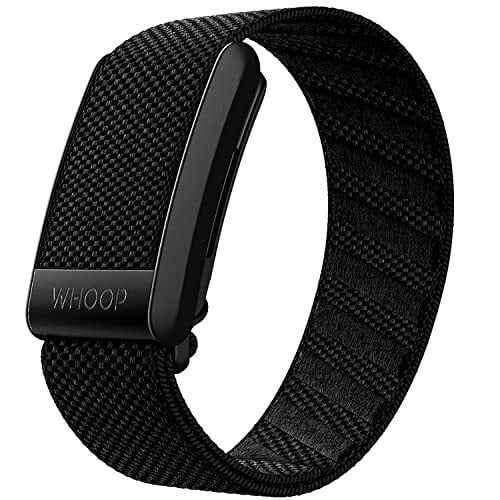
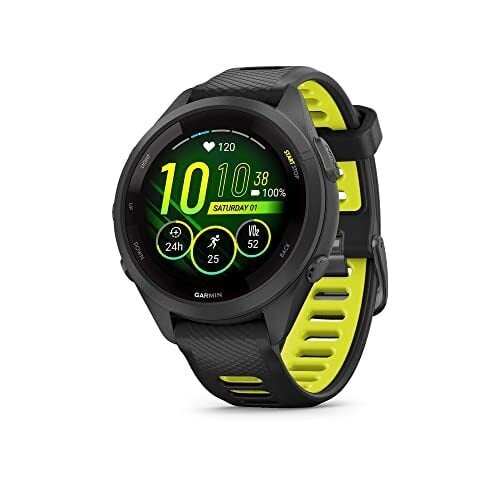
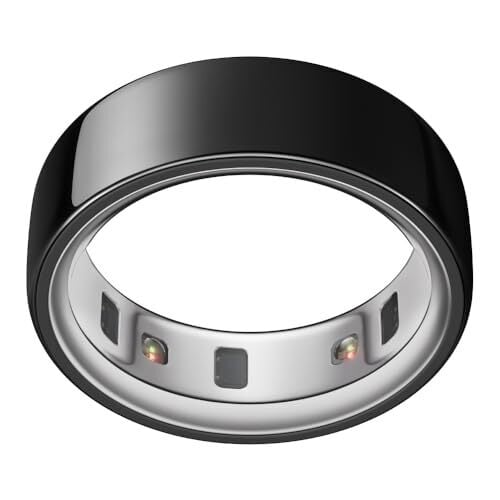
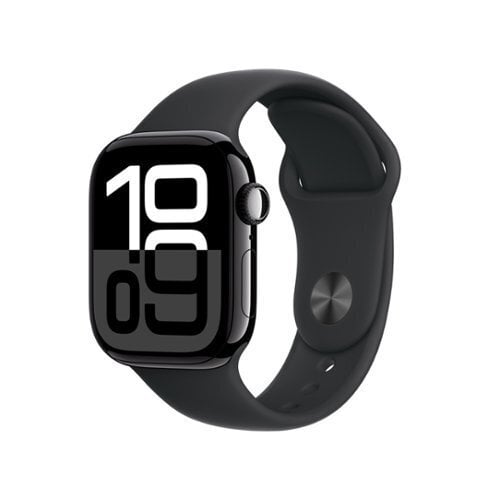
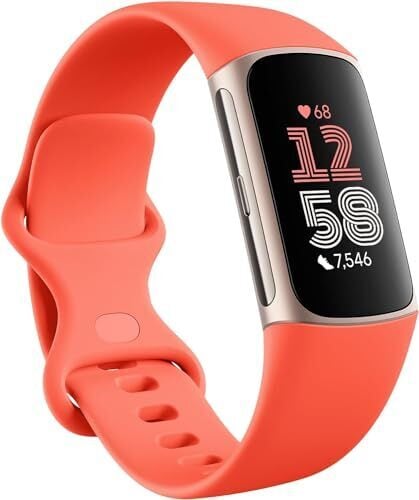
Heart rate variability (HRV) and resting heart rate (RHR) are the metrics that most wearables’ “recovery” numbers are based on. I wore five devices to bed for two weeks to see how their readings compared. Those devices were an Apple Watch Series 10, a Fitbit Charge 6, a Garmin Forerunner 265S, an Oura Ring 4, and a Whoop 4.0.
Why these five? Well, they’re the major brands that people tend to gravitate toward when they want to track sleep, and for each I chose the best (in my opinion) of each company’s current offerings. I had most of them on hand due to testing them for recent or upcoming reviews. The Apple Watch Series 10 is the one our Associate Tech Editor Michelle Ehrhardt crowned the best Apple Watch for most people. The Charge 6 is Fitbit’s standout no-nonsense fitness tracker (sorry to Fitbit smartwatch lovers, but there are better smartwatches out there.) The fourth-generation Oura ring is the company’s newest and best, and Whoop’s 4.0 strap is the current hardware for its subscription-based recovery and activity tracking service (which beat Oura in our head-to-head comparison). Garmin makes a multitude of watches that can track your sleep, but the one that I tested here is my personal device, a Forerunner 265S—which is, in my opinion, one of the best running watches out there.
As I’ve discussed before, the numbers we get from our smartwatches fall into a few different categories. Many are scores or icons that we can’t really verify with other devices—what does it mean to have a “sleep score” of 87, anyway? Others are measurements, and we can compare those from device to device, since they should all be measuring the same thing. Different devices may use different sensors to pick up the data and different algorithms to process and display it, but we’d expect to see similar numbers from all of the devices tested. Our HRV and resting heart rate numbers fall into this latter category, so let’s see how well the devices match.
Oura Ring 4 – Black – Size 8 – Smart Ring – Size First with Oura Ring 4 Sizing Kit – Sleep Tracking Wearable – Heart Rate – Fitness Tracker – Up to 8 Days of Battery Life
$349.00 at Amazon
$349.00 at Amazon
Apple Watch Series 10 (GPS, 42mm, Black, S/M 130-180mm, Sports Band)
$399.00 at Best Buy
$399.00 at Best Buy
Fitbit Charge 6 Activity Tracker – Heart Rate Monitoring, 7-Day Battery, Google Apps, Maps & Wallet, Comprehensive Health Insights, Sleep & Activity Analysis, S & L Bands, (Coral/Champagne Gold)
$149.00 at Amazon
$179.99 Save $30.99
$149.00 at Amazon
$179.99 Save $30.99
What is HRV, anyway?
HRV, or heart rate variability, is a measure of how steady your heartbeat is. Not how fast or how slow, but how different of a time frame passes between beats. The differences are only measurable with precise equipment, but here’s the basic idea: If your heart goes “beat…beat..beat………..beat….beat..beat…….beat,” you have a high HRV (high variability), and that’s a good thing. On the other hand, if your heart goes “beat….beat….beat…beat…..beat,” that’s a low HRV. We tend to have a low HRV when we’re stressed or fatigued, and a high HRV when we’re either not stressed, or recovering well from our stressors.
This may seem counterintuitive, because most of us think of an ideal heartbeat as being steady and regular, but subtle variations from one beat to another are healthy and normal. Our heart takes its orders on how fast to beat from two different parts of our nervous system (sympathetic and parasympathetic). It’s thought that a high HRV indicates that the two systems are both active—balancing each other out, in a sense.
Your HRV will change from day to day, and that’s where these devices come in. You’ll often see a change in your HRV numbers right after a hard workout or stressful work day, giving you an early heads up about what your body is dealing with. This information, used wisely, can help to guide your choices about how to manage your workout schedule, your stress, and your health-related habits.
What counts as a “good” HRV depends on your own history; it’s not worth comparing yourself to others. (I don’t mean that in a feel-good kind of way, but literally, scientifically: your HRV only makes sense when compared to itself.) Whoop reports that the middle 50% of 20-year-olds have an HRV between about 60 and 105, with numbers declining as we get older. If you’re 60, according to that data set, you’re likely to have HRV numbers somewhere between 30 and 50.
How does HRV differ from resting heart rate (RHR)?
Your resting heart rate is also a number that reflects stress on your body, including fatigue and illness. Unlike HRV, where higher is “better,” a higher resting heart rate means you’re more stressed, and a lower one is a sign that you’re well recovered.
Resting heart rate can also change over time as you become more fit. Athletes tend to have lower RHR numbers, and people who take up an exercise habit often find that their RHR declines a bit over time. (That said, RHR isn’t a direct measure of cardio fitness; there seems to be a significant genetic component as well. Take me as an example: my RHR is always pretty low, even when my cardio fitness is crap. If I’m doing a lot of endurance training, it will drop by two to three points, but no more.)
Most healthy adults have a resting heart rate of between 55 and 85 beats per minute (some sources give 60 to 100 as the typical range). It’s important to note that these numbers usually assume that you’re sitting quietly in a doctor’s office. When you’re asleep in your own bed, your heart rate can dip a bit lower. So it’s normal to see lower numbers on a wearable that records all night than you would see when you go to the doctor.
How to track your HRV and resting heart rate with wearables
Gone are the days when you may have charged your fitness tracker at night; now, fitness-focused wearables are expected to be worn in your sleep to track these nighttime metrics.
During the night, your device monitors your heartbeat. It may sample and average different readings, and each device measures and calculates its numbers slightly differently. (That’s why I didn’t expect much agreement between the devices, but more on that in a minute.) When you wake up, you might be presented with a “readiness” or “recovery” score, but I stand by my position that HRV and RHR are the only numbers really worth paying attention to (aside from time in bed, if you want to monitor your sleep).
This data on your HRV and RHR will be presented to you in the device’s companion app or, in the case of devices with a screen, on the device itself. Often the app or device will tell you how your numbers compare to your usual. What you do with that information is up to you.
How I gathered my data
For this experiment, I wore my five devices to bed every night. That meant:
The Oura ring on my finger (right hand, middle finger)
The Whoop band on my left bicep
The Apple Watch and Fitbit on my left wrist
The Garmin on my right wrist
A pro tip for device testers: when you’re wearing two watches on the same wrist, turn one toward the underside of your wrist. That way, the two watch bodies won’t clack against each other. Also, make sure the buttons are aligned so they aren’t going to bump against their neighbors in the middle of the night.
I entered each day’s resting heart rate and HRV from each device into a spreadsheet. Garmin reports your seven-day rolling average as your HRV “number,” but I used the nightly numbers instead, the better to match the other devices.
When it comes to using this data, I already have a sense of how the numbers compare to my experience. If my HRV is high and my RHR is low, I pretty much always feel good and am ready to take on whatever the day throws at me. If my HRV is low and my RHR is high, I’m either stressed, sick, or maybe didn’t sleep enough; I may or may not do an easier workout that day, but I’ll definitely pay more attention to taking care of myself and getting plenty of sleep going forward. If my RHR and HRV are both high, that tends to mean I’m dealing with a lot of stress or fatigue but am handling it well. For this experiment, I didn’t bother tracking data on how I felt; I already know that the Oura data is good at matching how I feel, so the question was whether the other devices tracked the same trends or not.
The results of my test
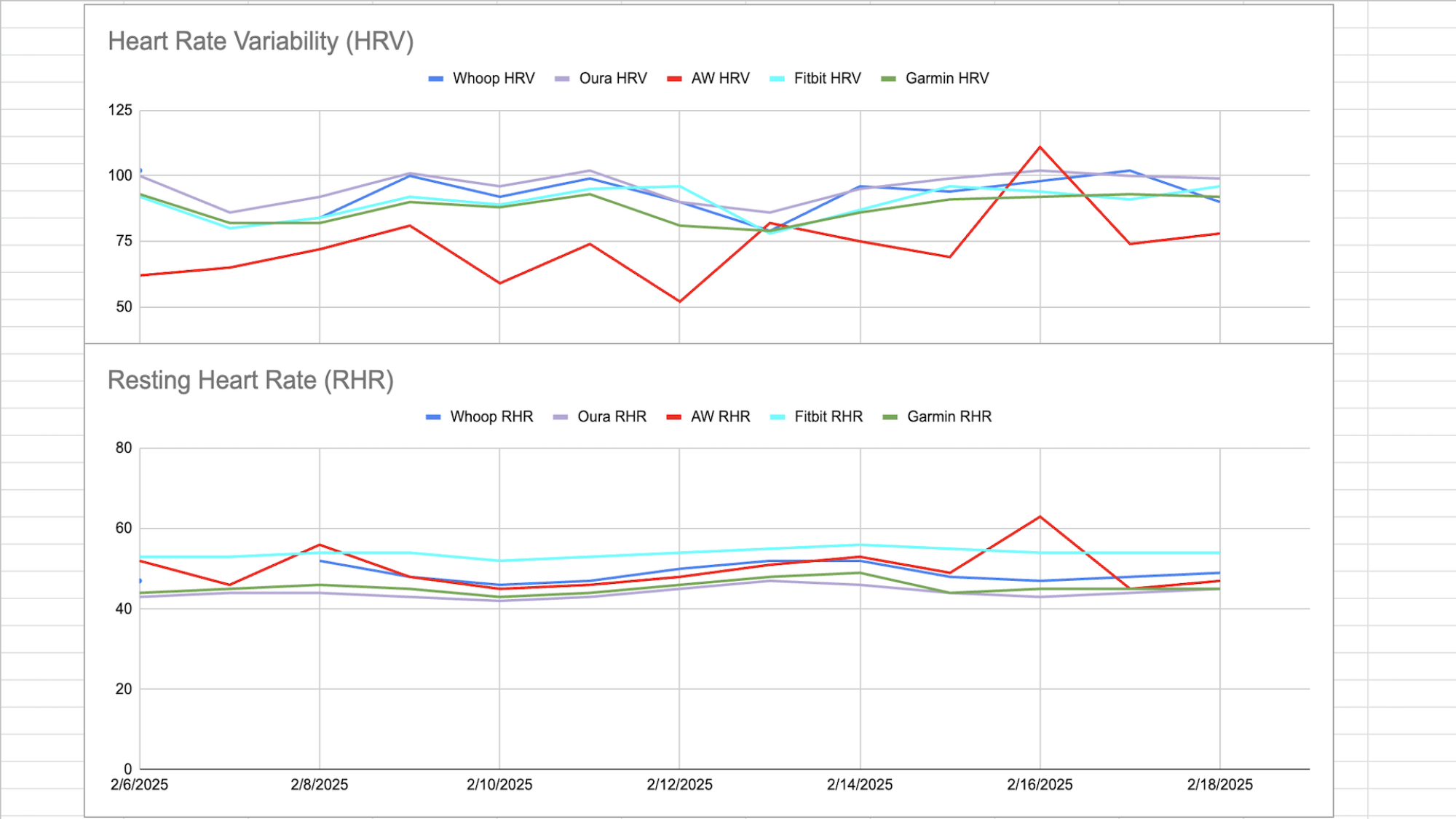
It was fascinating to watch the results take shape as I added more data points to the spreadsheet. The raw numbers were often pretty different: my resting heart rate on a given night might be 65 or 86 depending on which device I’m reading from. But as I logged weeks’ worth of data, the trend lines all told pretty much the same story:
Credit: Beth Skwarecki
For HRV, Oura almost always gives me the highest (“best” looking) readings. Whoop tends to stick pretty close, with Fitbit and Garmin not far behind. The Apple Watch, on the other hand, rides significantly lower on the chart than the other devices, and seems to disagree with their trend sometimes.
For resting heart rate, things are a bit more consistent. Oura usually gives the lowest readings, flattering me again, with the other devices slightly above, and Fitbit giving the highest of the bunch. This is roughly a 10-beat difference for many of the days I charted: for example, 53 from Fitbit and 43 from Oura. It’s hard to say which is right, since I’m not hiring a healthcare professional to stand by and take my pulse throughout the night.
In general, the lines tend to all go up together, and all down together. (Mostly…looking at you, Apple Watch.) I’m happy to see that the devices aren’t reporting drastically different readings that look like random numbers; they do all seem to be measuring the same underlying phenomenon even if they don’t all agree on the exact number to label it with.
Personally, when I want to look at my HRV or RHR, I tend to go with the device I’m most familiar with—in this case, the Oura ring. I’ve been wearing it the longest (through three generations of the product) and so I have a sense of whether a reading of 50 is high or low for me. (It’s high for Oura, even though it might be a low number if I saw it on a different device.)
The most important lesson I take from this, myself, is that not only is it useless to compare HRV from person to person, it’s also not helpful to compare it from device to device. Just like the weight labels on the machines at the gym, the numbers give you a way to compare your progress or trends with the same equipment. Switch devices, and all bets are off. So pick a device, stick with it, and you’ll probably get numbers worth paying attention to. What you do with them, of course, is another matter.
While 20th-century heists involved scoping out a location, recruiting a person on the inside and having a daredevil getaway driver waiting outside, the 21st-century version looks more like what Bybit experienced today. A hacker stole nearly $1.5 billion in Ethereum (ETH) and staked Ethereum from one of the exchange’s offline wallets, nabbing the largest cryptocurrency haul ever. One blockchain security expert said it’s likely the all-time biggest heist of any kind, not just crypto.
Bybit CEO Ben Zhou posted on X that the hacker took control of one of the exchange’s cold (offline) wallets, manipulating a planned transfer and sending it to an unknown party. “The signing message was to change the smart contract logic of our ETH cold wallet,” Zhou wrote. He explained that the hacker “took control of the specific ETH cold wallet we signed and transferred all ETH in the cold wallet to this unidentified address.”
Rob Behnke, co-founder and executive chairman of blockchain security company Halborn, toldBloomberg the heist was likely the “largest incident ever, not just crypto.”
The Bybit hack eclipses the previous record crypto thefts, including $620 million taken in 2022 from the Ronin Network and $610 million from Poly Network in 2021. There was also the infamous Mt. Gox hack of 2011, which took 850,000 Bitcoins. That translated to around $450 million in losses at the time. But one asterisk on Bybit’s “biggest ever” title is that the Mt. Gox haul would be worth significantly more today: over $81 billion. It’s hard to imagine what numbers for similar incidents could look like in a decade.
According to Bloomberg, Bybit had around $16.2 billion in assets before the hack, averaging over $36 billion in daily trading. Friday’s theft accounted for around nine percent of its total assets. As news of the heist spread, Ether dropped as much as 6.7 percent from its high of the day. Bitcoin also shaved about three percent off its high on Friday.
In what sounds like the ultimate embodiment of the “This is fine” meme, Zhou capped his X post by reassuring customers that everything is okie-dokie at Bybit. “Please rest assured that all other cold wallets are secure,” he posted. “All withdraws are NORMAL.” (Normal in all caps is most definitely a sign that things are peachy.)
To be fair, Zhou said Bybit had already secured around 80 percent of the funding needed to cover the loss through partner bridge loans. So, perhaps the Dubai-based exchange will recover from the incident better than one would imagine. “Your money is safe, and our withdrawals are still open,” he added on a livestream.
On the other hand, Bybit’s X account posted a request for help. After stating that its security team and blockchain forensic experts were on the case, it added, “Any teams with expertise in blockchain analytics and fund recovery who can assist in tracing these assets are welcome to collaborate with us.”
This article originally appeared on Engadget at https://www.engadget.com/cybersecurity/bybit-hacked-for-almost-15-billion-in-the-biggest-crypto-theft-ever-212248349.html?src=rss
Obsidian Entertainment’s Avowed is a wonderful single-player RPG featuring large fantasy zones to explore and chatty companions. But that wasn’t always the plan. In fact, it was originally designed as an online game similar to Destiny.
On Wednesday, Clone Robotics released video footage of its Protoclone humanoid robot, a full-body machine that uses synthetic muscles to create unsettlingly human-like movements. In the video, the robot hangs suspended from the ceiling as its limbs twitch and kick, marking what the company claims is a step toward its goal of creating household-helper robots.
Atherton, California-based Clone Robotics designed the Protoclone with a polymer skeleton that replicates 206 human bones. The company built the robot with the hopes that it will one day be able to operate human tools and perform tasks like doing laundry, washing dishes, and preparing basic meals.
The Protoclone reportedly contains over 1,000 artificial muscles built with the company’s “Myofiber” technology, which builds on the McKibbin pneumatic muscle concept. These muscles work through mesh tubes containing balloons that contract when filled with hydraulic fluid, mimicking human muscle function. A 500-watt electric pump serves as the robot’s “heart,” pushing fluid at 40 standard liters per minute.
The legal battle between authors and Meta over copyright infringement continues. Following the plaintiffs’ (Sarah Silverman, Richard Kadrey, Christopher Golden, et al., ) amended claim last month, Meta filed a reply on Tuesday, denying allegations of seeding (continuing to host files available on your systems so that other users can download
Long-time Sega producer Toshihiro Nagoshi left the Sonic publisher in 2021 to form a new studio under Chinese gaming giant NetEase. After establishing the Yakuza/Like a Dragon series as one of the best action-RPG sandboxes around, he had the chance to start up a new team to work on a new franchise. Fans have been…
Marvel Rivals has been a huge hit for NetEase. The Chinese publisher recently reported the free-to-play hero shooter had over 40 million players. But the Overwatch clone was almost canceled over the licensing fees the company would owe to Disney for using its popular comic book characters.
PC- and accessory-maker Asus has never been one to shy away from a strange idea, whether it’s a tablet that you need to slide your smartphone into before you can use it, a laptop touchpad that’s also a screen, or going with “Rock Solid, Heart Touching” as a corporate slogan. But an announcement the company made today stands out: Asus is launching something called the Asus Fragrance Mouse, a fairly regular-looking wireless mouse that also smells.
Yes, the main differentiating feature of the Fragrance Mouse is a “refillable vial” in its underside, next to the place where you put the battery and store its 2.4 GHz USB wireless receiver when not in use. The vial stores “aromatic oils” that “can be washed and refilled with different scents.” Asus doesn’t make any specific recommendations about the scents that you can put in the vial, so you have a lot of latitude as to what, exactly, you can make your mouse smell like.
Aside from the customizable stink, the Fragrance Mouse is a reasonably full-featured functional PC accessory. It supports Bluetooth as well as the USB wireless dongle, three DPI levels (1,200, 1,600, and 2,400) for customizing responsiveness, and understated white and pink color options. Asus says the mouse’s switches are rated for 10 million clicks, ensuring that you will be able to smell your mouse for years to come.
On May 16, 2024, a powerful derecho swept through Houston, killing seven people and causing significant damage to several of the city’s towering skyscrapers. Those buildings were constructed to withstand much stronger hurricane-force winds up to 67 meters per second, as one would get with a Category 4 hurricane. The derecho’s winds peaked at 40 meters per second, well below that threshold. And when Hurricane Beryl hit Houston that July with roughly comparable wind speeds of 36 meters per second, the damage wasn’t nearly so severe. Why would that be the case?
Engineers at Florida International University (FIU) in Miami think they’ve found the answer, according to a new paper published in the journal Frontiers in Built Environment. “We show that a type of highly localized strong winds called ‘downbursts,’ which were generated during the May derecho, can significantly impact tall buildings and facades due to their unique characteristics in comparison to hurricanes,” said co-author Amal Elawady. This is particularly the case for skyscrapers that are close together, creating a “wind-channeling” interference effect that increases pressure on walls and windows.
One might assume that hurricanes and derechos are similar in that they both produce markedly intense winds, but the origin and characteristics of those winds are very different, per the authors. Hurricanes are vast tropical storms that form over warm ocean waters and affect large areas, usually lasting for several days, accompanied by heavy rains, storm surges, waves, and yes, high winds. By contrast, derechos and downbursts are much more localized convective systems, producing hurricane-force winds but over a much smaller area and shorter period of time.