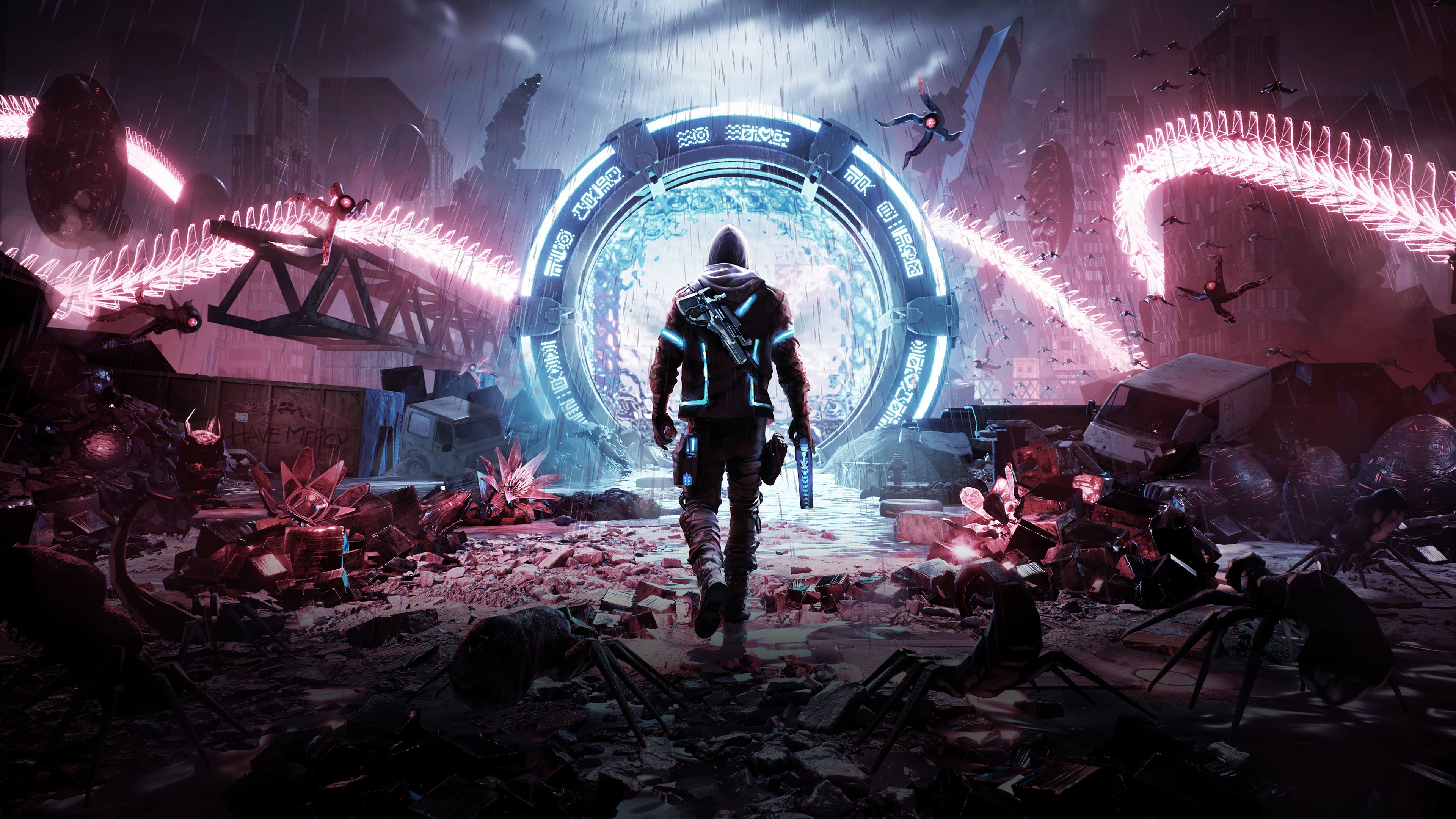
A small indie studio is taking a bold swing at the story-driven VR shooter genre spearheaded by Half-Life: Alyx.
The post With this VR sci-fi shooter, Half-Life: Alyx gets an indie rival on Playstation VR 2 appeared first on MIXED Reality News.

A small indie studio is taking a bold swing at the story-driven VR shooter genre spearheaded by Half-Life: Alyx.
The post With this VR sci-fi shooter, Half-Life: Alyx gets an indie rival on Playstation VR 2 appeared first on MIXED Reality News.
If you know you want an Apple Watch, but aren’t sure which one to get, this guide is here to explain the differences between the three models. The company’s flagship Apple Watch Series 10 has robust fitness tracking and health monitoring, as well as helpful iPhone integrations. We named it the best smartwatch overall. The Apple Watch Ultra 2 packs a few extra features and is geared towards serious athletes and outdoor adventurers — and it’s also the most expensive. The oldest model of the bunch is the budget Apple Watch SE from 2022, which you can often find on sale for under $200. It gives you a surprising number of features for the price. Check out the buying advice below to get the full story on the chips, sensors, features, battery life and price to help you pick the best Apple Watch for your wrist.
The new Apple Watch Series 10 has an S10 SiP (system in a package) chip with a four-core Neural Engine. The Ultra 2 was updated last September with Apple’s S9 SiP. Both chips allow for on-device processing of Siri requests as well as dictation, translation, automatic workout detection and the Double Tap gesture that lets you answer calls or stop an alarm by tapping your thumb and forefinger together twice. It also enables faster machine learning performance for interpreting sensor data, speech recognition and performing other “thinking” tasks. The Apple Watch SE still relies on the S8 SiP, which was also used in the Series 8 and the original Ultra.
Both the Series 10 and Ultra 2 can measure certain vital signs like heart rate, as well as take an ECG. Temperature sensors can help track ovulation, while underwater temperature sensors may come in handy while swimming and snorkeling. Both also support fall-detection and crash-detection as a safety feature. All three models have a compass and altimeter. The Apple Watch Ultra 2 has an onboard SOS siren, as well as dive features like a depth gauge. Water features were added to the Apple Watch Series 10, but with a shallower depth rating (just six meters, as compared to 40 meters on the Ultra). The Ultra includes blood oxygen sensors, but a patent dispute has forced Apple to disable that health feature on new models sold in the US and the hardware isn’t present in the new flagship model.
All three models support near field communication (NFC), the chip that enables Apple Pay. Once you set it up using the Apple Watch app on your iPhone, you can pay for stuff at any store that accepts Apple Pay, even if you don’t have your phone with you.
The wide-angle OLED display on the Apple Watch 10 lets you see the always-on display from more angles. The Ultra 2 also has an always-on display, but you’ll have to lift your wrist to tell time or read notifications on the SE. The SE can reach a maximum brightness of 1,000 nits, the Series 10 can get as bright as 2,000 and the Ultra 2 hits 3,000 nits. Both higher-end screens can dim to a single nit, making them less distracting in the dark.
The Apple Watch Series 10 came with a new finish and case material — a glossy anodized jet black finish on the aluminum model and the option for a titanium case. The Ultra 2 also got a new finish, satin black, that utilizes a PVD (physical vapor deposition) process to apply the color.
As for case sizes, the SE is available in 40 or 44mm. The Series 10 increased in size from the prior generation and now has a choice of a 42 or 46mm case. The Ultra 2 comes in just one size measuring 49mm. You also get the opportunity to pick the length and style for watch bands. The SE and Series 10 come in small/medium or medium/large and the Ultra 2 gives you the choice of small, medium or large.
Battery life
Since it’s the largest wearable, the Apple Watch Ultra 2 sports the biggest battery and can last for a claimed 36 hours on a charge. That number jumps up to 72 hours if you turn on low power mode. Both the Apple Watch 10 and the SE are rated by Apple to go for 18 hours before they need a visit to the charger, and longer when using battery saver mode. That means if you want to use either of those models regularly for sleep tracking, you may need to recharge them a bit before bed.
Believe it or not, all three Apple Watches have similar fitness tracker chops. The Activity app uses three “rings” to keep tabs on how much you’re moving in a day: The Move ring tracks your active calories; the Exercise ring monitors the minutes you’ve spent walking, running, doing yoga and so on; and the Stand ring tells you how many hours in a day you’ve stood up and moved around for at least one minute.
Different internal sensors detect those activities, for example the accelerometer senses when you’re moving versus sitting still, and the optical heart rate sensor judges how hard you’re working out and how many calories you’ve burned. You can set your goals for each ring and you’ll earn badges and animations when you hit them.
The Workout app lets you start and track an exercise session. The sensors can even auto-detect when you’re working out, tapping your wrist to suggest you track the activity. Apple Watches will integrate with Apple’s Fitness+ subscription, displaying real time heart rate and calorie burn data on your iPhone, iPad or even Apple TV 4K as you take a class. Fitness+ also includes audio-guided walks and runs with just your watch and Bluetooth earbuds. All three models support the Activity and Workout apps for free. The Fitness+ app also works with all Apple Watches, but costs $10 per month.
New features enabled with watchOS 11 include Training Load that gauges your body’s response to workouts over time, which could help athletes better prepare for events like marathons. Users can also now skip a day (or more) from fitness tracking metrics when they need to rest or aren’t feeling up to the challenge of closing their rings. The new OS also supports offline maps, which could prove useful when hiking far from cellular coverage.
You can get the weather, start a workout, identify a song and dictate a text just by asking Siri. All Apple Watch models support the Raise to Speak feature that bypasses the need to say “Hey Siri” and will instead listen for your request when you lift your wrist near your mouth.
Both the Series 10 and the Ultra 2 utilize onboard processing of Siri requests. That means executing simple requests like starting workouts and timers are quicker, as they won’t need to access external networks. However, requests like sending texts or getting weather forecasts still need to communicate with Wi-Fi or cellular, so you’ll need to have your phone nearby if you have a GPS-only model.
The Apple Watch Series 9 with the aluminum case was the company’s first carbon neutral product. Apple defines its carbon neutral products as those that use “100 percent clean electricity for manufacturing and product use, 30 percent recycled or renewable material by weight and 50 percent of shipping without the use of air transportation.” Combined, Apple says those changes reduced the emissions by around 75 percent, and the company will use credits so make up for the remaining emissions.
Currently, the Apple Watch Series 10 in either aluminum or titanium with the sport loop band, braided solo loop or Milanese loop, and the Apple Watch Ultra 2 with the trail loop or alpine loop bands are designated as carbon neutral products.
There’s a $550 difference between the cheapest and most expensive Apple Watches. For $250 (and often on sale for less), you can get the 40mm Apple Watch SE with GPS-only connectivity; adding cellular connectivity ups the price by $50. The Apple Watch Series 10 starts at $399 for the 42mm, non-cellular model in aluminum and goes as high as $749 for the 46mm titanium case (which is only available with GPS and cellular). The Apple Watch Ultra 2 has just one price: $799 for a titanium 49mm case with both GPS and cellular power.
Engadget has been reviewing Apple Watches since the first one came out in 2015. Since then, we’ve tested every subsequent model Apple has released, including the Ultra and SE models, spending at least a few days or even a couple weeks with one strapped to our wrists. During that time, we run, hit the gym, go on hikes and wear it while sleeping, all the while gauging how it tracks various metrics, integrates with the iPhone and performs every other trick Apple claims its smartwatches can do.
Since we also review smartwatches from other companies, such as Samsung and Google, our editors can compare Apple Watches not just to previous generations, but also to other wearables on the market. Our buying guides and recommendations rely on first-hand testing by Engadget staff.
This article originally appeared on Engadget at https://www.engadget.com/wearables/best-apple-watch-160005462.html?src=rss

The unofficial VR port of Doom 3 now runs on Pico Neo 3 and Pico 4. Pico 4 Ultra is not officially supported.
The post You can now experience Doom 3 in VR on Pico headsets appeared first on MIXED Reality News.
This conforms to the second part of the Torino scale level 3 description, which states: “Most likely, new telescopic observations will lead to re-assignment to Level 0. Attention by public and by public officials is merited if the encounter is less than a decade away.” “Asteroid 2024 YR4 has now been reassigned to Torino Scale Level Zero, the level for ‘No Hazard’ as additional tracking of its orbital path has reduced its possibility of intersecting the Earth to below the 1-in-1000 threshold,” Binzel continued. “1-in-1000 is the threshold established for downgrading to Level 0 for any object smaller than 100 meters; YR4 has an estimated size of 164 feet (50 meters).”
[…] While 2024 YR4 poses no threat, it will still have a major scientific impact when it passes Earth in 2028 and again in 2032. On Dec. 17, the asteroid will come to within 5 million miles of Earth. Then, on Dec.22, 2032, 2024 YR4 will pass within just 167,000 miles of our planet. For context, the moon is 238,855 miles away.


Read more of this story at Slashdot.
F.B.I. investigators then went a step further, according to newly released testimony, comparing the DNA profile from the knife sheath with two databases that law enforcement officials are not supposed to tap: GEDmatch and MyHeritage. It was a decision that appears to have violated key parameters of a Justice Department policy that calls for investigators to operate only in DNA databases “that provide explicit notice to their service users and the public that law enforcement may use their service sites.”
It also seems to have produced results: Days after the F.B.I.’s investigative genetic genealogy team began working with the DNA profiles, it landed on someone who had not been on anyone’s radar:Bryan Kohberger, a Ph.D. student in criminology who has now been charged with the murders. The case has shown both the promise and the unregulated power of genetic technology in an era in which millions of people willingly contribute their DNA profiles to recreational databases, often to hunt for relatives. In the past, law enforcement officials would need to find a direct match between DNA at the crime scene and that of a specific suspect. Now, investigators can use consumer DNA data to build family trees that can zero in on a person of interest — within certain policy limits.


Read more of this story at Slashdot.


Read more of this story at Slashdot.
The Danish wellbeing commission was set up by the prime minister, Mette Frederiksen, in 2023 to investigate growing dissatisfaction among children and young people. Its long-awaited report, published on Tuesday, raised the alarm over the digitisation of children and young people’s lives and called for a better balance between digital and analogue life. Among its 35 recommendations was the need for government legislation banning phones from schools and after-school clubs.
The minister for children and education, Mattias Tesfaye, told Politiken: “There is a need to reclaim the school as an educational space, where there is room for reflection and where it is not an extension of the teenage bedroom.” There will be scope for local authorities to make exceptions, including for children with special educational needs, but he said mobile phones and personal tablets “do not belong in school, neither during breaks nor during lessons.” He said the government had started preparing a legislative amendment.


Read more of this story at Slashdot.
Interior Minister Carolina Toha said hospitals, prisons and government buildings were switching on backup generators to keep essential equipment operating. In a press conference, Toha urged the public to stay calm and said officials were racing to put the grid back in operation and restore electric service across the country of some 19 million people. “It’s affecting the entire electrical system of the country,” she said of the breakdown in the 500-kV backbone transmission line. Toha said if all areas didn’t return to normal by sunset the government would take emergency measures to avert a crisis. […]
Videos on social media from all over Chile, a long ribbon of a country stretching 4,300 kilometers (over 2,600 miles) along the southern Pacific coast, showed chaos at intersections with no functioning traffic lights, people having to use their mobile phones as torches in the underground metro and police dispatched to help evacuate office buildings.


Read more of this story at Slashdot.

The prolific writer also worked on Xena, Hercules, Mission: Impossible, and others.
Per the AG’s lawsuit, DoorDash showed a message to customers that said “Dashers will always receive 100 percent of the tip” — a statement that is technically true but does not clarify that “tip” is actually the delivery drivers’ wage. New York argued that disclosures explaining how tips worked were buried in online documents and “customers had no way of knowing that DoorDash was using tips to reduce its own costs.” DoorDash did eventually change its payment model to ensure “earnings will increase by the exact amount a customer tips on every order,” but New York’s case represents drivers finally getting those tips they earned during the period when the company was less transparent about who was actually pocketing that extra cash. Dashers eligible for the settlement will be contacted by the settlement administrator so they can get their piece of the pie that was rightfully theirs in the first place.


Read more of this story at Slashdot.
Microsoft announced that it is making some features available for free in its Copilot AI assistant. Everyone now has unlimited access to Voice and Think Deeper, which is powered by OpenAI’s o1 model.
Copilot got the Voice feature, which allows users to have conversations with the AI assistant, in October 2024. Think Deeper is intended to parse complicated queries, such as assessing the pros and cons of major home purchases, taking cost and long-term value into account.
“We are working hard to scale unlimited access to advanced features to as many people as possible, as quickly as possible,” the blog post noted. Microsoft noted that users could experience delays or interruptions during times of high usage for these newly free Copilot applications. Members of the Copilot Pro subscription will still have preferred access to the company’s latest AI models at those peak usage times, as well as to new features that are still in the experimental stage.
This article originally appeared on Engadget at https://www.engadget.com/ai/microsoft-copilot-offers-voice-and-o1-powered-think-deeper-for-free-232723768.html?src=rss