Four Questions to Ask Yourself When You’re Lifting ‘Heavy’

Lift heavy to build muscle: That’s advice you’ve probably seen in a million places, whether you’re aiming to get stronger, get “toned,” or simply reap the health benefits of putting on a little muscle. But how heavy is “heavy,” and how do you know if your workout qualifies?

There’s no specific number of pounds that will constitute “heavy” for everyone. What’s heavy for a teenage girl picking up a dumbbell for the first time will be a lot less than what’s heavy for a pro strongman. (If you do want to compare your lifts to other people’s, sites like Symmetric Strength can show where you stand—but please consider these comps as just for fun.)

In basic terms, training “heavy” is shorthand for resistance training that is in a low-rep range and gets heavier over time. This is the type of training that delivers the biggest gains in terms of strength and muscle size.

Training heavy is not the only way to build muscle, but it’s an effective one. Here are the questions you should ask yourself when trying to figure out whether you’re training heavy enough.

How many reps are you doing?

Training for strength usually has you doing 1-5 reps in each set. Training for hypertrophy (bigger muscles) is often in the 8-12 range.

The truth is, there isn’t much difference in results between the two methods; getting stronger gives you bigger muscles and getting bigger muscles makes you stronger. I’d say that as long as you’re doing 12 reps or fewer, you’re in an appropriate range to say you are training heavy.

Once you’re doing much more than that—15, 20, 50 reps—you’re training your muscular endurance more than strength. You can build some strength this way, but it’s not what you’re going for when you’re trying to train heavy.

How hard does the set feel?

Let’s say you’re doing squats in sets of eight. That could count as heavy training, but only if you’re loading the squats enough that it’s hard to do all eight of them. For some exercises and some goals, you might be aiming to train “to failure”—literally, going until you can’t do another rep. An example would be if you’re doing eight bicep curls and can’t manage a ninth.

But you can also get close to failure without quite going there. For example, if you’re doing squats, a set of eight might be done at a weight that you could manage for 10 or 11 reps if you really pushed yourself. That still counts as heavy training.

What doesn’t count is if you’re doing eight reps of goblet squats with a light dumbbell because it’s the only dumbbell you have, or because you’re intimidated about going up in weight. Heavy lifting is when you’re doing the appropriate rep range with a weight that is challenging within that range.

Are you increasing the weight over time?

The only way to keep the lift challenging as you get stronger is to keep increasing the weight. This doesn’t mean you need to go heavier every time, but it does mean that you pick up a heavier weight once you’ve gotten a bit stronger.

To use that goblet squat example, maybe squatting with a 20-pound dumbbell was challenging the first time you tried it. But a week or two later, you can probably do the same eight reps with a 25-pound dumbbell. Before long, it may make more sense to do front squats with a barbell, to make it easier to add more weight. OK, now you’re lifting heavy.

But if you kept doing the same sets of eight squats with the same 20-pound dumbbell, you’re not efficiently challenging yourself to build muscle or strength—you’re just doing an exercise that keeps getting easier. That’s still good for you, because it’s still exercise, but it no longer fits the description of lifting heavy.

How long are you resting between sets?

This is where a lot of people go wrong, especially if they’re doing home workouts or are focused on calorie burn. You shouldn’t lift heavy for the calorie burn (or heart rate zones) during the workout; you should lift heavy to build muscle, and save the cardio for another day.

If you’re constantly working to keep your heart rate up, with little to no time to rest between exercises, you aren’t going to be able to train heavy. More likely you’re doing a strength/cardio hybrid such as circuit training. Crossfit “metcon” WODs (workouts of the day) often fall into this category, as do many home workout videos that bill themselves as high-intensity interval training (HIIT). They’re usually not really HIIT, but that’s a rant for another time.

If you aren’t resting, that means you aren’t approaching each set of lifts with fresh, rested muscles. Reducing rest times makes the workouts feel harder, but it also means you’ll be working with less weight. That means these exercises are usually too light fit the definition of working heavy. They might still help you build strength or muscle size, but not nearly as efficiently.

If you take a few minutes’ rest between exercises, then you’re lifting heavy. A typical range would be 2-4 minutes between exercises that work smaller or fewer muscles (like curls or presses) and 3-5 minutes or more between sets of big compound lifts (like squats or deadlifts). With an appropriate rest time, you’ll be able to properly lift heavy.

Wonder Woman Title Scrapped As Warner Bros Closes Multiple Game Studios

Wonder Woman Title Scrapped As Warner Bros Closes Multiple Game Studios
The video game industry continues to face big challenges, with Warner Bros. Games cancelling its planned Wonder Woman game and shuttering several game studios in its portfolio. Despite plenty of popular characters and worlds to draw from, the publisher hasn’t generated the hits it has expected. Its latest big swing, the live multiplayer game Suicide

YouTube Reaches 1 Billion Monthly Podcast Viewers

YouTube has surpassed 1 billion monthly active viewers of podcast content, the video platform announced on Wednesday, cementing its position as the most frequently used podcast service in the United States. The Google-owned platform reported viewers watched over 400 million hours of podcasts monthly on living room devices last year.

Read more of this story at Slashdot.

Alexa Is Getting an AI Upgrade

Are you ready to pay for Amazon Alexa? With the addition of AI to the assistant, Amazon thinks you are.

Announced in a closed-doors meeting with press and business partners today, Amazon’s Alexa+ is bringing AI to the familiar digital assistant, plus a new $20/month price tag. The secret? If you have Prime, you’ll get access to it at no extra charge.

Alexa+ devices

Credit: Amazon

As with standard Alexa, the assistant is built around vocal prompts, but is designed to be more conversational and personalized, and will supposedly be able to act on your behalf and integrate with partner apps including Hulu, Uber, and Xbox.

It also enables new features in Amazon’s own apps, like Prime video or Ring, and should make smart home integration simpler.

Amazon didn’t go over every potential use case at its event, seemingly because there are so many, but a few key ones include:

  • More complex questions: When asking Alexa+ a question, as with other AI, you’ll be able to keep a conversation going without multiple prompts or repeating yourself in each new prompt. For instance, you could tell Alexa that one of your family members is vegetarian, and any recipe suggestions it makes for them for the rest of the conversation will take that into account.

  • Multimodality: Alexa+ is able to use photos as input, or peruse uploaded documents and provide summaries of them.

  • Create new routines by voice: Rather than having to set up new smart home automations through a complicated app, you’ll be able to do them verbally. For example, you could tell Alexa once to remember to turn off the lights when you close the garage door, and it’ll do that from that moment onward.

  • Jump to a specific Prime Video scene: Alexa+ will be able to use details such as scene descriptions or actor names to take you to a specific moment in a specific piece of content within Prime Video. In a press release, Amazon claims that saying something like “what’s that movie where Bradley Cooper sings a duet? Jump to that scene…” will be enough to start it playing.

  • AI-powered Ring: People with Ring subscriptions will be able to ask Alexa+ to summarize saved footage and show you highlights, plus use “Smart Video Search” to find specific moments just by describing them to Alexa, i.e. by saying “When did I last take out the trash bins?”

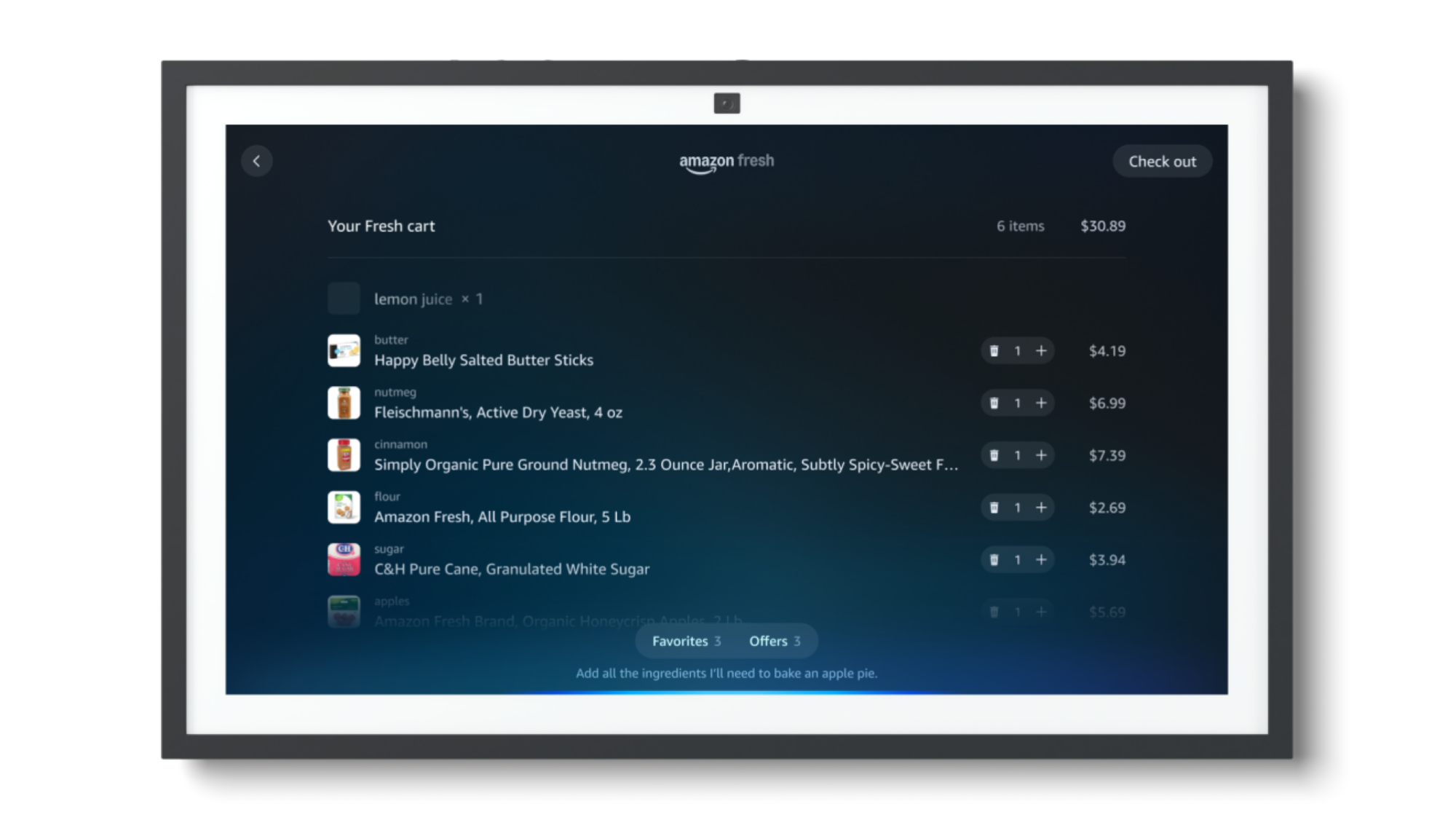
While that’s all set to make Alexa much more powerfuln (assuming it works) it’s also not too different from existing AI solutions. Where Alexa is set to go a step beyond is in taking action, in a way similar to what was promised by the Rabbit R1. Amazon says you could use it to order groceries, find event tickets, set up reservations, or book an Uber, among other things. 

Alexa+ groceries

Credit: Amazon

That’s thanks to those partner integrations mentioned earlier. Supposedly, there are dozens of these partnerships set up and ready to go, including various news outlets like Time or The Washington Post, which should help make the assistant’s answers more accurate. As for actions, while it’s said to be hands-free, it seems like Alexa will ask for confirmation before actually making any final purchases or bookings.

Similarly, Alexa+ is also set to integrate with Amazon Kids+, using AI to converse with kids using facts or interactive games and stories. Amazon promises “extra safety guardrails for younger users,” although details are still light at the moment.

Alexa+ Kids

Credit: Amazon

As is a lot about Alexa+. Amazon is promising transparency and privacy here, accessible via the Alexa Privacy dashboard, and has been surprisingly open about the technology powering Alexa+—it’s a combination of in-house models and Anthropic. But it’ll be a bit before you get to try out the upgraded assistant, with early access set for sometime next month. 

One surprise is that there are no new devices here, with Alexa+ instead being compatible with “almost every” shipped Echo device, although the company says that early access will come first to the Echo Show 8, 10, 15, and 21. Supposedly, the web and a new phone app will also get Alexa+, although it’s unclear when.

Personally, I’ve always been a little skeptical of Alexa and its always-on microphones, and I can’t say Alexa+ is doing anything to move the needle for me. But I also haven’t seen much of it yet. I tend to be a bit more practical-minded when it comes to what I’m willing to use AI for, so we’ll see if Alexa+ can change my mind when I finally get my hands on it—its ability to automatically turn emails into calendar events does seem pretty handy, assuming you’re fine handing that data over to Amazon, and that Amazon makes it easy to do so.

The PS Plus monthly games for March include Dragon Age: The Veilguard

A new month is almost upon us, which means Sony is about to refresh the lineup of games that all PlayStation Plus members can claim and keep in their collection as long as they maintain their subscription. Between March 4 and March 31, you’ll be able to snag Dragon Age: The Veilguard, Sonic Colors: Ultimate and Teenage Mutant Ninja Turtles: The Cowabunga Collection.

Dragon Age: The Veilguard (PS5) is the clear headliner this time around. Fans had to wait a decade between new installments in BioWare’s series, partly because the studio rebooted its work on the latest title several times. Veilguard, an action RPG, is a direct sequel to 2014’s Dragon Age Inquisition. It garnered generally positive reviews and we appreciated the visuals and BioWare’s attention to detail with the game’s characters.

However, Dragon Age: The Veilguard failed to meet BioWare parent EA’s sales expectations. In its first two months, the game brought in 1.5 million players, which is about half of what EA expected in that timeframe. That player count includes those who checked out the game on the EA Play Pro subscription service, so it’s not clear how many copies of the game EA has actually sold so far. That disappointing sales performance is perhaps one reason why Dragon Age: The Veilguard is joining the PS Plus Monthly Games lineup a hair over four months after it was released.

Sonic Colors: Ultimate (PS4) is a remaster of a platformer that was originally released on the Wii back in 2010. As for Teenage Mutant Ninja Turtles: The Cowabunga Collection (PS4 and PS5), that includes 13 classic TMNT games Konami released between 1989 and 1994, such as the all-time great Turtles in Time. The collection has a number of quality of life features, including online and local multiplayer, a rewind option, the ability to save at any point and button remapping. There’s also concept art and “historic TMNT media content.”

Until this trio joins the PS Plus Essential lineup on March 4, you can still snag February’s games. Those are Payday 3, High on Life and Pac-Man World Re-Pac.

This article originally appeared on Engadget at https://www.engadget.com/gaming/playstation/the-ps-plus-monthly-games-for-march-include-dragon-age-the-veilguard-181028013.html?src=rss

US Intelligence Chief Opposes UK Order for Apple Encryption Backdoor

U.S. Director of National Intelligence Tulsi Gabbard has condemned a British order requiring Apple to break its encrypted storage worldwide as an “egregious” violation of American rights that could breach the CLOUD Act facilitating cross-border investigations. In a letter [PDF] to Senator Ron Wyden and Representative Andy Biggs, Gabbard revealed she has directed a legal review of the secret order, which she learned about through media reports.

“This would be a clear and egregious violation of Americans’ privacy and civil liberties, and open up a serious vulnerability for cyber exploitation by adversarial actors,” Gabbard wrote. The UK Home Office, under the Investigatory Powers Act, prohibited Apple from disclosing the order to Congress or U.S. regulators. The directive would have forced Apple to compromise its Advanced Data Protection encryption, enabling officials to access individual data. Apple refused compliance, instead withdrawing the secure storage option from UK customers while maintaining it elsewhere globally. Despite Apple’s pullback, the UK demand for backdoor creation remains. Gabbard pledged to ensure UK actions protect American privacy rights “consistent with the CLOUD Act and other applicable laws.”

Read more of this story at Slashdot.

It’s easier than ever to scrub your personal info from Google Search

As Google’s 2024 antitrust loss proved, the company has worked very, very hard to ensure its search engine is the primary roadmap for the Internet. Google scours the Internet for data about everything—even you. And if you don’t want your personal info to wind up in Google search results, you can use the just-redesigned “Results About You” tool. The tool, which began its rollout in 2022, is easier to use now, and some of the most useful features are now better integrated with search results.

The first step in using Results About You—which has not changed—is a bit alarming when you’ve set out to obscure your personal information. Just head to the new hub for Results About You and enter your personal information. Google probably already knows your phone number, email, and even physical address, but this tells the tool what specific information to pluck out of search results. If that data is out there, Google has it whether or not you remove it from search results.

Before this update, most of the Results About You features were limited to this console, but the most important features are now integrated with the search results. They’re not exactly prominently displayed, though. When scrolling through a Google search (after the AI overview, ads, knowledge graph, and more ads), you can use the three-dot menu next to a result to get data about it. This menu now includes options to remove the result right at the top.

Read full article

Comments

World Record 228 Jump Rope Jumps In 30 Seconds

This is a video of jump roper Cen Xiaolin setting a new world speed record with an astonishing 228 jumps (technically alternate leg skips) in 30 seconds. That’s 7.6 jumps PER SECOND. Cen has been speed jumping for a while, and his record 8 years ago was only 108 jumps, so he’s more than doubled it in that time. How far can he go? My guess is ALL THE WAY. I don’t even know what that means, but I believe in him. Also, it’s safe to say I could never move that fast even if I was on fire, which I often am.

Keep going for the new record, as well as Cen’s previous record from 2016 for reference.

These Home Repairs Aren’t Your Landlord’s Responsibility

We may earn a commission from links on this page.

There are all kinds of laws that govern the rights you have when you’re renting your home, but landlords are also pretty well-protected. You might think that anything that goes on in your apartment is their business (for better or worse), but there are actually quite a few things that simply are not their responsibility. While it’s pretty wild that they technically own your home and can make all kinds of rules about it but don’t actually have to fix certain issues, it’s worth knowing what is and is not their job when it comes to your space.

Outdoor spaces are your responsibility

If you are renting a house or are lucky enough to have scored an apartment with a backyard, be warned: Your lease may stipulate that management of those areas is your responsibility. Read it carefully and ask your landlord if you have any questions, but know that you could be the one who has to clear snow, trim the grass, clean the gutters, remove pests, and more.

Small plumbing issues are also for you to handle

Clogs and other little plumbing issues are rarely your landlord’s responsibility. Unless it’s something really major, you’re probably on your own to get whatever is in that pipe out of it, which you should do because if your issue becomes the building’s issue, you’re likely on the hook for that, too.

I recommend the FlexiSnake Drain Weasel for clogs: It extends 18 inches, has a rotating handle that makes using it easy, and it’s less than $20. Regularly use this to avoid major problems down the line and only call your landlord when something is really, really wrong. For instance, my super stopped by a few months ago to fix my leaky shower—there was a problem with some valve seals that I didn’t cause and couldn’t fix on my own—but my stopped-up sink just a foot away? That’s my problem and mine alone. Speaking of…

Damage you cause is damage you fix

In most cases, if you cause damage, you have to fix it. If your wall develops a hole because of a water leak, that’s the landlord’s responsibility. If it develops a hole because you hung something too heavy, it’s yours.

This can get a little confusing, so this is the category it’s best to discuss with your super regardless. This week, I called mine out of exasperation because I couldn’t get some marks off the higher part of my wall. I assumed they were my fault. Wrong! They were caused by a faulty radiator valve (not my fault) and were actually a sign of a deeper problem inside the wall (also not my fault), which meant the management company did have to dispatch someone to not only tear up my wall, but replace my radiator valve. They did that, but other marks caused by scratches or wall hangings were left untouched; those are my responsibility, since I put them there.

This is not to say you’re on your own completely. Depending on the relationship you have with your super, you can ask to borrow their tools and resources and they might even help you out. It is, after all, in their financial interest to keep it in good condition. I rent a small apartment and certainly don’t have room for things like big tools or ladders, but my super lets me use his when I have to correct something that falls under the umbrella of my responsibility. More often than not, they actually come do it for me, preferring not to let me climb around on a ladder they own. Smart!

Cosmetic repairs are your responsibility

In that same vein, your landlord is likely not legally required to make repairs in your place that are purely cosmetic. If a crack in your bathroom tile is merely unsightly, that’s probably your problem. If a crack in the tub is causing a leak or making it unusable, it’s more likely theirs. What they are legally required to do is keep the building livable, which means you have to be warm and have access to the essentials. That’s it. I know from experience that they have little to no interest in how attractive your unit actually is, as long as it’s not driving the value down or visible from the outside. That said, once again, ask nicely and see if they’re willing to help you out or lend you tools. Just because they aren’t legally required to do something doesn’t always mean they won’t, especially if you can make the case that it will keep the value high.

What to do if you’re unsure

You can assume your landlord doesn’t have to provide you with window screens, air conditioners, lightbulbs, and other things of that nature, but you should always reach out to them if you think there’s a chance. My apartment has a vaulted ceiling, for instance, and like I said, I don’t have a gigantic ladder lying around. My landlord comes in and changes my lightbulb when I need it, which is considerate; I just have to provide the bulb. Read your lease carefully to see what repairs are specifically highlighted as their responsibility and yours and, if you do make requests or ask for clarification, be sure to always do it in writing so you have a record of what is said.

This week, after my wall catastrophe, my building manager gently reminded me that I should always err on the side of asking for help instead of assuming I have to take care of something myself. That’s great advice straight from the horse’s mouth. They might be willing to help you out, but you won’t know unless you ask. Just keep in mind they don’t have to do much beyond fix anything that makes the place unsafe or unlivable.

In addition to reading over your lease, being open with your landlord, and just asking for help on the chance they’ll provide it, familiarize yourself with the renter protections and laws in your specific state. The repairs above are generally accepted as the ones you’re in charge of, but that might not be true where you live. Here is a handy state-by-state list that can help you get started. The more you know about your lease and the laws that apply to your personal situation, the better equipped you are to deal with leaks, holes, and other issues.

This DJI Osmo Action 5 Pro bundle is cheaper than ever

The DJI Osmo Action 5 Pro Adventure Combo bundle is on sale via Amazon for $369. This is 18 percent off and represents a record low price, as the normal cost is $449. The bundle includes the well-regarded Action 5 Pro camera, a trio of rechargeable batteries, a protective frame, a lens cover, an extension rod and more.

We heaped praise on the Osmo Action 5 Pro camera in our official review, calling it “a worthy GoPro rival.” The battery life here is next-level, allowing for over two hours of use when shooting 4K 60p video and four hours when shooting in 1080p. Again, this bundle comes with three batteries, which means twelve full hours of continuous shooting in 1080p. That’s a whole lot of ski jumps or whatever.

There’s also 47GB of internal storage, in addition to a microSD slot. Most action cameras don’t even have internal storage, so this is a much-appreciated upgrade. The Action 5 Pro is lightweight and waterproof down to 66 feet. There’s a waterproof case that extends this limit to 200 feet, but that doesn’t ship with this particular bundle.

As for the actual footage, we found it to be serviceable, but thought the color was slightly oversaturated. The video is also a bit less sharp than what’s produced with rival cameras. Other than these minor nitpicks, however, this is a near-perfect action camera, and those accessories sure sound useful.

The Adventure Combo isn’t the only bundle on sale right now, though it is the best value. The Essential and Standard bundles are also on sale, at $319 and $329 respectively.

Follow @EngadgetDeals on Twitter and subscribe to the Engadget Deals newsletter for the latest tech deals and buying advice.

This article originally appeared on Engadget at https://www.engadget.com/deals/this-dji-osmo-action-5-pro-bundle-is-cheaper-than-ever-175747696.html?src=rss

Max reverses course, won’t charge extra for live sports and news

In an utterly shocking, consumer-friendly move, Max won’t charge for something previously offered for free. Warner Bros. Discovery said on Wednesday that it’s shelving its previously announced plan to charge an extra $10 monthly for sports and news content. Instead, it’s cutting the content from the ad-supported tier next month, which sounds reasonable enough.

In 2023, Max said its Bleacher Report (B/R) Sports Add-On tier would only be free until February 2024, when it would become a $10 add-on for all tiers. But that date came and went (and then went some more) without news of the extra fees. Viewers waited silently like students who hoped their teacher would forget their homework assignment. Then, last September, Bloomberg reported that the $10 fee was still in the works — and could arrive as soon as that month. Uh oh.

But today’s news puts those concerns to rest, at least for paying subscribers. Ad-supported members will lose access to B/R Sports and CNN Max (the news network’s streaming redo) on March 30. Warner says those on that tier who want to retain access to sports and news can visit the Max Help Center for more info. So far, that page says nothing about it, so you’ll probably want to check back closer to the cutoff date.

B/R Sports streams more than 1,700 live games and events annually across leagues like the NBA (although it loses those rights after this season), MLB, NHL, NCAA, NASCAR and more. Meanwhile, CNN Max is Warner CEO David Zaslav’s latest attempt to turn a CNN streaming service into a revenue stream — something the debt-ridden company direly needs. This month alone, it made sweeping cuts to its games division and began offering some of its movies on YouTube.

Although Max subscribers will welcome today’s announcement, there’s reason to question whether the free integration will be permanent. In its press release, where you have to assume words were chosen carefully and pored over by layers of management, Max only said it won’t pursue that path… “for now.”

This article originally appeared on Engadget at https://www.engadget.com/entertainment/streaming/max-reverses-course-wont-charge-extra-for-live-sports-and-news-175010512.html?src=rss

The Oversight Board will weigh in on Meta’s new hate speech policies

Less than two weeks before Donald Trump’s inauguration, Meta announced sweeping changes to its content moderation procedures, reportedly at the behest of Mark Zuckerberg and a small group of advisors. Among those caught off guard was the company’s own Oversight Board, the independent organization created by Meta to help shape its most sensitive policy decisions. The group is now looking to examine those changes, and in doing so, will test the enforceability of its own powers.

The changes Meta has enacted drastically reshape how the company polices content across Facebook, Instagram and Threads. It ended its fact-checking program in the US, and rolled back hate speech rules that protected immigrants and LGBTQ users on its apps. Unlike its previously proactive approach, it also reoriented its content moderation procedures so that many types of rule-breaking posts will only be removed if other users reported them.

The changes have raised questions about the role of the Oversight Board, which was created, Zuckerberg once said, because “Facebook should not make so many important decisions about free expression and safety on our own.” If that’s what Meta is now doing, critics have asked, what exactly is the point of an ostensibly independent Oversight Board?

But the Oversight Board is already working to address Meta’s rewritten “hateful conduct” policy, according to board member Paolo Carozza, who spoke to Engadget. When Zuckerberg announced the changes in early January, the board already had four open cases involving Meta’s hate speech rules. The board now plans to use those cases to examine the new policies, which were rewritten to allow people to use dehumanizing language to describe immigrants and accuse LGBTQ people of being mentally ill.

“We deliberately delayed the decision of those cases after January 7, precisely so that we could go back to Meta again and ask a new round of questions,” Carozza, a law professor at Notre Dame who joined the Oversight Board in 2022, told Engadget. “We’re trying as much as possible to use the tools that we have to find out more information, bring more transparency and more certainty to how it’s going to play out in practice.”

The board, according to Carozza, has already had briefings with Meta as it pushes for more details about the new hate speech policies. But it could still be some time before its findings are made public. The open cases deal with several aspects of Meta’s hate speech rules, including immigration, gender identity, hateful symbols and incitement of violence.

In addition to the questions surrounding each case, Carozza said that the board is also grappling with how to prioritize the case decisions given the renewed importance of the underlying policies. “There are competing concerns about being quick and efficient versus being more thoughtful and deliberative,” he said.

But while the board may hope to provide more transparency about Meta’s decision-making, it’s unclear how much influence the board will ultimately end up having. Under its rules, Meta is only required to comply with the group’s decisions surrounding individual posts. The board’s policy recommendations are non-binding and Meta has a mixed track record at implementing its suggestions.

It’s also unclear how the board might be able to weigh in on Meta’s other changes, like the shuttering of fact-checking programs or shift away from proactive content moderation. “We were quite critical of the fact checking program in general, but our ordinary cases make it a little bit hard to get at that problem because it doesn’t come up through an appeals process within the scope of the kinds of cases that we get,” Carozza says. The board, he notes, could write a policy advisory opinion as it has with rules around COVID-19 misinformation and Meta’s cross-check rules for celebrities. But the board is only empowered to make those kinds of non-binding recommendations at Meta’s request.

That gets at one of the fundamental tensions of the Oversight Board: it may operate independently, but Meta ultimately dictates how much influence it can wield. “It would be unrealistic to expect that the standard for value and success of the board is that Meta, 100% of the time, does everything we ever tell them to do,” Carozza says, “We’re one piece of a complicated jigsaw puzzle of accountability and oversight.”

Still, the fact that the group wasn’t consulted on such major policy moves has raised some uncomfortable questions for the board. Dozens of civil society groups recently signed an open letter urging board members to resign in protest. In a letter to Zuckerberg, some members of Congress said the board “is rendered toothless” when Meta refuses to follow its own principles.

Carozzo acknowledges the Oversight Board’s limitations, but says that the billions of people on Meta’s apps are ultimately better off with the board intervening where it can. “If everybody were to resign en masse … the only people who would lose are Meta’s end users, especially those who are in especially vulnerable situations [and] communities around the world.”

This article originally appeared on Engadget at https://www.engadget.com/social-media/the-oversight-board-will-weigh-in-on-metas-new-hate-speech-policies-174044682.html?src=rss

The 25 Best Oscar-Winning Movies on Netflix Right Now

The Academy Awards ain’t everything. Sometimes the movies that win truly represent the best films of their years; sometimes they reflect a trend or a zeitgeist that winds up looking a little backward after some time has passed; sometimes they’re just completely inexplicable.

But let’s focus on the times the Academy has awarded movies that are actually pretty good, or that at least reflect their eras enough to be interesting. Here are 25 of the best award winners currently streaming on Netflix (keeping in mind that some of the streamer’s buzziest awards contenders—think The Irishman and Maestro—got lots of nominations but no wins).


Barbie (2023)

The pink-drunk optimism of the summer of Barbenheimer feels impossibly distant at this dark point in the. winter of 2025, so why not recapture a little of that magic by revisiting the movie that made feminism palatable to the masses for a little while (at least until it was rudely shoved back under the bed in late 2024). I shouldn’t need to sell you on it: A star-making turn from Margot Robbie as Barbie, a delightfully egoless supporting turn from Ryan Gosling as her Ken, and a message of female empowerment that seemed a little trite until I realized that a lot of people apparently still haven’t absorbed it.

Oscar for: Best Original Song


The Wonderful Story of Henry Sugar (2023)

Audiences and critics had mixed reactions to Wes Anderson’s other 2023 release, the feature-length Asteroid City, but there was little division over this short film, an adaptation of the Roald Dahl story, and it finally earned Anderson his first Oscar—not that he was there to collect it. Benedict Cumberbatch stars as the pseudonymous Henry Sugar, a man who uses his inherited fortune to fund his gambling habit. When he learns of a secret means of winning by seeing through the eyes of others, he comes to perceive more than he, perhaps, bargained for. It’s a cute and sweet, and among one of Anderson’s most visually inventive works (which saying quite a bit). And, at 40 minutes (39, actually), it never has time to wear out its welcome. Ralph Fiennes, Dev Patel, Ben Kingsley, and Richard Ayoade also star.

Oscar for: Best Live Action Short Film


Roma (2018)

Stepping back from the cerebral science-fiction of Children of Men and Gravity, Alfonso Cuarón won his second Best Director Oscar for this semi-autobiographical drama inspired by his own childhood in Mexico City of the 1970s, in the middle of Mexico’s long, violent Dirty War. Yalitza Aparicio plays Cleo Gutiérrez, a Mixtec live-in maid for an upper-middle-class couple with four children whose marriage is slowly disintegrating. When husband Antonio leaves with his mistress, wife Sophia and the pregnant Cleo bond over their unexpected situations. Cuarón is wonderfully adept at creating a sense of time and place, and the performances are indelible. Roma won Best Foreign Language Film, but was also nominated for Best Picture, and it’s a far stronger work than the year’s actual winner, Green Book.

Oscars for: Best Director (Alfonso Cuarón), Best Foreign Language Film (Mexico), Best Cinematography (Alfonso Cuarón)


Marriage Story (2020)

Nominated for six Oscars, Noah Baumbach’s sensitive, devastating story of a crumbling marriage feels like a modern American update of Ingmar Bergman’s Scenes from a Marriage, and earns the right to be mentioned in the same company. As warring couple Nicole and Charlie Barber, Scarlett Johansson and Adam Driver give emotionally raw performances, but the real story is Laura Dern as Nicole’s lawyer Nora Fanshaw; she’s one of our finest actresses, with decades of excellent work, and it was high time she won her first Oscar. Driver and Johansson were also nominated, as was Baumbach for his original screenplay

Oscar for: Best Supporting Actress (Laura Dern)


Guillermo del Toro’s Pinocchio (2022)

More Oscar love for Guillermo del Toro (Pan’s Labyrinth, The Shape of Water). Ho hum. Yet, as in the past, it’s well-deserved. Set in Fascist Italy between the World Wars, this longtime passion project for the director boasts gorgeous stop-motion animation. More importantly, it embraces the darkness inherent in Carlo Collodi’s original fantasy novel—del Toro recognizing that a children’s story need be neither cloying nor condescending, and that kids recognize, as well as anyone, that sometimes the only way to the light is through the dark. The talented, but not distracting voice cast includes Ewan McGregor, Christoph Waltz, Tilda Swinton, and Cate Blanchett.

Oscar for: Best Animated Feature Film


All Quiet on the Western Front (2022)

A second adaptation of the 1929 anti-war novel from Erich Maria Remarque, this version didn’t take home Best Picture nor Best Director as the original 1930 version did, but still, All Quiet wound up being the second-most awarded film on Oscar night 2023, behind Best Picture winner Everything Everywhere All at Once. If it doesn’t have quite the impact of the earlier adaptation, it’s still a powerful film about the futility of war, set amid the trenches of World War I.

Oscars for: Best International Feature (Germany), Best Original Score (Volker Bertelmann), Best Production Design (Christian M. Goldbeck and Ernestine Hipper), Best Cinematography (James Friend)


My Octopus Teacher (2020)

Filmmaker Craig Foster spent a year forming a relationship with a wild common octopus in a South African kelp forest, transferring some of the lessons learned to his relationship with his own son. If Foster could form a bond with such an alien intelligence in its own natural (and naturally dangerous) environment, surely there’s hope for humanity? Maybe?

Oscar for: Best Documentary Feature


Ma Rainey’s Black Bottom (2020)

One sweaty, blues-filled afternoon in the Chicago of 1927, the great Ma Rainey (Viola Davis) shows up at the studio to make a new album. She’s been contracted by white promoters, and she’s fully aware that their deference to her is entirely dependent on her bankability as a singer. Over the course of the session, tensions rise and conflicts erupt, particularly between Ma Rainey and Chadwick Boseman’s Levee Green. Davis earned a Best Actress nomination, and is so good that she’s practically channeling the take-no-shit blues legend, while Chadwick Boseman was seen as a near-lock for a posthumous Best Actor award. Unfortunately, the Academy’s notorious stinginess when it comes to Black acting seems to have won out—there’s been exactly one Black Best Actress winner in 95 years of awards (Halle Berry), and only five Black acting winners overall.

Oscars for: Best Costume Design (Ann Roth), Best Makeup and Hairstyling (Sergio López-Rivera, Mia Neal and Jamika Wilson)


Mad Max: Fury Road (2015)

While the long-awaited prequel/followup Furiosa undeservedly bombed at the box office and with Oscar voters, it in no way tarnishes the reputation of this 2015 action masterpiece. In retrospect, director George Miller’s magnum opus would have been a far better Best Picture pick than the actual winner (when is the last time anyone thought about, let alone watched, The Revenant?), and it’s always a good time to revisit the road rage mayhem alongside Max, Immortan Joe, the War Boys, and, of course, the Doof Warrior himself.

Oscars for: Costume Design (Jenny Beavan), Film Editing (Margaret Sixel), Makeup and Hairstyling (Lesley Vanderwalt, Elka Wardega, and Damian Martin), Production Design (Colin Gibson, Lisa Thompson), Sound Editing (Mark Mangini and David White), Sound Mixing (Chris Jenkins, Gregg Rudloff, and Ben Osmo)


RRR (2022)

It’s wild that RRR wasn’t nominated in more categories, given its epic scope, sharp commentary, and crowd-pleasing style—but taking home India’s first Original Song Oscar was no small feat either, especially given that the competition included numbers from the likes of Rihanna and Lady Gaga. The movie itself is a blockbuster done right, with brilliantly choreographed action sequences and rousing musical numbers buttressing a strong “f*ck colonialism” message. Hopefully Hollywood was taking notes.

Oscars for: Best Original Song (“Naatu Naatu”)


Erin Brockovich (2000)

Julia Roberts finally took home an Academy Award for her irresistible turn as the title character, a feisty small town paralegal who manages to bring a massive corporation to its knees with a lawsuit over toxic pollution. Given the rapid dissolution of government agencies like the Environmental Protection Agency and an increasingly corporate-friendly judiciary, it kinda plays like a beautiful fairytale these days, thanks in no small part to lively direction from Steven Soderbergh (who won the Oscar the same year for directing a different movie altogether—and while Traffic is a good too, spending time with Erin Brockovich is a lot more fun.)

Oscars for: Best Actress (Julia Roberts)


The Power of the Dog (2021)

Like Brokeback Mountain, much of the press around Jane Campion’s film had to do with its queer themes (gay cowboys? what’s next!?), but its power lies in its deliberate, unhurried direction from Campion (a rarity these days), and also in its beautiful cinematography. Benedict Cumberbatch stars as one of two very different brothers, whose tenuous peace is shattered by the arrival of newcomers at their Montana ranch circa 1925.

Oscar for: Best Director (Jane Campion)


Period. End of Sentence. (2018)

The short (around 25 minutes) film follows a group of women in the Indian village of Kathikera, about 50 miles from Delhi, who work to overcome centuries of shame associated with menstruation. Learning that sanitary pads can be made with local materials, local women start a factory to manufacture and sell their own pads, starting a quiet but needed revolution in menstrual health.

Oscar for: Best Documentary Short Subject


The Last Days (1998)

In the last year of World War II and the Holocaust, the Nazis in occupied Hungary accelerated their program of deportation and extermination, even at the cost of war strategy. This documentary follows five survivors—and naturalized American citizens—traveling back to the camps they narrowly escaped.

Oscar for: Best Documentary Feature


The White Helmets (2016)

It’s easy to lose sight of documentaries dealing with war and crisis amid the many of that style that have received Oscar nominations and wins, but there are standouts even in that very particular crowd. The White Helmets documents the story of the Syrian Civil Defense, an all-volunteer group of Syrians who perform search and rescue operations in response to bombings. The real draw of this (relatively) short film is in the interludes with volunteers discussing their everyday lives, before and during the war; those moments make clear the cost of the ongoing conflict. Though seven years old, the Syrian Civil War continues, tragically, as does the work of the SCD.

Oscar for: Best Documentary (Short Subject)


American Factory (2019)

The first film from Barack and Michelle Obama’s production company, Higher Ground Productions, goes and wins an Oscar. The film looks at an abandoned GM plant in Ohio purchased by a Chinese billionaire for his company, glass manufacturer Fuyao. The plant came to employ 2,000 American workers, but the complicated dynamic between the Chinese leadership and working-class American employers quickly points to potentially insurmountable problems. The movie takes a fly-on-the-wall approach, without any narrative beyond what we’re seeing and hearing inside the factory itself; there’s no overriding sense that there are heroes or villains here—just a lot of people trying to figure it all out.

Oscar for: Best Documentary Feature


Apollo 13 (1995)

Ron Howard’s all-star astronaut docudrama is not only a better film than the one that won Best Picture in its year (Braveheart), it’s also a better picture than the one the director took home the Oscar for (A Beautiful Mind). Simultaneously heart-stopping and subdued, the true story of the aborted moon mission generates tension without going overboard on the histrionics.

Oscars for: Best Film Editing (Mike Hill and Daniel Hanley), Best Sound (Rick Dior, Steve Pederson, Scott Millan and David MacMillan)


The Sting (1973)

Very much the kind of movie they don’t make anymore, and not merely because it’s a depression-era period piece. George Roy Hill, who had directed Butch Cassidy and the Sundance Kid just a few years earlier, reunited Paul Newman and Robert Redford in a similarly good-natured caper film. The two play a couple of con men with an elaborate scheme to get revenge on the crime boss who murdered their friend. The period details are as meticulously crafted as the movie’s central scheme, and it’s ultimately an all-time great crowd-pleaser.

Oscars for: Best Picture, Best Director (George Roy Hill), Best Original Screenplay (David S. Ward), Best Art Direction (Henry Bumstead and James W. Payne), Best Costume Design (Edith Head), Best Film Editing (William Reynolds) Best Scoring (Marvin Hamlisch)


Dallas Buyers Club (2013)

While it’s not exactly the best example of trans rep—casting a cis actor as a transwoman, and Jared Leto, no less—a more or less well-intentioned queer story with big name stars, including Matthew McConaughey in an Oscar-winning role, feels like…something anyway, given trans folks have become a major target for hate in the decade since. Set amid the AIDS crisis, this story of a struggling community fighting to survive might even remind you that better times are possible, in theory.

Oscars for: Best Actor (Matthew McConaughey), Best Supporting Actor (Jared Leto)


Godzilla Minus One (2023)

Produced on a shoestring budget (at least by blockbuster terms), the thirty-third installment in the venerable Japanese sci-fi franchise (not counting the Hollywood entries) is both a supremely entertaining kaiju romp and a touching story about the impact of war on those “lucky” enough to survive it. And extra kudos for characterizing Godzilla as basically a giant, angry cat.

Oscar for: Best Visual Effects (Takashi Yamazaki, Kiyoko Shibuya, Masaki Takahashi, and Tatsuji Nojima)


Parasite (2019)

The 2020 Oscars were handed out just weeks before the start of the COVID-19 pandemic, making the Best Picture win for Parasite—South Korean director Bong Joon-ho’s darkly comic story of class warfare and the cruel hand of fate—feel like some kind of demarcation between “Then” (a time when a foreign film speaking truth to power could come out on top in Hollywood) and “Now.”

Oscars for: Best Picture, Best Director (Bong Joon-ho), Best Original Screenplay (Bong Joon-ho), Best International Film


Whiplash (2014)

Miles Teller plays Andrew Neiman, an ambitious and talented jazz musician in his first year at the prestigious Shaffer Conservatory in New York City. He’s come to the school with big dreams, and quickly gets noticed by the conductor of the conservatory’s studio band, Terence Fletcher (a terrifying J. K. Simmons). Fletcher is obsessive and cruel, which only feeds Neiman’s overwhelming desire to succeed.

Oscars for: Best Supporting Actor (J. K. Simmons), Best Film Editing (Tom Cross), Best Sound Mixing (Craig Mann, Ben Wilkins, and Thomas Curley)


Schindler’s List (1993)

Steven Spielberg shed his reputation as a maker of popcorn entertainments with this sobering true-life story of a German factory owner (Liam Neeson) who risked his own safety to protect Jewish workers in his employ during the darkest days of the Holocaust. It’s not exactly an “entertaining” choice, but then again, it’s always good to have something to point to when you need a reminder that, yes, fascism is bad. And Nazis? No good.

Oscars for: Best Picture, Best Director (Steven Spielberg), Best Adapted Screenplay (Steve Zaillian), Best Cinematography (Janusz Kaminski), Best Art Direction (Allan Starski, Ewa Braun), Best Film Editing (Michael Kahn), Best Original Score (John Williams)


Mank (2020)

David Fincher’s film about screenwriter Herman J. Mankiewicz (Gary Oldman) and the development of Citizen Kane is impressively dramatic, and even occasionally harrowing. It also did a bit better at Oscar time than the movie whose making it dramatizes: Kane received nine nominations and one win, while Mank picked up 10 nominations and won two of them.

Oscars for: Best Cinematography (Erik Messerschmidt), Best Production Design (Donald Graham Burt and Jan Pascale)


If Anything Happens I Love You (2020)

The very short (under 15 minutes) film, with a fairly simple animation style, manages to generate more emotion than many films many times its length. The movie follows two parents, grieving the death of their daughter in a school shooting, as they find themselves growing apart in the aftermath.

Oscar for: Best Animated Short Film

Incredible Horror Shooter F.E.A.R. Just $1 As GOG Races To Save Monolith’s Old Games

Following the news that Warner Bros is closing video game developer Monolith Productions, digital storefront GOG has stepped in and announced that one of the studio’s most beloved games, FEAR, will join the store’s preservation program. And it sounds like more Monolith games will also be joining in the near future.

Read more…

A Disney Worker Downloaded an AI Tool. It Led To a Hack That Ruined His Life.

A Disney employee’s download of an AI image generation tool from GitHub led to a massive data breach in July 2024, exposing over 44 million internal Slack messages. The software contained infostealer malware that compromised Matthew Van Andel’s computer [non-paywalled source] for five months, giving hackers access to his 1Password manager.

The attackers used the stolen credentials to access Disney’s corporate systems, publishing sensitive information including customer data, employee passport numbers, and revenue figures from Disney’s theme parks and streaming services. The breach also devastated Van Andel personally. Hackers exposed his Social Security number, financial login details, and even credentials for his home’s Ring cameras. Shortly after the incident, Disney fired Van Andel following a forensic analysis of his work computer, citing misconduct he denies. Security researchers believe the attacker, who identified as part of a Russia-based hacktivist group called Nullbulge, is likely an American individual.

Read more of this story at Slashdot.