The billionaire oligarch accidentally admitted it’s all up to his whims during a cabinet meeting.

The billionaire oligarch accidentally admitted it’s all up to his whims during a cabinet meeting.

$948 million has been spent so far as lawyers try to unravel the scheme.
Don Carson played Walkabout Mini Golf during the pandemic in 2020.
In 2025, he puts on a VR headset in his Oregon home to sketch places he wants people to visit and enjoy from their own homes beginning sometime in 2026.
Carson works as senior art director for a team called Mighty Coconut that’s steadily grown over his relatively brief tenure.
The Coconuts now number in the dozens.
Every seven weeks or so their creative engine releases a new destination priced just under $4. The last was Walkabout’s 31st course, Viva Las Elvis, and we toured the place with its lead artist.
Globally across stores from Meta, Apple, Sony, Valve, and Bytedance, Walkabout players return to the Welcome Shack to find a new course available. According to Mighty Coconut, when players did that for Elvis in January it created the highest day of revenue ever for them, with players buying Elvis and continuing the journey by grabbing a few more courses too.
That it’s unusual enough to be newsworthy for me to mention Martell uses no outside investment to employ these artists says something about the forces shaping the VR market. Here, you’re reading about a company called Mighty Coconut making one of the best paid multiplayer VR games ever conceived, employing dozens of deeply skilled artists who basically only come together in the physical world when it is time to brainstorm new ideas.
I don’t care what measure analysts use to apply the label “unicorn“ to a certain class of endeavor. To me, Walkabout is a VR unicorn if only because you can see in recent courses the continuous steady ripening of a platform. You can feel it looking around at the smoke in the lights of Elvis or when plucking a giant guitar string there.
“We don’t have any specific openings at the moment,” Mighty Coconut’s Job page says, though they do post an email address.
I include that because I know people out there are looking for jobs. You can read Quest To Horizon from my colleague Henry Stockdale. We also have a large body of links reporting on the many layoffs at a large number of studios. Some of them used to employ more people than Martell does for Walkabout.
What I’ve done is invite Carson for an intimate 1:1 voice conversation from his home in Oregon to mine in New York, hosted by my colleague Beck from Canada in the UploadVR Studios.
UploadVR recently received Carson’s “Principles Of Walkabout Mini Golf Course Design” which I published as a guest post, and I streamed our conversation first for UploadVR site members.
There are many insightful things Carson shared over the 45-minute discussion and I encourage you to make time to listen.
 Don Carson

One comment I wanted to pull out for you from Carson:
“Some uninitiated person who sees Walkabout Mini Golf on the surface could easily eye roll at how simple it is what we’re offering. But then they experience it. And especially when they experience it with friends, they’ll say something else is going on here.”
“And my answer is, yes, it is, and it is by design and by listing out these principles, we’re not showing off what we do, we’re saying to other world builders, ‘you can do this too. We give you permission to think about these things as you’re designing and not because it’s a secret, but because these principles thought in this order actually can create really immersive loved gifts to your audience.’”
“Why do I like this so much? Why is this so engaging? Why is this so immersive? It shouldn’t be. It looks like Legos. And yet I’m…being evoked. I’m having emotions. Well, a lot of that is based upon these simple rules and the same tricks and same techniques that have been used successfully in image making, movie making, film making, and ride making.”
“We’re just doing it in VR.”
If you enjoyed my conversation with Carson, you can also find us talking at length with Andrew Eiche, Rafael Brocado, and E McNeill.

Trump has made attacking DEI a key pillar of his new administration.
In a statement, Cellebrite said that “after a review of the allegations brought forth by the December 2024 Amnesty International report, Cellebrite took precise steps to investigate each claim in accordance with our ethics and integrity policies. We found it appropriate to stop the use of our products by the relevant customers at this time.”


Read more of this story at Slashdot.

Supernatural‘s main trio will reunite with creator Eric Kripke on his Prime Video superhero satire.
As a big fan of background music, I was intrigued by iOS 18.4’s Control Center changes. It adds a new tab called Ambient Music to Control Center’s list of customizable controls. You can use this to add one of four pre-selected Apple Music playlists (or your own) to the Control Center, your lock screen, or the Action Button (provided your iPhone has one). Up until now, you could play music via the Now Playing widget in the Control Center, but dedicated controls to launch playlists were missing.
This feature is different from Background Sounds, which lets you play nature sounds on your iPhone in order to help you focus better. Even though Background Sounds is useful for everyone, it was designed as an accessibility feature first, and hence it can be found in your iPhone’s accessibility settings. The new iOS 18.4 Ambient Music feature, meanwhile, is linked to Apple Music. With this feature, you can choose one of four playlists that Apple’s picked out for you, or pick any of your own Apple Music playlists.
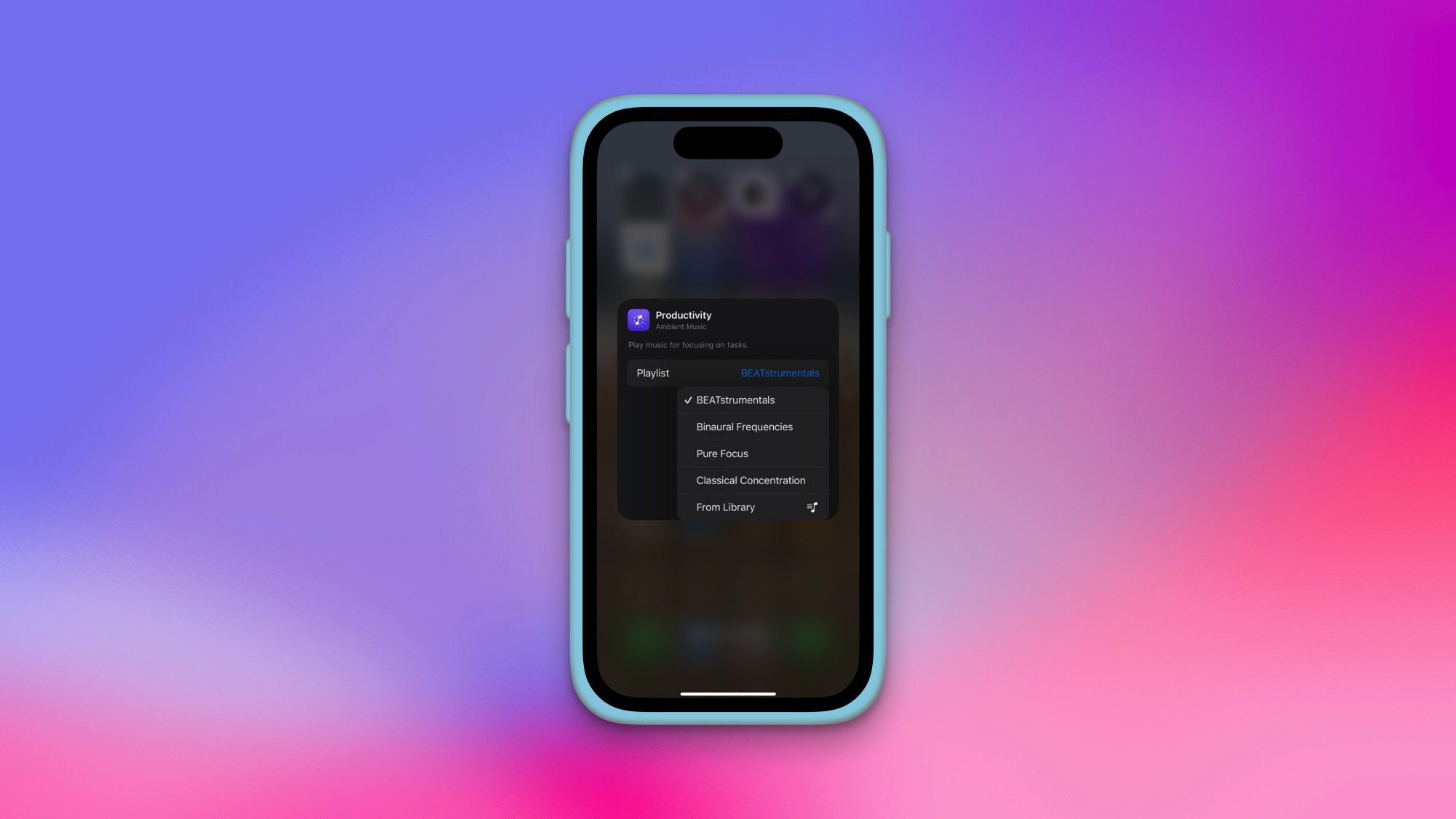
To check out these ambient music playlists, you’re going to have to update to iOS 18.4. At time of writing, that’s in the developer beta stage, which is the buggiest and most unstable of all available Apple OS releases. Be sure to back up your data before you attempt to upgrade, and ensure that you aren’t trying this on your primary iPhone. Crucial apps and services may stop working at any point on beta software, so it’s important to know about the risks.
Once you’ve installed iOS 18.4, you can open the Control Center, tap and hold an empty part of the screen, and hit the Add a Control button near the bottom of the display. Scroll down until you see the Ambient Music tab and select one of the controls. Apple lets you pick one of four moods: Sleep, Chill, Productivity, and Wellbeing. In the Control Center, tap and hold any of these playlists to reveal more options. You can tap From Library to add your own playlists to any of these controls, too.
You can also add these controls to your iPhone’s lock screen. To do that, lock your iPhone and then use Touch ID or Face ID to unlock the device. Tap and hold the lock screen, select Customize, and tap the lock screen on the left. You can now remove either of the two controls in the bottom-left and bottom-right corners, and replace them with your playlists.

124 cases and 18 hospitalizations from measles have been reported in Texas and New Mexico, though the true tally is likely higher.
Warner Bros Discovery recently shut down a trio of game studios, including the well-regarded Monolith Productions. This has put one of the coolest game mechanics of the 2010s in limbo. Middle-earth: Shadow of Mordor’s excellent Nemesis system is locked behind a patent owned by Warner Bros all the way until 2036, according to reporting by Eurogamer.
The Nemesis system was featured in both 2014’s Shadow of Mordor and the follow-up Middle-earth: Shadow of War. Simply put, it’s a gameplay mechanic in which enemies remember previous encounters with the protagonist. These antagonists, typically orcs in the LOTR games, would use these humiliating memories to fuel their thirst for revenge as they rose through the ranks. This mechanic also worked both ways, so enemies would remember besting you in a previous encounter.
It was the best part of those two titles and Monolith had planned on bringing back the mechanic for a now-cancelled Wonder Woman game. Now the system is lying unused, locked behind a patent vault in David Zaslav’s mega-yacht or whatever. Gigantic multinational corporations are awesome!
*Monolith makes the awesome Nemesis system for Shadow of Mordor, everyone loves it*
*WB patents it, making it pretty much impossible for other devs to use it*
*WB shuts down Monolith*
RIP the Nemesis system, I guess! pic.twitter.com/z2KVkT97tV
— Cade Onder (@Cade_Onder) February 25, 2025
Warner Bros Discovery patented the system in 2016, which you can read right here. The patent is active until 2036, so long as the company keeps up with the associated fees. It’s worth noting that in the nine years since patenting the system, it’s only been used in a single game. That’s Shadow of War, which came out in 2017 and was already in development when Warner Bros went ahead with the patent.
It remains to be seen if Warner Bros Discovery will do anything with the Nemesis system. It had nine years of heavy game development to make use of it across its entire IP portfolio, but didn’t. In that time period, plenty of Batman games and Hogwarts Legacy all came out. Those would have surely benefited from the unique mechanic. Oh well.
WB will still focus some resources on game development, but the company’s efforts will be primarily spent on four franchises. These include Harry Potter, Mortal Kombat, the DC universe and Game of Thrones. Three of those four seem like good fits for the Nemesis system to me.
This article originally appeared on Engadget at https://www.engadget.com/gaming/shadow-of-mordors-innovative-nemesis-system-is-locked-behind-a-patent-until-2036-195437208.html?src=rss
The price of bitcoin hit a record high of $109,114.88 during intraday trading on January 20, the day of President Trump’s inauguration, but has plummeted since and went as low as $83,741.94 during today’s trading.
That’s a 23.3 percent drop from the intraday record to today’s low, though it was back over $84,000 as of this writing. Bitcoin had been above $100,000 as recently as February 7, and was over $96,000 on Monday this week.
Bitcoin’s drop is part of a wider rout in which over $800 billion of nominal value “has been wiped off global cryptocurrency markets in recent weeks, as the enthusiasm that swept the crypto industry after Donald Trump’s election victory last year ebbs away,” the Financial Times wrote today.

The Nintendo DS’ stylus-based messaging app PictoChat wasn’t the first place I instant-messaged (that would be my friend’s AIM account) but it was absolutely the least overwhelming and most pleasant place it happened. PicoChat, an iMessage app from developer Idrees Hassan that you can download right now, attempts to recapture some of that peer-to-peer messaging magic on your iPhone.
PicoChat looks like a version of PictoChat that’s been squeezed into the lower-third of your iPhone, complete with alphanumeric and emoji keyboards, and controls to change the line weight of your drawings. It wouldn’t be PictoChat without the ability to draw and write with a stylus, so PicoChat also goes the extra mile and displays an onscreen stylus when you doodle with your finger.
Nintendo debuted PictoChat alongside the original Nintendo DS in 2004 as more of a curiosity than a play at messaging dominance. The app required both messengers to connect their handhelds over the same Wi-Fi network, which naturally limited its reach as a communication tool. Still, Nintendo included the software on the DS Lite and the DSi in 2006 and 2009, respectively, and the 3DS’ optional Swapnote app was considered a spiritual successor of sorts when it came out in 2011.
PicoChat can’t fully recreate the small, personal feeling of PictoChat while strapped on top of iMessage, but if you miss the cumbersome, but considered messaging of your DS days, it’s a pretty great hit of nostalgia.
This article originally appeared on Engadget at https://www.engadget.com/apps/the-dream-of-pictochat-on-the-nintendo-ds-lives-on-in-this-imessage-app-194040764.html?src=rss

We may earn a commission from links on this page. Deal pricing and availability subject to change after time of publication.
Samsung has been releasing Fan Edition (FE) smartphones, tablets, and earbuds for those looking for a more budget option compared to their flagship product. The Galaxy Tab S9 tablet has been Samsung’s flagship tablet until the Galaxy Tab S10+ succeeded it last year. But now you can get the more budget-friendly FE version for a record-low price. The Galaxy Tab S9 FE is $297.72 (originally $449.99), a great value considering it comes with a stylus.
The Tab S9 FE is a great budget tablet for anyone looking to get a lot for their money. The best part is that it comes with an S Pen, which by itself retails for $94.99. The Tab S9 FE won’t blow your mind with specs: It’s got a 90Hz refresh rate screen with a 1,440 x 2,304 resolution, it has not an IPS LCD screen instead of AMOLED, and comes with 6GB of RAM and 128GB of storage. But it’s water-resistant with an IP68 rating and includes the Android 13 software; it also includes Samsung DeX, which lets you use your tablet like a laptop (you can get the Dexnor Keyboard Case to attach it to the tablet and pair it with Samsung DeX); and it has the advantage of getting software updates, unlike most tablet competitors. Keep in mind that you can’t connect it to a monitor, however, even with a USB-C video cable.
At the front, you have a 12MP ultrawide camera; in the back, an 8MP. Wifi will be strong with Wi-Fi 6, and the battery life is great, offering you up to 18 hours depending on use (and it’s a USB-C charger). If you’re looking for a reliable tablet that will get software updates for years at a budget price and comes with a stylus, you could do worse than the Galaxy Tab S9 FE.
Meta for Education is now out of beta, offering schools and universities an “end-to-end solution” for adopting VR & mixed reality via Quest headsets.
Meta for Education is built on the Meta Horizon managed solutions (formerly Quest for Business) mass device management software stack, and the company says it enables educators to “access a range of education-specific apps and features”, while letting them “manage multiple Quest devices at once, without the need for each device in a classroom or training environment to be updated and prepared individually”.
The program ran as a beta from November, with over a dozen universities and colleges in the US & UK participating. Now, it’s generally available for any interested school, college, or university.
Under Meta for Education Quest 3 is priced at $630, and Quest 3S at $400 for the 128GB model or $500 for the 256GB model. These prices include two years of Meta Horizon managed services, the core backend for mass device management, which afterwards costs $24/month per headset for Shared Mode.
Unlike for businesses, though, Meta for Education offers the ability to unlock “lifetime” access for $100 per headset. Thus, organizations could buy Quest 3S headsets with “lifetime” access for $500, or Quest 3 for $730.
On the content side, Meta says the program offers “a range of subjects including science, history, and language arts”.
According to Meta, of the 43 schools already using VR & mixed reality, 87% of students reported “feeling more engaged and interested” in their lessons, 85% of teachers found it to be “a valuable tool to enhance their teaching”, and students also experienced a 15% improvement “in their academic performance on multiple-choice assessments”.
If you’re using VR or mixed reality in your classroom, via Meta for Education or a different program, please contact us and let us know how it’s going.
The scramble to sort out a suitable solution began nearly a decade ago, as Netflix rose to prominence. It has only intensified since. “It is more chaotic than it’s ever been,” said George Ivie, the chief executive of the Media Rating Council, a leading industry measurement watchdog. For decades, there was no dispute — Nielsen’s measurement was the only game in town.
But things started to go sideways after the emergence of streaming services like Netflix, Hulu and Amazon Prime Video. Nielsen had no ability — at least at first — to measure how many people clicked play on those apps. The streamers, of course, knew exactly how many people were watching on their own service but they either selectively disclosed some data or did not bother releasing it at all.
Over the past two years, as nearly all the major streaming services have introduced advertising, they have released more data. But the data they release makes apples-to-apples comparisons difficult. Netflix discloses what it calls “hours viewed” and “views” for its shows. Prime Video and Max prefer to describe how many million “viewers” watched a hit of their choosing. The disclosures can be helpful to compare one show with another on the same streaming service. Yet those figures, too, can lead to disagreements.


Read more of this story at Slashdot.

Oh no. A new Sims 4 update went live yesterday, and it seems to have added a very disturbing bug. According to some players online, kids are now walking around with big pregnant bellies in The Sims 4. Yikes.

She starred on the cult-beloved TV series as Buffy’s younger sister Dawn, and was also featured on Gossip Girl and the movie EuroTrip.
Following up on Microsoft’s announcement of a qubit based on completely new physics, Amazon is publishing a paper describing a very different take on quantum computing hardware. The system mixes two different types of qubit hardware to improve the stability of the quantum information they hold. The idea is that one type of qubit is resistant to errors, while the second can be used for implementing an error-correction code that catches the problems that do happen.
While there have been more effective demonstrations of error correction in the past, a number of companies are betting that Amazon’s general approach is the best route to getting logical qubits that are capable of complex algorithms. So, in that sense, it’s an important proof of principle.
The basic idea behind Amazon’s approach is to use one type of qubit to hold data and a second to enable error correction. The data qubit is extremely resistant to one type of error, but prone to a second. Those errors are where the second type of qubit comes in; it’s used to run an error-correction code that’s effective at picking up the problems the data qubits are prone to. Combined, the two are hoped to allow error correction to be handled by far fewer hardware qubits.