
In addition to their ongoing AMDGPU LLVM compiler back-end work for upcoming GFX1250 and recently the GFX13 target for their graphics IP, today AMD compiler engineers introduced a new “GFX1170” target to the LLVM codebase that is also called RDNA 4m…
Category Archives: Linux
“DHEI” Proposed For Linux To Help Cloud-Native Orchestrators & High Frequency Traders
Sent out today as a request for comments is a new patch series for Dynamic Housekeeping and Enhanced Isolation (DHEI). DHEI aims to provide run-time adjustments to kernel behavior around CPU isolation for helping with latency-sensitive tasks. The expressed goal is for helping cloud-native orchestrators and high frequency trading platforms dynamically re-partition CPU resources without downtime…
Latest VirtualBox Code Begins Supporting KVM Backend
As of this week Oracle’s latest VirtualBox development code begins to work with Linux’s native KVM back-end. Support for KVM or other native OS hypervisors in conjunction with VirtualBox has long been sought and it’s finally becoming a reality…
GTK Developers Working On Session Saving Support & Better Accessibility This Year
GTK toolkit developers met in Brussels once again for their annual hackfest during FOSDEM week…
Qualcomm QUPv3 Firmware Upstreamed For Snapdragon X1 Elite Linux Users
One of the headaches right now when dealing with the Snapdragon X Elite on Linux is that for a majority of the devices you need to fetch firmware files from the Windows 11 on ARM partition as the necessary firmware bits for Linux use aren’t upstreamed to linux-firmware.git. That has gradually improved over time from the qcom-firmware-extract making the process easier to more firmware bits eventually being added to linux-firmware.git…
How to evaluate your use of classroom technology with the PICRAT framework
There’s always something new to consider when teaching with technology. From the latest advancements in AI, to new software and hardware updates, it can be difficult to know which tools to use and how to incorporate it effectively into your lessons.
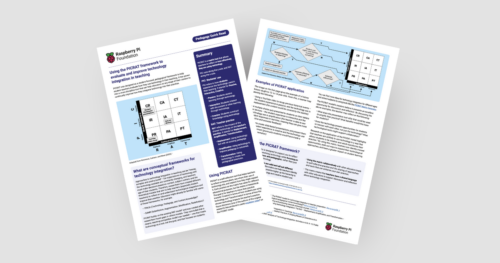
In today’s blog, we explore the PICRAT framework and how it can help you reflect on your use of technology in the classroom.
We also share our new PICRAT Quick Read, which you can download for free to:
- Find practical tips on how to use the PICRAT model when planning your lessons
- Read a summary of the research behind the framework
What is the PICRAT framework?
Technology is constantly changing, and educators must continually decide what tools to use in their practice. To help with this challenge, researchers started developing theoretical models that teachers (especially student teachers) could use to reflect on how they integrate technology in their classrooms.
You might already be familiar with frameworks like TPACK (Technology, Pedagogy, and Content Knowledge) and SAMR (Substitution, Augmentation, Modification, Redefinition). While these models are useful, the PICRAT framework was created to address gaps in these earlier models, offering a clearer, student-focused approach. Significantly, it encourages you to treat technology as a tool to support learning, rather than the goal itself.
It asks two simple questions: “How are students experiencing the technology?” and “How does this impact your practice?”. The answers to these questions form a matrix as pictured below.
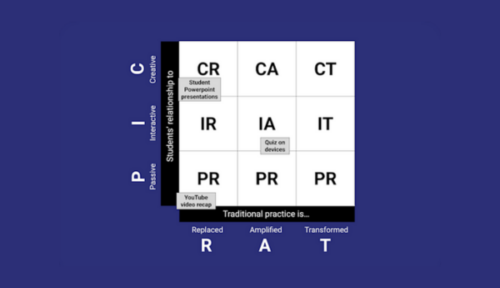
PIC (which runs along the y-axis) refers to the student’s relationship to the technology:
- Passive – Students receive learning through technology
- Interactive – Students interact with the content or other learning through technology
- Creative – Students construct knowledge using technology
RAT (which runs along the x-axis) refers to how the teacher uses the technology:
- Replaces – Using technology but with an existing pedagogy
- Amplifies – Using technology to improve pedagogy or outcomes
- Transforms – Using technology to create new pedagogical practices
How can I apply the PICRAT model?
First choose the lesson you’re planning to deliver. Consider what activities you’ll be running and the technologies involved. You’ll then be able to plot where they sit on the matrix using the PICRAT acronym.
For example, if you are teaching a lesson on Python loops, you might initially plan for students to watch a pre-recorded coding tutorial on their laptops. In this scenario, the student experience is Passive (receiving info via tech), and the teacher’s use is Replacement because the video simply replaces a live lecture. To move up the matrix, you could instead have students use an online IDE to complete a “Parson’s Problem” puzzle where they rearrange blocks of code to fix a loop. This shifts the activity to Interactive and Amplification, as the digital tool provides immediate debugging feedback that a paper-based exercise could not.
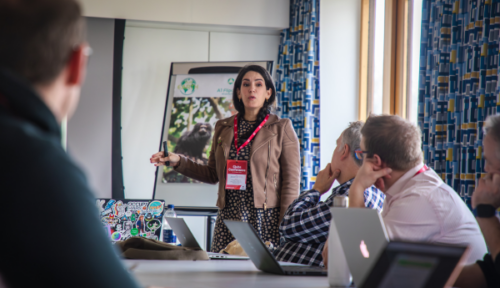
Next, think about how you might move your practice forwards. Although every position on the matrix has its own value, the framework is hierarchical. The overall goal is to try to move your practice towards the top right of the matrix to be Creative and Transformative.
To help you achieve this, take some time to reflect on your current lessons, activities, and the technologies you use. Ask yourself questions like:
- What does the technology I’m using offer that could be used to amplify my practice?
- What benefits would this have for students?
- Does the technology present opportunities for students to interact with each other, not just the technology?
- What other technological tools might support collaboration?
Research highlights that technology is rarely used in ways that allow young people to be creative. By using the PICRAT matrix, teachers can identify missed opportunities and explore ways to transform their lessons, ensuring learners can be creative and thrive.
The benefits of the PICRAT model
Potential benefits for educators:
- The framework encourages meaningful reflections, allowing teachers to easily evaluate how they’re using technology within their lessons
- Reflections and the PICRAT matrix helps teachers to identify missed opportunities and gaps in their practice, ultimately leading to better student experiences
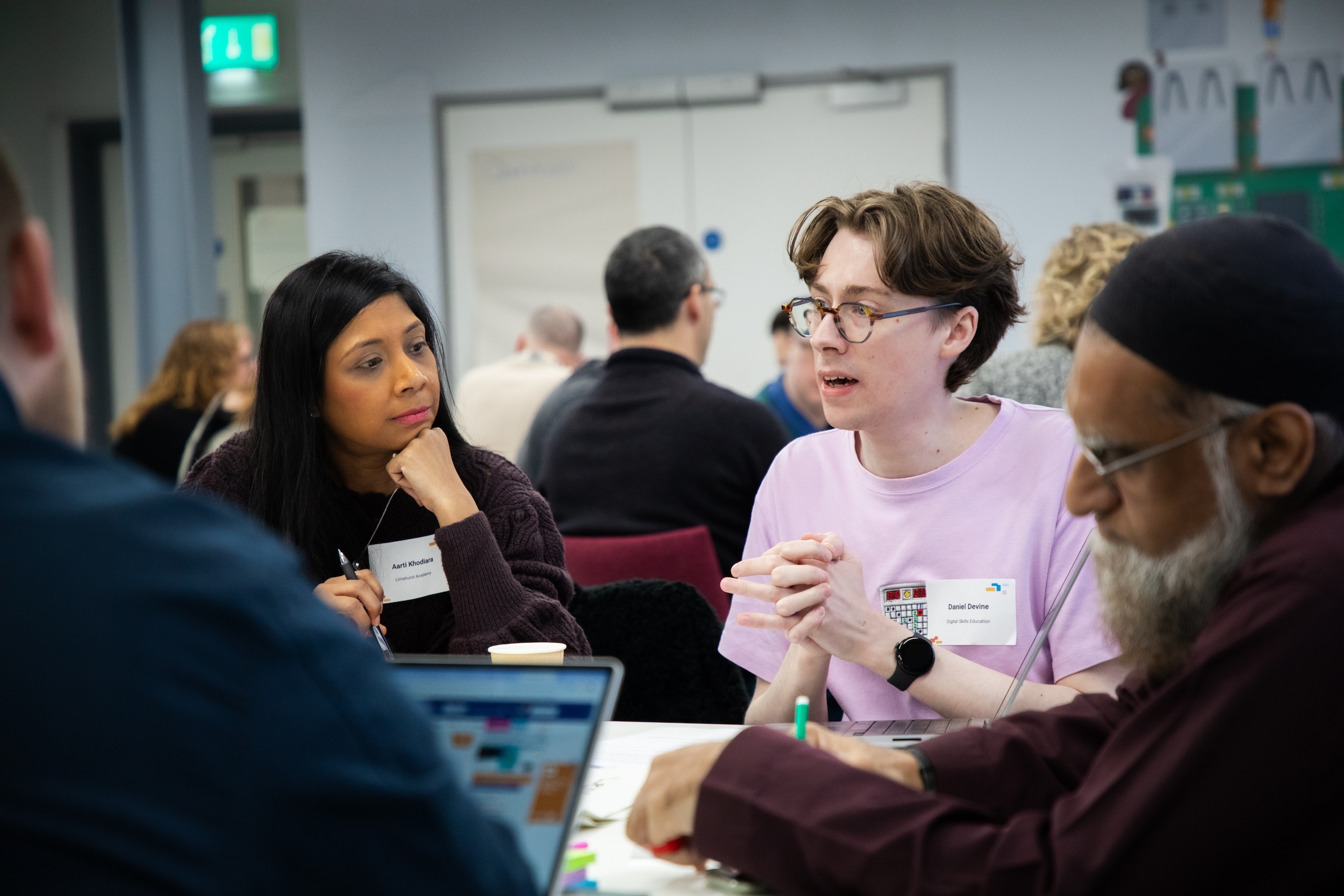
You can use the PICRAT framework as part of your own reflections, or as part of a group activity. It’s a great way to spark discussion about technology integration with colleagues and improve best practices.
Want to find out more about the PICRAT framework?
If you’d like to learn more about the PICRAT model, you can download our Quick Read for free via our new Pedagogy Quick Reads page.
The post How to evaluate your use of classroom technology with the PICRAT framework appeared first on Raspberry Pi Foundation.
GNU/Linux or Just Linux? Between Purism and Everyday Usage
A critical look at the GNU/Linux naming debate and why everyday usage settled on the shorter, simpler term: Linux.
Darktable 5.4.1 Brings Noise Profiles for Canon EOS 10D and Sony ILCE-7CR Cameras
Darktable 5.4.1 has been released today as the latest stable version in the Darktable 5.4 series of this open-source, free, and cross-platform RAW image editing software for GNU/Linux, macOS, and Windows systems.
GNU Nettle 4.0 Released With SLH-DSA Support
The GNU Nettle cryptographic library is out with a major new update that introduces support for SLH-DSA, the post-quantum signature scheme selected by NIST for the FIPS 205 standard…
Krita 5.3 and 6.0 Enter Beta With Text and Tooling Overhauls
The first betas of Krita 5.3 and Krita 6.0 are now available, launching a new feature cycle built from a shared Qt5 and Qt6 codebase.
How to Install and Use Yay on Arch Linux and Manjaro
In this article, you will learn how to install Yay on your Arch-based systems, how to use it (with practical examples), and when not to use it.
Ardour 9.0 Audio Workstation Released With Multi-Touch GUI, Many New Features
Ardour 9.0 is out today as the latest major feature release to this leading open-source digital audio workstation (DAW) software for musicians, recording engineers, and other audio editing needs…
Intel Xe Linux Driver Will No Longer Block D3cold For All Battlemage GPUs
Merged a year ago to the Linux kernel’s Xe graphics driver was a change to disable D3Cold across all Battlemage GPUs. This was done due instability issues around the D3cold to D0 power state transition. Finally with the upcoming Linux 7.0 kernel cycle that restriction is being loosened with restoring D3cold support with Battlemage GPUs aside from a specific NUC…
Microsoft’s New Open-Source Project: LiteBox As A Rust-Based Sandboxing Library OS
Microsoft engineers and other stakeholders have been developing LiteBox as a security-focused library OS written in the Rust programming language and leveraging Linux Virtualization Based Security “LVBS”. The design is for LiteBox to operate as a secure kernel protecting the normal guest kernel via virtualization hardware…
Debian’s CI Data No Longer Publicly Browseable Due To LLM Scrapers / Bot Traffic
LLM scrapers for AI are even hungry for Debian’s continuous integration “CI” data. Due to the ongoing abuse of the open web by LLM scrapers, the Debian CI infrastructure is restricting the publicly accessible data with their web server resources being hammered by bots/scrapers…
CentOS is coming to RISC-V soon if you have the kit
The RHELatives are more versatile than you might realizeFOSDEM 2026 CentOS Connect 2026 took place in Brussels last week, over the two days preceding the sprawling FOSDEM festival of FOSS – the nerd world’s Glastonbury, complete with the queues and the questionable hygiene.…
Tech Savvy Meets Principles in Emmabuntüs Debian 6
Helping those in need while saving old PCs from landfills is no easy task, but this Debian 12 spin paves the way.
The post Tech Savvy Meets Principles in Emmabuntüs Debian 6 appeared first on FOSS Force.
[$] Modernizing swapping: the end of the swap map
The first installment in this series
introduced several data structures in the kernel’s swap subsystem and
described work to replace some of those with a new “swap table” structure.
The work did not stop there, though; there is more modernization of the
swap subsystem queued for an upcoming development cycle, and even more for
multiple kernel releases after that. Once that work is done, the swap
subsystem will be both simpler and faster than it is now.
introduced several data structures in the kernel’s swap subsystem and
described work to replace some of those with a new “swap table” structure.
The work did not stop there, though; there is more modernization of the
swap subsystem queued for an upcoming development cycle, and even more for
multiple kernel releases after that. Once that work is done, the swap
subsystem will be both simpler and faster than it is now.
Intel Arc B390 Graphics Performance On Linux With Panther Lake
Yesterday was our first look at the Intel Panther Lake Linux performance with the Core Ultra X7 358H and focused on the CPU performance. In today’s benchmarking is a look at the very exciting Xe3 graphics found with the top-tier Panther Lake models: the Arc B390 Graphics with 12 Xe cores.
TrueNAS 26 Looks Toward OpenZFS 2.4, Linux 6.18 LTS & LXC Container Support
Following the release of TrueNAS 25.10 for this Linux-based, OpenZFS-running operating system focused on network appliances / storage devices, iX systems has shared some of their plans for TrueNAS 26 this year…