Debian Developer Thomas Lange has written a blog post
in the attempt to help users find the right Debian image for their
systems.
It’s difficult to find the right Debian image. We have thousands of
ISO files and cloud images and we support multiple CPU architectures
and several download methods. The directory structure of our main
image server is like a maze, and our web pages for downloading are
also confusing.
VKD3D 1.15 is out today as the newest version of this upstream Wine project for implementing the Microsoft Direct3D 12 APIs atop the Vulkan API for better Windows gaming on Linux and other D3D12 workloads on Linux or macOS when paired with MoltenVK…
The debate over the Linux kernel’s Rust programming language policy continues… While some kernel maintainers are against it, Linus Torvalds has reportedly said he would override maintainers that may be against honoring Rust code. Linux’s second-in-command Greg Kroah-Hartman has also been a big proponent of Rust kernel code. He’s crafted another Linux kernel mailing list post today outlining the benefits of Rust and encouraging new kernel code/drivers to be in Rust rather than C…
To get Nixon, “Deep Throat” advised Woodward and Bernstein to “follow the money.” To “get” this article, written by the latest addition to the FOSS Force team, we suggest that you follow the links. You’ll be glad you did.
One of the most logical paths forward for the Servo web browser engine is making it compelling for embedding within applications as an alternative to the Chromium Embedded Framework (CEF), WebKitGTK, and other browser engines. Servo developers recently realized though it’s around 200 lines of Rust code to embed Servo compared to around 50 lines of C code if targeting WebKitGTK… So improvements are being made to the Servo embedding API…
Code Club is more than just a place to learn coding — it’s a thriving global community where young minds discover, create, and grow with technology. With a refreshed look and ambitious goals for 2025, Code Club is set to connect an even larger network of mentors and reach millions more young people worldwide.
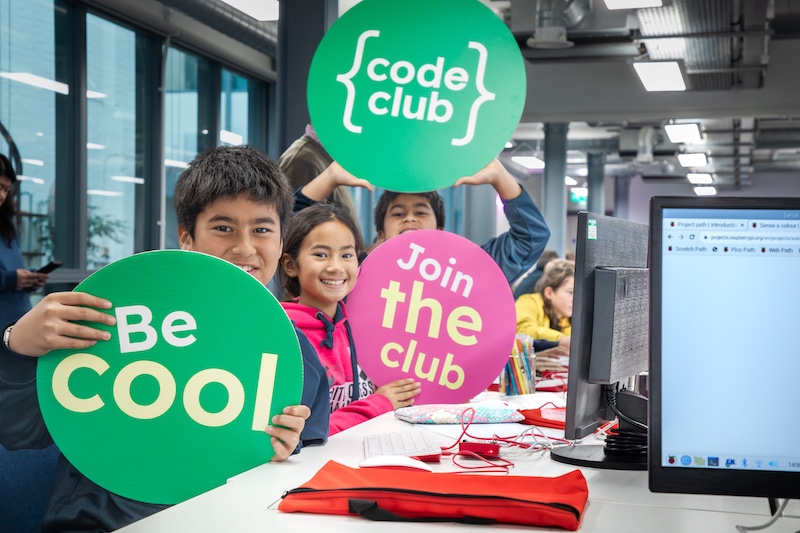
Code Club at RPF HQ, Cambridge
Since it was founded in the UK in 2012, Code Club has grown into a global movement, inspiring over two million young people to build apps, games, animations, websites, and more. Supported by the Raspberry Pi Foundation, Code Club provides free training and resources to mentors, ensuring creators achieve meaningful and lasting skills. Our vision for the next decade? To empower ten million more young people to have confidence in their coding.
A proven impact
A recent independent evaluation by the Durham University Evidence Centre for Education (DECE) confirmed what we’ve always believed: Code Club makes a real difference. Young people who attend gain valuable coding skills, grow in confidence, develop a strong interest in technology, and find a sense of belonging in the digital world.
Mentor Rajan at his Code Club in India
The power of mentorship
At the heart of Code Club are passionate volunteers who bring coding to life. Whether it’s the thrill of overcoming a challenge or the excitement of seeing an idea come to life on screen, mentors make a lasting impact while learning coding skills alongside their club’s creators.
Bob Bilsland, a dedicated volunteer since 2012, runs one of the world’s longest-running Code Clubs at Malvern CofE Primary School, Worcestershire, England. His motivation?
“What brings me back week after week is the sharing of what I enjoy doing. It’s so much fun to help others explore this space themselves, to see what they can personally create. I see that giving others the opportunity to explore and familiarise themselves with computing as something that could open up a world of possibilities for them in the future.”
For Yang, a mentor at the EY office clubs, representation in tech is key:
“If there are some female role models, I think for a little girl growing up, that means so much. Because if they can see somebody thrive in this industry, they will see themselves there one day. And that’s the inspiration.”
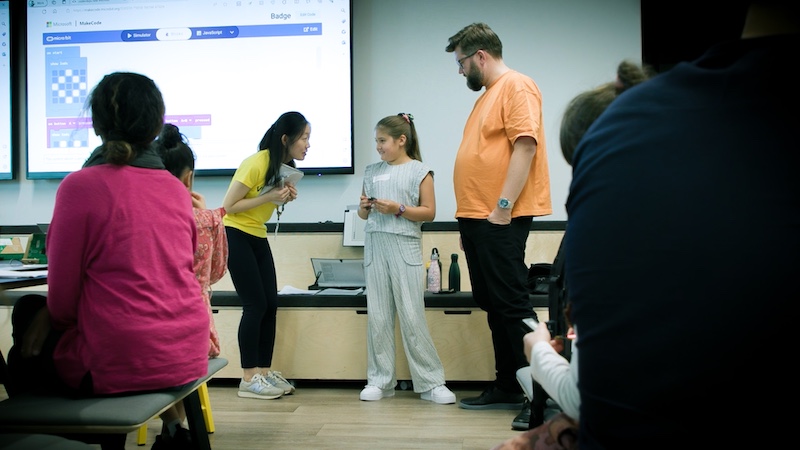
Mentor Yang at her Code Club in London
Across the world, volunteers like Nadia in Iraq and Solomon in The Gambia are using Code Club to bridge the digital divide, create opportunities, and empower communities.
“[Code Club] added to my skills. And at the same time, I was able to share my expertise with the young children and to learn from them as well.” – Nadia Al-Aboody, Iraq.
“We strongly believe in the transformative power of digital skills and their potential to create opportunities for young people. Witnessing the lack of access to computer knowledge among high school graduates in The Gambia and other sub-Saharan African countries inspired us to take action. By bridging the digital skills gap, we aim to empower young individuals to thrive in the 21st century.” – Solomon, Gambia
A community that inspires
Code Club isn’t just loved by mentors; it’s so important to the young people who participate.
Eoghan, a young creator from Ireland, values the collaboration and support he receives:
“It’s really fun to meet and talk about ideas with other creators, and the mentors are very helpful in fixing any coding problems.”
Mentor Jayantika at her Code Club in Pune, India
Jayantika, a 15-year-old from rural Pune, India, started as a creator and is now a peer mentor. For her, Code Club is about giving back:
“I believe coding opens doors and helps young children express their creativity. By mentoring, I hope to prepare them for a future that is increasingly driven by AI and technology.”
Join the movement
Along with the incredible community, Code Club is supported by sponsors and funders who share our mission. We would like to extend a thank you to Cognizant, who have committed their support to the Code Club mission in the UK and Ireland for 2025.
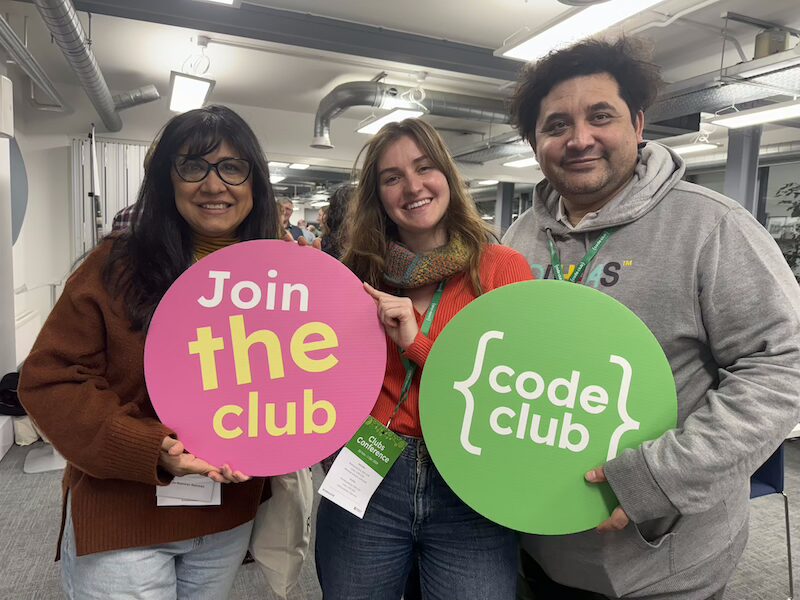
Mentors gathering at Clubs Con 2024
Code Club is more than just learning to code; it’s about creating opportunities, encouraging confidence, and building a global network of digital creators. Whether you’re a mentor, educator, or young digital maker, there’s a place for you in our community. Start your Code Club journey today and join a global community of digital creators.
Yesterday a number of Windows reviews began appearing for the AMD Ryzen AI Max+ PRO 395 “Strix Halo” with the debut of the ASUS ROG Flow Z13 as the first laptop to ship this SoC with 16 cores / 32 threads, 64 MB L3 cache, and 40 graphics cores with the Radeon 8060S Graphics. As expected, AMD Strix Halo is a beast with its very capable CPU performance and very compelling integrated graphics, at least under Windows 11…
Intel software engineers on Tuesday released oneDNN 3.7 as the newest version of this oneAPI Deep Neural Network Library that is in turn used by software like ONNX, MATLAB, PaddlePaddle, Apache MXNet, and others as part of the building blocks for deep learning software…
Germany’s Sovereign Tech Agency (née Sovereign Tech Fund) announced they have begun investing into the Eclipse Foundation and the work they are doing on open-source integrated development environment (IDE) software…
Our first look at the default desktop for Fedora 42 and Ubuntu ‘Plucky Puffin’. The next version of the default desktop for most of the big Linux distros is in beta. Here’s what to expect next month, or soon thereafter.
A fresh start isn’t just for your home — your iPhone or iPad deserves a privacy detox too. With Firefox for iOS, you can block hidden trackers, stop fingerprinting, and keep your browsing history more private with Enhanced Tracking Protection.
Cloud Controller Manager is a crucial yet often overlooked Kubernetes component that streamlines cloud integrations. Here’s why it matters and how to use it effectively.
Linux 6.13 is now the latest stable kernel and Ubuntu users can install it on their machines via the official Ubuntu Mainline Kernel PPA archive. Here’s a quick tutorial on how to do that via graphical or command-line methods.
The friends at CodeWeavers have relayed work that they are looking to hire multiple Wine developers to join their paid team working on upstream Wine as well as their CrossOver products, Valve’s Proton downstream for Steam Play, and related Wine-based tech.
The Veda SL917, developed by Ezurio and based on the Silicon Labs SiWx917 chipset, is a low-power wireless module designed for industrial IoT applications. It provides connectivity options, including Wi-Fi 6, Bluetooth Low Energy 5.4, and support for Matter and IP networking, providing secure cloud connectivity and efficient power management.