
Following the recent Rust drama within the Linux kernel that came out in part because Christoph Hellwig expressed objections to Rust bindings for the DMA mapping helpers that he is a maintainer of, Hellwig has now stepped down as one of the DMA mapping helper maintainers…
Category Archives: Linux
Setup Hypland with ML4W 2.9.8.2 Dotfiles as L2 KVM Guest inside Debian SID as L1 KVM Guest
Fist we deploy Debian Testing as L1 KVM Guest (8 VCPs,16 GB RAM,CachyOS 6.13.4 Kernel). Second step would be to install KVM Hypervisor on Debian Testing (Trixie Alpha) Virtual machine. Afterwards it appears possible to setup Hypland with ML4W 2.9.8.2 Dotfiles as L2 KVM Guest serving a dual DE for CachyOS which had been installed first as L2 KVM Guest inside Debian Testing L1 level. Running of Hypland with ML4W 2.9.8.2 Dotfiles (L2) doesn’t require enabling 3D acceleration in Virt-manager’s configuration running on top of Debian Testing as KVM Guest
KDE Plasma 6.3.2 Released with Animated WebP and GIF Support for Spectacle
Today, the KDE Project released KDE Plasma 6.3.2 as the second maintenance update to the latest KDE Plasma 6.3 desktop environment series to address more bugs, crashes, and other issues reported by users.
Orbit: Open-Source Nuclei Security Scanning and Automation Platform
Orbit is an open-source platform built to streamline large-scale Nuclei scans, enabling teams to manage, analyze, and collaborate on security findings. It features a SvelteKit-based web frontend and a Go-powered backend, with Terraform and Ansible handling infrastructure and automation.
The post Orbit: Open-Source Nuclei Security Scanning and Automation Platform appeared first on Linux Today.
A change in maintenance for the kernel’s DMA-mapping layer
The conversation around the merging of a set of Rust abstractions for the
kernel’s DMA-mapping layer has mostly settled after Linus Torvalds made it clear that the code would be
accepted. One other consequence of this decision, though, is that
Christoph Hellwig has quietly stepped down from the
maintenance of the DMA-mapping code. Marek Szyprowski will be the
maintainer of that layer going forward. Hellwig has maintained that code
for many years; his contributions will be missed.
kernel’s DMA-mapping layer has mostly settled after Linus Torvalds made it clear that the code would be
accepted. One other consequence of this decision, though, is that
Christoph Hellwig has quietly stepped down from the
maintenance of the DMA-mapping code. Marek Szyprowski will be the
maintainer of that layer going forward. Hellwig has maintained that code
for many years; his contributions will be missed.
KiCad 9.0 Released! Predefined Output Jobs & Multi-channel Design
KiCad, the free open-source suite for electronic computer-aided design, announced new 9.0.0 release a few days ago.
OSI’s Continually Changing Election Story
As OSI attempts to do damage control on social media without admitting that it made a mistake that needs to be rectified, more evidence surfaces indicating that the organization might be trying to change facts after the fact.
The post OSI’s Continually Changing Election Story appeared first on FOSS Force.
Need a Windows 10 alternative or still miss XP? This Linux distro is for you – and it’s free
Free10 is a repacking of the Q40S Linux distribution and it makes an outstanding option for anyone looking to migrate from Windows to Linux.
How’s that open source licensing coming along? That well, huh?
When a vendor and a community stop loving each other, things can get very forked up. State Of Open Multiple license changes have rocked the open source community over the last few years. For vendors concerned, the impact has ranged from business as usual to potentially catastrophic.
Apache NetBeans 25 Brings Updates for Java, PHP, Maven, and More
Apache NetBeans 25 open-source IDE updates Gradle, Maven, and Java tooling, refining dependency resolution, test execution, and UI stability.
AMD Ryzen 9000 vs. Intel Core Ultra Arrow Lake On Linux For Q1-2025 In ~400 Benchmarks
For those wondering how the latest AMD Ryzen 9000 “Zen 5” series and Intel Core Ultra Series 2 “Arrow Lake” desktop processors are battling it out on Linux, here are some fresh benchmarks on Ubuntu Linux with the latest software updates as well as the newest system BIOS updates for a fresh, all-new look at these Intel Core Ultra and AMD Ryzen desktop CPUs on Linux.
Eight New Security Vulnerabilities Reported Against The X.Org Server & XWayland
Eight new security issues have now been made public around the X.Org Server codebase that also impact XWayland…
[$] A possible path for cancelable BPF programs
The Linux kernel supports attaching BPF programs to many operations.
This is generally safe because the BPF verifier ensures
that BPF programs can’t misuse kernel resources, run indefinitely, or otherwise
escape their boundaries. There is continuing tension, however, between trying
to expand the capabilities of BPF programs and ensuring that the verifier can
handle every edge case. On February 14, Juntong Deng
shared a proof-of-concept patch set that
adds some run-time checks to BPF to make it possible in the future to interrupt
a running BPF program.
The tactical FPS ‘Due Process’ anti-cheat now supports Linux – plus it has a huge discount
Due Process from developer Giant Enemy Crab uses Easy Anti-Cheat that previously blocked Linux (and so Steam Deck too), but they’ve now enabled Linux players to jump in.
Teaching about AI – Teacher symposium
AI has become a pervasive term that is heard with trepidation, excitement, and often a furrowed brow in school staffrooms. For educators, there is pressure to use AI applications for productivity — to save time, to help create lesson plans, to write reports, to answer emails, etc. There is also a lot of interest in using AI tools in the classroom, for example, to personalise or augment teaching and learning. However, without understanding AI technology, neither productivity nor personalisation are likely to be successful as teachers and students alike must be critical consumers of these new ways of working to be able to use them productively.
In both England and globally, there are few new AI-based curricula being introduced and the drive for teachers and students to learn about AI in schools is lagging, with limited initiatives supporting teachers in what to teach and how to teach it. At the Raspberry Pi Foundation and Raspberry Pi Computing Education Research Centre, we decided it was time to investigate this missing link of teaching about AI, and specifically to discover what the teachers who are leading the way in this topic are doing in their classrooms.
A day of sharing and activities in Cambridge
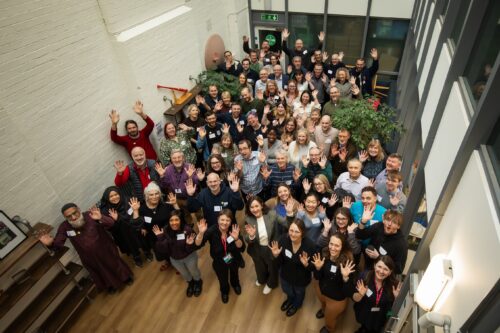
We organised a day-long, face-to-face symposium with educators who have already started to think deeply about teaching about AI, have started to create teaching resources, and are starting to teach about AI in their classrooms. The event was held in Cambridge, England, on 1 February 2025, at the head office of the Raspberry Pi Foundation.
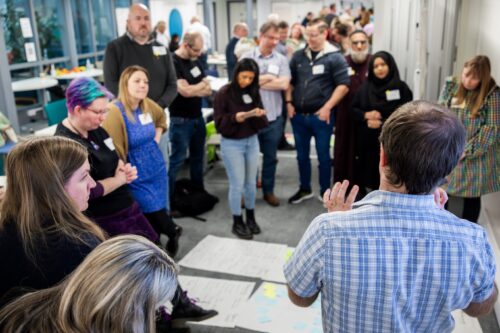
Over 150 educators and researchers applied to take part in the symposium. With only 50 places available, we followed a detailed protocol, whereby those who had the most experience teaching about AI in schools were selected. We also made sure that educators and researchers from different teaching contexts were selected so that there was a good mix of primary to further education phases represented. Educators and researchers from England, Scotland, and the Republic of Ireland were invited and gathered to share about their experiences. One of our main aims was to build a community of early adopters who have started along the road of classroom-based AI curriculum design and delivery.
Inspiration, examples, and expertise
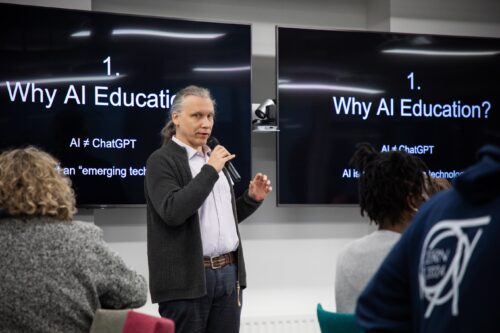
To inspire the attendees with an international perspective of the topics being discussed, Professor Matti Tedre, a visiting academic from Finland, gave a brief overview of the approach to teaching about AI and resources that his research team have developed. In Finland, there is no compulsory distinct computing topic taught, so AI is taught about in other subjects, such as history. Matti showcased tools and approaches developed from the Generation AI research programme in Finland. You can read about the Finnish research programme and Matti’s two month visit to the Raspberry Pi Computing Education Research Centre in our blog.
Attendees were asked to talk about, share, and analyse their teaching materials. To model how to analyse resources, Ben Garside from the Raspberry Pi Foundation modelled how to complete the activities using the Experience AI resources as an example. The Experience AI materials have been co-created with Google DeepMind and are a suite of free classroom resources, teacher professional development, and hands-on activities designed to help teachers confidently deliver AI lessons. Aimed at learners aged 11 to 14, the materials are informed by the AI education framework developed at the Raspberry Pi Computing Education Research Centre and are grounded in real-world contexts. We’ve recently released new lessons on AI safety, and we’ve localised the resources for use in many countries including Africa, Asia, Europe, and North America.
In the morning session, Ben exemplified how to talk about and share learning objectives, concepts, and research underpinning materials using the Experience AI resources and in the afternoon he discussed how he had mapped the Experience AI materials to the UNESCO AI competency framework for students.
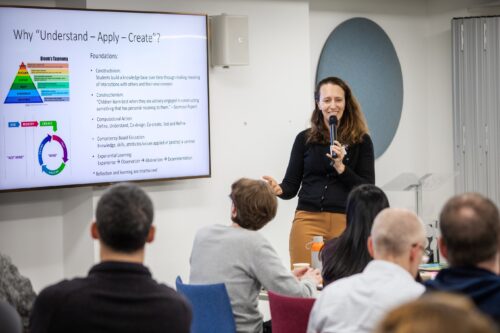
Kelly Shiohira, from UNESCO, kindly attended our session, and gave an invaluable insight into the UNESCO AI competency framework for students. Kelly is one of the framework’s authors and her presentation helped teachers understand how the materials had been developed. The attendees then used the framework to analyse their resources, to identify gaps and to explore what progression might look like in the teaching of AI.
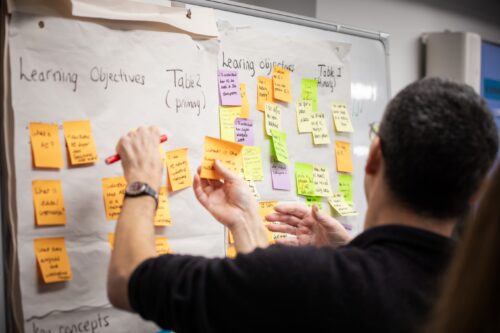
Throughout the day, the teachers worked together to share their experience of teaching about AI. They considered the concepts and learning objectives taught, what progression might look like, what the challenges and opportunities were of teaching about AI, what research informed the resources and what research needs to be done to help improve the teaching and learning of AI.
What next?
We are now analysing the vast amount of data that we gathered from the day and we will share this with the symposium participants before we share it with a wider audience. What is clear from our symposium is that teachers have crucial insights into what should be taught to students about AI, and how, and we are greatly looking forward to continuing this journey with them.
As well as the symposium, we are also conducting academic research in this area, you can read more about this in our Annual Report and on our research webpages. We will also be consulting with teachers and AI experts. If you’d like to ensure you are sent links to these blog posts, then sign up to our newsletter. If you’d like to take part in our research and potentially be interviewed about your perspectives on curriculum in AI, then contact us at: rpcerc-enquiries@cst.cam.ac.uk
We also are sharing the research being done by ourselves and other researchers in the field at our research seminars. This year, our seminar series is on teaching about AI and data science in schools. Please do sign up and come along, or watch some of the presentations that have already been delivered by the amazing research teams who are endeavouring to discover what we should be teaching about AI and how in schools
The post Teaching about AI – Teacher symposium appeared first on Raspberry Pi Foundation.
5 Mini PCs You Can Buy With Linux Preinstalled
Ready to ditch the setup headaches and jump straight into Linux? With a mini PC that has Linux preinstalled, you can skip the technical fuss and start exploring right away.
Nextcloud Releases Hub 10 to Take on Big Tech
The folks at Nextcloud have upped their game again with this release of Nextcloud Hub 10. Most impressive are the improvements made to the platform’s AI Assistant.
The post Nextcloud Releases Hub 10 to Take on Big Tech appeared first on FOSS Force.
Rust-Written Zlib-rs Is Not Only Safer But Now Outperforming Zlib C Implementations
Zlib-rs as a Rust programming language implementation of the Zlib file format for better safety is now beginning to outperform the C implementations of the widely-used Zlib…
Linux 6.15 Intel Xe Driver Enabling PXP HWDRM, Survivability Mode & GPU + VRAM Temperatures
Complementing yesterday’s initial set of Intel graphics driver feature patches planned for Linux 6.15, a drm-xe-next pull request was also submitted to DRM-Next containing a lot of new feature code for the modern Xe kernel Direct Rendering Manager driver. There’s a few fun features on the Xe side for Linux 6.15…
GNOME 48 Mutter Merges Wayland’s wp_color_management_v1 Support
As an exciting late addition to the GNOME 48 codebase ahead of its stable release in mid-March, the Wayland color management “wp_color_management_v1” protocol support has been merged!..