
Released on Wednesday was IGC 2.10.8 as the newest update to the Intel Graphics Compiler that is used by their Compute Runtime OpenCL/Level-Zero stack on Windows and Linux as well as being used as their graphics shader compiler under their Windows driver…
Category Archives: Linux
KDE Gear 25.04 Delivers Many Improvements To KDE’s Applications
Following the recent Plasma 6.3 desktop release, KDE Gear 25.04 is now available for shipping all of the latest and greatest KDE applications…
Research insights to help learners develop data awareness
An increasing number of frameworks describe the possible contents of a K–12 artificial intelligence (AI) curriculum and suggest possible learning activities (for example, see the UNESCO competency framework for students, 2024). In our March seminar, Lukas Höper and Carsten Schulte from the Department of Computing Education at Paderborn University in Germany shared with us a unit of work they’ve developed that could inform such a curriculum. At its core, the unit enhances young people’s awareness of how their personal data is used in the data-driven technologies that form part of their everyday lives.


Lukas Höper and Carsten Schulte are part of a larger team who are investigating how to teach school students about data science and Big Data.
Carsten explained that Germany’s informatics (computing) curriculum includes a competency area known as Informatics, People and Society (IPS), which explores the interrelationships between technology, individuals, and society, and how computation influences and is influenced by social, ethical, and cultural factors. However, research has suggested that teachers face several problems in delivering this topic, including:
- Lack of subject knowledge
- Lack of teaching material
- Lack of integration with other topics in informatics lessons
- A perception that IPS is the responsibility of other subjects
Some of the findings of that 2007 research were mirrored in a more recent local study in 2025, which found that although there have been some gains in subject knowledge in the interval period, the problems of a lack of teaching material and integration with other computer science (CS) topics persist, with IPS increasingly perceived as the responsibility of the informatics subject area alone. Despite this, within the informatics curriculum, IPS is often the first topic to be dropped when educators face time constraints — and concerns with what and how to assess the topic remain.

In this context, and as part of a larger, longitudinal project to promote data science teaching in schools called ProDaBi, Carsten and Lukas have been developing, implementing, and evaluating concepts and materials on the topics of data science and AI. Lukas explained the importance of students developing data awareness in the context of the digital systems they use in their everyday lives, such as search engines, streaming services, social media apps, digital assistants, and chatbots, and emphasised the difference between being a user of these systems and a data-aware user. Using the example of image recognition and ‘I am not a robot’ Captcha services, Lukas explained how young people need to develop a data-aware perspective of the secondary purposes of the data collected by these (and other) systems, as well as the more obvious, primary purposes.
Lukas went on to illustrate the human interaction system model, which presents a continuum of possible different roles, from the student as the user of digital artefacts to the student as the designer of digital artefacts.
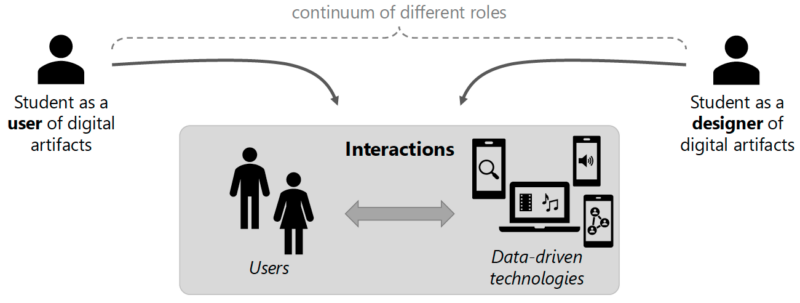
To become data-aware users of digital artefacts, students need to be able to understand and reflect on those digital artefacts. Only then can they proceed to become responsible designers of digital artefacts. However, when surveyed, some students were only moderately interested in engaging with the inner workings of the digital technologies they use in their everyday lives. Many students prefer to use the systems and are less interested in how they process data.
The explanatory model approach in computing education
Lukas explained how students often become more interested in data-driven technologies when learning about them with explanatory models. Such models can foster data awareness, giving students a different perspective of data-driven technologies and helping them become more empowered users of them.
To illustrate, Lukas gave the example of an explanatory model about the role of data in digital systems. Such a model can be used to introduce the idea that data is explicitly and implicitly collected in the interaction between the user and the technology, and used for primary and secondary purposes.
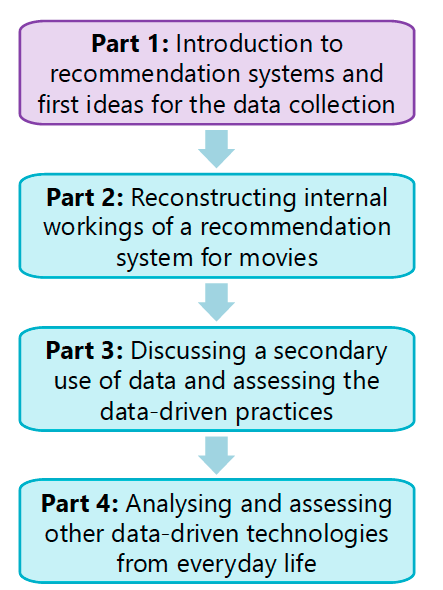
Lukas then introduced two teaching units that were developed for use with middle school children to evaluate the success of the explanatory model approach in computing education. The first unit explores location data collected by mobile phone networks and the second features recommendation systems used by movie streaming services such as Netflix and Amazon Prime.
Taking the second unit as their focus, Lukas and Carsten outlined the four parts of the explanatory model approach:
Part 1
The teaching unit begins by introducing recommendation systems and asking students to think about what a streaming service is, how a personalised start page is constructed, and how personal recommendations might be generated. Students then complete an unplugged activity to simulate the process of making movie recommendations for a peer:
Task 1: Students write down movie recommendations for another student.
Task 2: They then ask each other questions (they collect data).
Task 3: They write down revised movie recommendations.
Task 4: They share and evaluate their recommendations.
Task 5: Together they reflect on which collected data was helpful in this exercise and what kind of data a recommendation system might collect. This reflection introduces the concepts of explicit and implicit data collection.
Part 2
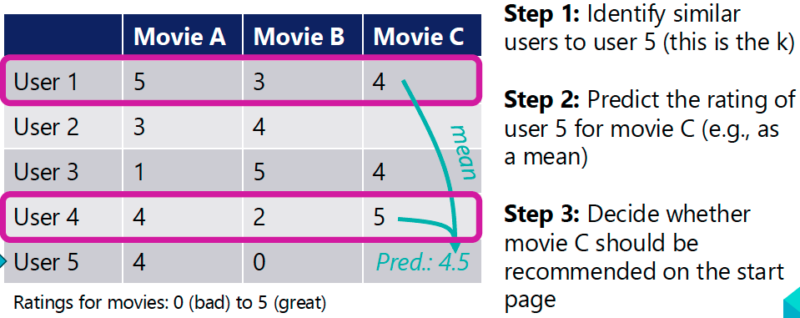
In part 2, students are given a prepared Jupyter Notebook, which allows them to explore a simulation of a recommendation system. Students rate movies and receive personal recommendations. They reconstruct a data model about users, using the idea of collaborative filtering with the k-nearest neighbours algorithm (see Figure 3).
Part 3
In part 3, the concepts of primary and secondary purposes for data collection are introduced. Students discuss examples of secondary purposes such as personalised paywalls for movies that can be purchased, and subscriptions based on the predictions of future behaviour. The discussion includes various topics about individual and societal issues (e.g. filter bubbles, behaviour engineering, information asymmetry, and responsible development of data-driven technologies).
Part 4
Finally, students use the explanatory model as an ‘analytical lens’. They choose other examples from their everyday lives of technologies that implement recommendation systems and analyse these examples, assessing the data practices involved. Students present their results in class and discuss their role in these situations and possible actions they can take to become more empowered, data-aware users.
Uses of explanatory models
Using the explanatory model is one approach to make the Informatics, People and Society strand of the German informatics curriculum more engaging for students, and addresses some of the problems teachers identify with delivering this competency area.

In presenting the idea of the explanatory model, Carsten and Lukas emphasised that the model in use delivers content as well as functioning as a tool to design teaching content. In the example above, we see how the explanatory model introduces the concepts of:
- Explicit and implicit data collection
- Primary and secondary purposes of that data
- Data models
The explanatory model framework can also be used as a focus for academic research in computing education. For example, further research is needed to evaluate if explanatory models are appropriate or ‘correct’ models and to determine the extent to which they are useful in computing education.
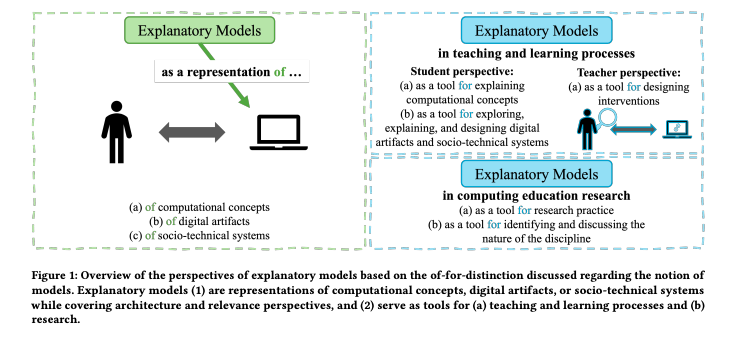
In summary, an explanatory model provides a specific perspective on and explanation of particular computing concepts and digital artefacts. In the example given here, the model focuses on the role of data in a recommender system. Explanatory models are representations of concepts, artefacts, and socio-technical systems, but can also serve as tools to support teaching and learning processes and research in computing education.
The teaching units referred to above are published on www.prodabi.de (in German and English).
See the background paper to the seminar, called ‘Learning an explanatory model of data-driven technologies can lead to empowered behaviour: A mixed-methods study in K-12 Computing education’.
You can also view the paper describing the development of the explanatory model approach, called ‘New perspectives on the future of Computing education: Teaching and learning explanatory models’.
Join our next seminar
In our current seminar series, we’re exploring teaching about AI and data science. Join us at our next seminar on Tuesday 13 May at 17:00–18:30 BST to hear Henriikka Vartiainen and Matti Tedre (University of Eastern Finland) discuss how to empower students by teaching them how to develop AI and machine learning (ML) apps without code in the classroom.
To sign up and take part in our research seminars, click below:
You can also view the schedule of our upcoming seminars, and catch up on past seminars on our previous seminars and recordings page.
The post Research insights to help learners develop data awareness appeared first on Raspberry Pi Foundation.
Chocolate Factory exudes Nougat as Android 7 begins rollout
Newer Nexus owners get it first, the rest will have to wait. Google is starting its rollout of Android 7, codenamed Nougat, but you’re only going to get it if you’re running one of the newer models of the firm’s Nexus devices.…
Linux turns 25, with corporate contributors now key to its future
What’s the weather in Hell today? Linus Torvalds has visited Microsoft at LinuxCon. On August 25, 1991, an unknown Finnish developer posted the following to the comp.os.minix newsgroup:…
Google’s brand new OS could replace Android
webOS, BeOS and Android heritageThe source code of Google’s latest operating system has emerged, and it looks like all new code from the ground up.…
Systemd adds filesystem mount tool
Linux mount gets a systemd wrapper. The developers behind Systemd, the alternative to sysvinit, have added a mount tool to their user space bootstrapper.…
[$] LWN.net Weekly Edition for April 17, 2025
Inside this week’s LWN.net Weekly Edition:
- Front: APT 3.0; Fedora 42; Lots more LSFMM+BPF coverage.
- Briefs: CVE funding; Yelp vulnerability; Fedora 42; Manjaro 25.0; GCC 15; Pinta 3.0; Quotes; …
- Announcements: Newsletters, conferences, security updates, patches, and more.
Intel Continues Exploring Energy Aware Scheduling For Hybrid CPUs Without SMT
While Intel’s Core Ultra 200V “Lunar Lake” SoCs with on-package memory has been reported to be a one-off design, besides the integrated memory it was also notable for being a hybrid core design while lacking Hyper Threading (HT / SMT) support. The notion of hybrid P/E core CPUs without SMT looks like it will continue with Intel software engineers still exploring Energy Aware Scheduling (EAS) around such layouts…
TurnkeyML 6.2 Released With AMD Ryzen AI NPU Improvements
Released at the end of 2023 was TurnkeyML as an open-source collaboration between ONNX and AMD developers. TurnkeyML has evolved into focusing on making it easy to use the most important tools within the ONNX ecosystem and their Lemonade SDK to deploy large language models on various devices/accelerators Out today is TurnkeyML 6.2 with a focus on delivering better AMD Ryzen AI NPU support…
NVIDIA 575 Linux Graphics Driver Enters Public Beta with NVIDIA Smooth Motion
NVIDIA released today the beta version of the upcoming NVIDIA 575 series of their graphics drivers for NVIDIA GPUs on Linux, BSD, and Solaris systems.
8 Best Free and Open Source Command-line FTP clients
This article provides our pick of the best open source command line file transfer programs. The software featured here supports a number of different protocols, not just FTP. They offer shell-like command syntax, and are great for scripting purposes.
Tor Browser 14.5 Introduces Android Connection Assist
The latest Tor Browser adds Connection Assist to Android, making it easier for users in censored regions to connect securely with one tap.
Fedora 43 Looking To Make It Easier To Deploy Intel TDX Confidential VMs
While Fedora 42 was just released yesterday, already Red Hat developers and the Fedora development community have been busy thinking about Fedora 43 that will debut this autumn. Among the early change proposals this week is one for better supporting Intel Trust Domain Extensions (TDX) with this next Fedora Linux release…
Armbian Introduces Optimized Cloud Images for x86 and aarch64 Deployments
Armbian has expanded its support for cloud infrastructure with a new line of dedicated cloud images designed for generic x86 and aarch64 platforms. These images are tailored for performance, efficiency, and streamlined deployment in virtualized and cloud-native environments. The new Armbian cloud image set aims to meet the growing demand for lightweight and reliable Linux […]
[$] What’s new in APT 3.0
Debian’s Advanced Package Tool (APT) is the suite of utilities that handle package
management on Debian and Debian-derived operating systems. APT recently received a
major upgrade to 3.0 just in time for inclusion in Debian 13
(“trixie”), which is planned for release sometime in 2025. The version bump is
warranted; the latest APT has user-interface improvements, switches to Sequoia to verify package
signatures, and includes solver3—a new solver that is designed to improve
how it evaluates and resolves package dependencies.
Catanzaro: Dangerous arbitrary file read vulnerability in Yelp
GNOME contributor Michael Catanzaro has written a blog
post about a noteworthy vulnerability in GNOME’s help browser, Yelp.
I don’t normally blog about particular CVEs, but Yelp CVE-2025-3155 is
noteworthy because it is quite severe, public for several weeks now,
and not yet fixed upstream. In short, help files can read your
filesystem and execute arbitrary JavaScript code, allowing an attacker
to exfiltrate any files your Unix user has access to.
The vulnerability was first reported on December 25, and it
was made public on March 26 after the 90-day-disclosure deadline
was reached. Patches
have been proposed to fix the issue. The bug reporter has published a writeup
demonstrating the attack. Catanzaro asks that Linux vendors
“please consider applying the provided patches even though they
“.
have not yet been accepted upstream
Mesa’s Old OpenCL “Clover” Driver Removed For Mesa 25.2
Now that Mesa 25.1 is branched for this quarter’s Mesa 3D feature release, Mesa 25.2 has entered development on the main Git branch. One of the first merged changes for Mesa 25.2 is removing the old OpenCL Gallium3D “Clover” driver…
Software-Defined Radio: 9 Best Free Tools for Linux
This roundup looks at the finest software-defined radio tools for Linux including apps that let you listen to DAB and DAB+ broadcasts.
[$] Parallel directory operations
Allowing directories to be modified in parallel was the topic of Jeff
Layton’s filesystem-track session at the 2025 Linux Storage, Filesystem,
Memory Management, and BPF Summit (LSFMM+BPF). There are certain use
cases, including for the NFS and Lustre filesystems, as mentioned in a patch set
referenced in the topic
proposal, where contention in creating multiple files in a directory is
causing noticeable performance problems. In some testing, Layton has found
that the inode read-write semaphore (i_rwsem) for the directory is
serializing operations; he wanted to discuss alternatives.