
The Servo open-source browser engine is out with their September 2025 development highlights. This Rust-based browser engine originally started by Mozilla continues making steady progress as well as to the “servoshell” demo/example browser implementation…
Category Archives: Linux
Berkeley boffins build better load balancing algo with AI
One way AI can improve on human workComputer scientists at UC Berkeley say that AI models show promise as a way to discover and optimize algorithms.…
KDE Plasma 6.6 Will Cater To Windows Power Users With “winver”
Plasma 6.5 debuted this week that KDE developers and users have been celebrating. But it’s already on to working out fixes for Plasma 6.5.1 as well as new feature activity toward Plasma 6.6…
FreeBSD 15.0 Beta 3 Brings Working Support For MediaTek MT76 WiFi
The newest weekly test release of the FreeBSD 15.0 is now available for evaluation ahead of the planned December official release…
Easily Convert TS Videos to MP4 File Format via CLI or GUI
Discover CLI and GUI methods to convert that Choppy-running TS video file in VLC Media Player with the step-by-step guide mentioned in this article.
Arch Linux Users Are the First to Experience KDE Plasma 6.5
KDE Plasma 6.5 has officially landed in Arch Linux’s stable repositories, making it the first distribution to ship the new desktop.
Rust Coreutils 0.3 Released With Some Major Speed-Ups, Better GNU Compatibility
The uutils project announced tonight the release of Rust Coreutils 0.3, another step forward for this Rust version alternative to GNU Coreutils that has been attracting a lot of interest lately due to Ubuntu 25.10 now using it by default…
OpenGL Sees New Extensions Added To The Registry
It’s been rare in recent years seeing any new OpenGL extensions given the wild success these days of the Vulkan API with its vast hardware adoption and increasing software support around that modern graphics and compute API. Yet this October has been unusual with now seeing multiple new OpenGL extensions merged to the OpenGL registry…
Austria Says ‘Auf Wiedersehen’ to Proprietary and ‘Willkommen’ to Open Source
The Austrian Ministry for Economic Affairs drops foreign clouds for a homegrown Nextcloud and LibreOffice solution, illustrating Europe’s steady move toward digital independence.
The post Austria Says ‘Auf Wiedersehen’ to Proprietary and ‘Willkommen’ to Open Source appeared first on FOSS Force.
The Latest Sheaves Work To Hopefully Improve Linux Performance
Merged for Linux 6.18 was a new feature called Sheaves as an opt-in, per-CPU array-based caching layer. Plus there is a per-NUMA-node cache of Sheaves called a “Barn”. In continuing to build out the Linux kernel usage of Sheaves, a set of initial patches were posted this week to replace the CPU slabs with Sheaves within the slub allocator code…
Test submission
This is a test from the site
The post Test submission appeared first on Linux Today.
Linux Lands Fix For “Serious Performance Regression” Affecting Some Intel Chromebooks
Merged this week to Linux Git ahead of Linux 6.18-rc3 this Sunday were the latest power management fixes for the kernel. Standing out in the power management code is a fix for a “serious performance regression” affecting some Intel-powered Chromebooks…
AMD EPYC Turin vs. Intel Xeon 6 Granite Rapids vs. Graviton4 Benchmarks With AWS M8 Instances
With Amazon recently launching their M8a AWS instances powered by 5th Gen AMD EPYC “Turin”, for their M8 class instance types there now are all the latest-generation CPU options with AMD EPYC Turin (M8a), Intel Xeon 6 Granite Rapids (M8i), and their in-house Graviton4 processors (M8g). After recently looking at the M7a vs. M8a performance with Amazon EC2, many Phoronix readers expressed interest in seeing an M8a vs. M8i vs. M8g performance showdown so here are those benchmarks.
Play, pedagogy, and real-world impact: What we learned from the AI Quests webinars
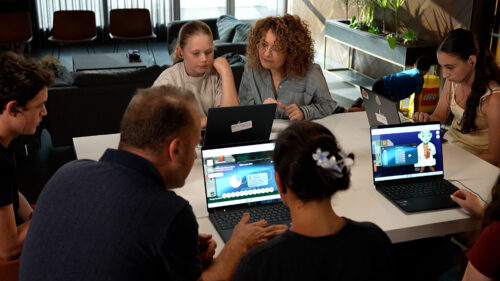
How do you teach AI in a way that resonates with 11- to 14-year-olds long after the lesson ends? In two recent Experience AI webinars, we explored that question with collaborators from Google Research, Google DeepMind, and the Stanford Accelerator for Learning. During the webinars, we also showcased AI Quests, a gamified, classroom-first experience where learners use AI concepts to solve real problems.
“The AI technology you’ll experience is amazing, but it’s not magic. Success depends on the decisions you make.”
That line, delivered by Professor Sky, the in-game mentor, captures the core message of AI Quests: AI systems are built by people and shaped by human judgment at every step.
What is AI Quests?
We’ve embedded AI Quests into the Foundations of AI unit in Experience AI, our free AI literacy programme created with Google DeepMind.
As Google Research’s Liat Ben Rafael explained, “AI Quests is a gamified experience… where students discover firsthand how AI is used in the real world to create positive impact.” Each quest is grounded in a real research programme and mirrors the AI project lifecycle you’ll recognise from our Experience AI lessons: define the problem, prepare data, train, test, deploy.

The first quest, Market Marshes, asks students to help Luna, one of the central characters, to protect a riverside market from flooding. Players roam, gather candidate data (from rainfall stats to town gossip), clean it, choose relevant features, and train a model. If the model underperforms, they iterate, exactly as real AI developers would.
Emma Staves, Learning Manager at the Foundation, notes that a key moment is when learners test their model: “It’s made really clear that the data that’s being used to test the model is historic data.” That simple design choice can help you to unlock rich discussions with your learners about validation, reliability, and what counts as “accurate enough” for real decisions.
Designed around how students actually learn
Developed in collaboration with learning scientists at the Stanford Accelerator for Learning, the quests reflect what Victor Lee, Faculty Lead for AI and Education at Stanford, describes as “enduring understanding”:
“The enduring understanding is about how humans can initiate and design AI applications that can address some of humanity’s biggest unsolved challenges.”
To keep that focus, the team blends:
- Situated learning – for example, a concrete flood scenario rather than abstract exercises
- Pedagogical agents – characters who nudge, model, and explain
- Embedded feedback and productive failure – learn by trying, revising, and trying again
- Self-explanation prompts – ‘learning tickets’ that ask students to articulate what they’re doing and why
In other words, the quests are all about playing with purpose.
What teachers are seeing in the classroom
We piloted AI Quests with some teachers, including Dave Cross, Curriculum Leader for Computer Science at North Liverpool Academy, who tested the quests with his Year 7 students, before extending it to his GCSE classes:
“We see it moving forward as a really solid foundation… for that further learning.”
He also saw strong cross-curricular ties: geography colleagues spotted “massive opportunities” to use the flood quest in their own units, while broader staff discussions turned to digital citizenship, data literacy, and fairness. The cross-disciplinary nature of AI is increasingly apparent, and so AI literacy shouldn’t be limited to computing — students need to encounter AI across multiple subjects and in everyday life.
Where the research comes in: Forecasting floods days in advance

The second webinar connected the classroom experience to the real project it’s modelled on: Google Research Flood Forecasting. Gila Loike, Product Manager, set the scene:
“Our research team develops AI models that predict flooding all over the world, five to seven days before the flood occurs.”
Deborah Cohen, the Research Scientist leading the team at Google Research focused on flooding, also explained that traditional models can’t easily predict floods in places with little data. However, AI can fill those gaps by combining information from rivers, weather forecasts, and satellites, to give accurate warnings around the world:
“With AI we were able to expand our coverage to the entire world.”
The results are real and practical. Accurate predictions help:
- People stay safe by receiving flood alerts through familiar apps
- Emergency teams plan routes and close roads in time
- Farmers decide whether to move animals or harvest early
- Aid organisations act sooner, delivering supplies or financial support before the flood hits

To make sure their models work well, the team compares predictions with real river data, where available, and with satellite images showing flooded areas. Students explore these same ideas in the AI Quest game, cleaning messy data, testing their models, and checking how accurate their results are.
“Students are really engaged by the real-world challenge,” said Emma Staves about the Market Marshes quest. “That authenticity makes learning come alive.” It helps students see how classroom ideas, like features, accuracy, bias, and model cards, connect directly to real decisions and their consequences.
Coming soon: Health quests and more languages

Liat also gave a sneak peek at the next quest, a health-focused story on blindness prevention. It introduces new layers — privacy, diverse data, field testing — while following the same lifecycle. More quests are in development, with additional languages planned from early 2026.
Why this matters now
The key message from both webinars is clear: AI literacy isn’t just about using technology — it’s about understanding our role in shaping it. As one Stanford researcher put it, “AI isn’t this magic thing that just happens to us. Humans decide how to use it, and how choices around data affect accuracy and fairness.”
Our goal with Experience AI is to help young people become thoughtful, creative problem-solvers who can navigate an AI-powered world with confidence and integrity — and AI Quests fits perfectly with that.
Find out more
You can watch both webinars anytime on our YouTube and LinkedIn channels
Webinar 1: LinkedIn, YouTube
Webinar 2: LinkedIn, YouTube
Explore our Experience AI resources — already used by nearly two million learners and educators to understand, question, and create with AI — to bring them and AI Quests into your classroom. You’ll find the Foundations of AI unit, alongside materials on large language models, ecosystems and AI, and AI safety, at rpf.io/experienceai-resources
The post Play, pedagogy, and real-world impact: What we learned from the AI Quests webinars appeared first on Raspberry Pi Foundation.
Typst 0.14 released
Version 0.14 of the
Typst document processor has been released.
Typst document processor has been released.
If you need to comply with accessibility-related regulations, Typst
0.14 has your back. Typst now generates accessible documents by
default, with opt-in support for stricter checks. For those working
with complex illustrations, PDFs are now supported as a native
image format. In case you’re typesetting a book, the new
character-level justification will give your layout the final
touch. And if you’re building a website or blog, many improvements
to Typst’s HTML export are waiting for you.
LWN looked at Typst in September.
Updated AMD ISP4 Driver Posted For Linux With Fixes & Improvements
AMD’s ISP4 image signal processing IP is so far just used by the HP ZBook Ultra G1a laptop but will presumably be used by more of the higher-end AMD Ryzen next-gen laptops. AMD engineers today posted their fifth iteration of their open-source Linux driver for enabling the ISP4 use…
Super Easy KDE Plasma 6 Customization | Beautiful Clean Nature Vibes
A minimal KDE Plasma 6 setup that’s effortless to build and customize.Combining Utterly Nord’s elegance with natural anime-inspired visuals, this desktop brings clarity and balance.Menus and widgets are adjusted for a smooth, clean
GTK 4.22 To Natively Support SVG – Including Animations
GTK has long supported Scalable Vector Graphics (SVG) for icons but with up until recently relying on the external librsvg library, the integration hasn’t been perfect. But Red Hat engineer Matthias Clasen has been working on having the GTK toolkit natively support SVG…
[$] GoFundMe to delete unwanted open-source foundation pages
Open-source foundations and projects that have charity status in
the US may want to see if GoFundMe has created a profile
for them without permission. The company has operated since 2010 as a
self-service fundraising platform; individuals or groups could create
pages to raise money for all manner of causes. In June, the company announced
that it would expand its offerings to “manage all aspects of
” for users through its platform. That seems to
charitable giving
include creating profiles for nonprofit organizations without their
involvement. After pushback, the company said
on October 23 that it would be removing the pages. It has not
answered more fundamental questions about how it planned to disburse
funds to nonprofits that had no awareness of the GoFundMe pages in the
first place.
Asahi Linux Still Working On Apple M3 Support, m1n1 Bootloader Going Rust
The Asahi Linux developers involved with working on Linux support for Apple Silicon M-Series devices have put out a new progress report on their development efforts…