NVIDIA’s GTC 2025 and the Coming Robot AI Revolution

NVIDIA’s GTC (GPU Technology Conference) has evolved into a premier showcase for artificial intelligence (AI) and accelerated computing. While NVIDIA has been known for its graphics processing units (GPUs) that power everything from gaming to data centers, recent GTC events have placed a significant emphasis on robotics. This focus suggests a future where robots are not confined to factory floors but become increasingly integrated into our daily lives.

NVIDIA’s Robotic Announcements

At recent GTC conferences, NVIDIA has unveiled a range of cutting-edge technologies aimed at advancing the field of robotics. These include:

  • NVIDIA Isaac Platform: A comprehensive platform for developing, simulating, and deploying robots. Isaac provides developers with the tools and software they need to build AI-powered robots for various applications, as detailed on the NVIDIA Isaac Platform Overview.
  • NVIDIA Jetson Modules: These are small, powerful computers designed to be the brains of robots. They provide the processing power necessary for robots to perceive their environment, make decisions, and interact with the world, as seen on the NVIDIA Jetson Platform.
  • NVIDIA Omniverse: A simulation and collaboration platform that allows developers to create virtual worlds where robots can be trained and tested. This virtual environment is crucial for developing robust and safe robotic systems, and you can learn more on the NVIDIA Omniverse Overview.
  • Foundation Models: NVIDIA is applying its expertise in large language models to robotics, enabling robots to better understand and respond to natural language commands. This will make robots more intuitive and easier for people to interact with, as highlighted in NVIDIA Research on Robotics and AI.

Personal Robotics: A Market Bigger Than PCs and Smartphones?

The potential market for personal robotics is staggering. While PCs and smartphones have revolutionized how we work, communicate, and access information, robots could go even further. Consider the possibilities:

  • Household chores: Robots could handle tasks like cleaning, laundry and yard work, freeing up our time for other activities.
  • Elderly care: Robots could provide companionship, assistance with daily living, and monitor health, enabling seniors to live more independently.
  • Personal assistants: Robots could act as highly capable personal assistants, managing schedules, providing information, and performing complex tasks.
  • Beyond the mundane: Robots could eventually take on dangerous jobs, explore other planets, and perform intricate surgeries.

If robots can successfully penetrate these markets, the total addressable market could indeed dwarf that of PCs and smartphones combined. Every household could have multiple robots, each performing specialized tasks.

Robots Replacing PCs and Smartphones

The long-term potential of AI-driven robotics is transformative. It’s conceivable that robots could eventually replace many of the functions of PCs and smartphones. Imagine a future where:

  • Converged Devices: Instead of carrying a smartphone and using a laptop, we interact with a personal robot that can project information onto any surface, respond to voice commands, and perform tasks with physical dexterity.
  • AI-Powered Interaction: We communicate with these robots using natural language, and they learn our preferences and anticipate our needs.
  • Head-Mounted Displays (HMDs): Devices like the Apple Vision Pro could become the primary interface, providing immersive augmented reality (AR) experiences, with robots acting as our physical avatars in the real world.
  • Brain-Computer Interfaces (BCIs): In the more distant future, direct mind-to-machine communication could eliminate the need for traditional input devices altogether, as explored in Brain-Computer Interfaces Research.

Advantages of This Future

This future offers several potential advantages:

  • Increased productivity: Robots could automate many tasks, freeing up human time for more creative and strategic pursuits.
  • Enhanced quality of life: Robots could provide personalized care, assistance and companionship, improving overall well-being.
  • New possibilities: Robots could enable us to explore new frontiers, both on Earth and in space, and perform tasks that are currently beyond human capabilities.

Disadvantages and Potential Dangers

However, this future also presents significant challenges and potential dangers:

  • Job displacement: The widespread adoption of robots could lead to significant job losses in various sectors, as detailed in the Impact of Automation on Employment.
  • Ethical concerns: We would need to address complex ethical questions related to robot autonomy, decision-making, and the potential for misuse, as discussed in the Ethics of Artificial Intelligence.
  • Existential risks: If AI and robotics development are not carefully managed, there’s a potential risk of unintended consequences, including the possibility of robots becoming uncontrollable or even posing a threat to humanity, a topic explored in Existential Risks of Artificial Intelligence.
  • Dependence: Over-reliance on robots could lead to a decrease in human skills and capabilities.

The Need for Protections

To mitigate these risks, it’s crucial to establish robust safeguards and ethical guidelines. These may include:

  • Safety protocols: Strict regulations and standards for robot design, manufacturing, and operation.
  • Ethical frameworks: Development of ethical principles to guide the behavior of AI-powered robots.
  • Security measures: Protection against hacking and malicious control of robots.
  • Human oversight: Maintaining human control over critical decisions and preventing robots from operating autonomously in potentially harmful situations.

Wrapping UP: NVIDIA’s Leadership

NVIDIA remains at the forefront of AI hardware and robotic intelligence. Its GPUs, software platforms, and developer tools are essential for the advancement of this technology. GTC continues to be a crucial event for anyone interested in the future of AI and robotics, showcasing the latest breakthroughs and providing a glimpse into the transformative potential of these technologies.
OpenAI delays rollout of ChatGPT’s image generator to free users

Free ChatGPT users will have to wait a while longer to be able to use its built-in image generation capability. OpenAI has just launched a feature that will allow users to generate images directly inside of ChatGPT, and it was supposed to roll out to all Plus, Pro, Team and Free users. But according to company CEO Sam Altman, it has been way more popular than OpenAI had expected even though they already had high expectations to begin with. As such, its rollout to the free tier is “unfortunately going to be delayed for a while.”

images in chatgpt are wayyyy more popular than we expected (and we had pretty high expectations).

rollout to our free tier is unfortunately going to be delayed for awhile.

— Sam Altman (@sama) March 26, 2025

People have been posting ChatGPT’s output all over social media. One popular trend that emerged from the launch is turning existing photos into Studio Ghibli-style illustrations. Even Altman poked fun at it and used a Ghibli-fied photo of himself as his profile picture on X/Twitter. Users have been creating Ghibli versions of everything from personal images to photos of political figures and memes. As VentureBeat has noted, Ghibli creator Hayao Miyazaki likely wouldn’t approve of them, seeing as he reacted quite negatively to AI-powered animation years ago, but we doubt that would stop the trend until people get tired of it. 

Altman didn’t give a timeline for when the feature will make its way to free users. For now, those who want to use the chatbot’s built-in generator will have to log into ChatGPT with a Plus, Pro or Team account and then select GPT-4o as their AI model in the lower left-corner. 

This article originally appeared on Engadget at https://www.engadget.com/ai/openai-delays-rollout-of-chatgpts-image-generator-to-free-users-123041109.html?src=rss

How to Up-Pot Your Seedlings Without Messing Them Up

We may earn a commission from links on this page.

Most seeds are grown in seed trays or blocks, but at some point, these seedlings will outgrow their cell or block and require more soil for their roots to grow. In some cases, the weather aligns and you can transplant your seedlings from the tray directly to the garden. But in most cases, your seedlings will need more time inside, protected, before the weather is warm enough, and that means you’ll need to take your seedlings out of the tray and give them a larger container where they can chill out and grow some more before going into the ground. This process is called “up-potting,” and while the process itself is simple, there is actually a lot that can go wrong at this point in the growing process. Here’s how to give your seedlings the best chance at survival. 

How to know when it’s time to up-pot

cotyledons, not true leaves
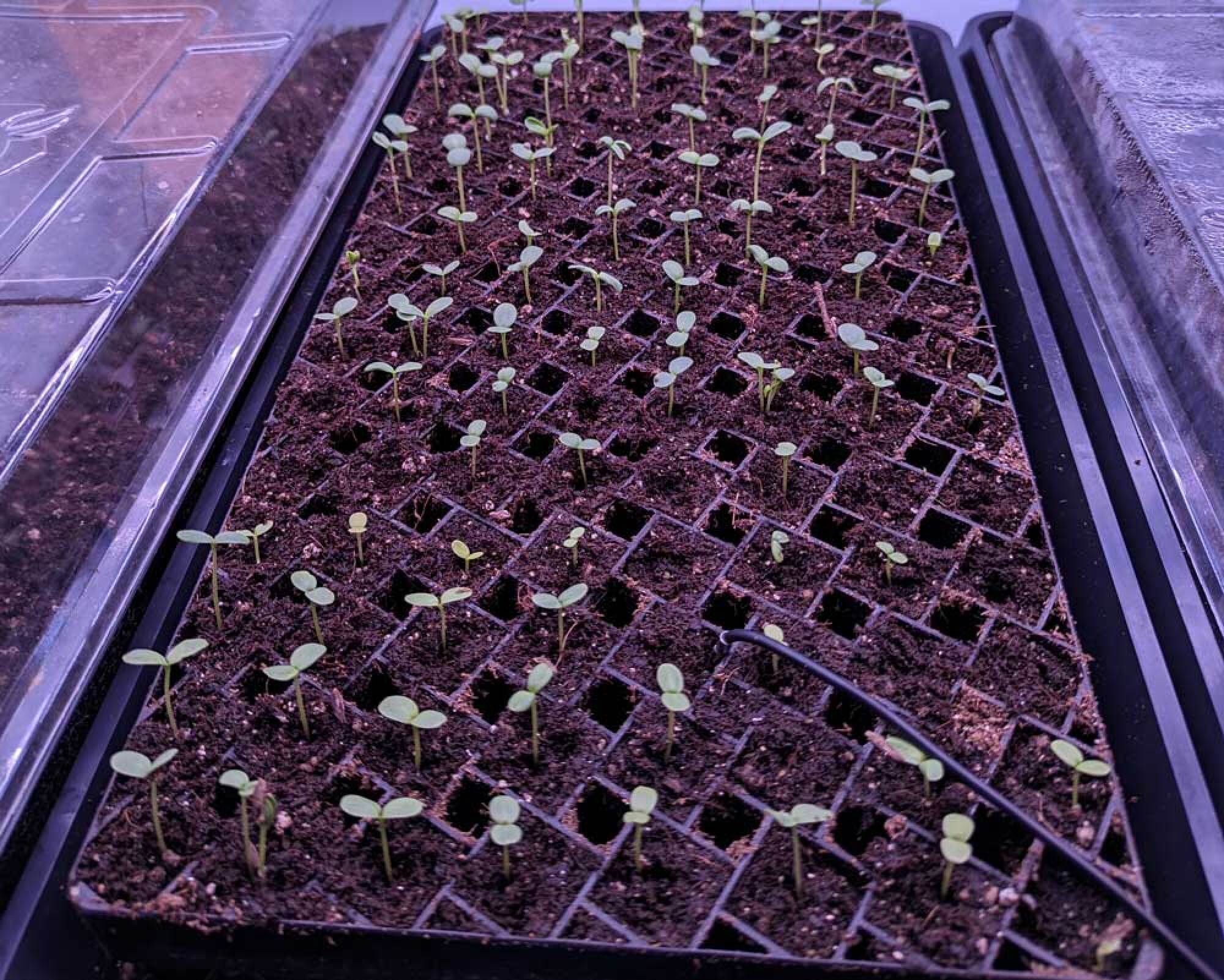
These are cotyledons, not “true leaves”
Credit: Amanda Blum

When you buy plants at the nursery, they’re priced based on the size of the pot you buy them in—a quart-sized pot versus a gallon, for instance. But if you pay attention, you’ll notice that the size of the plant in a 4-inch pot is frequently not all that different from a plant in a quart-sized pot. That’s because the plant has been up-potted, a process that is happening constantly to plants as they grow in size. One easy clue that it’s time to up-pot is that the roots are growing out holes in the seed tray. In seed trays, plants can easily become rootbound (the roots run out of room, so they start growing in circles, tangling in on themselves), so it’s important to up-pot before that happens—if you wait too long, it can stunt plants, which is the opposite of what you want. 

True leaves
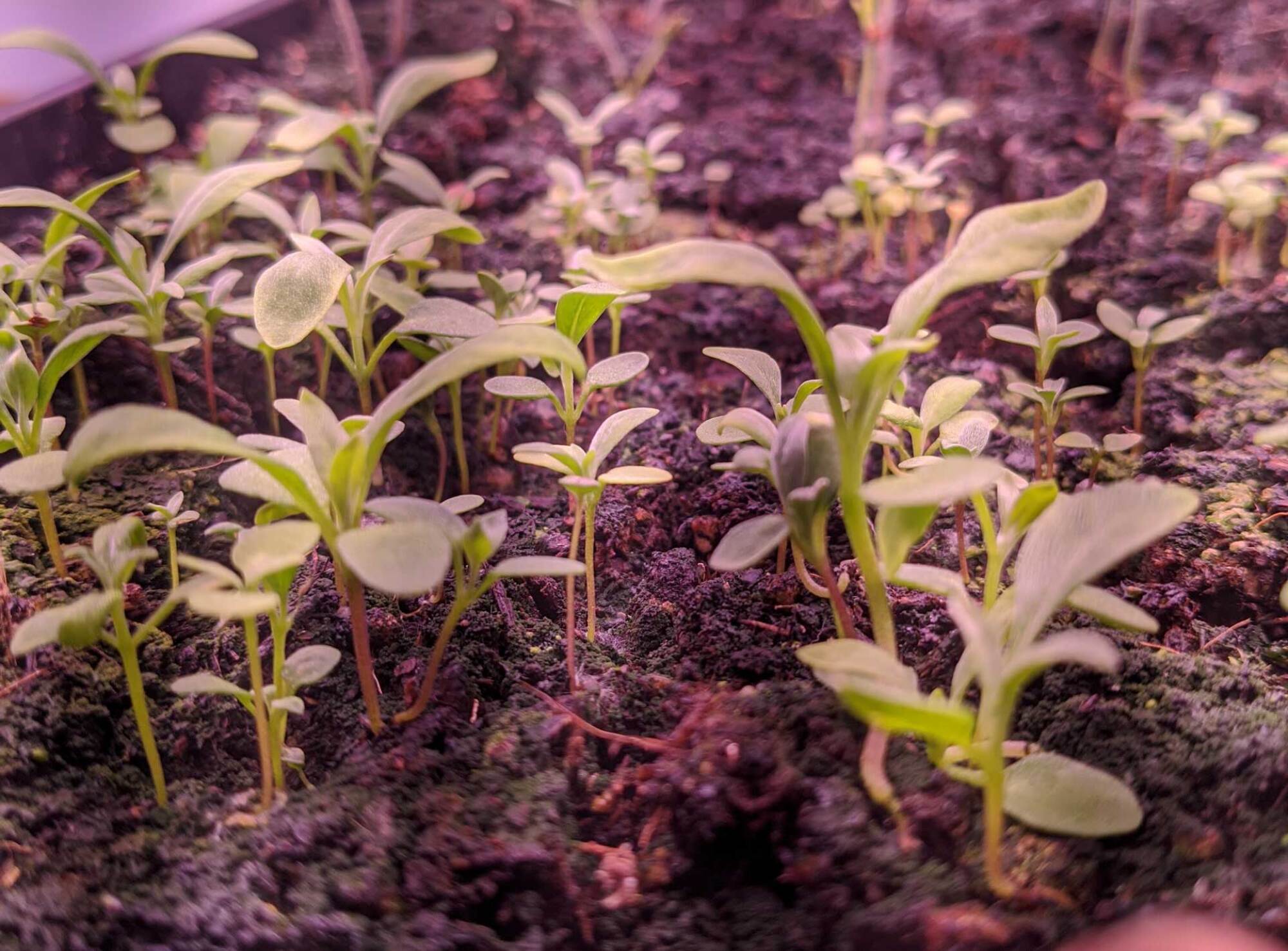
These starts have true leaves.
Credit: Amanda Blum

You can also up-pot too early, before the seedling is strong enough to survive the shock of transplanting. When vegetable and flower seeds grow, they form one or two leaves very early—these are called “cotyledons” and they are part of the seed itself. Later, the seedling will grow a second set, called the “true leaves”, because these are the first leaves that function the way leaves do. The cotyledons provide some photosynthesis, while true leaves provide actual food for the plant. These sets of leaves look quite different, and as soon as you know about cotyledons, you’ll have an easier time recognizing them in your seedlings. You can’t transplant until true leaves are established and grown in, and I’d wait even later. 

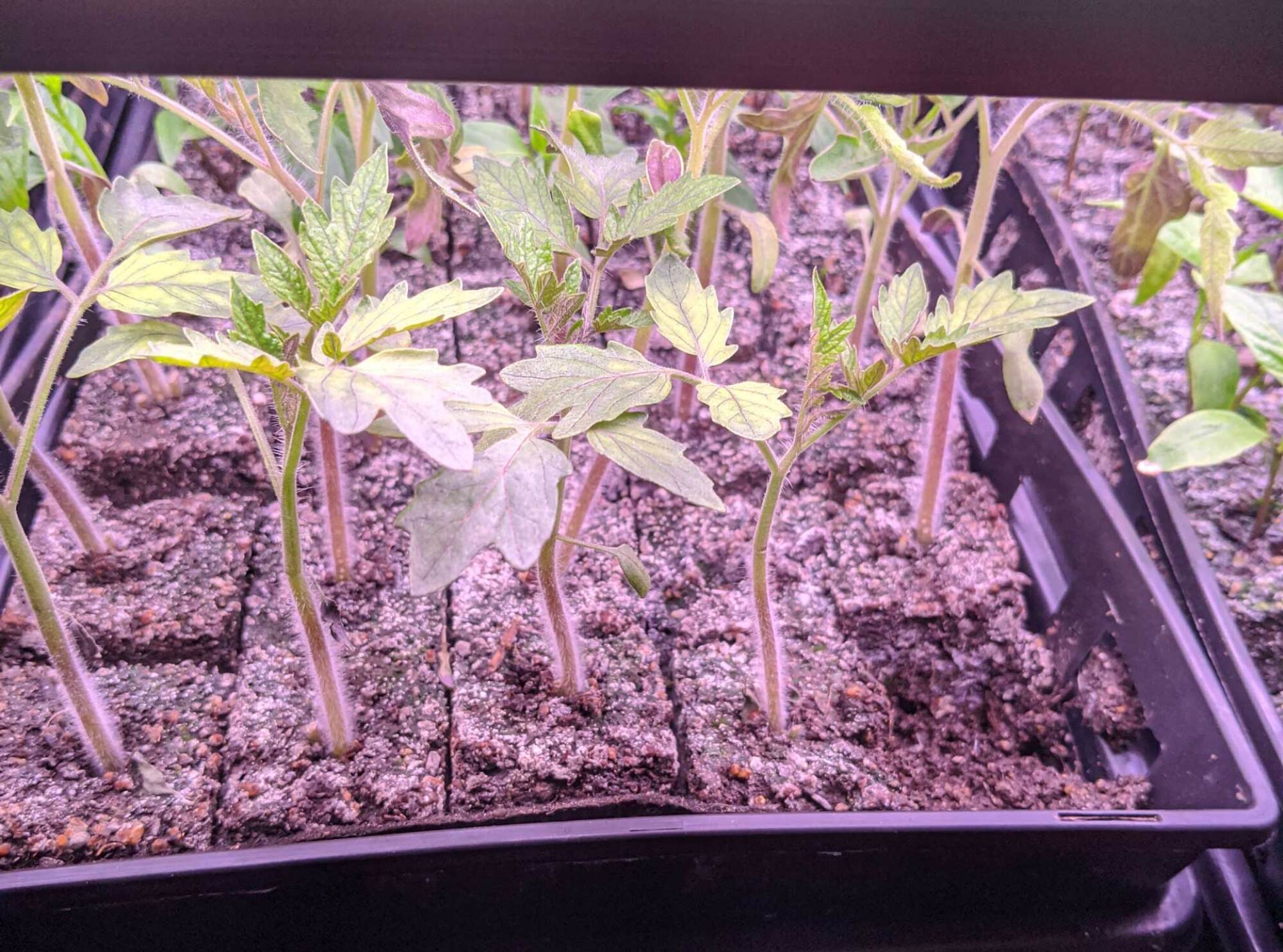
Tomatoes ready for up potting
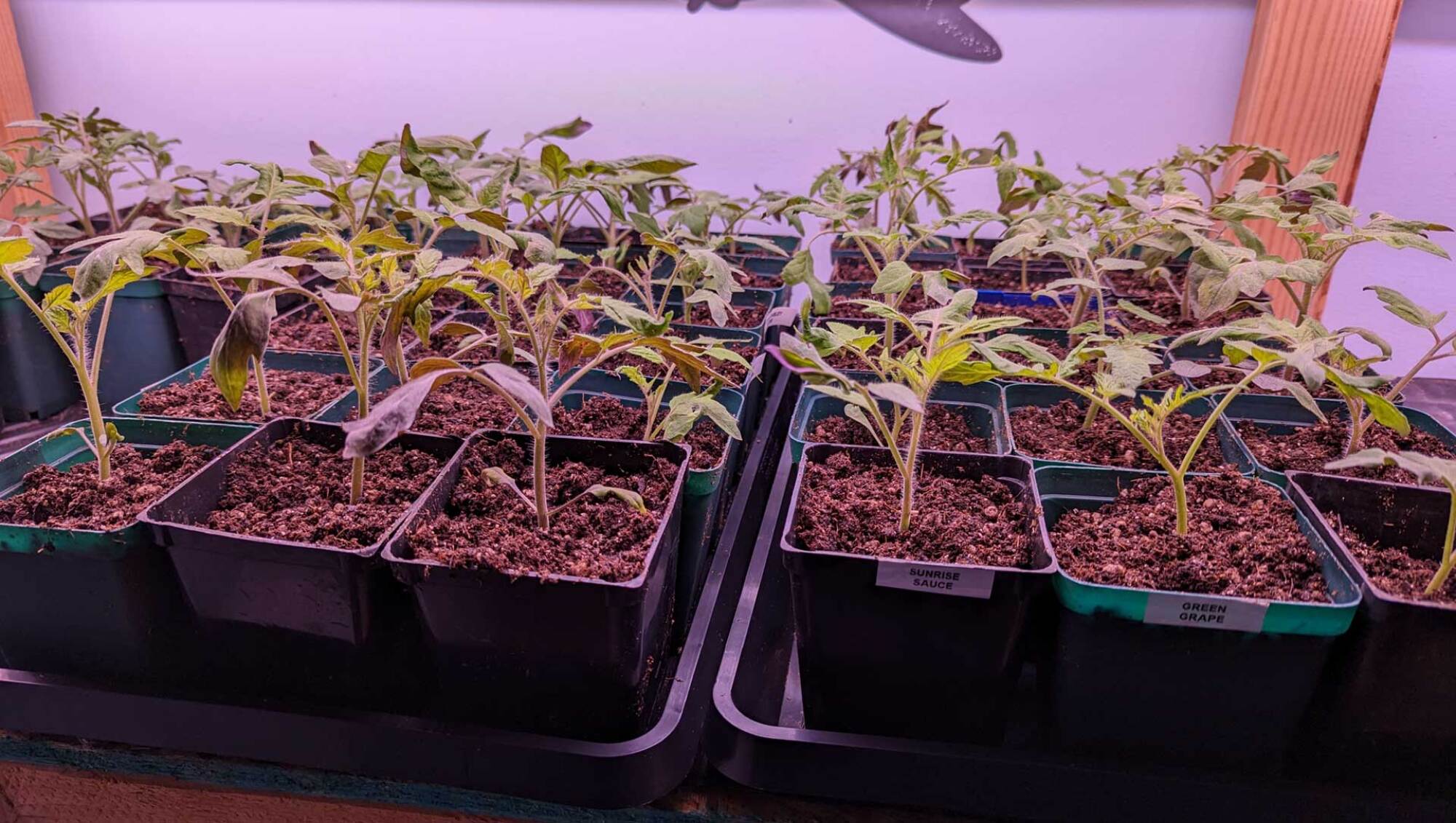
These tomatoes are ready for up-potting.
Credit: Amanda Blum

In addition to paying attention to the roots, I look at the seedlings themselves above the soil. When each seedling is running out of room to stretch, the plants are touching one another, or the seedling looks too tall for the cell or block, that’s my sign to up-pot. 

Choose the right soil for up-potting

potting soil

Credit: Amanda Blum

When you grow seedlings, you use a seedling mix—this has very little nutrients in it and is quite fine, which is all designed to help the seed grow. Now that your seeds are seedlings, they need nutrition and therefore, they’ll need a different soil mixture. When up-potting, use a potting soil, which will have nutrients in it like compost, but also ingredients to retain moisture like vermiculite. 

How to choose the right kind of pot

In most cases, you’re moving from a seed cell or block that is 0.75 inches to 2 inches in size, and so a 4-inch pot is usually appropriate. You’ll notice this at your nursery, too. In some cases, tomatoes will be up-potted to quart-sized containers, and yours might eventually need that, but it’s unlikely. 

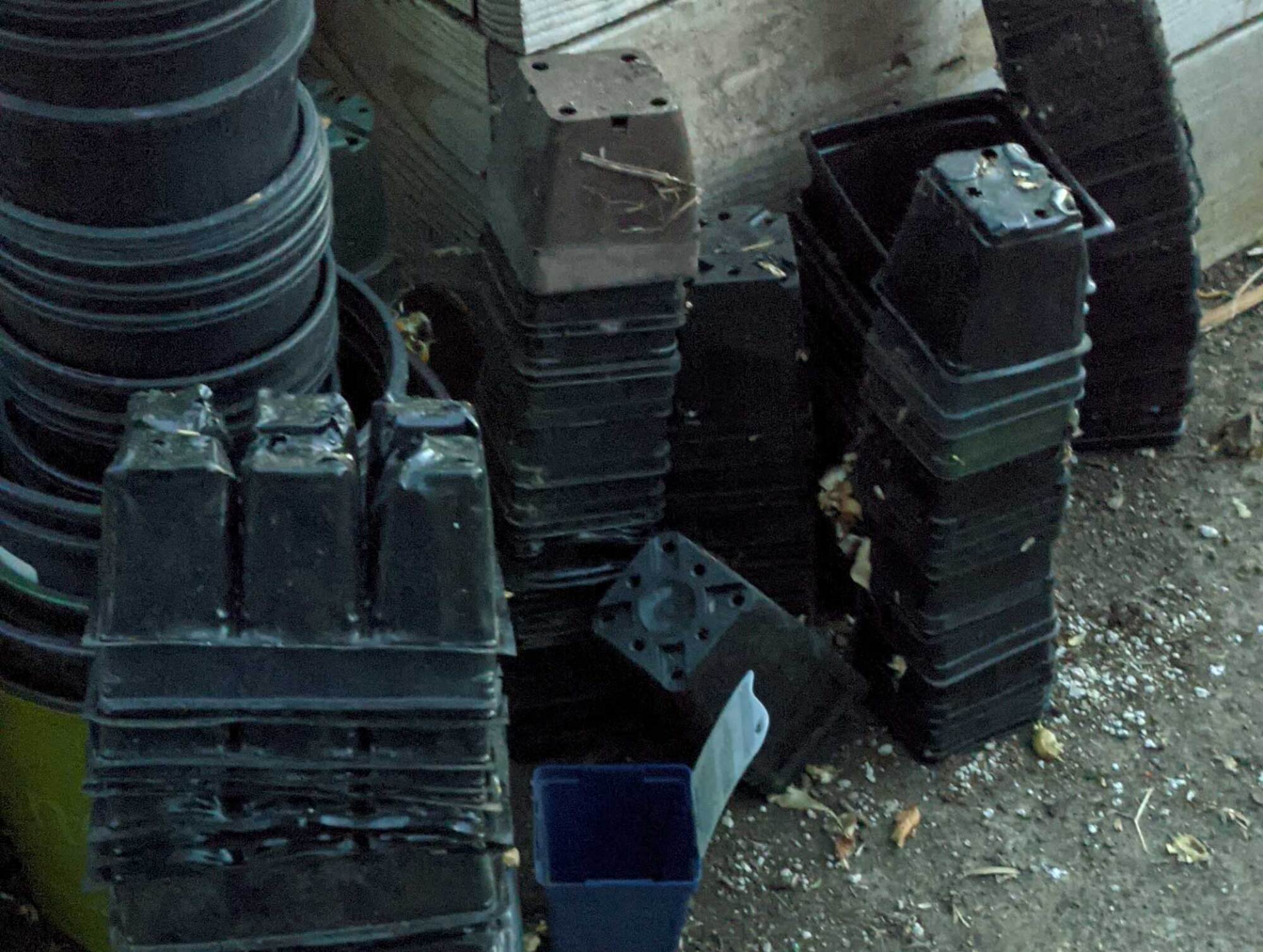
save these pots
If you’re not sitting on a collection of these disposable pots, others in your gardening group are.
Credit: Amanda Blum

A good way to save money would be to save these 3.5- or 4-inch pots from previous nursery visits, or solicit any gardening group online for them. Some nurseries may have old ones they’ll give away, too. Keep in mind that these are meant to be disposable and as such, with a good hot-water cleaning, will often break or deform. For a sturdier option, you can purchase a set of reusable, molded plastic pots, which is what I use. These stand up to cleaning and sterilizing year after year, so you rarely need to replace them and can even go through a cold or warm wash in the dishwasher. 

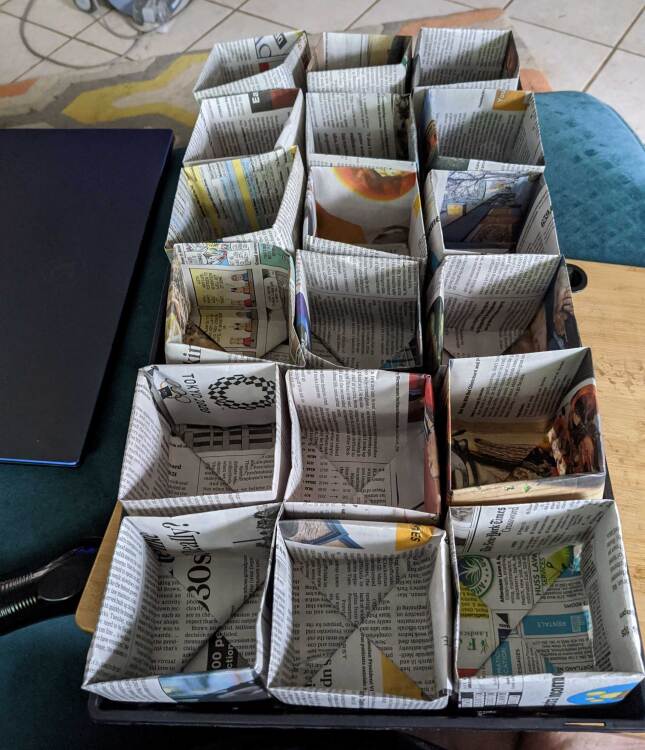
newspaper pots
I spent many nights making these newspaper pots.
Credit: Amanda Blum

However, for lots of gardeners, April is when they start making newspaper pots. Made the right way, a newspaper pot is sturdy, will decompose, and costs you nothing except time. I learned to make them from Meg Cowden of Seed to Fork. There are other variations of the paper pot out there, too, but a folded pot like this is the only one that seems to be strong enough to hold up for as long as you’ll need it. I only stopped making paper pots because it is time consuming and because I got one too many papercuts. 

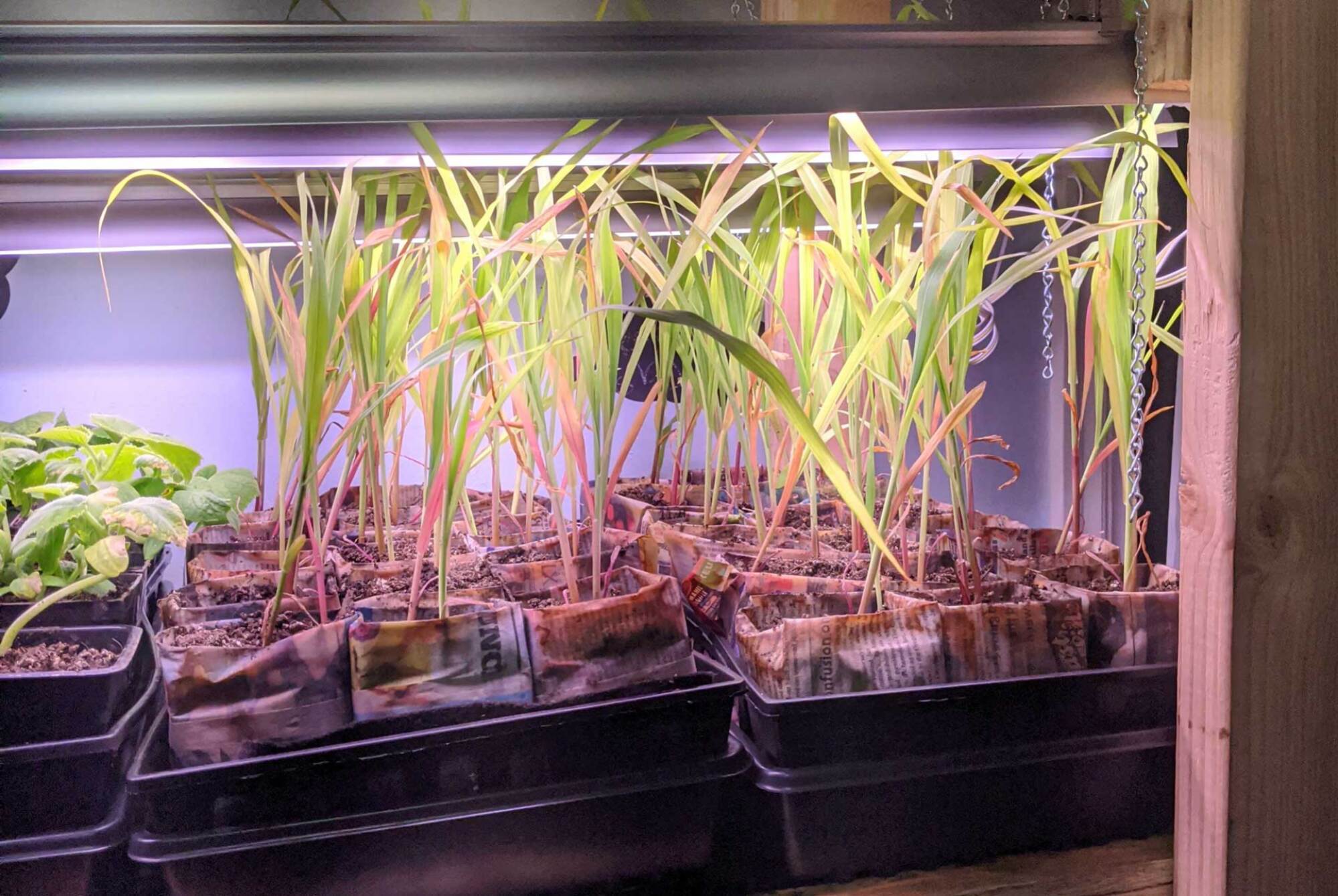
Corn in paper pots
Corn I up-potted in paper pots.
Credit: Amanda Blum

In case you were considering seed bags, I should mention that I tried them and found that they didn’t work very well. Some years ago, I thought I’d found a great, inexpensive solution for up-potting, and they could be planted outside, in the bag! But I found these to be hard to plant into, they fell over easily, and were never the right size. I’d steer clear and go with one of the other solutions I described above.

Transplanting can shock the plants, so be gentle

Many plants do not cope well with their roots being jostled around, like poppies, cucamelons and luffa; in those cases, you should grow the seedlings as close to planting time as possible to ensure you only have to transplant them once (directly into your garden) or direct sow them instead. Even for plants that don’t mind being transplanted, like tomatoes, the process is still a shock, so you want to be gentle. A lot can go wrong here, and usually it’s human-based error. Remember, you’ll be touching a lot of plants, so if one seedling has a virus or disease or fungus, you’re now using the same hands that touched that disease on all your other seedlings. Wash your hands often and don’t transplant seedlings that look diseased. Toss them (not into the compost) and wash your hands. 

Usually, people grow more than one seed in a seed cell or block in case one seed doesn’t germinate. But for beginner gardeners, it’s so hard to let go of one of those seedlings if both seeds germinate, so they’ll try to separate the seedlings and plant each into a new pot. My advice is not to do that. Part of gardening is steeling yourself to culling seedlings, and you should have done so before you get to the up-potting process. If there are still multiple seedlings in a cell at this point, cut one to the soil line and let the stronger one survive. This way, you’re not breaking apart the soil around the roots and trying to separate them. 

transplanted seedlings
Carefully labeled, up-potted tomatoes that have been buried deeply.
Credit: Amanda Blum

Remove the seedling from the tray as carefully as you can, with the soil intact. I do not water on mornings I’m planning to up-pot because the drier soil makes this process easier. You can push up from the bottom of the tray to pop out a cell of a seed tray, but this is where soil blocks shine: because there is no tray, they are much easier to move. You simply pick up the block and move it. 

When it’s time to up-pot, put 2 inches of soil into each pot and then carefully place the seedling into the center of the pot. With your hand, pour additional soil around the seedling block. Pat the soil down and give the seedling a sip of water, about a quarter of a cup. From there, the pot can go on a tray to go back under the lights. Keeping the pots on trays allows you to bottom water moving forward, if you want, but will catch water if you water from above, too. 

Remember that as you up-pot, you’re obliterating any labeling you had for your seed trays, so have a plan to label the pots as you up-pot, or you won’t know what’s in any of them. 

You can fix leggy starts when up-potting

Some plants, namely tomatoes, can form roots all along their stem. For this reason, when you move tomato seedlings or transplant them into the garden, bury the stem deeply. Up-potting is an opportunity to do so, and this can solve a problem with leggy starts. Eggplants, peppers, tomatillos, ground cherries, pumpkins, squash, melons, and potatoes can all be buried deep in the soil along the stem.

When you do this, you still want at least the two uppermost leaves to appear above the soil line.  You should remove any stems or leaves below this point and then bury the stem the appropriate depth and proceed as above. 

How to water your up-potted plants

At this point in the seedling process, you’ll feel great. Your plants are established, they look like real plants, and you’re waiting for the ground to warm enough to transplant them. Beware, though, because this is when they are most vulnerable, in my opinion. They are still inside with limited airflow and in close proximity to one another. Virus and fungus can spread quickly, and light is limited with all that new growth. 

Be careful to water just enough, but not too much. For that reason, I like to bottom water, which means you’ll place an inch or so of water in the trays the pots sit on, and allow the plants to take in the water they need, but not more. I discourage watering from above, because you don’t want the leaves wet, which leads to conditions that are more likely to spread disease. 

The plants also need some food now, so regardless of how you water, be sure you’re adding some fertilizer to the water. I like Fox Farm Vegetable fertilizer for this purpose. Follow the directions on the bottle and you should be good to go.

Trump to impose 25 percent tariffs on all cars not made in the US

President Donald Trump has signed a proclamation imposing 25 percent tariffs on “all cars that are not made in the United States” on top of taxes that are already in place. The tariffs will apply to all imported sedans, SUVs, crossovers, minivans, cargo vans and light trucks. They will also apply to key automotive components not made in the US, including engines, transmissions, powertrain parts and electrical components, and they could expand to cover additional parts if necessary. The new tariffs will take effect on April 2, and the US government expects to start collecting on April 3.

According to CNBC, the president assured automakers that there will be “absolutely no tariff” for cars made in the US. The administration is also giving automotive companies importing goods under the US-Mexico-Canada agreement time to get their US-made parts certified so that the additional taxes will only apply to the value of their non-US-made components. Trump first announced that his administration was going to impose 25 percent tariffs on automobile imports back in February. He also said at the time that the government intends to collect an additional 25 percent in taxes, or higher, on semiconductor imports. 

Trump White House aide Will Scharf said that the new automobile tariffs will earn the US “over $100 billion of new annual revenue.” European Commission’s president, Ursula von der Leyen, criticized the US government’s decision. “As I have said before, tariffs are taxes — bad for businesses, worse for consumers equally in the US and the European Union,” she said in a statement. In the White House’s announcement, however, the administration insisted that tariffs are good for the country’s economy and will not lead to inflation or an increase in prices.

This article originally appeared on Engadget at https://www.engadget.com/transportation/trump-to-impose-25-percent-tariffs-on-all-cars-not-made-in-the-us-120026997.html?src=rss

OpenAI’s new AI image generator is potent and bound to provoke

The arrival of OpenAI’s DALL-E 2 in the spring of 2022 marked a turning point in AI when text-to-image generation suddenly became accessible to a select group of users, creating a community of digital explorers who experienced wonder and controversy as the technology automated the act of visual creation.

But like many early AI systems, DALL-E 2 struggled with consistent text rendering, often producing garbled words and phrases within images. It also had limitations in following complex prompts with multiple elements, sometimes missing key details or misinterpreting instructions. These shortcomings left room for improvement that OpenAI would address in subsequent iterations, such as DALL-E 3 in 2023.

On Tuesday, OpenAI announced new multimodal image generation capabilities that are directly integrated into its GPT-4o AI language model, making it the default image generator within the ChatGPT interface. The integration, called “4o Image Generation” (which we’ll call “4o IG” for short), allows the model to follow prompts more accurately (with better text rendering than DALL-E 3) and respond to chat context for image modification instructions.

Read full article

Comments

After 50 million miles, Waymos crash a lot less than human drivers

The first ever fatal crash involving a fully driverless vehicle occurred in San Francisco on January 19. The driverless vehicle belonged to Waymo, but the crash was not Waymo’s fault.

Here’s what happened: A Waymo with no driver or passengers stopped for a red light. Another car stopped behind the Waymo. Then, according to Waymo, a human-driven SUV rear-ended the other vehicles at high speed, causing a six-car pileup that killed one person and injured five others. Someone’s dog also died in the crash.

Another major Waymo crash occurred in October in San Francisco. Once again, a driverless Waymo was stopped for a red light. According to Waymo, a vehicle traveling in the opposite direction crossed the double yellow line and crashed into an SUV that was stopped to the Waymo’s left. The force of the impact shoved the SUV into the Waymo. One person was seriously injured.

Read full article

Comments

Uber adds new shuttle rides between JFK Airport and Manhattan

Uber has new shuttle routes for NYC travelers. Less than six months after launching bus rides between LaGuardia Airport and Manhattan, the company is adding four routes between John F. Kennedy International Airport (JFK) and Manhattan.

Beginning on Thursday, you can book up to four seats for one of the new routes. You can reserve them as early as seven days in advance or as late as two minutes before you hop on. Each bus has a 14-passenger limit at launch. Much like your flight, you can bring one piece of luggage weighing up to 50 lbs and a personal item that fits in your lap or under your seat. When you get onboard, the driver will verify your identity with a QR code and PIN.

The four new routes include stops at either Port Authority Terminal and Grand Central Terminal or Chinatown and Atlantic Terminal. Each of those two Manhattan courses is split into two additional routes — one to JFK’s Terminal 4 and another to Terminal 5. They run every 30 minutes, from 5AM to 10:45PM, all week.

The JFK shuttles will typically cost “up to $25” for one way, but Uber is launching the new rides with introductory one-way pricing of $10 through April 30.

Uber says it’s booked hundreds of thousands of shuttle seats since it launched its LaGuardia routes last fall. Although it can be a handy way to get around (and cheaper than hailing a cab), there’s a free public transit shuttle running between the airport and the subway. As Redditor u/Kufat opined about Uber’s shuttles in October, “This is for tourists who think they’ll get stabbed the moment they enter the subway.”

This article originally appeared on Engadget at https://www.engadget.com/transportation/uber-adds-new-shuttle-rides-between-jfk-airport-and-manhattan-100039821.html?src=rss

Space Force Certifies Vulcan For National Security Launches

The U.S. Space Force has certified United Launch Alliance’s Vulcan Centaur rocket for national security missions after successful test flights and resolution of a booster nozzle issue. This certification allows ULA to join SpaceX in conducting launches under the National Security Space Launch program, with Vulcan missions expected to begin this summer. SpaceNews reports: “Thank you to all our customer partners who have worked hand-in-hand with us throughout this comprehensive certification process. We are grateful for the collaboration and excited to reach this critical milestone in Vulcan development,” said Tory Bruno, president and chief executive of United Launch Alliance in a ULA statement about the vehicle’s certification.

Bruno said at the roundtable that the next launch by ULA will be of its Atlas 5, carrying a set of Project Kuiper broadband satellites for Amazon. That launch is expected as soon as next month. He said then that would be followed by the first two Vulcan national security launches, missions designated USSF-106 and USSF-87. ULA did not give a schedule for those upcoming Vulcan launches but Space Systems Command, in a summary accompanying its press release, said the first NSSL mission on Vulcan is planned for the summer. Bruno said at the roundtable that the payloads for those missions have “complex processing” requirements beyond a typical mission, and did not state how long it would take them to be ready for a launch.

Bruno said ULA is projecting a dozen launches this year, split roughly evenly between Atlas and Vulcan and between national security and commercial missions. ULA has been stockpiling components, such as BE-4 engines and solid rocket boosters, needed for those missions. “We’re all staged up and ready, and as spacecraft show up, we’ll be able to fly them,” he said. He noted the company wants to get to a “baseline tempo” of two launches a month by the end of this year and perform 20 launches next year.


Read more of this story at Slashdot.

Surgeons Transplant Genetically Modified Pig Liver Into Chinese Patient

Scientists in China successfully transplanted a genetically modified pig liver into a brain-dead patient, where it functioned for 10 days. The liver, modified to reduce immune rejection, produced key proteins and bile, showing compatibility and offering hope for future short-term xenotransplants. The Guardian reports: The surgery, at a Chinese hospital last year, is thought to mark the first time a pig liver has been transplanted into a human. It raises the prospect of pig livers serving as a “bridging organ” for patients on the waiting list for a transplant or to support liver function while their own organ regenerates. […] The latest procedure was carried out in a 50-year-old man diagnosed with brain death after a severe head injury. The patient’s own liver was intact and, in a surgery that took more than 10 hours, the organ taken from a genetically modified Bama miniature pig was plumbed into his blood supply as an additional liver.

The pig had six genetic modifications aimed at preventing immune rejection. These included deactivating genes that contribute to the production of sugars on the surface of pig cells, which the human immune system attacks, and introducing genes that express human proteins to “humanize” the liver. After the transplant, the pig liver showed signs of functioning, including producing bile, which helps break down fats in the digestive system, and porcine albumin, a blood protein. The team behind the advance, described in the journal Nature, said it was not clear whether the liver would have been able to fully support the patient, given that he had an existing liver and because the liver was removed after 10 days at the request of his family.


Read more of this story at Slashdot.

OpenAI’s Viral Studio Ghibli Moment Highlights AI Copyright Concerns

An anonymous reader quotes a report from TechCrunch: It’s only been a day since ChatGPT’s new AI image generator went live, and social media feeds are already flooded with AI-generated memes in the style of Studio Ghibli, the cult-favorite Japanese animation studio behind blockbuster films such as “My Neighbor Totoro” and “Spirited Away.” In the last 24 hours, we’ve seen AI-generated images representing Studio Ghibli versions of Elon Musk, “The Lord of the Rings”, and President Donald Trump. OpenAI CEO Sam Altman even seems to have made his new profile picture a Studio Ghibli-style image, presumably made with GPT-4o’s native image generator. Users seem to be uploading existing images and pictures into ChatGPT and asking the chatbot to re-create it in new styles.

OpenAI’s latest update comes on the heels of Google’s release of a similar AI image feature in its Gemini Flash model, which also sparked a viral moment earlier in March when people used it to remove watermarks from images. OpenAI’s and Google’s latest tools make it easier than ever to re-create the styles of copyrighted works — simply by typing a text prompt. Together, these new AI image features seem to reignite concerns at the core of several lawsuits against generative AI model developers. If these companies are training on copyrighted works, are they violating copyright law?

According to Evan Brown, an intellectual property lawyer at the law firm Neal & McDevitt, products like GPT-4o’s native image generator operate in a legal gray area today. Style is not explicitly protected by copyright, according to Brown, meaning OpenAI does not appear to be breaking the law simply by generating images that look like Studio Ghibli movies. However, Brown says it’s plausible that OpenAI achieved this likeness by training its model on millions of frames from Ghibli’s films. Even if that was the case, several courts are still deciding whether training AI models on copyrighted works falls under fair use protections. “I think this raises the same question that we’ve been asking ourselves for a couple years now,” said Brown in an interview. “What are the copyright infringement implications of going out, crawling the web, and copying into these databases?”


Read more of this story at Slashdot.

Scientists Record First Sounds Ever Known To Be Made By Sharks

sciencehabit quotes a report from Science.org: Whales sing, orcas squeal, and sea turtles croak. But sharks are more the strong, silent type. Now, researchers report the first evidence that sharks make sounds, too, described today in Royal Society Open Science. The animals may be making the sounds — a series of clicking noises — by snapping their flat rows of teeth, which are blunt for crushing prey. The sharks can hear mostly low-frequency noise, and the clicks they emit are higher pitched, which suggests they are not for communicating with other rigs. It’s possible they are a defensive tactic. Marine mammals that eat rigs, such as leopard seals, can hear in the frequency range of the rig clicks, but the researchers question whether a few clicks would deter an attack. The sounds might be part of their response to being startled, the team says.


Read more of this story at Slashdot.

JPMorgan Says Quantum Experiment Generated Truly Random Numbers

JPMorgan Chase used a quantum computer from Honeywell’s Quantinuum to generate and mathematically certify truly random numbers — an advancement that could significantly enhance encryption, security, and financial applications. The breakthrough was validated with help from U.S. national laboratories and has been published in the journal Nature. From a report: Between May 2023 and May 2024, cryptographers at JPMorgan wrote an algorithm for a quantum computer to generate random numbers, which they ran on Quantinuum’s machine. The US Department of Energy’s supercomputers were then used to test whether the output was truly random. “It’s a breakthrough result,” project lead and Head of Global Technology Applied Research at JPMorgan, Marco Pistoia told Bloomberg in an interview. “The next step will be to understand where we can apply it.”

Applications could ultimately include more energy-efficient cryptocurrency, online gambling, and any other activity hinging on complete randomness, such as deciding which precincts to audit in elections.


Read more of this story at Slashdot.

Fidelity Prepares To Unveil Its Own Stablecoin

According to the Financial Times, Fidelity Investments is in advanced stages of developing its own stablecoin. Binance reports: The Boston-based financial services giant plans for the token to serve as a form of digital cash, according to the report, which cites two people close to the matter. The token would form part of company’s strategy to enter the tokenized government bonds market. Stablecoins are a cryptocurrency whose value is pegged to a real-world asset such as the U.S. dollar or gold. They provide a convenient way for crypto traders to preserve their fiat value without having to cash out of the market.

The news emerges just days after Fidelity filed paperwork to register a blockchain-based version of its U.S. dollar money market fund. The company seeks to register an “OnChain” share class of its Treasury Digital Fund (FYHXX), which holds cash and U.S. Treasury securities and is available only to Fidelity’s hedge fund and institutional clients. A Fidelity stablecoin could fill the role of cash in this fund. The report comes a day after World Liberty Financial, a crypto venture backed by Donald Trump and his family, launched a U.S. dollar-pegged stablecoin called USD1.


Read more of this story at Slashdot.

Linux Kernel 6.14 Is a Big Leap Forward In Performance, Windows Compatibility

An anonymous reader quotes a report from ZDNet, written by Steven Vaughan-Nichols: Despite the minor delay, Linux 6.14 arrives packed with cutting-edge features and improvements to power upcoming Linux distributions, such as the forthcoming Ubuntu 25.04 and Fedora 42. The big news for desktop users is the improved NTSYNC driver, especially those who like to play Windows games or run Windows programs on Linux. This driver is designed to emulate Windows NT synchronization primitives. What that feature means for you and me is that it will significantly improve the performance of Windows programs running on Wine and Steam Play. […] Gamers always want the best possible graphics performance, so they’ll also be happy to see that Linux now supports recently launched AMD RDNA 4 graphics cards. This approach includes support for the AMD Radeon RX 9070 XT and RX 9070 graphics cards. Combine this support with the recently improved open-source RADV driver and AMD gamers should see the best speed yet on their gaming rigs.

Of course, the release is not just for gamers. Linux 6.14 also includes several AMD and Intel processor enhancements. These boosts focus on power management, thermal control, and compute performance optimizations. These updates are expected to improve overall system efficiency and performance. This release also comes with the AMDXDNA driver, which provides official support for AMD’s neural processing units based on the XDNA architecture. This integration enables efficient execution of AI workloads, such as convolutional neural networks and large language models, directly on supported AMD hardware. While Rust has faced some difficulties in recent months in Linux, more Rust programming language abstractions have been integrated into the kernel, laying the groundwork for future drivers written in Rust. […] Besides drivers, Miguel Ojeda, Rust for Linux’s lead developer, said recently that the introduction of the macro for smart pointers with Rust 1.84: derive(CoercePointee) is an “important milestone on the way to building a kernel that only uses stable Rust functions.” This approach will also make integrating C and Rust code easier. We’re getting much closer to Rust being grafted into Linux’s tree.

In addition, Linux 6.14 supports Qualcomm’s latest Snapdragon 8 Elite mobile processor, enhancing performance and stability for devices powered by this chipset. That support means you can expect to see much faster Android-based smartphones later this year. This release includes a patch for the so-called GhostWrite vulnerability, which can be used to root some RISC-V processors. This fix will block such attacks. Additionally, Linux 6.14 includes improvements for the copy-on-write Btrfs file system/logical volume manager. These primarily read-balancing methods offer flexibility for different RAID hardware configurations and workloads. Additionally, support for uncached buffered I/O optimizes memory usage on systems with fast storage devices. Linux 6.14 is available for download here.


Read more of this story at Slashdot.

YouTube is changing how it calculates views for Shorts

YouTube Shorts has introduced a change that brings analytics for its bite-sized video option into closer parity with rival services TikTok and Instagram. The video platform will remove the minimum play time requirement it previously had for a user watching a clip to count as a view.

Beginning March 31, a “view” will be added any time a YouTube Short is played or replayed. This will likely mean that creators will see higher view counts after the change takes place. YouTube will continue to track “engaged views,” which measure the number of times a clip was played “for a certain number of seconds.” YouTube clarified that the shift would not impact Creator earnings or their eligibility for the YouTube Partner Program; both will continue to be assessed by the engaged view metric.

Both Instagram and TikTok have defined a “view” as the number of times a video starts playing, although those platforms also offer metrics for tracking time spent watching a piece of content. Considering YouTube Shorts, Instagram and TikTok have each claimed upwards of a billion monthly users, it makes sense that they count views similarly so that creators can better assess how many of those people they are reaching across the services.

This article originally appeared on Engadget at https://www.engadget.com/social-media/youtube-is-changing-how-it-calculates-views-for-shorts-233058880.html?src=rss

Over 4 Million Gen Zers Are Jobless

Fortune reports that over 4 million Gen Zers are currently not in education, employment, or training (NEET), with experts blaming a broken educational system and “worthless degrees” for failing to deliver on promises of career readiness. From the report: While some Gen Zers may fall into this category because they are taking care of a family member, many have become frozen out of the increasingly tough job market where white-collar jobs are becoming seemingly out of reach. In the U.S., this translates to an estimated over 4.3 million young people not in school or work. Across the pond in the U.K., the situation is also only getting worse, with the number of NEET young people rising by over 100,000 in the last year alone.

A British podcaster went so far as to call the situation a “catastrophe” — and cast a broad-stroke blame on the education system. “In many cases, young people have been sent off to universities for worthless degrees which have produced nothing for them at all,” the political commentator, journalist and author, Peter Hitchens slammed colleges last week. “And they would be much better off if they apprenticed to plumbers or electricians, they would be able to look forward to a much more abundant and satisfying life.” With millions of Gen Zers waking up each day feeling left behind, there needs to be a “wake-up call” that includes educational and workplace partners stepping up, Jeff Bulanda, vice president at Jobs for the Future, tells Fortune.


Read more of this story at Slashdot.

Utah just became the first state in the country to pass an age verification law for app stores

Utah Governor Spencer Cox has signed the App Store Accountability Act into law, making it the first state to require that app store makers verify their users’ ages. Under this law, people in Utah will need to be over age 18 to make a new account with an app store; underage users will either need to link their account to a parent’s so that the adult can give permission for the child to use certain apps.

The legislation is intended to protect children and teens, according to bill sponsor Todd Weiler, a Republican state senator. However, it has also raised questions about privacy and where the burden of responsibility falls to ensure that underage users don’t see inappropriate content. Meta, Snap and X have supported the measure. “We applaud Governor Cox and the State of Utah for being the first in the nation to empower parents and users with greater control over teen app downloads, and urge other states to consider this groundbreaking approach,” the three companies said in a joint statement Wednesday. “This approach spares users from repeatedly submitting personal information to countless individual apps and online services.”

Google, which runs the Play Store, had opposed the bill, and called on the governor to veto the measure. We’ve reached out to Apple and Google for comment now that the bill has been signed into law.

As it stands, the App Store Accountability Act is slated to take effect on May 7, but it seems likely that it will face legal challenges. Digital privacy groups have opposed the law and others like it, noting security concerns about how sensitive age verification data will be used or protected. Other state laws requiring online services to confirm users’ ages have also prompted lawsuits.

This article originally appeared on Engadget at https://www.engadget.com/big-tech/utah-just-became-the-first-state-in-the-country-to-pass-an-age-verification-law-for-app-stores-225846117.html?src=rss

US Expands Export Blacklist To Keep Computing Tech Out of China

The U.S. has added 80 entities to its export blacklist to prevent China from acquiring advanced American chips for military development, including AI, quantum tech, and hypersonic weapons. The Verge reports: More than 50 of the new entities added to the list are based in China, with others located in Iran, Taiwan, Pakistan, South Africa, and the United Arab Emirates. BIS says the restrictions have been applied to entities that acted “contrary to US national security and foreign policy,” and are intended to hinder China’s ability to develop high-performance computing capabilities, quantum technologies, advanced artificial intelligence, and hypersonic weapons.

Six of the newly blacklisted entities are subsidiaries of Inspur Group — China’s leading cloud computing service provider and a major customer for US chip makers such as Nvidia, AMD, and Intel — which BIS alleges had contributed to projects developing supercomputers for the Chinese military. The Beijing Academy of Artificial Intelligence is another addition to the list, which has criticized its inclusion. “American technology should never be used against the American people,” said Jeffrey Kessler, Under Secretary of Commerce for Industry and Security. “BIS is sending a clear, resounding message that the Trump administration will work tirelessly to safeguard our national security by preventing U.S. technologies and goods from being misused for high performance computing, hypersonic missiles, military aircraft training, and UAVs that threaten our national security.”


Read more of this story at Slashdot.

Business Schools Are Back

An anonymous reader shares a report: After years of decline, the number of applications to the country’s two-year MBA programs rebounded in 2024 — rising 19%, according to a survey by the Graduate Management Admission Council. The pandemic saw a blossoming of new ways to deliver an MBA, but tradition has reasserted itself: The biggest growth last year was in conventional two-year and part-time programs.

As in recent years, the great majority of student demand came from overseas, but applications from the US rose as well. While the two-year class graduating this spring included record levels of international students at many institutions, most of the top 20 schools as ranked by Bloomberg Businessweek welcomed classes last fall with a reduced international presence. Given the Trump administration’s hostility to immigration, the graduating class of 2025 could prove to be the high-water mark for international MBA students in the US for at least the near future.


Read more of this story at Slashdot.

After a spacecraft was damaged en route to launch, NASA says it won’t launch

Three weeks ago, NASA revealed that a shipping container protecting a Cygnus spacecraft sustained “damage” while traveling to the launch site in Florida.

Built by Northrop Grumman, Cygnus is one of two Western spacecraft currently capable of delivering food, water, experiments, and other supplies to the International Space Station. This particular Cygnus mission, NG-22, had been scheduled for June. As part of its statement in early March, the space agency said it was evaluating the NG-22 Cygnus cargo supply mission along with Northrop.

On Wednesday, after a query from Ars Technica, the space agency acknowledged that the Cygnus spacecraft designated for NG-22 is too damaged to fly, at least in the near term.

Read full article

Comments