Microsoft is Redesigning the Windows BSOD And It Might Change To Black

Microsoft has announced that it’s overhauling its Blue Screen of Death error message in Windows 11. From a report: The new design drops the traditional blue color, frowning face, and QR code in favor of a simplified screen that looks a lot more like the black screen you see when Windows is performing an update. It’s not immediately clear if this new BSOD will remain as a black screen once Microsoft ships the final version of this update.

“We’re previewing a new, more streamlined UI for unexpected restarts which better aligns with Windows 11 design principles and supports our goal of getting users back into productivity as fast as possible,” explains Microsoft in a blog post about the change. “We’ve simplified your experience while preserving the technical information on the screen.”


Read more of this story at Slashdot.

The Out-of-Touch Adults’ Guide to Kid Culture: Incels and the 80/20 Rule

The real 80/20 rule, also known as the Pareto Principle, is a saying that asserts 80% of outcomes come from 20% of all causes. You can use it to organize your to-do list, among other things. But to many young men, 80/20 means something very different.

Young men are not alright. Masculinity is growing more toxic by the day. Online incel communities are growing, and the most receptive audience to poisonous ideas about gender seems to be children. This week’s column isn’t going to be fun: I’m explaining one of the guiding principles of the incel movement, and discussing a TikToker devoted to changing her red pill son’s mind. And I can’t talk about toxic masculinity without mentioning Elon Musk!

Spray some deodorizer and let’s jump into the dank, upsetting world of incel beliefs.

What is the 80/20 rule?

The Netflix series Adolescence, is currently the buzziest show on streaming, a harrowing exploration of the inner world of an angry young boy accused of murdering one of his classmates, a girl who spurned him. One of the teenage characters mentions the “80/20 rule” as a way of explaining the incel/red pill culture that’s central to the murder plot. Put simply, the 80/20 rule is an axiom that states 80% of women are attracted to only 20% of men, and understanding the pervasiveness of this belief is essential to understanding online misogyny.

Different communities of toxic dudes believe different weird things—many “looksmaxxers” think breaking your own facial bones can make you more attractive; red pill dudes believe men have to psychologically manipulate women into liking them—but the 80/20 rule is nearly universally accepted.

The idea seems to have originated in a post on Medium that was written 10 years ago. Taken on its own terms, the article is a fairly interesting, though methodologically flawed, look at the distribution of “likes” on dating site Tinder. Incel types ignored the problems with the research, ignored the context (it’s only about Tinder likes), and accepted the 80/20 Rule as a hard-to-swallow truth that explains how women relate to men. Even though the Medium post concludes that most men who want to meet women would be “better off just going to a bar or joining some coed recreational sports team” than using Tinder, incels decided the 80/20 rule meant something like “all women are shallow,” and/or “it’s not my fault that no woman wants to spend time with me.”

For 10 years, incels and the incel-adjacent have expanded on the theory and repeated it to each other so many times that it’s rarely questioned in those spaces. If anyone you’re talking to mentions the 80/20 rule in an affirmative context, you know you’re talking to someone who has a specific set of (wrong) beliefs, and who doesn’t have a large enough social circle to compare what they read on the internet to the way people act in real life. But is there anything you can do about it? Maybe.

Viral video of the week: De-pilling a red pill son

The creator of in this week’s viral video, IAmRchlPrkr, is a mother trying to deprogram her teenage son. He has accepted some beliefs of the “red pill” community, a branch of incels, and she is not into it.

She first saw the problem when her child told her “all women are gold-diggers.” There’s a lot going on with that phrase. Despite bristling and yelling “not all men!” when anyone generalizes their own gender, the toxic male community is dominated by the idea that women are all the same: a Borg-like collective looking for the most attractive 20% of men, or the men with the most gold to dig.

This isn’t new. In her 1998 book Intercourse, Andrea Dworkin could have been describing the incels of 2025 when she wrote, “the first tenet of male supremacist ideology is that men have a self and that women must, by definition, lack it.” The difference is how sexist ideas that were once relegated to obscure corners of society have infiltrated the mainstream to the extent that literal children are repeating them to their mothers. (As with most of societal ills, we can thank the internet for that.)

Maybe this TikToker mom has the right approach to returning some sanity: When her son tells her, “all women are gold-diggers,” she responds with “Which women?” and “name one woman who is a gold-digger.” Of course he can’t. Because the incel philosophy falls apart in the face of actual relationships with real humans.

What is “serious hat Soyjack?”

A fitting response to me quoting Andrew Dworkin in an earnest post about online masculinity is serious hat Soyjak:

Serious Hat Sojak

Credit: SoyGemVault – Deviant Art

Created by DevianArt user SoyGemArt, Serious Hat is a Wojak posted to comment on people who are, well, too serious online.

(If you’re asking “what’s a wojak?” I have previously covered the subject.)

Elon musk gamer drama continues

Speaking of toxic men: Elon Musk! If you’re an adult, you probably know Musk best as the CEO of an electric car company or as a dedicated public servant with creative ideas about how forks work. But kids know a different Elon Musk: Gamer Elon. Gamer Elon is seen as the ultimate sweat, and Gamer Elon recently mixed it up on X with the official account of video game Assassin’s Creed and got roasted like a Costco chicken.

The online dust-up started when ex-game developer @grummz made a post about streamer Hasan Piker, who he labeled a terrorist (because that’s what you do on X when you disagree with someone about public policy):


This Tweet is currently unavailable. It might be loading or has been removed.

This led Musk, who is a grown adult, to post:


This Tweet is currently unavailable. It might be loading or has been removed.

And then:


This Tweet is currently unavailable. It might be loading or has been removed.

At this point, the official account of the video game at the center of the fight Assassin’s Creed: Shadows brought gasoline to the flame war.


This Tweet is currently unavailable. It might be loading or has been removed.

The Assassin’s Creed post was viewed over 52 million times. It references the all-but-confirmed rumor that Elon Musk, a grown adult with a major position of power within the United States government, pays someone so gamers will think he’s really good at Path of Exile 2, a video game where you pretend to be an elf.

What does “come eat lobster with a monster” mean?

I don’t want to leave you with all these toxic men, so let’s end with a funny meme.

Back in 2020, then-Twitter user @blanketm9 changed the world forever when they tweeted:


This Tweet is currently unavailable. It might be loading or has been removed.

Their post lay dormant until 2023, when a user (whose original post and name has been lost to history) added the context of a text conversation, complete with a “straight man.”

Lobster with a monster meme

Credit: iFunny

Things were quiet for a couple years, then, for reasons unknown, the meme started truly taking off this month. I guess the time is right for posts like these:


This Tweet is currently unavailable. It might be loading or has been removed.


This Tweet is currently unavailable. It might be loading or has been removed.


This Tweet is currently unavailable. It might be loading or has been removed.


This Tweet is currently unavailable. It might be loading or has been removed.

Bose Headphones Are Flying Off Amazon Shelves At Big Spring Sale Discounts

Bose Headphones Are Flying Off Amazon Shelves At Big Spring Sale Discounts
Amazon’s Big Spring Sale ends tonight, so now is a better time than ever to find some solid deals on some of the best consumer headphones from Bose (and more). We’ve compiled some of our favorites from the audio brand plus threw in some nice alternatives, because—you know—options are good. Without further ado…

Starting with the top dog

Final Fantasy IX Remake Teased As Classic Game Celebrates 25th Anniversary

Final Fantasy IX Remake Teased As Classic Game Celebrates 25th Anniversary
As the years have passed, video games are no longer become a mere novelty for the masses. With serious time behind them, they’re now becoming iconic in many respects, with some celebrating hefty anniversaries. Such is the case with Square Enix’s Final Fantasy IX, which is seeing its 25th anniversary coming up. 

Originally released on Sony’s

ASUS ROG Crosshair X870E Extreme Motherboard Pictured And It Looks Slick

ASUS ROG Crosshair X870E Extreme Motherboard Pictured And It Looks Slick
It looks as though ASUS is readying a new flagship socket AM5 (LGA 1718) motherboard for AMD’s Ryzen 9000 series processors based on Zen 5 (as well as previous gen Zen 4 chips based on the same socket). Either that or somebody meticulously crafted convincing-looking renders showcasing the front and pack, as well as the retail packaging.

Occam’s

Apple’s M4 MacBook Air is $50 off in the Amazon Spring Sale

We’ve reached the final day of Amazon’s Spring Sale, but there are still plenty of great deals to shop. That list includes a $50 price cut on our pick for best MacBook overall this year, Apple’s 2025 MacBook Air M4. The 13-inch, 16GB model is available for $949, down from $999. 

Apple only released the new MacBook Air M4 in mid-March. It scored a 92 in our review, thanks to features like its M4 chip. The 13-inch base model boasts a 10-core CPU, 8-core GPU and 16-core Neural Engine. It also has an excellent battery life, lasting more than 18 hours while playing HD video. 

The 2025 MacBook Air M4 is also well done from an exterior standpoint. It has a 13.6-inch liquid retina display and it’s very lightweight. The smaller model (it’s also available, and on sale, in a 15-inch option) is 0.44 inches thick and weighs 2.7 pounds. 

This article originally appeared on Engadget at https://www.engadget.com/deals/apples-m4-macbook-air-is-50-off-in-the-amazon-spring-sale-132413964.html?src=rss

Big brands are spending small sums on X to stay out of Musk’s crosshairs

Big brands are allocating small amounts of their advertising budget to Elon Musk’s X, seeking to avoid being seen as boycotting the social media platform and triggering a public fallout with its billionaire owner.

Multiple marketing executives told the Financial Times that companies have felt pressure to spend a nominal sum on X following Musk’s high-profile role in US President Donald Trump’s administration.

They said Musk’s pursuit of legal action against groups that have stopped advertising since his $44 billion acquisition in late 2022 had also sparked alarm. X last month added about half a dozen more companies to its case including Shell, Nestlé, Pinterest, and Lego.

Read full article

Comments

Trump on car tariffs: “I couldn’t care less if they raise prices”

Late last week, President Donald Trump decided to upend the automotive industry by levying a new 25 percent import tariff on all imported cars, which goes into effect on April 2. An additional 25 percent tariff on car parts is set to go into effect within the next month, which promises to make US-made cars more expensive as well, as many parts and subassemblies used in domestic manufacturing come from suppliers in Canada or Mexico.

During the election campaign (and in the years preceding it), Trump repeatedly claimed that the cost of tariffs would be borne by the exporters. But tariffs don’t work that way—they’re paid by the importer, at the time of import.

The White House does not appear to have any concerns about this, despite a report in The Wall Street Journal last week claiming that Trump had warned automakers not to pass the costs on to their customers.

Read full article

Comments

You Can Now Make WhatsApp the Default Calling and Messaging App on Your iPhone

In the iOS 18.2 update, Apple gave users a dedicated Default Apps tab, finally letting us pick our own default apps for messages and calls. Unfortunately, not many apps have been updated to take advantage of this yet. I previously talked about DefaultSMS, which takes over the default messaging app and redirects it to WhatsApp, Signal, or Telegram, but at least one of those now has an official option that you can use instead.

Yes, WhatsApp has finally been updated the to support the Default Apps feature. This means you can now make WhatsApp the default Calling and Messaging app on iPhone. But does this mean you can stop using the Phone app and Messaging app altogether? Not exactly.

Think of it more like a shortcut. When applicable, you can use this feature to quickly call someone using WhatsApp Audio, or open up a text conversation in WhatsApp, directly from the Phone app or anywhere you see a phone number.

How to make WhatsApp the default app for calls and messages

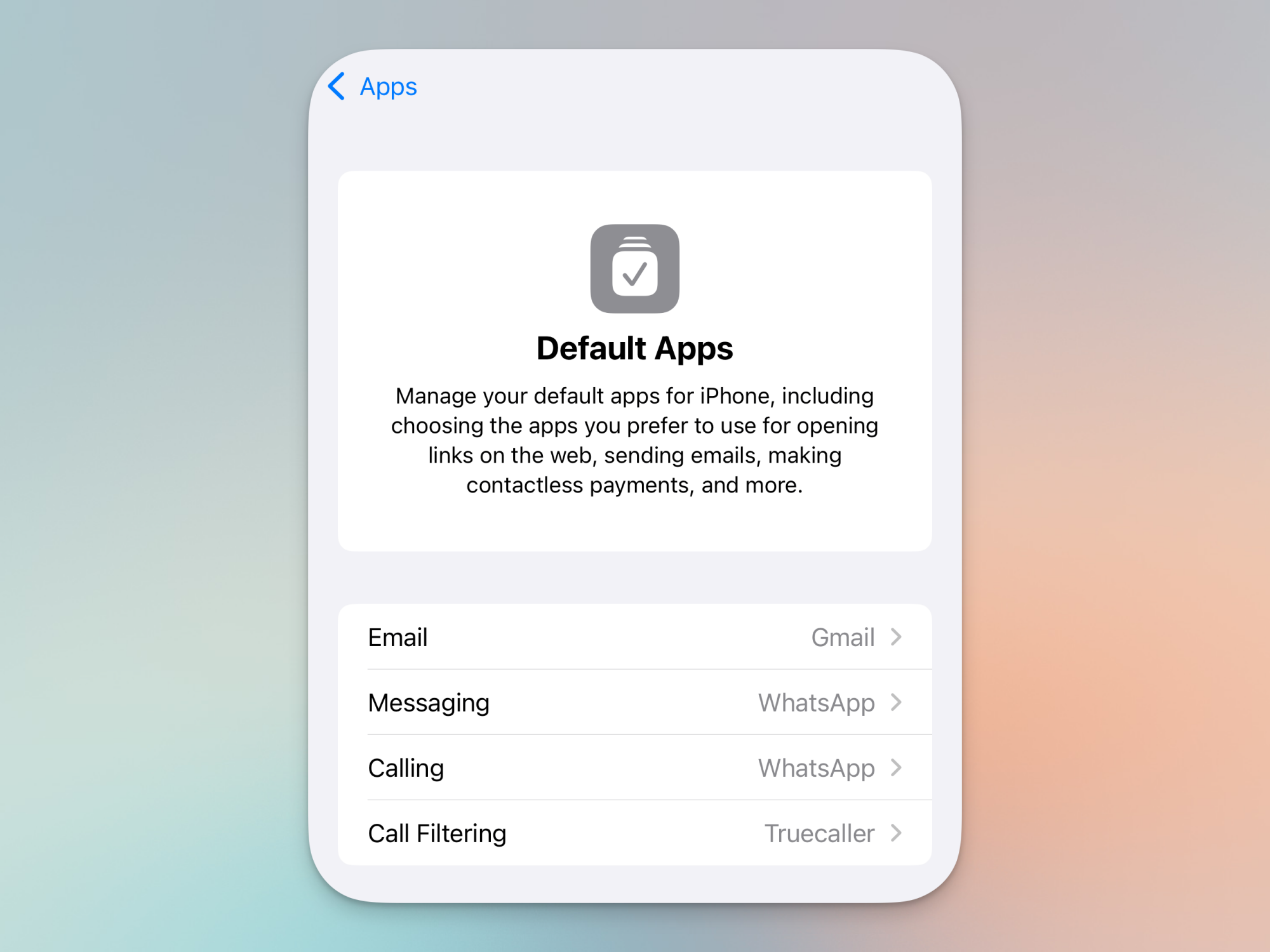
First, let’s talk about how to make this happen. On your iPhone running the latest iOS 18 build, go to Settings > Apps > Default Apps.

Default Apps hub in Settings for iPhone.

Credit: Khamosh Pathak

Scroll to the Messaging and Calling sections. Here, choose WhatsApp as the default.

How the iPhone’s default calling and messaging app features work

The default feature doesn’t mean that you can simply replace the Phone app and Messages app. When you get an incoming SMS or Apple iMessage, it will still show up in the Messages app. And when you get a phone call, you’ll still see it in the Phone app.

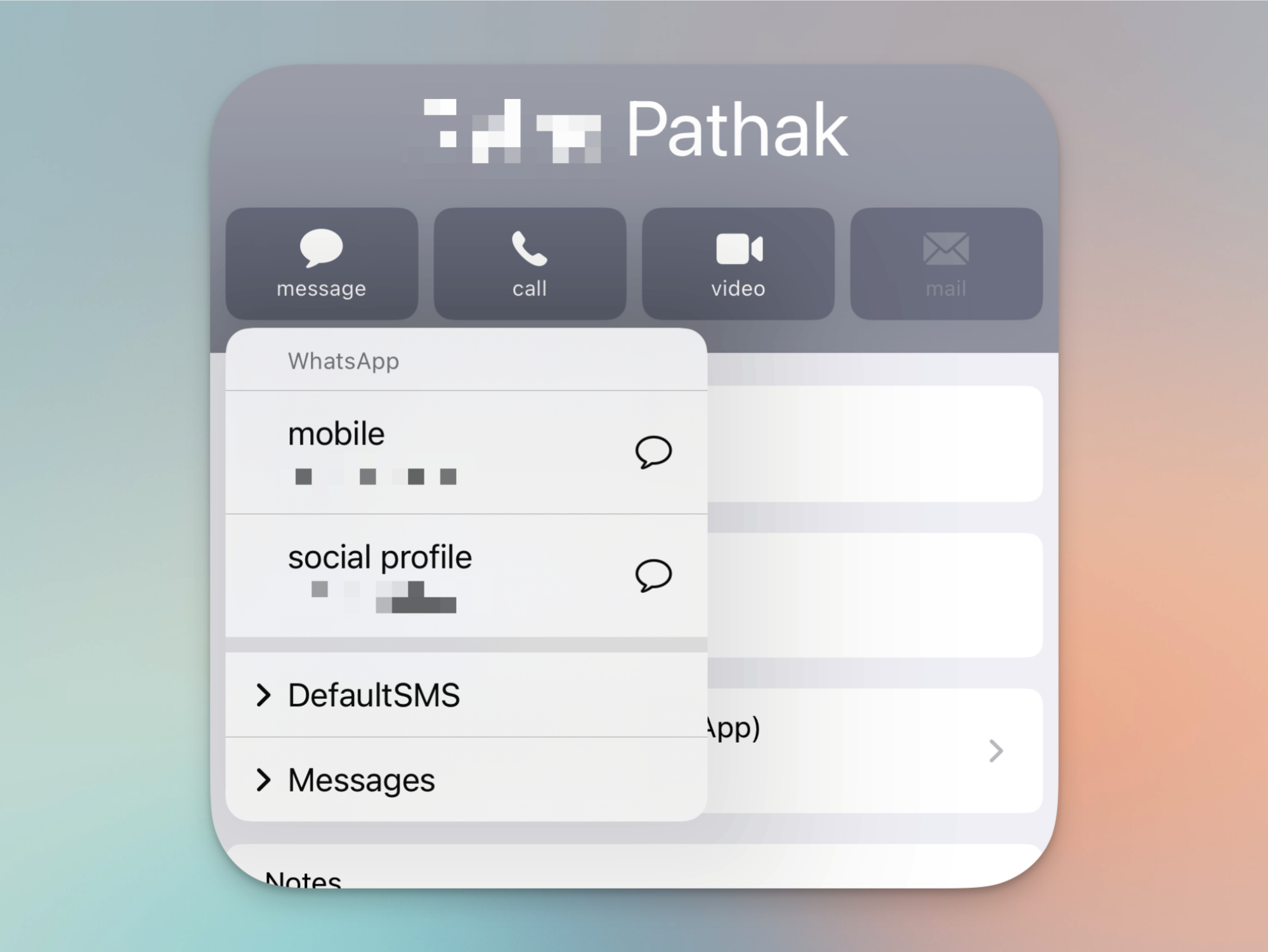
WhatsApp as default phone app.

Credit: Khamosh Pathak

In this context, “default app” means that when you tap the Message button or the Call button for a contact in your Phone app or Contacts app, it will now open a call or message with them via WhatsApp app directly. This essentially serves as a shortcut, rather than a full replacement for the apps that come with your phone.

After you change your default calling or messaging app, when you open a contact card and tap the Call button or Message button for the first time, you’ll get an overflow menu where WhatsApp will be the first and default option. You can pick another option to change your default if you like. From then on, tapping the Call button will directly call the contact using WhatsApp Audio (or whatever you changed your default to), unless you change your default again in your iPhone settings.

From there, you’re all set… mostly. If your contact doesn’t have WhatsApp, WhatsApp will simply tell that they’re not on WhatsApp, at which point you’ll have to manually open the Phone or Messages app to reach out instead.

California Has 48% More EV Chargers Than Gas Nozzles

California has 11.3% of America’s population — but bought 30% of America’s new zero-emission vehicles. That’s according to figures from the California Air Resources Board, which also reports 1 in 4 Californians have chosen a zero-emission car over a gas-powered one… for the last two years in a row.

But what about chargers? It turns out that California now has 48% more public and “shared” private EV chargers than the number of gasoline nozzles. (California has 178,000 public and “shared” private EV chargers, versus about 120,000 gas nozzles.) And beyond that public network, there’s more than 700,000 Level 2 chargers installed in single-family California homes, according to the California Energy Commission.

Of the 178,000 public/”shared” private chargers, “Over 162,000 are Level 2 chargers,” according to an announcement from the governor’s office, while nearly 17,000 are fast chargers. (A chart shows a 41% jump in 2024 — though the EV news site Electrek notes that of the 73,537 chargers added in 2024, nearly 38,000 are newly installed, while the other 35,554 were already plugged in before 2024 but just recently identified.)

California approved a $1.4 billion investment plan in December to expand zero-emission transportation infrastructure. The plan funds projects like the Fast Charge California Project, which has earmarked $55 million of funding to install DC fast chargers at businesses and publicly accessible locations.


Read more of this story at Slashdot.

Overblown quantum dot conspiracy theories make important points about QLED TVs

QLED TV manufacturers have dug themselves into a hole.

After years of companies promising that their quantum dot light-emitting diode TVs use quantum dots (QDs) to boost color, some industry watchers and consumers have recently started questioning whether QLED TVs use QDs at all. Lawsuits have been filed, accusing companies like TCL of using misleading language about whether their QLED TVs actually use QDs.

In this article, we’ll break down why new conspiracy theories about QLED TVs are probably overblown. We’ll also explore why misleading marketing from TV brands is responsible for customer doubt and how it all sets a bad precedent for the future of high-end displays, including OLED TVs and monitors.

Read full article

Comments

HTTPS Certificate Industry Adopts New Security Requirements

The Certification Authority/Browser Forum “is a cross-industry group that works together to develop minimum requirements for TLS certificates,” writes Google’s Security blog. And earlier this month two proposals from Google’s forward-looking roadmap “became required practices in the CA/Browser Forum Baseline Requirements,” improving the security and agility of TLS connections…

Multi-Perspective Issuance Corroboration
Before issuing a certificate to a website, a Certification Authority (CA) must verify the requestor legitimately controls the domain whose name will be represented in the certificate. This process is referred to as “domain control validation” and there are several well-defined methods that can be used. For example, a CA can specify a random value to be placed on a website, and then perform a check to verify the value’s presence has been published by the certificate requestor.

Despite the existing domain control validation requirements defined by the CA/Browser Forum, peer-reviewed research authored by the Center for Information Technology Policy of Princeton University and others highlighted the risk of Border Gateway Protocol (BGP) attacks and prefix-hijacking resulting in fraudulently issued certificates. This risk was not merely theoretical, as it was demonstrated that attackers successfully exploited this vulnerability on numerous occasions, with just one of these attacks resulting in approximately $2 million dollars of direct losses.

The Chrome Root Program led a work team of ecosystem participants, which culminated in a CA/Browser Forum Ballot to require adoption of MPIC via Ballot SC-067. The ballot received unanimous support from organizations who participated in voting. Beginning March 15, 2025, CAs issuing publicly-trusted certificates must now rely on MPIC as part of their certificate issuance process. Some of these CAs are relying on the Open MPIC Project to ensure their implementations are robust and consistent with ecosystem expectations…

Linting

Linting refers to the automated process of analyzing X.509 certificates to detect and prevent errors, inconsistencies, and non-compliance with requirements and industry standards. Linting ensures certificates are well-formatted and include the necessary data for their intended use, such as website authentication. Linting can expose the use of weak or obsolete cryptographic algorithms and other known insecure practices, improving overall security… The ballot received unanimous support from organizations who participated in voting. Beginning March 15, 2025, CAs issuing publicly-trusted certificates must now rely on linting as part of their certificate issuance process.

Linting also improves interoperability, according to the blog post, and helps reduce the risk of non-compliance with standards that can result in certificates being “mis-issued”.

And coming up, weak domain control validation methods (currently permitted by the CA/Browser Forum TLS Baseline Requirements) will be prohibited beginning July 15, 2025.

“Looking forward, we’re excited to explore a reimagined Web PKI and Chrome Root Program with even stronger security assurances for the web as we navigate the transition to post-quantum cryptography.”


Read more of this story at Slashdot.

Linus Torvalds Gently Criticizes Build-Slowing Testing Code Left in Linux 6.15-rc1

“The big set of open-source graphics driver updates for Linux 6.15 have been merged,” writes Phoronix, “but Linux creator Linus Torvalds isn’t particularly happy with the pull request.”

The new “hdrtest” code is for the Intel Xe kernel driver and is around trying to help ensure the Direct Rendering Manager header files are self-contained and pass kernel-doc tests — basic maintenance checks on the included DRM header files to ensure they are all in good shape.

But Torvalds accused the code of not only slowing down the full-kernel builds, but also leaving behind “random” files for dependencies “that then make the source tree nasty,” reports Tom’s Hardware:

While Torvalds was disturbed by the code that was impacting the latest Linux kernel, beginning his post with a “Grr,” he remained precise in his objections to it. “I did the pull, resolved the (trivial) conflicts, but I notice that this ended up containing the disgusting ‘hdrtest’ crap that (a) slows down the build because it’s done for a regular allmodconfig build rather than be some simple thing that you guys can run as needed (b) also leaves random ‘hdrtest’ turds around in the include directories,” he wrote.

Torvalds went on to state that he had previously complained about this issue, and inquired why the hdr testing is being done as a regular part of the build. Moreover, he highlighted that the resulting ‘turds’ were breaking filename completion. Torvalds underlined this point — and his disgust — by stating, “this thing needs to *die*.” In a shot of advice to fellow Linux developers, Torvalds said, “If you want to do that hdrtest thing, do it as part of your *own* checks. Don’t make everybody else see that disgusting thing….”
He then noted that he had decided to mark hdrtest as broken for now, to prevent its inclusion in regular builds.

As of Saturday, all of the DRM-Next code had made it into Linux 6.15 Git, notes Phoronix. “But Linus Torvalds is expecting all this ‘hdrtest’ mess to be cleaned up.”


Read more of this story at Slashdot.

As Microsoft Turns 50, Four Employees Remember Its Early Days

“Microsoft built things. It broke things.”
That’s how the Seattle Times kicks off a series of articles celebrating Microsoft’s 50th anniversary — adding that Microsoft also gave some people “a lucrative retirement early in their lives, and their own stories to tell.”

What did they remember from Microsoft’s earliest days?

Scott Oki joined Microsoft as employee no. 121. The company was small; Gates was hands-on, and hard to please. “One of his favorite phrases was ‘that’s the stupidest thing I’ve ever heard,'” Oki says. “He didn’t use that on me, so I feel pretty good about that.”

Another, kinder phrase that pops to Oki’s mind when discussing the international division he founded at Microsoft is “bringing home the bacon.” An obsession with rapid revenue growth permeated Microsoft in those early days. Oki was about three weeks into the job as marketing manager when he presented a global expansion plan to Gates. “Had I done business internationally before? No,” Oki said. “Do I speak a language other than English? No.” But Gates gave Oki a $1 million budget to found the international division and sell Microsoft products overseas.

He established subsidiaries in the most important markets at the time: Japan, United Kingdom, Germany and France. And, because he had a few bucks left over, Australia. “Of the initial subsidiaries we started, every single one of them was profitable in its first year,” he says…

Oki left Microsoft on March 1, 1992, 10 years to the day after he was hired.

Other memories shared by early Microsoft employees:

One recent graudate remembered her parents in Spokane saying “I think that’s Mary and Bill Gates’ son’s company. If that kid is anything like those two, that is going to be a great company,'” She got her first job at Microsoft in 1992 — and 33 years later, she’s a senior director at Microsoft Philanthropies.

The Times also interviewed one of Microsoft’s first lawyers, who remembers that “The day the U.S. government sued Microsoft … that was a tough day for me. It kind of turned my world upside down for about the next eight years.”
Microsoft senior VP Brad Chase remembers negotiating with the Rolling Stones for the rights to their song “Start Me Up” for the Windows 95 ad campaign. (“Chase is quick to dispel any rumor that Mick Jagger called up Bill Gates and got $12 million. But he won’t say how much the company paid.”)

But Chase does tell the Times that Bill Gates “used to say all of the time, ‘We’re going to bet the company on Windows.’ That was a huge bet because Windows, frankly, was a lousy product in its early days.”


Read more of this story at Slashdot.

Copilot Can’t Beat a 2013 ‘TouchDevelop’ Code Generation Demo for Windows Phone

What happens when you ask Copilot to “write a program that can be run on an iPhone 16 to select 15 random photos from the phone, tint them to random colors, and display the photos on the phone”?

That’s what TouchDevelop did for the long-discontinued Windows Phone in a 2013 Microsoft Research ‘SmartSynth’ natural language code generation demo. (“Write scripts by tapping on the screen.”)

Long-time Slashdot reader theodp reports on what happens when, 14 years later, you pose the same question to Copilot:

“You’ll get lots of code and caveats from Copilot, but nothing that you can execute as is. (Compare that to the functioning 10 lines of code TouchDevelop program). It’s a good reminder that just because GenAI can generate code, it doesn’t necessarily mean it will generate the least amount of code, the most understandable or appropriate code for the requestor, or code that runs unchanged and produces the desired results.
theodp also reminds us that TouchDevelop “was (like BASIC) abandoned by Microsoft…”

Interestingly, a Microsoft Research video from CS Education Week 2011 shows enthusiastic Washington high school students participating in an hour-long TouchDevelop coding lesson and demonstrating the apps they created that tapped into music, photos, the Internet, and yes, even their phone’s functionality. This shows how lacking iPhone and Android still are today as far as easy programmability-for-the-masses goes. (When asked, Copilot replied that Apple’s Shortcuts app wasn’t up to the task).


Read more of this story at Slashdot.

China is Already Testing AI-Powered Humanoid Robots in Factories

The U.S. and China “are racing to build a truly useful humanoid worker,” the Wall Street Journal wrote Saturday, adding that “Whoever wins could gain a huge edge in countless industries.”

“The time has come for robots,” Nvidia’s chief executive said at a conference in March, adding “This could very well be the largest industry of all.”

China’s government has said it wants the country to be a world leader in humanoid robots by 2027. “Embodied” AI is listed as a priority of a new $138 billion state venture investment fund, encouraging private-sector investors and companies to pile into the business. It looks like the beginning of a familiar tale. Chinese companies make most of the world’s EVs, ships and solar panels — in each case, propelled by government subsidies and friendly regulations. “They have more companies developing humanoids and more government support than anyone else. So, right now, they may have an edge,” said Jeff Burnstein [president of the Association for Advancing Automation, a trade group in Ann Arbor, Michigan]….

Humanoid robots need three-dimensional data to understand physics, and much of it has to be created from scratch. That is where China has a distinct edge: The country is home to an immense number of factories where humanoid robots can absorb data about the world while performing tasks. “The reason why China is making rapid progress today is because we are combining it with actual applications and iterating and improving rapidly in real scenarios,” said Cheng Yuhang, a sales director with Deep Robotics, one of China’s robot startups. “This is something the U.S. can’t match.” UBTech, the startup that is training humanoid robots to sort and carry auto parts, has partnerships with top Chinese automakers including Geely… “A problem can be solved in a month in the lab, but it may only take days in a real environment,” said a manager at UBTech…

With China’s manufacturing prowess, a locally built robot could eventually cost less than half as much as one built elsewhere, said Ming Hsun Lee, a Bank of America analyst. He said he based his estimates on China’s electric-vehicle industry, which has grown rapidly to account for roughly 70% of global EV production. “I think humanoid robots will be another EV industry for China,” he said. The UBTech robot system, called Walker S, currently costs hundreds of thousands of dollars including software, according to people close to the company. UBTech plans to deliver 500 to 1,000 of its Walker S robots to clients this year, including the Apple supplier Foxconn. It hopes to increase deliveries to more than 10,000 in 2027.

Few companies outside China have started selling AI-powered humanoid robots. Industry insiders expect the competition to play out over decades, as the robots tackle more-complicated environments, such as private homes.

The article notes “several” U.S. humanoid robot producers, including the startup Figure. And robots from Amazon’s Agility Robotics have been tested in Amazon warehouses since 2023. “The U.S. still has advantages in semiconductors, software and some precision components,” the article points out.

But “Some lawmakers have urged the White House to ban Chinese humanoids from the U.S. and further restrict Chinese robot makers’ access to American technology, citing national-security concerns…”


Read more of this story at Slashdot.

Microsoft Attempts To Close Local Account Windows 11 Setup Loophole

Slashdot reader jrnvk writes: The Verge is reporting that Microsoft will soon make it harder to run the well-publicized bypassnro command in Windows 11 setup. This command allows skipping the Microsoft account and online connection requirements on install. While the command will be removed, it can still be enabled by a regedit change — for now.

“However, there’s no guarantee Microsoft will allow this additional workaround for long,” writes the Verge. (Though they add “There are other workarounds as well” involving the unattended.xml automation.)

In its latest Windows 11 Insider Preview, the company says it will take out a well-known bypass script… Microsoft cites security as one reason it’s making this change. [“This change ensures that all users exit setup with internet connectivity and a Microsoft Account.”] Since the bypassnro command is disabled in the latest beta build, it will likely be pushed to production versions within weeks.


Read more of this story at Slashdot.

Apple is reportedly on track to launch the M5 iPad Pro and MacBook Pro later this year

According to Mark Gurman in the Power On newsletter this weekend, we may see at least two devices with Apple’s upcoming M5 chip before the end of the year. Gurman reports that the M5 iPad Pro has reached the late stages of testing, putting it “on track for production in the second half of this year.” And the M5 MacBook Pro should be here sometime in the fall, in line with the timing of the past few years’ releases.

This year’s iPad Pro likely won’t be the generation that adopts Apple’s in-house modem, though. According to Gurman, that shift is expected to happen in 2027 with the arrival of the M6 models — which he reports that Apple has already begun “early” work on. Apple introduced its first in-house cellular modem, the C1, with the iPhone 16e in February this year, and so far it seems to be performing pretty well.

This article originally appeared on Engadget at https://www.engadget.com/computing/apple-is-reportedly-on-track-to-launch-the-m5-ipad-pro-and-macbook-pro-later-this-year-211013731.html?src=rss

Bloomberg’s AI-Generated News Summaries Had At Least 36 Errors Since January

The giant financial news site Bloomberg “has been experimenting with using AI to help produce its journalism,” reports the New York Times. But “It hasn’t always gone smoothly.”

While Bloomberg announced on January 15 that it would add three AI-generated bullet points at the top of articles as a summary, “The news outlet has had to correct at least three dozen A.I.-generated summaries of articles published this year.” (This Wednesday they published a “hallucinated” date for the start of U.S. auto tariffs, and earlier in March claimed president Trump had imposed tariffs on Canada in 2024, while other errors have included incorrect figures and incorrect attribution.)

Bloomberg is not alone in trying A.I. — many news outlets are figuring out how best to embrace the new technology and use it in their reporting and editing. The newspaper chain Gannett uses similar A.I.-generated summaries on its articles, and The Washington Post has a tool called “Ask the Post” that generates answers to questions from published Post articles. And problems have popped up elsewhere. Earlier this month, The Los Angeles Times removed its A.I. tool from an opinion article after the technology described the Ku Klux Klan as something other than a racist organization.

Bloomberg News said in a statement that it publishes thousands of articles each day, and “currently 99 percent of A.I. summaries meet our editorial standards….” The A.I. summaries are “meant to complement our journalism, not replace it,” the statement added….

John Micklethwait, Bloomberg’s editor in chief, laid out the thinking about the A.I. summaries in a January 10 essay, which was an excerpt from a lecture he had given at City St. George’s, University of London. “Customers like it — they can quickly see what any story is about. Journalists are more suspicious,” he wrote. “Reporters worry that people will just read the summary rather than their story.” But, he acknowledged, “an A.I. summary is only as good as the story it is based on. And getting the stories is where the humans still matter.”

A Bloomberg spokeswoman told the Times that the feedback they’d received to the summaries had generally been positive — “and we continue to refine the experience.”


Read more of this story at Slashdot.