First Driverless Semis Have Started Running Regular Longhaul Routes

An anonymous reader quotes a report from CNN: Driverless trucks are officially running their first regular long-haul routes, making roundtrips between Dallas and Houston. On Thursday, autonomous trucking firm Aurora announced it launched commercial service in Texas under its first customers, Uber Freight and Hirschbach Motor Lines, which delivers time- and temperature-sensitive freight. Both companies conducted test runs with Aurora, including safety drivers to monitor the self-driving technology dubbed “Aurora Driver.” Aurora’s new commercial service will no longer have safety drivers.

“We founded Aurora to deliver the benefits of self-driving technology safely, quickly, and broadly, said Chris Urmson, CEO and co-founder of Aurora, in a release on Thursday. “Now, we are the first company to successfully and safely operate a commercial driverless trucking service on public roads.” The trucks are equipped with computers and sensors that can see the length of over four football fields. In four years of practice hauls the trucks’ technology has delivered over 10,000 customer loads. As of Thursday, the company’s self-driving tech has completed over 1,200 miles without a human in the truck. Aurora is starting with a single self-driving truck and plans to add more by the end of 2025.


Read more of this story at Slashdot.

We finally know a little more about Amazon’s super-secret satellites

The first production satellites for Amazon’s Kuiper broadband network launched earlier this week, but if you tuned in to the mission’s official livestream, the truncated coverage had the feel of a spy satellite launch.

This changed with a video Amazon posted on social media Friday, giving space enthusiasts and prospective Kuiper customers their first look at the real satellites. The 40-second clip shows the Kuiper satellites separating from their launch vehicle in the blackness of space following liftoff Monday from Cape Canaveral Space Force Station, Florida.

Since Amazon unveiled Project Kuiper in 2019, officials at the retail giant have been shy about showing even the most basic imagery of their satellites. Images released by Amazon previously provided glimpses inside the company’s satellite factory near Seattle, along with views of the shipping containers Amazon uses to transport spacecraft from Washington their launch base in Florida.

Read full article

Comments

Microsoft Appoints Deputy CISO For Europe To Reassure European IT leaders

Microsoft has appointed a Deputy CISO for Europe to address growing regulatory pressure and reassure EU leaders about its cybersecurity commitment. “The move also highlights strong fears from European IT execs and government officials that the Trump administration may exert significant influence on cybersecurity companies,” reports CSO Online. From the report: Who that Deputy CISO will ultimately be is unclear. Wednesday’s statement simply said that Microsoft CISO Igor Tsyganskiy is “appointing a new Deputy CISO for Europe as part of the Microsoft Cybersecurity Governance Council,” but the phrasing made it unclear when that would happen. However, Tsyganskiy made a separate announcement on LinkedIn that he has given the role to current Deputy CISO Ann Johnson. But he then said that Johnson, who is based at Microsoft’s head office in Redmond, Washington, will hold that post “temporarily.”

In his LinkedIn post, Tsyganskiy explained that the Cybersecurity Governance Council, which was created in 2024, consists of “our Global CISO and Deputy Chief Information Security Officers (Deputy CISOs) representing each of our technology services. This Council oversees the company’s cyber risks, defenses, and compliance across regions and domains.” “The Deputy CISO for Europe will be accountable for compliance with current and emerging cybersecurity regulations in Europe, including the Digital Operational Resilience Act (DORA), the NIS 2 Directive, and the Cyber Resilience Act (CRA),” Tsyganskiy wrote. “These laws will prove transformative not only in EU markets, but worldwide, and Microsoft is actively engaged in preparing for what lies ahead.” Microsoft said in Wednesday’s statement: “the appointment of a Deputy CISO for Europe reflects the importance and global influence of EU cybersecurity regulations and the company’s commitment to meeting and exceeding those expectations to prioritize cybersecurity across the region. This new position will report directly to Microsoft’s CISO.”

Michela Menting, France-based digital security research director at ABI Research, said when she heard on Wednesday that Microsoft was creating such a role, “I was mostly surprised that they don’t already have one.”

“GDPR has been in place for quite some time now and the fact they are only now putting in a European deputy CISO is concerning,” Menting added. “They are playing catch up.”


Read more of this story at Slashdot.

US Asks Judge To Break Up Google’s Ad Tech Business

The U.S. government is seeking to break up Google’s advertising technology business after a judge ruled the company holds an illegal monopoly over ad tools for publishers, marking the second such antitrust case following a similar request to divest Chrome. The Guardian reports: “We have a defendant who has found ways to defy” the law, US government lawyer Julia Tarver Wood told a federal court in Virginia, as she urged the judge to dismiss Google’s assurance that it would change its behavior. “Leaving a recidivist monopolist” intact was not appropriate to solve the issue, she added. […] The US government specifically alleged that Google controls the market for publishing banner ads on websites, including those of many creators and small news providers.

The hearing in a Virginia courtroom was scheduled to plan out the second phase of the trial, set for September, in which the parties will argue over how to fix the ad market to satisfy the judge’s ruling. The plaintiffs argued in the first phase of the trial last year that the vast majority of websites use Google ad software products which, combined, leave no way for publishers to escape Google’s advertising technology and pricing.

The district court judge Leonie Brinkema agreed with most of that reasoning, ruling last month that Google built an illegal monopoly over ad software and tools used by publishers, but partially dismissed the argument related to tools used by advertisers. The US government said it would use the trial to recommend that Google should spin off its ad publisher and exchange operations, as Google could not be trusted to change its ways. “Behavioral remedies are not sufficient because you can’t prevent Google from finding a new way to dominate,” Tarver Wood said.

Google countered that it would recommend that it agree to a binding commitment that it would share information with advertisers and publishers on its ad tech platforms. Google lawyer Karen Dunn did, however, acknowledge the “trust issues” raised in the case and said the company would accept monitoring to guarantee any commitments made to satisfy the judge. Google is also arguing that calls for divestment are not appropriate in this case, which Brinkema swiftly refused as an argument. The judge urged both sides to mediate, stressing that coming to a compromise solution would be cost-effective and more efficient than running a weeks-long trial.


Read more of this story at Slashdot.

Google Plans To Roll Out Its AI Chatbot To Children Under 13

An anonymous reader quotes a report from the New York Times: Google plans to roll out its Gemini artificial intelligence chatbot next week for children under 13 (source paywalled; alternative source) who have parent-managed Google accounts, as tech companies vie to attract young users with A.I. products. “Gemini Apps will soon be available for your child,” the company said in an email this week to the parent of an 8-year-old. “That means your child will be able to use Gemini” to ask questions, get homework help and make up stories. The chatbot will be available to children whose parents useFamily Link, a Google service that enables families to set up Gmail and opt into services like YouTube for their child. To sign up for a child account, parents provide the tech company with personal data like their child’s name and birth date. Gemini has specific guardrails for younger users to hinder the chatbot from producing certain unsafe content, said Karl Ryan, a Google spokesman. When a child with a Family Link account uses Gemini, he added, the company will not use that data to train its A.I.

Introducing Gemini for children could accelerate the use of chatbots among a vulnerable population as schools, colleges, companies and others grapple with the effects of popular generative A.I. technologies. Trained on huge amounts of data, these systems can produce humanlike text and realistic-looking images and videos. […] Google acknowledged some risks in its email to families this week, alerting parents that “Gemini can make mistakes” and suggesting they “help your child think critically” about the chatbot. The email also recommended parents teach their child how to fact-check Gemini’s answers. And the company suggested parents remind their child that “Gemini isn’t human” and “not to enter sensitive or personal info in Gemini.” Despite the company’s efforts to filter inappropriate material, the email added, children “may encounter content you don’t want them to see.”


Read more of this story at Slashdot.

Volkswagen recalls 5,700 ID.Buzz electric vans because their seats are too spacious

Volkswagen has recalled 2025 ID.Buzz electric vans, because their rear seats are only configured for two people but are wide enough to fit three. According to the NHTSA note (PDF) found by Electrek, Volkswagen is recalling 5,637 vehicles, which were manufactured between September 18, 2024 and February 11, 2025. The removable third-row of the 2025 ID.Buzz are only fitted with seatbelts for two people. However, its seating surface width exceeds the value specified for two occupants under Federal Motor Vehicle Safety Standard No. 208, which sets the standards to reduce the number of deaths in the event of a crash. 

In other words, the third row of the 2025 ID.Buzz is wide enough to require three seatbelts. As it is, it’ll be very easy to fit a third person in, and they will have no protection while the vehicle is on the road, increasing their likelihood of getting injured or dying if they get into an accident. Volkswagen intends to fix the issue by installing permanent “unpadded trim parts” to limit the surface width where passengers can sit on the rear bench. The 2025 Volkswagen ID.Buzz electric van was released in the US in November 2024 and has a starting price of $60,000. It has an EPA-estimated range of 234 miles on a full charge and comes in several possible color schemes. 

Seats inside a vehicle.
Volkswagen

This article originally appeared on Engadget at https://www.engadget.com/transportation/evs/volkswagen-recalls-5700-idbuzz-electric-vans-because-their-seats-are-too-spacious-120034140.html?src=rss

In his first 100 days, Trump launched an “all-out assault” on the environment

This article originally appeared on Inside Climate News, a nonprofit, non-partisan news organization that covers climate, energy, and the environment. Sign up for their newsletter here.

One hundred days into the second Trump administration, many environmentalists’ worst fears about the new presidency have been realized—and surpassed.

Facing a spate of orders, pronouncements, and actions that target America’s most cherished natural resources and most vulnerable communities, advocates fear the Trump agenda, unchecked, will set the country back decades.

Read full article

Comments

Man Pleads Guilty To Stealing 1.1 Terabytes of Disney’s Slack Data

A 25-year-old from Santa Clarita has pleaded guilty to hacking a Disney employee’s computer using malware disguised as an AI art tool, stealing over 1 terabyte of confidential Disney data and threatening to leak it under the guise of a fake Russian hacktivist group. Variety reports: Santa Clarita resident Ryan Mitchell Kramer, 25, pleaded guilty to two felony charges, including one count of accessing a computer and obtaining information and one count of threatening to damage a protected computer. Each charge carries a maximum sentence of five years in federal prison. According to the plea agreement, in early 2024 Kramer posted a computer program on various online platforms that appeared to be used to create AI-generated art, when it really contained a malicious file to gain access to victims’ computers.

Between April and May 2024, a Disney employee downloaded the program, and Kramer gained access to the victim’s personal and work accounts, including a non-public Disney Slack channel. Kramer dowloaded approximately 1.1 terabytes of confidential data from thousands of Disney Slack channels. In July, Kramer contacted the victim by pretending to be a member of a fake Russian hacktivist group called “Nullbulge” and threatened to leak their personal information and Disney Slack data. On July 12, Kramer publicly released the data, including the victim’s bank, medical, and personal information on multiple online platforms.


Read more of this story at Slashdot.

Temu To Stop Selling Goods From China Directly To US Customers

An anonymous reader quotes a report from the BBC: Temu has said it will stop selling goods imported from China in the US directly to customers from its platform. The online marketplace said sales would now be handled by “locally based sellers,” with orders fulfilled from within the country. The move comes as a duty-free rule for low-value packages is closed.

Temu, and rival Chinese retail giant Shein, had previously relied on the so-called “de minimis” exemption to sell and ship low-value items directly to the US without having to pay duties or import taxes. Temu said it had been actively recruiting US firms to join the platform. “All sales in the US are now handled by locally based sellers, with orders fulfilled from within the country. “The move is designed to help local merchants reach more customers and grow their businesses,” it added.

Supporters of the de minimis loophole, which applied to parcels worth less than $800, argue it helped streamline the customs process. But both Trump and his predecessor, Joe Biden, said it damaged American businesses and was used to smuggle illegal goods, including drugs. In February, Trump briefly closed the loophole but the suspension was quickly paused as delivery services and customs agencies struggled to adjust. During the pause, the U.S. Postal Service even stopped accepting parcels from mainland China and Hong Kong.


Read more of this story at Slashdot.

Uber Inks Robotaxi Deal With Chinese Startup Momenta

Uber is partnering with Chinese autonomous driving startup Momenta to launch robotaxi services outside the U.S. and China, starting in Europe in early 2026 with safety operators onboard. CNBC reports: Uber said the goal is to combine its global ridesharing network with Momenta’s technology to deliver safe and efficient robotaxi services. “This collaboration brings together Uber’s global ridesharing expertise and Momenta’s AI-first autonomous driving technology, paving the way for a future where more riders around the world experience the benefits of reliable and affordable autonomous mobility,” Uber CEO Dara Khosrowshahi said in the press release. Momenta CEO Xudong Cao said the arrangement “completes the key ecosystem needed to scale autonomous driving globally.”

Momenta, based in Beijing, is a leading autonomous driving company known for its “two-leg” product strategy. It offers both Mpilot, a mass-production-ready assisted driving system, and MSD (Momenta Self-Driving), aimed at full autonomy. The company has years of experience operating autonomous vehicles in cities across China and has partnerships with large equipment manufacturers.


Read more of this story at Slashdot.

How to Choose Between ChatGPT, Gemini, and Perplexity’s Deep Research Tools

You might be used to AI chatbots answering your questions with a few sentences or even paragraphs, but how about multipage reports? With Deep Research, that’s exactly what the likes of ChatGPT, Gemini, and Perplexity are doing, utilizing their large language models alongside web searches and reasoning capabilities to become research assistants of sorts.

A Deep Research query takes time (anything between five minutes to 30 minutes, depending on what you ask), but comes back to you with a detailed report on any subject you can ask about, including complex things like niche market research or scientific mysteries. Even better, all three major Deep Research AI providers now have free tiers.

Though, let’s be honest, most of us aren’t performing scientific research on a day to day basis. So, how can these Deep Research tools help you?

How Deep Research works

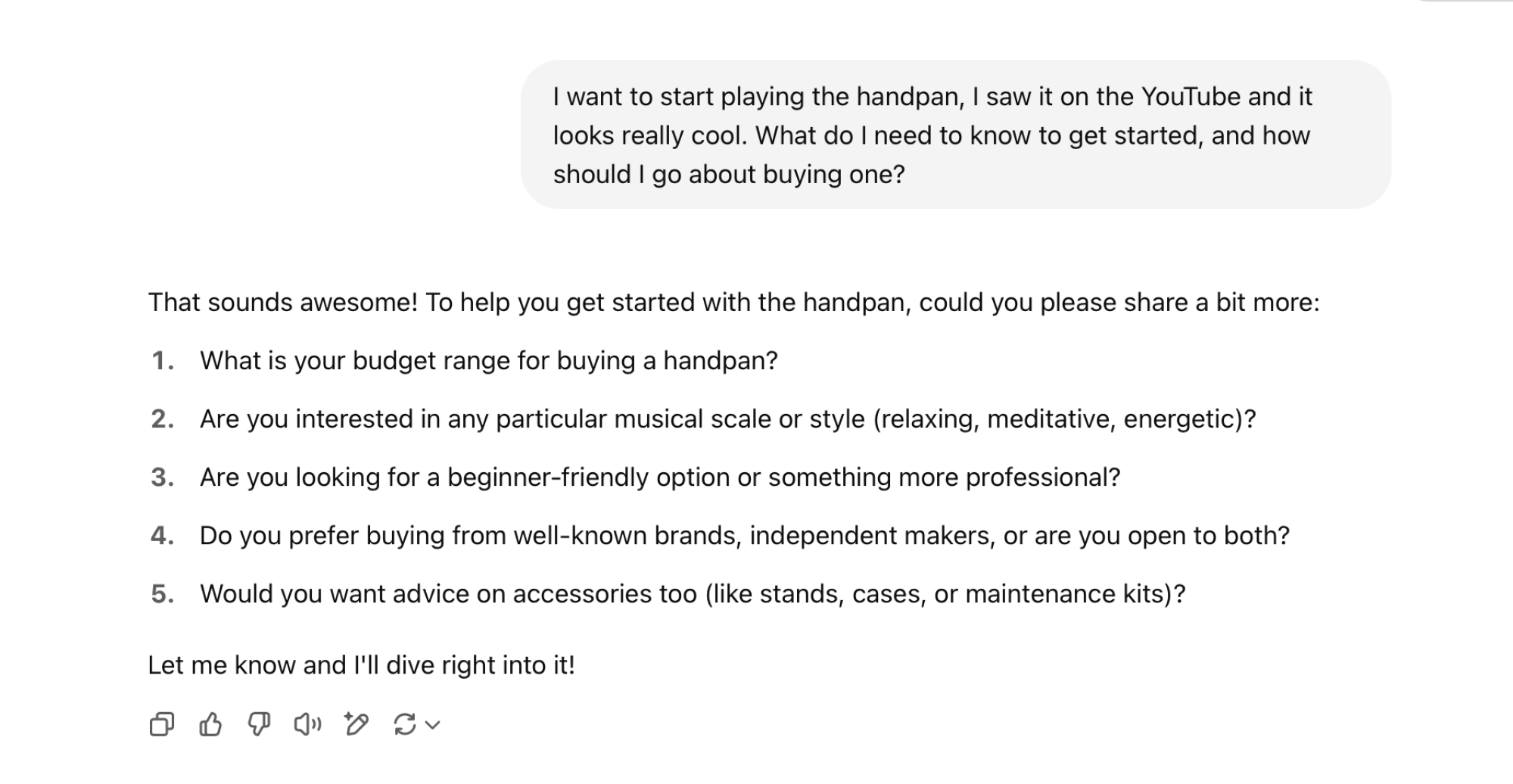
Deep Research combines the power of the open web, large language models, and new reasoning models. When you type in your prompt, it will first use a reasoning model to figure out what you’re really asking. At this point, the AI chatbot might even come back to you with clarifying questions and prepare a research plan all on its own. You are free to reply with answers and edit the research plan, but this is usually optional.

Once the research begins, you can follow along with what the AI is up to using a sidebar (or separate tab, if you’re using Perplexity). Here, you can see the searches the AI is making, documents it’s scanning, and information it’s collating.

As I mentioned above, detailed reports take up to 30 minutes, but that’s only true if you’re asking something really complicated. In my testing, I found that all three tools generate results in 5-10 minutes, spinning out reports that are still detailed and a couple of pages long.

When should you use Deep Research?

The best way to use Deep Research tools is when you can’t find something on Google yourself, or you don’t want to spend the time going through five different articles to distill the basics about a topic.

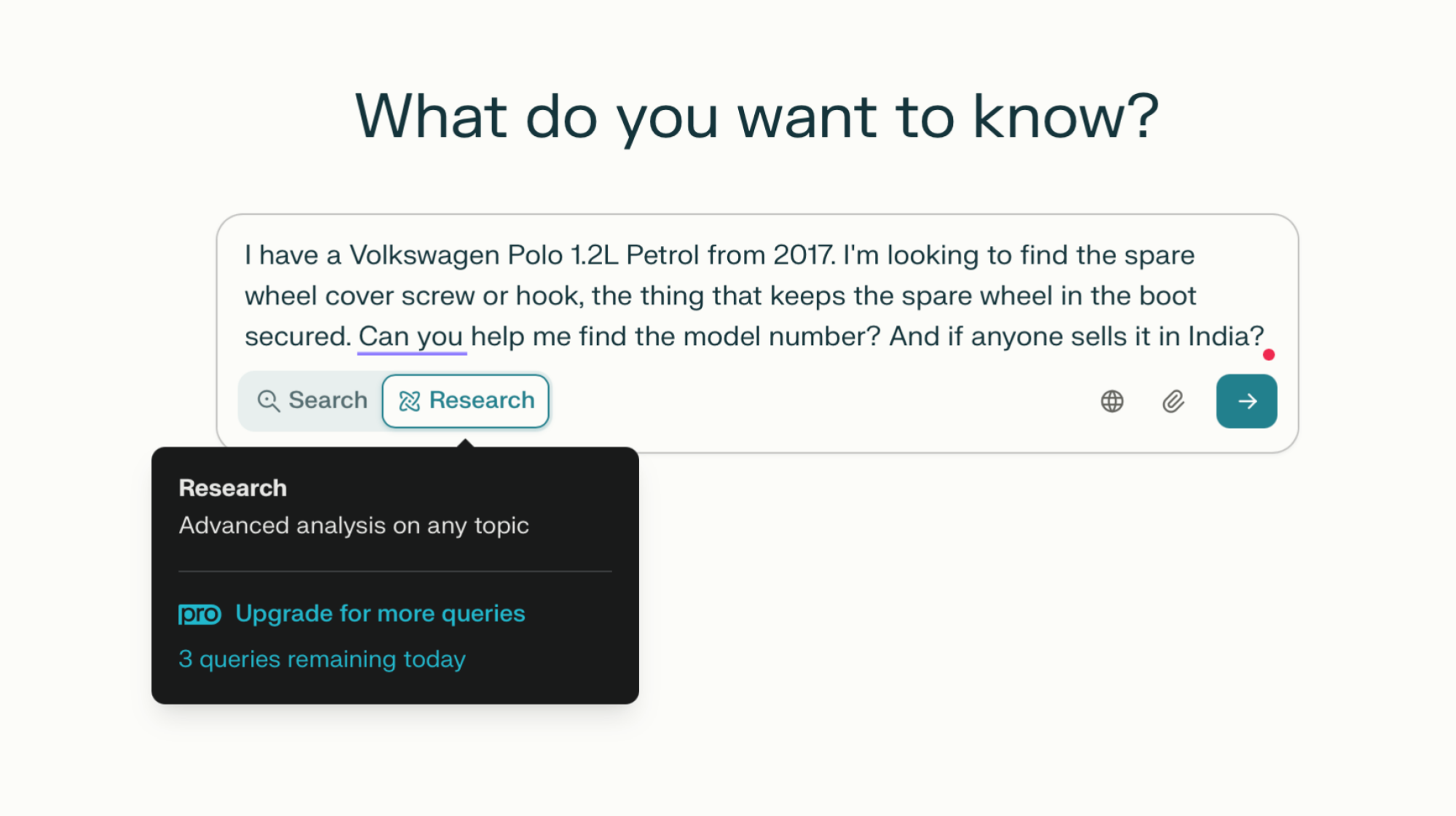
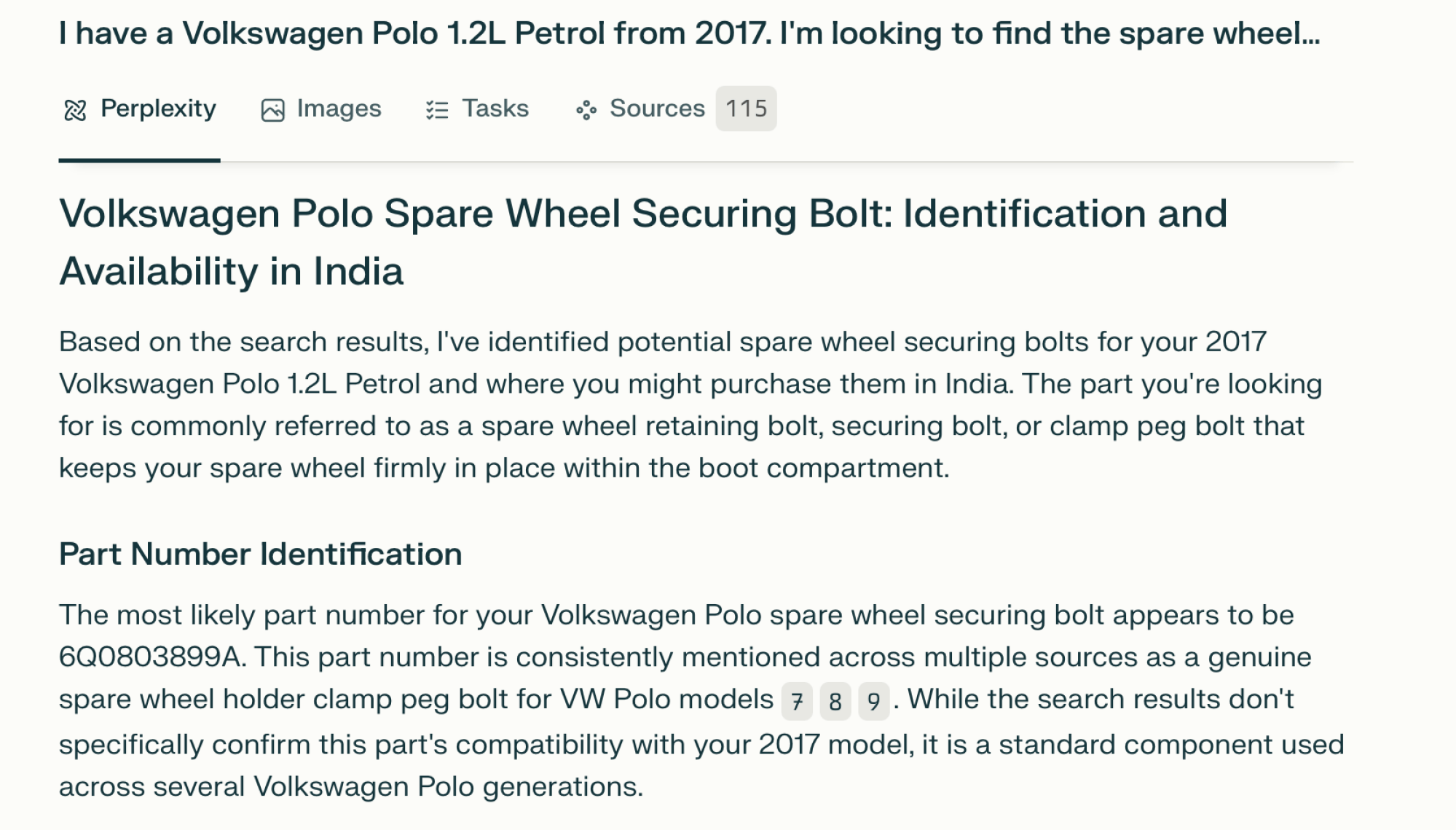
I’ve personally used these Deep Research tools to find a spare part code for my car that Google just wouldn’t tell me. I’ve also used them to research a company’s share price outlook, and to learn new things about the handpan, a musical instrument I can’t stop obsessing over.

If you want quick answers, a regular Search in a AI chatbot is, of course, going to be better. And if you’re working on a client pitch and you need a market research for five different competitors, you might want to spring for the paid version of whatever Deep Research tool you’re using. But for anything in between, it’s worth knowing how to use their lightweight alternatives.

How to use Deep Research tools in ChatGPT, Gemini, and Perplexity

All three competing major AI chatbots have their own Deep Research tools that work in roughly the same fashion. I’ll go into detail below, but in general, you start with a prompt, as detailed as you can make it, click the Deep Research button below the prompt, and then send out your query. You can also upload documents, spreadsheets, and images as added context.

ChatGPT Deep Research

Credit: Khamosh Pathak

The limits of free Deep Research

Perplexity daily limits.

Credit: Khamosh Pathak

The free versions of Deep Research tools are limited. Perplexity and Gemini provide the same quality of Deep Research reports to free users as they do paid plans, but they limit the usage. Perplexity is the most generous, though, with a daily limit system. Perplexity doesn’t specify its limits exactly, but it will show you how many Deep Research queries you have left in a day. In my testing, I’ve been able to make three Deep Research queries per day. You can upgrade to the $20 per month plan to remove all limits.

Gemini limits free users to 5 searches a month, and Gemini Advanced users can generate up to 20 reports a month on the $20 per month plan.

ChatGPT has the most complex structure. Free users get access to five monthly searches using ChatGPT’s lightweight model, which doesn’t generate full-length reports. Still, in my experience, this free model is enough for regular day-to-day searches.

ChatGPT’s $20/month Plus plan increases the limits to 10 queries a month using the full-fledged Deep Research model and 15 using the lightweight one.

How I tested ChatGPT, Gemini and Perplexity’s Deep Research tools

I tested the Deep Research features on all three platforms using the same three prompts. The first was to create a beginner-friendly guide on learning the handpan, the second was to research a company’s stock outlook in the market, and the third was to find a part number for a spare wheel screw cover for my car. The last one was something that I just couldn’t figure out myself using Google.

ChatGPT Deep Research: To the point and robust

I found ChatGPT’s Deep Research to be the most direct and robust. The reports that ChatGPT generates are easy to read, and importantly, contain the information you asked for and nothing else. ChatGPT always asks follow up questions whenever you make a Deep Research query. This can feel tiresome (it did for me), but it clearly works, and you can tell ChatGPT to proceed without follow up answers from you, if you want.

ChatGPT Research Questions

Credit: Khamosh Pathak

I saw this in both the report for the handpan and the stock research. However, ChatGPT is perhaps not the best at finding shopping links yet. While it did find me the right car part and highlighted it right at the top, it failed to find a link for buying the part in India, where I’m based (but it did find sellers in the US and Europe).

ChatGPT Report

Credit: Khamosh Pathak

Gemini Deep Research: Contextual, but wordy

When it comes to Deep Research, Gemini has two strengths: The ability to edit planned research, and access to other Google products.

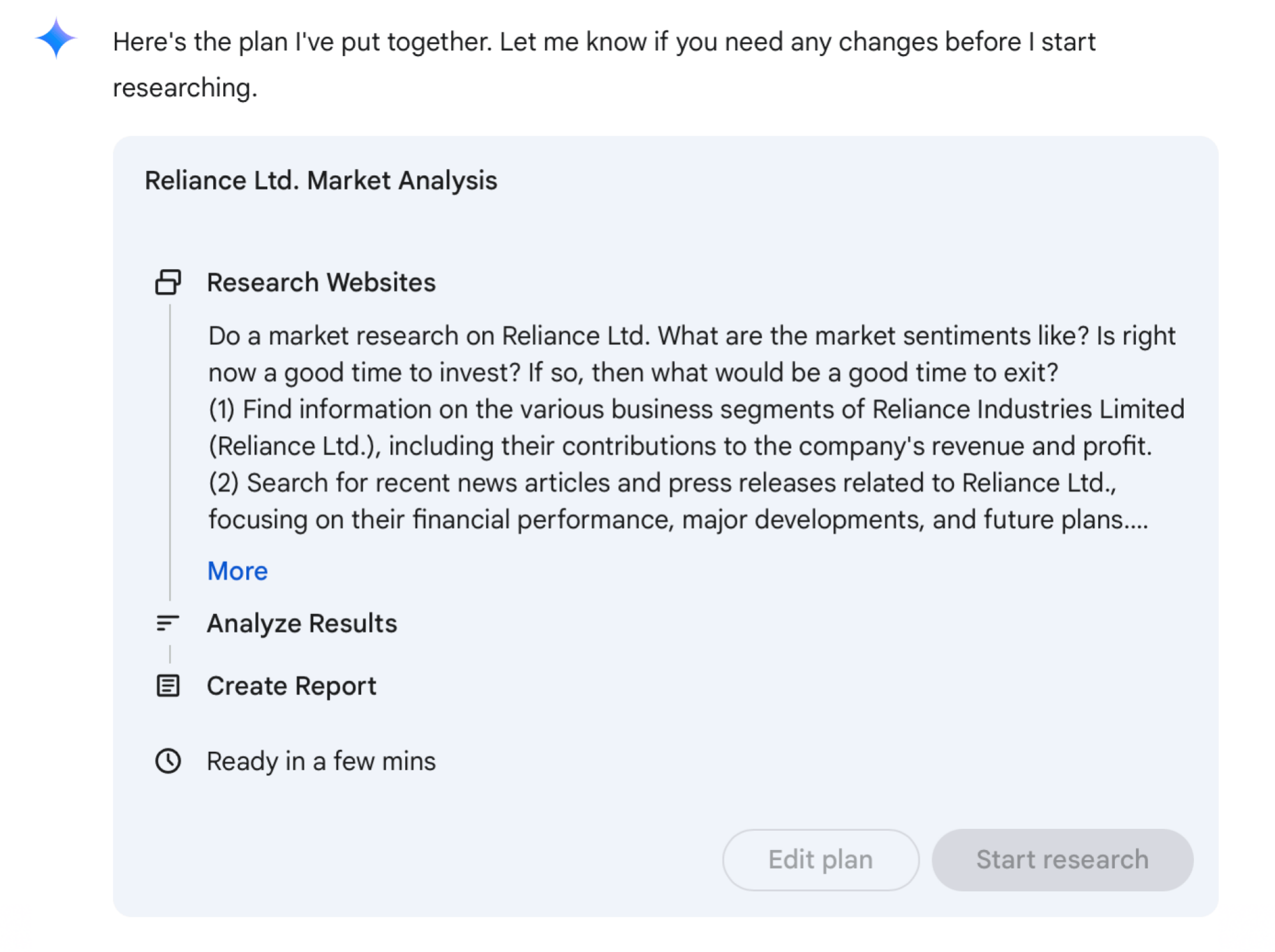
When you give Gemini a Deep Research prompt, it first goes out and creates a research plan. It will then show you a glimpse of this plan, and you can then edit it if you need to (just approve it if you don’t need to make any edits). Unlike ChatGPT, Gemini doesn’t ask you clarifying questions, instead focusing on using its integrations with your Google account for wide-level thinking. This being Google, it will include researching relevant information from around your hometown, for instance.

Gemini Research Plan

Credit: Khamosh Pathak

Gemini’s Deep Research feature integrates with Google Search, too. Basically, when you use Deep Research, you’re essentially asking the AI to perform multiple Google Searches for you. It can even take into account your browsing history (though, only if you want it to).

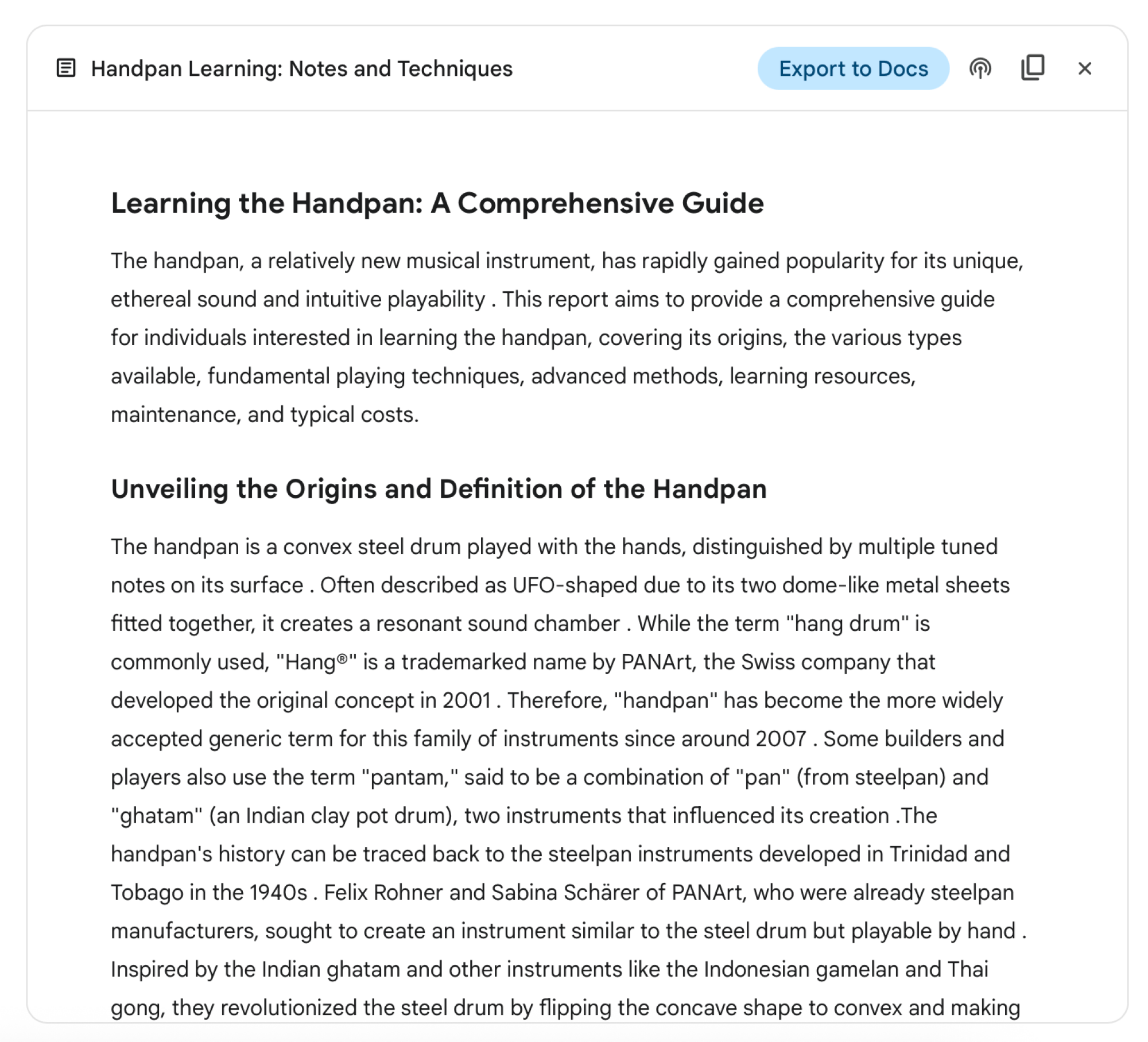
Handpan learning report from Gemini.

Credit: Khamosh Pathak

But Gemini’s downside is that it’s a bit too wordy, and its default research plan is often too broad in scope. It might be best to edit a research plan to make it more specific. I saw this in my test about finding a a number for my car part, where it spent multiple paragraphs talking about spare wheel covers instead of directly pointing out the part number I asked for (something that both ChatGPT and Perplexity do better). The upside is that Gemini integrates Deep Research directly into its Audio Overviews feature, though, so you can easily generate a short podcast episode based on your report.

Perplexity: Fast and made for web search

Perplexity’s Deep Research tool is fast. It’s the fastest at coming back with a Deep Research report, sometimes giving me answers in just two minutes or so. It does quite well with shopping links, and shopping research. And it’s a one-click affair. Perplexity doesn’t ask any follow up questions, nor does it ask you to approve its research plan like Gemini does. It just goes and does its thing.

Perplexity Deep Research.

Credit: Khamosh Pathak

Currently, Perplexity is adept at integrating web searches into its research, perhaps even better than Gemini is. But its speed comes at a cost. In my testing, I found Perplexity’s Deep Research reports to be lacking in detail, even though there were a lot of sources attached to the report.

Perplexity Deep Research Direct Answers.

Credit: Khamosh Pathak

Which Deep Research tool is right for you?

All three free Deep Research tools have their uses, but some are better suited to certain tasks than others. Based on my research and testing, this is what I’ve found:

  • ChatGPT’s Deep Research documents are the most robust while staying concise, although they suffer a bit when it comes to finding specific links online.

  • Gemini’s Deep Research reports are the most detail-oriented, although they tend to be too verbose, and sometimes unnecessarily long.

  • Perplexity’s Deep Research tool is the fastest, giving me results in mere minutes. While the research it generates is not often factually wrong, it is lacking in detail or depth when compared to ChatGPT or Gemini.

Rescued Roadrunner Brings Gifts To Rescuer Every Morning

This is a video highlighting the life of Chappy, a greater (I would argue the best) roadrunner that lives in Texas and comes to the door of wildlife rehabilitator Heather every morning. Chappy was rescued as a chick and returned to the wild, but comes to bring Heather a gift every day. That is sweet. Also, not what I thought roadrunners looked like. I expected it to have a lot longer neck, followed by a coyote riding a rocket into a the side of a cliff.

Schrodinger’s Cat Paradox Marks 90 Years as Quantum Question Endures

A thought experiment involving a cat trapped in a steel box with a potentially lethal device, first proposed by physicist Erwin Schrodinger in 1935, remains at the center of scientific and philosophical debate as it marks its 90th anniversary.

The paradox, initially published in a technical review of quantum mechanics, presented a scenario where a cat could theoretically exist in a superposition of states — both alive and dead simultaneously — until observed, highlighting profound questions about quantum reality. “Schrodinger understood that under no circumstances could his cat be considered to be both alive and dead at the same time,” science writer Jim Baggott noted in a recently published essay. Baggott co-authored “Quantum Drama: From the Bohr-Einstein Debate to the Riddle of Entanglement” in 2024.

The thought experiment gained cultural traction largely through science fiction writer Ursula Le Guin’s 1974 short story “Schrodinger’s Cat,” which wrestled with the paradox’s philosophical implications. This sparked widespread appearances across literature, film, and television.

The paradox continues to divide physicists between those accepting quantum mechanics as a mathematical framework for prediction and others, like Einstein and Schrodinger himself, who considered the theory fundamentally incomplete.


Read more of this story at Slashdot.

Federal Judge Orders Lawyer to Remove Dragon Watermark from Court Filings

A Michigan federal magistrate judge has banned a lawyer from using a cartoon dragon watermark on legal filings, calling the practice “juvenile and impertinent.” Judge Ray Kent of the Western District of Michigan issued the order on April 28 after receiving a complaint featuring a purple, suit-wearing dragon on every page.

“Each page of plaintiff’s complaint appears on an e-filing which is dominated by a large multi-colored cartoon dragon dressed in a suit,” Kent wrote. “The Court is not a cartoon.” The watermark belongs to Jacob A. Perrone of Dragon Lawyers, who told The New York Times he purchased the image online for $20 because “people like dragons.”

Perrone said it plans to continue using the logo in his practice but will tone it down in future court submissions.


Read more of this story at Slashdot.

Piaggio turned its cute follow robot into a Star Wars droid

Since 2017, the Vespa-maker Piaggio’s Fast Forward division has been exploring a unique way to cut down on car trips: Building robots that can follow you around and carry your stuff. We called its original Gita (pronounced “jee-tah,” Italian for “trip”) robot an attractive rolling porter, but its size and initial $3,250 price made it more of a robo-curio than something you’d actually want to buy. The company followed that up with the Gitamini, a smaller and slightly cheaper $1,850 model, but even that remains niche.

Most people just don’t have thousands of dollars to spend on a cute follow bot — but the calculation may be different for Star Wars fans. Squint a bit, and Piaggio’s devices don’t look that different from BB-8, R2-D2 and the multitude of other droids. So it’s not a huge surprise to see Piaggio Fast Forward debut a special Star Wars edition robot: the G1T4-M1N1. It’s basically just a $2,875 version of the Gitamini (which now sells for $2,475) with Star Wars decals and sound effects.

Piaggio Fast Forward Star Wars Gitamnini
Devindra Hardawar for Engadget

G1T4-M1N1 boasts all of the same specs as the Gitamini: It can carry up to 20 pounds in its top compartment; it lasts for 7 hours, or 24 miles; and its speed tops out at a jaunty 6 MPH. But like a true Star Wars droid, it’s more talkative than its older sibling. Lucasfilm offered up some of its unique sound effects for the bot, so you might hear it sound extra flustered as it’s rushing to catch up to you, or turning quickly around a corner. It’s a big leap beyond the Sphero-powered BB8 toy from 2015.

I had a chance to spend a weekend with G1T4-M1N1 at my home, but unfortunately I couldn’t take it outside or use it in public, where it’s really meant to shine. Instead, it was stuck puttering around my home and deck. While that delighted my kids — who both jumped in the air the moment G1T4-M1N1 awoke with a loud boot-up sound — they were still frustrated they could’t pile their toys into its compartment and walk it to the neighborhood park.

From my brief time with it, I can confirm G1T4-M1N1 followed me around like an eager droid, ready to carry whatever I needed. But it also had some trouble navigating around my cluttered floors — if it hit any major obstacle or corner, it would go to standby mode until I tapped the capacitive button on its noggin. Unlike my Roomba vacuums, it doesn’t back up and try again. I also had to be extremely careful with the G1T4-M1N1 around my deck stairs, since it continually tried to fall to its death like a robotic lemming.

According to Piaggio Fast Forward CEO and co-founder Greg Lynn, the company expects bot owners to watch out for major “cliff” drops like stairs. Gitamini and Gita have the ability to pause before jumping over large curb drops, he says, but I couldn’t see that in action.

Piaggio Fast Forward Star Wars Gitamnini
Devindra Hardawar for Engadget

Between its trouble with stairs and obstacle avoidance, I couldn’t imagine ever using any Gita robot indoors without headaches. But I could see it being useful if I still lived in Brooklyn, where it could accompany my kids and I to the park while lugging their gear. (My aching back sure would appreciate that, anyway.) I could also see parking it outside a local grocery store and having it follow me home afterwards.

Even in that dream scenario, though, I’d worry about someone trying to steal the G1T4-M1N1. While you can lock it down from an app, which closes the storage compartment and turns off any following capability, you still have to remember to do that manually. According to Lynn, he’s seen curious strangers accidentally enable the Gita bots’ following feature more than he’s encountered stories of potential theft. Still, the worry is there, especially since the G1T4-M1N1 and Gitamini weigh 28 pounds. It’s not hard to imagine some intrepid thief driving up to a parked G1T4-M1N1 and throwing it in their car. (Unfortunately, there’s no way to physically chain it like a bike, either.)

I’m not making any final judgements on the G1T4-M1N1, or its siblings, since I couldn’t test it properly. But it’s clearly not something meant for everyone — not at that price, and not with the navigation problems I encountered. But I could see a future where assistive robots like these could be helpful. We currently have robots delivering food on the streets of some cities, and I’ve seen them helping waiters move food around local restaurants. At some point, we’ll see cheaper and more useful home bots beyond the Roomba and its ilk. And whatever comes next will likely owe a debt to the ground being tread by Gita’s large wheels.

This article originally appeared on Engadget at https://www.engadget.com/transportation/piaggio-turned-its-cute-follow-robot-into-a-star-wars-droid-140019416.html?src=rss

This Amazon Fire TV Stick Is $30 Right Now

We may earn a commission from links on this page. Deal pricing and availability subject to change after time of publication.

If your TV is stuck in the past and you’ve been itching to modernize your setup without going all in on a new screen, the Amazon Fire TV Stick 4K (2nd Gen) is currently $29.99, down from $49.99. It’s compact—roughly the size of a flash drive—and comes with a short HDMI extender in case your TV’s ports are not easily accessible. Setup’s a breeze, though it still uses micro USB for power, which feels a little dated in 2025. But once it’s tucked behind your screen and plugged into the wall (which it should be—TV USB ports are often too weak), you can pretty much forget about it.

Performance is where this model earns its stripes (like PCMag’s “Best Media Hub of the Year 2023“). The 1.7GHz processor and 2GB of RAM keep things moving smoothly, even when juggling heavy apps like Netflix and Prime Video. There’s Wi-Fi 6 support, too, which will benefit crowded households where every device is fighting for bandwidth. Granted, you need a Wi-Fi 6 router to actually see the benefits, but if your setup supports it, this stick delivers. Xbox Game Pass streaming also works here, which is impressive for something that looks like a chunky USB stick, and it supports Bluetooth headphones and gamepads, so you can sneak in some late-night gaming without waking the house.

As for the interface, it’s unmistakably Amazon-first. Prime Video content is front and center, but nearly every major streaming app—Netflix, Disney+, Hulu, YouTube, Apple TV, Tubi, and more—is here and runs well. Dolby Vision and Dolby Atmos support mean this can actually handle high-end streaming setups if you’ve got the hardware, notes this PCMag review. Voice search via the Alexa button feels smarter this time, even letting you search by quotes or scene types, like “action movies with car chases,” which is genuinely useful when your brain blanks on titles. It’s still missing AirPlay or Google Cast, which is a letdown if you’re big into mirroring. But if you mostly want a fast, 4K-capable streamer with a solid remote and access to every service under the sun, this Fire TV Stick 4K is hard to argue against.

DJI’s Osmo Pocket 3 camera now starts at $799 following Trump’s tariffs

If you’re concerned about how new US tariffs might affect future electronics purchases, look no further than DJI. The company has raised the price of its popular Osmo Pocket 3 camera to $799, or $280 (54 percent) more than it cost at launch. The Pocket 3 Creator Combo that includes a wireless Mic 2 and other accessories also went up from $700 to $950. Recent tariffs levied by President Trump on Chinese products were “certainly among the key considerations” for the hefty price bumps, the company told The Verge. 

The Osmo Pocket 3 was a success from the get go, thanks to the built-in gimbal, motorized subject tracking and large 1-inch sensor that delivers excellent video quality, even in low light. It’s widely beloved by content creators for those reasons and is a recommended option in several of Engadget’s camera buying guides — in fact we bought some for our own reporters. 

It’s fair to say that the new tariffs are 100 percent behind the price increase, despite DJI’s diplomatic wording. The price is the same as at launch in Europe and in Canada, suggesting that there are no other technical reasons to raise it. DJI quietly boosted the US price from $520 to $620 a couple of months ago, around the time that Trump first announced potential tariffs on Chinese products. Other DJI products like drones have yet to rise in price, however.  

DJI said that the Osmo Pocket 3 is one of the best selling products in the history of the company and that it’s popularity “continues to exceed expectations.” However, much of that popular was likely due to the original $520 price (on top of the camera’s strong feature set), that was a bargain next to standard compact cameras like Canon’s new $899 PowerShot V1. At $799, the Pocket 3 loses some of its competitive advantage. 

It’s difficult to find the Pocket 3 in the US (and elsewhere) at any price at the moment, though DJI says it’s striving to keep up with demand. On top of all that, the company is facing a full ban of its drone products in the US in 2026 unless it obtains an exemption from regulators. That will affect the company as well as consumers, as its drones are widely used in production, emergency services and elsewhere — and it’s far ahead of rivals in terms of technology. DJI sent a formal letter to five national security agencies (DHS, DoD, FBI, NSA, and ODNI) in March requesting that any or all of the agencies begin evaluating its products “right away.”

This article originally appeared on Engadget at https://www.engadget.com/cameras/djis-osmo-pocket-3-camera-now-starts-at-799-following-trumps-tariffs-131536721.html?src=rss

The FTC Is Warning Consumers About a Scam on Discounted Monthly Bills

Scams often fit with the old adage: “if it sounds too good to be true, it probably is.” The Federal Trade Commission (FTC) and the FBI are warning consumers about several similar-sounding scams that involve the promise of discounted services—ranging from utilities to health insurance—that end with fraudsters stealing your money and you having nothing to show for it.

Here’s how scammers are ripping people off, and how to protect yourself.

How discounted services scams work

One iteration of this scam type begins with a robocall from someone who claims to be from a utility company (like AT&T or Comcast Xfinity) that offers phone, TV, or internet services. As the FTC alert describes, the scammer promises a 40 to 50% discount on future bills, bundles, or product purchases, but only if you act fast and pay up front. They’ll ask you to purchase a gift card and provide them with the number—and they may also request your utility account information.

A public service announcement from the FBI’s Internet Crime Complaint Center describes a similar scam involving discount medical insurance. In this scheme, fraudsters reach out via unsolicited calls, texts, or emails and pretend to represent legitimate health insurance providers. They may pressure targets to sign up for a new plan at a discounted rate that’s available only for a limited time or promise free services. Once victims purchase a plan, they are unable to cancel it, receive refunds, or use the supposed benefits upon receiving costly medical or dental bills they believed were covered.

How to protect yourself

As with many scams, there are a few telltale signs that the promise of discounted services is fake, including a stranger contacting you out of the blue trying to sell you something, the sense of urgency to act now or lose the opportunity, and the demand to pay right away (especially with a gift card).

To avoid becoming a victim, don’t make any quick decisions. End the conversation, and contact the company that’s supposedly offering the deal to confirm whether it’s real. Only use phone numbers and websites you search for directly—do not click links or call back numbers you’re sent in messages. Never pay anything up front.

If you are targeted for discounted medical insurance, research the company through your state insurance commissioner and the Better Business Bureau to check whether it’s reputable and licensed in your state. Confirm that your providers accept the plan, and read any policy documents carefully before signing. If you don’t receive any documents, it’s almost certainly a fraud.

Waymo Says Its Driverless Cars Are Better Than Humans At Avoiding Crashes

An anonymous reader quotes a report from Teslarati: Waymo Driver is already reducing severe crashes and enhancing the safety of vulnerable road users. As per a new research paper set for publication in the Traffic Injury Prevention Journal, Waymo Driver had outperformed human drivers in safety, particularly for vulnerable road users (VRUs). Over 56.7 million miles, compared to human drivers, Waymo Driver achieved a 92% reduction in pedestrian injury crashes. It also saw 82% fewer crashes with injuries with cyclists and 82% fewer crashes with injuries with motorcyclists. Waymo Driver also slashed injury-involving intersection crashes by 96%, which are a leading cause of severe road harm for human drivers. Waymo Driver saw 85% fewer crashes with suspected serious or worse injuries as well. “It’s encouraging to see real-world data showing Waymo outperforming human drivers when it comes to safety. Fewer crashes and fewer injuries — especially for people walking and biking — is exactly the kind of progress we want to see from autonomous vehicles,” said Jonathan Adkins, Chief Executive Officer at Governors Highway Safety Association.


Read more of this story at Slashdot.

Apple could spend $900 million on tariffs over the next quarter

In an earnings call for the quarter ending in March, Apple CEO Tim Cook said the company expects to pay around $900 million for US tariffs for the months of April to June. Apple saw limited impacts from tariffs for the months January through March, which doesn’t come as a surprise since most of the government’s new import taxes didn’t exist before April. The company was also able to optimize its supply chain and inventory before then. Cook admitted that Apple can’t give a precise estimate of the impact tariffs will have on the company in the coming months because the Trump administration’s rules could still change the future. 

“For the June quarter, currently, we are not able to precisely estimate the impact of tariffs as we are uncertain of potential future actions prior to the end of the quarter,” the CEO explained. The $900 million figure came from the company’s estimates, assuming “current global tariff rates, policies and applications do not change for the balance of the quarter and no new tariffs are added.” Investors seemed relieved that Apple is only slated to spend $900 million to pay the new taxes, which is a drop in the bucket for a company valued at over $3 trillion. When an inventor asked what tariffs would look like for Apple after June, though, Cook said: “I don’t want to predict the future, because I’m not sure what will happen with the tariffs.”

“For our part, we will manage the company the way we always have, with thoughtful and deliberate decisions, with a focus on investing for the long term, and with dedication to innovation and the possibilities it creates,” Cook assured investors. Apple posted a quarterly revenue of $95.4 billion, up 5 percent year over year, for January to March 2025. Apple told CNBC that it’s manufacturing half the iPhones meant for the US in India instead of China, which would mean lower tariff rates for the company. It will also manufacture most of its other products for the US in Vietnam. 

This article originally appeared on Engadget at https://www.engadget.com/big-tech/apple-could-spend-900-million-on-tariffs-over-the-next-quarter-123037323.html?src=rss