High Tariffs Become ‘Real’ For Adafruit – With Their First $36K Bill Just For Import Duties

Adafruit’s managing director Phillip Torrone is also long-time Slashdot reader ptorrone.

He stopped by Thursday to share what happened after a large portion of a recent import was subjected to a 125% +20% +25% import markup…

We’re no stranger to tariff bills, although they have definitely ramped up over the last two months. However, this is our first “big bill”… Unlike other taxes like sales tax where we collect on behalf of the state and then submit it back at the end of the month — or income taxes, where we only pay if we are profitable — tariff taxes are paid before we sell any of the products. And they’re due within a week of receipt, which has a big impact on cash flow.

In this particular case, we’re buying from a vendor, not a factory, so we can’t second-source the items. (And these particular products we couldn’t manufacture ourselves even if we wanted to, since the vendor has well-deserved IP protections). And the products were booked & manufactured many months ago, before the tariffs were in place.

Since they are electronics products/components, there’s a chance we may be able to request reclassification on some items to avoid the 125% “reciprocal” tariff, but there’s no assurance that it will succeed, and even if it does, it is many, many months until we could see a refund.

We’ll have to increase the prices on some of these products. But we’re not sure if people will be willing to pay the higher cost, so we may well be “stuck” with unsellable inventory — that we have already paid a large fee on…

Their blog post even includes a photo of the DHL customs invoice with the five-digit duty fee…

Share your own stories and experiences in the comments. Any other Slashdot readers being affected by the new U.S. tariffs?


Read more of this story at Slashdot.

Google Will Pay $1.4 Billion to Texas to Settle Claims It Collected User Data Without Permission

Google will pay $1.4 billion to the state of Texas, reports the Associated Press, “to settle claims the company collected users’ data without permission, the state’s attorney general announced Friday.”

Attorney General Ken Paxton described the settlement as sending a message to tech companies that he will not allow them to make money off of “selling away our rights and freedoms.”
“In Texas, Big Tech is not above the law.” Paxton said in a statement. “For years, Google secretly tracked people’s movements, private searches, and even their voiceprints and facial geometry through their products and services. I fought back and won….”

The state argued Google was “unlawfully tracking and collecting users’ private data.” Paxton claimed, for example, that Google collected millions of biometric identifiers, including voiceprints and records of face geometry, through such products and services as Google Photos and Google Assistant.

Google spokesperson José Castañeda said the agreement settles an array of “old claims,” some of which relate to product policies the company has already changed. “We are pleased to put them behind us, and we will continue to build robust privacy controls into our services,” he said in a statement. The company also clarified that the settlement does not require any new product changes.

Google’s settlement with Texas “far surpasses any other state’s claims for similar violations,” according to a statement from their attorney general’s office. “To date, no state has attained a settlement against Google for similar data-privacy violations greater than $93 million. Even a multistate coalition that included forty states secured just $391 million — almost a billion dollars less than Texas’s recovery.”
The statement calls the $1.375 billion settlement “a major win for Texans’ privacy” that “tells companies that they will pay for abusing our trust.”


Read more of this story at Slashdot.

Police Dismantles Botnet Selling Hacked Routers As Residential Proxies

An anonymous reader quotes a report from BleepingComputer: Law enforcement authorities have dismantled a botnet that infected thousands of routers over the last 20 years to build two networks of residential proxies known as Anyproxy and 5socks. The U.S. Justice Department also indicted three Russian nationals (Alexey Viktorovich Chertkov, Kirill Vladimirovich Morozov, and Aleksandr Aleksandrovich Shishkin) and a Kazakhstani (Dmitriy Rubtsov) for their involvement in operating, maintaining, and profiting from these two illegal services.

During this joint action dubbed ‘Operation Moonlander,’ U.S. authorities worked with prosecutors and investigators from the Dutch National Police, the Netherlands Public Prosecution Service (Openbaar Ministerie), and the Royal Thai Police, as well as analysts with Lumen Technologies’ Black Lotus Labs. Court documents show that the now-dismantled botnet infected older wireless internet routers worldwide with malware since at least 2004, allowing unauthorized access to compromised devices to be sold as proxy servers on Anyproxy.net and 5socks.net. The two domains were managed by a Virginia-based company and hosted on servers globally.

On Wednesday, the FBI also issued a flash advisory (PDF) and a public service announcement warning that this botnet was targeting patch end-of-life (EoL) routers with a variant of the TheMoon malware. The FBI warned that the attackers are installing proxies later used to evade detection during cybercrime-for-hire activities, cryptocurrency theft attacks, and other illegal operations. The list of devices commonly targeted by the botnet includes Linksys and Cisco router models, including:
– Linksys E1200, E2500, E1000, E4200, E1500, E300, E3200, E1550 – Linksys WRT320N, WRT310N, WRT610N – Cisco M10 and Cradlepoint E100 “The botnet controllers require cryptocurrency for payment. Users are allowed to connect directly with proxies using no authentication, which, as documented in previous cases, can lead to a broad spectrum of malicious actors gaining free access,” Black Lotus Labs said. “Given the source range, only around 10% are detected as malicious in popular tools such as VirusTotal, meaning they consistently avoid network monitoring tools with a high degree of success. Proxies such as this are designed to help conceal a range of illicit pursuits including ad fraud, DDoS attacks, brute forcing, or exploiting victim’s data.”


Read more of this story at Slashdot.

Jam To Big Deals Up To 50% Off Beats Studio, $60 Off Galaxy Buds 3 & More

Jam To Big Deals Up To 50% Off Beats Studio, $60 Off Galaxy Buds 3 & More
It’s almost Mother’s Day and if the annual maternal day of celebration crept up on you, have no fear—in addition to the flowers and candy that you might have picked up last minute, there’s still time to go bigger with some sweet savings on a variety of earbuds and headphones. And yes, some of them will even arrive by tomorrow (Mother’s Day)

Industry groups are not happy about the imminent demise of Energy Star

It’s a voluntary program launched during a Republican administration, endorsed by manufacturers and well-recognized by U.S. consumers, who have saved an estimated $500 billion over the past 33 years guided by its familiar blue label.

But President Donald Trump’s administration has decided the Energy Star program has got to go.

CNN and The Washington Post first reported the plan to eliminate the program that certifies the most energy-efficient appliances and buildings with the Energy Star label. Knowledgeable sources have confirmed to Inside Climate News that Environmental Protection Agency staffers learned the details at an internal meeting earlier this week.

Read full article

Comments

Bill Gates Plans To Give Away His Wealth, Shutter Foundation Over Next 20 Years

joshuark shares a report from Axios: Bill Gates, once the richest man in the world, vowed to give away “virtually all” of his wealth through the Gates Foundation over the next two decades. Then, the foundation will close its doors on Dec. 31, 2045. […] Gates wrote in a Thursday Gates Notes essay that the original plan was to sunset the foundation several decades after he and his then-wife died. Now, Gates believes that a “shorter timeline” is feasible.

Gates pledged three “key aspirations” to guide the foundation’s funding over the next two decades, which center on promoting child and maternal health and fighting infectious diseases and poverty. He emphasized that progress is not possible without government cooperation, as the U.S. and other nations slash their foreign aid budgets. “The reality is, we will not eradicate polio without funding from the United States,” Gates wrote. It’s unclear whether the world’s richest countries will continue to stand up for its poorest people,” Gates wrote. He added, “But the one thing we can guarantee is that, in all of our work, the Gates Foundation will support efforts to help people and countries pull themselves out of poverty.”


Read more of this story at Slashdot.

Lithium Deposit Valued At $1.5 Trillion Discovered In Oregon

Longtime Slashdot reader schwit1 shares a report from Earth.com: McDermitt Caldera in Oregon is attracting attention for what could be one of the largest lithium deposits ever identified in the United States. Many view it as a potential boost for domestic battery production, while local communities voice concern over the impact on wildlife and cultural sites. The excitement stems from estimates that value the deposit at about $1.5 trillion. Some geologists say these ancient volcanic sediments could contain between 20 and 40 million metric tons of lithium. The study is published in the journal Minerals.


Read more of this story at Slashdot.

Court Unanimously Denies Theranos Founder Elizabeth Holmes’ Request For Rehearing

Elizabeth Holmes has lost her bid to have the appeal of her 2022 fraud conviction reheard by the 9th Circuit Court of Appeals, leaving the U.S. Supreme Court as her final option. She and former Theranos executive Sunny Balwani remain liable for $452 million in restitution, while Holmes continues serving her 11-year sentence. CNBC reports: The 9th Circuit U.S. Court of Appeals denied Holmes’ request for a rehearing before the original three-judge panel that upheld her conviction. At the same time, the court said no judge on the circuit court had asked for a vote on whether to have the full court rehear the appeal.

Holmes, 41, was sentenced in January 2023 to 11 years and 3 months in prison after being found guilty of four counts of wire fraud in January 2022. She was found guilty of deceiving investors about the capabilities of Theranos, the blood-testing company she founded in 2003. The company crumbled after a Wall Street Journal story outlined the firm’s struggles and shut down in 2018.


Read more of this story at Slashdot.

Huawei Unveils a HarmonyOS Laptop, Its First Windows-Free Computer

Huawei has launched its first laptop running HarmonyOS instead of Windows, complete with AI features and support for over 2,000 mostly China-focused apps. The product is largely a result of U.S. sanctions that prevented U.S.-based companies like Google and Microsoft from doing business with Huawei, forcing the company to develop its own in-house solution. Liliputing reports: Early version of HarmonyOS were basically skinned version of Android, but over time Huawei has moved the two operating systems further apart and it now includes Huawei’s own kernel, user interface, and other features. The version designed for laptops features a desktop-style operating system with a taskbar and dock on the bottom of the screen and support for multitasking by running multiple applications in movable, resizable windows.

Since this is 2025, of course Huawei’s demos also heavily emphasize AI features: the company showed how Celia, its AI assistant, can summarize documents, help prepare presentation slides, and more. While the operating system won’t support the millions of Windows applications that could run on older Huawei laptops, the company says that at launch it will support more than 2,000 applications including WPS Office (an alternative to Microsoft Office that’s developed in China), and a range of Chinese social media applications.


Read more of this story at Slashdot.

Mexico Sues Google Over Changing Gulf of Mexico’s Name For US Users

Mexico has filed a lawsuit against Google for changing the name of the Gulf of Mexico to “Gulf of America” for U.S. users on Google Maps, following a Republican-led House vote on Thursday to codify the name change. President Claudia Sheinbaum argues the U.S. only has authority to rename its portion of the continental shelf and warned of legal action unless Google reversed the change. The Guardian reports: “All we want is for the decree issued by the US government to be complied with,” Sheinbaum said. “The US government only calls the portion of the US continental shelf the Gulf of America, not the entire gulf, because it wouldn’t have the authority to name the entire gulf,” she added. In response to Trump, Sheinbaum has cheekily suggested calling the United States “America Mexicana” — Mexican America, pointing to a map dating back to before 1848, when one-third of her country was seized by the United States.


Read more of this story at Slashdot.

When doctors describe your brain scan as a “starry sky,” it’s not good

A starry sky can be stunning—even inside a hospital emergency room.

But instead of celestial bodies sparkling in the night, doctors in South Korea were gazing at bright brain lesions punctuating a magnetic resonance imaging (MRI) scan. The resulting pattern, called a “starry sky,” meant that their 57-year-old patient had a dangerous form of tuberculosis. The doctors report the case in this week’s issue of the New England Journal of Medicine.

The man had previously been treated for the infection in his lungs but came into the hospital’s emergency department after two weeks of unexplained headaches, neck pain, and tingling in his right hand. The MRI and Computed-Tomography (CT) scans clearly revealed the problem: rare nodules and lesions, called tuberculomas, speckling his lungs and central nervous system, including both cerebral hemispheres, the basal ganglia deep inside the brain, the cerebellum at the back of the brain, the brain stem, and the upper spinal cord.

Read full article

Comments

New Lego-building AI creates models that actually stand up in real life

On Thursday, researchers at Carnegie Mellon University unveiled LegoGPT, an AI model that creates physically stable Lego structures from text prompts. The new system not only designs Lego models that match text descriptions (prompts) but also ensures they can be built brick by brick in the real world, either by hand or with robotic assistance.

“To achieve this, we construct a large-scale, physically stable dataset of LEGO designs, along with their associated captions,” the researchers wrote in their paper, which was posted on arXiv, “and train an autoregressive large language model to predict the next brick to add via next-token prediction.”

This trained model generates Lego designs that match text prompts like “a streamlined, elongated vessel” or “a classic-style car with a prominent front grille.” The resulting designs are simple, using just a few brick types to create primitive shapes—but they stand up. As one Ars Technica staffer joked this morning upon seeing the research, “It builds Lego like it’s 1974.”

Read full article

Comments

Florida Fails To Pass Bill Requiring Encryption Backdoors For Social Media Accounts

An anonymous reader quotes a report from TechCrunch: A Florida bill, which would have required social media companies to provide an encryption backdoor for allowing police to access user accounts and private messages, has failed to pass into law. The Social Media Use by Minors bill was “indefinitely postponed” and “withdrawn from consideration” in the Florida House of Representatives earlier this week. Lawmakers in the Florida Senate had already voted to advance the legislation, but a bill requires both legislative chambers to pass before it can become law.

The bill would have required social media firms to “provide a mechanism to decrypt end-to-end encryption when law enforcement obtains a subpoena,” which are typically issued by law enforcement agencies and without judicial oversight. Digital rights group the Electronic Frontier Foundation called the bill “dangerous and dumb.” Security professionals have long argued that it is impossible to create a secure backdoor that cannot also be maliciously abused, and encryption backdoors put user data at risk of data breaches.


Read more of this story at Slashdot.

Wearables firm’s endless free hardware upgrades were too good to be true

Fitness tracker company Whoop has upset some long-time customers by ending an upgrade system that promised free hardware upgrades to anyone who had a subscription with the company for at least six months.

Whoop makes fitness tracker bracelets that let users access things like sleep tracking, menstrual tracking, and electrocardiograms (ECGs) via a subscription companion app. Since the first Whoop wearable came out in 2015, the Boston-based company’s business has been built on subscriptions. Whoop has traditionally lured customers in by giving its hardware away for “free” to Whoop app subscribers. Further, customers who subscribed to the Whoop app for at least six months got access to free hardware upgrades.

“Instead of purchasing new hardware every time an updated model is produced, WHOOP members receive the next-generation device for free after having been a member for six months or more,” said a webpage on Whoop’s website that is no longer active but was accessible as recently as March 28, as reported by The Verge and confirmed via the Internet Archive’s Wayback Machine.

Read full article

Comments

Newark Airport Radar Outage Strikes Again, Delaying More Flights

Just days after a radar and communications outage at Newark Liberty International Airport, the FAA confirmed a second incident on May 9 that disrupted radar and radio contact for 90 seconds due to a telecom failure at Philadelphia TRACON. “As of 12:30PM ET, FlightAware stats showed 292 total delays for flights into or out of Newark, which is also experiencing delays due to runway construction,” reports The Verge. From the report: After the first outage on April 28th, an air traffic controller who had been on duty that day told CNN it “…was the most dangerous situation you could have.” CNN reports that after a change made last July, the airport’s radar and radio communication flows over a single data feed from a facility in New York, where controllers used to manage Newark’s flights, to Philadelphia.

The FAA has announced a plan to replace the current copper connection with fiber, as well as adding “three new, high-bandwidth telecommunications connections between the New York-based STARS and the Philadelphia TRACON,” and more air traffic controllers. Until those and other changes are made, the agency also said a new backup system is being deployed in Philadelphia, but it’s unclear when that will be available.

NBC News reports the Friday outage affected a limited number of sectors, but it’s another incident in the string of issues that have highlighted the problems with the airport’s aging control system and lack of staffing. […] A statement from the FAA said, “Frequent equipment and telecommunications outages can be stressful for controllers. Some controllers at the Philadelphia TRACON who work Newark arrivals and departures have taken time off to recover from the stress of multiple recent outages.”


Read more of this story at Slashdot.

Queen’s ‘Bohemian Rhapsody’ Performed By 102,974 Singers

This is a video of Queen’s 1975 banger of all bangers ‘Bohemian Rhapsody’ being performed by the 102,974 people who attended concerts of the Australian band Pub Choir over the past 2.5 years, where the band had each audience sing a line from the song (apparently that guy in the bottom left didn’t listen to what he was singing). Put all those lines together, and this is what you get. Also, I assume 102,974 is the total number of tickets sold to all their concerts? But what if some of those people were just mouthing the words because they can’t stand the sound of their own voice? “Are you projecting?” I’m never not projecting.

US Senator Introduces Bill Calling For Location-Tracking on AI Chips To Limit China Access

A U.S. senator introduced a bill on Friday that would direct the Commerce Department to require location verification mechanisms for export-controlled AI chips, in an effort to curb China’s access to advanced semiconductor technology. From a report: Called the “Chip Security Act,” the bill calls for AI chips under export regulations, and products containing those chips, to be fitted with location-tracking systems to help detect diversion, smuggling or other unauthorized use of the product.

“With these enhanced security measures, we can continue to expand access to U.S. technology without compromising our national security,” Republican Senator Tom Cotton of Arkansas said. The bill also calls for companies exporting the AI chips to report to the Bureau of Industry and Security if their products have been diverted away from their intended location or subject to tampering attempts.


Read more of this story at Slashdot.

The Best Chrome Alternatives on Android

Chrome on Android can be a bit much. It’s undeniably a heavy browser, with not that many features to boot. There’s no built-in reading mode, no ad-blocker, no tab management, no VPN, nothing. Chrome isn’t even that customizable.

If you want more from your Android browser, you’re not wrong. If you’re willing to switch to a third-party browser, you can get a browser that’s faster than Chrome, uses less resources, provides all those features I just talked about, and more.

There are many options to choose from, but here are my top 5 picks for Chrome alternatives, depending on what kind of user you are.

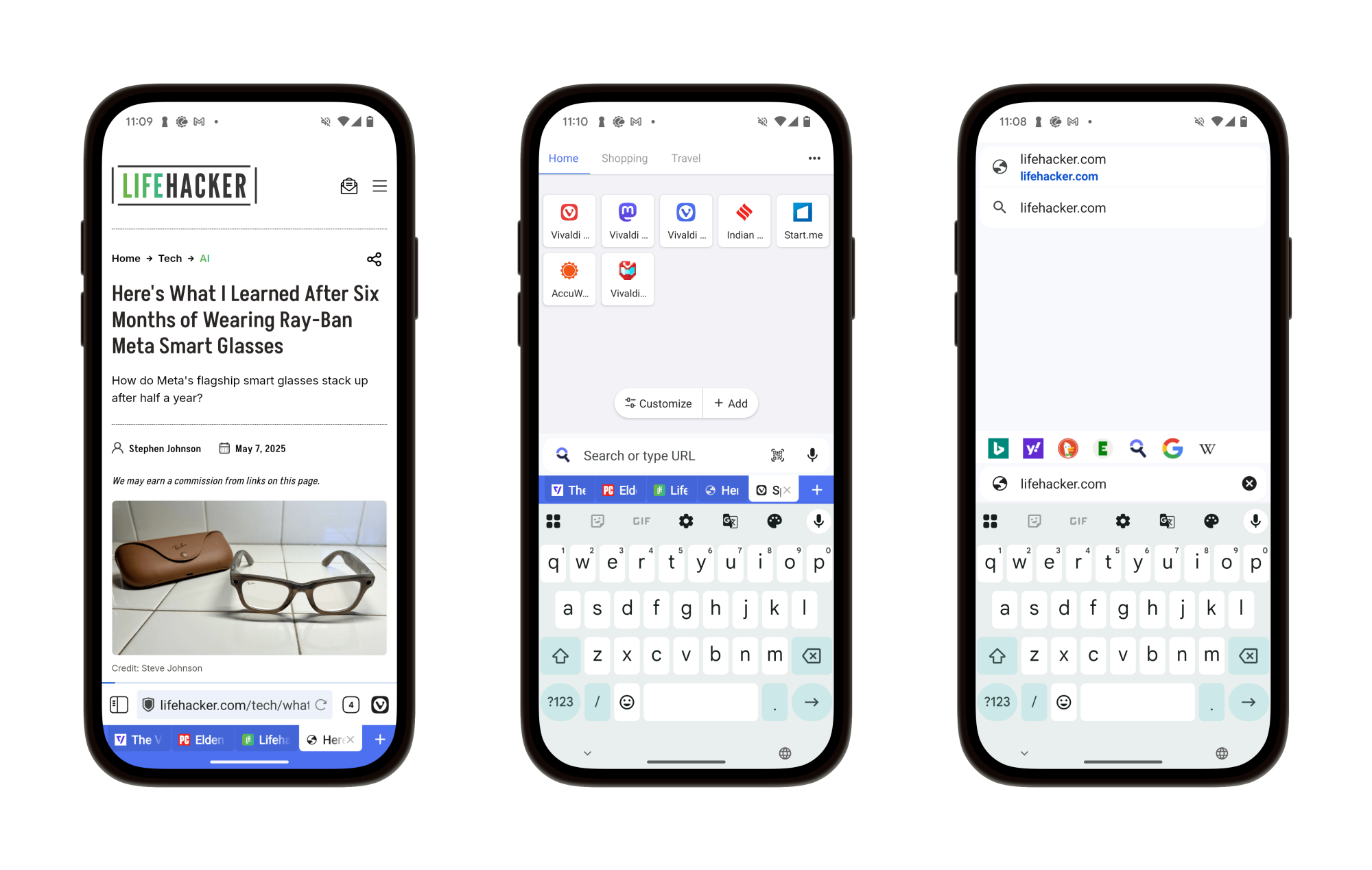
Vivaldi: Best for large screen devices

Vivaldi Browser for Android

Credit: Khamosh Pathak

Vivaldi is a fast and stable browser with desktop-style tabs that are perfect for those with large phones. With this app, you get a scrolling tab bar featuring full titles, right in the tab bar. No need to tap a button to switch to different tabs or manage them.

Instead, you’ll find a horizontally scrolling list of tabs. Though, you can turn it off as well, if you wish. And like most Android browsers, you can choose to keep the tab bar at the top, or the bottom of the screen. Vivaldi also supports this tab layout on larger screens, so if you’re using an Android tablet, or a foldable, this might be the right browser for you.

Vivaldi’s Android browser syncs with the desktop counterpart, and like the desktop app, it offers ad-blocking and tracker-blocking options by default. You also get speed dial, search engine shortcuts, reading list and themes.

Other than that Vivaldi is quite light, and the interface is also easy to use. There is no AI agent here, no free VPN, no news feed that you need to disable.

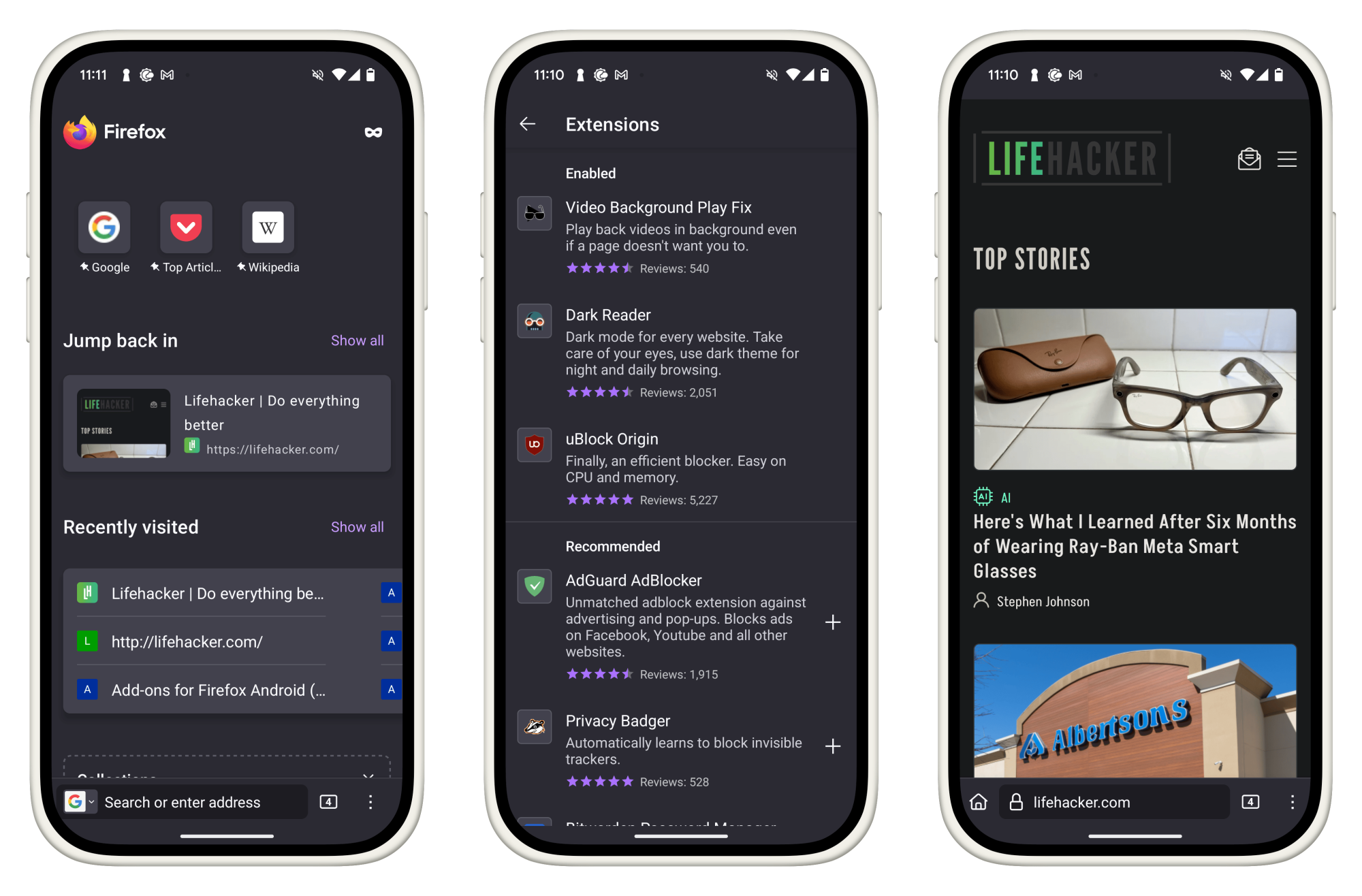
Firefox: Best for adding functionality

Firefox for Android

Credit: Khamosh Pathak

Firefox is the only browser on this list that supports extensions. This instantly makes Firefox the best pick with it comes to customization.

The Firefox app for Android is quite capable by itself. It’s fast, simple, and the easy to use. Using Firefox Sync you can access all your Firefox tabs (or any other Firefox-based browser) on your Android smartphone. The same goes for passwords too.

Firefox also features Collections, which is their own feature for manually grouping tabs in the tab switcher. The tab bar supports a nice gesture, where you can swipe left or right to switch between the recently used tabs (like how you swipe between apps using the Home bar).

But, as I mentioned, the main feature, are the Extensions. The Dark Reader extension will enable dark mode for any website, uBlock Origin will bring a fast and efficient ad blocker to Firefox, Bitwarden’s extension brings in autofill passwords, and more. There are extensions for tracking prices online, downloading videos from YouTube, and more.

Though, you don’t need to worry with most of them. Just adding a couple of extensions like uBlock Origin and Dark Reader will improve your browsing experience by a noticeable margin.

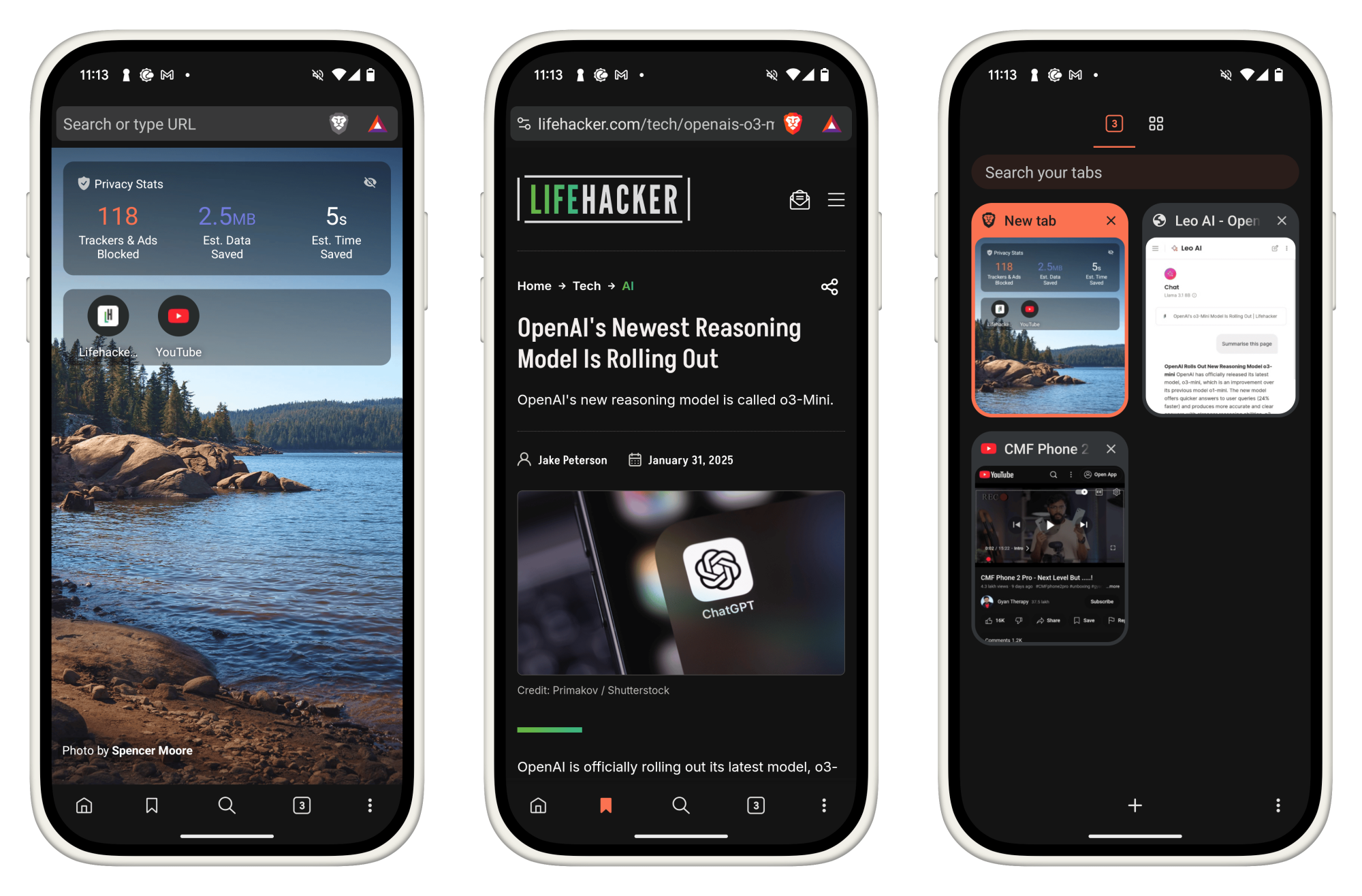
Brave: Best for privacy

Brave browser for Android

Credit: Khamosh Pathak

Brave is known for its privacy and security, and the Android browser is no different. Brave is faster compared to Chrome, and blocks ads and trackers by default, there’s no need to enable a setting for it, or to set things up. By default, Brave uses its own Brave search engine, which is also private by default, and uses its own custom search engine instead of using third-party data.

Brave offers a lot of extra features, but they are all disabled by default. You can enable a private news feed if you want. And while Brave as its own AI bot Leo and its own paid VPN, but are tucked away in the menu, easy to ignore.

There’s an experimental Night mode that will automatically invert the colors on all website, giving them a dark background, and light text. Brave also features group tabs for easier tab management.

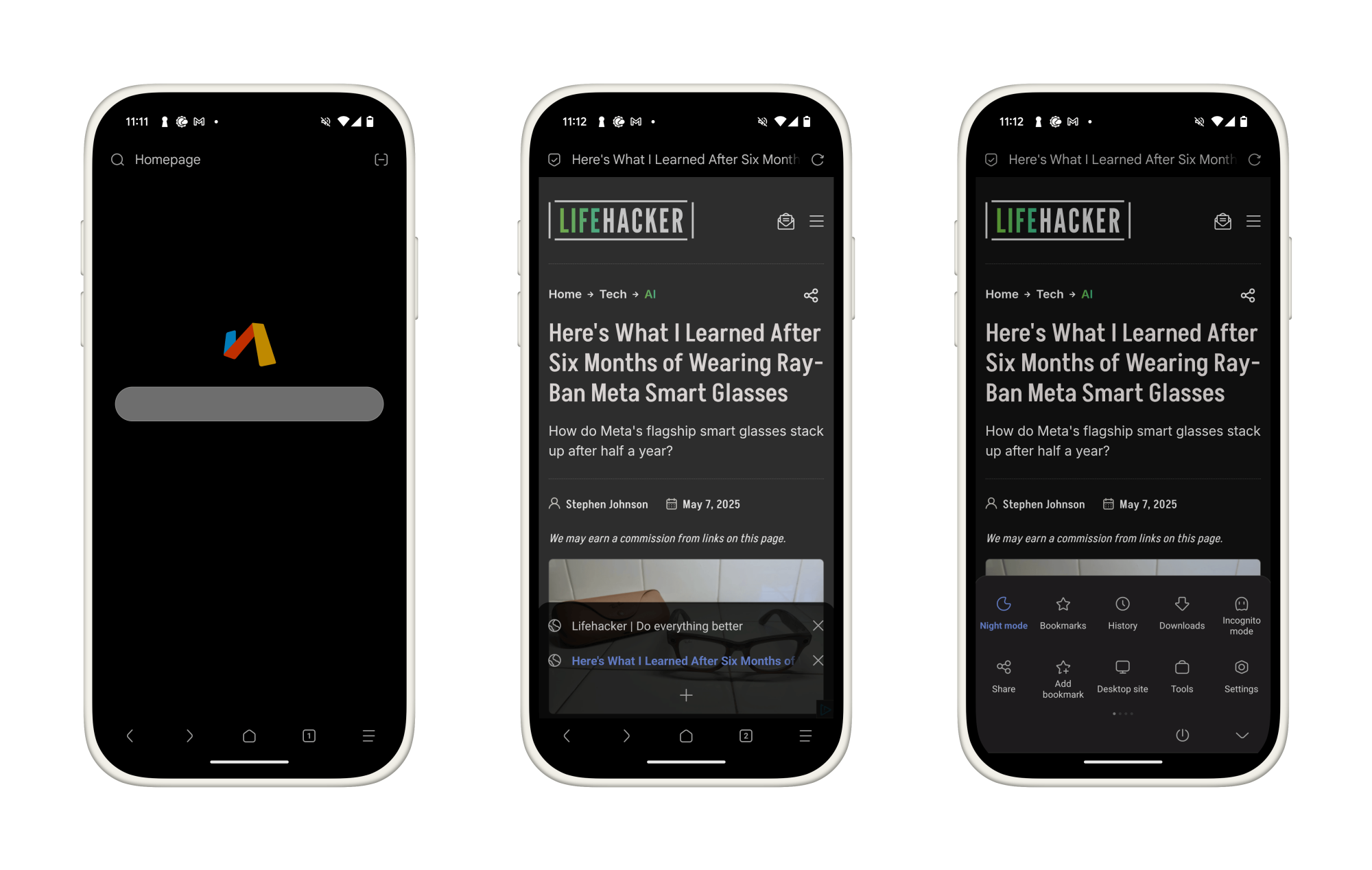
Via: Best for older devices

Via Browser for Android

Credit: Khamosh Pathak

Via is a minimalist and light browser, designed to run well on any Android device. The browser weighs just 1.5 MB, making it idea of devices with limited storage. It also works well on devices with limited amount of RAM.

Via is a barebones browser. It opens to a minimal start page, and there are no news feeds or shortcuts. It does have a really simple tab management feature, and the tab bar can be found at the bottom of the screen.

The app has built-in ad blocking, and there’s an option to edit and customize the ad blocking filters as well. There is a reader mode, and even a night mode that inverts the colors on all websites.

Overall, if you’re tired of the bloatware from Chrome, or if you have an older device where Chrome just drags on way too much, Via is the browser you should be looking into.

Opera: Best for managing tab overload

Opera browser Android

Credit: Khamosh Pathak

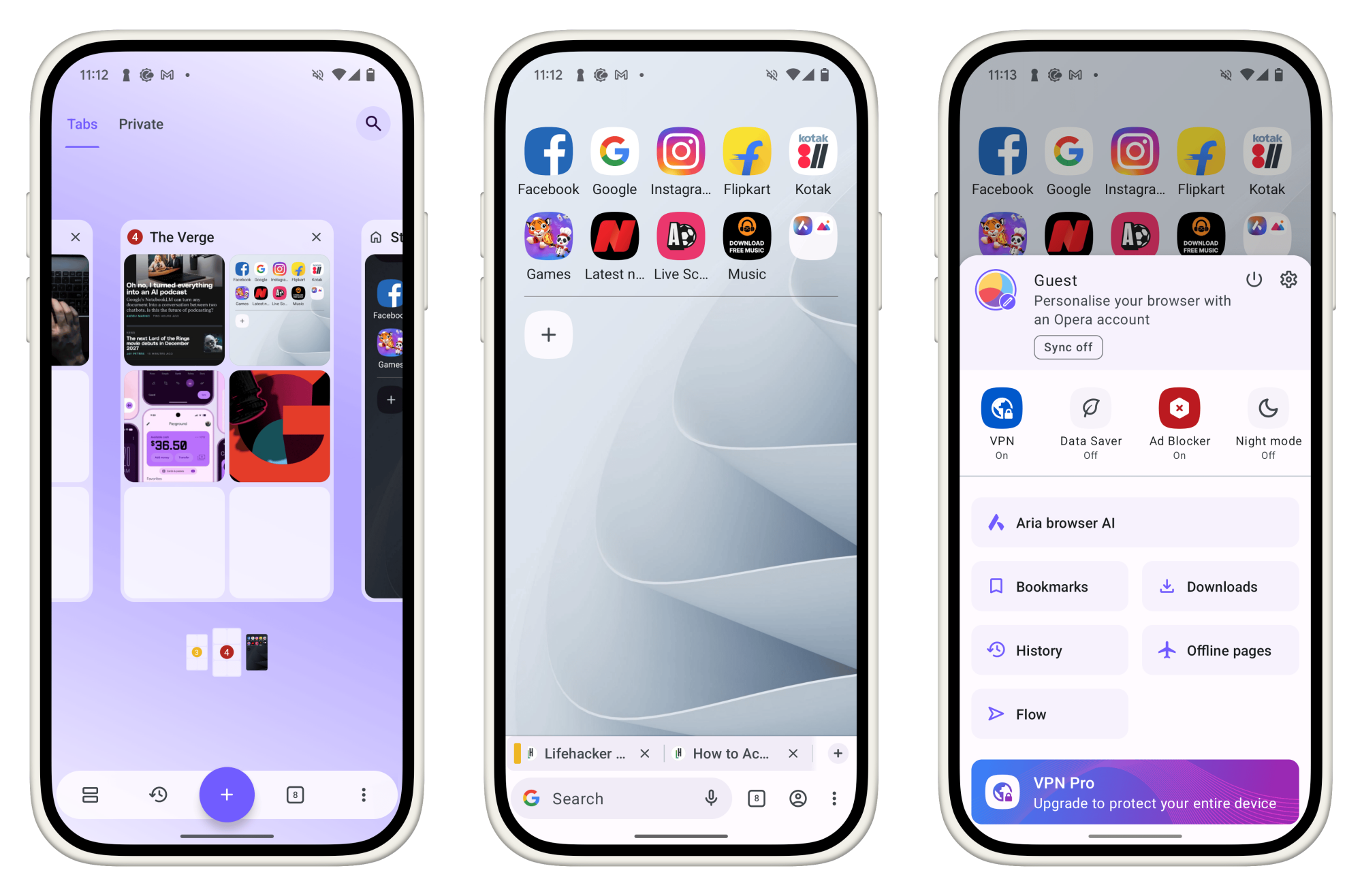
Opera browser for Android is all about features. There’s a built-in reader mode, an ad-blocker that’s enabled by default, a free VPN service, a customizable address bar that you can dock to the bottom of the screen.

Opera puts its Arai AI front and center, reserving a slot in the toolbar. But you can edit it out easily.

Just like Vivaldi, there’s an option to enable desktop style tabs, that you can swipe through. And tabs is what Opera really specializes in. There’s support for tab islands, where Opera automatically groups and color codes multiple web pages from the same site. When you go into the tab switcher, you’ll find three different layout options: Carousel, Grid, and List. The Carousel option lets you quickly scroll between open tab groups and tabs. You are free to drag and drop tabs between the groups to rearrange them.

If you use Opera on the desktop, the tabs from your computer can show up on Android, and you can use the Flow feature to share links, files and notes between all your devices.

GeForce RTX 5090 Can Smoke An 8-Digit Password In Just A Few Hours

GeForce RTX 5090 Can Smoke An 8-Digit Password In Just A Few Hours
Hive Systems has released the 2025 edition of its password crack time estimate table, and it’s a doozy. Among many other findings, the company’s researchers calculated that all random passwords around 8 characters in length are easily brute-forced with only consumer-grade hardware.

Hive Systems used only 12 RTX 5090 cards for this experiment.

37signals To Delete AWS Account, Cutting Cloud Costs By Millions

Software firm 37signals is completing its migration from AWS to on-premises infrastructure, expecting to save $1.3 million annually on storage costs alone. CTO David Heinemeier Hansson announced the company has begun migrating 18 petabytes of data from Amazon S3 to Pure Storage arrays costing $1.5 million upfront but only $200,000 yearly to operate.

AWS waived $250,000 in data egress fees for the transition, which will allow 37signals to completely delete its AWS account this summer. The company has already slashed $2 million in annual costs after replacing cloud compute with $700,000 worth of Dell servers in 2024. “Cloud can be a good choice in certain circumstances, but the industry pulled a fast one convincing everyone it’s the only way,” wrote Hansson, who began the repatriation effort in 2022 after discovering their annual AWS bill exceeded $3.2 million.


Read more of this story at Slashdot.