General Motors is partnering with LG to develop lithium manganese-rich (LMR) batteries, which are safer, denser, and cheaper than current EV battery tech. The automaker aims to begin U.S. production by 2028 and become the first to deploy LMR cells in electric vehicles. Ford also announced it would start adopting LMR batteries for its EVs, but not until 2030. The Verge reports: GM’s current crop of electric Chevys and Cadillacs use high-nickel batteries, which supply enough energy for around 300-320 miles of range. The new LMR batteries are denser, with greater space efficiency due to their prismatic shape, enabling up to 400 miles of range, GM says. Prismatic cells are packed flat in rigid cases and are generally thought to be less complex to manufacture than cylindrical cells. Less complexity and cheaper materials will hopefully lead to lower-cost EVs, which has been a significant challenge for the auto industry’s shift to electric vehicles. “The EV growth rate is really dependent on how quickly we can bring the costs down over time,” says GM’s VP for batteries Kurt Kelty. “And this is the biggest lever we have. Batteries make up roughly 30 to 40 percent of the cost of vehicles. And if you can drop that down significantly like we’re doing here, then it ends up being a lower cost to the consumer.”
Eight Sleep has launched a new sleep system called the Pod 5, which uses the power of artificial intelligence, as one would expect from a lot of new products these days. The Pod 5 system consist of a cover, a hub, a blanket and a base that works with any mattress you already have. Its cover and hydro-powered blanket cool down or heat up from 55 to 110 degrees Fahrenheit across your whole body, adjusting their temperatures based on the biometric reading from the cover’s embedded sensors.
If the system detects that you’re snoring through vibrations, the base automatically but gently elevates your head in response, which had been clinically proven to reduce snoring. The base is supposed to go in between your mattress and the bed frame, but it can also be used freestanding with an optional leg kit. Pod 5’s base comes with a built-in surround-sound speaker that plays audio, which the company says was designed to support relaxation and recovery. The company has added a guided meditation technique to its audio options, as well as a curated selection of white noise and calming sounds. Finally, the Hub contains the water that the system uses to regulate the cover’s and blanket’s temperatures. It also contains tech like the WiFi that connects the Pod 5 to the internet.
The company says the whole experience is powered by its proprietary AI engine Autopilot that’s trained on almost 10 million hours of sleep data. It also learns from your own biometrics and sleep patterns, so it can adjust the system as needed. In addition, Eight Sleep has launched a set of AI-powered algorithms called Health Check that monitors your heart and respiratory rates while you sleep through the sensors in the cover. If your heart rate or breathing shows some abnormality, for instance, you’ll see a report in the system’s accompanying app notifying you of the reading.
The Pod 5 system is now available for purchase in the US, the EU, the UK, Canada, Australia, the UAE, Mexico, Saudi Arabia, Monaco and Switzerland. Prices begin at $2,849, and you can get up to a 30-night trial and free returns in case you change your mind.
Eight Sleep
This article originally appeared on Engadget at https://www.engadget.com/home/smart-home/eight-sleep-launches-the-ai-powered-pod-5-sleep-system-130034283.html?src=rss
As people continue to move away from sedans to larger vehicles, the distinction between SUVs, crossovers and MPVs has become even blurrier. But make no mistake, if you’re looking for a big car with tons of power, excellent handling and a true seven-person capacity, the Lucid Gravity might be the coolest three-row EV on sale today. Just don’t call it a minivan.
Not that you would be incorrect. Between its extra-long dimensions (198 inches, three inches longer than a LWB VW ID. Buzz), a smooth, sloping front end and an emphasis on aerodynamics, the Gravity certainly looks more like a Chrysler Pacifica than a brawny Rivian R1S. But as one Lucid representative told me, minivans have gotten a bad rap in recent times, due to their focus on basic practicality while eschewing anything in the way of engaging driving dynamics. This makes slapping the minivan tag on a car feel almost like a death sentence, even if the biggest difference between the Gravity and some of its cross-category rivals is the lack of sliding doors.
Sam Rutherford for Engadget
With the Gravity’s Grand Touring spec (which starts at $94,900) packing a whopping 828 horsepower along with fancy features like standard air suspension and optional rear-wheel steering, this thing is anything but pokey. And that’s before you consider a 0 to 60 time of just 3.4 seconds, which puts most sports cars (especially gas-powered ones) to shame. So despite how it looks, there’s no doubt the Gravity offers better performance than any minivan on the planet.
The speed continues when it’s time to charge. Thanks to its 926 volt architecture, the Gravity can suck down up to 400 kW of juice, which makes this the fastest charging EV outside of China. Lucid’s charging tech is also capable of adding 200 miles of driving distance in under 11 minutes. When combined with up to 450 miles of range, this vehicle is almost single-handedly upending the idea that electric cars are bad for long road trips.
The sky was cloudy that day.
Sam Rutherford for Engadget
Meanwhile, for those who want to travel in luxury, the Gravity has more creature comforts than minivans too, even for a class of vehicle that can often be judged by its number of cupholders. Not only are the front and second row seats heated, Lucid’s glass panoramic roof runs nearly the entire length of the car. That means unlike most rivals where the driver is stuck without a view, all you see is sky when you look up from behind the wheel. There’s even a screen for second row occupants to control music and climate (among other things).
Lucid also makes great use of the Gravity’s length. While I wouldn’t want to ride back there as an adult all the time, it has one of the most spacious third rows I’ve ever sat in. Alternatively, if you need extra cargo space, the rearmost seats fold into the floor, providing you with a flat load space featuring 56.2 cubic feet of room (and that’s with the second row still up). And while it’s not something you’ll use all the time, I love the company’s optional folding cushion that transforms the frunk into a loveseat — complete with cupholders on each side. It’s a fun little feature that makes me sad that drive-in movie theaters are becoming extinct.
Sam Rutherford for Engadget
The most enchanting contradiction about the Gravity is what it feels like to drive. After getting into the pilot’s seat, you’re greeted by a massive 34-inch 6K OLED display. And unlike some of its competitors, it’s not two or three screens sandwiched together. It’s all a single panel that’s an absolute treat to look at. This expansiveness is only reinforced by Lucid’s squircle-shaped wheel. It’s a touch smaller than you might expect on a vehicle this size, but it also gives you increased visibility at its giant infotainment system.
The hard thing to wrap your head around though, is that for a long SUV with three rows of seats, it doesn’t drive like a big car. The cabin is spacious and airy and it feels like you could fit a pickleball court between its mirrors. And yet, thanks to features like the optional rear-wheel steering on my demo vehicle, it almost felt petite during a quick drive around New York City.
Now, I will admit that my route down the West Side Highway wasn’t the best place to really test out its driving dynamics. But there were a few spots where I got a sense of how good the Gravity will be on the open road. For example, I had to make a U-turn down near Battery Park and I thought there was no way I was going to make it without committing to a three-point maneuver. But to my delight, it just darted around the divider in a way that defies its dimensions.
Lucid’s suspension is also a work of art. For a car that weighs around 6000 pounds (depending on spec), it doesn’t lumber or bounce when it goes over bumps. It just kind of floats. You can still feel the road, but it’s just more of a gentle reminder that its surface texture is constantly changing rather than a jolt up your backside. Granted, my test vehicle was equipped with Lucid’s Dynamic Handling Package, which includes three-chamber air suspension instead of the standard two. But, honestly, that extra $2,900 feels well worth it, especially when that option also adds the rear-wheel steering.
Sam Rutherford for Engadget
I also appreciate how the car automatically hunkers down when you set it to sport mode to improve performance. Even without room to get it up to top speed, it’s impossible to escape the feeling of immense power the car gets from its dual motors (a single-motor RWD is slated to come out later). The Gravity might just have the best ride quality of any EV SUV currently on sale.
However, I do have some complaints. The most obvious one is that this thing ain’t cheap at just shy of $95,000 for the initial Grand Touring version. And even when the base model eventually comes out at around $80,000, that’s still a far cry from mainstream affordability. It really makes me wonder why Lucid didn’t jump straight to making its rumored (and almost certainly more affordable) mid-size SUV.
Sam Rutherford for Engadget
I don’t love Lucid’s current color options either, which seem aimed more at boomers than younger, more EV-friendly drivers. (Though I guess that’s where the money is.) The most vibrant paint choice is either a brownish bronze or a faded olive green. I was hoping that the company had learned something from the stunning blue it uses on the Air Sapphire and carried over some of that styling to the Gravity. But here we are.
Finally, Lucid won’t have its version of Dream Drive 2 Pro hands-free driving tech available at launch. Furthermore, the company is running into issues sourcing components for its HUD system, which means you’ll have to wait a bit longer for that option. The good news is that when (or if) Lucid eventually figures out its hand-free tech, all the hardware needed to support it will already be in the Gravity, so all you’ll need is an OTA update to turn it on.
Regardless, as Lucid continues ramping production throughout the year, the Gravity already feels like the coolest big EV SUV on sale today and an immediate top contender for anyone looking for a luxurious three-row people carrier.
This article originally appeared on Engadget at https://www.engadget.com/transportation/evs/the-lucid-gravity-is-the-coolest-three-row-ev-on-the-market-120024089.html?src=rss
Sony has sold 77.8 million PlayStation 5s since the console first went on sale in 2020 after shipping 2.8 million units in its latest quarter, the company announced. That figure lines up remarkably well with PlayStation 4 sales which hit 79.1 million units in approximately the same amount of time. However, Sony’s full year fiscal 2024 PS5 sales of 18.5 million were down compared to the 20.8 million it sold in 2023.
Game sales more than made up for that though, rising nine percent and helping push the division’s operating income up 43 percent year over year. That was largely due to third-party sales, as first-party sales actually fell a bit. Sony has only released one first-party game so far this year with key titles like Death Stranding 2: On the Beach and Ghost of Yōtei still to come.
Sony doesn’t expect this growth to continue, though. The company is predicting a ¥100 billion ($700 million) hit to sales next year due to tariffs, given that most of its sales occur in the US — and the company had already forecast flat revenue for 2025. Another key blow was the delay of Rockstar’s Grand Theft Auto VI launch that was just pushed back to May 2026.
During its earnings call, Sony said that it was considering “passing on” tariff hikes to consumers, though it didn’t mention the PS5 or US specifically. The company has already raised the price of the console in other territories including Europe, but US increases are extremely rare. Sony CEO HIroki Totoki also brought up the possibility of building the PlayStation 5 in the US, saying it’s something that “has to be considered going forward.”
This article originally appeared on Engadget at https://www.engadget.com/gaming/playstation/sony-has-sold-778-million-ps5s-to-date-but-expects-a-downturn-due-to-tariffs-120013001.html?src=rss
Longtime Slashdot reader ndsurvivor shares a report from TechCrunch: In 2018, Liangbing Hu, a materials scientist at the University of Maryland, devised a way to turn ordinary wood into a material stronger than steel. It seemed like yet another headline-grabbing discovery that wouldn’t make it out of the lab. “All these people came to him,” said Alex Lau, CEO of InventWood, “He’s like, OK, this is amazing, but I’m a university professor. I don’t know quite what to do about it.”
Rather than give up, Hu spent the next few years refining the technology, reducing the time it took to make the material from more than a week to a few hours. Soon, it was ready to commercialize, and he licensed the technology to InventWood. Now, the startup’s first batches of Superwood will be produced starting this summer. “Right now, coming out of this first-of-a-kind commercial plant — so it’s a smaller plant — we’re focused on skin applications,” Lau said. “Eventually we want to get to the bones of the building. Ninety percent of the carbon impact from buildings is concrete and steel in the construction of the building.” To build the factory, InventWood has raised $15 million in the first close of a Series A round. The round was led by the Grantham Foundation with participation from Baruch Future Ventures, Builders Vision, and Muus Climate Partners, the company exclusively told TechCrunch. How do they do it? According to TechCrunch, InventWood’s Superwood is made by treating regular timber with “food industry” chemicals to remove lignin and modify its structure, then compressing it to increase hydrogen bonding between cellulose fibers. This densification makes the wood up to 10 times stronger than natural wood, with a higher strength-to-weight ratio than steel. “You end up with something that looks like these richer, tropical hardwoods,” Lau added.
Identity thieves have found an insidious target: death row inmates. A SentiLink report published this week reveals scammers are stealing identities of Texas prisoners awaiting execution to orchestrate “bust-out” fraud schemes — patiently building credit before disappearing with up to $100,000.
Nearly 10% of Texas’ 172 death row inmates have fallen victim. The operation, active since March 2023, exploits inmates’ isolation from financial communications. “They wouldn’t receive text or email alerts from a financial institution,” said Robin Maher of the Death Penalty Information Center.
Beyond opening credit accounts, NBC reports, fraudsters have registered fake businesses using inmates’ identities, including a landscaping company created under Ronald Haskell’s name — a man imprisoned since 2014 for killing six people. TransUnion estimates bust-out scams now cost banks $1 billion annually.
An anonymous reader quotes a report from Ars Technica: Federal Communications Commission Chairman Brendan Carr has threatened to revoke EchoStar licenses for radio frequency bands coveted by rival firms including SpaceX, which alleges that EchoStar is underutilizing the spectrum. “I have directed agency staff to begin a review of EchoStar’s compliance with its federal obligations to provide 5G service throughout the United States per the terms of its federal spectrum licenses,” Carr wrote in a May 9 letter to EchoStar Chairman Charles Ergen. EchoStar and its affiliates “hold a large number of FCC spectrum licenses that cover a significant amount of spectrum,” the letter said.
Ergen defended his company’s wireless deployment but informed investors that EchoStar “cannot predict with any degree of certainty the outcome” of the FCC proceedings. The letter from Carr and Ergen’s statement is included in a Securities and Exchange Commission filing submitted by EchoStar today. EchoStar’s stock price was down about 8 percent in trading today. EchoStar bought Dish Network in December 2023 and offers wireless service under the Boost Mobile brand. As The Wall Street Journal notes, the firm “has spent years wiring thousands of cellphone towers to help Boost become a wireless operator that could rival AT&T, Verizon and T-Mobile, but the project has been slow-going. Boost’s subscriber base has shrunk in the five years since Ergen bought the brand from Sprint.” […]
EchoStar will have to prove its case in the two FCC proceedings. The FCC set a May 27 deadline for the first round of comments in both proceedings and a June 6 deadline for reply comments. The proceedings could result in the FCC letting other companies use the spectrum and other remedies. “In particular, we seek information on whether EchoStar is utilizing the 2 GHz band for MSS consistent with the terms of its authorizations and the Commission’s rules and policies governing the expectation of robust MSS,” the FCC Space Bureau’s call for comments said. “We also seek comment on steps the Commission might take to make more intensive use of the 2 GHz band, including but not limited to allowing new MSS entrants in the band.” Last month, SpaceX urged the FCC to reallocate the spectrum, saying “the 2 GHz band remains ripe for sharing among next-generation satellite systems that seek to finally make productive use of the spectrum for consumers and first responders.”
EchoStar countered that SpaceX’s filing is “intended to cloak another land grab for even more free spectrum,” and that its “methodology is completely nonsensical, given that EchoStar’s terrestrial deployment is subject to population-based milestones that EchoStar has repeatedly demonstrated in status reports.”
Google’s stalwart search button has a new neighbor: AI Mode. From a report: The artificial intelligence feature is being tested directly beneath the Google search bar beside a “Google Search” button, replacing the “I’m Feeling Lucky” widget. The new feature, though not widely available yet, is being tested in a location where Google rarely makes changes.
Qatar is gifting Trump a $400 million luxury 747 to serve as a temporary Air Force One, but experts warn that retrofitting it to meet presidential security standards could take years, cost hundreds of millions more, and risk national security due to potential embedded surveillance. The Register’s Iain Thomson reports: The current VC-25s aren’t just repainted 747s. They’re a pair of flying fortresses that must be capable of allowing the president to run the country, survive wartime conditions (even nuclear), and be totally secure from outside influence or intrusion. While the precise details of the current airframe are a tightly guarded secret, some details are included on government fact sheets or have been revealed in various media reports. For a start, it must have an in-flight refueling capability so the president can go anywhere in the world and stay up as long as needed. Retrofitting this to an existing 747 would be very expensive, as the feds would need to strengthen portions of the hull to handle the refueling system and reconfigure the fuel tanks to handle trim issues.
Then there’s the hull, which is known to be armored, and the windows are also thicker than you’d find on a normal flight. The government would also need to build in weapons systems like the chaff rockets used against radar-guided missiles, flares against heat seekers, and AN/ALQ-204 Matador Infrared Countermeasure systems, or similar to try and confuse incoming missiles. Next up, the engines and electrical systems would have to be replaced. The electronics in the current VC-25s are hardened as much as possible against an electromagnetic pulse that would be generated by a nuclear detonation. There are also claims that the aircraft have extra shielding in the engines to help against missile fragments should a physical attack happen.
Next up are communications. Air Force One has air-to-ground, air-to-air, and satellite comms systems that are thought to be the equal of what’s in the White House. There are at least two separate internal phone systems – one open and the other highly secure – that would need to be installed and checked as well. Then there are incidentals. Contrary to what films will tell you, there is no escape capsule on the current Air Force One, nor a rear parachute ramp, but there is a medical suite with emergency equipment and space for a physician which would already need to be installed, as well as a secured cargo area designed to prevent tampering or unauthorized access. As for the threat of embedded surveillance devices, Richard Aboulafia, managing director of aircraft consultancy AeroDynamic Advisory, said: “You’d have to take it apart piece by piece to stop a professional operator putting in lots of equipment to confuse things, like spare sensors and wiring.”
“It wouldn’t be in the air before 2030 at the earliest, long after he’s left office and probably later than the existing planned replacements,” said Aboulafia. “It makes no sense on any level, except that he wants a free 747 for himself. Nothing else makes any sense.”
“What’s sort of annoying about the whole thing is I’m not sure what’s wrong with the current Air Force One,” Aboulafia said. “Maybe if they gave it a gold makeover, he’d like it more.”
According to Rest of the World, a major confrontation between Meta and the local authorities in Nigeria is currently taking place: “Local authorities have fined Meta $290 million for regulatory breaches, prompting the social media giant to threaten pulling Facebook and Instagram from the country.” Techdirt reports: As with earlier EU fines imposed on the company, the sticking point is Meta’s refusal to comply with local privacy laws […]. The fine itself is small change for Meta, which had a net income of $62 billion on a turnover of $165 billion in 2024, and a market capitalization of $1.5 trillion. Meta’s current revenues in Nigeria are relatively small, but its market shares are high: “According to social media performance tracker Napoleoncat, Meta has a massive presence in the country, with Facebook alone reaching about 51.2 million users as of May 2024, more than a fifth of the population. Instagram had 12.6 million Nigerian users as of November 2023, while WhatsApp had about 51 million users, making Nigeria the 10th largest market globally for the messaging app.”
Since many Nigerians depend on Meta’s platforms, the company might be hoping that there will be public pressure on the government not to impose the fine in order to avoid a shutdown of its services there. But it is hard to see Meta carrying out its threat to walk away from a country expected to be the third most populous nation in the world by 2050. In 2100, the population of Nigeria could reach 541 million according to current projections.
Amazon’s Audible is expanding its audiobook offerings by giving select publishers access to its AI-powered production tools that will let them more easily convert books into audiobooks with over 100 customizable AI voices to choose from. It will also launch an AI translation tool in beta later this year to help publishers translate and localize audiobooks into multiple languages, with both automated and human-assisted options. The Verge reports: Audible says its new AI narration technology leverages Amazon’s advanced AI capabilities and will be made available to interested publishing partners in the coming months in one of two ways. For publishers wanting to be hands-off, an end-to-end service managed by Audible handles the “entire audiobook production process” right up to publication, while a self-service option will give publishers access to the same tools so they can independently direct the entire production process.
With both options, publishers are able to “choose from a quickly growing and improving selection of more than 100 AI-generated voices across English, Spanish, French, and Italian with multiple accent and dialect options, and will be able to access voice upgrades for their titles as our technology evolves,” according to Amazon. […] Publishers will also be able to review translations themselves or opt for a human review through Audible with a professional linguist.
Steam announced this week that it will offer a compatibility rating that will designate when a game is supported on the company’s operating system. The SteamOS Compatibility assessment is slated to roll out “in the next few weeks.”
This metric is an extension of the Steam Deck Verified program, and it will award a checkmark to games based on a data subset within that vetting process. In other words, game developers won’t have to take any additional steps if they’re already completing Steam Deck Verified. On the player end, compatible games will show a blue checkmark when viewed in the Steam Store and Steam Client while running the operating system on a device other than the Steam Deck.
The announcement is mostly a future-proofing move. Right now, the Lenovo Legion Go S is the only handheld besides the Steam Deck that’s officially running Valve’s operating system. But Lenovo was already teasing a second iteration of the hardware at CES this year and Valve clearly has plans for the number of SteamOS platforms to grow. The landscape for handheld gaming could start looking quite different if SteamOS really takes off as a standalone service.
This article originally appeared on Engadget at https://www.engadget.com/gaming/valve-made-a-steam-deck-verified-program-for-things-that-arent-steam-decks-224535134.html?src=rss
An anonymous reader quotes a report from the BBC: A student’s robot has beaten the world record for solving a four-by-four Rubik’s cube — by 33 seconds. Matthew Pidden, a 22-year-old University of Bristol student, built and trained the “Revenger” over 15 weeks for his computer science bachelor’s degree. The robot solved the cube in 45.305 seconds, obliterating the world record of 1 minute 18 seconds. However, the human record for solving the cube is 15.71 seconds.
Mr Pidden’s robot uses dual webcams to scan the cube, a custom mechanism to manipulate the faces, and a fully self-built solving algorithm to generate efficient solutions. The student now plans to study for a master’s degree in robotics at Imperial College London.
SpaceX fired six Raptor engines on the company’s next Starship rocket Monday, clearing a major hurdle on the path to launch later this month on a high-stakes test flight to get the private rocket program back on track.
Starship ignited its Raptor engines Monday morning on a test stand near SpaceX’s Starbase launch facility in South Texas. The engine ran for approximately 60 seconds, and SpaceX confirmed the test-firing in a post on X: “Starship completed a long duration six-engine static fire and is undergoing final preparations for the ninth flight test.”
SpaceX hasn’t officially announced a target launch date, but maritime warnings along Starship’s flight path over the Gulf of Mexico suggest the launch might happen as soon as next Wednesday, May 21. The launch window would open at 6:30 pm local time (7:30 pm EDT; 23:30 UTC). If everything goes according to plan, Starship is expected to soar into space and fly halfway around the world, targeting a reentry and controlled splashdown into the Indian Ocean.
Google is enhancing Android’s Factory Reset Protection (FRP) to make stolen phones virtually unusable by detecting setup wizard bypasses and requiring a second factory reset until ownership is verified. Android Authority reports: You can factory reset an Android phone in several ways. However, triggering a reset through the Android recovery menu or Google’s Find My Device service activates Factory Reset Protection (FRP). During setup after such a reset, the wizard requires you to verify ownership by either signing into the previously associated Google account or entering the device’s former lock screen PIN, password, or pattern. Failing this verification step blocks setup completion, rendering the device unusable. […]
Factory Reset Protection (FRP) is a valuable feature that discourages theft by rendering stolen Android phones useless to potential buyers if wiped improperly. However, FRP isn’t foolproof; thieves have discovered numerous methods over the years to circumvent it. These bypasses typically involve skipping the setup wizard, allowing someone to use the phone without entering the previous owner’s Google account details or screen lock.
During The Android Show: I/O Edition, Google announced plans to “further harden Factory Reset protections, which will restrict all functionalities on devices that are reset without the owner’s authorization.” While the company didn’t elaborate much, a screenshot it shared suggests that Android will likely detect if someone bypasses the setup wizard and then force another factory reset, preventing unauthorized use until the user proves ownership. […] Google stated this FRP improvement is coming “later this year.” Since the stable Android 16 release is coming soon, this timeline suggests the feature won’t be part of the initial launch. It might arrive later in one of Android 16’s Quarterly Platform Releases (QPRs), but that remains to be seen.
Some software updates pack in a number of features and changes, while others fundamentally overhaul the experience of using the device in question. iOS 18.5 is neither: This is a minor update, but that’s to be expected. WWDC is next month, where Apple will almost assuredly announce iOS 19.
But iOS 18.5 isn’t an empty update. Once you install it on your iPhone, you will notice some changes—and some of the changes you don’t notice are the most important of all. Here’s everything that’s new in the latest iOS update:
An easy way to disable contact photos in Mail
With iOS 18.2, Apple upgraded the Mail app. For some, the changes made the Mail app more organized and efficient to use. For others, it was bloated and confusing. Contact photos didn’t help.
The idea is that if you have a contact photo for a sender, it’ll appear in the left side of the message in your inbox. However, if you don’t have such a photo, Mail will use an image from Apple’s stock library. Taste is subjective, but, frankly, these stock icons just don’t look good.
Luckily, you can disable them, but you’d never know that unless you’re someone who loves diving through your Settings app. iOS 18.5 fixes that with an easy option right in the Mail app itself. Lifehacker’s Khamosh Pathak explained the change in more depth here.
It just got more difficult to bypass Screen Time settings
Apple’s Screen Time feature is a great tool for parents—and, I can only image, a pain for kids. Parents can set a passcode to lock Screen Time settings, and ensure that kids can’t access aspects of their iPhone their parents don’t want them to. Of course, passcodes are an infamously futile restriction, as savvy kids will always figure out how to break in.
While Apple’s isn’t reinventing the passcode wheel with iOS 18.5, it is making Screen Time a bit more secure. Once you update, you’ll receive a notification whenever the Screen Time passcode is used on a child’s device. That won’t stop your kids from figuring out your Screen Time passcode, but it will nip their fun in the bud pretty quickly.
I imagine the kids will figure out some workaround to this feature in the future. But, for now, you have an additional tool to help ensure the restrictions stay in place.
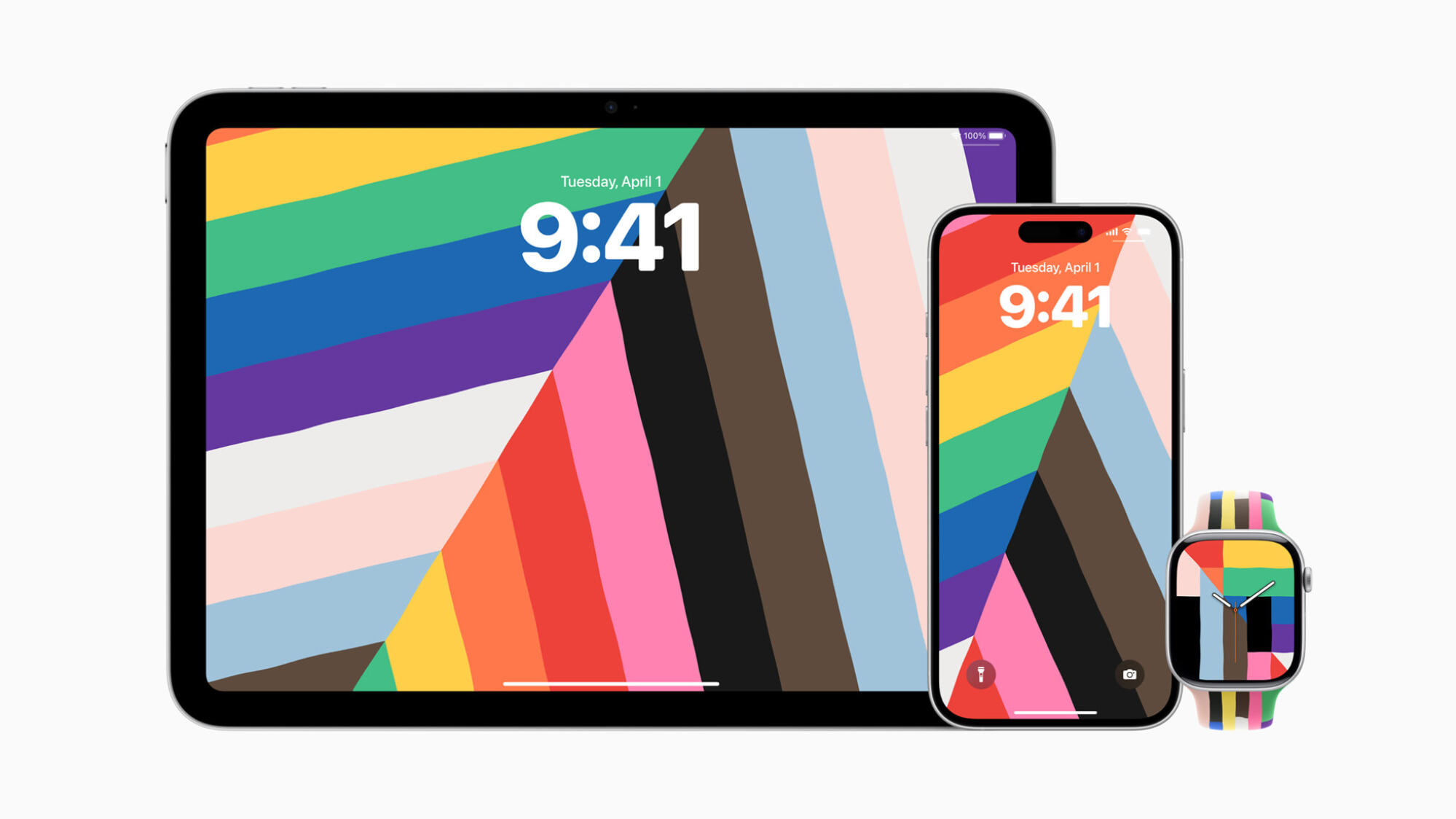
A new “Pride Harmony” wallpaper
Credit: Apple
In anticipation of Pride Month, Apple is rolling out a new “Pride Harmony” wallpaper for its various devices. The wallpaper features colors of the rainbow that adjust their positions as you move, lock, or unlock your iPhone or iPad. Apple also has a new Pride Edition Sport Band, which features a similar color scheme. Apple says its goal with the Pride Harmony design is to “celebrate the strength and beauty of LGBTQ+ communities around the world.”
It’s easy to be cynical about corporate pride, but considering the times we live in, it’s cool to see Apple continuing to be as openly supportive of the LGBTQ+ community as it has been in recent years. (Tim Cook’s donations aside.)
“Buy with iPhone” now available on third-party devices
When you buy something on the Apple TV’s TV app (say that three times fast), you have the option to approve that purchase with your iPhone. With iOS 18.5, that feature is coming to the TV app on non-Apple devices. That way, you don’t need to make the purchase on the TV app of another Apple device before being able to watch on your third-party device.
Carrier-provided satellite features are now available on the iPhone 13 series
Since 2023, Apple has officially supported satellite communications for all iPhones starting with the 14 series. If you’re out without cell services, you can connect to a satellite to reach out to the authorities for help—or even just text a friend.
Following this latest update, however, iPhone 13 users will be able to take advantage of satellite features as well.
Apple Vision Pro app gets a bug fix
The update also fixes an issue with the Apple Vision Pro app, where the app may sometimes display a black screen.
Security updates
iOS 18.5’s sleeper feature is the security boost it provides your iPhone. In all, the update patches over 30 bugs. Luckily, Apple isn’t aware of any exploits for these vulnerabilities, which means hackers have likely not used these flaws to target iPhone users. That said, the safest course of action is to update your iPhone as soon as possible, in case someone does figure out how to use these flaws against you.
Plus, there are some non-hacking vulnerabilities here you should patch. FaceTime’s mute button, for example, might not actually work, which should be more than enough reason to update to iOS 18.5. (Be careful when talking smack while on a FaceTime call.)
Buried in the blog posts and videos that accompanied Google’s The Android Show: I/O Edition announcements was a nugget of Nothing news: The Nothing Phone 3 is going to be expensive. In an Android marketing video showcasing the company’s phones, Nothing CEO Carl Pei shared that the new phone will cost around £800 when it launches this summer.
That new cost is thanks to Nothing’s decision to go “all-in” on the new device by including “premium materials, major performance upgrades and software that really levels things up,” according to Pei. The Nothing Phone 2 launched at £580 in the UK and $600 in the US, so selling the Phone 3 at £800 is a noticeable price jump. Assuming Nothing follows through on the premium upgrades it’s promising, though, maybe it’ll make sense that the Phone 3 costs as much as a Pixel 9 or iPhone 16.
Nothing made its name on affordable phones that have unique, premium designs. For example, the company launched the Phone 3a and Phone 3a Pro in March 2025, the budget and mid-range counterparts to the Phone 3. Both phones use mid-range chips and camera sensors, but feature a futuristic design and clever AI features that you’d expect out of a much more expensive device.
Switching to trying to compete with Apple and Samsung in terms of price suggests Nothing is confident, at the very least. We’ll have to wait until this summer when the Phone 3 is actually released to see if that confidence is justified.
This article originally appeared on Engadget at https://www.engadget.com/mobile/smartphones/carl-pei-teases-the-all-in-nothing-phone-3-with-a-flagship-price-213023983.html?src=rss
Spotify’s AI DJ is like if ChatGPT decided to switch careers. The DJ curates a playlist of music based on Premium subscribers’ previous play history, including new and old songs in the mix. Of course, the headline feature is the DJ’s voice, as the AI bot announces which songs are up next, as well as some information about each. Whether you love or hate AI, it’s a pretty harmless feature, and seems fun for those who pay for Spotify.
While DJ feels interactive, it really isn’t. Aside from skipping songs, it’s mostly a passive feature. That’s now changing: In a blog post on Tuesday, Spotify announced that you will now be able to make requests to the DJ with your voice. If you’re enjoying the personalized playlist, but want to listen to something in particular—whether that be a song, genre, or mood—you can now ask the DJ to play it.
In a video on the press release, Spotify demos a user asking, “DJ, morning motivation needed ASAP…give me some dance-pop vibes.” The DJ responds in kind: “No problem. Here’s some LISA.” In another example, the user asks, “play me something with a Y2K vibe to celebrate.” DJ decides to run with Tate McRae, “with that nostalgic sound you’ve had on repeat.”
Some other request examples Spotify highlighted include:
“Surprise me with some indie tracks I’ve never heard before.”
“Give me some electronic beats for a midday run.”
“Play me some cry-in-the-car songs.”
Spotify says that DJ requests are available in English for Premium users in over 60 markets. If you have access to the DJ, you have access to requests.
How to make a DJ request on Spotify
First, you’ll need to subscribe to Spotify Premium and live in an area where the DJ is available. If those two points are met, open Spotify and search for “DJ.” Press play to launch the DJ, then press and hold the DJ button in the right-hand corner. (Listen for a beep.) Now, place your request.
As usual, if you don’t have a specific request but want to hear something else, you can simply skip to the next track, which will likely be something totally different than what was just playing.
Nextcloud has accused Google of sabotaging its Android Files app by revoking the “All files access” permission, which the company says
cripples functionality for its 824,000 users and forces reliance on limited alternatives like SAF and MediaStore. The Register reports: Nextcloud’s Android Files app is a file synchronization tool that, according to the company, has long had permission to read and write all file types. “Nextcloud has had this feature since its inception in 2016,” it said, “and we never heard about any security concerns from Google about it.” That changed in 2024, when someone or something at Google’s Play Store decided to revoke the permission, effectively crippling the application. Nextcloud was instructed to use “a more privacy-aware replacement.” According to Nextcloud, “SAF cannot be used, as it is for sharing/exposing our files to other apps … MediaStore API cannot be used as it does not allow access to other files, but only media files.”
Attempts to raise the issue with Google resulted in little more than copy-and-pasted sections of the developer guide. “Despite multiple appeals from our side and sharing additional background, Google is not considering reinstating upload for all files,” Nextcloud said. The issue seems to stem from the Play Store. While a fully functional version is available on F-Droid, the Play Store edition is subject to Google’s imposed limitations. Regarding the All files access permission, Google’s developer documentation states: “If you target Android 11 and declare All files access, it can affect your ability to publish and update your app on Google Play.”
Nextcloud is clearly aggrieved by the change, as are its users. “This might look like a small technical detail but it is clearly part of a pattern of actions to fight the competition,” it said. “What we are experiencing is a piece of the script from the big tech playbook.” […] Are there nefarious actors at play here, an automated process that auto-rejects apps with elevated access requirements, or is it just simple incompetence? “Either way,” Nextcloud said, “it results in companies like ours just giving up, reducing functionality just to avoid getting kicked out of their app store.”
“The issue is that small companies — like ours — have pretty much no recourse,” it added. Nextcloud went on to criticize oversight processes as slow-moving, with fines that sound hefty but amount to little more than a slap on the wrist. “Big Tech is scared that small players like Nextcloud will disrupt them, like they once disrupted other companies. So they try to shut the door.”
In the early days of President Donald Trump‘s second administration, federal agencies including the US Department of Agriculture were ordered to remove information about climate change from their websites. Now, the USDA has committed to reinstating the deleted content following a lawsuit on behalf of the Northeast Organic Farming Association of New York, the National Resources Defense Council and the Environmental Working Group. According to a letter sent yesterday to a district court judge, the agency has already begun the restoration process and expects to “substantially complete” the effort in about two weeks.
The material removed from USDA sites in February included content about climate-smart agriculture, forest conservation, climate change adaptation and clean energy project investments in rural areas. The trio of plaintiffs sued on the basis that removing that information violated the Freedom of Information Act that allows public access to important federal records, as well as failing to provide advanced notice required by the Paperwork Reduction Act and without the reasoned decision-making of the Administrative Procedure act. The USDA said that it “will restore the climate-change-related web content that was removed post-Inauguration, including all USDA webpages and interactive tools enumerated in plaintiffs’ complaint.”
“This is a major victory and an important first step. Members of the public, including our clients, rely on information from USDA to understand how climate change is affecting our nation’s forests, food supply, and energy systems,” said Stephanie Krent, staff attorney with Knight First Amendment Institute, which helped file the lawsuit. “USDA was wrong to remove these webpages in the first place, and it must comply with federal law going forward.”
This article originally appeared on Engadget at https://www.engadget.com/science/the-usda-will-republish-climate-change-information-online-following-farmer-lawsuit-211907357.html?src=rss