Spies hack high-value mail servers using an exploit from yesteryear

Threat actors, likely supported by the Russian government, hacked multiple high-value mail servers around the world by exploiting XSS vulnerabilities, a class of bug that was among the most commonly exploited in decades past.

XSS is short for cross-site scripting. Vulnerabilities result from programming errors found in webserver software that, when exploited, allow attackers to execute malicious code in the browsers of people visiting an affected website. XSS first got attention in 2005, with the creation of the Samy Worm, which knocked MySpace out of commission when it added more than one million MySpace friends to a user named Samy. XSS exploits abounded for the next decade and have gradually fizzled more recently, although this class of attacks continues now.

Just add JavaScript

On Thursday, security firm ESET reported that Sednit, a Kremlin-backed hacking group also tracked as APT28, Fancy Bear, Forest Blizzard, and Sofacy—gained access to high-value email accounts by exploiting XSS vulnerabilities in mail server software from four different makers. Those packages are: Roundcube, MDaemon, Horde, and Zimbra.

Read full article

Comments

IBM and Dell AI – Two Solid Tech Giants, Two Very Different Paths

Both Dell Technologies and IBM are typically seen as solid, consistent performers in the technology sector. Dell benefits from the rare advantage of having its original founder, Michael Dell, still leading the company. That continuity in vision and leadership has allowed Dell to maintain a sense of cohesion as it has grown. In contrast, IBM has spent decades trying to rediscover its identity after the passing of its founding visionaries. While IBM laid the groundwork for modern computing, it never fully recovered from its 1980s/90s upheaval that still affects its brand perception today.

Over the past decade, however, Dell has grown into a company nearly as sprawling and complex as IBM once was in its heyday. Through a combination of bold acquisitions—such as the EMC deal in 2016—and a focus on scale and infrastructure, Dell has transformed itself into a broad-based tech conglomerate. That alone is a credit to the company and its leadership. But as the industry pivots hard toward AI, the divergence in strategy between Dell and IBM becomes increasingly clear—and increasingly consequential.

IBM Led Early in AI, While Dell Slept

IBM made its move into artificial intelligence (AI) at roughly the same time NVIDIA began its transformation into an AI juggernaut. With the launch of IBM Watson in 2011 and its high-profile performance on Jeopardy!, the company signaled its intent to lead in this new frontier. While Watson didn’t quite live up to the initial hype in healthcare, it laid the groundwork for IBM’s modern AI strategy.

Dell, by contrast, remained largely on the sidelines until this decade. Despite Michael Dell predicting AI and robotics as the future back in 2014, the company never truly acted on that vision. It wasn’t until the AI gold rush of the 2020s that Dell started making serious noise. Since then, the company has thrown significant marketing muscle behind AI—promoting everything from AI-ready infrastructure to hybrid AI solutions—but critics argue it lacks substance beneath the flash.

Dell’s approach in recent years feels manic—technology thrown at the wall to see what sticks, accompanied by shiny marketing campaigns and aggressive sales pushes. But while Dell talks up AI, it often seems more focused on closing deals than shaping a thoughtful, long-term AI strategy. Ironically, that’s the very same criticism once leveled at IBM before its own decline.

Ethics, Trust and Human-Centric AI: IBM’s Strategic Edge

Where IBM shines today is in its thoughtful and deliberate approach to artificial intelligence. The company has positioned itself as a global leader in ethical AI, investing in frameworks and tools that prioritize transparency, fairness and trust. Its AI Governance toolkit and policy contributions stand out in an industry often more interested in speed than responsibility.

Rather than focusing solely on replacing human labor, IBM has consistently aimed to augment human productivity. Its AI solutions are designed to help employees make better decisions, reduce repetitive tasks and increase value—without eliminating the human element. This stands in stark contrast to many other tech companies whose automation initiatives tend to focus on labor displacement.

IBM’s partnership with major corporations to integrate AI into enterprise workflows, and its emphasis on explainable AI, have earned it quiet but deep respect in government and regulated sectors. The company may not always lead in flash or headlines, but it consistently delivers tools that organizations can trust. In the age of AI disruption, trust is currency.

Dell Must Learn from IBM’s Cautionary Tale

The irony is hard to ignore: over a decade ago, Dell publicly championed AI and robotics as the next great transformation in technology. But when the moment arrived, Dell had little to show for it. Now, as it scrambles to catch up, there’s a concerning resemblance to IBM’s pre-decline era—an over-reliance on deals, marketing and short-term metrics.

If Dell wants to remain a long-term player in the AI space, it must start focusing less on selling and more on building. That means investing in trustworthy AI, transparency frameworks and meaningful partnerships. It also means resisting the temptation to treat AI as just another sales tool and instead fostering an ecosystem where AI actually delivers sustained business value.

To its credit, Dell has a history of learning from its peers. The EMC acquisition showed that Dell could evolve by absorbing the best from others. IBM, despite its struggles, has shown how to lead in AI ethically and responsibly. If Dell can absorb some of that philosophy—and combine it with its scale and execution capability—it could become a more trusted and effective AI supplier.

Wrapping Up

In the evolving AI landscape, Dell and IBM offer a compelling study in contrast. IBM, humbled by its past and focused on rebuilding trust, has quietly become a leader in ethical and practical AI. Dell, confident and aggressive, is racing to catch up—armed with marketing campaigns but still searching for a core AI identity.

The road ahead will demand more than hype. It will require trust, transparency and long-term vision. IBM seems to understand that already. Dell would be wise to learn from IBM’s journey—not just its mistakes, but its quiet reinvention in the age of artificial intelligence.

When You Need Different Shoes for Different Types of Runs (and When One Pair Is Fine)

We may earn a commission from links on this page.

As a marathon runner, I’ve always taken a minimalist (read: cheap) approach to my gear. But when it comes to properly investing in—and maybe even splurging on—running gear, nothing is more important than your shoes. According to Jessica Lyons-Quirk, director of footwear merchandising at Road Runner Sports, wearing proper footwear is crucial for staying injury-free: “The biggest thing about injuries and foot health is that you need to be in the right shoe for your foot—every foot is different.”

So as you’re racking up miles and incorporating different types of runs into your training, is one pair of sneakers really getting the job done? After all, different running activities place unique demands on your feet and body. Long, slow runs stress your feet differently than explosive track workouts or technical trail runs. But do you really need different shoes for different types of runs? From cushioned trainers to minimalist racers, here’s how many shoes you actually need.

Different shoes for different runs

Alternating or “rotating” shoes gives each pair time to decompress and dry out between runs. Plus, since different shoes stress your muscles and joints in slightly different ways, it helps reduce repetitive strain. And anecdotally, I appreciate the mental shift that comes with a shoe rotation. Changing shoes gives me a sort of psychological transition between easy runs and hard efforts.

For distance running, I need a shoe that focuses on cushioning and support. Long-run shoes typically feature:

  • More substantial midsole cushioning to absorb impact over many miles

  • Higher stack heights (the distance between your foot and the ground)

  • More durable materials to withstand extended wear

  • Balanced stability features to maintain proper form as fatigue sets in

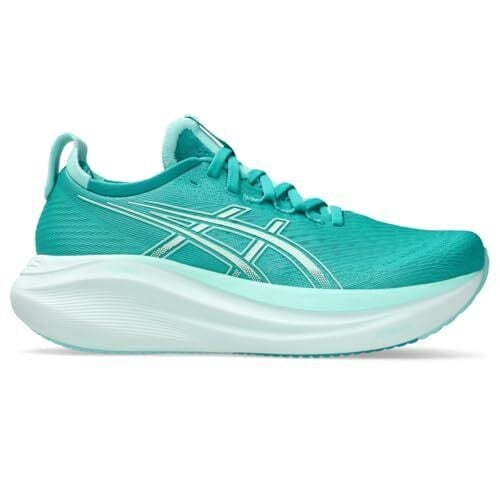
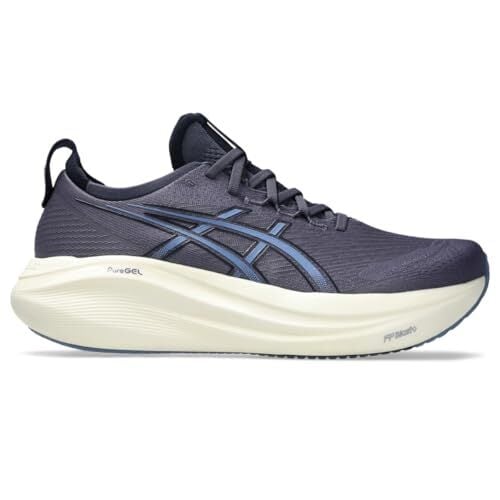
These design elements help protect your joints from the repetitive impact of logging serious mileage. Lyons-Quirk’s go-to recommendation for max cushion is the the ASICS GEL-Nimbus 27: “The softness of both the upper and midsole make this shoe pure magic to run in.” If you’re looking for a deal, since that Asics Gel Nimbus 27 was released this year at $165, you can bet that the Asics Gel Nimbus 26 just got way more affordable.

When doing intervals, tempo runs, or racing, different qualities become important:

  • Lighter weight to reduce energy expenditure

  • Responsive, often firmer cushioning that returns energy more efficiently

  • Lower stack heights for better ground feel and stability

  • Racing-specific features, like carbon plates

These shoes sacrifice some cushioning and durability, but they’re lightweight so you can feel like you’re flying as fast as you can. Currently, I’m rocking the Brooks Ghost 16—they’re the most worn pair you can see in the photo above.

Is a shoe rotation really necessary?

Despite these benefits, not everyone needs multiple specialized pairs. UESCA certified running coach James Rodgers says if you’re just getting started, you don’t have to invest in multiple pairs. Instead, “having one properly fitted pair to suit you and the majority of your runs would be fine.” A proper fitting at a specialty running store is worth the time investment, even if you eventually purchase elsewhere.

Similarly, ultramarathoner Merili Freear says you simply don’t need dozens of shoes. Even with her ultra-mileage, she typically rotates just three pairs: One pair of trail shoes and two pairs of road shoes. Like a lot of runners, she saves the newer road pair for races and uses the older ones for daily training. “Ultimately, rotating your shoes isn’t about collecting gear—it’s about function, comfort, and protecting your body from overuse.”

However, if you want to get into trail runs and off-road running, a specialized pair could make sense. According to Rodgers, “having slightly different shoes helps because certain shoes for some running gaits may put increased stress on certain muscles, such as your calves and achilles.”

Even if you’re not rotating shoes simultaneously, remember even the best running shoes have a limited lifespan. Most experts recommend replacing shoes every 300-500 miles; some signs that it’s time for new shoes include compressed cushioning, worn outsoles, and new aches and pains.

Finding your perfect shoe balance

For most recreational runners, a two-shoe rotation strikes a good balance:

  1. A well-cushioned, durable daily trainer for most runs.

  2. A lighter, more responsive shoe for workouts and races.

Of course, there are plenty of other factors to consider. Quality running shoes aren’t cheap, and if you mostly do similar runs, the benefits diminish. Generally speaking, higher-mileage runners benefit more from rotation. More serious runners might expand to three or more pairs, adding trail shoes or super-cushioned recovery shoes to the mix.

The bottom line

Many runners successfully train in a single pair of well-chosen, all-purpose running shoes. While specialized shoes can enhance specific types of running, rotating shoes isn’t necessary for the average runner. Here are some of my money-saving strategies that work across all runner types.

Whatever approach you take, remember that the best shoes are the ones that keep you running comfortably. You’re going to constantly be injury-prone if you aren’t in the right shoe, and you’re never going to hit your training goals if you’re constantly resting off an injury. For more, check out my round-up of the best running shoes on the market right now, according to the experts.

Microsoft Layoffs Hit Coders Hardest With AI Costs on the Rise

An anonymous reader shares a report: Microsoft’s recently announced job cuts fell hardest on the people who build the company’s products, showing that even software developers are at risk in the age of artificial intelligence.

In Microsoft’s home state of Washington, software engineering was by far the largest single job category to receive layoff notices, making up more than 40% of the roughly 2,000 positions cut, according to state documents reviewed by Bloomberg. Microsoft on Tuesday said it would cut about 6,000 workers across the company. The Washington state data represents about a third of the total.


Read more of this story at Slashdot.

How to turn your old iPhone into an alarm clock

Getting a new phone might leave you wondering what to do with your old one. Trading it in, particularly for credit towards your new handset, is ideal and could make a future refurbished shopper happy. But if the trade-in value isn’t worthwhile to you and you’ve been wondering what else your retired pocket computer can do, we have a few ideas. One suggestion is to turn it into a dedicated alarm clock. Yes, you can absolutely use your new phone for that purpose — you probably already do. But there are clear advantages to using your decommissioned device instead. Here’s how to upcycle your old iPhone into an alarm clock.

What’s the point?

Stuffing a retired gadget in a drawer does nothing — except make you half-heartedly contemplate doing something with it each time you open said drawer. Recycling is a valid option, but even if your old handset isn’t as speedy as your new one, it’s almost assuredly more powerful than any sleep machine or smart alarm clock on the market. And with the setup tips detailed here, it can actually perform more advanced functions, too.

Plus, using your current phone when you’re trying to sleep is perilous. I’ve never picked up my phone without getting distracted. Finally, with on-again, off-again tariffs making electronic gadgets harder to come by for a good price, rethinking what an existing device can do is intelligent alchemy.

First, delete everything

OK, not everything. But the idea is to make your phone as unexciting as possible — no Instagram, no Monument Valley, no Photos memories from last year’s road trip. Your iPhone won’t let you delete certain apps, such as Phone, Messages, the App Store and others — but you can hide them from your home screen so they’ll only pop up if you search for them.

You’ll still need a few apps to create your alarm clock, so don’t delete or hide the following:

  • Clock

  • Music (and iTunes store if you don’t pay for Apple Music)

  • Shortcuts

  • Health

  • Settings

Upcycle your iphone to an alarm clock
Make your phone look exactly as boring as this.
Amy Skorheim for Engadget

Set a personalized alarm tone

If you’d rather wake up to something more pleasant than the Clock app’s chirps and bleeps, pick a personalized sound instead.

1. Set your sleep schedule in Health. Apple requires you to set your Sleep Schedule in the Health app before you can set an alarm in the Clock app.

2. Download a song. Theoretically, you can use any song you have downloaded to your phone as a sound for your alarm. But I couldn’t get it to work with any song that supported Dolby Atmos or Lossless audio (even if I turned those options off in Settings > Music > Audio).

But standard quality songs worked great. If, like me, you’re not a heavy sleeper, you might like something like singing bowls or a meditative flute. If you need the thunder of the gods to wake you, perhaps go for something more rousing.

3. Set your alarm. Open the Clock app and select the Alarms tab. Set your alarm as usual. Then tap Sound > Pick a song > Downloaded > and select the (non Lossless!) song you desire. Hit Save.

4. Turn off vibrate. If you don’t want your phone to vibrate when it plays your alarm, turn the Haptics option to Never Play in Settings > Sounds & Haptics.

Screenshots of how to set a custom tone for your alarm.
Tap Sound then select any downloaded song as your alarm sound. Just be sure not to select a Lossless or Dolby Atmos track.
Amy Skorheim for Engadget

Make some (white) noise

My favorite thing about my sleep machine is the ambient music it plays as I drift off into slumber. Unsurprisingly, your old iPhone is capable of playing lulling tunes as well. And if white noise helps you stay in dreamland, you can program your phone to play those sounds, too. A combination of Shortcuts and Automations will make your sleep routine play automatically so you don’t have to touch your screen at all.

1. Build a sleepytime playlist. Open Apple Music and make a playlist. (Unfortunately, Shortcuts doesn’t work with Spotify.) I populated Amy’s Sleepytime Mix with songs from Apple’s Ambient Chill and Pure Ambient playlists. I made the set about 30 minutes long because that’s a little longer than it takes me to drift off.

2. Turn off Autoplay. It’s pretty jarring when you’re drifting off and your dreamy playlist morphs into some algorithmically selected oontz oontz banger. To turn Autoplay off:

  • Play any track in Apple Music.

  • Tap the name of the song to enlarge the album cover and track controls.

  • Tap the three lines at the bottom right. You’ll now see upcoming tracks and three buttons at the top of the list: crossed arrows (shuffle), looped arrows (repeat) and an infinity symbol (Autoplay).

  • Toggle Autoplay off so it’s greyed out.

Upcycle your old iphone to an alarm clock
Tap the song that’s currently playing to access the Autoplay option (left). Tap the infinity symbol at the top of the screen to toggle Autoplay off (right).
Amy Skorheim for Engadget

Note: Turning Autoplay off turns it off across ALL your Apple devices. If you like it when Apple keeps the tunes flowing after a playlist ends, you’ll have to complete a side quest, which is detailed at the end of this post.

3. Pick your white noise sound. An accessibility feature gives you the option of eight different white noise sounds, including Rain, Ocean, Fire and Night (with more functions coming soon).

  • Open the Settings app

  • Tap Accessibility

  • Tap Audio & Visual

  • Tap Background Sounds

  • Toggle Background Sounds on

  • Tap Sound then pick your favorite

  • Press back and toggle Background Sounds back off

  • Toggle on Use When Media Is Playing

  • Toggle off Stop Sounds When Locked

3. Create a Shortcut. This will make your phone play your playlist with white noise beneath it (which softens song transitions) and when the playlist ends, the white noise continues.

  • Open Shortcuts and tap All Shortcuts, then tap + in the upper right

  • Search for the term “volume,” tap Set Volume and choose a percentage, such as 25-percent or your desired level

  • Search for “background,” tap Set Background Sounds. The shortcut should read: [Turn] [Background Sounds] [On]

  • Search for “play” and tap Play Music

  • Tap Music > Library > Playlist > [Your sleepy time mix]. Then tap the tiny ⊕ in the upper right

  • Tap the arrow next to the Shortcut title at the very top to rename your shortcut, perhaps something like Sleep Routine or Night Night.

  • Tap Done.

4. Trigger your Shortcut with an Automation. To run your Shortcut, you can just ask Siri by saying “Hey Siri, Night Night” (or “Hey Siri, Sleep Routine” or whatever you named the above shortcut). But if you want your routine to start at the same time each night, create an automation.

  • In the Shortcut app, tap the Automation tab at the bottom

  • Tap + to create a new Automation

  • Tap Time of Day and enter your preferred start time and days

  • Make sure there’s a checkmark near Run Immediately (and not Run After Confirmation) and keep Notify When Run toggled off

  • Tap Next

  • If you don’t see the name of the Shortcut you created at the top, search for its name and tap on it

Upcycle your old iphone to an alarm clock
Create a Shortcut that sets the volume, turns on white noise and plays a playlist (left). Set an Automation that automatically runs the Shortcut at bedtime (right), or just say “Hey Siri…” and the name of your shortcut.
Amy Skorheim for Engadget

5. Turn off Background Sounds. Whether you want your white noise to play all the way up to your alarm or just for an hour or two, it’s wise to create an automation to turn it off so you don’t have to do it manually.

  • Create a new Shortcut

  • Search for “background”

  • Tap Set Background Sound

  • Tap [On] to [Off] so the Shortcut reads [Turn] [Background Sounds] [Off]

  • Rename the Shortcut: Background Sounds Off

  • Hit done

  • Create a new Automation in the Automation tab

  • Tap Time of Day

  • Set it for your alarm time or a couple hours after you’re usually asleep

  • Tap Run Immediately and make sure Notify When Run is toggled off

  • Hit done and choose the shortcut you just made (Background Sounds Off)

Upcycle your old iphone to an alarm clock
To enable an Automation that turns off Background noises (left) first, create a Shortcut that turns Background Sounds Off (middle). You can change which background sound you want in Settings > Accessiblity > Audio & Visual (right).
Amy Skorheim for Engadget

Stand it up

Phones running iOS 17 or later have StandBy mode, which displays your choice of stylized clock faces when the handset is charging and oriented horizontally. To enable StandBy:

  • Open Settings

  • Tap StandBy and toggle it on

  • Toggle on Night Mode (This makes the clock dimmer when it’s dark in the room)

If you put your phone in a stand, it’ll look a lot like an alarm clock (and be easier to see from afar). Whether you use a MagSafe wireless stand or a basic stand-and-cord combo, your new alarm clock (aka old phone) will likely be plugged in all the time. So you may want to change your battery settings to keep it from reaching 100 percent. (Being fully charged or fully empty is what strains batteries the most). To do that:

  • Open Settings

  • Tap Battery

  • Tap Charging

  • Set Charge Limit to 80 percent

Upcycle your old iphone to an alarm clock
Putting your phone on a stand and plugging it in enables StandBy mode and makes it look like a real alarm clock!
Amy Skorheim for Engadget

Side quest: Make your sleep playlist stop without turning off Autoplay

Some people like it when the algorithm tries to keep the party going with related songs after a playlist ends. But, playing random music all night probably isn’t great for sleep. The good news is, you can set a timer to have your sleep tunes play for a specified period, so it ends on its own without you having to disable Autoplay across all your devices.

  • Note the length of your playlist

  • Open the Clock app and tap the Timers tab

  • Tap When Timer Ends and scroll down to and tap Stop Playing

  • Tap Set

  • Open Shortcuts and edit your night time routine by tapping the three dots in the Shortcut card (the one with your playlist and Background sounds)

  • Search for “timer”

  • Tap Start Timer

  • Enter the length of your playlist in the Duration field

  • Tap Done

Because the Background Sounds are a setting and not technically media that’s playing, your white noise selection will still play until the automation that ends it runs.

This article originally appeared on Engadget at https://www.engadget.com/mobile/smartphones/how-to-turn-your-old-iphone-into-an-alarm-clock-110001148.html?src=rss

CoreWeave To Spend Up To $23 Billion This Year To Tap AI Demand Boom

Nvidia-backed CoreWeave plans to spend up to $23 billion this year on AI infrastructure and data center capacity, as it aims to meet the booming demand from clients. Reuters reports: The heavy spending plan weighed on its shares, which fell 5% after surging as much as 11% on better-than-expected revenue in its first results as a public company after debuting on the Nasdaq in March. The company’s projected capital expenditure of between $3 billion and $3.5 billion for the second quarter was way above its revenue expectation of $1.06 billion to $1.1 billion. “While the revenue from Microsoft is likely secure for the next three years, CoreWeave represents overflow capacity for Microsoft, which may not need that capacity in the future,” D.A. Davidson analyst Gil Luria said.

The company’s revenue backlog was $25.9 billion as of March 31, with its five-year deal with OpenAI adding $11.2 billion to the pile up. As part of the deal signed in March, CoreWeave will provide AI infrastructure to OpenAI, while the ChatGPT maker will get a stake. CoreWeave expects annual revenue of $4.9 billion to $5.1 billion, above analysts’ expectation of $4.61 billion, according to data compiled by LSEG. It reported revenue of $981.6 million for the first quarter, beating the estimate of $852.9 million.


Read more of this story at Slashdot.

Trump Tells Apple CEO To Avoid Manufacturing in India

U.S. President Donald Trump said he has told Apple CEO Tim Cook to stop expanding manufacturing operations in India despite New Delhi offering a “no-tariff deal” to the United States, a move that could impede India’s aspirations to become a global technology manufacturing hub.

“I had a little problem with Tim Cook yesterday,” Trump said during his state visit to Qatar, referring to the Apple chief executive. “He is building all over India. I don’t want you building in India. India can take care of itself.”

Apple has significantly increased its Indian manufacturing footprint, assembling $22 billion worth of iPhones in India during the 12 months through March. Apple said earlier this month a majority of its devices shipped into the U.S. in the June quarter will originate in India and Vietnam.


Read more of this story at Slashdot.

What’s the Best Way to Treat Addiction in 2025? The Answers Are Finally Getting Clearer

Addiction doesn’t always look the way people expect. It isn’t just someone falling asleep in a parking lot or disappearing for days. It can also be a sharp-dressed professional who hits their targets at work, smiles on Zoom calls, and quietly crumbles when no one’s watching. Behind closed doors, addiction slips into every kind of life — not just the ones that scream “trouble.” And in a digital world where everything moves at full speed, treatment options have had to evolve to keep up.

Today’s addiction treatment landscape isn’t built just for the stereotypical cases. It’s becoming more adaptable, more nuanced, and yes, more effective — especially when it’s taken seriously early on. But cutting through the noise and understanding what actually works can feel like trying to fix a leaky pipe with 12 different kinds of tape. So let’s get into it — the real types of treatment that are actually helping people get their lives back, one day at a time.

Why People Need Different Kinds of Help, Not Just One

No two addictions are exactly alike. That’s part of what makes treatment tricky — and part of what makes it so personal. Some people are struggling with alcohol, some with prescription medication, some with stimulants, and some with a combination of substances. What’s more, people come into recovery with different backgrounds, different work pressures, and very different reasons for using in the first place.

There’s no one-size-fits-all fix, and that’s probably a good thing. One person might benefit from a 30-day inpatient program with full medical supervision. Another might need something much less intense but more flexible, like outpatient counseling sessions built around their job. Searching rehab sites for more info is a great place to start, especially for professionals who work for companies such as Boeing, Sysco, or AstraZeneca and don’t want to broadcast what they’re going through. Quiet research opens the door. It’s the first move that tells the brain, “You’re not ignoring this anymore.” And that simple step can make all the difference.

Outpatient Programs Are Quietly Transforming Recovery

Outpatient care used to be seen as the easier, softer way — something you did if you weren’t “that bad.” But that attitude has shifted, fast. These days, outpatient treatment is one of the most respected ways to treat addiction, especially for people who need to stay functional while they heal. That might mean a person continues showing up to work while they also attend therapy sessions, peer support meetings, or even medication appointments.

This model works well for people who are in high-pressure jobs, especially in tech and business, where taking 30 days off to disappear might not be a real option. Outpatient treatment respects the life someone has already built — and helps them protect it, rather than dismantling it. It leans heavily on accountability, structured support, and community, all without pulling someone out of their daily rhythm. And for many people, that makes it sustainable in the long run.

That said, this only works if someone is genuinely committed. The flexibility can be a gift or a trap, depending on how much someone wants recovery. The people who make real progress are the ones who show up, again and again, even when they’re tired or frustrated or tempted. They take the structure seriously. They participate fully. And eventually, they start taking control of their choices again — not all at once, but steadily.

Inpatient Programs Still Matter — Especially for Breaking the Cycle

For people who are physically dependent on substances or caught in a pattern of daily use, inpatient programs can be life-saving. These are the settings where people step away from their normal environments completely. It’s not just about detoxing in a medical setting. It’s about pressing pause on the chaos and giving the brain a chance to reset, with real clinical support and 24/7 monitoring.

This kind of treatment is intense by design. It forces someone to slow down. To sleep. To eat. To start noticing how their body actually feels without the blur of a substance. Many inpatient centers also build in group therapy, one-on-one counseling, and educational workshops — not to “fix” someone overnight, but to help them understand what made them vulnerable in the first place. There’s a big difference between abstaining and healing, and inpatient work leans into the second one hard.

Yes, it can be expensive. Yes, it requires time away from regular life. But for many people, that interruption is exactly what they need. There’s no Wi-Fi in your old patterns. Stepping out of them, even briefly, can be what finally makes a long-term change possible.

Tech-Supported Recovery Is Quietly Becoming the New Normal

This part often surprises people: some of the strongest tools in addiction recovery today live on your phone. Whether it’s daily check-in apps, remote therapy sessions, secure group chat platforms, or calendar-based tracking tools, digital support is showing up big in the recovery space. It’s not meant to replace in-person help — but for people who don’t live near treatment centers, or who are managing life on the go, it can be a lifeline.

Think of it like scaffolding. Digital tools let people track patterns, vent to a support group, or attend a Zoom meeting at midnight when things get hard. And because these tools are available 24/7, they remove one of the biggest hurdles: waiting for the right moment. Recovery doesn’t happen only during business hours. A lot of the hardest moments happen late at night, early in the morning, or on a random Tuesday when everything feels like too much. Being able to log on and talk to someone, even briefly, can be what keeps a person from relapsing.

It’s also a reminder that addiction treatment isn’t about removing technology — it’s about rethinking how it’s used. For people who spend their entire day plugged in, tech-based support feels intuitive. It feels like something you can actually do. That ease of access matters.

Long-Term Support Is the Piece That Holds It All Together

Treatment isn’t something that ends when you walk out of a clinic or finish your last therapy appointment. In fact, what happens after the formal treatment ends is often what determines whether someone stays sober. Long-term support isn’t flashy, and it’s not always interesting to talk about, but it’s the foundation. That can mean continuing therapy. It can mean joining recovery-based communities or getting a sponsor. It might even mean finding a sober coach or attending check-in appointments regularly for months.

The goal isn’t perfection. The goal is learning how to live your life — real life, with its emails and its bills and its surprise chaos — without needing to escape it every time something feels hard. And that takes practice. Nobody masters it in 30 days. But the people who build systems around their sobriety, who stay connected, who stay honest, are the ones who actually make it stick.

Because recovery isn’t about becoming a different person. It’s about becoming yourself, without the thing that used to blur everything.

Real Recovery, Real Lives

Addiction treatment isn’t what it used to be. It’s more flexible, more varied, and more in tune with what real people actually need. Whether it’s outpatient structure, inpatient care, tech-based tools, or long-term support, there’s no wrong door — only the door you walk through. And the sooner someone walks through it, the more life they have waiting on the other side.

Written by Lara Harper

First US Hub For Experimental Medical Treatments Is Coming

Montana has passed a bill allowing licensed clinics to offer experimental medical treatments that haven’t been approved by the FDA, provided the drugs have passed phase I safety trials. MIT Technology Review reports: The bill, which was passed by the state legislature on April 29 and is expected to be signed by Governor Greg Gianforte, essentially expands on existing Right to Try legislation in the state. But while that law was originally designed to allow terminally ill people to access experimental drugs, the new bill was drafted and lobbied for by people interested in extending human lifespans — a group of longevity enthusiasts that includes scientists, libertarians, and influencers. These longevity enthusiasts are hoping Montana will serve as a test bed for opening up access to experimental drugs. […]

Supporters of the bill say it gives individuals the freedom to make choices about their own bodies. At the same event, bioethicist Jessica Flanigan of the University of Richmond said she was “optimistic” about the measure, because “it’s great any time anybody is trying to give people back their medical autonomy.” Ultimately, they hope that the new law will enable people to try unproven drugs that might help them live longer, make it easier for Americans to try experimental treatments without having to travel abroad, and potentially turn Montana into a medical tourism hub.

But ethicists and legal scholars aren’t as optimistic. “I hate it,” bioethicist Alison Bateman-House of New York University says of the bill. She and others are worried about the ethics of promoting and selling unproven treatments — and the risks of harm should something go wrong. […] At any rate, the clinics are coming to Montana, says [Dylan Livingston, founder and CEO of the Alliance for Longevity Initiatives]. “We have half a dozen that are interested, and maybe two or three that are definitively going to set up shop out there.” He won’t name names, but he says some of the interested clinicians already have clinics in the US, while others are abroad.”

Mac Davis — founder and CEO of Minicircle, the company that developed the controversial “anti-aging” gene therapy — told MIT Technology Review he was “looking into it.” “I think this can be an opportunity for America and Montana to really kind of corner the market when it comes to medical tourism,” says Livingston. “There is no other place in the world with this sort of regulatory environment.”


Read more of this story at Slashdot.

Klarna Pivots Back To Humans After AI Experiment Fails

Fintech startup Klarna is now recruiting humans after its AI customer service agents underperformed. The buy-now-pay-later company, which eliminated its marketing contracts in 2023 and customer service team in 2024, now plans an “Uber-type setup” with remote gig workers.

This marks a stark reversal from CEO Sebastian Siemiatkowski’s 2024 claim that “AI can already do all of the jobs that we, as humans, do.” Siemiatkowski told Bloomberg: “From a brand perspective, I just think it’s so critical that you are clear to your customer that there will be always a human if you want.” He added that “cost unfortunately seems to have been a too predominant evaluation factor” leading to “lower quality.”


Read more of this story at Slashdot.

For the first time in the US, a rotating detonation rocket engine takes flight

A US-based propulsion company, Venus Aerospace, said Wednesday it had completed a short flight test of its rotating detonation rocket engine at Spaceport America in New Mexico.

The company’s chief executive and co-founder, Sassie Duggleby, characterized the flight as “historic.” It is believed to be the first US-based flight test of an idea that has been discussed academically for decades, a rotating detonation rocket engine. The concept has previously been tested in a handful of other countries, but never with a high-thrust engine.

“By proving this engine works beyond the lab, Venus brings the world closer to a future where hypersonic travel—traversing the globe in under two hours—becomes possible,” Duggleby told Ars.

Read full article

Comments

Microsoft Is Open-Sourcing Its Linux Integration Services Automation Image-Testing Service

An anonymous reader quotes a report from ZDNet: Would you believe Microsoft has announced a new Linux distribution service for its Azure cloud service? You should. For many years, the most popular operating system on Azure has not been Windows Server, it’s been Linux. Last time I checked, in 2024, Azure Linux Platforms Group Program Manager Jack Aboutboul told me that 60% of Azure Marketplace offerings and more than 60% of virtual machine cores use Linux. Those figures mean it’s sensible for Microsoft to make it easier than ever for Linux distributors to release first-class Linux distros on Azure. The tech giant is taking this step, said Andrew Randall, principal manager for the Azure Core Linux product management team, by making “Azure Image Testing for Linux (AITL) available ‘as a service’ to distro publishers.”

ATIL is built on Microsoft’s Linux Integration Services Automation project (LISA). Microsoft’s Linux Systems Group originally developed this initiative to validate Linux OS images. LISA is a Linux quality validation system with two parts: a test framework to drive test execution and a set of test suites to verify Linux distribution quality. LISA is now open-sourced under the MIT License. The system enables continuous testing of Linux images, covering a wide range of scenarios from kernel updates to complex cloud-native workloads. […] Specifically, the ATIL service is designed to streamline the deployment, testing, and management of Linux images on Azure. The service builds on the company’s internal expertise and open-source tools to provide:

– Curated, Azure-optimized, security-hardened Linux images
– Automated quality assurance and compliance testing for Linux distributions
– Seamless integration with Azure’s cloud-native services and Kubernetes environments

Krum Kashan, Microsoft Azure Linux Platforms Group program manager, said in a statement: “While numerous testing tools are available for validating Linux kernels, guest OS images, and user space packages across various cloud platforms, finding a comprehensive testing framework that addresses the entire platform stack remains a significant challenge. A robust framework is essential, one that seamlessly integrates with Azure’s environment while providing coverage for major testing tools, such as LTP and kselftest, and covers critical areas like networking, storage, and specialized workloads, including Confidential VMs, HPC, and GPU scenarios. This unified testing framework is invaluable for developers, Linux distribution providers, and customers who build custom kernels and images.”


Read more of this story at Slashdot.

xAI’s Grok suddenly can’t stop bringing up “white genocide” in South Africa

Users on X (formerly Twitter) love to tag the verified @grok account in replies to get the large language model’s take on any number of topics. On Wednesday, though, that account started largely ignoring those requests en masse in favor of redirecting the conversation towards the topic of alleged “white genocide” in South Africa and the related song “Kill the Boer.”

Searching the Grok account’s replies for mentions of “genocide” or “boer” currently returns dozens if not hundreds of posts where the LLM responds to completely unrelated queries with quixotic discussions about alleged killings of white farmers in South Africa (though many have been deleted in the time just before this post went live; links in this story have been replaced with archived versions where appropriate). The sheer range of these non-sequiturs is somewhat breathtaking; everything from questions about Robert F. Kennedy Jr.’s disinformation to discussions of MLB pitcher Max Scherzer’s salary to a search for new group-specific put-downs, see Grok quickly turning the subject back toward the suddenly all-important topic of South Africa.

It’s like Grok has become the world’s most tiresome party guest, harping on its own pet talking points to the exclusion of any other discussion.

Read full article

Comments

OpenAI adds GPT-4.1 to ChatGPT amid complaints over confusing model lineup

On Wednesday, OpenAI announced that ChatGPT users now have access to GPT-4.1, an AI language model previously available only through the company’s API since its launch one month ago. The update brings what OpenAI describes as improved coding and web development capabilities to paid ChatGPT subscribers, with wider enterprise rollout planned in the coming weeks.

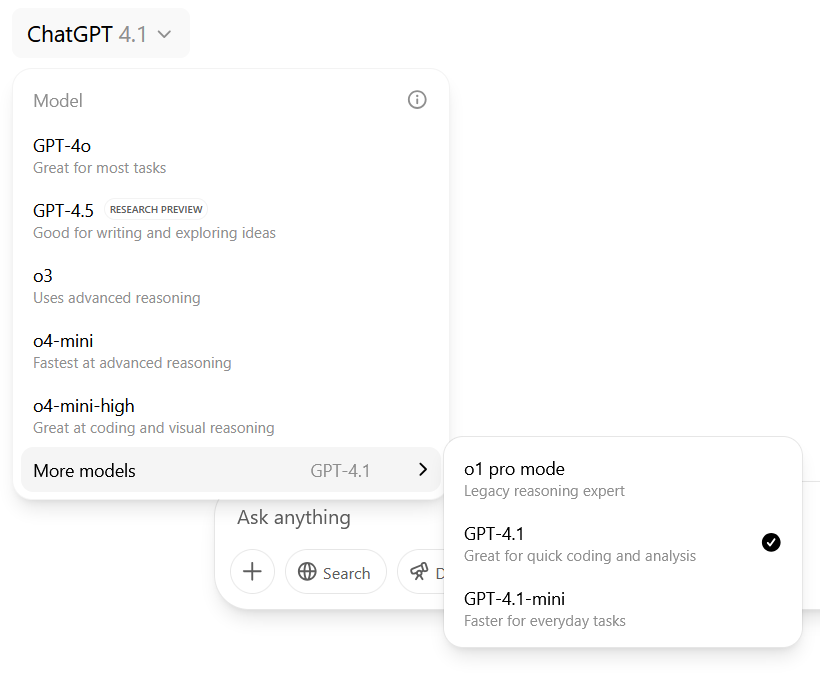
GPT-4.1 and 4.1 mini to ChatGPT adds to an already complex model selection that includes GPT-4o, various specialized GPT-4o versions, o1-pro, o3-mini, and o3-mini-high models. There are technically nine AI models available for ChatGPT Pro subscribers. Wharton professor Ethan Mollick recently publicly lampooned the awkward situation on social media.

As of May 14, 2025, ChatGPT Pro users have access to 8 different main AI models, plus Deep Research.
As of May 14, 2025, ChatGPT Pro users have access to eight main AI models, plus Deep Research.
Credit:
Benj Edwards

Deciding which AI model to use can be daunting for AI novices. Reddit users and OpenAI forum members alike commonly voice confusion about the available options. “I do not understand the reason behind having multiple models available for use,” wrote one Reddit user in March. “Why would anyone use anything but the best one?” Another Redditor said they were “a bit lost” with the many ChatGPT models available after switching back from using Anthropic Claude.

Read full article

Comments

Here’s How the Tariffs Are Impacting the Price of Gaming

Contrary to the White House’s assertions, we consumers are indeed footing the bill for all these tariffs. Companies from across industries have been stopping sales or raising prices over the past month or so, and the chaos continues on.

It doesn’t help that the actual tariff situation is so volatile. President Donald Trump kept escalating the tariffs against China in particular, all the way up to 145%. Then, the administration made a deal with China to suspend most of the tariffs until August, but some tariffs still remain. As such, companies are scrambling to figure out the best way to protect their bottom lines and shareholder values—part of that strategy involves raising costs.

Gaming is no exception to this reality. Many gaming companies manufacture their components in China, which means their devices face tariffs if they ship to the U.S. Here’s where the situation currently stands with the biggest gaming companies.

Microsoft

Xboxes are apparently an appreciating asset. On May 1, Microsoft raised the prices on all Xbox consoles, and some Xbox accessories—including controllers and headsets. These price hikes were actually pretty steep: Both the standard and digital Series X models jumped by $100, while the 2TB model jumped a whopping $130. On April 30, Series X with 2TB of internal storage would have set you back $600. Now, you’re out $730.

Games aren’t wholly exempt here, either, but the news is a bit better: Existing titles will keep the same MSRP they did before the price hikes, while select new titles will cost $80 this holiday season.

To be fair, Microsoft doesn’t directly attribute the tariffs to these raised prices, instead referring to “market conditions and the rising cost of development.” However, seeing as tariffs are the driving force of current market conditions, it seems a safe assumption that Microsoft is recouping some increased costs due to these import fees.

Sony

Sony, too, raised the prices on its flagship consoles—but only in select markets.

The company increased the price of certain PS5 units in Europe, the UK, Australia, and New Zealand. The price increases, as well as which console received them, depends on the region: Europe, for example, only saw an increase on the PS5 Digital Edition by €50, while the disc drive PS5 remained the same. Australia and New Zealand, on the other hand, were not so lucky, seeing price increases on both. New Zealand has the highest MSRP for a PS5 on the list at NZD $949.95 (or roughly $560 USD at this time).

However, that doesn’t mean those of us in the U.S. are safe from PS5 price increases. As reported by The Verge, Sony says that it expects tariffs to cost the company 100 billion yen ($681 million), and is considering both relocating manufacturing to the U.S., as well as raising costs for consumers.

Sony is a massive company, so that could involve raising prices on products other than PS5. However, the lack of a definitive answer on which products would be affected means that Sony may raise PS5 prices in the future.

Nintendo

Here’s the good news: Nintendo did not raise the MSRP of the Switch 2, nor any of its existing Switch consoles. The Switch 2 will remain $450, or $500 if you buy the Mario Kart World bundle.

However, Nintendo has reacted to the tariffs in other ways. First, it paused preorders for the Switch 2 in the U.S. and Canada, “to assess the potential impact of tariffs and evolving market conditions.” We already know it ultimately kept the Switch prices the same, but once Nintendo picked a new preorder date, it also announced new price increases for Switch 2 accessories.

The Pro Controller is now $15 more than it was, and while the Joy-Con 2 controllers are only $5 more, they now cost an astounding $95. The Switch 2 camera is also $55, when originally it was $50. The rest of the Switch 2 accessories remain the same.

PC gaming

PC gaming is a more complicated beast than console gaming. Unless you opt for a gaming laptop, you most likely are looking to build your own PC, which requires purchasing a number of parts—many of which are made in China. Luckily computers, phones, and PC cases were exempt from the full 145% tariff, but not other PC components.

According to PCMag, most PC parts haven’t been hit that hard by tariffs yet—at least when it comes to April prices. The outlet observed that PC cases, processors, and memory kits all had modest increases ($10, $15, and $3, respectively), while a liquid cooler unit actually dropped in price by $60.

However, they did find a concerning price increase when it came to one particularly important component: graphics cards. In January, the MSI SHADOW GeForce RTX 5070 Ti graphics card cost $750. In April, it cost $840, a $90 increase. PCMag found a similar trend across other popular graphics cards, with price increases ranging from $250 all the way to $750.

Graphics cards had been in hot demand long before Trump was even elected, largely due to their use in processing AI. Increased tariffs are now only putting more pressure on that product category.

Gaming laptops largely haven’t taken much of a hit yet, but Razer was one of the companies to pause direct sales to the U.S. last month.

You can’t predict the future

This is where the market stands now, but there’s no telling what will change in the coming days, weeks, and months. Sony could raise PS5 prices in the U.S. tomorrow; Nintendo could decide that the OG Switch needs to cost more now, too.

Nothing is certain, but one thing seems reasonable to assume: The prices you see today are the best they’re going to be for a while. If you’re holding out for the Xbox Series X to drop in cost, or crossing your fingers that Mario Kart World won’t actually cost $80 on release, you’re probably not going to be happy with the future.

Anything’s possible, but given where we are with tariffs and global markets, prices only seem to be going up. Remaining the same is perhaps the best we can hope for—unless you’re willing to give the secondhand market a try.

Appeals court confirms that tracking-based online advertising is illegal in Europe

The Belgian Court of Appeal ruled today that the Transparency and Consent Framework (TCF) currently used as the foundation for most online advertising is illegal in the EU. This decision upholds the findings of the Belgian Data Protection Authority from 2022 that the technology underpinning online ads violates several principles of the General Data Protection Regulations, an EU digital privacy law that took effect in 2018.

Engadget’s Daniel Cooper wrote a thorough explainer of the different systems that support the current online advertising ecosystem, which is valuable reading for anybody spending time online. The very simplified version is that advertisers participate in real-time bidding (RTB) to show their content online. Currently, those bids are based on information gathered from tracking individuals’ activities online with cookies. The TCF was created by the Interactive Advertising Bureau as a way to standardize how websites ask users for permission to be tracked. The original 2022 decision determined that both the consent collected by the TCF and the data collected in the RTB process were illegal under the GDPR.

“Today’s court’s decision shows that the consent system used by Google, Amazon, X, Microsoft, deceives hundreds of millions of Europeans,” said Dr Johnny Ryan, director of Enforce at the Irish Council for Civil Liberties, who has been leading the legal charge against the current approach to ad tech. “The tech industry has sought to hide its vast data breach behind sham consent popups. Tech companies turned the GDPR into a daily nuisance rather than a shield for people.”

The reaction from IAB Europe, which filed the appeal, seems to mostly be relief that it hasn’t been found responsible for the data collected by TCF. “The Market Court has rejected the APD’s view that IAB Europe is a joint controller together with TCF participants for their own respective processing of personal data, for instance for the purpose of digital advertising,” the organization’s statement says. IAB Europe notes that it has already suggested changes to the TCF that better reflect the “limited controllership” and submitted them to the Belgian Data Protection Authority. The group faced fines and was ordered to rebuild its current ad-tech framework as a result of the original decision.

We’ve also reached out to some of the major advertisers that use the RTB technology for comment on the ruling.

While this does seem like a big win for privacy advocates and internet users in the EU, it’s unclear exactly what the next steps will be for advertisers and for ad tech systems. Most likely, regulators will oversee changes the IAB Europe makes to the TCF, so consent pop-ups may not yet be a thing of the past.

This article originally appeared on Engadget at https://www.engadget.com/big-tech/appeals-court-confirms-that-tracking-based-online-advertising-is-illegal-in-europe-223714124.html?src=rss

NordVPN Finally Gets a Proper GUI On Linux

BrianFagioli shares a report from BetaNews: For years, NordVPN made Linux users live in the terminal. Sure, the command-line interface technically worked, but let’s not pretend it was ideal for everyone. Meanwhile, competitors like Surfshark and ExpressVPN had already given their Linux users full graphical interfaces. Now, NordVPN has finally caught up by launching its very own GUI for Linux. So, what exactly does this mean? Well, instead of typing in commands, users can now click their way through connection options, settings, and even theme preferences like light or dark mode. This will arguably make using the service on Linux much easier. […]

Just like on Windows and macOS, the NordVPN GUI lets you quickly connect to servers, activate features, and monitor your connection in a clean, modern interface. And yes, those features include fan favorites like Dedicated IP, Double VPN, Onion Over VPN, Kill Switch, and Threat Protection. In other words, the features are the same, only easier to access now. That said, some advanced tools, like Meshnet, are still CLI-only for the time being. But at least now there’s a choice. And if you want to stick to the terminal, don’t worry, that option hasn’t gone away.


Read more of this story at Slashdot.

A dangerous E. coli strain has emerged; a small mutation may explain its rise

Since 2017, a particularly dangerous strain of E. coli O157:H7 has emerged across the country to spark outbreaks, severe disease, and deaths. It spreads in various ways: via leafy greens and contaminated beef, like its relatives, but also recreational waters. Hundreds of people across 46 states have been infected, and health officials have documented at least nine separate outbreaks. One in 2018, linked to lettuce, caused over 200 infections across 37 states, killing five people and causing a severe kidney condition in 26.

Now, a sweeping genetic analysis by researchers at the Centers for Disease Control and Prevention suggests a tiny mutation in one of the bacteria’s molecular weapons may be behind the strain’s rise. The finding, published recently in the journal Emerging Infectious Diseases, provides insights into this clinically significant plague and its rise to prominence. It also highlights the role of the bacteria’s sophisticated military tactics.

The mutated weapon is part of a complex system that E. coli and other harmful bacteria sometimes use called a Type 3 Secretion System (T3SS). This involves molecular machinery that basically functions like a syringe, complete with a long needle that is poked into the cells of its victims. The T3SS then directly injects a fleet of hostile proteins. Those proteins—called effectors—attack specific targets that collectively disable the host’s defense responses and make the host more hospitable for its bacterial conqueror.

Read full article

Comments

Google DeepMind creates super-advanced AI that can invent new algorithms

Google’s DeepMind research division claims its newest AI agent marks a significant step toward using the technology to tackle big problems in math and science. The system, known as AlphaEvolve, is based on the company’s Gemini large language models (LLMs), with the addition of an “evolutionary” approach that evaluates and improves algorithms across a range of use cases.

AlphaEvolve is essentially an AI coding agent, but it goes deeper than a standard Gemini chatbot. When you talk to Gemini, there is always a risk of hallucination, where the AI makes up details due to the non-deterministic nature of the underlying technology. AlphaEvolve uses an interesting approach to increase its accuracy when handling complex algorithmic problems.

According to DeepMind, this AI uses an automatic evaluation system. When a researcher interacts with AlphaEvolve, they input a problem along with possible solutions and avenues to explore. The model generates multiple possible solutions, using the efficient Gemini Flash and the more detail-oriented Gemini Pro, and then each solution is analyzed by the evaluator. An evolutionary framework allows AlphaEvolve to focus on the best solution and improve upon it.

Read full article

Comments

Netflix will show generative AI ads midway through streams in 2026

Netflix is joining its streaming rivals in testing the amount and types of advertisements its subscribers are willing to endure for lower prices.

Today, at its second annual upfront to advertisers, the streaming leader announced that it has created interactive mid-roll ads and pause ads that incorporate generative AI. Subscribers can expect to start seeing the new types of ads in 2026, Media Play News reported.

“[Netflix] members pay as much attention to midroll ads as they do to the shows and movies themselves,” Amy Reinhard, president of advertising at Netflix, said, per the publication.

Read full article

Comments