Scientists have successfully treated a 9.5-month-old boy with an ultra-rare genetic disorder using the world’s first personalized gene-editing therapy. The patient, identified as KJ, has CPS1 deficiency — a condition affecting just one in 1.3 million babies that prevents proper ammonia processing and is often fatal.
The breakthrough treatment, detailed in the New England Journal of Medicine, uses base editing technology to correct KJ’s specific DNA mutation. The therapy delivers CRISPR components wrapped in fatty lipid molecules that protect them in the bloodstream until they reach liver cells, where they make the precise edit needed.
After three infusions, KJ now eats normal amounts of protein and has maintained stable ammonia levels even through viral illnesses that would typically cause dangerous spikes. His weight has increased from the 7th to 40th percentile. Dr. Peter Marks, former FDA official, called the approach “one of the most potentially transformational technologies” because it could be rapidly adapted for thousands of other rare genetic diseases without lengthy development cycles.
Americans are living through interesting times, economically. The tariffs imposed, delayed, and frequently adjusted by the government have thrown household budgets into confusion. One thing that’s pretty certain is that the baseline tariffs applied to just about every country are likely to raise prices at the grocery store no matter what happens from here (prices could go up by about 3% overall).
For families that are already struggling to make their grocery budgets work, this is unwelcome news, but there is one thing you can do right now—while prices are still largely unaffected by tariff chaos—to help mitigate the impact and protect you from future grocery inflation: start putting together a “tariff pantry.” This involves laying in a supply of nonperishable groceries to lock in today’s prices, and focusing on recipes and meals that will keep your grocery costs down in the coming months. Here’s what to consider.
How to plan out your tariff pantry
Setting up a “tariff pantry” requires a little planning. “Take inventory first,” advises food blogger and bestselling cookbook author Kyndra Holley. “Know what you already have and make a list of essentials—stick to long-lasting pantry staples you actually use. Stock up gradually. Monitor prices and buy when it makes sense, not out of fear. Then set a budget and stick to it: Decide how much you can spend and avoid impulse buys or panic stockpiling. Buy what you already use when it’s discounted—don’t get lured by deals on items you wouldn’t otherwise use or need.”
Holley also warns against relying too much on bulk-buying. “Bulk can save money—but only if you’ll use it,” she says. “Always check unit prices and shelf life, and don’t buy more than you can store safely. Use airtight containers and freeze what you can’t use quickly.”
Changing your whole diet and meal-planning approach can help deal with tariff cost increases. “Go more plant-based,” Holley suggests. “Reduce meat and opt for beans, lentils, eggs, and grains. They’re cheaper, filling, and shelf-stable. One-pot, sheet-pan, and slow cooker meals use fewer ingredients and repurpose leftovers easily. And simplify recipes—use fewer, local ingredients. Stick to basic seasonings like garlic, onions, vinegar, and herbs.”
Careful meal prepping can also reduce waste and make the most of items bought in bulk. “When you cook in bulk, you maximize every ingredient, stretching your dollars further,” says Laurie Hise, founder of the budgeting blog Passionate Penny Pincher. “Think buying meat in family packs, prepping meals in batches, and locking in today’s prices before more inflation sneaks in!”
Hise also suggests broadening your grocery store choices. “Don’t put loyalty above savings! Make sure Aldi is in your store rotation, and scan weekly ads to get your must-haves for the cheapest. Eggs are almost always the cheapest there, they have a great Keto and Gluten Free selection, and you can buy meat for cheap on Wednesdays.”
What to stock in a tariff pantry
Although the blanket tariffs imposed will likely raise prices in general, the grocery items most likely to be affected by tariffs include fresh fruits and vegetables (the bulk of which are imported), coffee, cheese, olive oil, seafood, nuts, and candy.
Aside from dodging future price hikes, you want to focus on items in those categories that have lengthy shelf lives and flexible uses. “Stock up on items that are both cost-effective, long-lasting, and versatile,” Holley advises, including:
Grains and legumes, like rice, pasta, lentils, dried beans, and oats.
Canned and frozen goods. “A variety of canned tomatoes (whole, diced, crushed) are perfect for sauces, soups, and stews,” Holley notes. “Canned vegetables and fruits can be stored for long periods, and frozen vegetables are often cheaper than fresh, and retain nutrients. And canned tuna or salmon are protein-rich and shelf-stable.”
Baking ingredients like flour, sugar, yeast, baking soda, baking powder, and cornstarch. “Basic ingredients for a wide range of uses,” notes Holley.
Shelf-stable dairy and dairy alternatives like powdered or evaporated milk can be rehydrated and used for baking, cooking, or even drinking, protecting you from price spikes on the fresh stuff.
Oils and vinegars are likely to go up in price and are useful in cooking, dressing, and preserving food.
Seasonings and spices—the U.S. imports a lot of spices from countries like India, China, and Peru, so they’re vulnerable to tariff price spikes. Laying in a supply of herbs and spices like salt and pepper, garlic and onion powder, paprika, chili powder, ginger, basil, parsley oregano, thyme, as well as soy sauce, hot sauce, mustard, and bouillon cubes will help ride out any disruptions or price hikes in the seasonings aisle.
Nuts and seeds—Holley recommends adding a supply of peanut butter or almond butter. “They’re high in protein, and last a long time.”
Coffee and tea. “Tea is a low-cost way to diversify your drink options,” notes Holley.
Canned meats and proteins. “Canned chicken or Spam can be used in a variety of meals, especially in emergencies,” Holley notes. “And canned ham or sausage can add protein and are good for quick meals.”
Building up a tariff pantry will pay off even if the impact of those tariffs is overestimated—as we all know too well, prices never go down.
There’s a new Persona game coming very soon, but sadly it isn’t time for the next mainline entry just yet. Rather, Persona 5: The Phantom X is a spinoff in a similar vein to Persona 5 Strikers. Like that game, The Phantom X is set in the same universe as Atlus’ incredibly successful RPG, Persona 5, but unlike Strikers, this one features a new cast of characters, including a talking owl named Lufel that presumably takes the place of Morgana.
First announced in 2023, Persona 5: The Phantom X is a free-to-play live service game from Chinese publisher Perfect World, which released the game in open beta in its native country in April last year. It introduces a fresh team of Phantom Thieves and seems to be aiming for the classic Persona blend of high school drama, social interaction and dungeon crawling with impossibly stylish turn-based battles. There’s a new “Synergy” system that develops as you form bonds with NPCs, new mini-games and a PvE mode called The Velvet Trials.
Underpinning the whole experience will be a free-to-play model, the exact nature of which is not yet clear. Time will tell if gacha tactics will get in the way of a good time, and how well the familiar Persona gameplay loop translates to your phone, but the game’s official website says it’s intended for both Persona 5 fans and newcomers.
Atlus will be hoping that P5X tides fans over until it has any news on Persona 6. Its most recent release was last year’s Metaphor: ReFantazio, and the studio is currently saying nothing about the follow-up to Persona 5, which launched in its original pre-Royal state way back in 2016. Persona 5: The Phantom X launches June 26 on PC, iOS and Android.
This article originally appeared on Engadget at https://www.engadget.com/gaming/persona-5-the-phantom-x-is-coming-to-pc-and-mobile-next-month-170837106.html?src=rss
The much-anticipated successor to Garmin’s Forerunner 965 was announced today, and it’s a $749.99 watch called the Forerunner 970 with voice calling, triathlon coaching, and an LED flashlight. Alongside it, instead of a simple upgrade to its little sister the 265, we get a watch at an entirely new place in the Forerunner lineup: the Forerunner 570 ($549.99). Read on for the most important new features, and my first impressions on whether it’s worth splurging on either one compared to the older models. Both will be available to order on May 21, 2025.
A primer on Garmin’s confusing model names
Just to help you keep your bearings here: The first digit in a Forerunner’s number tells you where it sits in the product line, and the latter two numbers tell you how new it is. Until today, the newest models were the 165, 265, and 965, with the 165 being the budget model and 965 the top of the Forerunner line.
So the 970 is a newer version of the 965, the same basic watch with a few updates. But the 570 occupies a new spot in the lineup, priced higher than the 265, and Garmin probably hopes that some 265 users will want to spring for a fancier watch to get the new features.
How does the 570 compare to the 265?
The new Forerunner 570 is a watch that has everything the Forerunner 265 had, plus some new extra features. (It’s also more expensive and has slightly worse battery life, but we’ll get to that). Here are the biggest things the 570 has that the 265 doesn’t:
Voice calls and texts, and voice commands
The new evening report, which tells you how much sleep you should get and what weather and workouts to expect in the morning
Triathlon coaching, instead of making you choose between run coaching and bike coaching
Auto lap for races with timing gates (the watch will adjust your mileage as you pass the gate)
Finish line trimming for races (if you’ve uploaded a course, you won’t have to stop your watch when you cross the finish line—the watch will keep recording and then ask later if you’d like to trim your activity to end at the finish line)
The 570 is available in both a 47-millimeter size and a 42-millimeter size, similar to the 265 and 265S (46 and 42 millimeters, respectively). Mercifully for me, a person who has to write about both watches, they have dropped the “S” naming system, so instead of calling the smaller watch the “570S,” as if it were a totally different watch, there is just a 570 that comes in two sizes.
Here are the less exciting but still new features of the 570 that the 265 doesn’t have:
A sharper screen—454×454 resolution instead of 416×416, and Garmin says it’s their brightest AMOLED screen yet (sorry to those who were hoping for an old-school MIP display)
A skin temperature sensor
More triathlon workout types, including bricks and pool triathlon
Heat and altitude acclimation scores
The speaker and microphone mean you can play music from your wrist
Golfing features
There are two major downsides to the new watch, though. One is battery life: The 265 and 265S got 13-15 days of battery life in smartwatch mode, while the new 570 gets 10-11 days. Actual use, including activities, shaves off a few days, so expect about a week.
The other is cost. The new Forerunner 570 is priced at $549.99, whereas the Forerunner 265 originally cost $449.99 and, as I write this, is on sale for $349.99. Bumping up the first digit in the model name is supposed to make us feel like we’re getting a nicer watch, but is it really worth paying an extra $200? I’m not convinced.
How does the 970 compare to the 965?
The Forerunner 970 is an improved version of the Forerunner 965, although it, too, has a shorter battery life and a higher price tag. But maybe it’s worth it for you, given these upgrades:
An LED flashlight on the front of the watch—yes, an actual light, not just the ability to turn the screen white.
Sapphire crystal instead of glass on the watch face
ECG readings
Running tolerance score, judging how much more mileage your body can handle, so you know when you’re doing “too much”
Running economy score, judging how efficiently you run
Step speed loss, a running dynamic that describes how much you slow down when your foot hits the ground—but this requires the new HRM 600 heart rate monitor.
The 970 also has all the same major features as the 965 (including maps), and only comes in one size, as did the 965. The new 970 also has everything I described in the 570 above, including voice calls and texts, evening reports, triathlon coaching, and the race day lap and trimming features. The 970 is an AMOLED watch, not MIP as some had speculated.
Battery life takes a pretty big hit, down to 15 days in smartwatch mode, compared to 23 days for the previous model, the 965. (Again, real-life use with activities will be a bit shorter, so subtract a few days.) The price has also jumped significantly: The 970 is $749.99, where the 965 had been $599.99 at the start, and the 965 is on sale now for $499.99. Personally, I’m not sure if the upgrades are worth that much of a price increase, but it’s certainly a nicer watch.
Apple has implemented conspicuous warning labels featuring red exclamation marks on EU App Store listings that use external payment systems. The company’s new tactic targets apps like Instacar, a popular Hungarian vehicle valuation tool with thousands of positive reviews, displaying ominous warnings that the app “does not support the App Store’s private and secure payment system.”
The associated support page cautions users that external payments require providing personal information directly to developers and third parties “based on their privacy and security controls.” The move also follows the Epic vs Apple ruling that prohibits Apple from interfering with developers linking to alternative payment systems.
Three years ago, at WWDC 2022, Apple showed off its vision for the next generation of CarPlay. The sneak peak showed off a car with huge, wrap-around displays, featuring customizable widgets, a futuristic UI, and car controls built-into CarPlay. Frankly, it just looked cool.
But in the years since, CarPlay has remained largely the same, other than more vehicles offering wireless CarPlay than before. I’ve mostly forgotten about the promised updates, especially considering that my own car doesn’t have an infotainment display in the first place.
But Apple surprised us this morning with its latest press release: This radical change to CarPlay, now called CarPlay Ultra, is finally rolling out, today—but only for a very limited audience.
Aston Martin or bust
CarPlay Ultra is coming to new Aston Martin vehicles today, and will roll out in the coming weeks to existing models that feature the company’s “next-generation infotainment system” through a software update.
That’s a major bummer for any of us who don’t happen to own the right Aston Martin. But there’s a silver lining: Apple says that Hyundai, Kia, and Genesis have all opted into CarPlay Ultra, and will bring the feature to their cars as well. There’s no timeline for when that will happen, but hey—better than nothing.
CarPlay Ultra vs. CarPlay
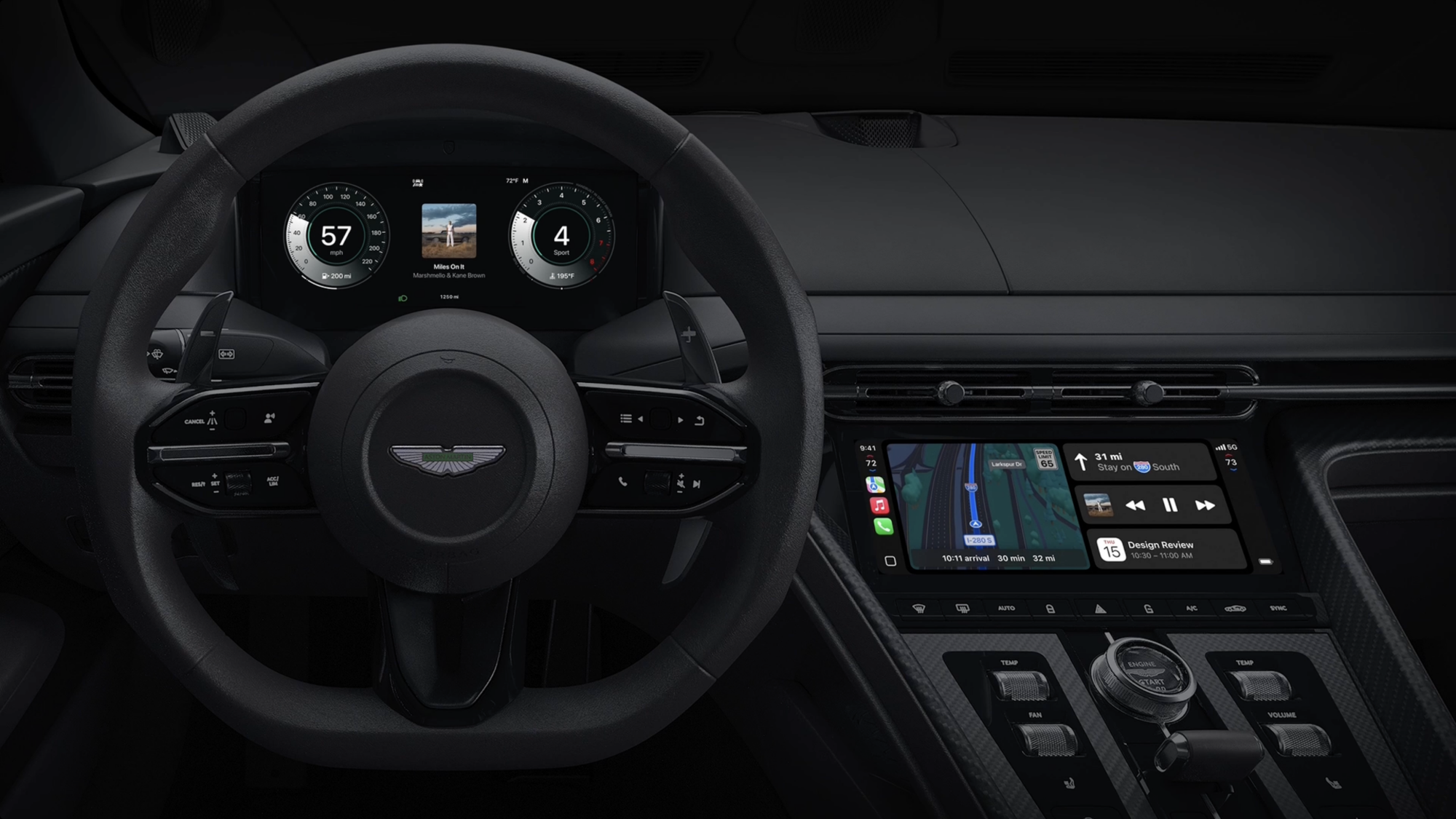
The key feature that sets CarPlay Ultra apart from CarPlay is its integration with all the screens in your car. Many cars these days have multiple displays, including one behind the steering wheel. Typically, only a designated display—or a portion of that designated display—is allocated for CarPlay. But with CarPlay Ultra, all the screens are fair game.
So, you can have CarPlay Ultra elements take up the display behind your steering wheel. That might manifest as your speedometer, tachometer, and a tool of your choosing, including the driving assist window, Apple Music, Maps, or tire pressure. I’d personally find it quite useful to have my directions featured front and center behind my wheel, so any time I check my speed, I get a heads-up about my next turn.
Credit: Apple
Once CarPlay Ultra rolls out in full, it won’t necessarily look the same from car to car. That’s due to two key reasons: First, Apple is letting carmakers customize the experience to “express their distinct design philosophy with the look and feel their customers expect.” On the other hand, you, the driver, are also able to customize the look of CarPlay Ultra, between adjusting the colors, wallpaper, and “instrument cluster” themes.
We’re sure to see more about this feature from Apple as it begins rolling out in full. But if you want a small glimpse of what to expect, check out that initial press release. There’s a short simulation of the interior of an Aston Martin; it shows the driver’s screen with an active speedometer, tachometer, and Apple Music widget, while the main display has an active Apple Maps view. To its right, you can see a smaller Apple Maps widget displaying the next turn, a small Apple Music widget featuring playback controls, and a small Calendar widget showing the driver’s next meeting.
The third season of Star Trek: Strange New Worldsfinally drops on July 17. It’s been around two years since the Paramount+ exclusive was last on the air. It’s a two-episode premiere, so that’s something.
We’ve already gotten a juicy trailer for the upcoming season and Paramount+ just unveiled a cool poster to advertise the release date. It shows all of the main characters wandering through, well, a strange new world.
For the uninitiated, Star Trek: Strange New Worldsfollows Captain Christopher Pike and the crew of the USS Enterprise. This is the very same Enterprise that will one day be captained by James Kirk. It’s a prequel, so there are new actors playing franchise legends like Spock, Uhura and Nurse Chapel.
Of course, as the show gets closer to the events of The Original Series, more familiar characters have been popping up. Kirk has been all over the place and the same goes for Scotty. We’ve even gotten Sybok, Spock’s half-brother who will one day lead the crew on a search to find God in the critically-reviled Star Trek V: The Final Frontier.
It’s a neat show, with a mystery-of-the-week format that recalls classic Trek. Season two ended on a cliffhanger, so it’ll be interesting to see how that shakes out. Season three of Strange New Worlds looks to include a visit to the 1960s version of Star Trek, complete with period-accurate costumes and sets, and a murder-mystery set in the Holodeck (or something similar.)
This article originally appeared on Engadget at https://www.engadget.com/entertainment/tv-movies/star-trek-strange-new-worlds-returns-on-july-17-162935572.html?src=rss
Back in February, Elon Musk skewered the Treasury Department for lacking “basic controls” to stop payments to terrorist organizations, boasting at the Oval Office that “any company” has those controls.
Fast-forward three months, and now Musk’s social media platform X is suspected of taking payments from sanctioned terrorists and providing premium features that make it easier to raise funds and spread propaganda—including through X’s chatbot, Grok. Groups seemingly benefiting from X include Houthi rebels, Hezbollah, and Hamas, as well as groups from Syria, Kuwait, and Iran. Some accounts have amassed hundreds of thousands of followers, paying to boost their reach while X apparently looks the other way.
In a report released Thursday, the Tech Transparency Project (TTP) flagged popular accounts likely linked to US-sanctioned terrorists. Some of the accounts bear “ID verified” badges, suggesting that X may be going against its own policies that ban sanctioned terrorists from benefiting from its platform.
Toyota is on a tear unveiling new EVs for the American market, announcing a new model for the third day in a row. After debuting the bZ SUV and the C-HR crossover, Toyota is adding the bZ Woodland SUV to the lineup, yet another fully electric vehicle built on the company’s e-TNGA platform. This more rugged version of the bZ is aimed at adventurous drivers, akin to the Subaru Outback, with marketing images depicting the electric SUV over rocky terrain.
The bZ Woodland will feature all-wheel drive as a standard option and boasts 375 combined horsepower from its dual-motor setup. At 260 miles of estimated range, this model has the lowest range of the three new electric models announced so far. Like the other models, it comes equipped with the North American Charging Standard (NACS) outlet as standard and supports DC fast charging, which can take it from 10 percent to 80 percent charge in around 30 minutes.
While the two models share “bZ” in the name, the bZ Woodland is not just a different trim of the bZ. The body of the Woodland is 6 inches longer and about 1 inch higher in the back. This gives it more than 30 cubic feet of rear cargo space.
Toyota has designed the bZ Woodland to be off-road and all-terrain friendly with details like 8.3-inch ground clearance, standard roof rails, a Panoramic View Monitor with Multi-Terrain Monitor and a 3,500-pound towing capacity. All-terrain tires are also available as an option when buying the Woodland. The AWD SUV also has the Toyota X-Mode system, which modulates the power delivered to each motor to improve grip when off-road.
Toyota expects the bZ Woodland to arrive in early 2026. Pricing has not yet been announced.
This article originally appeared on Engadget at https://www.engadget.com/transportation/evs/toyota-announces-the-bz-woodland-a-rugged-all-terrain-electric-suv-161925373.html?src=rss
This is a video of ‘Caress’ by artistic duo Pfeifer & Kreutzer, a piece of kinetic art featuring two windshield wipers repeatedly brushing a piece of faux fur. Is it relaxing to watch? Yes. But would I want it in my house? Absolutely, except with the fur replaced with moss green shag carpet. My rumpus room has a certain vibe, you know? “And what would that be?” No clue, but my girlfriend hates it.
China has been installing renewable energy at a spectacular rate, and it now has more renewable capacity than the next 13 countries combined and four times that of its closest competitor, the US. So far, though, that hasn’t been enough to offset the rise of fossil fuel use in that country. But a new analysis by the NGO Carbon Brief suggests that things may be changing, as China’s emissions have now dropped over the past year, showing a 1 percent decline compared to the previous March. The decline is largely being led by the power sector, where growth in renewables has surged above rising demand.
This isn’t the first time that China’s emissions have gone down over the course of a year, but in all previous cases the cause was primarily economic—driven by things like the COVID pandemic or the 2008 housing crisis. The shift was driven largely by the country’s energy sector, which saw a 2 percent decline in emissions over the past year.
China’s emissions have shown a slight decline over the last year, despite economic growth and rising demand for electricity.
Credit: Carbon Brief
Carbon Brief put the report together using data from several official government sources, including the National Bureau of Statistics of China, the National Energy Administration of China, and the China Electricity Council. Projections for future growth come from the China Wind Energy Association and the China Photovoltaic Industry Association.
To say I’m familiar with Sony’s 1000X line of headphones would be an understatement. I’ve tested every pair thus far, except the OG: the MDR-1000X. With each successive model, the company managed to add new features, develop better technology and expand the sonic capabilities of its flagship headphones. And with each new release, Sony kept its spot atop our best wireless headphones list.
This time around, Sony made us wait longer than usual. The first three sets of 1000X headphones each arrived a year apart. Then it was two years between the WH-1000XM3 and WH-1000XM4, perhaps delayed in part by the COVID pandemic, and then nearly two more before the redesigned WH-1000XM5 debuted. We’re three years out from that last model and today Sony is finally revealing the follow-up: the WH-1000XM6 ($450).
The extended interval is understandable once you consider the number of updates Sony has included to overhaul its pride and joy. There’s a new processor, more microphones, improved active noise cancellation (ANC), refined design and a retuned sound platform. Those changes join the long list of features Sony has amassed on the 1000X line over the years, a number of which automatically adapt when enabled, and many that provide great convenience in daily use. Other companies may have surpassed Sony in audio quality (at least until now), but none of the competition offers a collection of tools that even comes close to the WH-1000XM6.
Design updates
At first glance, the WH-1000XM6 might not look much different from the M5, but there are some notable tweaks that improve comfort and storage. First, there’s a wider, asymmetrical headband that makes these headphones even easier to wear for long periods of time. The previous model was already lightweight, and that continues here. Together with the new headband, it provides a comfy fit that beats every other wireless headphone.
Next, Sony returned to its folding design that older 1000X models used to have. With recent models, the company opted to just let the ear cups rotate before the headphones went in the case. They still do that, but they also fold in for easier storage. Due to this change, the company designed a smaller case, and instead of a zipper, Sony chose a magnetic closure.
One complaint I have about the design is how the ear cups rotate. When you take the WH-1000XM6 off, the cups rotate inside up to lay flat. To me, it should be the opposite, with the ear pads flipping down, because that’s how you’re going to put them in the case. This is a change from the M5, where the ear cups turn in what I’d consider the correct way, which makes this switch an even more confounding choice for this new model.
Sony mostly kept the controls on the WH-1000XM6 the same, save for a couple of small revisions. First, the company still uses a mix of physical buttons and touch panels on the outside of each ear cup. With the former, the only two options there are power (which doubles as Bluetooth pairing) and the noise control button that cycles through ANC, ambient sound and off.
That power button was redesigned so it’s now larger, round and concave. This makes it easier to find by touch and differentiates it from the noise control button. What’s more, Sony has added the ability for users to mute/unmute the microphones on the M6 during calls by double pressing the noise control button. This is handy when you don’t want to reach for your phone or keyboard during a voice or video chat.
Improved sound quality
Billy Steele for Engadget
The 1000X line has never been a slouch when it comes to sound quality, and Sony has made strides to continually improve audio performance over the years. With the WH-1000XM6, the company made changes in three areas to further boost the sound profile. First, Sony developed new drivers for the M6, which it says deliver “richer details and clearer vocals.” That’s due to what the company describes as smoother, extended high frequency reproduction created by perforations in the driver’s voice coil. And there’s better overall balance in the sound too, thanks to a more rigid dome for these components.
The company also enlisted mastering engineers from three recording studios to help tune the sound profile of the 1000XM6. They all contributed various quotes praising the audio quality of these headphones, but the general goal here was to deliver results that were closer to the artist’s intention. That includes more immersive sound and finer details. To further aid this, Sony also added 360 Spatial Sound upmixing for stereo content on the M6. Essentially, this feature can turn regular content into spatial audio. It’s something similar to what Bose does on its QuietComfort Ultra headphones, and it’s separate from both 360 Reality Audio support and DSEE Extreme compression upscaling.
On Sleep Token’s Even In Arcadia, the WH-1000XM6 provides boomy bass when tracks call for it, like the loud, crunchy guitars and thundering drums in “Look To Windward.” Throughout the album, treble and mid-range cut through cleanly, providing ample separation so you can hear all of the elements clearly. And that’s no easy feat, given the genre-bending production the band employs. Plus, the big, soaring, loud parts of these songs seem to completely surround you with sound.
The recently remastered The Musings of Miles by Miles Davis exhibits a different side of the M6. Here, the textures of the instruments are what stand out, where you can hear the subtle nuances of the trumpet, piano, bass and drums. I’m not sure there would be much more clarity if you time-traveled back to Rudy Van Gelder’s home studio in 1955. The audio is pristine here. There’s a similar vibe given to Billy Strings & Bryan Sutton’s Live At The Legion, where the two bluegrass virtuosos lend only two acoustic guitars and their voices to the show. Listening to this album with the M6, I might as well be sitting between them.
New chip, more mics and a dash of AI
Billy Steele for Engadget
Inside the WH-1000XM6, the star of the show is the new QN3 processor. Sony says it’s seven times faster than the QN1 used in the M5, a chip that first debuted on the WH-1000XM3 in 2018. Given that’s the main power behind noise cancellation, it was definitely time for an update.
With the QN3, Sony was able to add four additional microphones for its ANC setup, bringing the total on the 1000XM6 to 12. More mics means the company can more effectively detect and block noise. Alongside the new hardware,, Sony upgraded the Auto NC Optimizer on the M5 to what it now calls the Adaptive NC Optimizer on the M6. This technology accounts for changes in fit and air pressure, automatically adapting the ANC coverage as needed. What’s more, the company says the M6 can block more mid-to-high-range frequencies than the M5, putting all of that power to good use.
There’s a noticeable improvement in ANC performance on the M6 — it’s not just marketing hype. I can easily tell the headphones are blocking more background noise than their predecessor, which isn’t always the case across 1000X generations. Particularly with human voices, this model does a better job of reducing the sound of chatty neighbors in the office than much of the competition. Even though it doesn’t entirely silence them, this still constitutes an upgrade in performance. The company has been giving Bose a run for its money for a while now, and the M6 further cements the fact the noise-cancelling arms race is closer than ever.
Like it did on the M5, Sony employs AI-based noise reduction on the M6 to reduce background noise during calls. The company says it trained its model on 500 million voice samples so the system can properly extract the user’s voice. What’s more, Sony now utilizes two additional microphones for voice performance (with a smidge more AI on them) that are better positioned for speech pickup.
In practice, call performance is a mixed bag. First, the M6 does an excellent job of blocking background noise. It rendered a loud fan completely silent during one of my tests. However, that processing impacts overall clarity, so you won’t sound nearly as good as you do in quieter locations. Plus, the results in noiseless conditions aren’t pristine, but it’s good enough to get the job done for most call scenarios.
Sony brought back the convenient automation features that have made its flagship headphones the best option for years. Adaptive Sound Control can automatically adjust settings based on activity or location, like when you arrive at the office or when you’re out for a walk. Ambient sound still has pleasant, natural quality and is helpful to have on during calls. Speak-to-Chat continues to reduce the volume and activates that transparency mode when it detects your voice, though it’s still far too easily duped by coughs and when you clear your throat. You can also use head gestures to accept (nod) or reject calls (shake). There’s plenty more, but suffice it to say Sony is still ahead of the pack for the sheer volume of features it packs into its 1000X headphones.
Battery life
Billy Steele for Engadget
One of the few things that’s unchanged on the WH-1000XM6 is battery life. Just like the M5, this model offers up to 30 hours of use with ANC on or up to 40 hours with it off. The quick charge function is also the same: three minutes gives you three hours. I had no problem hitting these stated figures during my tests, which were primarily conducted with ANC on as well as Sony’s DSEE Extreme audio upscaling enabled. I would occasionally switch to transparency mode for calls, but 80 percent of the time I was in noise-blocking mode. After 25 hours of use, I still have 50 percent left in the tank.
There is one item Sony tweaked when it comes to battery and charging performance. On the M6, you’ll be able to listen to music while the headphones are charging. This functionality wasn’t available previously, and it’s sure to provide some added convenience in a pinch — like when you’re waiting for your flight in a raucous airport terminal.
The competition
Whether it’s Bose, Bowers & Wilkins or Sennheiser, there are a number of companies that inch closer to Sony’s crown with each product cycle. I’m convinced Sony has surpassed Bose in terms of pure noise-cancelling performance, but the QuietComfort Ultra headphones are still plenty good and can regularly be found for less than their $449 suggested retail price. I don’t care for the design of Sennheiser’s Momentum Wireless 4, but the headphones have nearly double the battery life of the M6 with plenty of audio and ANC performance to boot. And they do so for less money than the WH-1000XM6.
This leads me to the Bowers & Wilkins Px7 S3. The company’s Px7 S2e had been my pick for best sounding headphones for a while, and were only recently bested by Noble Audio’s pricey FoKus Apollo ($649). The S3 edition supposedly offers improvements to sound and ANC performance, but I haven’t tested them yet and there’s no clear indication how much they’ll cost or when they’ll arrive. Still, if you’re not in a hurry, the Px7 S3 may be worth waiting on as they should be slightly more affordable than the M6 and Bowers & Wilkins has a strong track record for sound quality.
Wrap-up
With the WH-1000XM6, the three-year-long wait was well worth it. The company has made significant gains in both sound quality and noise-canceling performance, thanks in part to a powerful new chip. Subtle, but impactful design tweaks increase comfort, while spatial audio upmixing further expands the sonic abilities of the 1000X line. The only real downside is the price continues to go up: the M6 is $50 more than the M5 was at launch. When you combine their performance with Sony’s ever-growing list of features, the 1000XM6 are the best headphones you can buy right now.
This article originally appeared on Engadget at https://www.engadget.com/audio/headphones/sony-wh-1000xm6-review-the-best-headphones-just-keep-on-getting-better-160058170.html?src=rss
Today is Global Accessibility Awareness Day (GAAD), and, as in years past, many tech companies are marking the occasion with the announcement of new assistive features for their ecosystems. Apple got things rolling on Tuesday, and now Google is joining in on the parade. To start, the company has made TalkBack, Android’s built-in screen reader, more useful. With the help of one of Google’s Gemini models, TalkBack can now answer questions about images displayed on your phone, even they don’t have any alt text describing them.
“That means the next time a friend texts you a photo of their new guitar, you can get a description and ask follow-up questions about the make and color, or even what else is in the image,” explains Google. The fact Gemini can see and understand the image is thanks to the multi-modal capabilities Google built into the model. Additionally, the Q&A functionality works across the entire screen. So, for example, say you’re doing some online shopping, you can first ask your phone to describe the color of the piece of clothing you’re interested in and then ask if it’s on sale.
Separately, Google is rolling out a new version of its Expressive Captions. First announced at the end of last year, the feature generates subtitles that attempt to capture the emotion of what’s being said. For instance, if you’re video chatting with some friends and one of them groans after you make a lame joke, your phone will not only subtitle what they said but it will also include “[groaning]” in the transcription. With the new version of Expressive Captions, the resulting subtitles will reflect when someone drags out the sound of their words. That means the next time you’re watching a live soccer match and the announcer yells “goallllllll,” their excitement will be properly transcribed. Plus, there will be more labels now for sounds like when someone is clearing their throat.
The new version of Expressive Captions is rolling out to English-speaking users in the US, UK, Canada and Australia running Android 15 and above on their phones.
This article originally appeared on Engadget at https://www.engadget.com/mobile/smartphones/androids-screen-reader-can-now-answer-questions-about-images-160032185.html?src=rss
Accessibility features built into devices and apps are essential for making tech easier to use. Apple recently announced a suite of new and expanded accessibility updates—like Accessibility Reader and improved Braille support—coming to its devices later this year. TikTok is now rolling out a handful of new features to make its platform and content more accessible for everyone. Here’s what’s coming.
AI-powered alt text
TikTok already has an alternative text feature that allows creators to manually add alt text—a brief description that can be accessed by screen readers—to photo posts when uploading or even after content has been published. (This can be found under More options > Add alternative text.) The platform is now testing an AI feature that will automatically describe content aloud if creators don’t include alt text, improving usability for those who are blind or low vision.
Increased color contrast
TikTok users can now enable a high-contrast mode, which increases the foreground color of text, icons, and other app elements. Color contrast ups the distinction between text and objects on a page and their background, improving readability. This joins the existing text size feature, which allows users to increase or decrease the size of text in the TikTok app specifically (independent of device settings). Both features can be turned on or off under Accessibility > Appearance.
Bold text
TikTok will now match device-level bold text settings, so all text in the app will appear bold if that display feature has been enabled. Bold text can be turned on or off under Settings > Display & Brightness on iOS or Settings > Accessibility > Display size and text > Bold text on Android.
Other accessibility settings already available on TikTok include toggles to remove photosensitive videos, add auto-generated captions to content, and animate thumbnails, as well as dark mode and compatibility with device-level screen readers.
Following a series of leaks, Sony’s much anticipated WH-1000XM6 wireless headphones have officially arrived. The new model has to follow the WH-1000XM5 that was among the best-sounding we’ve ever tested. To that end, Sony has updated them in nearly every way, from sound to noise cancellation to call quality.
The WH-1000XM6 has largely the same design as the previous model, but there are subtle tweaks. The case is smaller and now has a magnetic lock, while the headphones have a new asymmetric headband that’s wider than the one on the XM5 for increased comfort. The power and mute buttons were also redesigned for improved usability.
Sony was able to make some major updates in the noise cancellation (ANC) thanks to the new QN3 chip that’s seven times faster than the QN1 from the XM5. It now carries 12 ANC microphones instead of eight to better detect surrounding noise and uses adaptive ANC optimization rather than auto optimization before. The latter allows the XM6 headphones to push noise levels down across a wider range of frequencies.
Sony
On the sound quality side, Sony worked with “world-renowned mastering engineers” to tune audio for improved realism and deeper bass. New driver units supposedly allow for “richer details, clearer vocals [and] improved balance thanks to more rigid dome,” along with smoother and more extended high frequency reproduction via a new voice coil design. And a new feature can upmix regular stereo to spatial audio using Sony’s 360 Spatial Sound technology for a surround sound effect with any music or audio.
Finally, Sony improved call quality with updated noise reduction that uses “AI beamforming” and six mics instead of four as before. Battery life is the same at 30 hours with ANC on and 40 hours with it disabled, and you can still get up to three hours of life with just three minutes of charging.
All of this new tech comes at a price, as the WH-1000XM6 costs $450, a price that’s $50 higher than the XM5 was at launch. Still, if it lives up to Sony’s claims and follows the footsteps of other WH-1000 models, it’s bound to be among the best wireless ANC headphones you can get at any price.
This article originally appeared on Engadget at https://www.engadget.com/audio/headphones/sonys-flagship-wh-1000xm6-headphones-arrive-with-updated-sound-and-more-robust-anc-160005817.html?src=rss
Google has overtaken IBM to become the leader in generative AI-related patents and also leads in the emerging area of agentic AI, according to data from IFI Claims. Axios: In the patents-for-agents U.S. rankings, Google and Nvidia top the list, followed by IBM, Intel and Microsoft, according to an analysis released Thursday.
Globally, Google and Nvidia also led the agentic patents list, but three Chinese universities also make the top 10, highlighting China’s place as the chief U.S. rival in the field. In global rankings for generative AI, Google was also the leader — but six of the top 10 global spots were held by Chinese companies or universities. Microsoft was No. 3, with Nvidia and IBM also in the top 10.
The Ray-Ban Meta glasses are getting an upgrade to better help the blind and low vision community. The AI assistant will now provide “detailed responses” regarding what’s in front of users. Meta says it’ll kick in “when people ask about their environment.” To get started, users just have to opt-in via the Device Settings section in the Meta AI app.
The company shared a video of the tool in action in which a blind user asked Meta AI to describe a grassy area in a park. It quickly hopped into action and correctly pointed out a path, trees and a body of water in the distance. The AI assistant was also shown describing the contents of a kitchen.
I could see this being a fun add-on even for those without any visual impairment. In any event, it begins rolling out to all users in the US and Canada in the coming weeks. Meta plans on expanding to additional markets in the near future.
It’s Global Accessibility Awareness Day (GAAD), so that’s not the only accessibility-minded tool that Meta announced today. There’s the nifty Call a Volunteer, a tool that automatically connects blind or low vision people to a “network of sighted volunteers in real-time” to help complete everyday tasks. The volunteers come from the Be My Eyes foundation and the platform launches later this month in 18 countries.
The company recently announced a more refined system for live captions in all of its extended reality products, like the Quest line of VR headsets. This converts spoken words into text in real-time, so users can “read content as it’s being delivered.” The feature is already available for Quest headsets and within Meta Horizon Worlds.
This article originally appeared on Engadget at https://www.engadget.com/ai/metas-smart-glasses-will-soon-provide-detailed-information-regarding-visual-stimuli-153046605.html?src=rss
Folks who are starting to build out their smart home security systems could do a lot worse than going with Nest’s cameras. The Google brand offers an accessible entry point into home security (especially if you already have a Google account for Gmail, YouTube or the company’s other services). As such, the Google Nest Security Cam (Wired) is our pick for the best security camera for smart home newbies. That model is currently on sale for $70, which is $30 off and a record-low price.
The camera is a cinch to set up and get working the way you want it to. You can manage it through the Google Home app, which is smartly designed, clean and easy to navigate. The app takes you through the setup process with step-by-step directions, and the plain language helps make it a breeze to do things like customizing routines. The camera supports features like location-based triggers on both Android and iPhone — you can set things up so that you’re only notified of a detected incident when you’re away from home.
Along with viewing your camera feed in the Home app, you can also access it from a Nest Hub, Google TV or Streamer. You should get a decent look at whatever’s going on as the camera captures 1080p HD video with what we felt were accurate colors. Infrared images captured at night are smooth as well.
The Nest Cam has a fairly sleek, modern design featuring two half-orbs, one acting as the base (which can be wall-mounted) and another as the camera module. The arm that connects the two allows for a 90-degree range of vertical movement and full 360-degree horizontal rotation. That’s especially useful as the camera has a 135-degree field of view, which is decent enough but not exactly the widest among home security cameras.
Google gates some of the Nest Cam’s more useful features behind subscriptions. If you opt out, you’ll only get access to three hours of the most recent event history. That might not be long enough, especially if you’re away on a trip and something notable happens that your camera picks up.
With an $8-per-month Nest Aware subscription, you can access the past 30 days of recorded activity. Upgrade further to the $15 per month Nest Aware Plus plan and you can call up 90 days of recorded activity and store up to 10 days of round-the-clock recordings. A subscription isn’t required for the people, animal and people detection features, or customizing alerts for any of those.
This article originally appeared on Engadget at https://www.engadget.com/deals/the-best-security-camera-for-smart-home-newbies-is-on-sale-for-a-record-low-price-152534663.html?src=rss
The Federal Trade Commission has postponed enforcement of its consumer-friendly “click to cancel” rule from May 14 to July 14, giving businesses two additional months to comply. The regulation requires companies to make subscription cancellations as straightforward as the sign-up process, prohibiting practices like forcing customers who subscribed online to navigate through chatbots or call centers to cancel.
The rule, established under former Democratic Chair Lina Khan, unsurprisingly has garnered support from consumer advocates while facing legal opposition from industry groups. A coalition including the U.S. Chamber of Commerce and organizations representing major telecom and media companies — Charter Communications, Comcast, Disney Entertainment, and Warner Bros. Discovery — has sued to block implementation, claiming the agency exceeded its authority.
Moto Razr Ultra (2025) – MSRP Starting A $1,299 With the Razr Ultra, Motorola has gone all out and made a Snapdragon 8 Elite-equipped, flagship-grade folding flip phone with very few compromises.. Stylish design, premium materials Big beautiful displays Excellent speakers Solid performance and battery life Android apps on the cover screen…