Elden Ring Nightreign Launches Thursday For $40, And You Should Buy It

Elden Ring Nightreign Launches Thursday For $40, And You Should Buy It
If you’re a die-hard “Soulsborne” series veteran, you probably already know about this unusual spinoff title’s rather quiet launch. Instead, we’re going to try and pull in some of the folks who may have bounced off of Dark Souls or Elden Ring because of those games’ dense RPG mechanics and long playtime. If you’re just here for the reminder:

What Strava Buying ‘The Breakaway’ App Means for Its Users

We may earn a commission from links on this page.

It looks like Strava is making moves to become more than just a social fitness tracker. The popular fitness app—arguably the best one of its kind—announced Thursday that it has acquired The Breakaway, an AI-powered cycling training app, marking its second major acquisition in just over a month.

This follows Strava’s purchase of Runna back in April. So, what do these acquisitions mean for users of The Breakaway and Strava alike? Will those apps’ specific training plans become available a part of the Strava subscription? Will I have to pay for that whether I like it or not? Here’s what you need to know.

What The Breakaway brings to Strava

The Breakaway uses AI to create customized training plans for cyclists pursuing specific performance goals. The app analyzes individual fitness data and objectives to generate workouts tailored to each user’s needs and schedule.

Similarly, Runna offers AI-generated training plans, but focuses on runners rather than cyclists. As people are speculating on Reddit, these apps could represent Strava’s strategic push into more personalized training and coaching features.

Zooming out, Strava has built its reputation on social fitness tracking. As a loyal Strava user myself, I believe no other running app can beat Strava’s social and mapping features. This ability to tap into a community of fellow runners and cyclists has always differentiated Strava from pure tracking apps.

Strava’s core offering has remained relatively (and refreshingly) basic compared to specialized training apps. That said, these acquisitions sure do suggest the company wants to capture more and more of the fitness ecosystem by offering the kind of structured, goal-oriented training that serious athletes need.

What this means for pricing

Current subscribers don’t need to worry about immediate price hikes. The Breakaway costs $9.99/month, or $69.99/year. (I guess runners are willing to shell out more, since Runna costs $19.99/month, or $119.99/year.) Strava‘s free tier lets you post your runs, interact with other users, and track some basic statistics about your performance. The premium tier, at $11.99/month or $79.99/year, gives you extra performance tracking and mapping tools.

And according to statements from Strava, there are no plans to alter pricing structures or eliminate free access to the acquired apps’ basic features. Whether this pricing structure will hold long-term remains to be seen, especially as Strava integrates these services into its broader platform.

The bottom line

Rather than users needing separate apps for social tracking and structured training, Strava appears to be building an all-in-one fitness ecosystem. Even for the most casual users, this could mean access to more training tools without leaving the Strava ecosystem. But as some disgruntled fans are voicing, it can be frustrating to see Strava scoop up AI-powered training features, rather than fix some of its most basic issues. (Seriously: I should be able to accurately search for for past runs.)

And we can only hope that pricing doesn’t get too crazy. We’ll see whether users are willing to pay more for what has traditionally been a social-first fitness app.

Finally, as Strava continues to expand its feature set, it’s worth remembering that the app defaults to public sharing. Regularly review your privacy settings to ensure you’re not inadvertently sharing location data or personal information more broadly than intended.

How The New 80 Plus Ruby PSU Rating Compares To Titanium, Platinum, And Gold

How The New 80 Plus Ruby PSU Rating Compares To Titanium, Platinum, And Gold
Move over, 80 Plus Titanium, there’s a new boss in town, and her name is Ruby. CLEARresult, the entity handling the well-known 80 Plus power supply certification program, has unveiled 80 Plus Ruby, its top-end badge aimed at super-efficient server power supplies.

80 Plus Titanium already demanded over 90% efficiency at 10% to 100% delivery

The problem with The Last of Us season 2 is that it’s too faithful an adaptation

Season 2 of HBO’s The Last of Us wrapped up on Sunday night, and Ars’ Kyle Orland (who’s played the games) and Andrew Cunningham (who hasn’t) are back to talk about the finale like they’ve talked about every other episode this season. While these recaps don’t delve into every single plot point of the episode, there are obviously heavy spoilers contained within, so go watch the episode first if you want to go in fresh.

Kyle: Coming back from last week’s Joel flashback, it took me a second to remember what was actually going on in “The Present” of The Last of Us as we enter the season 2 finale. Ellie marvels at how easy it was to torture a hated enemy even though the result was just two words indicating Abby’s supposed location: “whale” and “wheel.”

I don’t think Ellie’s turn to “the dark side” is unearned, exactly. But I do think that this single-minded, revenge-obsessed version of Ellie is a lot less interesting than the character we grew to love in season 1. We went into this season in a sort of adolescent family drama, and we are leaving it in post-apocalyptic Breaking Bad.

Andrew: To compare it to Breaking Bad implies some kind of gradual, nuanced transformation has taken place, where my problem with the season so far has been mostly the opposite thing. Everyone’s motivations here make sense and are consistent, to some extent, with who we know these characters to be. Ellie is rash and impulsive; Dina is lovestruck; Jesse is loyal and selfless.

It’s just that trading the first season’s story (an unlikely pairing navigates the breadth of a post-apocalyptic America, driven by the promise of a cure) for the second season’s story (Ellie’s revenge fantasy) is a huge downgrade! And I say this as someone who has been slightly warmer on the season overall than you have. They killed the most interesting character and, with him, the story’s most interesting dynamic. Whatever followed that was probably always going to be a letdown, and I’m sure you can attest to that as a game-player who has already experienced a version of all of this.


The show has spun its wheels a bit in Seattle, even with just seven episodes to fill.
Credit:
HBO

Kyle: Yes, I soured on the second game for pretty much the same reasons. But I also feel the show has been more artlessly blunt with some of its character moments. Like the way Jesse finds out about Dina’s pregnancy, and then similarly declares that he “can’t die” because he’s going to be a father. It felt like an AI trained on the TV Tropes website was writing some of these scenes…

Andrew: Listen, normally I’m all for blaming AI, but to blame AI for this one is to imply that lowest-common-denominator TV storytelling hasn’t existed for as long as the medium has. Everyone is just performing the most-predictable version of their respective character archetypes. It’s an expensive show with a talented cast and an interesting riff on the zombie apocalypse idea, so at a baseline it remains watchable. But I suppose that’s damning with faint praise.

Kyle: Yeah I didn’t mean a literal AI. I meant that as a sick burn on the human writers.

Andrew: I am trying to think of things to say to stop this from just being a litany of complaints, but unfortunately complaints are a lot of what I’ve got about this episode. I liked the visuals of Ellie’s nighttime sojourn to the abandoned Ferris wheel. I feel like there is a slightly more interesting TV show happening off to the side of this one, about the conflict between the militarized WLF types and the cultists. But as far as Ellie has been concerned so far, these factions mostly exist to chase the other faction off at the last minute, saving Ellie’s bacon again.

Kyle: And to set up contrived philosophical discussions. Like when Jesse makes the perfectly reasonable decision not to mount a doomed attempt to save a cultist when they’re outnumbered by WLF members. Then, later, Ellie twists that into Jesse chickening out because the guy “wasn’t a member of your community.” No… I’m pretty sure the 6-to-2 odds had at least as much to do with it. But Ellie needs to turn the conversation back to how Joel represents “my community… beaten to death.” It’s not subtle…


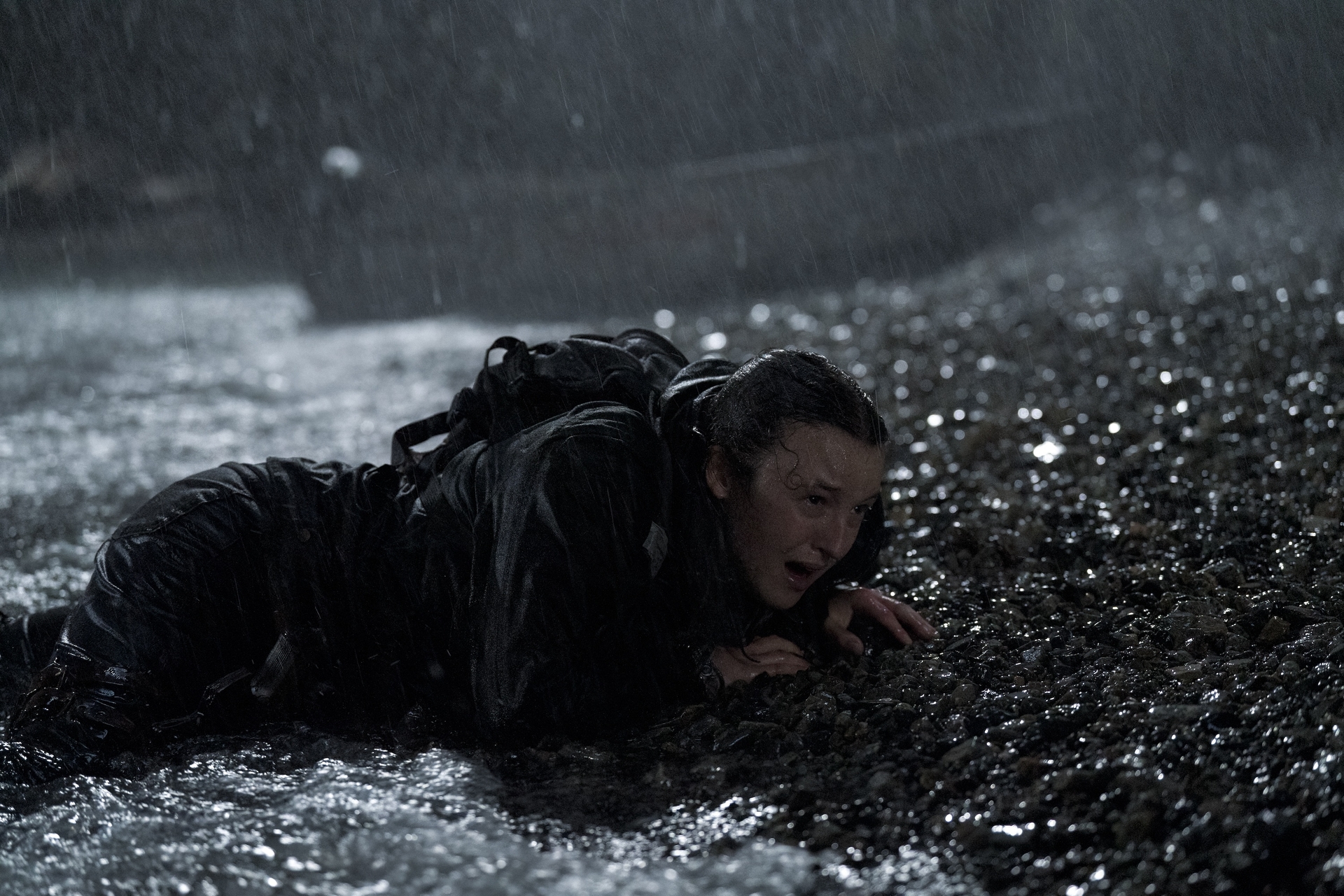
Ellie’s single-minded quest for revenge this season has been less compelling than the first season’s unlikely buddy story.
Credit:
HBO

Andrew: Yeah I found that moment frustrating because Ellie is here in direct contravention of what her community decided! And it is her community, as a group of people who have looked out for her and provided for her for years, whether she wants to admit that or not. She only uses this idea of “community” with Joel selectively, as a cudgel, so she can do what she already wants to do.

By letting her have the last word on it, the show tacitly endorses her read of the situation, and it’s a variety of vigilante justice that TV audiences have been primed to sympathize with, but man it just falls flat for me.

Kyle: I was also perplexed by Ellie’s brief shipwreck storyline, which led to her being put in a noose by angry cultists. Then she gets saved just seconds from death by a deus ex machina problem in “The Village” that requires the cultists to immediately put her execution on hold and run away. And after all that she just… hops in a boat and goes off to the next completely unrelated bit of the story.

I suppose they’re probably setting things up to provide more context for that scene in the next season, but in the context of this episode as it stands it was just a baffling way to use up 10 minutes or so.

Andrew: Yes I am assuming all the time spent setting up these cultists is going to pay off somehow, eventually, but it hasn’t happened yet.

The episode’s other Big Emotional Moment comes when Ellie catches up with a couple of members of Abby’s crew (I imagine a Hells Angels-style leather jacket, emblazoned with ABBY’S CREW on the back) and ends up killing them both, including a heavily pregnant woman whose dying breaths are spent trying to talk Ellie into cutting her baby out of her. There’s some kind of lesson here, about the ultimate futility of revenge, about the sins of the parents, about what perpetuating the cycle of violence ultimately gets you. We’ll see if Ellie ends up absorbing any of this in the end.

In both her response to the underground torture scene and here, Ellie seems continually shocked that her quest for vengeance might involve any kind of collateral damage to anyone other than Abby.

Kyle: Yes, this bit is culled from the game, but there she just discovers the unborn baby after both of Abby’s companions are already dead. The whole “cut my baby out of me before I die” thing was seemingly crafted to make this just that much more emotionally scarring for Ellie. But as you said, she doesn’t really get to spend any time absorbing any of that, because we’re moving right on to the next plot point.

I understand how and why we don’t get to have 23 episode seasons of TV shows anymore, but it feels like some of the 17 side stories they introduce in this episode (and many more throughout this season) could have stood to have some more time to breathe.

Andrew: I was astounded—astounded! That this was our season finale, because it feels like such a transitional piece-moving episode, and because we’re only seven episodes in. I get that we are stretching one game into two seasons here, but the nine-episode first season was already short, and then this one’s even shorter. Can we just agree to return to 13-episode seasons, please?

Anyway, if your main complaint about the Seattle section of the show has been “too much wheel spinning,” this episode’s big, dramatic cliffhanger is bad news for you. Every day Ellie has spent in Seattle has gotten some big Majora’s Mask-esque “DAY ONE, DAY TWO, etc” subtitle, and now we know why. The beginning of next season is going to show us the events of these three days—but from Abby’s perspective!

I guess I caused this by saying “what if Abby were a more fully formed antagonist” to my monkey’s paw at the start of the season. But I can’t say that this has me on the edge of my seat about season 3, this little slip of a teaser at the end of an episode that I didn’t know was the season finale until after the fact.


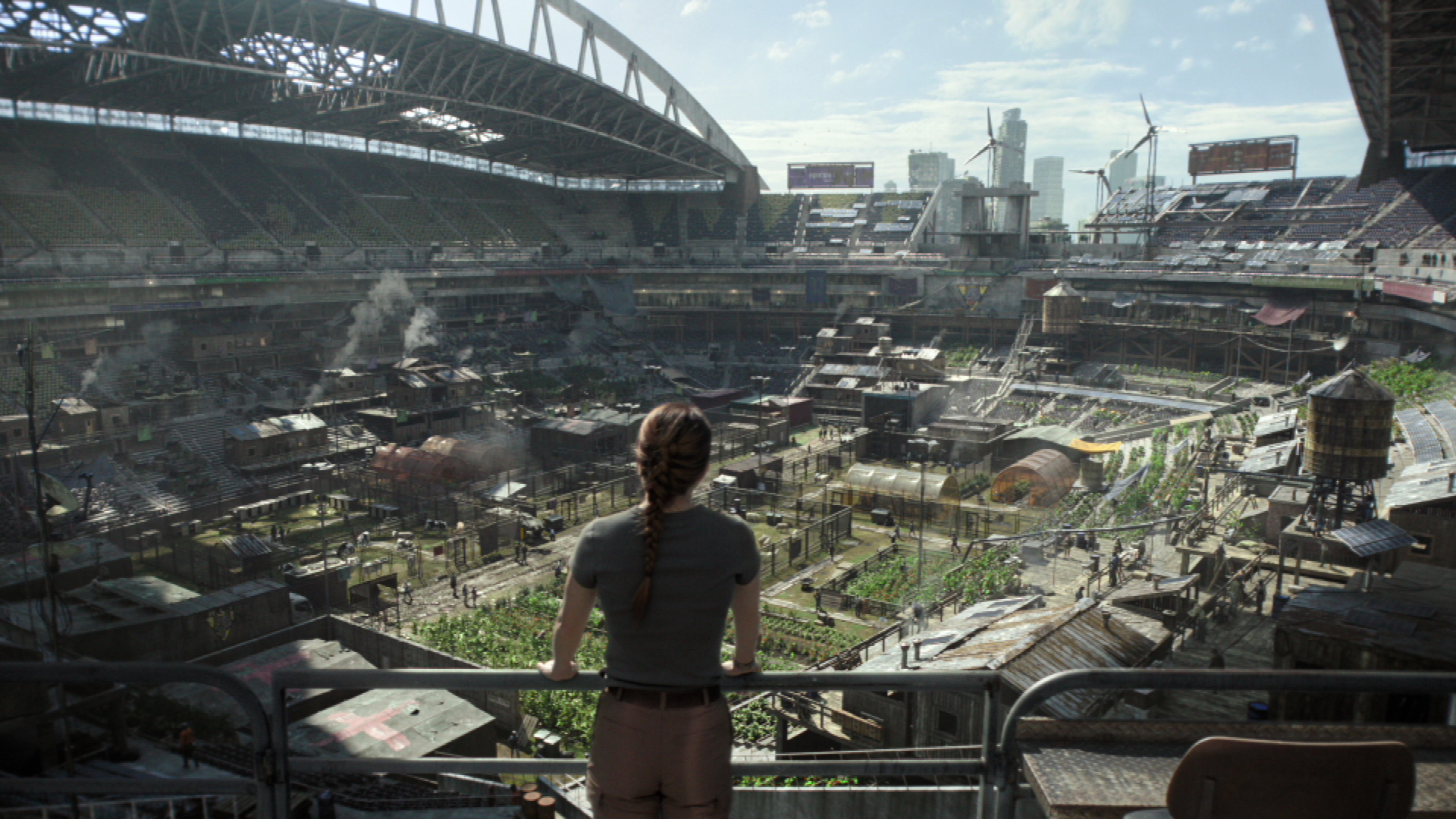
Abby oversees her empire.
Credit:
HBO

Kyle: Yes, this structure also apes the second game, which switches to Abby’s backstory halfway through (though there’s no “season break” in the middle there). The dramatic reveal of Abby’s community being housed in a football stadium is one of the most memorable moments of the game and was a rare highlight of this episode, I felt.

Before that, though, we get the inevitable and deadly confrontation between Ellie/Jesse/Tommy and Abby. After seeing it in the show, I had to go back and rewatch how it plays out in the game because something just felt off in the translation. Sure enough, the TV show production added Ellie screaming “no no no” and the sound of a gunshot before that dramatic cut to black and transition to Abby’s earlier POV.

As usual, it feels like the show has a need to just crank up the drama at every turn in an effort to make sure people tune in next week (or next season).

Andrew: Let’s return to that divide between me as a show-watcher and you as a game-player as we wrap up.

I find myself with more gripes than praise here at the end of the season. There are still a lot of things I like here—like I said, the fictional universe is compelling enough to keep it watchable, and for all my complaints about Ellie the character, Bella Ramsey as a performer is doing the best work they can with sort of underwhelming material (predictably, some corners of the Internet have decided to harangue Ramsey relentlessly, partly because they’re a non-binary person who has decided to exist in public).

But my impression is that my biggest problems with this season, from the killing of Joel to the single-minded vengeance arc, are all downstream of story decisions made years ago during the development of The Last of Us Part 2. Normally the complaint with an adaptation is that the show or film’s creators are ruining the story somehow by being insufficiently faithful to the source material and losing something in the process. But it feels like the show’s problems are mostly inherited from the game—in other words, that the show is being too faithful to underwhelming source material. Is this a fair assessment, or am I missing something?

Kyle: I’d say that the structural problems of the show are mostly derived from the game’s decision to transition from “buddy adventure” to “revenge saga” as we’ve discussed ad nauseam. But a lot of the nitty-gritty problems of this season—stuff like pacing, flow, character development, etc.—actually come off a little worse because of decisions to add or change things for the show.

After season 1, I was hopeful that some light-touch changes could help redeem a game that I did not enjoy much. Instead, I think they somehow made it worse.

Andrew: Oops!

Well, there’s always next season. Maybe all of our complaints will be substantively addressed and then some. The only thing we can say for sure is: We haven’t seen the last of The Last of Us.

Kyle: In the end, the real Last of Us was all the people we killed along the way.

Read full article

Comments

‘AI Role in College Brings Education Closer To a Crisis Point’

Bloomberg’s editorial board warned Tuesday that AI has created an “untenable situation” in higher education where students routinely outsource homework to chatbots while professors struggle to distinguish computer-generated work from human writing. The editorial described a cycle where assignments that once required days of research can now be completed in minutes through AI prompts, leaving students who still do their own work looking inferior to peers who rely on technology.

The board said that professors have begun using AI tools themselves to evaluate student assignments, creating what it called a scenario of “computers grading papers written by computers, students and professors idly observing, and parents paying tens of thousands of dollars a year for the privilege.”

The editorial argued that widespread AI use in coursework undermines the broader educational mission of developing critical thinking skills and character formation, particularly in humanities subjects. Bloomberg’s board recommended that colleges establish clearer policies on acceptable AI use, increase in-class assessments including oral exams, and implement stronger honor codes with defined consequences for violations.


Read more of this story at Slashdot.

Europe tries to force age verification onto Pornhub and other adult sites

European regulators have opened formal proceedings into Pornhub and three other adult platforms for suspected violations of the Digital Services Act (DSA), the European Commission announced yesterday. Pornhub, Stripchat, XNXX, and XVideos are accused of failing to prevent minors from accessing adult content.

“The Commission preliminarily found that the platforms do not comply with putting in place appropriate and proportionate measures to ensure a high level of privacy, safety and security for minors, in particular with age verification tools to safeguard minors from adult content,” the EC said.

The regulatory body said preventing minors from accessing adult content with age verification tools is needed to prevent “negative effects on the rights of the child” and “the mental and physical well-being of users.”

Read full article

Comments

Massive 47GB Data Breach Exposes Millions Of Passwords For Google, Netflix And More

Massive 47GB Data Breach Exposes Millions Of Passwords For Google, Netflix And More
It might surprise you to learn this, but cybercriminals are usually fairly protective of the data they steal, because things like credentials and login details have value, and can be sold to the right buyer. That’s why it’s so unusual that this latest discovery was apparently found completely unencrypted and visible to the open web; a massive

14 Ways to Customize Your Mac’s Dock

The dock, an iconic Mac feature, is used to launch apps, switch between them, and as a hub for displaying key apps and minimized windows while they’re open. By default, the dock has a clean look and features a few apps that your computer thinks you might want to use. However, you can get a lot out of customizing your dock, like removing the icons for default Apple apps you don’t use. You can also change its placement and its look. Here’s what you need to know to do just that, plus a bit extra.

Remove apps you’re not going to use

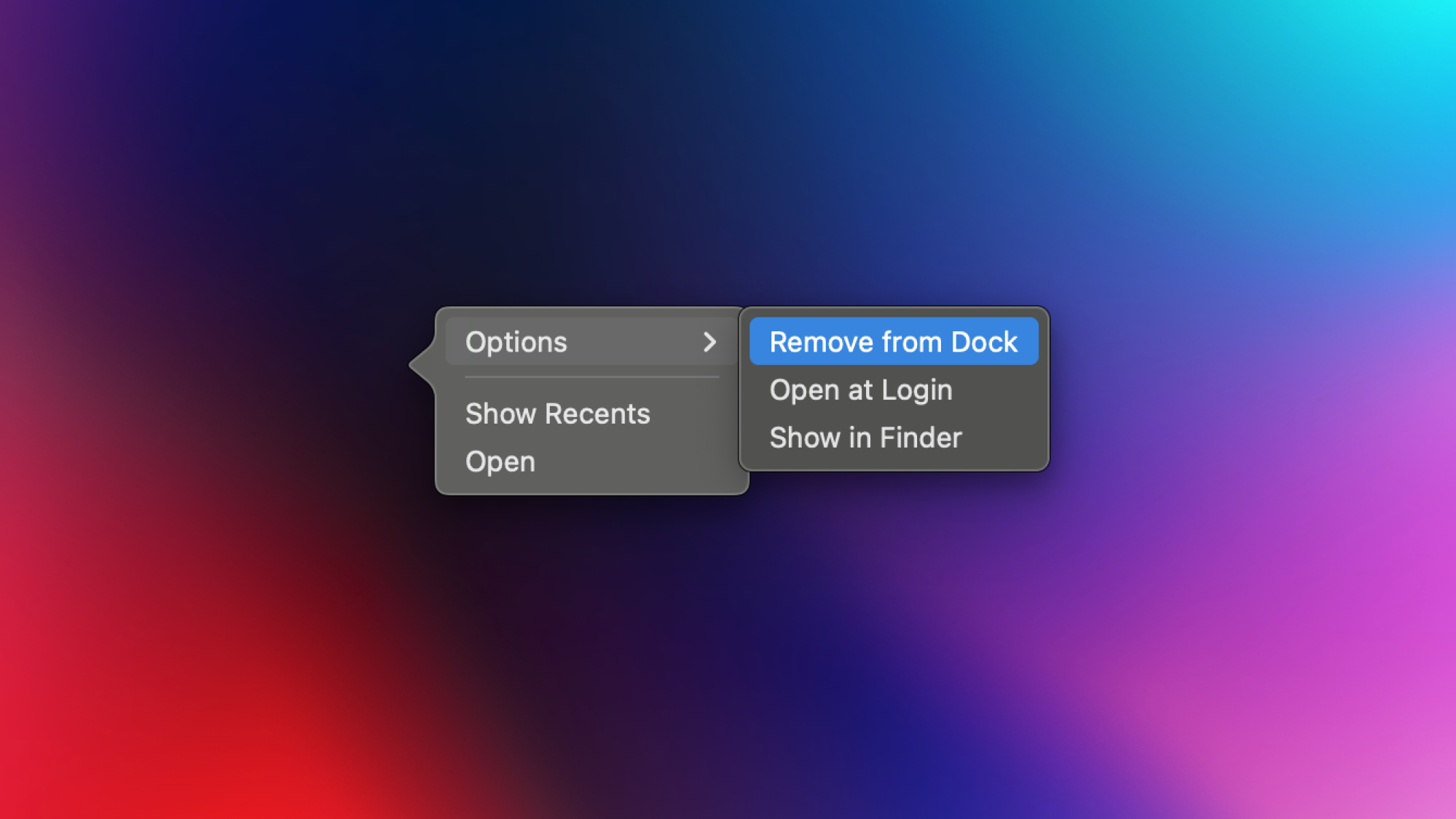
The Remove From Dock option highlighted in Mac dock settings.

Credit: Pranay Parab

You should start your dock tweaks by removing apps you’re never going to use. To remove an app from your dock, right-click it and select Options > Remove from Dock. You can also ensure apps that are only in the dock temporarily (which appear on the right side of the dock, next to a separator) stay there by right-clicking them and selecting Options > Keep in Dock. 

Move apps around to make them easy to access

Your next step should be to reorder your Dock’s apps, which is as simple dragging their icons where you want them. Note, though, that if you accidentally drop an icon outside of the dock, it’ll be removed from your dock and you’ll have to add it again.

Change the size of the dock

You can also adjust your dock’s size. Hover your mouse cursor over any of your dock’s separators (those vertical dividing lines). The cursor will change to an arrow that points up and down. Drag it towards the top of the screen to make the dock larger or drag it downwards to make it smaller.

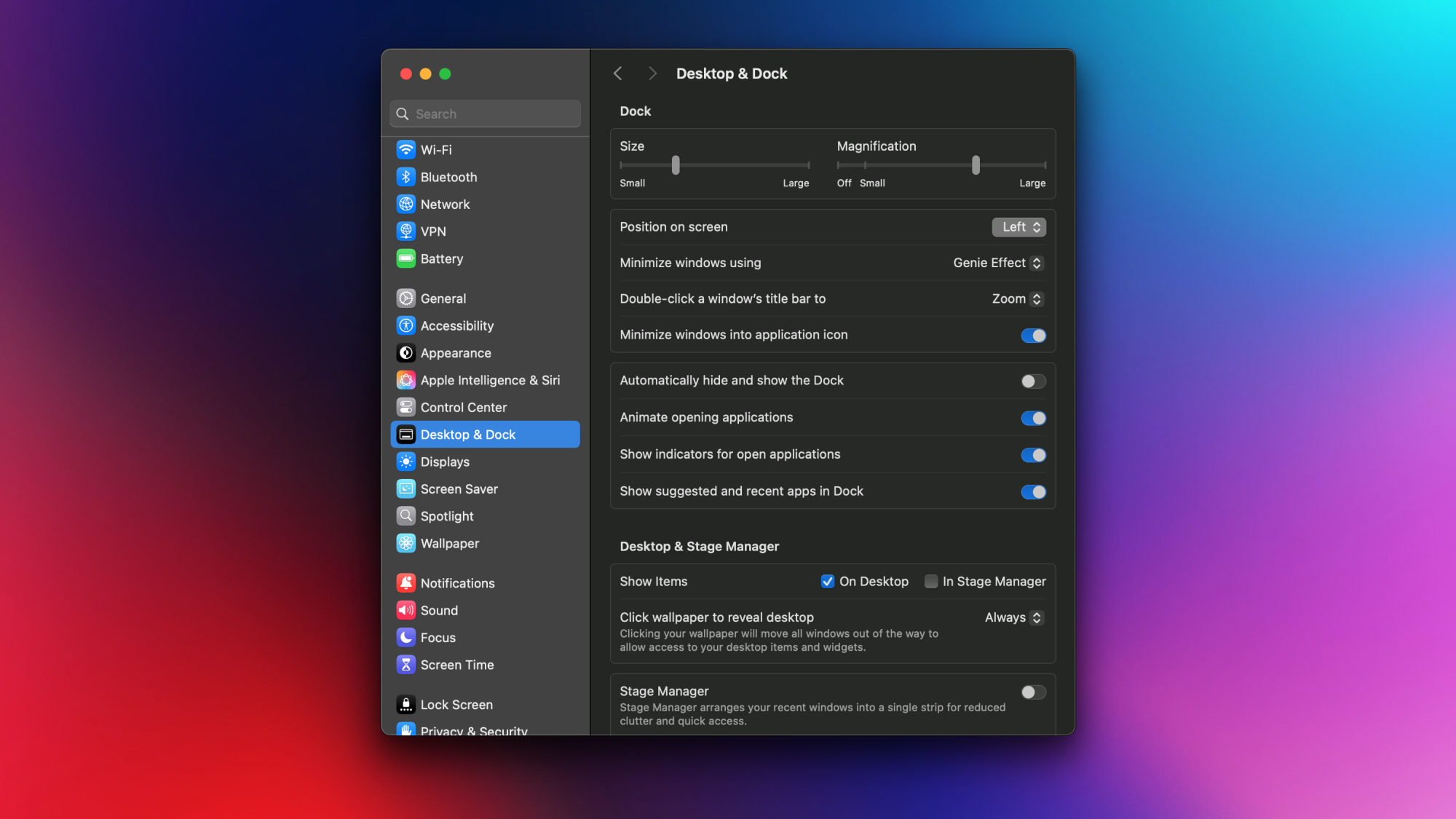
Alternatively, you can adjust the dock’s size by clicking the Apple logo in the top-left corner of your Mac’s screen and going to System Settings > Desktop & Dock and moving the Size slider.  

Change the dock’s position

The dock can be moved to either side of your screen, saving you precious real estate. To change this, right-click any vacant area in the dock and select Position on Screen. Pick Left or Right to align your dock vertically to your selected position. Center will place it back in the default spot.

This option is also available in System Settings > Desktop & Dock > Position on screen.

Automatically hide and show the dock

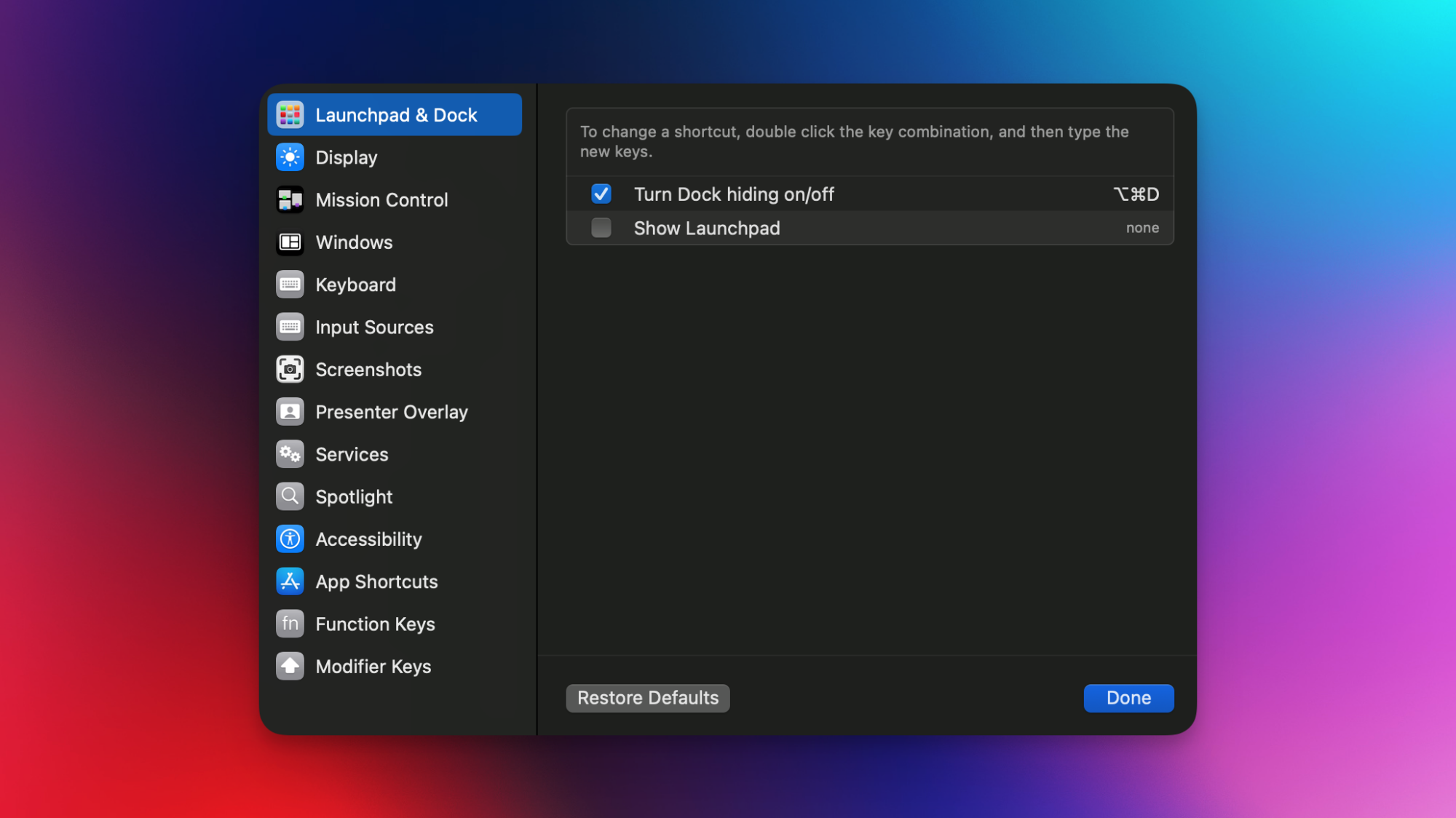
The keyboard shortcut to hide the Mac's dock.

Credit: Pranay Parab

Some of us prefer to have a clean workspace, and if that’s you, you can auto-hide the dock when it’s not in use. It won’t be gone entirely, but it’ll only make itself visible when you move the cursor towards its location. This is also a good feature for those with limited screen space. Enable this feature by going to System Settings > Desktop & Dock > Automatically hide & show the dock. Alternatively, you can use the keyboard shortcut Command-Option-D to toggle this setting on and off.

Remove recently opened apps from the dock

The right side of your dock will show your most recently opened apps. If this annoys you, you can disable the setting by going to System Settings > Desktop & Dock and disabling Show suggested and recent apps in Dock. I prefer this feature on, to help me navigate commonly used apps, but if you’re short on screen space, it could be useful.

Move minimized windows into the app icon

Whenever you minimize apps on your Mac, each window appears as a separate icon on the dock. This can cause the dock to fill up fast, automatically making it smaller. If you’d rather avoid this, macOS allows you to minimize windows directly into the appropriate app icon instead. Just go to System Settings > Desktop & Dock and select Minimize windows into application icon. To access a window that’s been minimized into an app icon, right-click it.

Hide indicators for open apps

Desktop & Dock settings on a Mac.

Credit: Pranay Parab

If an app is open on your Mac, a small dot will appear near its icon on the dock. You can remove these open app indicators if you’d like. Go to System Settings > Desktop & Dock and disable Show indicators for open applications.

Customize magnification of icons

When you move your cursor near any app icon on your Mac’s dock, it’ll automatically enlarge. You can change the level of this magnification effect, or disable it altogether by going to System Settings > Desktop & Dock.

To enable or disable enlarging icons, use the slider below Magnification. Moving the slider all the way to the left switches off magnification, while moving it elsewhere will adjust magnification size. Fun tip: If you have this feature disabled, you can temporarily activate it on command by holding Shift + Control.

Add folders to the dock

An applications folder in the Mac's dock.

Credit: Pranay Parab

You can add browsable folders to your Mac’s dock, as long as the folder is in the Favorites bar in Finder. Open Finder and locate the folder you want to add and drag it to the Favorites bar in the left pane. Right-click any folder in the Favorites bar and select Add to Dock. 

Here’s the fun part: you can use this trick to group a bunch of apps into a single dock icon, which is great when you have a few apps that you want to keep in the dock, but you don’t need them every single day. The trick is to go to the Applications folder in Finder and move the apps to a new folder. Just give the folder a name, move it to the Favorites Bar, and add it to the dock. You’re all set!

Add spacers to the dock

You can go a little beyond the options macOS gives you and add a few spacers, or blank spaces, to your dock to help organize it. You can use these blank spaces for aesthetics or to group similar apps. To do this, you’ll need to use your Mac’s Terminal. Press Command-Space, search for Terminal, and open the app. Then, paste and run the following command to add a full-size spacer in the dock.

defaults write com.apple.dock persistent-apps -array-add '{tile-data={}; tile-type="spacer-tile";}' && killall Dock

If you want a smaller spacer, use this command instead.

defaults write com.apple.dock persistent-apps -array-add '{"tile-type"="small-spacer-tile";}' && killall Dock

For more than one spacer, simply re-run your chosen command. The good news is that this is the only time you’ll need the Terminal. Once you have your spacer, simply drag it around to change its position in the dock, or drop it outside the dock to remove it.

Change app icons to make the dock more visually pleasing

You can also customize the dock by simply changing various app icons. This can make it look more pleasant or help it fit a particular theme. The best way to do this is to open your favorite apps and see if they let you change their app icons. If not, check out my guide on replacing macOS app icons, which highlights both a built-in method and one third-party app that makes it easier to change app icons. For alternative icons, a good resource is macOSicons.com.

Use third-party apps to access hidden dock settings

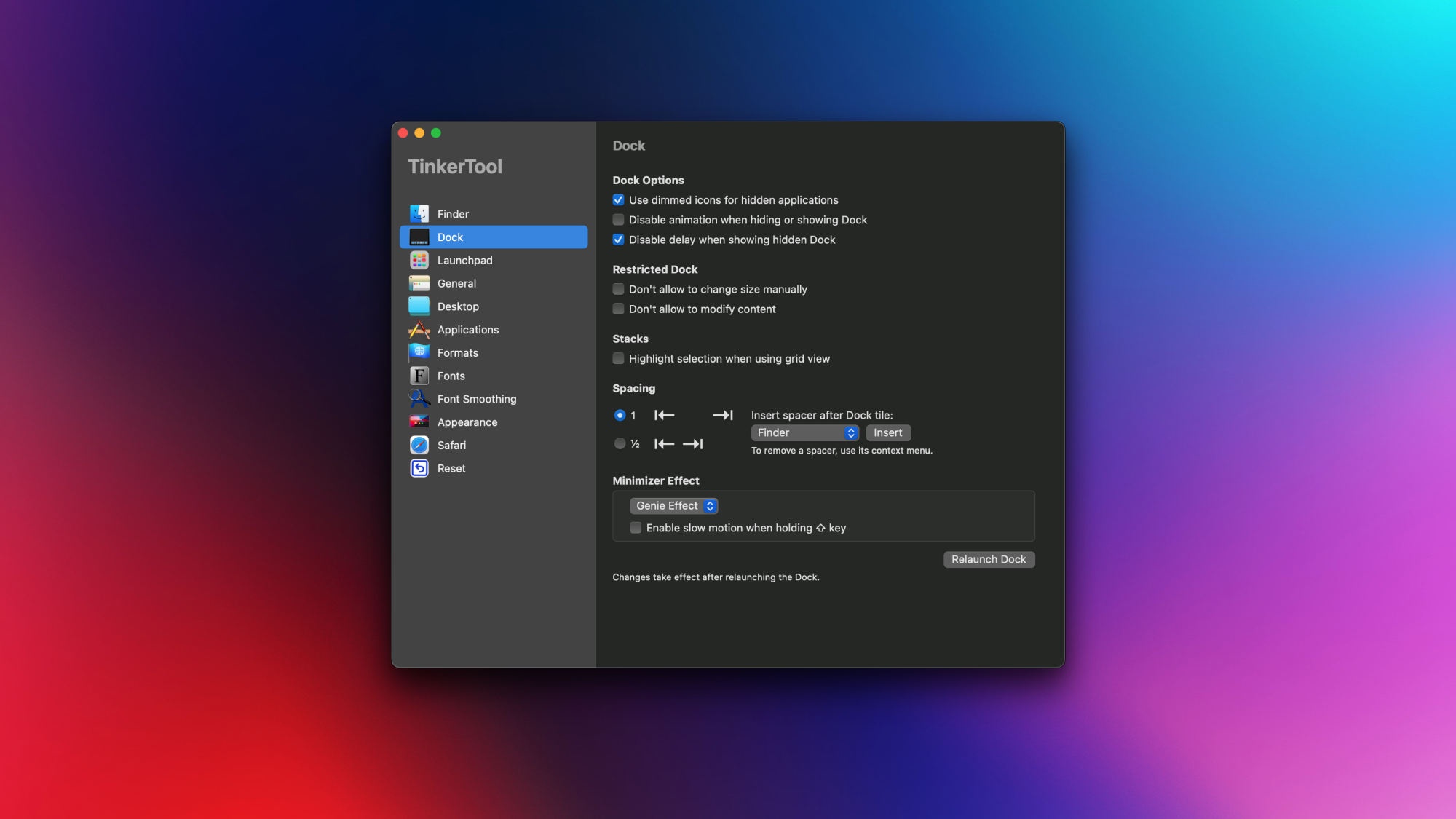
TinkerTool running on a Mac.

Credit: Pranay Parab

Your Mac doesn’t always make it easy to find everything you can do with it. Sometimes, you need to run a few Terminal commands to access hidden features (such as the spacers I just highlighted), and even then, some features aren’t user-accessible at all. For more control, consider trying Mac apps that unlock these hidden features for you, such as TinkerTool (free) or Supercharge ($11). I’ve written about TinkerTool before, and my colleague Khamosh Pathak has covered Supercharge. Both apps have a few useful options for tweaking your dock, such as the ability to remove the delay before macOS reveals your hidden dock, or dimming the icons of hidden apps. 

TinkerTool also makes it easier to add spacers to the dock, and it even allows you to lock the dock, so that the positions of icons and spacers can’t be changed. Supercharge, meanwhile, has a feature that directly opens dock folders in Finder, instead of showing their contents right in the dock. 

Use a dedicated dock customization app

If your goal is only to tweak the dock and nothing else, you may be better-served by a dedicated dock customization app. This type of an app will allow you to make cosmetic and functional changes to the dock, but won’t be useful if you want other systemwide tweaks. Two good examples are DockFlow ($5.60) and uBar ($30). DockFlow lets you create presets for your dock. You can think of it like creating various profiles such as work, gaming, education, social media, etc. For each of these presets, you can drop a few apps into them and quickly switch between them as needed. uBar, meanwhile, focuses on making the dock look like the Windows taskbar, which could be useful if you’re moving operating systems. 

CISA Loses Nearly All Top Officials

Multiple readers shared the following report about the executive departures at CISA: Virtually all of the top officials at the Cybersecurity and Infrastructure Security Agency (CISA) have departed the agency or will do so this month, according to an email obtained by Cybersecurity Dive, further widening a growing void in expertise and leadership at the government’s lead cyber defense force at a time when tensions with foreign adversaries are escalating.

Five of CISA’s six operational divisions and six of its 10 regional offices will have lost top leaders by the end of the month, the agency’s new deputy director, Madhu Gottumukkala, informed employees in an email on Thursday. […] The exits of these leaders could undermine the efficiency and strategic clarity of CISA’s partnerships with critical infrastructure operators, private security firms, foreign allies, state governments and local emergency managers, experts say.


Read more of this story at Slashdot.

RFK Jr. revokes COVID shot recommendations for kids, during pregnancy

Anti-vaccine advocate and health secretary Robert F. Kennedy Jr. has unilaterally revoked federal recommendations for healthy children and pregnant people to get COVID-19 booster shots.

The abrupt change, announced on social media, could make it yet more difficult, if not impossible, for healthy children and pregnant people to have access to the seasonal vaccines, which have proven safe and effective at protecting both of those groups from severe illness.

In a regulatory meeting last week, Centers for Disease Control and Prevention epidemiologist Ruth Link-Gelles presented 2023–2024 data showing that COVID-19 boosters effectively protected children and teens from needing urgent or emergency care due to COVID-19 (slide 36). In children 9 months to 4 years old in that season, the boosters provided 52 percent added effectiveness over background immunity from past vaccination and illness. The boosters were 64 percent effective in kids ages 5 to 17.

Read full article

Comments

WhatsApp finally launches an official version for iPads

The wait is (finally) over. There’s an official WhatsApp release for Apple iPads. It only took 16 years, as WhatsApp first entered the scene all the way back in 2009. As a matter of fact, the messaging platform predates the iPad itself, which launched in 2010.

The iPad offers much more screen real estate than a smartphone, and Meta seems to have made good use of the extra space. The app takes advantage of the tablet’s multitasking features like Split View and Slide Over, so users can view multiple apps at once. This lets folks, for instance, browse the web as they chat with a friend.

The iPad version of the app also works with Magic Keyboard and Apple Pencil, which should speed up conversations. It allows for video and audio calls with up to 32 people, and integrates with both the front and rear cameras. Just like other versions of WhatsApp, chats sync across devices. WhatsApp for iPad is available right now via the App Store.

One down, one to go. We are still waiting for Meta to make a dedicated Instagram app for iPad tablets. Recent reports indicate that the company is actually working on it, after a long 15 years in which we all have had to use a resized iPhone app and pretend we were enjoying ourselves.

This article originally appeared on Engadget at https://www.engadget.com/apps/whatsapp-finally-launches-an-official-version-for-ipads-165608577.html?src=rss

TCL’s newest TVs will automatically calibrate wireless speakers

Dolby’s automatic speaker calibration tech FlexConnect finally comes to market via TCL’s 2025 QD-Mini LED TVs. The company had originally announced the technology back in 2023, and was set to debut it with TCL’s 2024 TV lineup.

FlexConnect lets users place wireless speakers anywhere in a room without worrying about perfect configuration. The surround sound will then be optimized automatically based on the layout of the room and the position of the speakers.

The first audio device to support this tech will be TCL’s Z100 smart speaker, which is designed to pair with TCL’s FlexConnect-enabled TVs. TCL’s Precise Dimming Series, which includes the QM6K, QM7K and the newly announced QM8K, will all be FlexConnect-compatible.

Users will be able to pair up to four Z100 speakers with their TCL TVs, which will work in concert with the TV’s built-in speakers to deliver intelligently calibrated Dolby Atmos sound. This innovation allows for immersive spatial sound without the need for a perfectly symmetrical speaker setup.

In today’s joint press release, John Couling, Senior VP of Entertainment at Dolby Labs, said “With Dolby Atmos FlexConnect, consumers can unlock even more flexibility and adaptability in how they design their home entertainment systems, while removing the stress of whether their speakers are in the right location to get an incredible Dolby Atmos experience.”

In the same release, TCL said the Z100 speakers are expected this summer. The Z100 and the TCL Precise Dimming Series represent the first FlexConnect products launched in the United States. Along with the QM8K launch, TCL also announced its first model of party speakers, as well as the Q65H, its latest Dolby Atmos soundbar.

This article originally appeared on Engadget at https://www.engadget.com/home/home-theater/tcls-newest-tvs-will-automatically-calibrate-wireless-speakers-163907846.html?src=rss

GLP-1 Drug Use Surges 600% as 2% of Americans Take Weight-Loss Medications

An anonymous reader shares a report: More than 2% of Americans are taking the blockbuster class of GLP-1 drugs for overweight or obesity, up nearly 600% over six years, according to a report from FAIR Health given to Axios first. The data from FAIR Health’s repository of over 51 billion commercial healthcare claim records shows the explosion in use of the drugs specifically for weight loss — roughly half of all users.

In all, roughly 4% of Americans were taking GLP-1 drugs in 2024 for either overweight, obesity or Type 2 diabetes (their original approved use). The data shows Novo Nordisk’s Ozempic is still by far the most commonly taken GLP-1, followed by Eli Lilly’s Mounjaro. The percentage of adults who were prescribed a GLP-1 drug but did not have bariatric surgery increased from 2.5% in 2019 to 11.2% in 2024 while the the percentage of adult patients who had bariatric surgery decreased 41.8%.


Read more of this story at Slashdot.

Falcon 9 sonic booms can feel more like seismic waves

The Vandenberg Space Force Base in Santa Barbara, California, serves military space launch missions as well as launches for NASA and commercial entities like SpaceX. But how do all those launches affect residents living along the Central Coast? People might marvel at the spectacular visual display, but as launch activity at the base has ramped up, so have the noise complaints, particularly about the sonic booms produced by Falcon 9 launches, which can reach as far south as Ventura County. The booms rattle windows, frighten pets, and have raised concerns about threats to the structural integrity of private homes.

There have been rockets launching from Vandenberg for decades, so why are the Falcon 9 launches of such concern? “Because of the Starlink satellites, the orbital mechanics for where they’re trying to place these in orbit is bringing [the trajectories] closer to the coast,” said Brigham Young University’s Kent Gee, who described his research into sonic boom effects on neighboring communities in a press briefing at a meeting of the Acoustical Society of America in New Orleans. And the launches are occurring much more frequently, from two to three launches per year in the 1980s to between five and seven launches each month today. There were 46 Falcon 9 launches out of the Vandenberg base in 2024 alone, per Gee.

Gee joined a project called ECOBOOM (Environmental and Community Observation of Sonic Booms) to study the factors that can impact just how jarring those sonic booms might be, conducted jointly by BYU and California State University, Bakersfield, with cooperation from the Space Force. “Space Force is interested in this because they feel a sense of stewardship,” said Gee. “These rockets from SpaceX and other providers are launched from the base for a variety of missions and they want to understand the effects both on and off base, trying to understand how they can complete the mission while minimizing [negative] impacts.”

Read full article

Comments

These Beats Fit Pro Earbuds Are Half Their Original Price Right Now

We may earn a commission from links on this page. Deal pricing and availability subject to change after time of publication.

There’s no shortage of wireless earbuds out there, but if you’re after strong noise cancellation, bass-heavy sound, full iOS compatibility, and a fit that won’t budge during a workout, you should consider the Beats Fit Pro, and this open-box deal on StackSocial drops the price to $99.99 from the usual $199.99. The sale includes all four color options—white, black, gray, and purple.

The “open box” tag just means they’ve likely been handled but not used, and they’ve been inspected to make sure they’re still in new condition. They’re rated IPX4 for water resistance, so sweat and light rain aren’t a problem, though the case itself isn’t protected and doesn’t support wireless charging. Battery life is around six hours with ANC on and another 18 to 23 hours from the case, depending on how you use them.

Sound-wise, these lean hard into bass, which some folks will love and others might find a bit much. The low end hits especially well at high volumes without distortion, which makes them great for hip-hop, pop or EDM, notes this PCMag review. The downside is that there’s no customizable EQ, so if you’re not into that sculpted sound, you can’t do much about it. The noise cancellation holds up pretty well for things like plane rumbles and low-frequency distractions, but don’t expect total silence in a noisy café (higher-pitched noises still leak through). There’s also a decent Transparency Mode that lets in just enough outside sound for you to cross the street or chat with someone without pulling out an earbud. Android users do get access to most core features through the Beats app, but some perks like automatic switching, hands-free Siri, and Spatial Audio are still iOS-only. Getting all that for half off isn’t a bad deal.

Firearms Expert Reacts To Weapons From DOOM Video Game

This is a video of firearms expert and the UK’s Royal Armouries museum curator Jonathan Ferguson (complete with an “I’m Your Huckleberry” t-shirt under his blazer) reacting to and seriously discussing a variety of the outlandish weapons seen in the video game DOOM: The Dark Ages. That look on his face says it all. That’s the look of a man who can’t believe he’s had to crush and pulverize skulls the old fashioned way.

Cancer-Fighting Immune Cells Could Soon Be Engineered Inside Our Bodies

Researchers are developing techniques to genetically modify cancer-fighting immune cells directly inside patients rather than in expensive laboratory facilities, potentially making CAR-T therapy accessible to far more people.

Current CAR-T treatments require removing a patient’s T cells, shipping them to specialized facilities for genetic engineering, then returning them weeks later at costs around $500,000 per dose. The new “in vivo” approaches use viral vectors or RNA-loaded nanoparticles to deliver genetic instructions directly to T cells circulating in the bloodstream, which could reduce costs by an order of magnitude. Companies including Capstan Therapeutics, co-founded by Nobel laureates, and AstraZeneca-backed EsoBiotec have launched early human trials. While only about 200 US centers currently offer traditional CAR-T therapy, the approach could make the powerful treatment available on demand like conventional drugs.


Read more of this story at Slashdot.

OnePlus is the latest smartphone maker to go all-in with AI

OnePlus thrives on trends—if other smartphone makers are doing something, you can bet OnePlus is going to have a take. The company recently confirmed it’s ditching the storied alert slider in favor of an Apple-like shortcut button called the Plus Key, and that’s not the only trend it’ll chase with its latest phones. OnePlus has also announced an expanded collection of AI features for translation, photography, screen capture, and more. OnePlus isn’t breaking new ground here, but it is cherry-picking some of the more useful AI features we’ve seen on other phones.

The OnePlus approach covers most of the established AI use cases. There will be AI VoiceScribe, a feature that records and summarizes calls in popular messaging and video chat apps. Similarly, AI Call Assistant will record and summarize phone calls, a bit like Google’s Pixel phones. However, these two features are India-only for now.

Globally, OnePlus users will get AI Translation, which pulls together text, voice, camera, and screen translation into a single AI-powered app. AI Search, meanwhile, allows you to search for content on your phone and in OnePlus system apps in a “conversational” way. That suggests to us it’s basically another chatbot on your phone, like Motorola’s Ask and Search feature, which we didn’t love.

Read full article

Comments

Why Cleaning A $4 Million Aston Martin Valkyrie Hypercar Is A Terrifying Task

Why Cleaning A $4 Million Aston Martin Valkyrie Hypercar Is A Terrifying Task
Apparently, sending your brand new Aston Martin Valkyrie off for its first detailing could lead to over $200,000 in repairs just by having the wrong buttons pressed. That was the warning a professional detailing studio was given when the keys were handed over: don’t touch XX buttons or else.

The Aston Martin Valkyrie, a breathtaking collaboration